MOLECULAR
MECHANICS
Presented By
Akshay Avinash Kank
(M.Pharm, First Year)
Guided By
Proff. Dr. S.R. Butle
(M.Pharm Ph.D)
PARAMETERS
 Introduction to computational chemistry
 Need to study
 Molecular mechanics
 Basic principle of MM
 Force field methods
 Novel Techniques
 Discreteness between QM and MM
 Application
 References
COMPUTATIONAL CHEMISTRY
 Computational chemistry is a branch of chemistry
that uses principles of computer science to assist in
solving chemical problems.
 Since chemistry concerns the study of properties of
substances or molecular systems in terms of
atoms, the basic challenge facing computational
chemistry is to describe or even predict-
1. The structure and stability of a molecular
system,
2. The (free) energy of different states of a
molecular systems,
3. Reaction processes within molecular systems.
MOLECULAR MECHANICS
 Molecular mechanics is a computational method
that computes the potential energy surface for a
particular arrangement of atoms using potential
functions that are derived using classical physics.
 Molecular mechanics ignores the electronic motions
and calculate the potential energy of a system as a
function of nuclear position only.
 Molecular mechanics methods are the basic for
other methods , such as construction of homology
models, molecular dynamics, crystallographic
structure refinement and docking.
CONT’D…
 The mechanical molecular models was developed out of
a need to describe molecular structures and properties
in as practical a manner as possible.
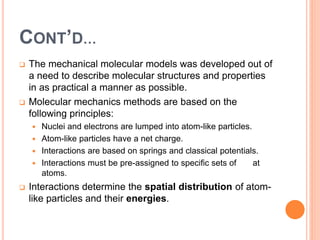
 Molecular mechanics methods are based on the
following principles:
 Nuclei and electrons are lumped into atom-like particles.
 Atom-like particles have a net charge.
 Interactions are based on springs and classical potentials.
 Interactions must be pre-assigned to specific sets of at
atoms.
 Interactions determine the spatial distribution of atom-
like particles and their energies.
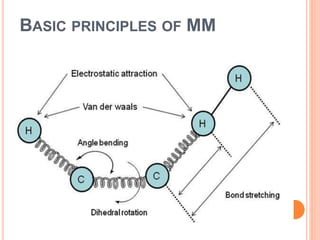
BASIC PRINCIPLES OF MM
BASICS PRINCIPLES OF MM
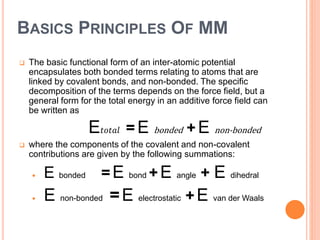
 The basic functional form of an inter-atomic potential
encapsulates both bonded terms relating to atoms that are
linked by covalent bonds, and non-bonded. The specific
decomposition of the terms depends on the force field, but a
general form for the total energy in an additive force field can
be written as
E𝑡𝑜𝑡𝑎𝑙 = E bonded + E non-bonded
 where the components of the covalent and non-covalent
contributions are given by the following summations:
 E bonded =E bond +E angle + E dihedral
 E non-bonded =E electrostatic +E van der Waals
WHAT IS A FORCE FIELD?
 A force field is a mathematical function in which the
conformational energy of a system studied.
 Force fields are also sometimes referred to as potentials.
 Many different kinds of force fields have been developed over
the years.
 Some force-fields account for coupling between bending and
stretching in adjacent bonds in order to improve the accuracy
of the mechanical model.
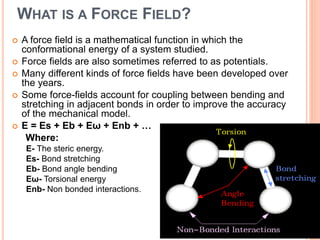
 E = Es + Eb + Eω + Enb + …
Where:
E- The steric energy.
Es- Bond stretching
Eb- Bond angle bending
Eω- Torsional energy
Enb- Non bonded interactions.
CONT’D…
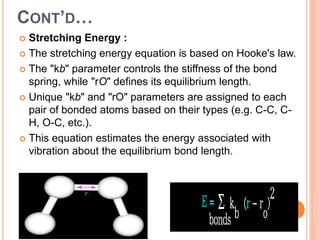
 Stretching Energy :
 The stretching energy equation is based on Hooke's law.
 The "kb" parameter controls the stiffness of the bond
spring, while "rO" defines its equilibrium length.
 Unique "kb" and "rO" parameters are assigned to each
pair of bonded atoms based on their types (e.g. C-C, C-
H, O-C, etc.).
 This equation estimates the energy associated with
vibration about the equilibrium bond length.
CONT’D…
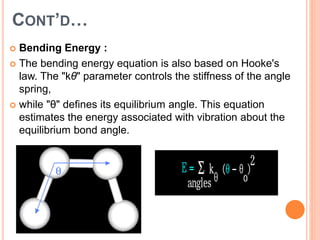
 Bending Energy :
 The bending energy equation is also based on Hooke's
law. The "kθ" parameter controls the stiffness of the angle
spring,
 while "θ" defines its equilibrium angle. This equation
estimates the energy associated with vibration about the
equilibrium bond angle.
CONT’D…
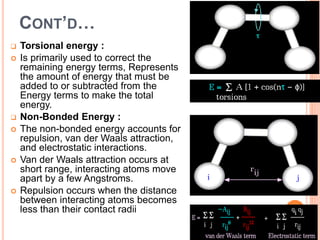
 Torsional energy :
 Is primarily used to correct the
remaining energy terms, Represents
the amount of energy that must be
added to or subtracted from the
Energy terms to make the total
energy.
 Non-Bonded Energy :
 The non-bonded energy accounts for
repulsion, van der Waals attraction,
and electrostatic interactions.
 Van der Waals attraction occurs at
short range, interacting atoms move
apart by a few Angstroms.
 Repulsion occurs when the distance
between interacting atoms becomes
less than their contact radii
MOLECULAR MECHANICS MODELS
 AMBER:-
 Assisted model building with energy refinement (AMBER)
 It was parameterized specifically for proteins and nucleic acids
 CHARMM:-
 Chemistry at Harvard macromolecular mechanics (CHARMM).
 The academic version of this program is designated CHARMM
and the commercial version is called CHARMm
 It was originally devised for proteins and nucleic acids.
 GROMOS:-
 Groningen Molecular Simulation package
 COMPASS:-
 Condensed-phase Optimized Molecular Potentials for Atomistic
Simulation Studies
 MMFF:-
 Merck Molecular Force Field
NOVEL TECHNIQUE- IN
MOLECULAR MODELING
 QM/MM- Monte Carlo method
 This is the ‘Hybrid’ of quantum and molecular mechanics
 The QM/MM procedure is applicable when the system
can be partitioned into two regions;
 one region (the ‘active site’) requires an accurate QM
calculation of its potential and
 the second region (the rest of the system) acts as a
perturbation on the active site and can be treated with
an approximate and fast MM calculation of its potential.
 By using a quantum mechanical calculation, we can
treat bond breaking and bond-forming accurately at the
active site yet still take into account the role of the
surrounding atoms using MM.
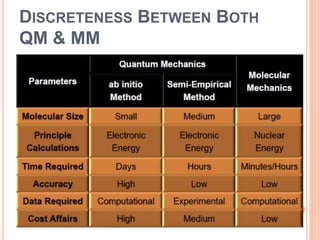
DISCRETENESS BETWEEN BOTH
QM & MM
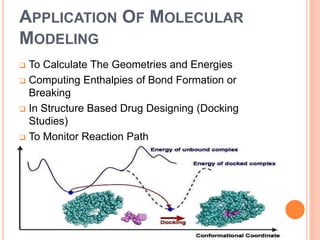
APPLICATION OF MOLECULAR
MODELING
 To Calculate The Geometries and Energies
 Computing Enthalpies of Bond Formation or
Breaking
 In Structure Based Drug Designing (Docking
Studies)
 To Monitor Reaction Path
REFERENCES
 Computer application in Pharmaceutical Research
and Development By Sean Ekins, A John Wiley and
Sons Publication.
 https://www.youtube.com/watch?v=GMsD8vPdL7o
 Practical application of computer aided drug design,
By Paul S. Charifson, Marcel Dekker INC.
 Chapter 3, molecular modeling techniques, By
Swami Ramanand Teerth Marathwada University.
 https://www.slideshare.net/RikeshlalShrestha/molecu
lar-modelling-75429338
 Molecular Modeling By Dr. Vibha Tandan, Shree
Publishers and Distributers, first Edition.
Molecular Mechanics in Molecular Modeling

Molecular Mechanics in Molecular Modeling

  • 1.
    MOLECULAR MECHANICS Presented By Akshay AvinashKank (M.Pharm, First Year) Guided By Proff. Dr. S.R. Butle (M.Pharm Ph.D)
  • 2.
    PARAMETERS  Introduction tocomputational chemistry  Need to study  Molecular mechanics  Basic principle of MM  Force field methods  Novel Techniques  Discreteness between QM and MM  Application  References
  • 3.
    COMPUTATIONAL CHEMISTRY  Computationalchemistry is a branch of chemistry that uses principles of computer science to assist in solving chemical problems.  Since chemistry concerns the study of properties of substances or molecular systems in terms of atoms, the basic challenge facing computational chemistry is to describe or even predict- 1. The structure and stability of a molecular system, 2. The (free) energy of different states of a molecular systems, 3. Reaction processes within molecular systems.
  • 4.
    MOLECULAR MECHANICS  Molecularmechanics is a computational method that computes the potential energy surface for a particular arrangement of atoms using potential functions that are derived using classical physics.  Molecular mechanics ignores the electronic motions and calculate the potential energy of a system as a function of nuclear position only.  Molecular mechanics methods are the basic for other methods , such as construction of homology models, molecular dynamics, crystallographic structure refinement and docking.
  • 5.
    CONT’D…  The mechanicalmolecular models was developed out of a need to describe molecular structures and properties in as practical a manner as possible.  Molecular mechanics methods are based on the following principles:  Nuclei and electrons are lumped into atom-like particles.  Atom-like particles have a net charge.  Interactions are based on springs and classical potentials.  Interactions must be pre-assigned to specific sets of at atoms.  Interactions determine the spatial distribution of atom- like particles and their energies.
  • 6.
  • 7.
    BASICS PRINCIPLES OFMM  The basic functional form of an inter-atomic potential encapsulates both bonded terms relating to atoms that are linked by covalent bonds, and non-bonded. The specific decomposition of the terms depends on the force field, but a general form for the total energy in an additive force field can be written as E𝑡𝑜𝑡𝑎𝑙 = E bonded + E non-bonded  where the components of the covalent and non-covalent contributions are given by the following summations:  E bonded =E bond +E angle + E dihedral  E non-bonded =E electrostatic +E van der Waals
  • 8.
    WHAT IS AFORCE FIELD?  A force field is a mathematical function in which the conformational energy of a system studied.  Force fields are also sometimes referred to as potentials.  Many different kinds of force fields have been developed over the years.  Some force-fields account for coupling between bending and stretching in adjacent bonds in order to improve the accuracy of the mechanical model.  E = Es + Eb + Eω + Enb + … Where: E- The steric energy. Es- Bond stretching Eb- Bond angle bending Eω- Torsional energy Enb- Non bonded interactions.
  • 9.
    CONT’D…  Stretching Energy:  The stretching energy equation is based on Hooke's law.  The "kb" parameter controls the stiffness of the bond spring, while "rO" defines its equilibrium length.  Unique "kb" and "rO" parameters are assigned to each pair of bonded atoms based on their types (e.g. C-C, C- H, O-C, etc.).  This equation estimates the energy associated with vibration about the equilibrium bond length.
  • 10.
    CONT’D…  Bending Energy:  The bending energy equation is also based on Hooke's law. The "kθ" parameter controls the stiffness of the angle spring,  while "θ" defines its equilibrium angle. This equation estimates the energy associated with vibration about the equilibrium bond angle.
  • 11.
    CONT’D…  Torsional energy:  Is primarily used to correct the remaining energy terms, Represents the amount of energy that must be added to or subtracted from the Energy terms to make the total energy.  Non-Bonded Energy :  The non-bonded energy accounts for repulsion, van der Waals attraction, and electrostatic interactions.  Van der Waals attraction occurs at short range, interacting atoms move apart by a few Angstroms.  Repulsion occurs when the distance between interacting atoms becomes less than their contact radii
  • 12.
    MOLECULAR MECHANICS MODELS AMBER:-  Assisted model building with energy refinement (AMBER)  It was parameterized specifically for proteins and nucleic acids  CHARMM:-  Chemistry at Harvard macromolecular mechanics (CHARMM).  The academic version of this program is designated CHARMM and the commercial version is called CHARMm  It was originally devised for proteins and nucleic acids.  GROMOS:-  Groningen Molecular Simulation package  COMPASS:-  Condensed-phase Optimized Molecular Potentials for Atomistic Simulation Studies  MMFF:-  Merck Molecular Force Field
  • 13.
    NOVEL TECHNIQUE- IN MOLECULARMODELING  QM/MM- Monte Carlo method  This is the ‘Hybrid’ of quantum and molecular mechanics  The QM/MM procedure is applicable when the system can be partitioned into two regions;  one region (the ‘active site’) requires an accurate QM calculation of its potential and  the second region (the rest of the system) acts as a perturbation on the active site and can be treated with an approximate and fast MM calculation of its potential.  By using a quantum mechanical calculation, we can treat bond breaking and bond-forming accurately at the active site yet still take into account the role of the surrounding atoms using MM.
  • 14.
  • 15.
    APPLICATION OF MOLECULAR MODELING To Calculate The Geometries and Energies  Computing Enthalpies of Bond Formation or Breaking  In Structure Based Drug Designing (Docking Studies)  To Monitor Reaction Path
  • 16.
    REFERENCES  Computer applicationin Pharmaceutical Research and Development By Sean Ekins, A John Wiley and Sons Publication.  https://www.youtube.com/watch?v=GMsD8vPdL7o  Practical application of computer aided drug design, By Paul S. Charifson, Marcel Dekker INC.  Chapter 3, molecular modeling techniques, By Swami Ramanand Teerth Marathwada University.  https://www.slideshare.net/RikeshlalShrestha/molecu lar-modelling-75429338  Molecular Modeling By Dr. Vibha Tandan, Shree Publishers and Distributers, first Edition.