Monte Carlo Methods:
- Markov Chain
Random movements, one follow another
- Importance sampling
To sample many points in the region where the Boltzmann
factor is large and few elsewhere
- Ergodicity (ensemble average)
Such an average over all possible quantum states of a system
- Detailed Balance
?
?
Metropolis Method:
]/)(exp[yprobabilithaccept wit:
accept:
TKEEEE
EE
Bonon
on
−−>
<
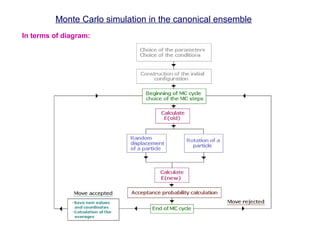
In terms of words:
- Canonical ensemble: N,V,T constant
- Metropolis method: To generate a new configuration with probabilities
Monte Carlo simulation in the canonical ensemble
0. Generate the initial configuration (random or c(2×2))
Beginning of the MC cycle
1. Calculate Eold
2. Randomly select a particle
3. Random displacement (or rotation)
4. Calculate Enew
5. Accept the move with probability (Metropolis method)
En<Eo accept (the move)
En>Eo accept with probability exp[-(En-Eo)/kT]
(Periodic boundary conditions)
End of MC cycle
In terms of diagram:
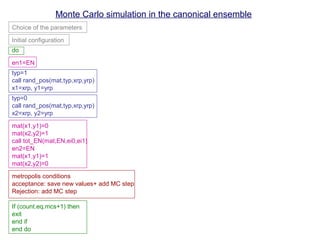
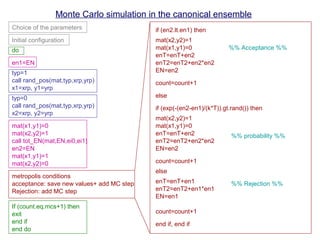
Monte Carlo simulation in the canonical ensemble
Choice of the parameters
Initial configuration
do
en1=EN
typ=1
call rand_pos(mat,typ,xrp,yrp)
x1=xrp, y1=yrp
typ=0
call rand_pos(mat,typ,xrp,yrp)
x2=xrp, y2=yrp
mat(x1,y1)=0
mat(x2,y2)=1
mat(x1,y1)=1
mat(x2,y2)=0
call tot_EN(mat,EN,ei0,ei1)
en2=EN
metropolis conditions
acceptance: save new values+ add MC step
Rejection: add MC step
If (count.eq.mcs+1) then
exit
end if
end do
Monte Carlo simulation in the canonical ensemble
Choice of the parameters
Initial configuration
do
en1=EN
typ=1
call rand_pos(mat,typ,xrp,yrp)
x1=xrp, y1=yrp
typ=0
call rand_pos(mat,typ,xrp,yrp)
x2=xrp, y2=yrp
mat(x1,y1)=0
mat(x2,y2)=1
mat(x1,y1)=1
mat(x2,y2)=0
call tot_EN(mat,EN,ei0,ei1)
en2=EN
metropolis conditions
acceptance: save new values+ add MC step
Rejection: add MC step
If (count.eq.mcs+1) then
exit
end if
end do
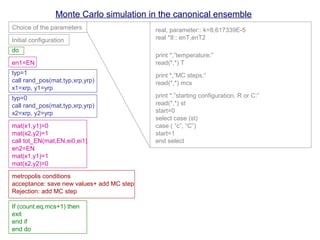
real, parameter:: k=8,617339E-5
real *8:: enT,enT2
print *,”temperature:”
read(*,*) T
print *,”MC steps:”
read(*,*) mcs
print *,”starting configuration, R or C:”
read(*,*) st
start=0
select case (st)
case ( “c”, “C”)
start=1
end select
Monte Carlo simulation in the canonical ensemble
Choice of the parameters
Initial configuration
do
en1=EN
typ=1
call rand_pos(mat,typ,xrp,yrp)
x1=xrp, y1=yrp
typ=0
call rand_pos(mat,typ,xrp,yrp)
x2=xrp, y2=yrp
mat(x1,y1)=0
mat(x2,y2)=1
mat(x1,y1)=1
mat(x2,y2)=0
call tot_EN(mat,EN,ei0,ei1)
en2=EN
metropolis conditions
acceptance: save new values+ add MC step
Rejection: add MC step
If (count.eq.mcs+1) then
exit
end if
end do
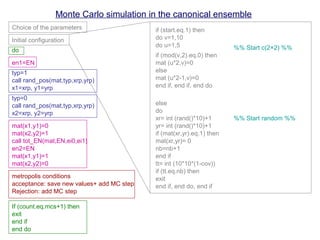
if (start.eq.1) then
do v=1,10
if (mod(v,2).eq.0) then
mat (u*2,v)=0
else
mat (u*2-1,v)=0
end if, end if, end do
else
do
xr= int (rand()*10)+1
yr= int (rand()*10)+1
if (mat(xr,yr).eq.1) then
mat(xr,yr)= 0
do u=1,5
nb=nb+1
end if
tt= int (10*10*(1-cov))
if (tt.eq.nb) then
exit
end if, end do, end if
%% Start c(2×2) %%
%% Start random %%
Monte Carlo simulation in the canonical ensemble
Choice of the parameters
Initial configuration
do
en1=EN
typ=1
call rand_pos(mat,typ,xrp,yrp)
x1=xrp, y1=yrp
typ=0
call rand_pos(mat,typ,xrp,yrp)
x2=xrp, y2=yrp
mat(x1,y1)=0
mat(x2,y2)=1
mat(x1,y1)=1
mat(x2,y2)=0
call tot_EN(mat,EN,ei0,ei1)
en2=EN
metropolis conditions
acceptance: save new values+ add MC step
Rejection: add MC step
If (count.eq.mcs+1) then
exit
end if
end do
if (en2.lt.en1) then
mat(x2,y2)=1
enT=enT+en2
enT2=enT2+en2*en2
count=count+1
else
if (exp(-(en2-en1)/(k*T)).gt.rand()) then
mat(x2,y2)=1
mat(x1,y1)=0
enT=enT+en2
enT2=enT2+en2*en2
count=count+1
mat(x1,y1)=0
else
end if, end if
enT=enT+en1
enT2=enT2+en1*en1
EN=en1
count=count+1
EN=en2
EN=en2
%% Acceptance %%
%% probability %%
%% Rejection %%
Monte Carlo simulation in the canonical ensemble
Choice of the parameters
Initial configuration
do
en1=EN
typ=1
call rand_pos(mat,typ,xrp,yrp)
x1=xrp, y1=yrp
typ=0
call rand_pos(mat,typ,xrp,yrp)
x2=xrp, y2=yrp
mat(x1,y1)=0
mat(x2,y2)=1
mat(x1,y1)=1
mat(x2,y2)=0
call tot_EN(mat,EN,ei0,ei1)
en2=EN
metropolis conditions
acceptance: save new values+ add MC step
Rejection: add MC step
If (count.eq.mcs+1) then
exit
end if
end do
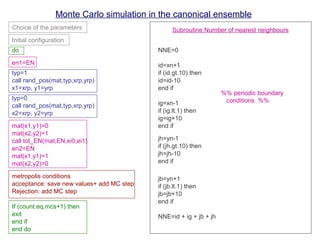
Subroutine Number of nearest neighbours
NNE=0
id=xn+1
if (id.gt.10) then
end if
ig=xn-1
if (ig.lt.1) then
ig=ig+10
end if
jh=yn-1
if (jh.gt.10) then
jh=jh-10
end if
jb=yn+1
if (jb.lt.1) then
jb=jb+10
end if
NNE=id + ig + jb + jh
%% periodic boundary
conditions %%
id=id-10
Monte Carlo simulation in the canonical ensemble
Choice of the parameters
Initial configuration
do
en1=EN
typ=1
call rand_pos(mat,typ,xrp,yrp)
x1=xrp, y1=yrp
typ=0
call rand_pos(mat,typ,xrp,yrp)
x2=xrp, y2=yrp
mat(x1,y1)=0
mat(x2,y2)=1
mat(x1,y1)=1
mat(x2,y2)=0
call tot_EN(mat,EN,ei0,ei1)
en2=EN
metropolis conditions
acceptance: save new values+ add MC step
Rejection: add MC step
If (count.eq.mcs+1) then
exit
end if
end do
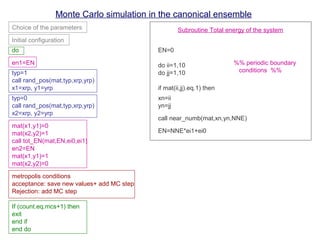
Subroutine Total energy of the system
EN=0
do ii=1,10
do jj=1,10
if mat(ii,jj).eq.1) then
%% periodic boundary
conditions %%
xn=ii
yn=jj
call near_numb(mat,xn,yn,NNE)
EN=NNE*ei1+ei0
Monte Carlo simulation in the canonical ensemble
Choice of the parameters
Initial configuration
do
en1=EN
typ=1
call rand_pos(mat,typ,xrp,yrp)
x1=xrp, y1=yrp
typ=0
call rand_pos(mat,typ,xrp,yrp)
x2=xrp, y2=yrp
mat(x1,y1)=0
mat(x2,y2)=1
mat(x1,y1)=1
mat(x2,y2)=0
call tot_EN(mat,EN,ei0,ei1)
en2=EN
metropolis conditions
acceptance: save new values+ add MC step
Rejection: add MC step
If (count.eq.mcs+1) then
exit
end if
end do
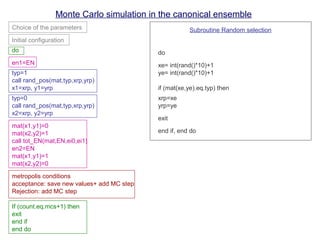
Subroutine Random selection
do
xe= int(rand()*10)+1
ye= int(rand()*10)+1
if (mat(xe,ye).eq.typ) then
xrp=xe
yrp=ye
exit
end if, end do
Monte Carlo simulation in the canonical ensemble
Choice of the parameters
Initial configuration
do
en1=EN
typ=1
call rand_pos(mat,typ,xrp,yrp)
x1=xrp, y1=yrp
typ=0
call rand_pos(mat,typ,xrp,yrp)
x2=xrp, y2=yrp
mat(x1,y1)=0
mat(x2,y2)=1
mat(x1,y1)=1
mat(x2,y2)=0
call tot_EN(mat,EN,ei0,ei1)
en2=EN
metropolis conditions
acceptance: save new values+ add MC step
Rejection: add MC step
If (count.eq.mcs+1) then
exit
end if
end do
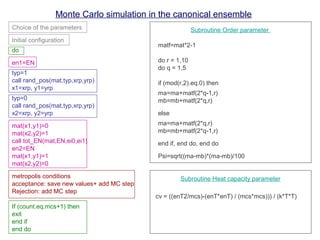
Subroutine Order parameter
matf=mat*2-1
do r = 1,10
do q = 1,5
if (mod(r,2).eq.0) then
ma=ma+matf(2*q-1,r)
mb=mb+matf(2*q,r)
else
ma=ma+matf(2*q,r)
mb=mb+matf(2*q-1,r)
end if, end do, end do
Psi=sqrt((ma-mb)*(ma-mb)/100
Subroutine Heat capacity parameter
cv = ((enT2/mcs)-(enT*enT) / (mcs*mcs))) / (k*T*T)
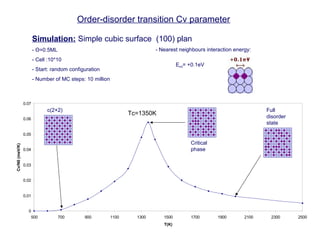
Order-disorder transition Cv parameter
0
0.01
0.02
0.03
0.04
0.05
0.06
0.07
500 700 900 1100 1300 1500 1700 1900 2100 2300 2500
T(K)
Cv/N0(meV/K)
Tc=1350K
Simulation: Simple cubic surface (100) plan
- Θ=0.5ML
- Cell :10*10
- Start: random configuration
- Number of MC steps: 10 million
c(2×2)
Critical
phase
Full
disorder
state
- Nearest neighbours interaction energy:
Eint= +0.1eV
0
0.1
0.2
0.3
0.4
0.5
0.6
0.7
0.8
0.9
1
500 700 900 1100 1300 1500 1700 1900 2100 2300 2500
T(K)
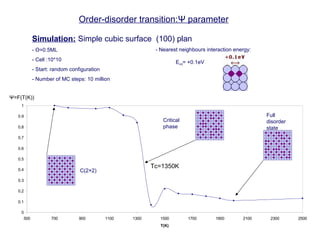
Order-disorder transition:Ψ parameter
Simulation: Simple cubic surface (100) plan
- Θ=0.5ML
- Cell :10*10
- Start: random configuration
- Number of MC steps: 10 million
Tc=1350K
C(2×2)
Critical
phase
Full
disorder
state
- Nearest neighbours interaction energy:
Eint= +0.1eV
Ψ=F(T(K))

Monte Carlo Simulation Methods

  • 1.
    Monte Carlo Methods: -Markov Chain Random movements, one follow another - Importance sampling To sample many points in the region where the Boltzmann factor is large and few elsewhere - Ergodicity (ensemble average) Such an average over all possible quantum states of a system - Detailed Balance ? ? Metropolis Method: ]/)(exp[yprobabilithaccept wit: accept: TKEEEE EE Bonon on −−> <
  • 2.
    In terms ofwords: - Canonical ensemble: N,V,T constant - Metropolis method: To generate a new configuration with probabilities Monte Carlo simulation in the canonical ensemble 0. Generate the initial configuration (random or c(2×2)) Beginning of the MC cycle 1. Calculate Eold 2. Randomly select a particle 3. Random displacement (or rotation) 4. Calculate Enew 5. Accept the move with probability (Metropolis method) En<Eo accept (the move) En>Eo accept with probability exp[-(En-Eo)/kT] (Periodic boundary conditions) End of MC cycle
  • 3.
    In terms ofdiagram: Monte Carlo simulation in the canonical ensemble
  • 4.
    Monte Carlo simulationin the canonical ensemble Choice of the parameters Initial configuration do en1=EN typ=1 call rand_pos(mat,typ,xrp,yrp) x1=xrp, y1=yrp typ=0 call rand_pos(mat,typ,xrp,yrp) x2=xrp, y2=yrp mat(x1,y1)=0 mat(x2,y2)=1 mat(x1,y1)=1 mat(x2,y2)=0 call tot_EN(mat,EN,ei0,ei1) en2=EN metropolis conditions acceptance: save new values+ add MC step Rejection: add MC step If (count.eq.mcs+1) then exit end if end do
  • 5.
    Monte Carlo simulationin the canonical ensemble Choice of the parameters Initial configuration do en1=EN typ=1 call rand_pos(mat,typ,xrp,yrp) x1=xrp, y1=yrp typ=0 call rand_pos(mat,typ,xrp,yrp) x2=xrp, y2=yrp mat(x1,y1)=0 mat(x2,y2)=1 mat(x1,y1)=1 mat(x2,y2)=0 call tot_EN(mat,EN,ei0,ei1) en2=EN metropolis conditions acceptance: save new values+ add MC step Rejection: add MC step If (count.eq.mcs+1) then exit end if end do real, parameter:: k=8,617339E-5 real *8:: enT,enT2 print *,”temperature:” read(*,*) T print *,”MC steps:” read(*,*) mcs print *,”starting configuration, R or C:” read(*,*) st start=0 select case (st) case ( “c”, “C”) start=1 end select
  • 6.
    Monte Carlo simulationin the canonical ensemble Choice of the parameters Initial configuration do en1=EN typ=1 call rand_pos(mat,typ,xrp,yrp) x1=xrp, y1=yrp typ=0 call rand_pos(mat,typ,xrp,yrp) x2=xrp, y2=yrp mat(x1,y1)=0 mat(x2,y2)=1 mat(x1,y1)=1 mat(x2,y2)=0 call tot_EN(mat,EN,ei0,ei1) en2=EN metropolis conditions acceptance: save new values+ add MC step Rejection: add MC step If (count.eq.mcs+1) then exit end if end do if (start.eq.1) then do v=1,10 if (mod(v,2).eq.0) then mat (u*2,v)=0 else mat (u*2-1,v)=0 end if, end if, end do else do xr= int (rand()*10)+1 yr= int (rand()*10)+1 if (mat(xr,yr).eq.1) then mat(xr,yr)= 0 do u=1,5 nb=nb+1 end if tt= int (10*10*(1-cov)) if (tt.eq.nb) then exit end if, end do, end if %% Start c(2×2) %% %% Start random %%
  • 7.
    Monte Carlo simulationin the canonical ensemble Choice of the parameters Initial configuration do en1=EN typ=1 call rand_pos(mat,typ,xrp,yrp) x1=xrp, y1=yrp typ=0 call rand_pos(mat,typ,xrp,yrp) x2=xrp, y2=yrp mat(x1,y1)=0 mat(x2,y2)=1 mat(x1,y1)=1 mat(x2,y2)=0 call tot_EN(mat,EN,ei0,ei1) en2=EN metropolis conditions acceptance: save new values+ add MC step Rejection: add MC step If (count.eq.mcs+1) then exit end if end do if (en2.lt.en1) then mat(x2,y2)=1 enT=enT+en2 enT2=enT2+en2*en2 count=count+1 else if (exp(-(en2-en1)/(k*T)).gt.rand()) then mat(x2,y2)=1 mat(x1,y1)=0 enT=enT+en2 enT2=enT2+en2*en2 count=count+1 mat(x1,y1)=0 else end if, end if enT=enT+en1 enT2=enT2+en1*en1 EN=en1 count=count+1 EN=en2 EN=en2 %% Acceptance %% %% probability %% %% Rejection %%
  • 8.
    Monte Carlo simulationin the canonical ensemble Choice of the parameters Initial configuration do en1=EN typ=1 call rand_pos(mat,typ,xrp,yrp) x1=xrp, y1=yrp typ=0 call rand_pos(mat,typ,xrp,yrp) x2=xrp, y2=yrp mat(x1,y1)=0 mat(x2,y2)=1 mat(x1,y1)=1 mat(x2,y2)=0 call tot_EN(mat,EN,ei0,ei1) en2=EN metropolis conditions acceptance: save new values+ add MC step Rejection: add MC step If (count.eq.mcs+1) then exit end if end do Subroutine Number of nearest neighbours NNE=0 id=xn+1 if (id.gt.10) then end if ig=xn-1 if (ig.lt.1) then ig=ig+10 end if jh=yn-1 if (jh.gt.10) then jh=jh-10 end if jb=yn+1 if (jb.lt.1) then jb=jb+10 end if NNE=id + ig + jb + jh %% periodic boundary conditions %% id=id-10
  • 9.
    Monte Carlo simulationin the canonical ensemble Choice of the parameters Initial configuration do en1=EN typ=1 call rand_pos(mat,typ,xrp,yrp) x1=xrp, y1=yrp typ=0 call rand_pos(mat,typ,xrp,yrp) x2=xrp, y2=yrp mat(x1,y1)=0 mat(x2,y2)=1 mat(x1,y1)=1 mat(x2,y2)=0 call tot_EN(mat,EN,ei0,ei1) en2=EN metropolis conditions acceptance: save new values+ add MC step Rejection: add MC step If (count.eq.mcs+1) then exit end if end do Subroutine Total energy of the system EN=0 do ii=1,10 do jj=1,10 if mat(ii,jj).eq.1) then %% periodic boundary conditions %% xn=ii yn=jj call near_numb(mat,xn,yn,NNE) EN=NNE*ei1+ei0
  • 10.
    Monte Carlo simulationin the canonical ensemble Choice of the parameters Initial configuration do en1=EN typ=1 call rand_pos(mat,typ,xrp,yrp) x1=xrp, y1=yrp typ=0 call rand_pos(mat,typ,xrp,yrp) x2=xrp, y2=yrp mat(x1,y1)=0 mat(x2,y2)=1 mat(x1,y1)=1 mat(x2,y2)=0 call tot_EN(mat,EN,ei0,ei1) en2=EN metropolis conditions acceptance: save new values+ add MC step Rejection: add MC step If (count.eq.mcs+1) then exit end if end do Subroutine Random selection do xe= int(rand()*10)+1 ye= int(rand()*10)+1 if (mat(xe,ye).eq.typ) then xrp=xe yrp=ye exit end if, end do
  • 11.
    Monte Carlo simulationin the canonical ensemble Choice of the parameters Initial configuration do en1=EN typ=1 call rand_pos(mat,typ,xrp,yrp) x1=xrp, y1=yrp typ=0 call rand_pos(mat,typ,xrp,yrp) x2=xrp, y2=yrp mat(x1,y1)=0 mat(x2,y2)=1 mat(x1,y1)=1 mat(x2,y2)=0 call tot_EN(mat,EN,ei0,ei1) en2=EN metropolis conditions acceptance: save new values+ add MC step Rejection: add MC step If (count.eq.mcs+1) then exit end if end do Subroutine Order parameter matf=mat*2-1 do r = 1,10 do q = 1,5 if (mod(r,2).eq.0) then ma=ma+matf(2*q-1,r) mb=mb+matf(2*q,r) else ma=ma+matf(2*q,r) mb=mb+matf(2*q-1,r) end if, end do, end do Psi=sqrt((ma-mb)*(ma-mb)/100 Subroutine Heat capacity parameter cv = ((enT2/mcs)-(enT*enT) / (mcs*mcs))) / (k*T*T)
  • 12.
    Order-disorder transition Cvparameter 0 0.01 0.02 0.03 0.04 0.05 0.06 0.07 500 700 900 1100 1300 1500 1700 1900 2100 2300 2500 T(K) Cv/N0(meV/K) Tc=1350K Simulation: Simple cubic surface (100) plan - Θ=0.5ML - Cell :10*10 - Start: random configuration - Number of MC steps: 10 million c(2×2) Critical phase Full disorder state - Nearest neighbours interaction energy: Eint= +0.1eV
  • 13.
    0 0.1 0.2 0.3 0.4 0.5 0.6 0.7 0.8 0.9 1 500 700 9001100 1300 1500 1700 1900 2100 2300 2500 T(K) Order-disorder transition:Ψ parameter Simulation: Simple cubic surface (100) plan - Θ=0.5ML - Cell :10*10 - Start: random configuration - Number of MC steps: 10 million Tc=1350K C(2×2) Critical phase Full disorder state - Nearest neighbours interaction energy: Eint= +0.1eV Ψ=F(T(K))