Topic 4.3
The Graphs of
Polynomial
Functions
Copyright © 2014 Pearson Education, Inc. Topic 1.1, Slide 1
Topic 4.3, Slide 1
Copyright © 2010, 2012, 2015 Pearson Education, Inc.
OBJECTIVES
Copyright © 2014 Pearson Education, Inc. Topic 1.1, Slide 1
Topic 4.3, Slide 2
Copyright © 2010, 2012, 2015 Pearson Education, Inc.
1. Understanding the Definition of a Polynomial Function
2. Sketching the Graphs of Power Functions
3. Determining the End Behavior of Polynomial Functions
4. Determining the Intercepts of a Polynomial Function
5. Determining the Real Zeros of Polynomial Functions
and Their Multiplicities
6. Sketching the Graph of a Polynomial Function
7. Determining a Possible Equation of a Polynomial
Function Giving Its Graph
Polynomial
Functions
Copyright © 2014 Pearson Education, Inc. Topic 1.1, Slide 1
Topic 4.3, Slide 3
Copyright © 2010, 2012, 2015 Pearson Education, Inc.
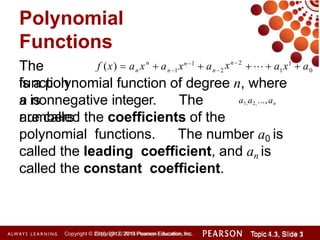
The
function
is a polynomial function of degree n, where
n is
a nonnegative integer. The
numbers
are called the coefficients of the
polynomial functions. The number a0 is
called the leading coefficient, and an is
called the constant coefficient.
0
n
f (x)  a x  a xn2
xn1
 a    a x1
 a
n n1 n2 1
a1,a2, ...,an
Polynomial
Functions-cont
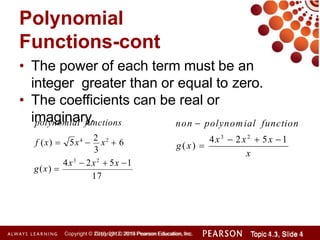
• The power of each term must be an
integer greater than or equal to zero.
• The coefficients can be real or
imaginary.
17
4x3
 2x2
 5x 1
g(x) 
3
f (x)  5x4

2
x2
 6
polynomial functions
x
Copyright © 2014 Pearson Education, Inc. Topic 1.1, Slide 1
Topic 4.3, Slide 4
Copyright © 2010, 2012, 2015 Pearson Education, Inc.
4x3
 2x2
 5x 1
g(x) 
non  polynomial function
Understanding the Definition of a
Polynomial Function
a. f (x)  3x3
 2x2

Polynomial? yes
1
6
EXAMPLE
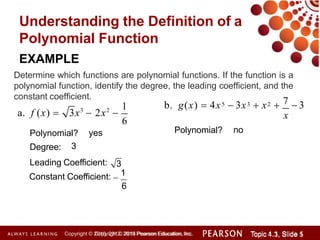
Determine which functions are polynomial functions. If the function is a
polynomial function, identify the degree, the leading coefficient, and the
constant coefficient.
Degree:
Leading Coefficient:
3
3
Constant Coefficient: 
1
6
5 3 2
Copyright © 2014 Pearson Education, Inc. Topic 1.1, Slide 1
Topic 4.3, Slide 5
Copyright © 2010, 2012, 2015 Pearson Education, Inc.
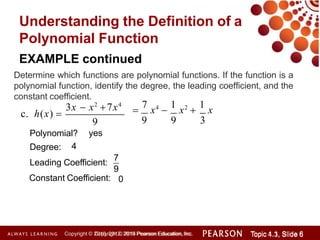
7
b. g(x)  4x  3x  x   3
x
Polynomial? no
Understanding the Definition of a
Polynomial Function
3x  x2
7x4
c. h(x) 
EXAMPLE continued
Determine which functions are polynomial functions. If the function is a
polynomial function, identify the degree, the leading coefficient, and the
constant coefficient.
Degree:
9
Polynomial? yes
4
Constant Coefficient:
Leading Coefficient:
7
9
0

7
x4

1
x2

1
x
9 9 3
Copyright © 2014 Pearson Education, Inc. Topic 1.1, Slide 6
Topic 4.3, Slide 6
Copyright © 2010, 2012, 2015 Pearson Education, Inc.
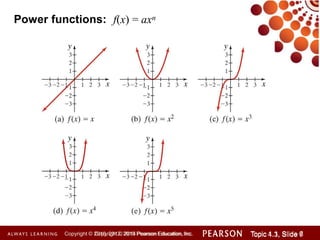
Power functions: f(x) = axn
Copyright © 2014 Pearson Education, Inc. Topic 1.1, Slide 6
Topic 4.3, Slide 7
Copyright © 2010, 2012, 2015 Pearson Education, Inc.
Sketching the Graphs of Power
Functions
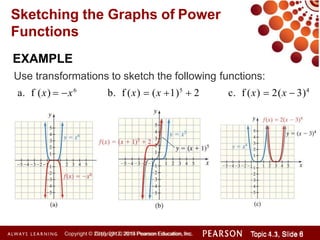
EXAMPLE
Use transformations to sketch the following functions:
a. f (x)  x6
b. f (x)  (x 1)5
 2 c. f (x)  2(x  3)4
Copyright © 2014 Pearson Education, Inc. Topic 1.1, Slide 6
Topic 4.3, Slide 8
Copyright © 2010, 2012, 2015 Pearson Education, Inc.
Determining the End Behavior of
Polynomial Functions
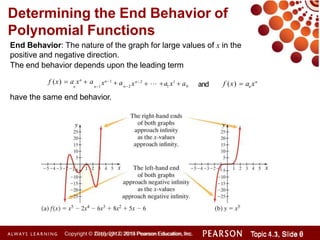
End Behavior: The nature of the graph for large values of x in the
positive and negative direction.
The end behavior depends upon the leading term
1 0
n2
xn1
 a
f (x)  a xn
 a
n n1 n
xn2
  a x1
 a f (x)  a xn
and
have the same end behavior.
Copyright © 2014 Pearson Education, Inc. Topic 1.1, Slide 6
Topic 4.3, Slide 9
Copyright © 2010, 2012, 2015 Pearson Education, Inc.
Determining the End Behavior of
Polynomial Functions
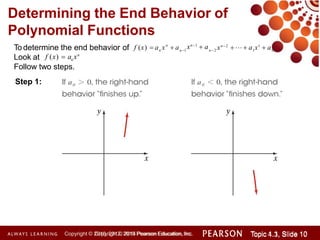
To determine the end behavior of
Look at
0
1
n
n
f (x)  a x  a xn2
   a x1
 a
n2
xn1
 a
n1
n
f (x)  a xn
Follow two steps.
Step 1:
Copyright © 2014 Pearson Education, Inc. Topic 1.1, Slide 10
Topic 4.3, Slide 10
Copyright © 2010, 2012, 2015 Pearson Education, Inc.
Determining the End Behavior of
Polynomial Functions
To determine the end behavior of
Look at
n
f (x)  a x  a xn2
   a x1
 a
1 0
xn1
 a
n n1 n2
n
f (x)  a xn
Follow two steps.
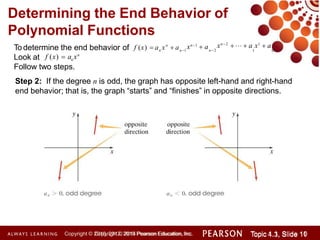
Step 2: If the degree n is odd, the graph has opposite left-hand and right-hand
end behavior; that is, the graph “starts” and “finishes” in opposite directions.
Copyright © 2014 Pearson Education, Inc. Topic 1.1, Slide 10
Topic 4.3, Slide 11
Copyright © 2010, 2012, 2015 Pearson Education, Inc.
Determining the End Behavior of
Polynomial Functions
To determine the end behavior of
Look at
n
f (x)  a x  a xn2
   a x1
 a
1 0
xn1
 a
n n1 n2
n
f (x)  a xn
Follow two steps.
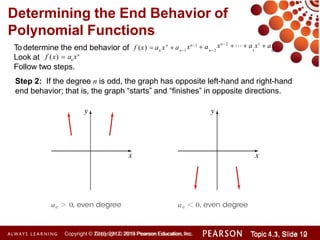
Step 2: If the degree n is odd, the graph has opposite left-hand and right-hand
end behavior; that is, the graph “starts” and “finishes” in opposite directions.
Copyright © 2014 Pearson Education, Inc. Topic 1.1, Slide 10
Topic 4.3, Slide 12
Copyright © 2010, 2012, 2015 Pearson Education, Inc.
Determining the End Behavior of
Polynomial Functions
EXAMPLE
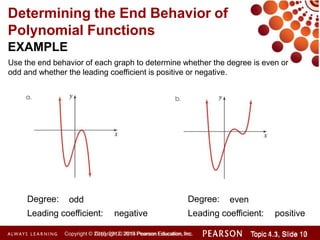
Use the end behavior of each graph to determine whether the degree is even or
odd and whether the leading coefficient is positive or negative.
Degree: odd
Leading coefficient: negative
Copyright © 2014 Pearson Education, Inc. Topic 1.1, Slide 10
Topic 4.3, Slide 13
Copyright © 2010, 2012, 2015 Pearson Education, Inc.
Degree: even
Leading coefficient: positive
Determining the intercepts
of a Polynomial Function
• y-intercept: Found by evaluating
f(0)
• x-intercepts:Found by solving f(x) =
0
Copyright © 2014 Pearson Education, Inc. Topic 1.1, Slide 10
Topic 4.3, Slide 14
Copyright © 2010, 2012, 2015 Pearson Education, Inc.
Determining the intercepts
of a Polynomial Function
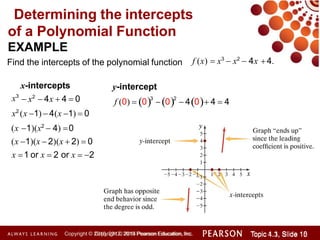
EXAMPLE
Find the intercepts of the polynomial function f (x)  x3
 x2
 4x 4.
x3
x2
(x 1) 4(x 1)  0
(x 1)(x2
 4) 0
(x 1)(x  2)(x  2)  0
x 1 or x  2 or x  2
x-intercepts
 x2
 4x  4  0
y-intercept
f (0)  03
02
 40 4  4
Copyright © 2014 Pearson Education, Inc. Topic 1.1, Slide 10
Topic 4.3, Slide 15
Copyright © 2010, 2012, 2015 Pearson Education, Inc.
Determining the Real Zeros of Polynomial
Functions and Their Multiplicities
Copyright © 2014 Pearson Education, Inc. Topic 1.1, Slide 10
Topic 4.3, Slide 16
Copyright © 2010, 2012, 2015 Pearson Education, Inc.
If (x – c) is a factor of a polynomial function, then
x = c is a zero.
If f is a polynomial function and x = c is a zero,
then (x – c) is a factor.
If a factor (x – c) occurs n times in a polynomial, n
is an integer greater than 0, the zero x = c is said
to have a multiplicity n.
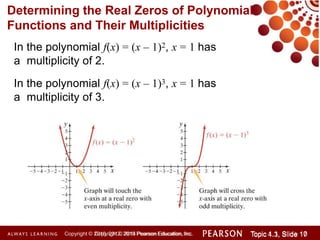
In the polynomial f(x) = (x – 1)2, x = 1 has
a multiplicity of 2.
In the polynomial f(x) = (x – 1)3, x = 1 has
a multiplicity of 3.
Determining the Real Zeros of Polynomial
Functions and Their Multiplicities
Copyright © 2014 Pearson Education, Inc. Topic 1.1, Slide 10
Topic 4.3, Slide 17
Copyright © 2010, 2012, 2015 Pearson Education, Inc.
Determining the Real Zeros of Polynomial
Functions and Their Multiplicities
Shape of the Graph of a Polynomial Function
Near a Zero of Multiplicity k
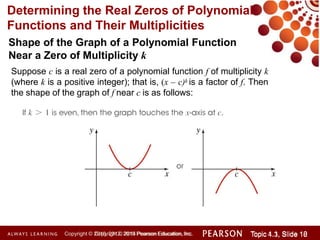
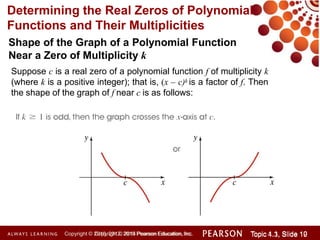
Suppose c is a real zero of a polynomial function f of multiplicity k
(where k is a positive integer); that is, (x – c)k is a factor of f. Then
the shape of the graph of f near c is as follows:
Copyright © 2014 Pearson Education, Inc. Topic 1.1, Slide 10
Topic 4.3, Slide 18
Copyright © 2010, 2012, 2015 Pearson Education, Inc.
Determining the Real Zeros of Polynomial
Functions and Their Multiplicities
Shape of the Graph of a Polynomial Function
Near a Zero of Multiplicity k
Suppose c is a real zero of a polynomial function f of multiplicity k
(where k is a positive integer); that is, (x – c)k is a factor of f. Then
the shape of the graph of f near c is as follows:
Copyright © 2014 Pearson Education, Inc. Topic 1.1, Slide 10
Topic 4.3, Slide 19
Copyright © 2010, 2012, 2015 Pearson Education, Inc.
Determining the Real Zeros of Polynomial
Functions and Their Multiplicities
EXAMPLE
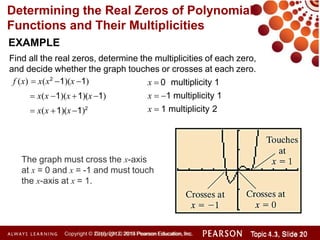
Find all the real zeros, determine the multiplicities of each zero,
and decide whether the graph touches or crosses at each zero.
f (x)  x(x2
1)(x 1)
 x(x 1)(x 1)(x1)
 x(x 1)(x 1)2
x  0 multiplicity 1
x  1 multiplicity 1
x  1 multiplicity 2
The graph must cross the x-axis
at x = 0 and x = -1 and must touch
the x-axis at x = 1.
Copyright © 2014 Pearson Education, Inc. Topic 1.1, Slide 10
Topic 4.3, Slide 20
Copyright © 2010, 2012, 2015 Pearson Education, Inc.
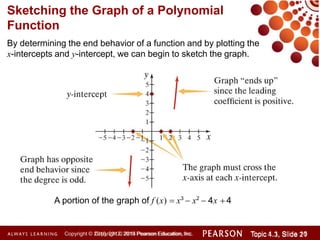
By determining the end behavior of a function and by plotting the
x-intercepts and y-intercept, we can begin to sketch the graph.
Sketching the Graph of a Polynomial
Function
A portion of the graph of f (x)  x3
 x2
 4x  4
Copyright © 2014 Pearson Education, Inc. Topic 1.1, Slide 10
Topic 4.3, Slide 21
Copyright © 2010, 2012, 2015 Pearson Education, Inc.
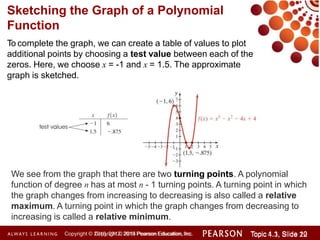
To complete the graph, we can create a table of values to plot
additional points by choosing a test value between each of the
zeros. Here, we choose x = -1 and x = 1.5. The approximate
graph is sketched.
Sketching the Graph of a Polynomial
Function
We see from the graph that there are two turning points. A polynomial
function of degree n has at most n - 1 turning points. A turning point in which
the graph changes from increasing to decreasing is also called a relative
maximum. A turning point in which the graph changes from decreasing to
increasing is called a relative minimum.
Copyright © 2014 Pearson Education, Inc. Topic 1.1, Slide 10
Topic 4.3, Slide 22
Copyright © 2010, 2012, 2015 Pearson Education, Inc.
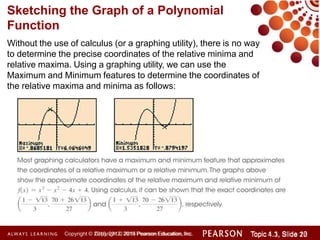
Without the use of calculus (or a graphing utility), there is no way
to determine the precise coordinates of the relative minima and
relative maxima. Using a graphing utility, we can use the
Maximum and Minimum features to determine the coordinates of
the relative maxima and minima as follows:
Sketching the Graph of a Polynomial
Function
Copyright © 2014 Pearson Education, Inc. Topic 1.1, Slide 10
Topic 4.3, Slide 23
Copyright © 2010, 2012, 2015 Pearson Education, Inc.
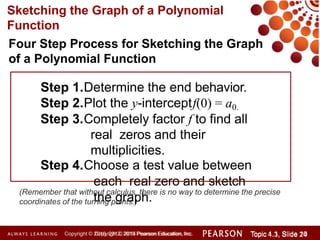
Four Step Process for Sketching the Graph
of a Polynomial Function
Step 1.Determine the end behavior.
Step 2.Plot the y-interceptf(0) = a0.
Step 3.Completely factor f to find all
real zeros and their
multiplicities.
Step 4.Choose a test value between
each real zero and sketch
the graph.
Sketching the Graph of a Polynomial
Function
(Remember that without calculus, there is no way to determine the precise
coordinates of the turning points.)
Copyright © 2014 Pearson Education, Inc. Topic 1.1, Slide 10
Topic 4.3, Slide 24
Copyright © 2010, 2012, 2015 Pearson Education, Inc.
EXAMPLE
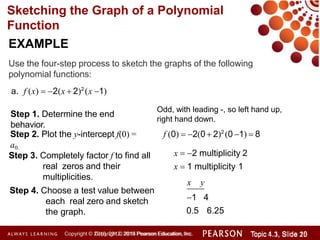
Use the four-step process to sketch the graphs of the following
polynomial functions:
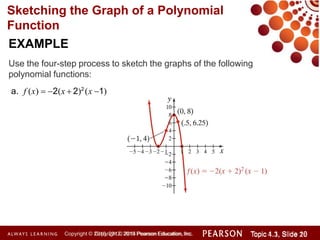
a. f (x)  2(x  2)2
(x 1)
Sketching the Graph of a Polynomial
Function
Step 1. Determine the end
behavior.
Step 2. Plot the y-intercept f(0) =
a0.
Step 3. Completely factor f to find all
real zeros and their
multiplicities.
Step 4. Choose a test value between
each real zero and sketch
the graph.
Odd, with leading -, so left hand up,
right hand down.
f (0)  2(0 2)2
(0 1)  8
x  2 multiplicity 2
x  1 multiplicity 1
x y
0.5 6.25
Copyright © 2014 Pearson Education, Inc. Topic 1.1, Slide 10
Topic 4.3, Slide 25
Copyright © 2010, 2012, 2015 Pearson Education, Inc.
1 4
EXAMPLE
Use the four-step process to sketch the graphs of the following
polynomial functions:
a. f (x)  2(x  2)2
(x 1)
Sketching the Graph of a Polynomial
Function
Copyright © 2014 Pearson Education, Inc. Topic 1.1, Slide 10
Topic 4.3, Slide 26
Copyright © 2010, 2012, 2015 Pearson Education, Inc.
EXAMPLE
Use the four-step process to sketch the graphs of the following
polynomial functions:
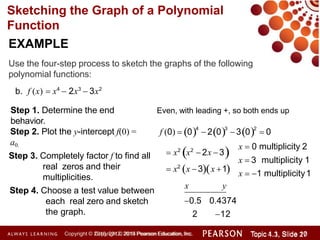
b. f (x)  x4
 2x3
 3x2
Sketching the Graph of a Polynomial
Function
Step 1. Determine the end
behavior.
Step 2. Plot the y-intercept f(0) =
a0.
Step 3. Completely factor f to find all
real zeros and their
multiplicities.
Step 4. Choose a test value between
each real zero and sketch
the graph.
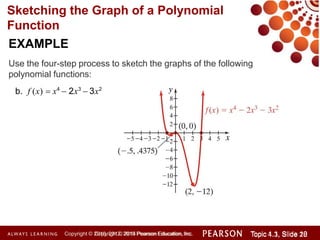
Even, with leading +, so both ends up
x  3 multiplicity 1
x  1 multiplicity1
0.5 0.4374
2 12
Copyright © 2014 Pearson Education, Inc. Topic 1.1, Slide 10
Topic 4.3, Slide 27
Copyright © 2010, 2012, 2015 Pearson Education, Inc.
x y
 x2
x2
 2x 3
 x2
x 3x 1
f (0)  04
 203
302
 0
x  0 multiplicity 2
EXAMPLE
Use the four-step process to sketch the graphs of the following
polynomial functions:
b. f (x)  x4
 2x3
 3x2
Sketching the Graph of a Polynomial
Function
Copyright © 2014 Pearson Education, Inc. Topic 1.1, Slide 10
Topic 4.3, Slide 28
Copyright © 2010, 2012, 2015 Pearson Education, Inc.
Determining a Possible Equation of a
Polynomial Function Given its Graph
EXAMPLE
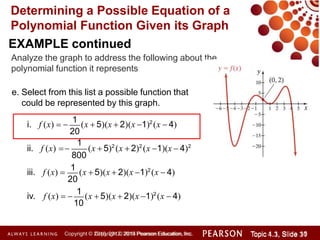
Analyze the graph to address the following about the
polynomial function it represents
a.Is the degree of the polynomial
function even or odd?
Odd because the graph starts up
and finishes down.
b. Is the leading coefficient positive or negative?
Negative because the right hand behavior finishes down
Copyright © 2014 Pearson Education, Inc. Topic 1.1, Slide 10
Topic 4.3, Slide 29
Copyright © 2010, 2012, 2015 Pearson Education, Inc.
Determining a Possible Equation of a
Polynomial Function Given its Graph
of each.
EXAMPLE continued
Analyze the graph to address the following about the
polynomial function it represents
c. What is the value of the constant coefficient?
2 because the y-intercept is 2.
d. Identify the real zeros, and state the multiplicity
x =-5 multiplicity odd
x =-2 multiplicity odd
x =1 multiplicity even
x =4 multiplicity odd
Copyright © 2014 Pearson Education, Inc. Topic 1.1, Slide 10
Topic 4.3, Slide 30
Copyright © 2010, 2012, 2015 Pearson Education, Inc.
Determining a Possible Equation of a
Polynomial Function Given its Graph
EXAMPLE continued
Analyze the graph to address the following about the
polynomial function it represents
e. Select from this list a possible function that
could be represented by this graph.
ii. f (x) 
20
1
i. f (x)  
1
(x  5)(x  2)(x 1)2
(x  4)
800
(x  5)2
(x  2)2
(x 1)(x  4)2
20
iii. f (x) 
1
(x  5)(x  2)(x 1)2
(x  4)
10
iv. f (x)  
1
(x  5)(x  2)(x 1)2
(x  4)
Copyright © 2014 Pearson Education, Inc. Topic 1.1, Slide 10
Topic 4.3, Slide 31
Copyright © 2010, 2012, 2015 Pearson Education, Inc.

end behavior.....pptx

  • 1.
    Topic 4.3 The Graphsof Polynomial Functions Copyright © 2014 Pearson Education, Inc. Topic 1.1, Slide 1 Topic 4.3, Slide 1 Copyright © 2010, 2012, 2015 Pearson Education, Inc.
  • 2.
    OBJECTIVES Copyright © 2014Pearson Education, Inc. Topic 1.1, Slide 1 Topic 4.3, Slide 2 Copyright © 2010, 2012, 2015 Pearson Education, Inc. 1. Understanding the Definition of a Polynomial Function 2. Sketching the Graphs of Power Functions 3. Determining the End Behavior of Polynomial Functions 4. Determining the Intercepts of a Polynomial Function 5. Determining the Real Zeros of Polynomial Functions and Their Multiplicities 6. Sketching the Graph of a Polynomial Function 7. Determining a Possible Equation of a Polynomial Function Giving Its Graph
  • 3.
    Polynomial Functions Copyright © 2014Pearson Education, Inc. Topic 1.1, Slide 1 Topic 4.3, Slide 3 Copyright © 2010, 2012, 2015 Pearson Education, Inc. The function is a polynomial function of degree n, where n is a nonnegative integer. The numbers are called the coefficients of the polynomial functions. The number a0 is called the leading coefficient, and an is called the constant coefficient. 0 n f (x)  a x  a xn2 xn1  a    a x1  a n n1 n2 1 a1,a2, ...,an
  • 4.
    Polynomial Functions-cont • The powerof each term must be an integer greater than or equal to zero. • The coefficients can be real or imaginary. 17 4x3  2x2  5x 1 g(x)  3 f (x)  5x4  2 x2  6 polynomial functions x Copyright © 2014 Pearson Education, Inc. Topic 1.1, Slide 1 Topic 4.3, Slide 4 Copyright © 2010, 2012, 2015 Pearson Education, Inc. 4x3  2x2  5x 1 g(x)  non  polynomial function
  • 5.
    Understanding the Definitionof a Polynomial Function a. f (x)  3x3  2x2  Polynomial? yes 1 6 EXAMPLE Determine which functions are polynomial functions. If the function is a polynomial function, identify the degree, the leading coefficient, and the constant coefficient. Degree: Leading Coefficient: 3 3 Constant Coefficient:  1 6 5 3 2 Copyright © 2014 Pearson Education, Inc. Topic 1.1, Slide 1 Topic 4.3, Slide 5 Copyright © 2010, 2012, 2015 Pearson Education, Inc. 7 b. g(x)  4x  3x  x   3 x Polynomial? no
  • 6.
    Understanding the Definitionof a Polynomial Function 3x  x2 7x4 c. h(x)  EXAMPLE continued Determine which functions are polynomial functions. If the function is a polynomial function, identify the degree, the leading coefficient, and the constant coefficient. Degree: 9 Polynomial? yes 4 Constant Coefficient: Leading Coefficient: 7 9 0  7 x4  1 x2  1 x 9 9 3 Copyright © 2014 Pearson Education, Inc. Topic 1.1, Slide 6 Topic 4.3, Slide 6 Copyright © 2010, 2012, 2015 Pearson Education, Inc.
  • 7.
    Power functions: f(x)= axn Copyright © 2014 Pearson Education, Inc. Topic 1.1, Slide 6 Topic 4.3, Slide 7 Copyright © 2010, 2012, 2015 Pearson Education, Inc.
  • 8.
    Sketching the Graphsof Power Functions EXAMPLE Use transformations to sketch the following functions: a. f (x)  x6 b. f (x)  (x 1)5  2 c. f (x)  2(x  3)4 Copyright © 2014 Pearson Education, Inc. Topic 1.1, Slide 6 Topic 4.3, Slide 8 Copyright © 2010, 2012, 2015 Pearson Education, Inc.
  • 9.
    Determining the EndBehavior of Polynomial Functions End Behavior: The nature of the graph for large values of x in the positive and negative direction. The end behavior depends upon the leading term 1 0 n2 xn1  a f (x)  a xn  a n n1 n xn2   a x1  a f (x)  a xn and have the same end behavior. Copyright © 2014 Pearson Education, Inc. Topic 1.1, Slide 6 Topic 4.3, Slide 9 Copyright © 2010, 2012, 2015 Pearson Education, Inc.
  • 10.
    Determining the EndBehavior of Polynomial Functions To determine the end behavior of Look at 0 1 n n f (x)  a x  a xn2    a x1  a n2 xn1  a n1 n f (x)  a xn Follow two steps. Step 1: Copyright © 2014 Pearson Education, Inc. Topic 1.1, Slide 10 Topic 4.3, Slide 10 Copyright © 2010, 2012, 2015 Pearson Education, Inc.
  • 11.
    Determining the EndBehavior of Polynomial Functions To determine the end behavior of Look at n f (x)  a x  a xn2    a x1  a 1 0 xn1  a n n1 n2 n f (x)  a xn Follow two steps. Step 2: If the degree n is odd, the graph has opposite left-hand and right-hand end behavior; that is, the graph “starts” and “finishes” in opposite directions. Copyright © 2014 Pearson Education, Inc. Topic 1.1, Slide 10 Topic 4.3, Slide 11 Copyright © 2010, 2012, 2015 Pearson Education, Inc.
  • 12.
    Determining the EndBehavior of Polynomial Functions To determine the end behavior of Look at n f (x)  a x  a xn2    a x1  a 1 0 xn1  a n n1 n2 n f (x)  a xn Follow two steps. Step 2: If the degree n is odd, the graph has opposite left-hand and right-hand end behavior; that is, the graph “starts” and “finishes” in opposite directions. Copyright © 2014 Pearson Education, Inc. Topic 1.1, Slide 10 Topic 4.3, Slide 12 Copyright © 2010, 2012, 2015 Pearson Education, Inc.
  • 13.
    Determining the EndBehavior of Polynomial Functions EXAMPLE Use the end behavior of each graph to determine whether the degree is even or odd and whether the leading coefficient is positive or negative. Degree: odd Leading coefficient: negative Copyright © 2014 Pearson Education, Inc. Topic 1.1, Slide 10 Topic 4.3, Slide 13 Copyright © 2010, 2012, 2015 Pearson Education, Inc. Degree: even Leading coefficient: positive
  • 14.
    Determining the intercepts ofa Polynomial Function • y-intercept: Found by evaluating f(0) • x-intercepts:Found by solving f(x) = 0 Copyright © 2014 Pearson Education, Inc. Topic 1.1, Slide 10 Topic 4.3, Slide 14 Copyright © 2010, 2012, 2015 Pearson Education, Inc.
  • 15.
    Determining the intercepts ofa Polynomial Function EXAMPLE Find the intercepts of the polynomial function f (x)  x3  x2  4x 4. x3 x2 (x 1) 4(x 1)  0 (x 1)(x2  4) 0 (x 1)(x  2)(x  2)  0 x 1 or x  2 or x  2 x-intercepts  x2  4x  4  0 y-intercept f (0)  03 02  40 4  4 Copyright © 2014 Pearson Education, Inc. Topic 1.1, Slide 10 Topic 4.3, Slide 15 Copyright © 2010, 2012, 2015 Pearson Education, Inc.
  • 16.
    Determining the RealZeros of Polynomial Functions and Their Multiplicities Copyright © 2014 Pearson Education, Inc. Topic 1.1, Slide 10 Topic 4.3, Slide 16 Copyright © 2010, 2012, 2015 Pearson Education, Inc. If (x – c) is a factor of a polynomial function, then x = c is a zero. If f is a polynomial function and x = c is a zero, then (x – c) is a factor. If a factor (x – c) occurs n times in a polynomial, n is an integer greater than 0, the zero x = c is said to have a multiplicity n.
  • 17.
    In the polynomialf(x) = (x – 1)2, x = 1 has a multiplicity of 2. In the polynomial f(x) = (x – 1)3, x = 1 has a multiplicity of 3. Determining the Real Zeros of Polynomial Functions and Their Multiplicities Copyright © 2014 Pearson Education, Inc. Topic 1.1, Slide 10 Topic 4.3, Slide 17 Copyright © 2010, 2012, 2015 Pearson Education, Inc.
  • 18.
    Determining the RealZeros of Polynomial Functions and Their Multiplicities Shape of the Graph of a Polynomial Function Near a Zero of Multiplicity k Suppose c is a real zero of a polynomial function f of multiplicity k (where k is a positive integer); that is, (x – c)k is a factor of f. Then the shape of the graph of f near c is as follows: Copyright © 2014 Pearson Education, Inc. Topic 1.1, Slide 10 Topic 4.3, Slide 18 Copyright © 2010, 2012, 2015 Pearson Education, Inc.
  • 19.
    Determining the RealZeros of Polynomial Functions and Their Multiplicities Shape of the Graph of a Polynomial Function Near a Zero of Multiplicity k Suppose c is a real zero of a polynomial function f of multiplicity k (where k is a positive integer); that is, (x – c)k is a factor of f. Then the shape of the graph of f near c is as follows: Copyright © 2014 Pearson Education, Inc. Topic 1.1, Slide 10 Topic 4.3, Slide 19 Copyright © 2010, 2012, 2015 Pearson Education, Inc.
  • 20.
    Determining the RealZeros of Polynomial Functions and Their Multiplicities EXAMPLE Find all the real zeros, determine the multiplicities of each zero, and decide whether the graph touches or crosses at each zero. f (x)  x(x2 1)(x 1)  x(x 1)(x 1)(x1)  x(x 1)(x 1)2 x  0 multiplicity 1 x  1 multiplicity 1 x  1 multiplicity 2 The graph must cross the x-axis at x = 0 and x = -1 and must touch the x-axis at x = 1. Copyright © 2014 Pearson Education, Inc. Topic 1.1, Slide 10 Topic 4.3, Slide 20 Copyright © 2010, 2012, 2015 Pearson Education, Inc.
  • 21.
    By determining theend behavior of a function and by plotting the x-intercepts and y-intercept, we can begin to sketch the graph. Sketching the Graph of a Polynomial Function A portion of the graph of f (x)  x3  x2  4x  4 Copyright © 2014 Pearson Education, Inc. Topic 1.1, Slide 10 Topic 4.3, Slide 21 Copyright © 2010, 2012, 2015 Pearson Education, Inc.
  • 22.
    To complete thegraph, we can create a table of values to plot additional points by choosing a test value between each of the zeros. Here, we choose x = -1 and x = 1.5. The approximate graph is sketched. Sketching the Graph of a Polynomial Function We see from the graph that there are two turning points. A polynomial function of degree n has at most n - 1 turning points. A turning point in which the graph changes from increasing to decreasing is also called a relative maximum. A turning point in which the graph changes from decreasing to increasing is called a relative minimum. Copyright © 2014 Pearson Education, Inc. Topic 1.1, Slide 10 Topic 4.3, Slide 22 Copyright © 2010, 2012, 2015 Pearson Education, Inc.
  • 23.
    Without the useof calculus (or a graphing utility), there is no way to determine the precise coordinates of the relative minima and relative maxima. Using a graphing utility, we can use the Maximum and Minimum features to determine the coordinates of the relative maxima and minima as follows: Sketching the Graph of a Polynomial Function Copyright © 2014 Pearson Education, Inc. Topic 1.1, Slide 10 Topic 4.3, Slide 23 Copyright © 2010, 2012, 2015 Pearson Education, Inc.
  • 24.
    Four Step Processfor Sketching the Graph of a Polynomial Function Step 1.Determine the end behavior. Step 2.Plot the y-interceptf(0) = a0. Step 3.Completely factor f to find all real zeros and their multiplicities. Step 4.Choose a test value between each real zero and sketch the graph. Sketching the Graph of a Polynomial Function (Remember that without calculus, there is no way to determine the precise coordinates of the turning points.) Copyright © 2014 Pearson Education, Inc. Topic 1.1, Slide 10 Topic 4.3, Slide 24 Copyright © 2010, 2012, 2015 Pearson Education, Inc.
  • 25.
    EXAMPLE Use the four-stepprocess to sketch the graphs of the following polynomial functions: a. f (x)  2(x  2)2 (x 1) Sketching the Graph of a Polynomial Function Step 1. Determine the end behavior. Step 2. Plot the y-intercept f(0) = a0. Step 3. Completely factor f to find all real zeros and their multiplicities. Step 4. Choose a test value between each real zero and sketch the graph. Odd, with leading -, so left hand up, right hand down. f (0)  2(0 2)2 (0 1)  8 x  2 multiplicity 2 x  1 multiplicity 1 x y 0.5 6.25 Copyright © 2014 Pearson Education, Inc. Topic 1.1, Slide 10 Topic 4.3, Slide 25 Copyright © 2010, 2012, 2015 Pearson Education, Inc. 1 4
  • 26.
    EXAMPLE Use the four-stepprocess to sketch the graphs of the following polynomial functions: a. f (x)  2(x  2)2 (x 1) Sketching the Graph of a Polynomial Function Copyright © 2014 Pearson Education, Inc. Topic 1.1, Slide 10 Topic 4.3, Slide 26 Copyright © 2010, 2012, 2015 Pearson Education, Inc.
  • 27.
    EXAMPLE Use the four-stepprocess to sketch the graphs of the following polynomial functions: b. f (x)  x4  2x3  3x2 Sketching the Graph of a Polynomial Function Step 1. Determine the end behavior. Step 2. Plot the y-intercept f(0) = a0. Step 3. Completely factor f to find all real zeros and their multiplicities. Step 4. Choose a test value between each real zero and sketch the graph. Even, with leading +, so both ends up x  3 multiplicity 1 x  1 multiplicity1 0.5 0.4374 2 12 Copyright © 2014 Pearson Education, Inc. Topic 1.1, Slide 10 Topic 4.3, Slide 27 Copyright © 2010, 2012, 2015 Pearson Education, Inc. x y  x2 x2  2x 3  x2 x 3x 1 f (0)  04  203 302  0 x  0 multiplicity 2
  • 28.
    EXAMPLE Use the four-stepprocess to sketch the graphs of the following polynomial functions: b. f (x)  x4  2x3  3x2 Sketching the Graph of a Polynomial Function Copyright © 2014 Pearson Education, Inc. Topic 1.1, Slide 10 Topic 4.3, Slide 28 Copyright © 2010, 2012, 2015 Pearson Education, Inc.
  • 29.
    Determining a PossibleEquation of a Polynomial Function Given its Graph EXAMPLE Analyze the graph to address the following about the polynomial function it represents a.Is the degree of the polynomial function even or odd? Odd because the graph starts up and finishes down. b. Is the leading coefficient positive or negative? Negative because the right hand behavior finishes down Copyright © 2014 Pearson Education, Inc. Topic 1.1, Slide 10 Topic 4.3, Slide 29 Copyright © 2010, 2012, 2015 Pearson Education, Inc.
  • 30.
    Determining a PossibleEquation of a Polynomial Function Given its Graph of each. EXAMPLE continued Analyze the graph to address the following about the polynomial function it represents c. What is the value of the constant coefficient? 2 because the y-intercept is 2. d. Identify the real zeros, and state the multiplicity x =-5 multiplicity odd x =-2 multiplicity odd x =1 multiplicity even x =4 multiplicity odd Copyright © 2014 Pearson Education, Inc. Topic 1.1, Slide 10 Topic 4.3, Slide 30 Copyright © 2010, 2012, 2015 Pearson Education, Inc.
  • 31.
    Determining a PossibleEquation of a Polynomial Function Given its Graph EXAMPLE continued Analyze the graph to address the following about the polynomial function it represents e. Select from this list a possible function that could be represented by this graph. ii. f (x)  20 1 i. f (x)   1 (x  5)(x  2)(x 1)2 (x  4) 800 (x  5)2 (x  2)2 (x 1)(x  4)2 20 iii. f (x)  1 (x  5)(x  2)(x 1)2 (x  4) 10 iv. f (x)   1 (x  5)(x  2)(x 1)2 (x  4) Copyright © 2014 Pearson Education, Inc. Topic 1.1, Slide 10 Topic 4.3, Slide 31 Copyright © 2010, 2012, 2015 Pearson Education, Inc.