Leading Filipino
Composers
(1880-1900)
Francisco Buencamino Sr.
•
•
Born in San Miguel de Mayumo, Bulacan
His father was an organist and
symphonic band leader.
He studied at the Liceo de Manila
He put up a publishing company and
Buencamino Music Academy
His compositional output ranges from
small-scale piano and kundiman.
•
•
•
Francisco Buencamino Sr.
• He incorporated Philippine folk melodies
to Western musical tradition.
His famous works are “Mayon”,
“Harana”, “Damdamin”, and “Ang
Larawan”
•
Dr. Francisco Santiago
•
•
•
He was born in Santa Maria, Bulacan.
His uncle taught him solfeggio and violin.
He taught piano at the University of the
Philippines Conservatory of Music.
He studied at the American Conservatory
of Music and Chicago Musical School
(master’s and doctorate degrees in
music)
•
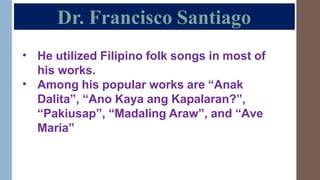
Dr. Francisco Santiago
• He utilized Filipino folk songs in most of
his works.
Among his popular works are “Anak
Dalita”, “Ano Kaya ang Kapalaran?”,
“Pakiusap”, “Madaling Araw”, and “Ave
Maria”
•
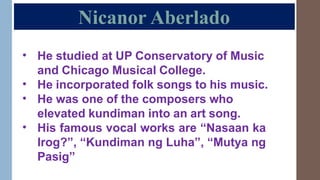
Nicanor Aberlado
• He was born in San Miguel de Mayumo,
Bulacan.
His father taught him the solfeggio and
banduria at the age of 5.
He made his first composition at the age
of 8 (“Unang Buko”)
He played piano background music for
silent movies.
•
•
•
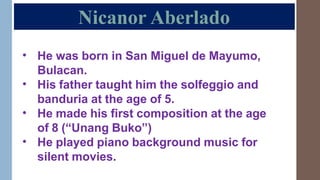
Nicanor Aberlado
• He studied at UP Conservatory of Music
and Chicago Musical College.
He incorporated folk songs to his music.
He was one of the composers who
elevated kundiman into an art song.
His famous vocal works are “Nasaan ka
Irog?”, “Kundiman ng Luha”, “Mutya ng
Pasig”
•
•
•
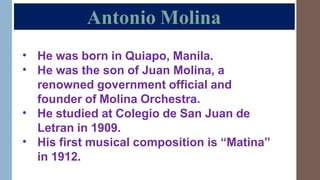
Antonio Molina
•
•
He was born in Quiapo, Manila.
He was the son of Juan Molina, a
renowned government official and
founder of Molina Orchestra.
He studied at Colegio de San Juan de
Letran in 1909.
His first musical composition is “Matina”
in 1912.
•
•
Antonio Molina
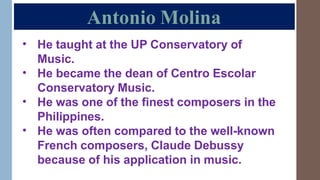
• He taught at the UP Conservatory of
Music.
He became the dean of Centro Escolar
Conservatory Music.
He was one of the finest composers in the
Philippines.
He was often compared to the well-known
French composers, Claude Debussy
because of his application in music.
•
•
•
Antonio Molina
• His famous musical composition is
“Hatinggabi”, a serenade for solo violin
and piano accompaniment.
Important Filipino
Composers Born in
1901 - 1930
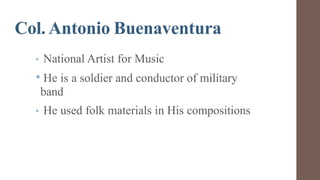
Col. Antonio Buenaventura
• National Artist for Music
• He is a soldier and conductor of military
band
• He used folk materials in His compositions
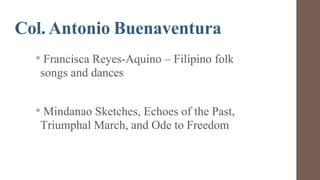
Col. Antonio Buenaventura
• Francisca Reyes-Aquino – Filipino folk
songs and dances
• Mindanao Sketches, Echoes of the Past,
Triumphal March, and Ode to Freedom
Lucio San Pedro
• Known for conducting and composing music for
symphonic band.
• He was born in Angono, Rizal
• He studied at UP Conservatory of Music and
Julliard School of Music.
• Advocate of Folk Songs
• Lahing Kayumanggi at sa Ugoy ng Duyan
Jose Maceda
• Born in Manila in 1917
• He is known for his experimental music
technique.
• He graduated from the Academy of Music f
Manila and studied in France.
• He became the first ethnomusicologist.
Jose Maceda
• Research on Filipino indigenous music (Main
Contribution)
• He incorporated rituals, electronic devices,
cassette tapes, and indigenous instruments.
• “Udlot-udlot”, “Agungan”, “Ugma-ugma”
Lucresia Kasilag
• Born in San Fernando, La Union
• First Filipino Female Composer
• Studied at St. Scholastica College, Philippine
Women University
• “Neoclassiscist”
• Philippine Scenes
Prominent Filipino
Composers
Ernani Cuenco
• Levi Celerio – Writes most of the lyrics of
Ernani’s composition; Uses mostly bamboo
leaves
Josefino “Chino” Toledo
• He played with Pangkat Kawayan, a folk
Bamboo ensemble founded by his father.
Jonas Baes
• He is a composer of interdisciplinary works.
• An ethnomusicologist
Raymundo Cipriano Pujante
Cayabyab
• His mother was an opera singer.
•Musical works: Paraiso, Kay Ganda ng ating musika,
and Kumukuti-kutitap
Photography, Film,
Art and Animation
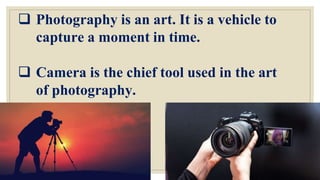
 Photography is an art. It is a vehicle to
capture a moment in time.
 Camera is the chief tool used in the art
of photography.
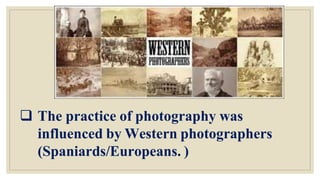
 The practice of photography was
influenced by Western photographers
(Spaniards/Europeans. )
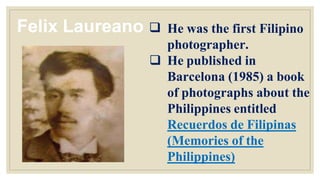
photographer.
 He published in
Barcelona (1985) a book
of photographs about the
Philippines entitled
Recuerdos de Filipinas
(Memories of the
Philippines)
Felix Laureano  He was the first Filipino
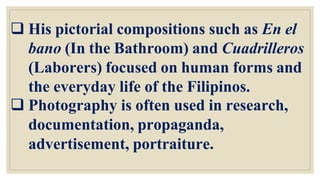
 His pictorial compositions such as En el
bano (In the Bathroom) and Cuadrilleros
(Laborers) focused on human forms and
the everyday life of the Filipinos.
 Photography is often used in research,
documentation, propaganda,
advertisement, portraiture.
Famous Filipino
Photographers
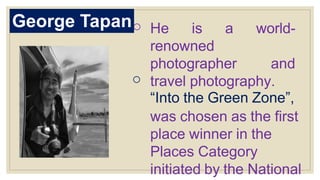
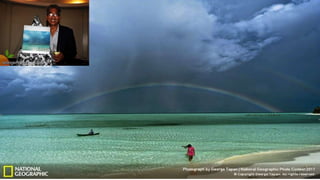
George Tapano
o
He is a world-
renowned
photographer and
travel photography.
“Into the Green Zone”,
was chosen as the first
place winner in the
Places Category
initiated by the National
o It was taken from the island of Onuk,
Palawan where he captured a rainbow
after a rainstorm.
o “A good travel photograph is what your
eyes see as traveler. You should not
make your photo artificially beautiful
using post-editing because that is not
what the eyes see.”
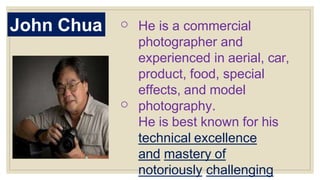
John Chua o
o
He is a commercial
photographer and
experienced in aerial, car,
product, food, special
effects, and model
photography.
He is best known for his
technical excellence
and mastery of
notoriously challenging
He founded AdPhoto in
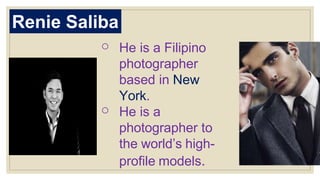
Renie Saliba
o He is a Filipino
photographer
based in New
York.
o He is a
photographer to
the world’s high-
profile models.
Film
FILM
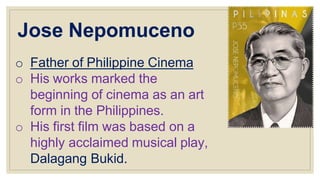
Jose Nepomuceno
o Father of Philippine Cinema
o His works marked the
beginning of cinema as an art
form in the Philippines.
o His first film was based on a
highly acclaimed musical play,
Dalagang Bukid.
Silent movies
Sound films
Black and
white
Comedies &
Dramas
Color
Various Genres:
adventures,
superhero, flicks,
documentary,
travelogue films,
CGI
Old Films Modern Films
•
•
•
•
Film has become the most popular
of all the art forms.
1950s (Golden Years of Philippine
Cinema) Cinematic techniques were
improved.
21st century- birth of Independent
filmmaking or indie film through the
use of digital technology.
Indie Film
o It is produced with a low
budget.
o Critically acclaimed and
shown in international film
festival
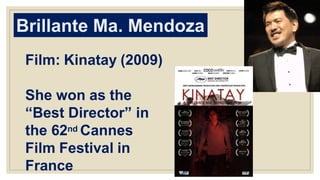
Brillante Ma. Mendoza
Film: Kinatay (2009)
She won as the
“Best Director” in
the 62nd Cannes
Film Festival in
France
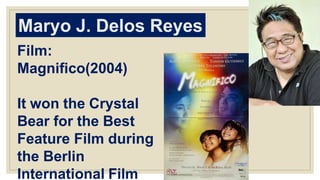
Maryo J. Delos Reyes
Film:
Magnifico(2004)
It won the Crystal
Bear for the Best
Feature Film during
the Berlin
International Film
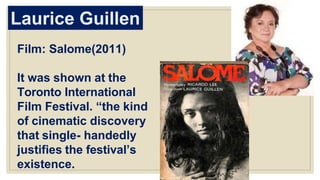
Laurice Guillen
Film: Salome(2011)
It was shown at the
Toronto International
Film Festival. “the kind
of cinematic discovery
that single- handedly
justifies the festival’s
existence.
Animation
•
•
•
Animation in the
Philippines began in
1980s.
Asian animation & Fil-
Cartoons were export-
oriented and provided
service to foreign
animators.
Philippine Animation Studio,
Inc. (PASI), is an animation
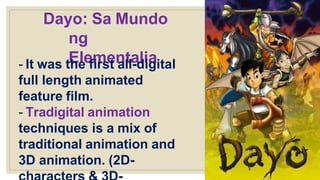
Dayo: Sa Mundo
ng
Elementalia
- It was the first all-digital
full length animated
feature film.
- Tradigital animation
techniques is a mix of
traditional animation and
3D animation. (2D-
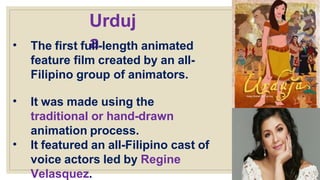
Urduj
a
• The first full-length animated
feature film created by an all-
Filipino group of animators.
• It was made using the
traditional or hand-drawn
animation process.
• It featured an all-Filipino cast of
voice actors led by Regine
Velasquez.
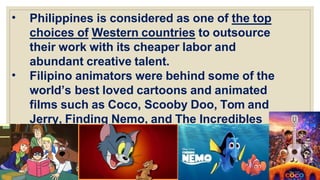
• Philippines is considered as one of the top
choices of Western countries to outsource
their work with its cheaper labor and
abundant creative talent.
• Filipino animators were behind some of the
world’s best loved cartoons and animated
films such as Coco, Scooby Doo, Tom and
Jerry, Finding Nemo, and The Incredibles
It serves as the primary overseer and
coordinator for Filipino animators.
Its main goal is to promote the animation industry
locally and globally, making the Philippines
center of excellence for animation and content-
creative services.
LOCAL PRINTAND
DIGITAL MEDIA
Print Media
◦Print media is a medium by which printed matter is
disseminated to the audience.
◦ It is the oldest form of advertising methods.
◦ It remains as the most popular form of advertising.
◦ It has informative and entertaining content.
Print Media
◦Its primary use is to spread information about daily
events and news.
◦It provides entertainment to the readers and is also
widely used in advertisements.
TYPES OF PRINT
MEDIA
Newspapers
◦News papers are collection of printed pages folded
together.
◦These are the most popular form of print media and the
most inexpensive wat to reach a wide readership.
◦It contains various section such as national, and local
news, current events, sports, food, entertainment, fashion,
business, and politics, informative articles, classified ads,
advertisements, and etc.
Magazines
◦Magazines are collections of printed pages bounded
together.
◦ It contains both information and entertainment.
◦Advertising in magazine is quite expensive but it is a
great way to target some market segments.
◦Advertisements are eye-catching, yet simple and
elegant.
Banners and Posters
◦Banners and Posters are often used for advertising
brands in exhibition, giving out more information
about the products, to show slogans logos, or some
messages.
◦It is made attractive to easily catch the attention of
passerby.
Brochures and Flyers
◦ They are often used in advertisements.
◦These are often distributed by hand or found on
display racks in public places.
◦It is very necessary that the brochures contain all
the required details of the product or the service.
Comic Book
◦Comic book is also called comic magazine or simply
comics.
◦This is a print media in a form of sequential panels that
represent individual scenes.
◦Each panel is often accompanied by a dialog placed in
world balloons.
◦It is sometimes humorous in tone and feature stories in
all genres.
DIGITAL MEDIA
Website
◦A website is the collection of webpages owned and
updated by an individual, group of people, company,
government agency, and other institutions.
Webpage
◦A webpage is a document which includes text,
graphics, audio, and video.
Webpage Designing
◦Uses creative instincts for color, text, images, and style
to create useful and attractive webpages.
◦A good webpage designer knows how to put together
the elements and principles of design to create a website
that will look great and persuade the viewer.
INNOVATIONS IN
PRODUCTS AND
INDUSTRIAL DESIGN
Impressive Designs
◦ Well-planned
◦Not copied from other local or foreign products and
compliments and harmonizes with the material used.
◦Goal: To improve the aesthetic design and
functionality of a product.
FILIPINO DESIGNERS
Kenneth Cobonpue
◦ Multi-awarded industrial designer
◦ Born in Cebu
◦Signature design – natural fibers and materials like
Rattan, Buri, Bamboo, and Abaca.
◦ Makes and designs furniture using indigenous materials.
Monique Lhuillier
◦ Known for making bridal wear and red carpet gowns.
Josie Natori
◦CEO of the Natori Company who produces lingerie, sleep wear,
and loungewear.
◦She was awarded the Order of Lakandula in March 2007 which
is the highest civilian awards in the Philippines
Lulu Tan-Gan
◦ “Queen of Knitwear”
Aze Ong
◦Filipino designer who is known for her bold and
impressive crochet art.
◦ She incorporates crochet art in her designs.
HIP-HOP
Hip-hop Dance
◦ Hip-hop dance refers to street dance styles
primarily performed to hip-hop music or that have
evolved as part of hip-hop culture. It includes a wide
range of styles primarily breaking, locking, and
popping which were created in the 1970s and made
popular by dance crews in the United States.
IMPORTANT TERMS
IN HIP-HOP
Battle
◦Battle is a showdown between two or more hip-hop
dancers or rappers.
Cypher
◦It is an informal gathering of rappers, beat boxers, and break-
dancers in a circle or in order to jam and dance together.
Freestyle
◦It is a type of hip-hop dance which includes non-choreographed
steps and movements based solely on the rhythm of the hip-hop.
ELEMENTS OF
HIPHOP
Rapping or Mcing
◦ A spoken or chanted rhyming lyrics.
◦ Its components are content, flow, and delivery.
Djing
◦ Known as the first element of Hip-hop culture.
◦It can also refer to the playing of Electronic Dance
Music (EDM) at clubs, restaurants, or festivals.
B-boying / Breaking / Breakdancing
◦It is a style or street dance that originated primarily
among Puerto Rican or African-American Youth.
Graffiti
◦Graffiti are writing or drawing that have been scribbled,
scratched, or painted illicitly on a wall or other surface,
often within public view.
CATEGORIES OF
HIP-HOP
Early Hip-hop
◦Original hip-hop dance and music which involves
breaking, popping, and locking movements.
Contemporary Hip-hop
◦Newer version of hip-hop dance which incorporates
different dancing styles and techniques.
HIP-HOP
MOVEMENTS
Top Rock
◦ Simple steps rhythmically executed while on the upright or
standing position as a pre-requisite into a down rock movement.
(e.g. kick step series)
Up rock
◦Duel of top rock competitive steps between dancers; this is a fight
without contact. (e.g. spins and turns or fancy footwork)
Down rock
◦ Total body movement on the floor which includes the following
steps: freeze, power, moves, and spin.
Contemporar y
Dance
Contemporary Dance
- is a kind of dance
performance which was
first developed during the
mid-twentieth century in
some parts of Europe
and the U.S.
It is a medley of different
styles of dances such as
ballet dance, modern
dance, lyrical dance, and
jazz dance.
It is a dance style that
requires a very strict and
disciplined dance form. It
is performed with
classical music.
Ballet
Dance
• It is a dance style that allows
for an unrestrained chance for
self- expression.
No specific limitation; it
caters to all kinds of dance
routines & movements and
invention of new steps and
Modern
Dance
- It is a combination of ballet and
jazz.
- The lyrics of music draw the
dancer to portray deep
emotions.
-It incorporates light and
fluid movements in the
Lyrical
Dance
- It is fast paced and requires
high energy to deliver fast,
sporadic movements.
- Good jazz dancer (scope of
knowledge one has about jazz
music)
- popular and often used in
television
Jazz
Dance
Contemporary dance
focuses on the
combination of controlled
legwork from ballet dance
and torso workout from
modern dance. It
showcase strong and
heavy footsteps and body
GLOBAL HEALTH ISSUES:
THE MILLENNIUM
DEVELOPMENT GOALS
Global Health Initiatives
◦Global Health Initiatives are programs designed to
pool financial resources to address specific health
problems worldwide.
◦It sets an acceptable standard of health for all people
of the world, considering the varied and possibly
extreme environmental, economic, and health.
Millennium Development Goals
◦Millennium Development Goals are developed in the
year 2000 when different countries under the
leadership of United Nations created a bold plan to
reduce global poverty in various dimensions by 2015.
◦ A series of plans by the United Nations.
MILLENNIUM
DEVELOPMENT
GOALS
Millennium Development Goals
1. Eradicate extreme poverty and hunger
2. Achieve universal primary education.
3. Promote Gender equality and empower Women.
4. Reduce Child Mortality
5. Improve Maternal Health
6. Combat HIV/AIDS, Malaria, and other diseases
7. Ensure Environmental Sustainability
8. A global partnership for development
GLOBAL HEALTH
INITIATIVE: ALCOHOL
AND TOBACCO
CONTROL
RA 10586:
Anti-Drunk and Drugged Driving Acts
of 2013
◦Individuals who are caught driving under the
influence of alcohol or drugs.
◦Punishments: confiscation of driver’s license and
fine from 20,000 to 30,000.
GLOBAL HEALTH
INITIATIVE: MENTAL
HEALTH
Misconceptions
◦People with Mental health issues who sees a
psychiatrist are weak or crazy.
◦ Mental service creates mores damage to their health.
◦ Mental illness isn’t real and it’s all in your head.
◦ Mental illness is a sign of weakness.
◦ There is no cure for mental illness.
◦ Youth do not suffer from mental illness.
RA 11036:
Philippine Mental Health Act of 2014
◦It aims to integrate Mental health services in the
national healthcare program to ensure that poor can
have access to quality mental health services and
medicine.
October 10 is HD World Mental
Health Day.

mapeh-ten-all-ppt-3rd-qtr_compress .pptx

  • 1.
  • 2.
    Francisco Buencamino Sr. • • Bornin San Miguel de Mayumo, Bulacan His father was an organist and symphonic band leader. He studied at the Liceo de Manila He put up a publishing company and Buencamino Music Academy His compositional output ranges from small-scale piano and kundiman. • • •
  • 3.
    Francisco Buencamino Sr. •He incorporated Philippine folk melodies to Western musical tradition. His famous works are “Mayon”, “Harana”, “Damdamin”, and “Ang Larawan” •
  • 4.
    Dr. Francisco Santiago • • • Hewas born in Santa Maria, Bulacan. His uncle taught him solfeggio and violin. He taught piano at the University of the Philippines Conservatory of Music. He studied at the American Conservatory of Music and Chicago Musical School (master’s and doctorate degrees in music) •
  • 5.
    Dr. Francisco Santiago •He utilized Filipino folk songs in most of his works. Among his popular works are “Anak Dalita”, “Ano Kaya ang Kapalaran?”, “Pakiusap”, “Madaling Araw”, and “Ave Maria” •
  • 6.
    Nicanor Aberlado • Hewas born in San Miguel de Mayumo, Bulacan. His father taught him the solfeggio and banduria at the age of 5. He made his first composition at the age of 8 (“Unang Buko”) He played piano background music for silent movies. • • •
  • 7.
    Nicanor Aberlado • Hestudied at UP Conservatory of Music and Chicago Musical College. He incorporated folk songs to his music. He was one of the composers who elevated kundiman into an art song. His famous vocal works are “Nasaan ka Irog?”, “Kundiman ng Luha”, “Mutya ng Pasig” • • •
  • 8.
    Antonio Molina • • He wasborn in Quiapo, Manila. He was the son of Juan Molina, a renowned government official and founder of Molina Orchestra. He studied at Colegio de San Juan de Letran in 1909. His first musical composition is “Matina” in 1912. • •
  • 9.
    Antonio Molina • Hetaught at the UP Conservatory of Music. He became the dean of Centro Escolar Conservatory Music. He was one of the finest composers in the Philippines. He was often compared to the well-known French composers, Claude Debussy because of his application in music. • • •
  • 10.
    Antonio Molina • Hisfamous musical composition is “Hatinggabi”, a serenade for solo violin and piano accompaniment.
  • 11.
  • 12.
    Col. Antonio Buenaventura •National Artist for Music • He is a soldier and conductor of military band • He used folk materials in His compositions
  • 13.
    Col. Antonio Buenaventura •Francisca Reyes-Aquino – Filipino folk songs and dances • Mindanao Sketches, Echoes of the Past, Triumphal March, and Ode to Freedom
  • 14.
    Lucio San Pedro •Known for conducting and composing music for symphonic band. • He was born in Angono, Rizal • He studied at UP Conservatory of Music and Julliard School of Music. • Advocate of Folk Songs • Lahing Kayumanggi at sa Ugoy ng Duyan
  • 15.
    Jose Maceda • Bornin Manila in 1917 • He is known for his experimental music technique. • He graduated from the Academy of Music f Manila and studied in France. • He became the first ethnomusicologist.
  • 16.
    Jose Maceda • Researchon Filipino indigenous music (Main Contribution) • He incorporated rituals, electronic devices, cassette tapes, and indigenous instruments. • “Udlot-udlot”, “Agungan”, “Ugma-ugma”
  • 17.
    Lucresia Kasilag • Bornin San Fernando, La Union • First Filipino Female Composer • Studied at St. Scholastica College, Philippine Women University • “Neoclassiscist” • Philippine Scenes
  • 18.
  • 19.
    Ernani Cuenco • LeviCelerio – Writes most of the lyrics of Ernani’s composition; Uses mostly bamboo leaves Josefino “Chino” Toledo • He played with Pangkat Kawayan, a folk Bamboo ensemble founded by his father.
  • 20.
    Jonas Baes • Heis a composer of interdisciplinary works. • An ethnomusicologist Raymundo Cipriano Pujante Cayabyab • His mother was an opera singer. •Musical works: Paraiso, Kay Ganda ng ating musika, and Kumukuti-kutitap
  • 21.
  • 22.
     Photography isan art. It is a vehicle to capture a moment in time.  Camera is the chief tool used in the art of photography.
  • 23.
     The practiceof photography was influenced by Western photographers (Spaniards/Europeans. )
  • 24.
    photographer.  He publishedin Barcelona (1985) a book of photographs about the Philippines entitled Recuerdos de Filipinas (Memories of the Philippines) Felix Laureano  He was the first Filipino
  • 25.
     His pictorialcompositions such as En el bano (In the Bathroom) and Cuadrilleros (Laborers) focused on human forms and the everyday life of the Filipinos.  Photography is often used in research, documentation, propaganda, advertisement, portraiture.
  • 26.
  • 27.
    George Tapano o He isa world- renowned photographer and travel photography. “Into the Green Zone”, was chosen as the first place winner in the Places Category initiated by the National
  • 29.
    o It wastaken from the island of Onuk, Palawan where he captured a rainbow after a rainstorm. o “A good travel photograph is what your eyes see as traveler. You should not make your photo artificially beautiful using post-editing because that is not what the eyes see.”
  • 30.
    John Chua o o Heis a commercial photographer and experienced in aerial, car, product, food, special effects, and model photography. He is best known for his technical excellence and mastery of notoriously challenging
  • 31.
  • 32.
    Renie Saliba o Heis a Filipino photographer based in New York. o He is a photographer to the world’s high- profile models.
  • 33.
  • 34.
    Jose Nepomuceno o Fatherof Philippine Cinema o His works marked the beginning of cinema as an art form in the Philippines. o His first film was based on a highly acclaimed musical play, Dalagang Bukid.
  • 35.
    Silent movies Sound films Blackand white Comedies & Dramas Color Various Genres: adventures, superhero, flicks, documentary, travelogue films, CGI Old Films Modern Films
  • 36.
    • • • • Film has becomethe most popular of all the art forms. 1950s (Golden Years of Philippine Cinema) Cinematic techniques were improved. 21st century- birth of Independent filmmaking or indie film through the use of digital technology.
  • 37.
    Indie Film o Itis produced with a low budget. o Critically acclaimed and shown in international film festival
  • 38.
    Brillante Ma. Mendoza Film:Kinatay (2009) She won as the “Best Director” in the 62nd Cannes Film Festival in France
  • 39.
    Maryo J. DelosReyes Film: Magnifico(2004) It won the Crystal Bear for the Best Feature Film during the Berlin International Film
  • 40.
    Laurice Guillen Film: Salome(2011) Itwas shown at the Toronto International Film Festival. “the kind of cinematic discovery that single- handedly justifies the festival’s existence.
  • 41.
  • 42.
    • • • Animation in the Philippinesbegan in 1980s. Asian animation & Fil- Cartoons were export- oriented and provided service to foreign animators. Philippine Animation Studio, Inc. (PASI), is an animation
  • 43.
    Dayo: Sa Mundo ng Elementalia -It was the first all-digital full length animated feature film. - Tradigital animation techniques is a mix of traditional animation and 3D animation. (2D-
  • 44.
    Urduj a • The firstfull-length animated feature film created by an all- Filipino group of animators. • It was made using the traditional or hand-drawn animation process. • It featured an all-Filipino cast of voice actors led by Regine Velasquez.
  • 45.
    • Philippines isconsidered as one of the top choices of Western countries to outsource their work with its cheaper labor and abundant creative talent. • Filipino animators were behind some of the world’s best loved cartoons and animated films such as Coco, Scooby Doo, Tom and Jerry, Finding Nemo, and The Incredibles
  • 46.
    It serves asthe primary overseer and coordinator for Filipino animators. Its main goal is to promote the animation industry locally and globally, making the Philippines center of excellence for animation and content- creative services.
  • 47.
  • 48.
    Print Media ◦Print mediais a medium by which printed matter is disseminated to the audience. ◦ It is the oldest form of advertising methods. ◦ It remains as the most popular form of advertising. ◦ It has informative and entertaining content.
  • 49.
    Print Media ◦Its primaryuse is to spread information about daily events and news. ◦It provides entertainment to the readers and is also widely used in advertisements.
  • 50.
  • 51.
    Newspapers ◦News papers arecollection of printed pages folded together. ◦These are the most popular form of print media and the most inexpensive wat to reach a wide readership. ◦It contains various section such as national, and local news, current events, sports, food, entertainment, fashion, business, and politics, informative articles, classified ads, advertisements, and etc.
  • 52.
    Magazines ◦Magazines are collectionsof printed pages bounded together. ◦ It contains both information and entertainment. ◦Advertising in magazine is quite expensive but it is a great way to target some market segments. ◦Advertisements are eye-catching, yet simple and elegant.
  • 53.
    Banners and Posters ◦Bannersand Posters are often used for advertising brands in exhibition, giving out more information about the products, to show slogans logos, or some messages. ◦It is made attractive to easily catch the attention of passerby.
  • 54.
    Brochures and Flyers ◦They are often used in advertisements. ◦These are often distributed by hand or found on display racks in public places. ◦It is very necessary that the brochures contain all the required details of the product or the service.
  • 55.
    Comic Book ◦Comic bookis also called comic magazine or simply comics. ◦This is a print media in a form of sequential panels that represent individual scenes. ◦Each panel is often accompanied by a dialog placed in world balloons. ◦It is sometimes humorous in tone and feature stories in all genres.
  • 56.
  • 57.
    Website ◦A website isthe collection of webpages owned and updated by an individual, group of people, company, government agency, and other institutions. Webpage ◦A webpage is a document which includes text, graphics, audio, and video.
  • 58.
    Webpage Designing ◦Uses creativeinstincts for color, text, images, and style to create useful and attractive webpages. ◦A good webpage designer knows how to put together the elements and principles of design to create a website that will look great and persuade the viewer.
  • 59.
  • 60.
    Impressive Designs ◦ Well-planned ◦Notcopied from other local or foreign products and compliments and harmonizes with the material used. ◦Goal: To improve the aesthetic design and functionality of a product.
  • 61.
  • 62.
    Kenneth Cobonpue ◦ Multi-awardedindustrial designer ◦ Born in Cebu ◦Signature design – natural fibers and materials like Rattan, Buri, Bamboo, and Abaca. ◦ Makes and designs furniture using indigenous materials.
  • 63.
    Monique Lhuillier ◦ Knownfor making bridal wear and red carpet gowns. Josie Natori ◦CEO of the Natori Company who produces lingerie, sleep wear, and loungewear. ◦She was awarded the Order of Lakandula in March 2007 which is the highest civilian awards in the Philippines
  • 64.
    Lulu Tan-Gan ◦ “Queenof Knitwear” Aze Ong ◦Filipino designer who is known for her bold and impressive crochet art. ◦ She incorporates crochet art in her designs.
  • 65.
  • 66.
    Hip-hop Dance ◦ Hip-hopdance refers to street dance styles primarily performed to hip-hop music or that have evolved as part of hip-hop culture. It includes a wide range of styles primarily breaking, locking, and popping which were created in the 1970s and made popular by dance crews in the United States.
  • 67.
  • 68.
    Battle ◦Battle is ashowdown between two or more hip-hop dancers or rappers. Cypher ◦It is an informal gathering of rappers, beat boxers, and break- dancers in a circle or in order to jam and dance together.
  • 69.
    Freestyle ◦It is atype of hip-hop dance which includes non-choreographed steps and movements based solely on the rhythm of the hip-hop.
  • 70.
  • 71.
    Rapping or Mcing ◦A spoken or chanted rhyming lyrics. ◦ Its components are content, flow, and delivery. Djing ◦ Known as the first element of Hip-hop culture. ◦It can also refer to the playing of Electronic Dance Music (EDM) at clubs, restaurants, or festivals.
  • 72.
    B-boying / Breaking/ Breakdancing ◦It is a style or street dance that originated primarily among Puerto Rican or African-American Youth. Graffiti ◦Graffiti are writing or drawing that have been scribbled, scratched, or painted illicitly on a wall or other surface, often within public view.
  • 73.
  • 74.
    Early Hip-hop ◦Original hip-hopdance and music which involves breaking, popping, and locking movements. Contemporary Hip-hop ◦Newer version of hip-hop dance which incorporates different dancing styles and techniques.
  • 75.
  • 76.
    Top Rock ◦ Simplesteps rhythmically executed while on the upright or standing position as a pre-requisite into a down rock movement. (e.g. kick step series) Up rock ◦Duel of top rock competitive steps between dancers; this is a fight without contact. (e.g. spins and turns or fancy footwork) Down rock ◦ Total body movement on the floor which includes the following steps: freeze, power, moves, and spin.
  • 77.
  • 78.
    Contemporary Dance - isa kind of dance performance which was first developed during the mid-twentieth century in some parts of Europe and the U.S.
  • 79.
    It is amedley of different styles of dances such as ballet dance, modern dance, lyrical dance, and jazz dance.
  • 80.
    It is adance style that requires a very strict and disciplined dance form. It is performed with classical music. Ballet Dance
  • 81.
    • It isa dance style that allows for an unrestrained chance for self- expression. No specific limitation; it caters to all kinds of dance routines & movements and invention of new steps and Modern Dance
  • 82.
    - It isa combination of ballet and jazz. - The lyrics of music draw the dancer to portray deep emotions. -It incorporates light and fluid movements in the Lyrical Dance
  • 83.
    - It isfast paced and requires high energy to deliver fast, sporadic movements. - Good jazz dancer (scope of knowledge one has about jazz music) - popular and often used in television Jazz Dance
  • 84.
    Contemporary dance focuses onthe combination of controlled legwork from ballet dance and torso workout from modern dance. It showcase strong and heavy footsteps and body
  • 85.
    GLOBAL HEALTH ISSUES: THEMILLENNIUM DEVELOPMENT GOALS
  • 86.
    Global Health Initiatives ◦GlobalHealth Initiatives are programs designed to pool financial resources to address specific health problems worldwide. ◦It sets an acceptable standard of health for all people of the world, considering the varied and possibly extreme environmental, economic, and health.
  • 87.
    Millennium Development Goals ◦MillenniumDevelopment Goals are developed in the year 2000 when different countries under the leadership of United Nations created a bold plan to reduce global poverty in various dimensions by 2015. ◦ A series of plans by the United Nations.
  • 88.
  • 89.
    Millennium Development Goals 1.Eradicate extreme poverty and hunger 2. Achieve universal primary education. 3. Promote Gender equality and empower Women. 4. Reduce Child Mortality 5. Improve Maternal Health 6. Combat HIV/AIDS, Malaria, and other diseases 7. Ensure Environmental Sustainability 8. A global partnership for development
  • 90.
  • 91.
    RA 10586: Anti-Drunk andDrugged Driving Acts of 2013 ◦Individuals who are caught driving under the influence of alcohol or drugs. ◦Punishments: confiscation of driver’s license and fine from 20,000 to 30,000.
  • 92.
  • 93.
    Misconceptions ◦People with Mentalhealth issues who sees a psychiatrist are weak or crazy. ◦ Mental service creates mores damage to their health. ◦ Mental illness isn’t real and it’s all in your head. ◦ Mental illness is a sign of weakness. ◦ There is no cure for mental illness. ◦ Youth do not suffer from mental illness.
  • 94.
    RA 11036: Philippine MentalHealth Act of 2014 ◦It aims to integrate Mental health services in the national healthcare program to ensure that poor can have access to quality mental health services and medicine.
  • 95.
    October 10 isHD World Mental Health Day.