Comparative Education Exploring Issues in International Context Kubow & Fossum Prepared by Carla Piper, Ed.D.
Difference between Texts Kubow & Fossum Focus on issues or important themes in education Issues seen as dilemmas – not problems Issues are looked at as cross-cultural Uses analytic framework to view issues Broaden one’s perspective in light of differing cultural, social, and political contexts in each country Mazurek & Winzer Survey of 16 educational systems - curricula, programs, lessons learned, strengths, challenges Examine the nature of interdisciplinary field Appreciate value of other country’s systems Understand how comparative studies are conducted Encyclopedic resource
Countries Examined in Each Text Kubow & Fossum US Brazil South Africa Japan England Germany Hong Kong Israel Mazurek & Winzer Mexico US Brazil South Africa Japan France England Russia Poland Germany Australia South Korea China Australia Palestine Pakistan India
Educational Concerns Egalitarian  – need for equality and opportunity for all Economic  – prepare for future competency and skill in the workplace Civic  – educate citizens who can participate in public life Humanistic  – develop the whole person for lifelong education (Kubow & Fossum, p. 3)
Technology and Mass Communication Challenges national boundaries Changes economic relationships Fosters great interdependence Challenges citizens to reconsider their loyalites and identities (Kubow & Fossum, p. 4)
Rationale for Studying Comparative Education Broaden one’s perspective and sharpen one’s focus Understand issues from different perspectives in different contexts: Cultural Social Political Need to understand the theoretical and philosophical assumptions of each country Can then begin to understand each country’s educational practices. (Kubow & Fossum, p. 5)
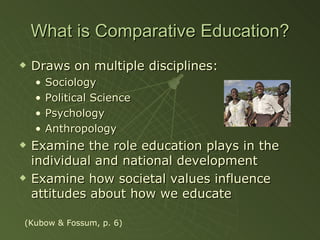
What is Comparative Education? Draws on multiple disciplines: Sociology Political Science Psychology Anthropology Examine the role education plays in the individual and national development Examine how societal values influence attitudes about how we educate (Kubow & Fossum, p. 6)
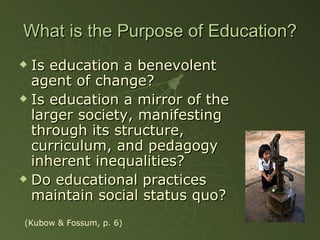
What is the Purpose of Education? Is education a benevolent agent of change? Is education a mirror of the larger society, manifesting through its structure, curriculum, and pedagogy inherent inequalities? Do educational practices maintain social status quo? (Kubow & Fossum, p. 6)
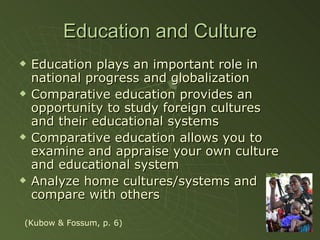
Education and Culture Education plays an important role in national progress and globalization Comparative education provides an opportunity to study foreign cultures and their educational systems Comparative education allows you to examine and appraise your own culture and educational system Analyze home cultures/systems and compare with others (Kubow & Fossum, p. 6)
Comparative Education as a Field Comparative education is a  field  – not a discipline Discipline dedicated to a specific set of rules and standards Field draws on varous disciplines to understand the complexity Extends and deepens our understanding of the world Helps educators decide What issues are important? What factors should be considered to improve education? (Kubow & Fossum, p. 7)
Historical Stages of Development Travelers’ tales – observatons of cultural practices and customs Educational borrowing – 19 th  Century Observations of foreign school systems  Identify useful techniques/practices Systematic scientific study – 20 th  Century  Examine forces shaping foreign educational systems Use quantitative methods to explain education Period of international cooperation – today Necessary for world harmony Improve the quality of citizens’ lives (Kubow & Fossum, p. 9)
A Multidisciplinary Field of Inquiry Anthropology concept of culture How do cultural values of ethnically diverse students mediate against the dominant values within the school? Sociology  - group affiliation and subcultures, social norms and mores How do the conformists differ from non-conformists in a school setting? Political science  Which student groups are in power and which ones are not? (Kubow & Fossum, pp. 19-20)
A Multidisciplinary Field of Inquiry Philosophical commitment to school and society How does schooling develop democratic values and allow student participation? Economic perspective – class, markets, human resources How do schools prepare students for work and financial reward? Historical - interpreting the past How have schools changed? Psychology – mind-sets and values of society How do we counteract school violence? (Kubow & Fossum, pp. 19-20)
Perspectives Interpretive Focus on concepts and theories Explain educational phenomena by considering cultural, philosophical, and historical context Normative Examine differing value positions Develop own values about education Critical Develop ability to question contradictions and inconsistencies in educational beliefs, policies, and practices. (Kubow & Fossum, p. 21)
Issues Approach Group projects for this course will be based on issues/tensions/dilemmas presented in the Kubow & Fossum Issues Addressed in Textbook Purpose of Schooling Educational Access and Opportunity Education Accountability and authority Teacher Professionalism (Kubow & Fossum, pp. 22-23)
Comparative Perspective Taking Expand understanding beyond own localized perspective Cross-cultural investigation Make sense out of the new or unknown by comparing to own frame of reference Multiple interpretation of the issues Avoid dichotomous thinking Widen conceptual lenses Develop the critical thinking skills of a global citizen Systematic critique and reflection must accompany curiousity (Kubow & Fossum, pp. 26-27)
Value of Comparative Education Alerts students to enduring social questions Helps teachers function as citizens of the U.S. as well as citizens of a global society Encourage a sprit of exploration transcending local boundaries Awareness that educators in different parts of the world are wrestling with similar issues Educators are part of a global professional community (Kubow & Fossum, pp. 26-27)
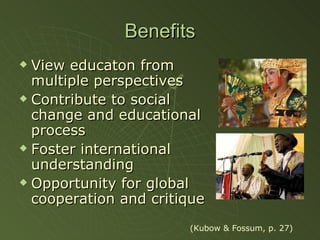
Benefits View educaton from multiple perspectives Contribute to social change and educational process Foster international understanding Opportunity for global cooperation and critique (Kubow & Fossum, p. 27)