eMÖTiÔN
PRESENTED BY:-SHUBHAM GUPTA
NISHANK VERMA
1
History
▶ Aristotle:- People are THINKING ANIMAL. What make people special
isthey can overcome theirbrutishemotions.
▶ Rousseau:- Emotions are what makes people special and gives us a
reason for living.
▶ Hippocrates:- Brain is the site of emotion.
2
Emotion
▶ The word emotion derived from the Latin word EMOVERE which
means to strip up to get agitated.
▶ It is a stirred-up state caused by physiological changes occurring
as a response to some event and which tends to maintain or
abolish the causative events.
▶ Complex feeling state with psychic, somatic and behavioral
components; external manifestations of which is affect.
3
DEFINITION OF eMOTION
▶ Emotion is a complex psychological
phenomenon which occurs as animals or
people live theirlives.
▶ It is I
ntense feeling that are directed at
someone or something.
4
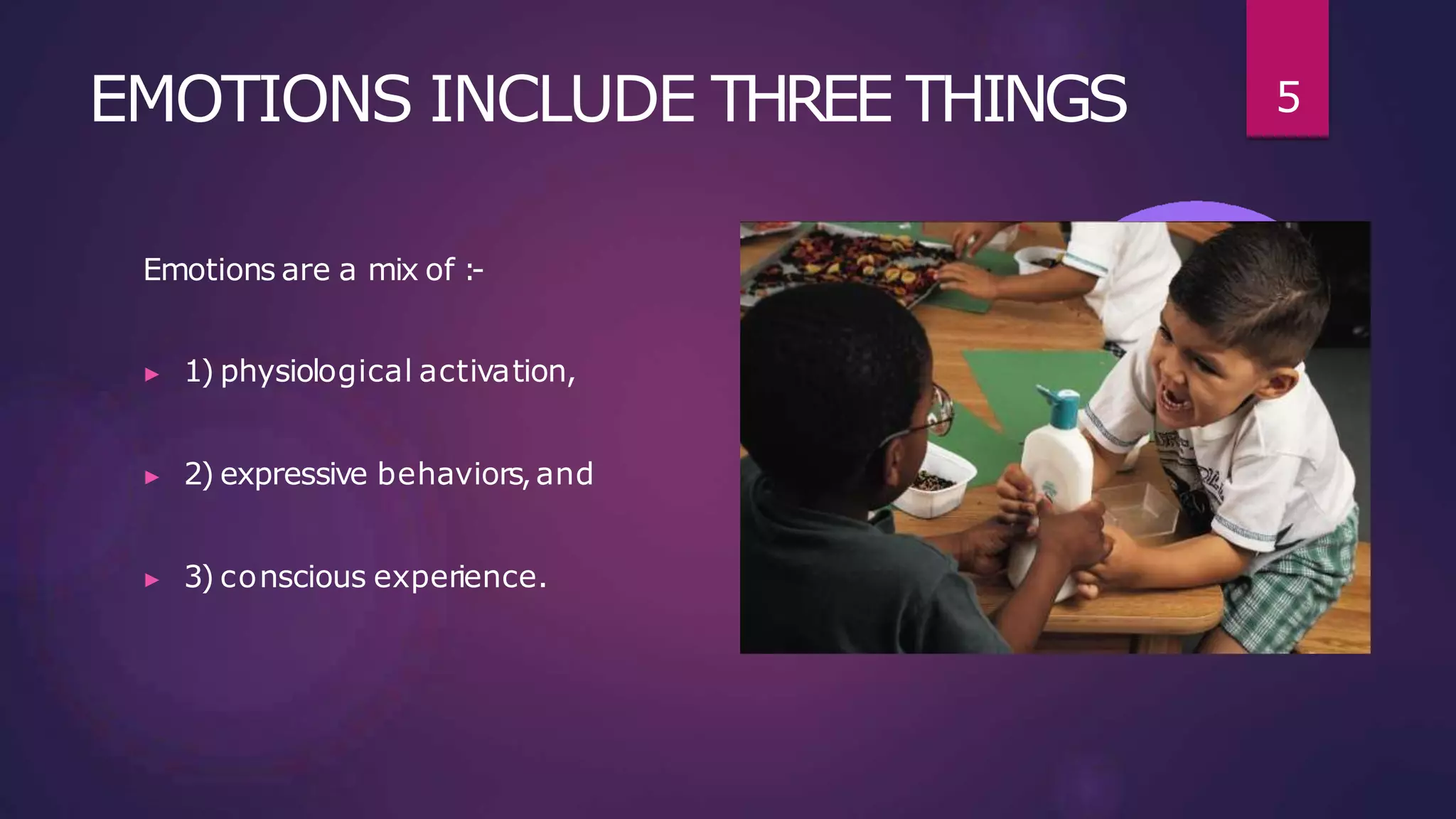
EMOTIONS INCLUDE THREE THINGS
Emotions are a mix of :-
▶ 1) physiological activation,
▶ 2) expressive behaviors,and
▶ 3) conscious experience.
5
EMOTION ISASSOCIATED WITH
▶ MOOD
▶ TEMPERAMENT
▶ PERSONALITY
▶ DISPOSITION
▶ MOTIVATION
6
Overview of Emotion
Emotion have two components:
▶ Mental
▶ Physical
Emotion involves:
 Cognition:- an awarenessof the sensation.
 Affect:-the feeling itself.
 Conation:- the urge to take action.
 Physical changes:- hypertension, tachycardia & sweating.
7
8
Emotion
Cognition
Affect
Physical
Changes
Conation
Characteristics of Emotions
▶ Emotions are accompanied by both physiological and
cognitive changes.
▶ Emotions are valanced, that is, they are either positive or
negative.
▶ Emotions influence behavior
.
9
Basic Emotions
▶ Ekman's findings have led some to propose that there are a set of
basic emotions that are shared cross culturally and that combine to
make up more complex emotions.
Basic Emotions
 Happiness
 Sadness
 Fear
 Anger
 Surprise
 Disgust
There can be combined to yield more complex emotions like-
1.anger +disgust +contempt
2.sadness+surprise +disappointment.
10
Classification of Emotions
▶ Primary emotion
▶ Secondary emotion
▶ Tertiary emotions
11
12
13
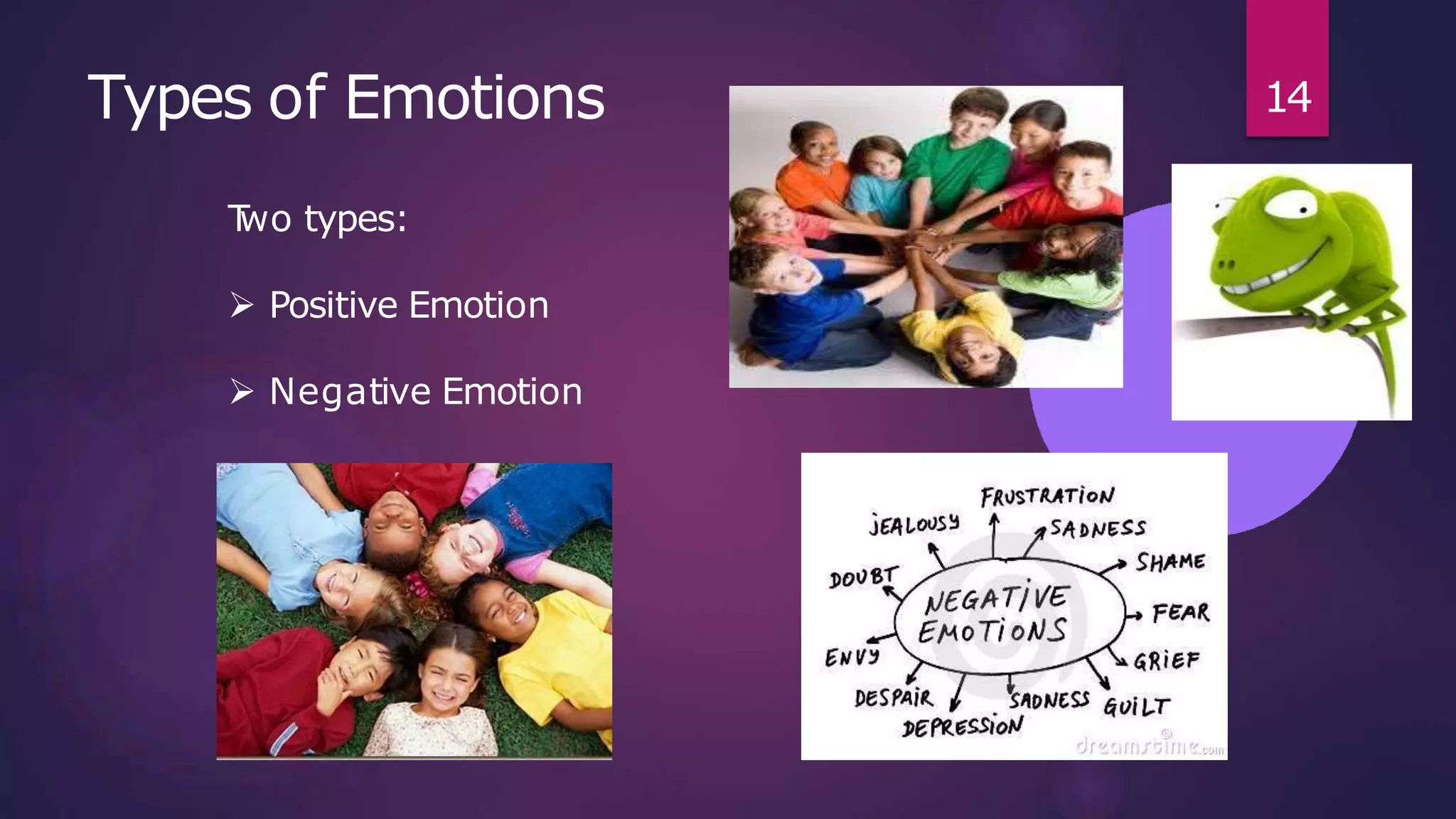
Types of Emotions
T
wo types:
 Positive Emotion
 Negative Emotion
14
Theoriesof Emotion
▶ Cannon-Bard T
heory
▶ James-Lange T
heory
▶ Schachter-Singer T
heory
( Two-Factor Theory )
▶ Opponent Process T
heory
▶ Facial feedback Hypothesis
▶ Emotional set point T
heory
15
Cannon-Bard Theory
Walter B. Cannon and
Phillip Bard
questioned the James-
Lange Theory and
proposed that an
emotion-triggering
stimulus and the
body's arousal take
place simultaneously.
1871-1945
1898-1977
16
James-Lange Theory
William James
(Eminence = 14th) and
Carl Lange proposed
an idea that was
diametrically opposed
to the common-sense
view. The James-Lange
Theory proposes that
physiological activity
precedes the emotional
experience.
1842-1910
1834 -1900
15
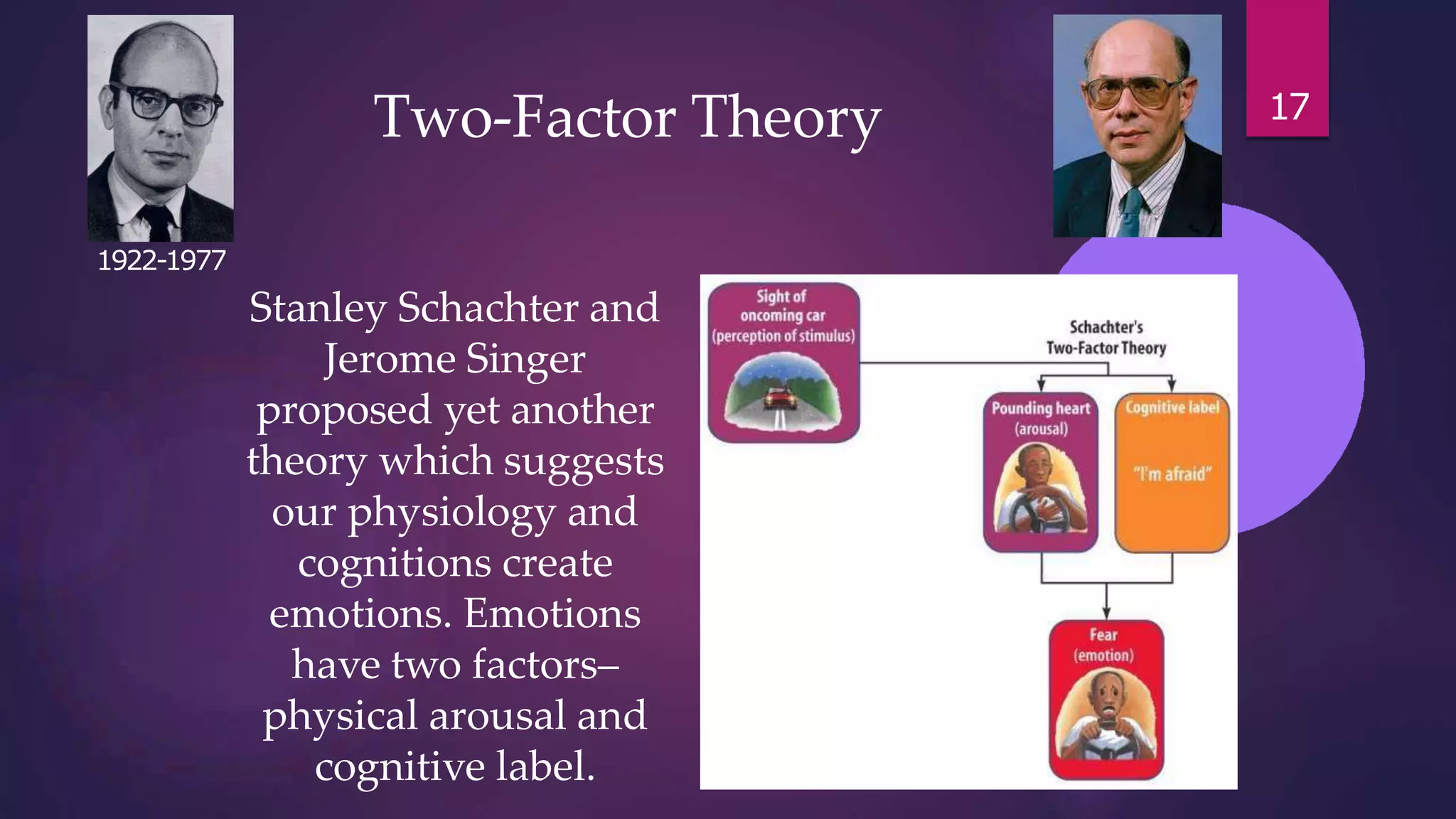
Two-Factor Theory
Stanley Schachter and
Jerome Singer
proposed yet another
theory which suggests
our physiology and
cognitions create
emotions. Emotions
have two factors–
physical arousal and
cognitive label.
1922-1977
17
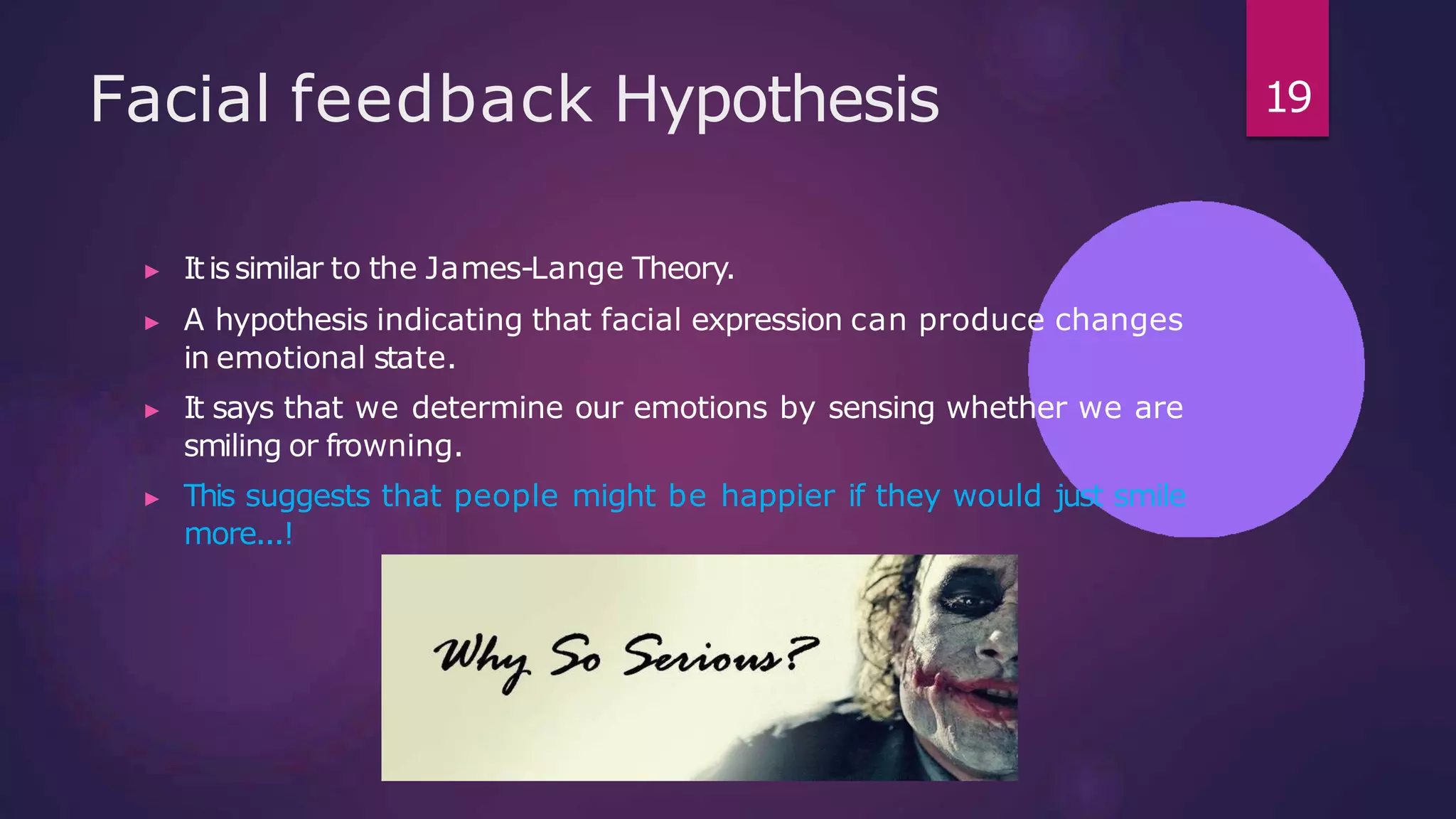
Facial feedback Hypothesis
▶ Itissimilar to the James-Lange Theory.
▶ A hypothesis indicating that facial expression can produce changes
in emotional state.
▶ It says that we determine our emotions by sensing whether we are
smiling or frowning.
▶ This suggests that people might be happier if they would just smile
more...!
19
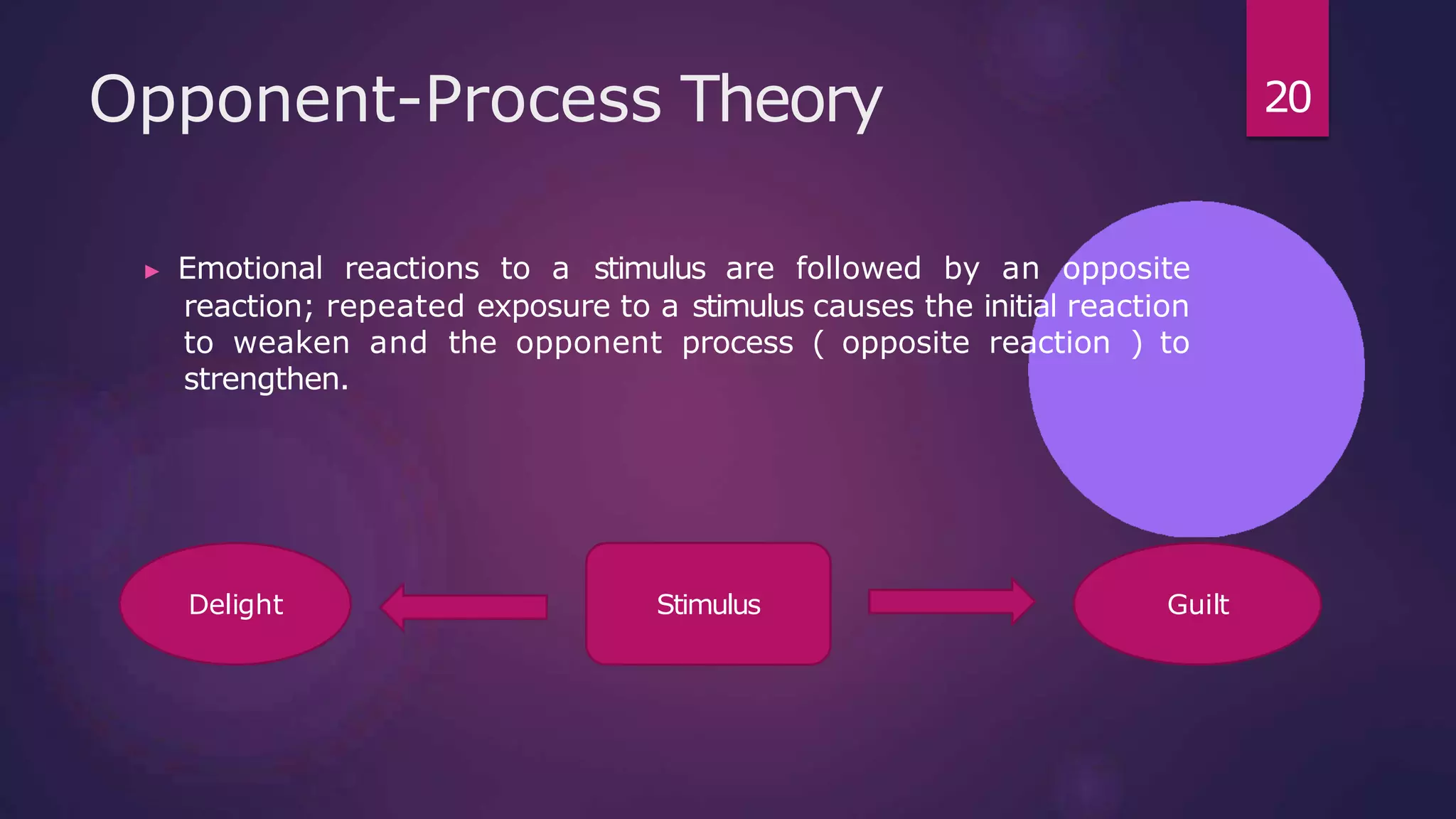
Opponent-Process Theory
▶ Emotional reactions to a stimulus are followed by an opposite
reaction; repeated exposure to a stimulus causes the initial reaction
to weaken and the opponent process ( opposite reaction ) to
strengthen.
20
Stimulus Guilt
Delight
Emotional Set Point Theory
▶ Some recent research has shown that how happy or unhappy you
are on average may not be a function of what happens to you.
▶ According to emotional set point theory our happiness is
determined by a Biological Set Point ( perhaps innate ) and
average happiness always returns to that set point.
21
Why does this occur ?
▶ Adaptation Level Principle: Emotions are relative to our current
state.
▶ Relative Deprivation Principle: Compare your state to those of others
in your social group.
▶ The pessimistic view of this finding: It does not matter what you do,
you are never going to be any happier with your life than you are
right now.
▶ The optimistic view of this finding: Happiness is more a matter to how
you feels events in your life than the events themselves. If you want
to be happier than you are now, you should change your outlook
on events.
22
The Biological Basis of Emotion
▶ Right cerebral hemisphere plays important role in emotional
functions. Right hemisphere is specialized for processing emotional
information.
▶ Activation of the left cerebral hemisphere is associated with positive
affect.
▶ Activation of the right cerebral hemisphere is associated with
negative affect.
▶ Activation of anterior portion of both hemisphere is associated with
Valence (pleasantness/unpleasantness) of emotion.
▶ Activation of the posterior portion of both hemisphere is associated
with Arousal-the intensity of emotion.
23
Emotional Processing & The Brain
Modern affective neuroscience focuses on the four brain regions in the
regulation normal emotion:-
▶ The Prefrontal Cortex
▶ The Anterior Cingulate Cortex (ACC)
▶ The Hippocampus
▶ The Amygdala.
24
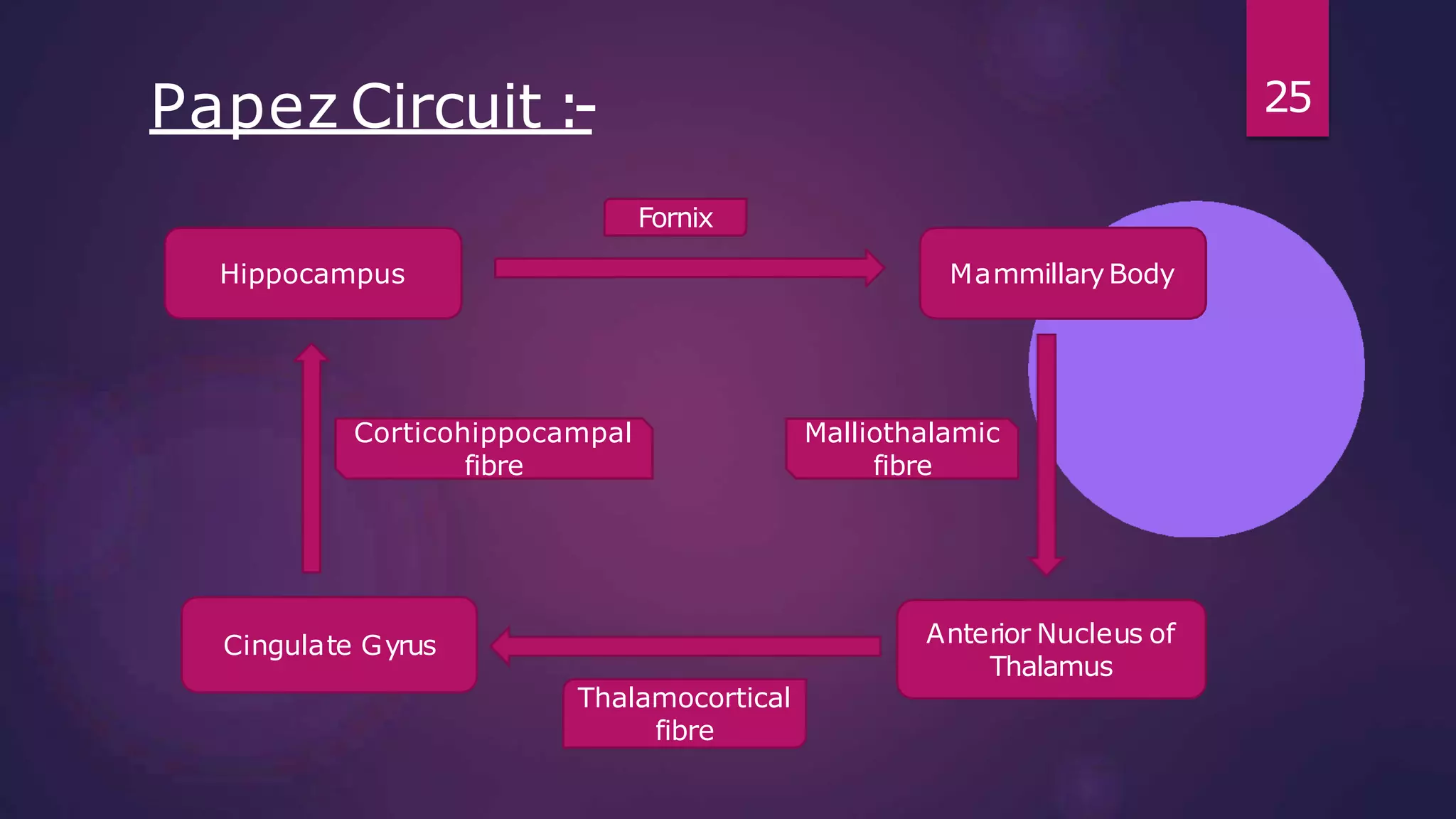
25
Papez Circuit :-
Hippocampus MammillaryBody
Cingulate Gyrus Anterior Nucleus of
Thalamus
Fornix
Thalamocortical
fibre
Malliothalamic
fibre
Corticohippocampal
fibre
Factors Affecting Emotions
▶ Genetic
▶ Cognition
▶ Memory
▶ External Stimuli
▶ Health
▶ Circadian Rhythm
▶ Meditation.
26
Polygraphy
▶ Measure physiological responses of the autonomic nervous system
in an attempt to detect the feelings of anxiety that often
accompany deception.
Typesof polygraphy :-
▶ Guilty/ innocent Test
▶ Control Question T
est
▶ Guilty Knowledge Test
27
Expressed Emotion
▶ Emotions are expressed on the face, by the body, and
by the intonation of voice. Is this nonverbal language of
emotion universal?
28
Detecting Emotion
▶ Most of us are good at deciphering emotions through
nonverbal communication. In a crowd of faces a single
angry face will “pop out” faster than a single happy
face (Fox et al, 2000).
29
Detecting Emotion
▶ Hard-to-control facial muscles reveal signs of emotions you may be
trying to conceal. A feigned smile may continue for more than 4-5
seconds while a genuine smile will have faded by then.
30
Which of Paul Ekman’ssmilesisgenuine?
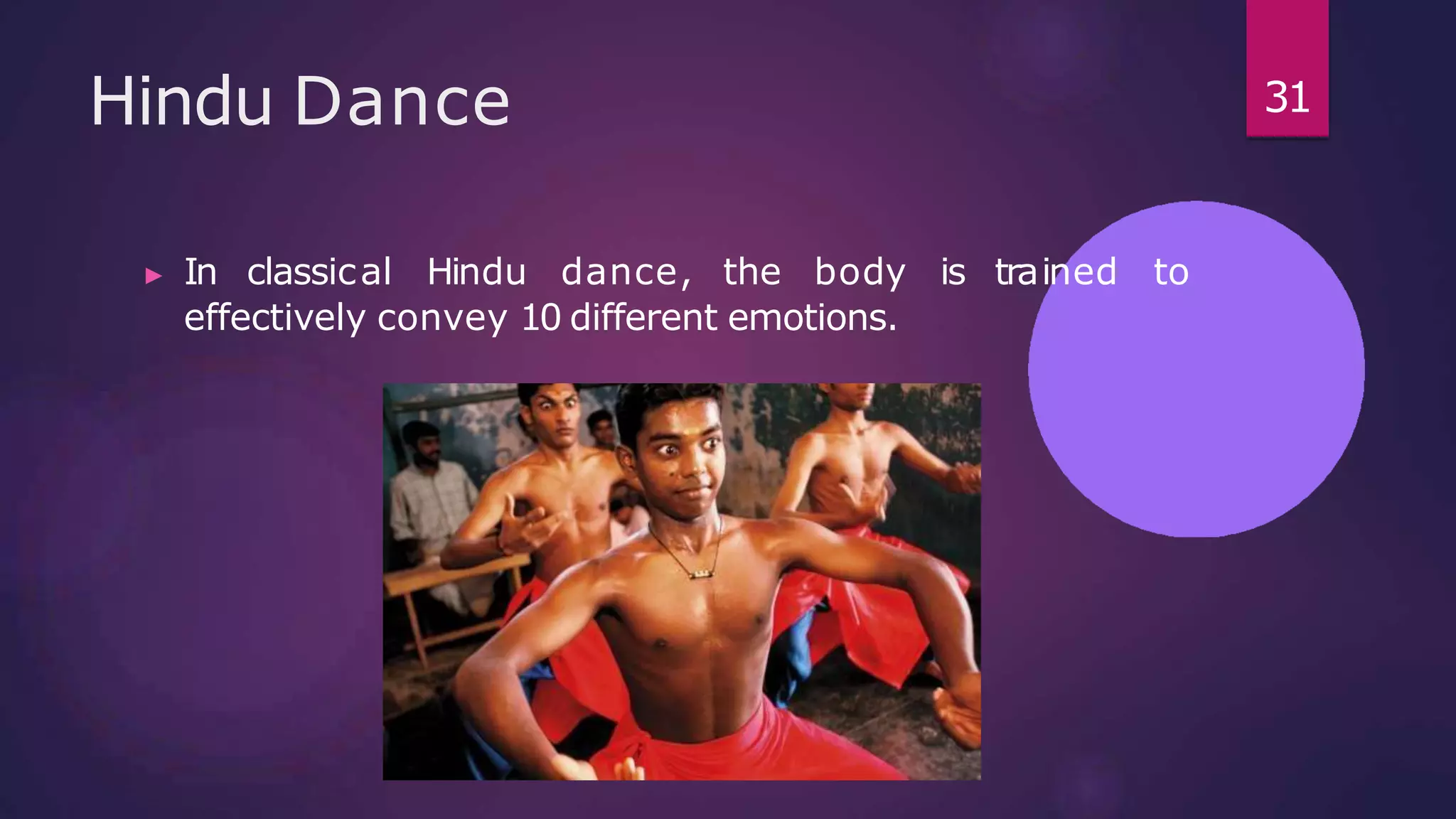
Hindu Dance
▶ In classical Hindu dance, the body is trained to
effectively convey 10 different emotions.
31
Emotions are Adaptive
Darwin speculated
that our ancestors
communicated with
facial expressions in
the absence of
language.
Nonverbal facial
expressions led to
our ancestor’s
survival.
Charles Darwin (1809-1882)
32
Analyzing Emotion
Analysis of emotions are carried on different levels.
33
HOW TO CONTROL
YOUR EMOTION..?
34
Method 1: Taking Physical Actions
▶ 1. Control your breathing
▶ 2. Keep your head up
▶ 3. Use assertive body language
▶ 4. Get some exercise
▶ 5. Take a break
▶ 6. Meditate
▶ 7. Practice mindfulnessmeditation
▶ 8. Practice progressive muscle relaxation.
35
Method 2: Reframing Your Feelings
▶ 1. Learn to recognize your emotional stimuli
▶ 2. Repeat self-calming statements
▶ 3. Find something funny orsilly in your situation
▶ 4. Set small goals
▶ 5. Savour the good thingsin your life
▶ 6. Speak kindly to yourself
▶ 7. Refrain from judging yourself
▶ 8. Reject perfectionism
▶ 9. Talk about how you feel
▶ 10. Consider talking with a counsellor or therapist.
36
Method 3:Reworking Your Thinking
▶ 1. Look ahead
▶ 2. Stop fighting your emotions
▶ 3. Change the story
▶ 4. Examine what you’re actually reacting to
▶ 5. Challenge negative thoughtsby reframing them productively.
37
Method 4:Fighting Distorted Ways
of Thinking
▶ 1. Learn to recognize cognitive distortions
▶ 2. Challenge “filtering”
▶ 3. Challenge “catastrophizing”
▶ 4. Challenge “personalization”
▶ 5. Challenge “overgeneralization”.
38
Method 5: Understanding Your
Emotions
▶ 1. Understand how emotions work
▶ 2. Consider whether past experiences are affecting you now
▶ 3. Be aware of “emotional contagion”
▶ 4. Determine your emotional needs
▶ 5. T
ry STOPP-ing.
39
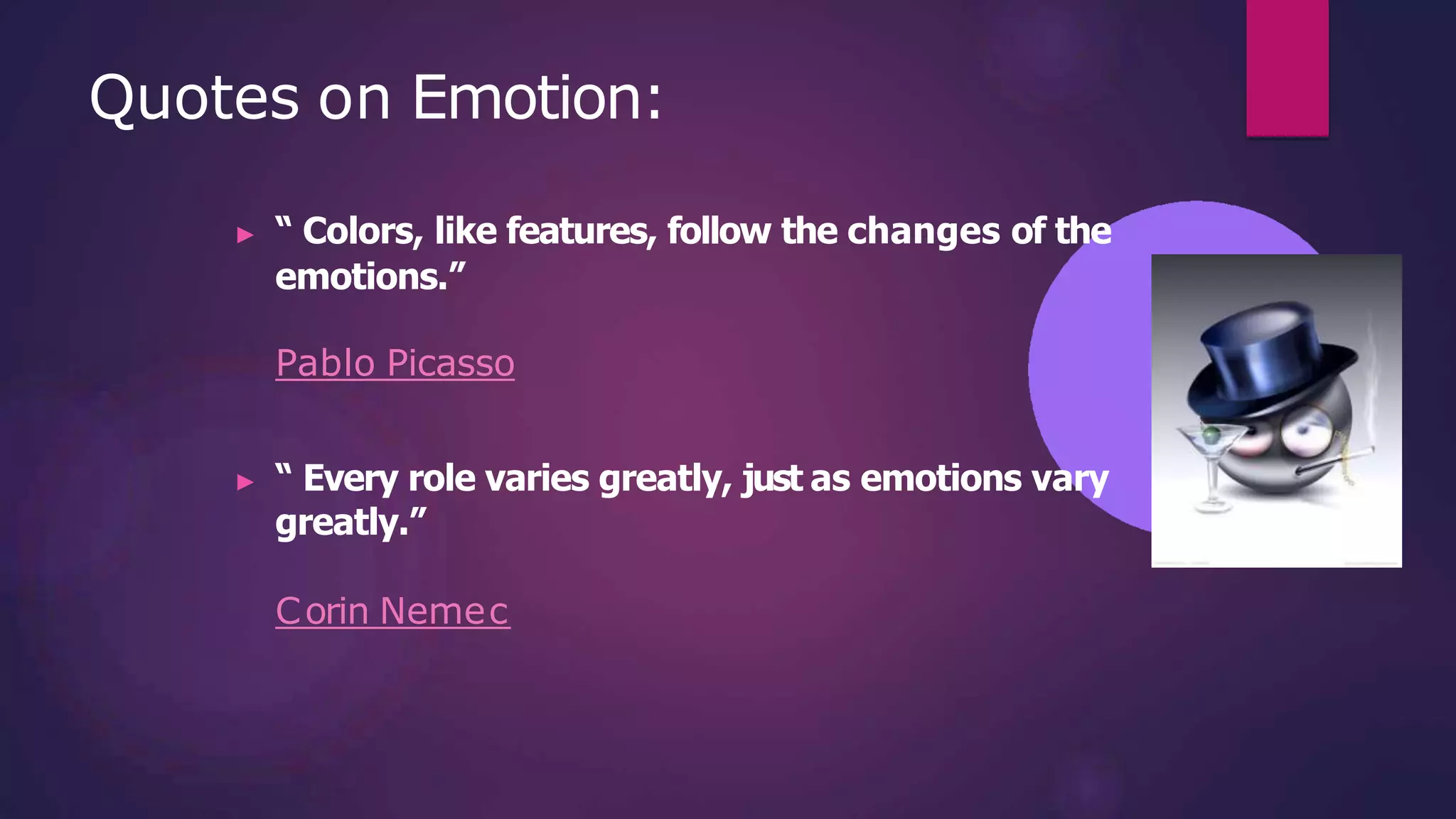
Quotes on Emotion:
▶ “ Colors, like features, follow the changes of the
emotions.”
Pablo Picasso
▶ “ Every role varies greatly, just as emotions vary
greatly.”
Corin Nemec
Thank You…!
41

emotion

  • 1.
  • 2.
    History ▶ Aristotle:- Peopleare THINKING ANIMAL. What make people special isthey can overcome theirbrutishemotions. ▶ Rousseau:- Emotions are what makes people special and gives us a reason for living. ▶ Hippocrates:- Brain is the site of emotion. 2
  • 3.
    Emotion ▶ The wordemotion derived from the Latin word EMOVERE which means to strip up to get agitated. ▶ It is a stirred-up state caused by physiological changes occurring as a response to some event and which tends to maintain or abolish the causative events. ▶ Complex feeling state with psychic, somatic and behavioral components; external manifestations of which is affect. 3
  • 4.
    DEFINITION OF eMOTION ▶Emotion is a complex psychological phenomenon which occurs as animals or people live theirlives. ▶ It is I ntense feeling that are directed at someone or something. 4
  • 5.
    EMOTIONS INCLUDE THREETHINGS Emotions are a mix of :- ▶ 1) physiological activation, ▶ 2) expressive behaviors,and ▶ 3) conscious experience. 5
  • 6.
    EMOTION ISASSOCIATED WITH ▶MOOD ▶ TEMPERAMENT ▶ PERSONALITY ▶ DISPOSITION ▶ MOTIVATION 6
  • 7.
    Overview of Emotion Emotionhave two components: ▶ Mental ▶ Physical Emotion involves:  Cognition:- an awarenessof the sensation.  Affect:-the feeling itself.  Conation:- the urge to take action.  Physical changes:- hypertension, tachycardia & sweating. 7
  • 8.
  • 9.
    Characteristics of Emotions ▶Emotions are accompanied by both physiological and cognitive changes. ▶ Emotions are valanced, that is, they are either positive or negative. ▶ Emotions influence behavior . 9
  • 10.
    Basic Emotions ▶ Ekman'sfindings have led some to propose that there are a set of basic emotions that are shared cross culturally and that combine to make up more complex emotions. Basic Emotions  Happiness  Sadness  Fear  Anger  Surprise  Disgust There can be combined to yield more complex emotions like- 1.anger +disgust +contempt 2.sadness+surprise +disappointment. 10
  • 11.
    Classification of Emotions ▶Primary emotion ▶ Secondary emotion ▶ Tertiary emotions 11
  • 12.
  • 13.
  • 14.
    Types of Emotions T wotypes:  Positive Emotion  Negative Emotion 14
  • 15.
    Theoriesof Emotion ▶ Cannon-BardT heory ▶ James-Lange T heory ▶ Schachter-Singer T heory ( Two-Factor Theory ) ▶ Opponent Process T heory ▶ Facial feedback Hypothesis ▶ Emotional set point T heory 15
  • 16.
    Cannon-Bard Theory Walter B.Cannon and Phillip Bard questioned the James- Lange Theory and proposed that an emotion-triggering stimulus and the body's arousal take place simultaneously. 1871-1945 1898-1977 16
  • 17.
    James-Lange Theory William James (Eminence= 14th) and Carl Lange proposed an idea that was diametrically opposed to the common-sense view. The James-Lange Theory proposes that physiological activity precedes the emotional experience. 1842-1910 1834 -1900 15
  • 18.
    Two-Factor Theory Stanley Schachterand Jerome Singer proposed yet another theory which suggests our physiology and cognitions create emotions. Emotions have two factors– physical arousal and cognitive label. 1922-1977 17
  • 19.
    Facial feedback Hypothesis ▶Itissimilar to the James-Lange Theory. ▶ A hypothesis indicating that facial expression can produce changes in emotional state. ▶ It says that we determine our emotions by sensing whether we are smiling or frowning. ▶ This suggests that people might be happier if they would just smile more...! 19
  • 20.
    Opponent-Process Theory ▶ Emotionalreactions to a stimulus are followed by an opposite reaction; repeated exposure to a stimulus causes the initial reaction to weaken and the opponent process ( opposite reaction ) to strengthen. 20 Stimulus Guilt Delight
  • 21.
    Emotional Set PointTheory ▶ Some recent research has shown that how happy or unhappy you are on average may not be a function of what happens to you. ▶ According to emotional set point theory our happiness is determined by a Biological Set Point ( perhaps innate ) and average happiness always returns to that set point. 21
  • 22.
    Why does thisoccur ? ▶ Adaptation Level Principle: Emotions are relative to our current state. ▶ Relative Deprivation Principle: Compare your state to those of others in your social group. ▶ The pessimistic view of this finding: It does not matter what you do, you are never going to be any happier with your life than you are right now. ▶ The optimistic view of this finding: Happiness is more a matter to how you feels events in your life than the events themselves. If you want to be happier than you are now, you should change your outlook on events. 22
  • 23.
    The Biological Basisof Emotion ▶ Right cerebral hemisphere plays important role in emotional functions. Right hemisphere is specialized for processing emotional information. ▶ Activation of the left cerebral hemisphere is associated with positive affect. ▶ Activation of the right cerebral hemisphere is associated with negative affect. ▶ Activation of anterior portion of both hemisphere is associated with Valence (pleasantness/unpleasantness) of emotion. ▶ Activation of the posterior portion of both hemisphere is associated with Arousal-the intensity of emotion. 23
  • 24.
    Emotional Processing &The Brain Modern affective neuroscience focuses on the four brain regions in the regulation normal emotion:- ▶ The Prefrontal Cortex ▶ The Anterior Cingulate Cortex (ACC) ▶ The Hippocampus ▶ The Amygdala. 24
  • 25.
    25 Papez Circuit :- HippocampusMammillaryBody Cingulate Gyrus Anterior Nucleus of Thalamus Fornix Thalamocortical fibre Malliothalamic fibre Corticohippocampal fibre
  • 26.
    Factors Affecting Emotions ▶Genetic ▶ Cognition ▶ Memory ▶ External Stimuli ▶ Health ▶ Circadian Rhythm ▶ Meditation. 26
  • 27.
    Polygraphy ▶ Measure physiologicalresponses of the autonomic nervous system in an attempt to detect the feelings of anxiety that often accompany deception. Typesof polygraphy :- ▶ Guilty/ innocent Test ▶ Control Question T est ▶ Guilty Knowledge Test 27
  • 28.
    Expressed Emotion ▶ Emotionsare expressed on the face, by the body, and by the intonation of voice. Is this nonverbal language of emotion universal? 28
  • 29.
    Detecting Emotion ▶ Mostof us are good at deciphering emotions through nonverbal communication. In a crowd of faces a single angry face will “pop out” faster than a single happy face (Fox et al, 2000). 29
  • 30.
    Detecting Emotion ▶ Hard-to-controlfacial muscles reveal signs of emotions you may be trying to conceal. A feigned smile may continue for more than 4-5 seconds while a genuine smile will have faded by then. 30 Which of Paul Ekman’ssmilesisgenuine?
  • 31.
    Hindu Dance ▶ Inclassical Hindu dance, the body is trained to effectively convey 10 different emotions. 31
  • 32.
    Emotions are Adaptive Darwinspeculated that our ancestors communicated with facial expressions in the absence of language. Nonverbal facial expressions led to our ancestor’s survival. Charles Darwin (1809-1882) 32
  • 33.
    Analyzing Emotion Analysis ofemotions are carried on different levels. 33
  • 34.
    HOW TO CONTROL YOUREMOTION..? 34
  • 35.
    Method 1: TakingPhysical Actions ▶ 1. Control your breathing ▶ 2. Keep your head up ▶ 3. Use assertive body language ▶ 4. Get some exercise ▶ 5. Take a break ▶ 6. Meditate ▶ 7. Practice mindfulnessmeditation ▶ 8. Practice progressive muscle relaxation. 35
  • 36.
    Method 2: ReframingYour Feelings ▶ 1. Learn to recognize your emotional stimuli ▶ 2. Repeat self-calming statements ▶ 3. Find something funny orsilly in your situation ▶ 4. Set small goals ▶ 5. Savour the good thingsin your life ▶ 6. Speak kindly to yourself ▶ 7. Refrain from judging yourself ▶ 8. Reject perfectionism ▶ 9. Talk about how you feel ▶ 10. Consider talking with a counsellor or therapist. 36
  • 37.
    Method 3:Reworking YourThinking ▶ 1. Look ahead ▶ 2. Stop fighting your emotions ▶ 3. Change the story ▶ 4. Examine what you’re actually reacting to ▶ 5. Challenge negative thoughtsby reframing them productively. 37
  • 38.
    Method 4:Fighting DistortedWays of Thinking ▶ 1. Learn to recognize cognitive distortions ▶ 2. Challenge “filtering” ▶ 3. Challenge “catastrophizing” ▶ 4. Challenge “personalization” ▶ 5. Challenge “overgeneralization”. 38
  • 39.
    Method 5: UnderstandingYour Emotions ▶ 1. Understand how emotions work ▶ 2. Consider whether past experiences are affecting you now ▶ 3. Be aware of “emotional contagion” ▶ 4. Determine your emotional needs ▶ 5. T ry STOPP-ing. 39
  • 40.
    Quotes on Emotion: ▶“ Colors, like features, follow the changes of the emotions.” Pablo Picasso ▶ “ Every role varies greatly, just as emotions vary greatly.” Corin Nemec
  • 41.