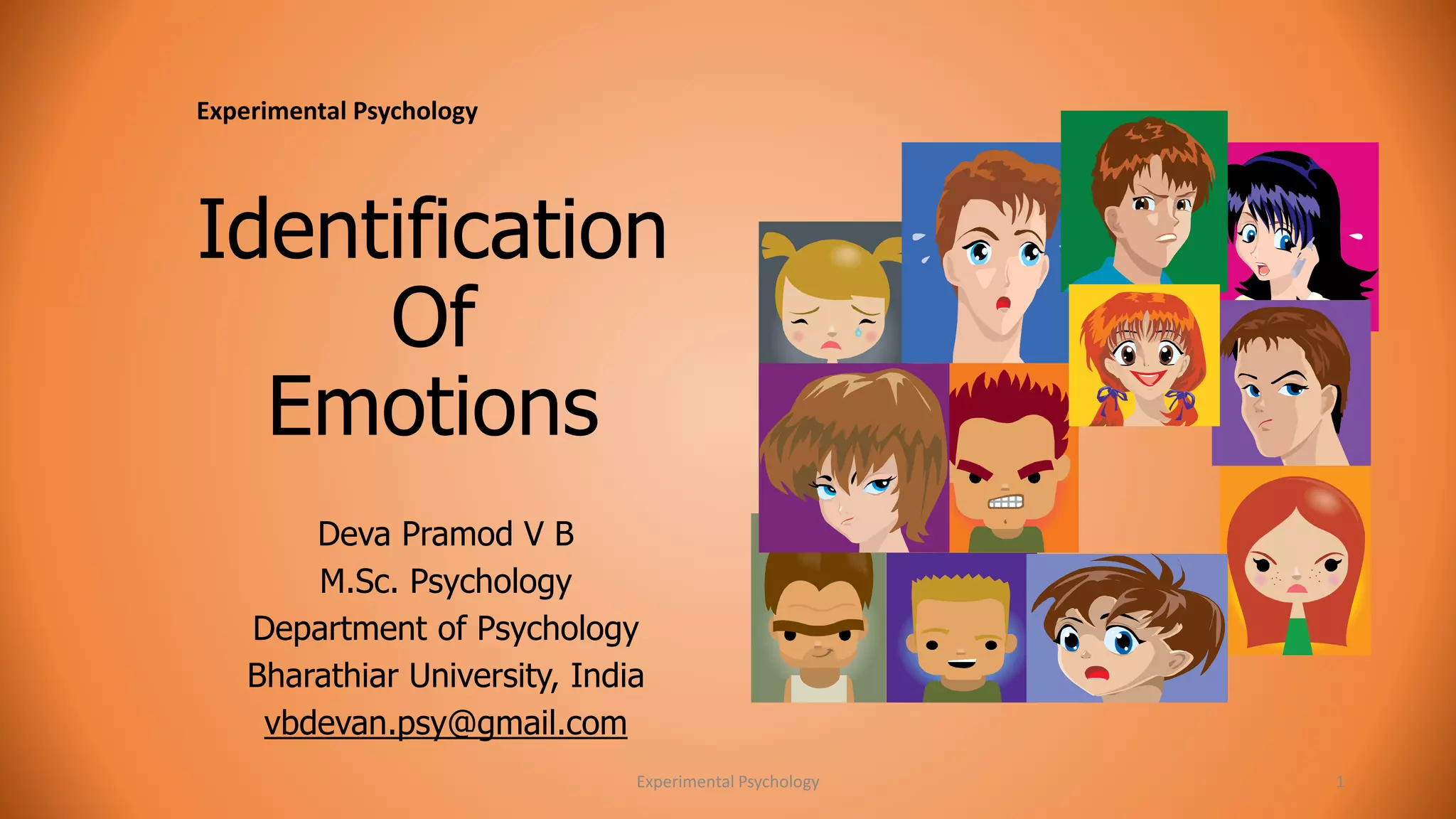
Identification 
Of 
Emotions 
Deva Pramod V B 
M.Sc. Psychology 
Department of Psychology 
Bharathiar University, India 
vbdevan.psy@gmail.com 
Experimental Psychology 1 
Experimental Psychology
Definition 
“feelings states that involve a pattern of cognitive, physiological 
and behavioural reactions to events.” 
"positive or negative experience that is associated with a 
particular pattern of physiological activity." 
Experimental Psychology 2
Nature of emotions 
• Emotions are triggered by external or internal eliciting stimuli. 
• Emotional responses result from our appraisal of these stimuli, 
• Our bodies respond physiologically to our appraisals. 
• Emotions include behavior tendencies. 
Experimental Psychology 3
The main characteristics of emotions are: 
• Every emotion is followed by physiological change such as rapid 
heartbeat, change in the pulse rate, change in blood pressure, and 
change in the facial expression, voice and body movements. 
• Emotion is accompanied by a feeling of pleasantness and 
unpleasantness, following physiological changes. 
• Emotions are subjective and purely individual. The same situation 
may evoke different emotions in different individuals. 
Experimental Psychology 4
• Emotions rise abruptly. The passing away of emotions is, however 
slow, leaving behind an emotional state which lasts for some time. 
• Emotions have swings. One emotion may give rise to another 
emotion and the two may get merged. 
• An emotion mostly raises when the organism faces a difficult 
situation or when the basic need is challenged or is not satisfied. In 
fact, a situation, real or imaginary, is always connected with an 
emotion. 
Experimental Psychology 5
• Emotion is a tripolar response having affective, cognitive and 
conative aspects. 
• Emotions have wide range and are not restricted to a particular 
age period. They occur to children, adolescents and adults. 
Experimental Psychology 6
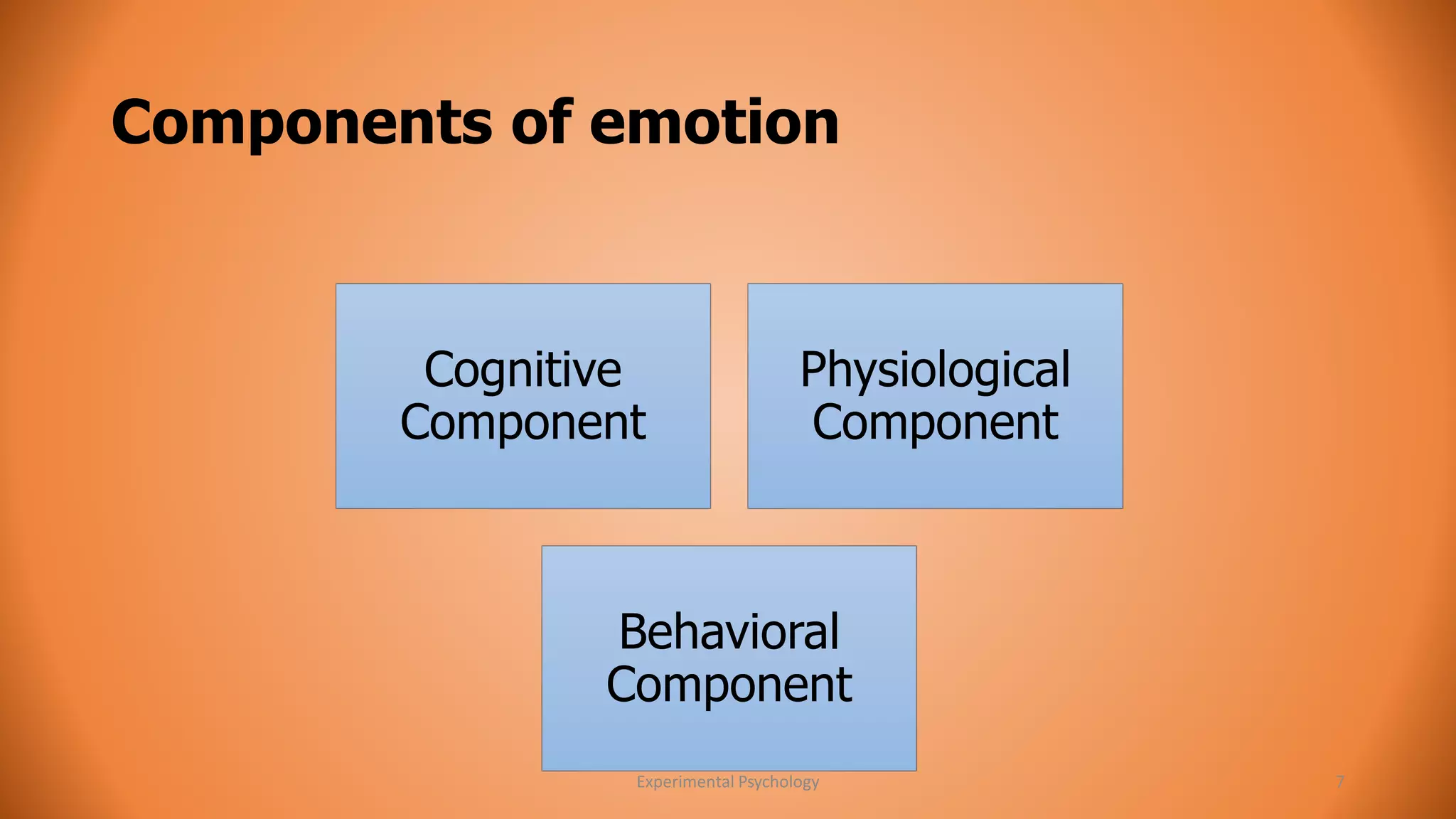
Components of emotion 
Cognitive 
Component 
Physiological 
Component 
Behavioral 
Component 
Experimental Psychology 7
• Eliciting Stimuli 
• Trigger cognitive appraisals and emotional responses. 
• The Cognitive Component 
• The interpretations and meanings that we attach to sensory stimuli. 
• Culture and Appraisal 
• The Physiological Component 
• Brain structures and neurotransmitters 
• Hemispheric activation and emotion 
• The Behavioral Component 
• Evolution and emotional expression 
• Facial expression of emotion 
• Cultural Display Rules 
Experimental Psychology 8
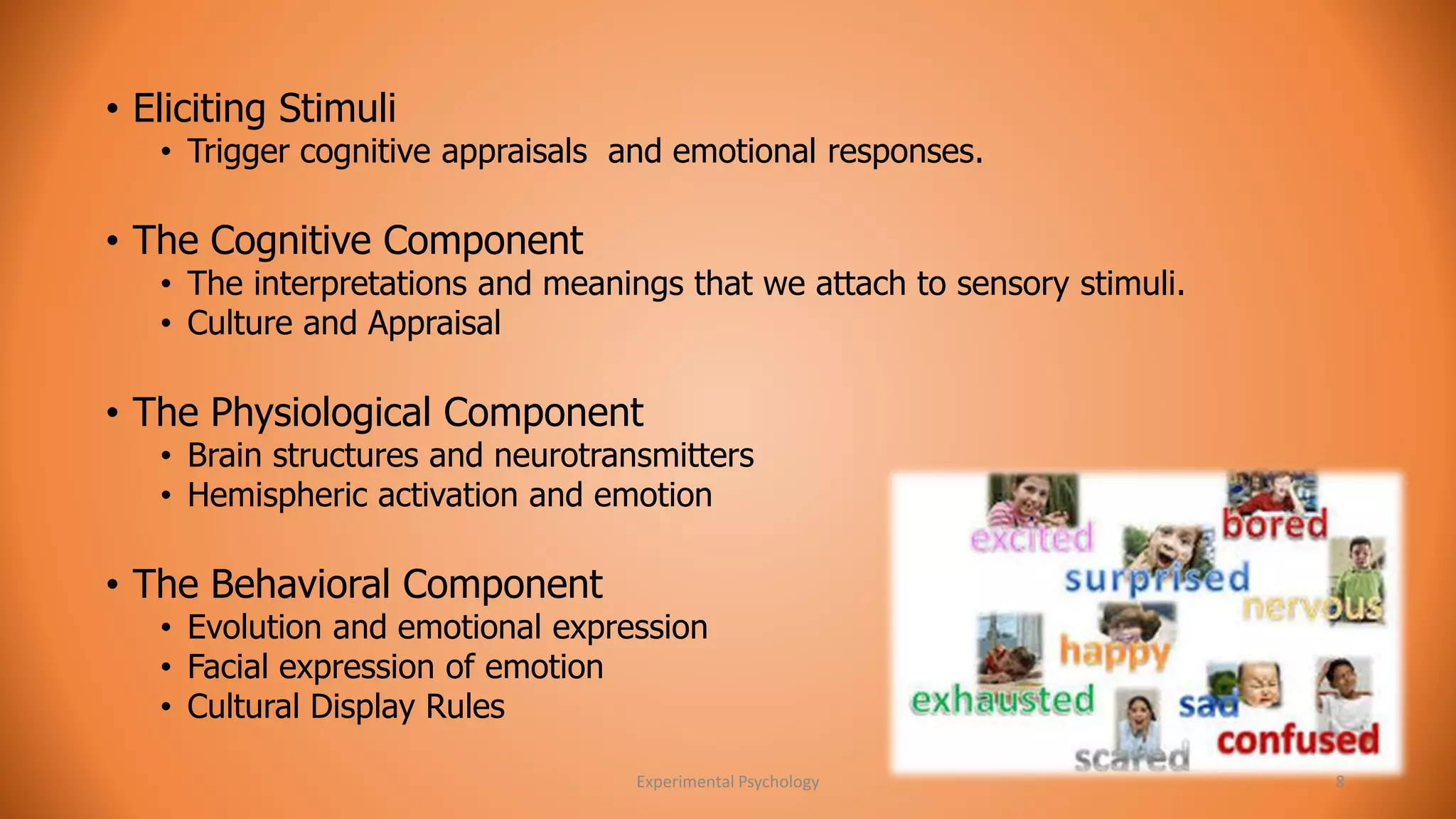
Primary Emotions 
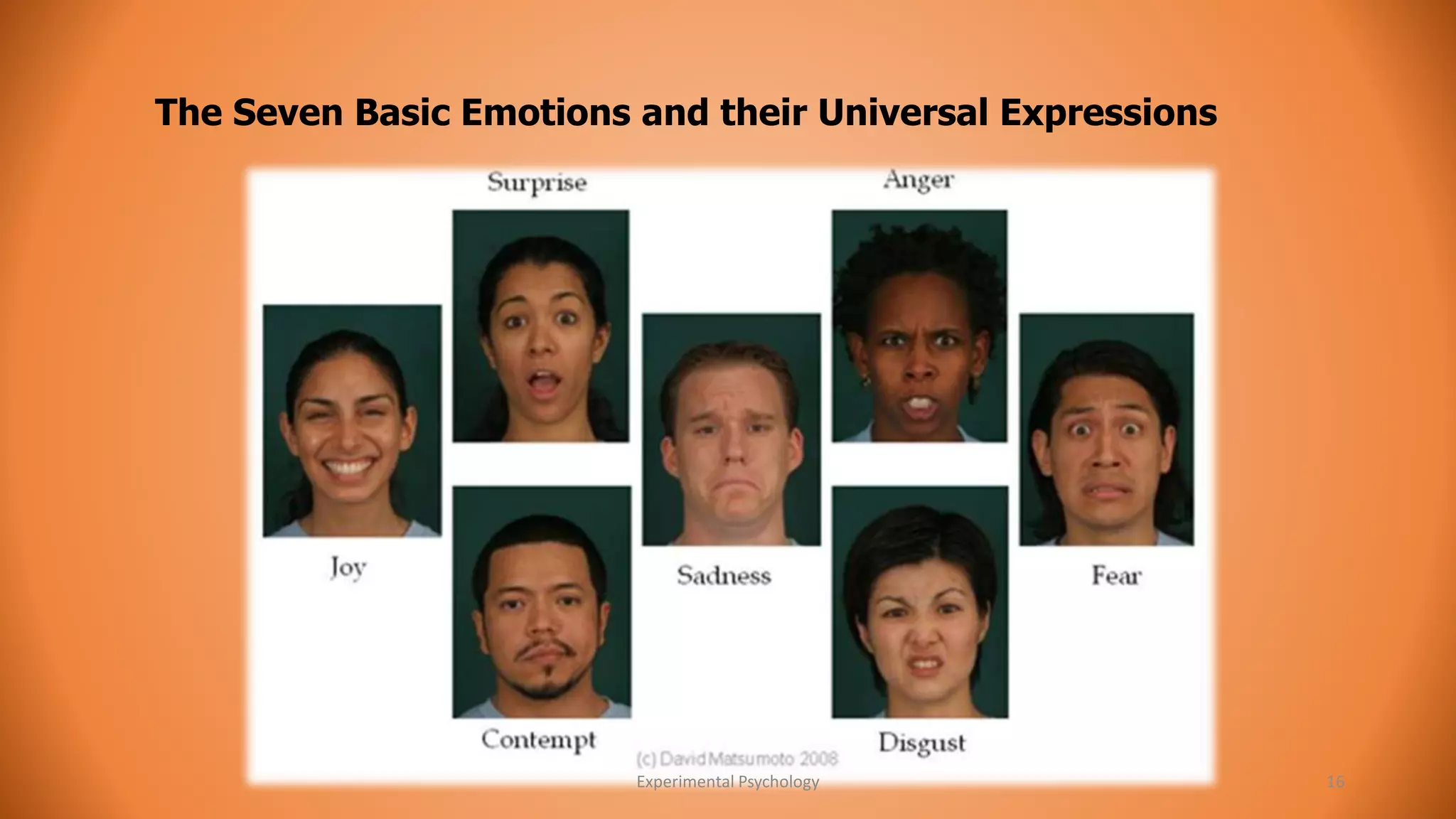
• The 6 photos of the previous slide makes the major Primary 
Emotions: Happy, Sad, Surprise, Fear, Disgust and Anger 
• Primary emotions are those that we feel first, as a first response to a 
situation. 
• Thus, if we are threatened, we may feel fear. When we hear of a 
death, we may feel sadness. They are unthinking, instinctive 
responses that Humans have. One would typically see these in 
animals also, which confirms the suspicion that they have an 
evolutionary basis. 
Experimental Psychology 9
Secondary Emotions 
• Secondary emotions appear after primary emotions. They trigger some other 
kind, for example where the fear of a threat turns to anger that fuels the body for 
a fight reaction. They may also come from more complex chains of thinking 
• Secondary emotions turn emotions into complex reactions. They increase the 
intensity of your reactions. Differentiating between primary and secondary 
emotions provides powerful coping skills 
• Some of these are triggered by thinking about what might happen, what might 
have happened, what did not happen, etc., unlike primary emotions which are 
triggered only by actual occurrences 
Experimental Psychology 10
Kinds of emotions (Secondary) 
• Positive emotions 
• Negative emotions 
Experimental Psychology 11
Positive Emotions 
• Secondary Emotions are divided into Positive and Negative 
Emotions. 
• Positive Emotions are, 
• Love 
• Confidence 
• Astonished 
• Gratitude 
• Patience 
• Appreciation 
• Trust 
• Enthusiasm 
• Optimistic 
• Vitality 
Experimental Psychology 12
Negative Emotions 
Negative Emotions are: 
• Guilt 
• Depression 
• Pride 
• Jealousy 
• Self Pity 
• Anxiety 
• Resentment 
• Envy 
• Frustration 
• Shame 
• Denial 
• Offended 
• Regret 
• Worry and Grief 
Experimental Psychology 13
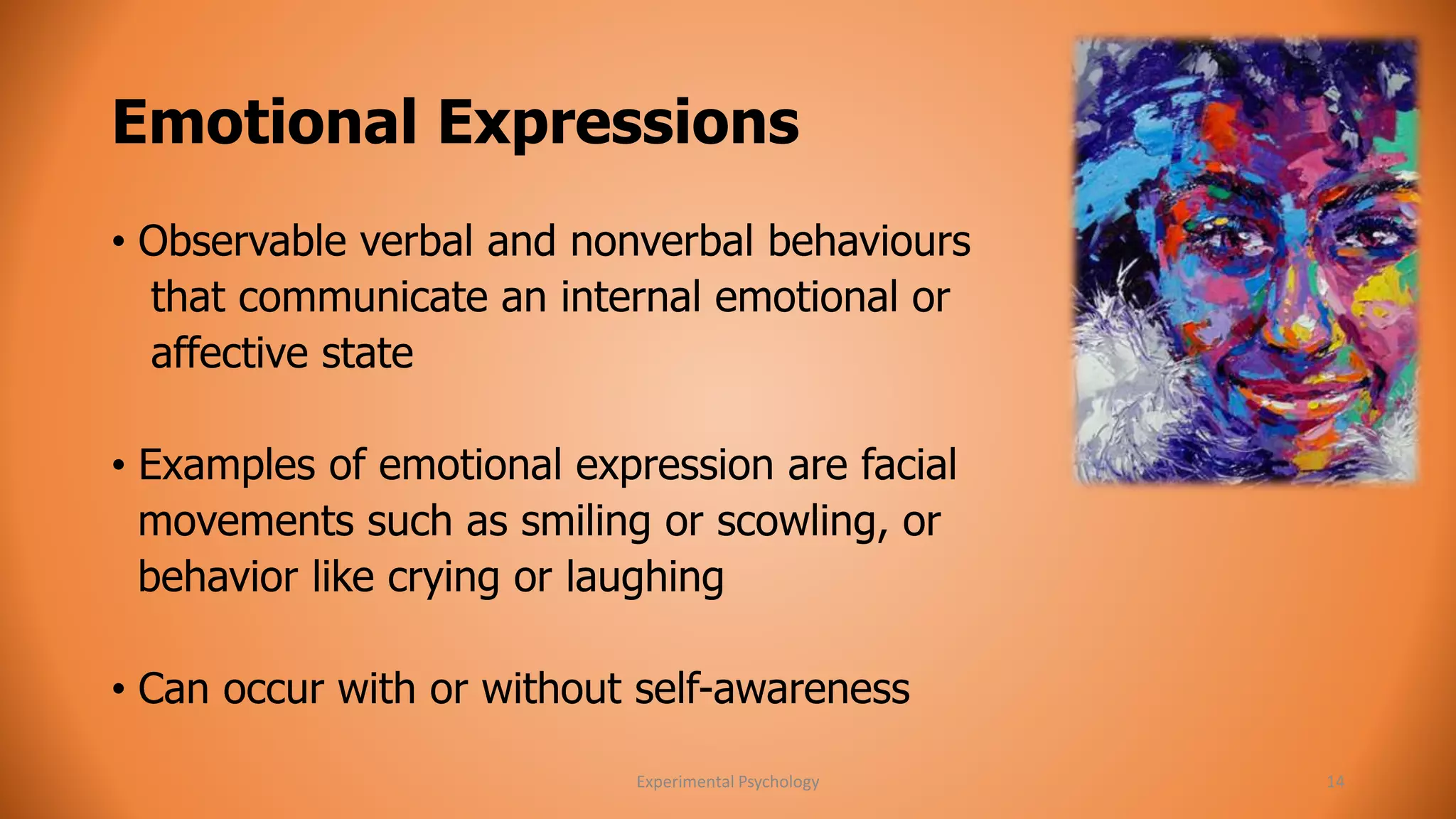
Emotional Expressions 
• Observable verbal and nonverbal behaviours 
that communicate an internal emotional or 
affective state 
• Examples of emotional expression are facial 
movements such as smiling or scowling, or 
behavior like crying or laughing 
• Can occur with or without self-awareness 
Experimental Psychology 14
Emotion and Facial Expression 
• The term "expression" implies the existence of something that 
is expressed 
• Facial expressions are associated with particular human 
emotions. 
Experimental Psychology 15
The Seven Basic Emotions and their Universal Expressions 
Experimental Psychology 16
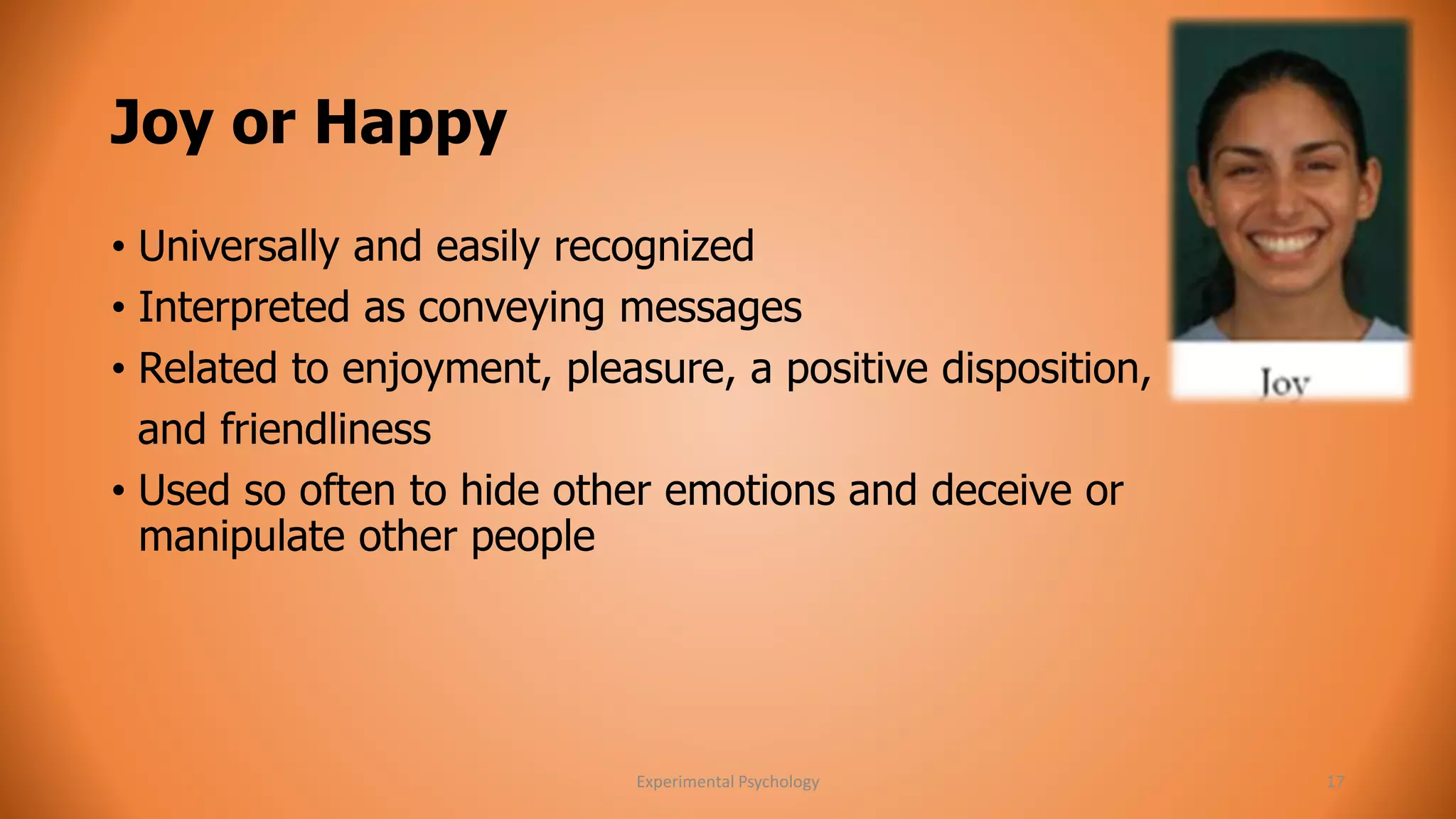
Joy or Happy 
• Universally and easily recognized 
• Interpreted as conveying messages 
• Related to enjoyment, pleasure, a positive disposition, 
and friendliness 
• Used so often to hide other emotions and deceive or 
manipulate other people 
Experimental Psychology 17
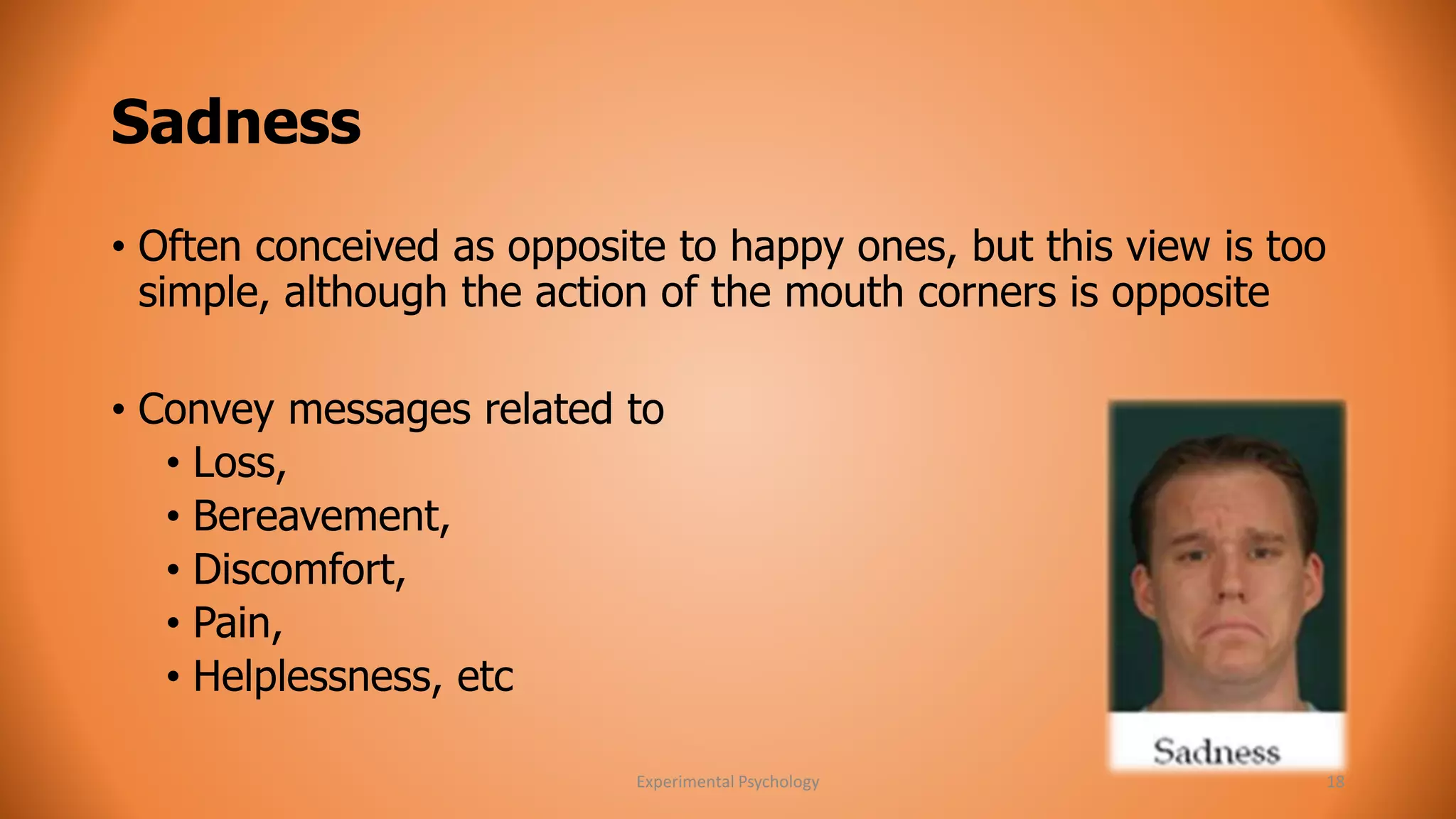
Sadness 
• Often conceived as opposite to happy ones, but this view is too 
simple, although the action of the mouth corners is opposite 
• Convey messages related to 
• Loss, 
• Bereavement, 
• Discomfort, 
• Pain, 
• Helplessness, etc 
Experimental Psychology 18
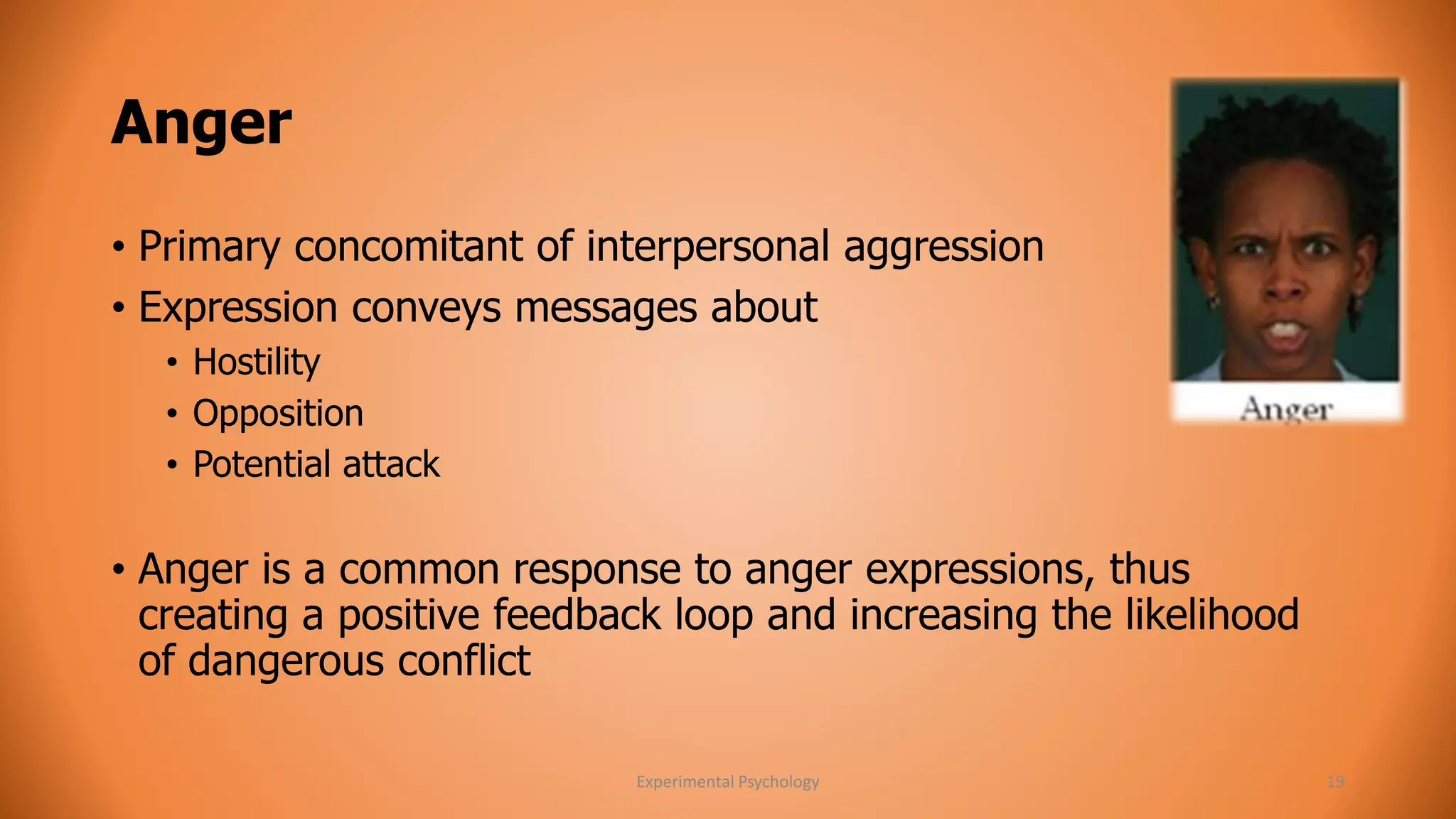
Anger 
• Primary concomitant of interpersonal aggression 
• Expression conveys messages about 
• Hostility 
• Opposition 
• Potential attack 
• Anger is a common response to anger expressions, thus 
creating a positive feedback loop and increasing the likelihood 
of dangerous conflict 
Experimental Psychology 19
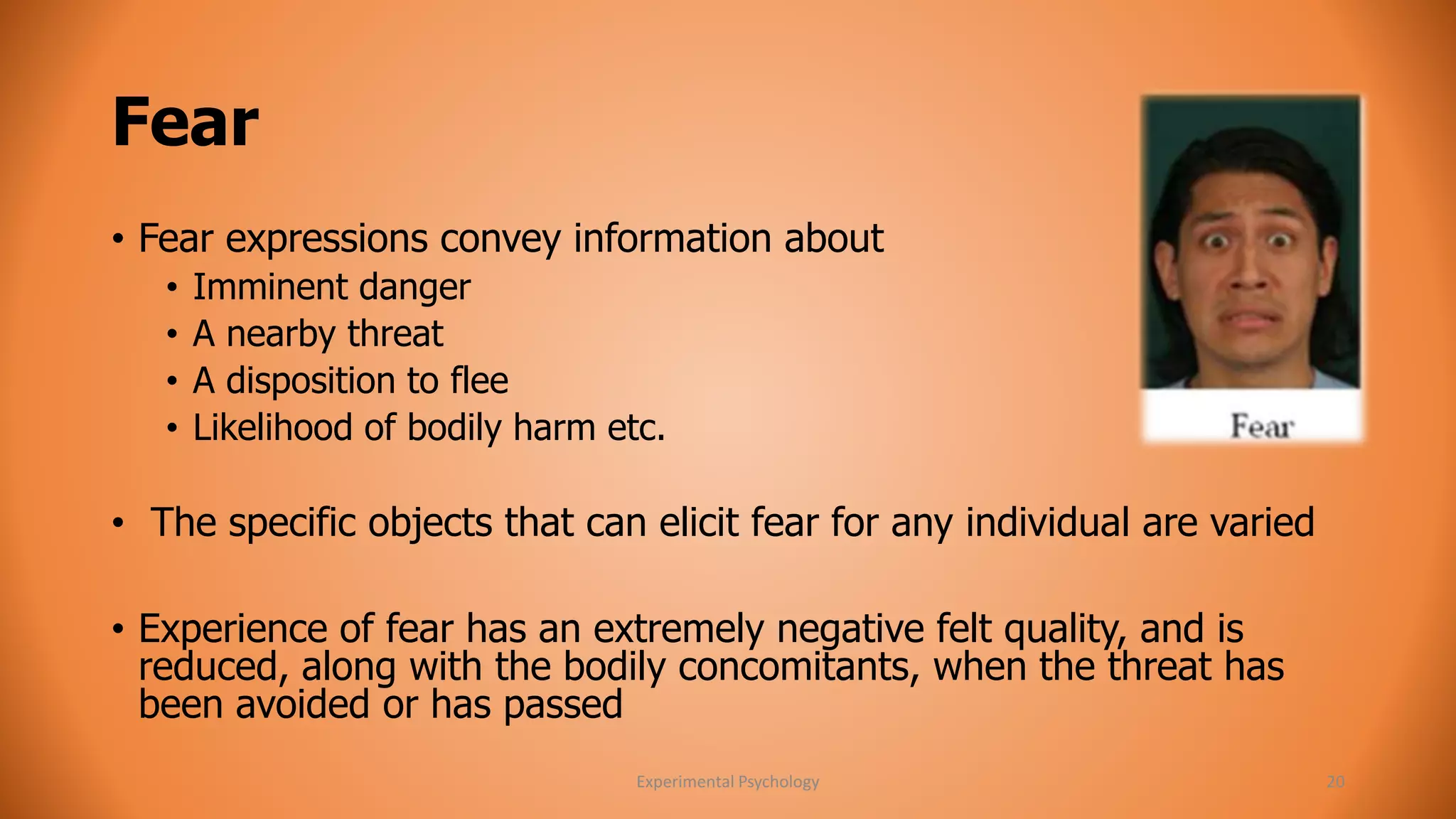
Fear 
• Fear expressions convey information about 
• Imminent danger 
• A nearby threat 
• A disposition to flee 
• Likelihood of bodily harm etc. 
• The specific objects that can elicit fear for any individual are varied 
• Experience of fear has an extremely negative felt quality, and is 
reduced, along with the bodily concomitants, when the threat has 
been avoided or has passed 
Experimental Psychology 20
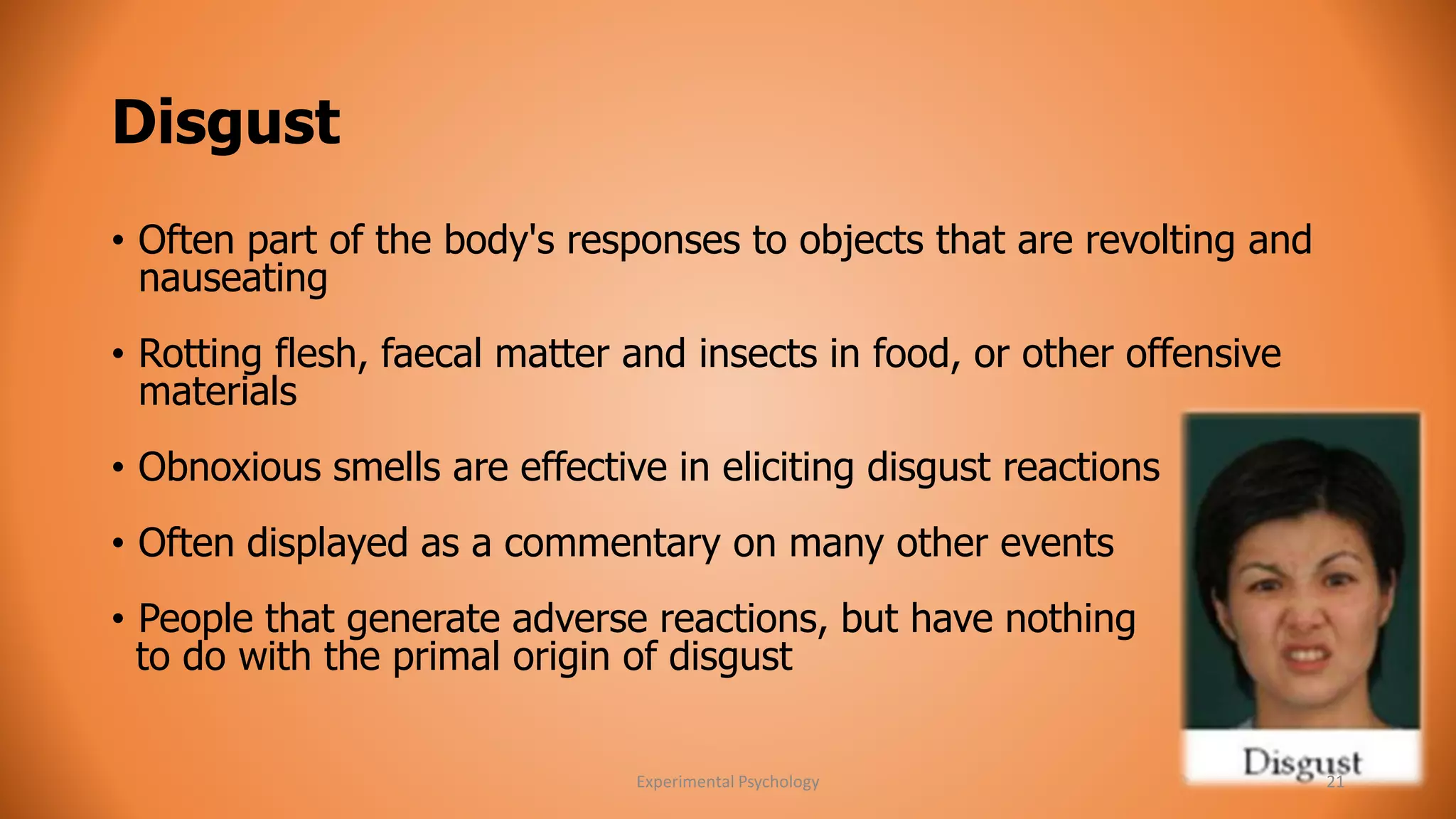
Disgust 
• Often part of the body's responses to objects that are revolting and 
nauseating 
• Rotting flesh, faecal matter and insects in food, or other offensive 
materials 
• Obnoxious smells are effective in eliciting disgust reactions 
• Often displayed as a commentary on many other events 
• People that generate adverse reactions, but have nothing 
to do with the primal origin of disgust 
Experimental Psychology 21
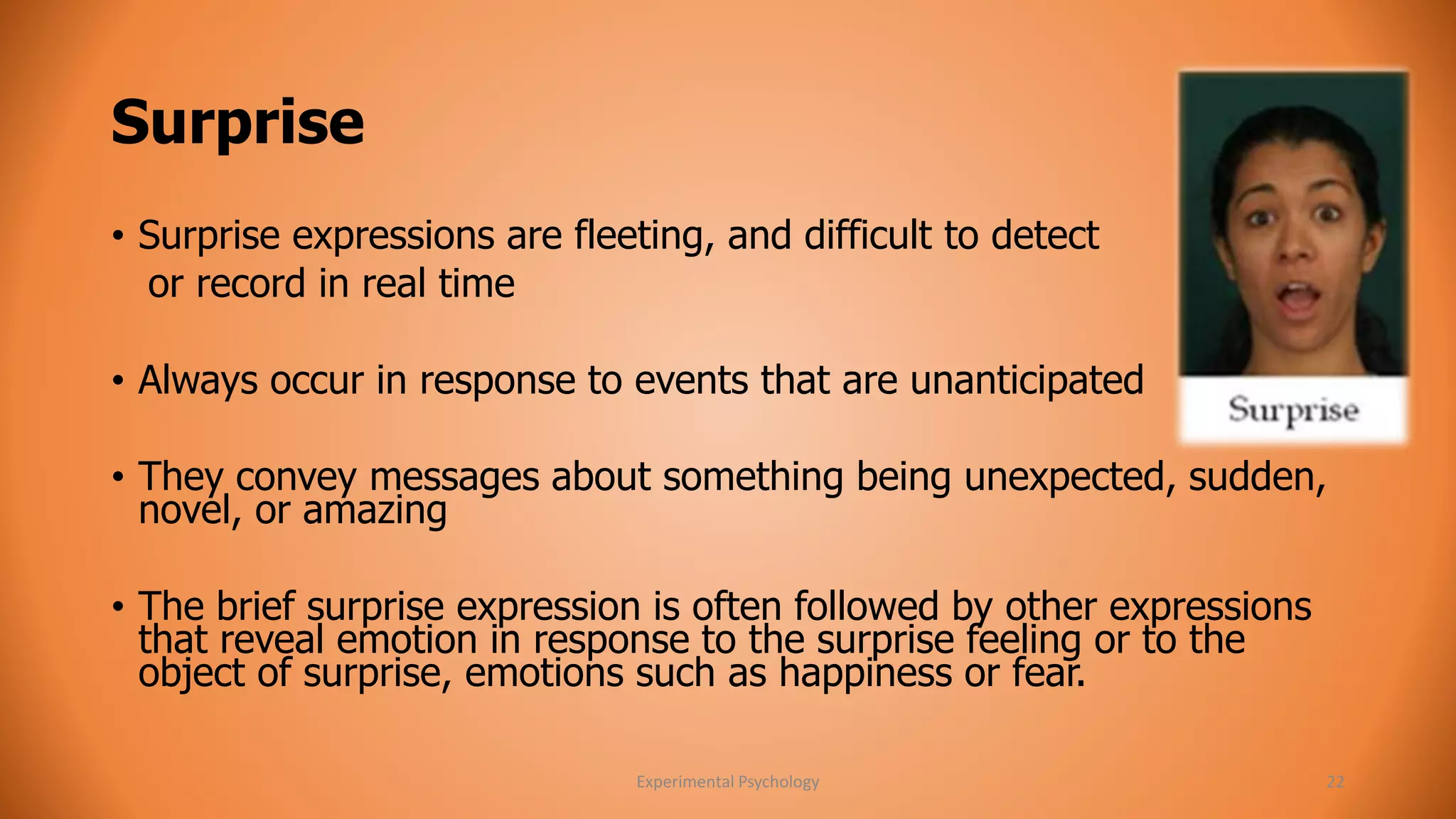
Surprise 
• Surprise expressions are fleeting, and difficult to detect 
or record in real time 
• Always occur in response to events that are unanticipated 
• They convey messages about something being unexpected, sudden, 
novel, or amazing 
• The brief surprise expression is often followed by other expressions 
that reveal emotion in response to the surprise feeling or to the 
object of surprise, emotions such as happiness or fear. 
Experimental Psychology 22
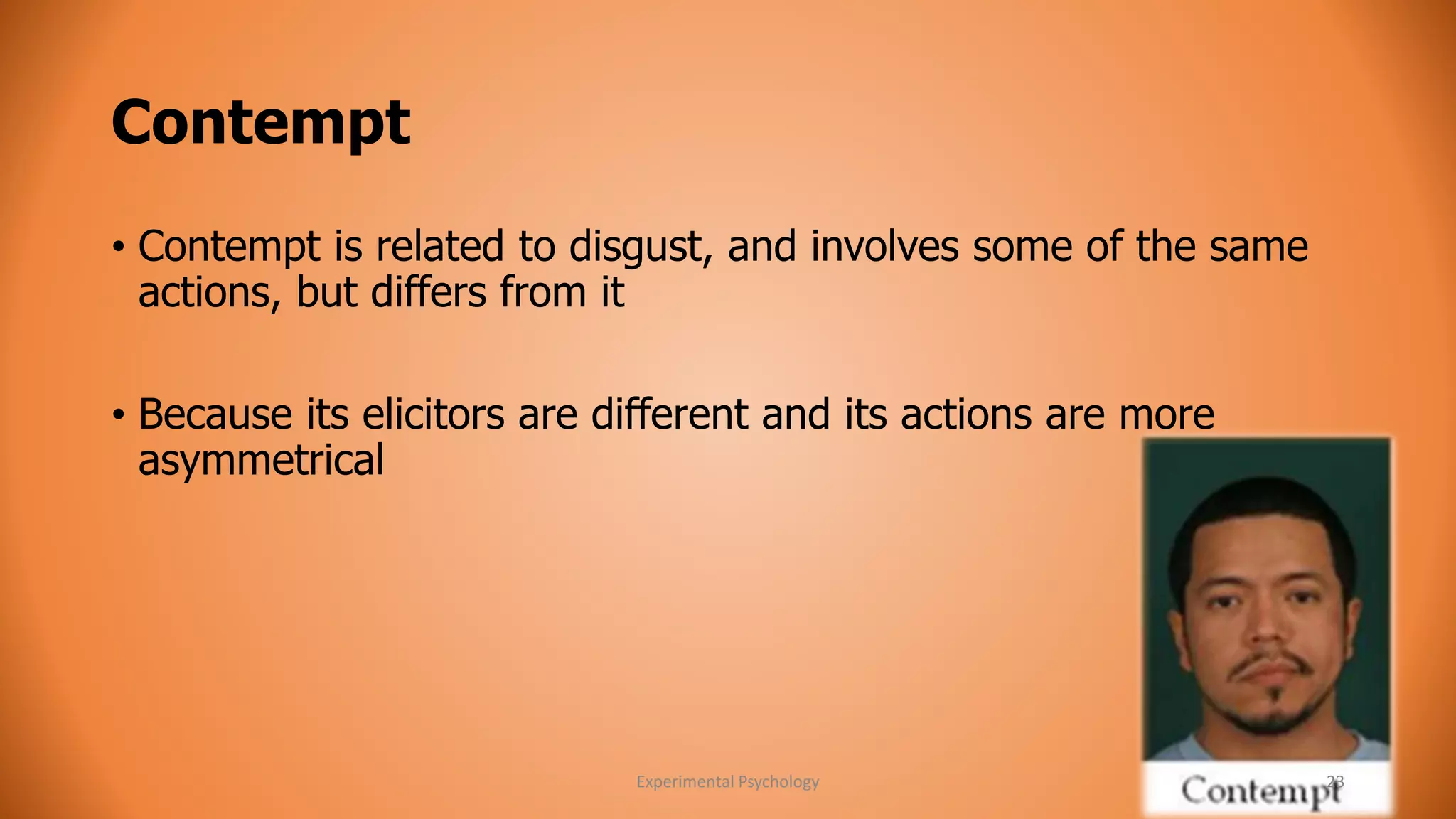
Contempt 
• Contempt is related to disgust, and involves some of the same 
actions, but differs from it 
• Because its elicitors are different and its actions are more 
asymmetrical 
Experimental Psychology 23
Conclusion 
In psychology and philosophy, emotion is a subjective, conscious 
experience characterized primarily by psychophysiological 
expressions, biological reactions, and mental states. 
Facial expressions of emotion are part of our evolutionary history 
and are a biologically innate ability, we all have the ability to read 
them. It is an ability that gets better on the job in our everyday 
lives. 
Experimental Psychology 24
Thank You... 
Experimental Psychology 25

Identification of emotions

  • 1.
    Identification Of Emotions Deva Pramod V B M.Sc. Psychology Department of Psychology Bharathiar University, India vbdevan.psy@gmail.com Experimental Psychology 1 Experimental Psychology
  • 2.
    Definition “feelings statesthat involve a pattern of cognitive, physiological and behavioural reactions to events.” "positive or negative experience that is associated with a particular pattern of physiological activity." Experimental Psychology 2
  • 3.
    Nature of emotions • Emotions are triggered by external or internal eliciting stimuli. • Emotional responses result from our appraisal of these stimuli, • Our bodies respond physiologically to our appraisals. • Emotions include behavior tendencies. Experimental Psychology 3
  • 4.
    The main characteristicsof emotions are: • Every emotion is followed by physiological change such as rapid heartbeat, change in the pulse rate, change in blood pressure, and change in the facial expression, voice and body movements. • Emotion is accompanied by a feeling of pleasantness and unpleasantness, following physiological changes. • Emotions are subjective and purely individual. The same situation may evoke different emotions in different individuals. Experimental Psychology 4
  • 5.
    • Emotions riseabruptly. The passing away of emotions is, however slow, leaving behind an emotional state which lasts for some time. • Emotions have swings. One emotion may give rise to another emotion and the two may get merged. • An emotion mostly raises when the organism faces a difficult situation or when the basic need is challenged or is not satisfied. In fact, a situation, real or imaginary, is always connected with an emotion. Experimental Psychology 5
  • 6.
    • Emotion isa tripolar response having affective, cognitive and conative aspects. • Emotions have wide range and are not restricted to a particular age period. They occur to children, adolescents and adults. Experimental Psychology 6
  • 7.
    Components of emotion Cognitive Component Physiological Component Behavioral Component Experimental Psychology 7
  • 8.
    • Eliciting Stimuli • Trigger cognitive appraisals and emotional responses. • The Cognitive Component • The interpretations and meanings that we attach to sensory stimuli. • Culture and Appraisal • The Physiological Component • Brain structures and neurotransmitters • Hemispheric activation and emotion • The Behavioral Component • Evolution and emotional expression • Facial expression of emotion • Cultural Display Rules Experimental Psychology 8
  • 9.
    Primary Emotions •The 6 photos of the previous slide makes the major Primary Emotions: Happy, Sad, Surprise, Fear, Disgust and Anger • Primary emotions are those that we feel first, as a first response to a situation. • Thus, if we are threatened, we may feel fear. When we hear of a death, we may feel sadness. They are unthinking, instinctive responses that Humans have. One would typically see these in animals also, which confirms the suspicion that they have an evolutionary basis. Experimental Psychology 9
  • 10.
    Secondary Emotions •Secondary emotions appear after primary emotions. They trigger some other kind, for example where the fear of a threat turns to anger that fuels the body for a fight reaction. They may also come from more complex chains of thinking • Secondary emotions turn emotions into complex reactions. They increase the intensity of your reactions. Differentiating between primary and secondary emotions provides powerful coping skills • Some of these are triggered by thinking about what might happen, what might have happened, what did not happen, etc., unlike primary emotions which are triggered only by actual occurrences Experimental Psychology 10
  • 11.
    Kinds of emotions(Secondary) • Positive emotions • Negative emotions Experimental Psychology 11
  • 12.
    Positive Emotions •Secondary Emotions are divided into Positive and Negative Emotions. • Positive Emotions are, • Love • Confidence • Astonished • Gratitude • Patience • Appreciation • Trust • Enthusiasm • Optimistic • Vitality Experimental Psychology 12
  • 13.
    Negative Emotions NegativeEmotions are: • Guilt • Depression • Pride • Jealousy • Self Pity • Anxiety • Resentment • Envy • Frustration • Shame • Denial • Offended • Regret • Worry and Grief Experimental Psychology 13
  • 14.
    Emotional Expressions •Observable verbal and nonverbal behaviours that communicate an internal emotional or affective state • Examples of emotional expression are facial movements such as smiling or scowling, or behavior like crying or laughing • Can occur with or without self-awareness Experimental Psychology 14
  • 15.
    Emotion and FacialExpression • The term "expression" implies the existence of something that is expressed • Facial expressions are associated with particular human emotions. Experimental Psychology 15
  • 16.
    The Seven BasicEmotions and their Universal Expressions Experimental Psychology 16
  • 17.
    Joy or Happy • Universally and easily recognized • Interpreted as conveying messages • Related to enjoyment, pleasure, a positive disposition, and friendliness • Used so often to hide other emotions and deceive or manipulate other people Experimental Psychology 17
  • 18.
    Sadness • Oftenconceived as opposite to happy ones, but this view is too simple, although the action of the mouth corners is opposite • Convey messages related to • Loss, • Bereavement, • Discomfort, • Pain, • Helplessness, etc Experimental Psychology 18
  • 19.
    Anger • Primaryconcomitant of interpersonal aggression • Expression conveys messages about • Hostility • Opposition • Potential attack • Anger is a common response to anger expressions, thus creating a positive feedback loop and increasing the likelihood of dangerous conflict Experimental Psychology 19
  • 20.
    Fear • Fearexpressions convey information about • Imminent danger • A nearby threat • A disposition to flee • Likelihood of bodily harm etc. • The specific objects that can elicit fear for any individual are varied • Experience of fear has an extremely negative felt quality, and is reduced, along with the bodily concomitants, when the threat has been avoided or has passed Experimental Psychology 20
  • 21.
    Disgust • Oftenpart of the body's responses to objects that are revolting and nauseating • Rotting flesh, faecal matter and insects in food, or other offensive materials • Obnoxious smells are effective in eliciting disgust reactions • Often displayed as a commentary on many other events • People that generate adverse reactions, but have nothing to do with the primal origin of disgust Experimental Psychology 21
  • 22.
    Surprise • Surpriseexpressions are fleeting, and difficult to detect or record in real time • Always occur in response to events that are unanticipated • They convey messages about something being unexpected, sudden, novel, or amazing • The brief surprise expression is often followed by other expressions that reveal emotion in response to the surprise feeling or to the object of surprise, emotions such as happiness or fear. Experimental Psychology 22
  • 23.
    Contempt • Contemptis related to disgust, and involves some of the same actions, but differs from it • Because its elicitors are different and its actions are more asymmetrical Experimental Psychology 23
  • 24.
    Conclusion In psychologyand philosophy, emotion is a subjective, conscious experience characterized primarily by psychophysiological expressions, biological reactions, and mental states. Facial expressions of emotion are part of our evolutionary history and are a biologically innate ability, we all have the ability to read them. It is an ability that gets better on the job in our everyday lives. Experimental Psychology 24
  • 25.