Topic –
Presented By :
Darshan Harsora (150280116029)
Subject : Elements of Mechanical Engineering
(2110006)
~ History
 The First two stroke design was a diesel engine invented by Dugald Clark in
1878.
 He used a similar cylinder head to a four stroke diesel engine and a
supercharger.
 The petrol two stroke engine with cylinder ports was invented by Joseph Day in
1889.
 The two-stroke petrol (gasoline) engine was very popular throughout the
19th-20th century in motorcycles and small-engined devices, such
as chainsaws and outboard motors.
The first truly practical two-stroke engine
was attributed by Yorkshireman Alfred
Angas Scott, who started producing twin-
cylinder water-cooled motorcycles in
1908.
~ Function of Two Stroke Petrol
Engine The functionof a two stroke
petrol engine is to deliverpower
to thecrankshaft joined with the
rotary wheel with theuse of
working substance as Petrol
(Gasoline)enteredthrough inlet
port (Carbureter) whichis ignited
inside the cylinderthrough the
spark plug and remaining
substance is released through
exhaust port. This whole process
is completed in one revolution of
flywheel.
 When the piston moves upward
a partial vaccum is created in
the crank case until its lowers
edge uncovers the inlet port
completely as shown in Fig.(A)
 The pressure difference set up
between the atmosphere and
crankcase will suck the petrol-
Air mixture through the
carburetor fitted to inlet port into
the crank case.
 The suction will be continued till
the inlet port is covered by the
piston during its next downward
stroke.
 After the inlet port is covered by
the piston as shown in the Fig.
(B) , its further downward
motion will compress the
Charge ( Petrol-Air Mixture ) in
the crankcase upto the top edge
of the piston uncovers the
transfer port as shown in fig.
(B).
 The Compressed charge flows
from the crank case to the
cylinder through transfer port.
 The electric spark ignites the
compressed charge . The
combustion of charge will
release hot gases which
increase the pressure and
temperature in the cylinder .
 The high pressure combustion gases
force the piston downwards .The piston
performs the power stroke till it uncovers
the exhaust port as shown in the figure.
(B)
 The combustion gases which are at a
pressure slightly higher than the
atmosphere pressure escape through
the exhaust port .
 The piston uncovers the transfer port
.The fresh charge which enters the
cylinder pushes the burnt gases so
more amount of exhaust gases comes
out .
 This sweeping out of exhaust gases by
the incoming fresh charge is called
scavenging
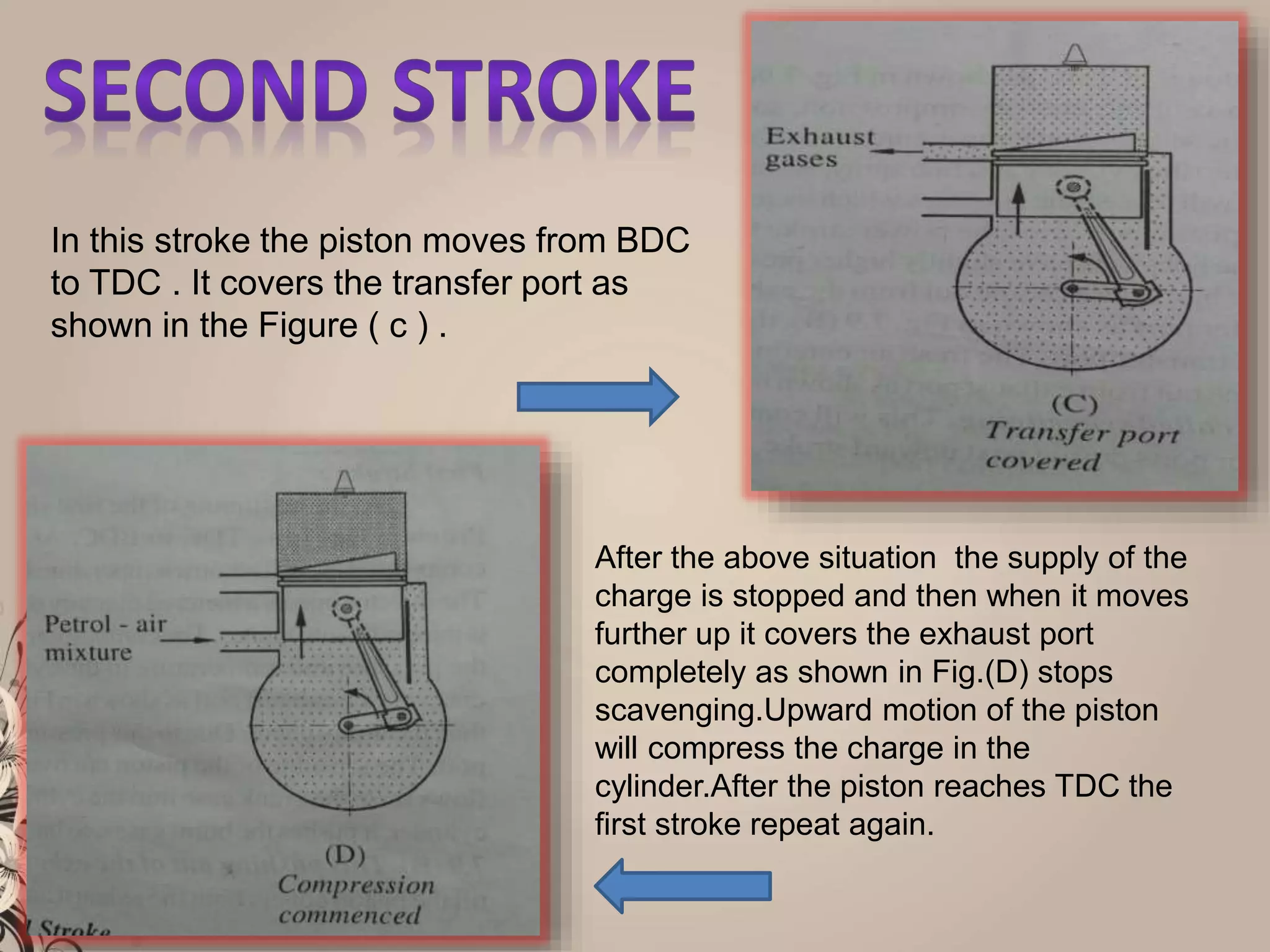
In this stroke the piston moves from BDC
to TDC . It covers the transfer port as
shown in the Figure ( c ) .
After the above situation the supply of the
charge is stopped and then when it moves
further up it covers the exhaust port
completely as shown in Fig.(D) stops
scavenging.Upward motion of the piston
will compress the charge in the
cylinder.After the piston reaches TDC the
first stroke repeat again.
EME ( GTU)  Two Stroke Petrol Engine

EME ( GTU) Two Stroke Petrol Engine

  • 1.
    Topic – Presented By: Darshan Harsora (150280116029) Subject : Elements of Mechanical Engineering (2110006)
  • 2.
    ~ History  TheFirst two stroke design was a diesel engine invented by Dugald Clark in 1878.  He used a similar cylinder head to a four stroke diesel engine and a supercharger.  The petrol two stroke engine with cylinder ports was invented by Joseph Day in 1889.  The two-stroke petrol (gasoline) engine was very popular throughout the 19th-20th century in motorcycles and small-engined devices, such as chainsaws and outboard motors. The first truly practical two-stroke engine was attributed by Yorkshireman Alfred Angas Scott, who started producing twin- cylinder water-cooled motorcycles in 1908.
  • 3.
    ~ Function ofTwo Stroke Petrol Engine The functionof a two stroke petrol engine is to deliverpower to thecrankshaft joined with the rotary wheel with theuse of working substance as Petrol (Gasoline)enteredthrough inlet port (Carbureter) whichis ignited inside the cylinderthrough the spark plug and remaining substance is released through exhaust port. This whole process is completed in one revolution of flywheel.
  • 5.
     When thepiston moves upward a partial vaccum is created in the crank case until its lowers edge uncovers the inlet port completely as shown in Fig.(A)  The pressure difference set up between the atmosphere and crankcase will suck the petrol- Air mixture through the carburetor fitted to inlet port into the crank case.  The suction will be continued till the inlet port is covered by the piston during its next downward stroke.
  • 6.
     After theinlet port is covered by the piston as shown in the Fig. (B) , its further downward motion will compress the Charge ( Petrol-Air Mixture ) in the crankcase upto the top edge of the piston uncovers the transfer port as shown in fig. (B).  The Compressed charge flows from the crank case to the cylinder through transfer port.  The electric spark ignites the compressed charge . The combustion of charge will release hot gases which increase the pressure and temperature in the cylinder .
  • 7.
     The highpressure combustion gases force the piston downwards .The piston performs the power stroke till it uncovers the exhaust port as shown in the figure. (B)  The combustion gases which are at a pressure slightly higher than the atmosphere pressure escape through the exhaust port .  The piston uncovers the transfer port .The fresh charge which enters the cylinder pushes the burnt gases so more amount of exhaust gases comes out .  This sweeping out of exhaust gases by the incoming fresh charge is called scavenging
  • 8.
    In this strokethe piston moves from BDC to TDC . It covers the transfer port as shown in the Figure ( c ) . After the above situation the supply of the charge is stopped and then when it moves further up it covers the exhaust port completely as shown in Fig.(D) stops scavenging.Upward motion of the piston will compress the charge in the cylinder.After the piston reaches TDC the first stroke repeat again.