“A two-stroke engine is a type of internal combustion engine that completes a power cycle with two strokes of the piston during only one crankshaft revolution.”
Two Stroke engine are classified as-
2-stroke petrol engine
2-stroke diesel engine
Fundamentals of Mechanical
Engineering(BME-101/201)
UNIT-2
2-STROKE ENGINE
PREPARED BY
ER. PEEYUSH CHAUHAN
ASSISTANT PROFESSOR
DEPARTMENT OF MECHANICAL ENGINEERING
2.
“A two-stroke engineis a type of internal combustion engine that
completes a power cycle with two strokes of the piston during only one
crankshaft revolution.”
Two Stroke engine are classified as-
1. 2-stroke petrol engine
2. 2-stroke diesel engine
INTRODUCTION
3.
• Key Points:
•In two stroke engine the suction and exhaust strokes are eliminated.
• There are only two remaining strokes – these are the
1. Compression stroke (Upward stroke)
2. Expansion or power stroke (Downward stroke).
• Instead of valves, the two stroke engine consists of inlet and exhaust
ports.
5.
1. Piston- Thepiston transfers the expanding force of gases to the
mechanical rotation of the crankshaft through a connecting rod.
2. Crankshaft- It converts the reciprocating motion to rotational
motion.
3. Connecting Rod- It transfers motion from a piston to the crankshaft
and acts as a lever arm.
4. Flywheel – It is a mechanical device that is used to store energy.
Construction of A Two-Stroke Engine
6.
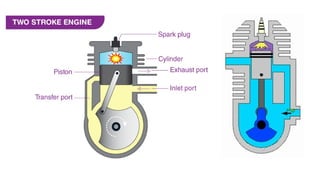
5. Spark Plug– It delivers electric current to the combustion chamber
and in turn ignites the air-fuel mixture leading to abrupt expansion of
gases.
6. Counter Weight – Counterweight on the crankshaft is used to
reduce the vibrations due to imbalances in the rotating assembly.
7. Inlet and Outlet Ports – These ports allow fresh air with fuel to
enter and exit from the cylinder.
8. Transfer Port- The compressed air fuel mixture is transferred from
the crankcase to the combustion space through the transfer port.
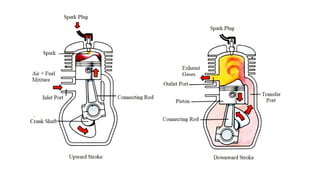
1. Upward stroke:
•Piston moves from BDC to TDC and compresses the charge (air-fuel
mixture) in the combustion chamber of the cylinder.
• Because of the upward movement of the piston, a partial vacuum is
created in the crankcase and this allows the entry of the fresh charge
into the crankcase through the uncovered inlet port.
• The exhaust port and the inlet port remains covered when the piston
at the TDC.
• The ignition of the fresh charge is takes place by the spark plug.
Working of A Two-Stroke Petrol Engine
12.
2. Downward stroke:
•As soon as the combustion of the fresh charge takes place, a large
amount of the hot gases is produced which exerts a very high-
pressure force on the top of the piston. Due to this high-pressure
force, the piston moves downward (TDC to BDC) and rotates the
crankshaft and does useful work.
• During this stroke the inlet port is covered by the piston and the new
charge is compressed in the crankcase.
• Further downward movement of the piston uncovers first the exhaust
port and the transfer port and the exhaust starts through the exhaust
port.
• As soon as the transfer port opens, the charge through it is forced into
the cylinder.
13.
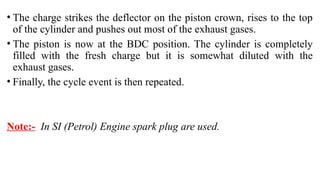
• The chargestrikes the deflector on the piston crown, rises to the top
of the cylinder and pushes out most of the exhaust gases.
• The piston is now at the BDC position. The cylinder is completely
filled with the fresh charge but it is somewhat diluted with the
exhaust gases.
• Finally, the cycle event is then repeated.
Note:- In SI (Petrol) Engine spark plug are used.
14.
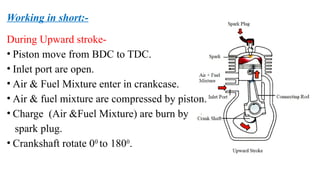
Working in short:-
DuringUpward stroke-
• Piston move from BDC to TDC.
• Inlet port are open.
• Air & Fuel Mixture enter in crankcase.
• Air & fuel mixture are compressed by piston.
• Charge (Air &Fuel Mixture) are burn by
spark plug.
• Crankshaft rotate 00
to 1800
.
15.
During Downward stroke-
•Piston move from TDC to BDC.
• Burn Gases force on the piston.
• First exhaust port uncover after that transfer
port are uncover.
• Exhaust gases leave out from the exhaust
port & same time fresh charge enter in crankcase.
• Crankshaft rotate 1800
to 3600
.
1. Upward stroke:
•When piston move from BDC to TDC a partial vacuum is created in
the crankcase and this allows the entry of the fresh Air into the
crankcase through the uncovered inlet port.
• The fresh air move on the top of the cylinder through transfer port.
• The exhaust port and the inlet port remains covered when the piston
at the TDC.
• When piston reach at TDC its compressed the fresh air due to which
temperature of air rise. In the end of upward stroke fuel is injected by
fuel injector.
Working of A Two-Stroke Diesel Engine
19.
2. Downward stroke:
•As soon as the combustion of the fresh air takes place, a large amount
of the hot gases is produced which exerts a very high-pressure force
on the top of the piston. Due to this high-pressure force, the piston
moves downward (TDC to BDC) and rotates the crankshaft and does
useful work.
• During this stroke the inlet port is covered by the piston and the new
air is compressed in the crankcase.
• Further downward movement of the piston uncovers first the exhaust
port and the transfer port and the exhaust starts through the exhaust
port.
• As soon as the transfer port opens, the fresh air through it is forced
into the cylinder.
20.
• The freshair strikes the deflector on the piston crown, rises to the top
of the cylinder and pushes out most of the exhaust gases.
• The piston is now at the BDC position. The cylinder is completely
filled with the fresh air but it is somewhat diluted with the exhaust
gases.
• Finally, the cycle event is then repeated.
21.
Working in short:-
DuringUpward stroke-
• Piston move from BDC to TDC.
• Inlet port are open.
• Fresh Air enter in crankcase.
• The fresh Air is compressed by piston.
• Fuel injected by fuel injector.
• Fuel burn by compressed air.
• Crankshaft rotate 00
to 1800
.
22.
During Downward stroke-
•Piston move from TDC to BDC.
• Burn Gases force on the piston.
• First exhaust port uncover after that transfer
port are uncover.
• Exhaust gases leave out from the exhaust
port & same time fresh air enter in crankcase.
• Crankshaft rotate 1800
to 3600
.
23.
1. Two strokeengine gives a working stroke for each revolution of the
crankshaft. The four stroke engine gives a working stroke for each
two revolutions of the crankshaft.
2. Power developed by the two-stroke engine is twice that developed
by the four-stroke engine for the same engine speed and volume.
3. Lighter flywheel is required in two stroke engine because of the
more turning moment on the crankshaft.
4. For the same power, a two stroke engine is more compact, light and
requires less space than a four stroke engine, therefore is used in
motorcycles and scooters.
Advantages of A Two-Stroke Engine
24.
• It issimpler in construction and mechanism.
• There is no valve and valve mechanism in it. The ports can be easily
designed and covered and uncovered by the movement of the piston
itself.
• It has high mechanical efficiency.
• It requires fewer spare parts due to its simple design.
25.
1. It hashigh fuel consumption.
2. Thermal efficiency is less than four stroke engine.
3. The charge is diluted by the burnt gases due to incomplete
scavenging.
4. It produces greater noise & vibrations.
5. It does more consumption of the lubricating oil.
6. There is a greater wear and tear of moving parts.
7. Scavenging problems.
8. Incomplete combustion, carbon deposit on the piston head and
exhaust port.
Disadvantages of A Two-Stroke Engine
26.
Two-stroke engines arestill found in a variety of small propulsion
applications, such as-
• Outboard motors
• Small on- and off-road motorcycles
• Mopeds
• Scooters
• Tuk-tuks
• Snowmobiles
• Go-karts
• Ultralight and model airplanes.
Applications of A Two-Stroke Engine
27.
Q:1 What is2-stroke engine?
Q:2 What is 2-stroke petrol engine?
Q:3 What is 2-stroke Diesel engine?
Q:4 Write the applications of 2-stroke engine.
Q:5 How 2-stroke SI engine works? Explain with neat & clean
diagram. Also write its merit & demerits.
Q:6 How 2-stroke CI engine works? Explain with neat & clean
diagram. Also write its merit & demerits.
Questions