TOPICS :
Heat engine
Classification of Heat Engine
Applications of I.C. Engine
Classification of I.C. engines
Different parts of I.C. engine
Two & four stroke engine
DEFINITION :
Any type of engine or machine which derives heat energy from the
combustion of fuel or any other source and converts energy into
mechanical work is termed as Heat Engine.
Heat engine
Internal
combustion
Reciprocating type
Spark ignition
Petrol engine
2 stroke 4 stroke
Gas engine
Compression
ignition
Oil engine/diesel
engine
2 stroke 4 stroke
Rotary type
E.g. – gas turbines
External
combustion
 I.C. engines have many applications, including:
 Road vehicles(e.g. scooter , motorcycle , buses etc.)
 Aircraft
 Motorboats
 Small machines, such as lawn mowers, chainsaws and portable
engine-generators
 I.C. engines may be classified as given below :
1. According to cycle of operation :
2. According to arrangement of cylinder
3. According to method of ignition
4. According to method of cooling the cylinder
5. According to number of cylinder
6. According to air intake process
Classification of I.C. Engine
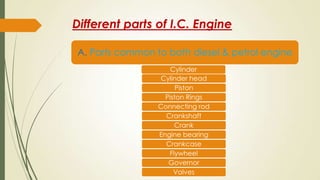
A. Parts common to both diesel & petrol engine
Cylinder
Cylinder head
Piston
Piston Rings
Connecting rod
Crankshaft
Crank
Engine bearing
Crankcase
Flywheel
Governor
Valves
Different parts of I.C. Engine
Parts common to Petrol engine only
 Spark plug
 Carburetor
Parts common to Diesel engine only
 Injector
Cylinder:
• It contains gas under pressure and guides the
piston.
• It is in direct contact with the products of
combustion and it must be cooled.
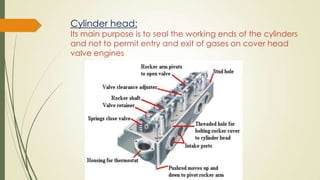
Cylinder head:
Its main purpose is to seal the working ends of the cylinders
and not to permit entry and exit of gases on cover head
valve engines
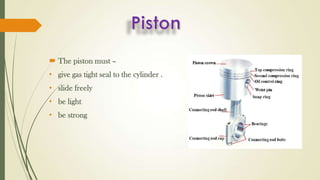
 The piston must –
• give gas tight seal to the cylinder .
• slide freely
• be light
• be strong
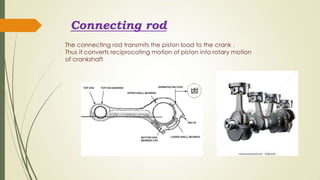
Connecting rod
The connecting rod transmits the piston load to the crank .
Thus it converts reciprocating motion of piston into rotary motion
of crankshaft
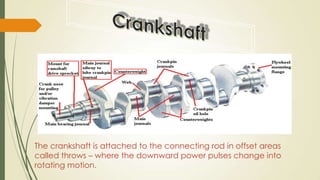
The crankshaft is attached to the connecting rod in offset areas
called throws – where the downward power pulses change into
rotating motion.
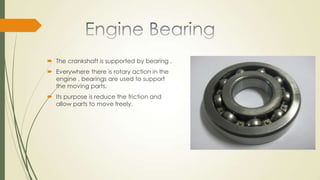
 The crankshaft is supported by bearing .
 Everywhere there is rotary action in the
engine , bearings are used to support
the moving parts.
 Its purpose is reduce the friction and
allow parts to move freely.
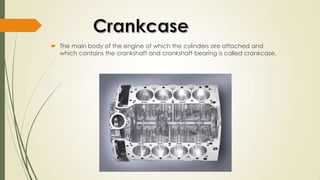
 The main body of the engine of which the cylinders are attached and
which contains the crankshaft and crankshaft bearing is called crankcase.
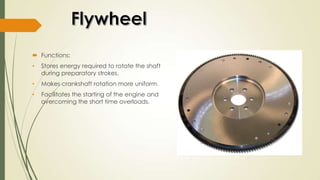
 Functions:
• Stores energy required to rotate the shaft
during preparatory strokes.
• Makes crankshaft rotation more uniform.
• Facilitates the starting of the engine and
overcoming the short time overloads.
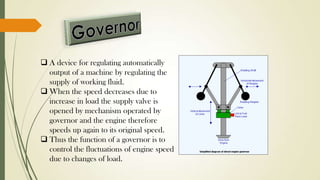
 A device for regulating automatically
output of a machine by regulating the
supply of working fluid.
 When the speed decreases due to
increase in load the supply valve is
opened by mechanism operated by
governor and the engine therefore
speeds up again to its original speed.
 Thus the function of a governor is to
control the fluctuations of engine speed
due to changes of load.
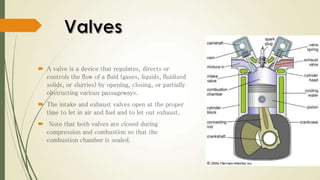
 A valve is a device that regulates, directs or
controls the flow of a fluid (gases, liquids, fluidized
solids, or slurries) by opening, closing, or partially
obstructing various passageways.
 The intake and exhaust valves open at the proper
time to let in air and fuel and to let out exhaust.
 Note that both valves are closed during
compression and combustion so that the
combustion chamber is sealed.
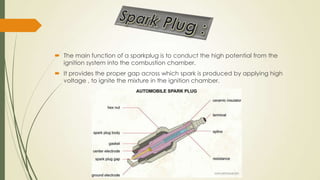
 The main function of a sparkplug is to conduct the high potential from the
ignition system into the combustion chamber.
 It provides the proper gap across which spark is produced by applying high
voltage , to ignite the mixture in the ignition chamber.
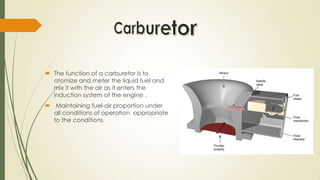
 The function of a carburetor is to
atomize and meter the liquid fuel and
mix it with the air as it enters the
induction system of the engine .
 Maintaining fuel-air proportion under
all conditions of operation appropriate
to the conditions.
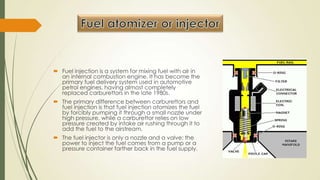
 Fuel injection is a system for mixing fuel with air in
an internal combustion engine. It has become the
primary fuel delivery system used in automotive
petrol engines, having almost completely
replaced carburettors in the late 1980s.
 The primary difference between carburettors and
fuel injection is that fuel injection atomizes the fuel
by forcibly pumping it through a small nozzle under
high pressure, while a carburettor relies on low
pressure created by intake air rushing through it to
add the fuel to the airstream.
 The fuel injector is only a nozzle and a valve: the
power to inject the fuel comes from a pump or a
pressure container farther back in the fuel supply.
 A two-stroke engine is an internal combustion engine which
completes the thermodynamic cycle in two movements of the
piston (compared to twice that number for a four-stroke engine).
 This increased efficiency is accomplished by using the beginning of
the compression stroke and the end of the combustion stroke to
simultaneously perform the intake and exhaust (or scavenging)
functions.
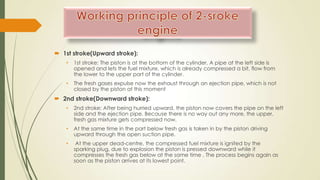
 1st stroke(Upward stroke):
• 1st stroke: The piston is at the bottom of the cylinder. A pipe at the left side is
opened and lets the fuel mixture, which is already compressed a bit, flow from
the lower to the upper part of the cylinder.
• The fresh gases expulse now the exhaust through an ejection pipe, which is not
closed by the piston at this moment
 2nd stroke(Downward stroke):
• 2nd stroke: After being hurried upward, the piston now covers the pipe on the left
side and the ejection pipe. Because there is no way out any more, the upper,
fresh gas mixture gets compressed now.
• At the same time in the part below fresh gas is taken in by the piston driving
upward through the open suction pipe.
• At the upper dead-centre, the compressed fuel mixture is ignited by the
sparking plug, due to explosion the piston is pressed downward while it
compresses the fresh gas below at the same time . The process begins again as
soon as the piston arrives at its lowest point.
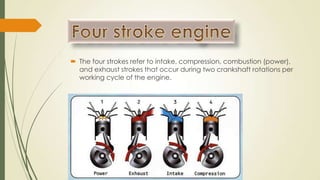
 The four strokes refer to intake, compression, combustion (power),
and exhaust strokes that occur during two crankshaft rotations per
working cycle of the engine.
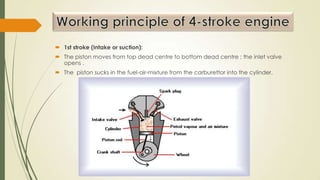
 1st stroke (Intake or suction):
 The piston moves from top dead centre to bottom dead centre ; the inlet valve
opens .
 The piston sucks in the fuel-air-mixture from the carburettor into the cylinder.
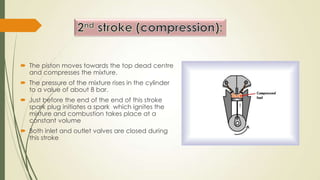
 The piston moves towards the top dead centre
and compresses the mixture.
 The pressure of the mixture rises in the cylinder
to a value of about 8 bar.
 Just before the end of the end of this stroke
spark plug initiates a spark which ignites the
mixture and combustion takes place at a
constant volume
 Both inlet and outlet valves are closed during
this stroke
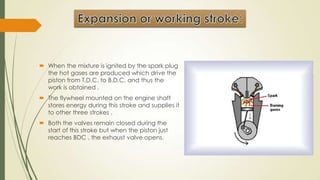
 When the mixture is ignited by the spark plug
the hot gases are produced which drive the
piston from T.D.C. to B.D.C. and thus the
work is obtained .
 The flywheel mounted on the engine shaft
stores energy during this stroke and supplies it
to other three strokes .
 Both the valves remain closed during the
start of this stroke but when the piston just
reaches BDC , the exhaust valve opens.
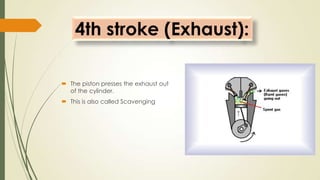
 The piston presses the exhaust out
of the cylinder.
 This is also called Scavenging
4th stroke (Exhaust):

Introduction to IC engines

  • 1.
    TOPICS : Heat engine Classificationof Heat Engine Applications of I.C. Engine Classification of I.C. engines Different parts of I.C. engine Two & four stroke engine
  • 2.
    DEFINITION : Any typeof engine or machine which derives heat energy from the combustion of fuel or any other source and converts energy into mechanical work is termed as Heat Engine.
  • 3.
    Heat engine Internal combustion Reciprocating type Sparkignition Petrol engine 2 stroke 4 stroke Gas engine Compression ignition Oil engine/diesel engine 2 stroke 4 stroke Rotary type E.g. – gas turbines External combustion
  • 4.
     I.C. engineshave many applications, including:  Road vehicles(e.g. scooter , motorcycle , buses etc.)  Aircraft  Motorboats  Small machines, such as lawn mowers, chainsaws and portable engine-generators
  • 5.
     I.C. enginesmay be classified as given below : 1. According to cycle of operation : 2. According to arrangement of cylinder 3. According to method of ignition 4. According to method of cooling the cylinder 5. According to number of cylinder 6. According to air intake process Classification of I.C. Engine
  • 6.
    A. Parts commonto both diesel & petrol engine Cylinder Cylinder head Piston Piston Rings Connecting rod Crankshaft Crank Engine bearing Crankcase Flywheel Governor Valves Different parts of I.C. Engine
  • 7.
    Parts common toPetrol engine only  Spark plug  Carburetor Parts common to Diesel engine only  Injector
  • 9.
    Cylinder: • It containsgas under pressure and guides the piston. • It is in direct contact with the products of combustion and it must be cooled.
  • 10.
    Cylinder head: Its mainpurpose is to seal the working ends of the cylinders and not to permit entry and exit of gases on cover head valve engines
  • 11.
     The pistonmust – • give gas tight seal to the cylinder . • slide freely • be light • be strong
  • 12.
    Connecting rod The connectingrod transmits the piston load to the crank . Thus it converts reciprocating motion of piston into rotary motion of crankshaft
  • 13.
    The crankshaft isattached to the connecting rod in offset areas called throws – where the downward power pulses change into rotating motion.
  • 14.
     The crankshaftis supported by bearing .  Everywhere there is rotary action in the engine , bearings are used to support the moving parts.  Its purpose is reduce the friction and allow parts to move freely.
  • 15.
     The mainbody of the engine of which the cylinders are attached and which contains the crankshaft and crankshaft bearing is called crankcase.
  • 16.
     Functions: • Storesenergy required to rotate the shaft during preparatory strokes. • Makes crankshaft rotation more uniform. • Facilitates the starting of the engine and overcoming the short time overloads.
  • 17.
     A devicefor regulating automatically output of a machine by regulating the supply of working fluid.  When the speed decreases due to increase in load the supply valve is opened by mechanism operated by governor and the engine therefore speeds up again to its original speed.  Thus the function of a governor is to control the fluctuations of engine speed due to changes of load.
  • 18.
     A valveis a device that regulates, directs or controls the flow of a fluid (gases, liquids, fluidized solids, or slurries) by opening, closing, or partially obstructing various passageways.  The intake and exhaust valves open at the proper time to let in air and fuel and to let out exhaust.  Note that both valves are closed during compression and combustion so that the combustion chamber is sealed.
  • 19.
     The mainfunction of a sparkplug is to conduct the high potential from the ignition system into the combustion chamber.  It provides the proper gap across which spark is produced by applying high voltage , to ignite the mixture in the ignition chamber.
  • 20.
     The functionof a carburetor is to atomize and meter the liquid fuel and mix it with the air as it enters the induction system of the engine .  Maintaining fuel-air proportion under all conditions of operation appropriate to the conditions.
  • 21.
     Fuel injectionis a system for mixing fuel with air in an internal combustion engine. It has become the primary fuel delivery system used in automotive petrol engines, having almost completely replaced carburettors in the late 1980s.  The primary difference between carburettors and fuel injection is that fuel injection atomizes the fuel by forcibly pumping it through a small nozzle under high pressure, while a carburettor relies on low pressure created by intake air rushing through it to add the fuel to the airstream.  The fuel injector is only a nozzle and a valve: the power to inject the fuel comes from a pump or a pressure container farther back in the fuel supply.
  • 22.
     A two-strokeengine is an internal combustion engine which completes the thermodynamic cycle in two movements of the piston (compared to twice that number for a four-stroke engine).  This increased efficiency is accomplished by using the beginning of the compression stroke and the end of the combustion stroke to simultaneously perform the intake and exhaust (or scavenging) functions.
  • 23.
     1st stroke(Upwardstroke): • 1st stroke: The piston is at the bottom of the cylinder. A pipe at the left side is opened and lets the fuel mixture, which is already compressed a bit, flow from the lower to the upper part of the cylinder. • The fresh gases expulse now the exhaust through an ejection pipe, which is not closed by the piston at this moment  2nd stroke(Downward stroke): • 2nd stroke: After being hurried upward, the piston now covers the pipe on the left side and the ejection pipe. Because there is no way out any more, the upper, fresh gas mixture gets compressed now. • At the same time in the part below fresh gas is taken in by the piston driving upward through the open suction pipe. • At the upper dead-centre, the compressed fuel mixture is ignited by the sparking plug, due to explosion the piston is pressed downward while it compresses the fresh gas below at the same time . The process begins again as soon as the piston arrives at its lowest point.
  • 24.
     The fourstrokes refer to intake, compression, combustion (power), and exhaust strokes that occur during two crankshaft rotations per working cycle of the engine.
  • 25.
     1st stroke(Intake or suction):  The piston moves from top dead centre to bottom dead centre ; the inlet valve opens .  The piston sucks in the fuel-air-mixture from the carburettor into the cylinder.
  • 26.
     The pistonmoves towards the top dead centre and compresses the mixture.  The pressure of the mixture rises in the cylinder to a value of about 8 bar.  Just before the end of the end of this stroke spark plug initiates a spark which ignites the mixture and combustion takes place at a constant volume  Both inlet and outlet valves are closed during this stroke
  • 27.
     When themixture is ignited by the spark plug the hot gases are produced which drive the piston from T.D.C. to B.D.C. and thus the work is obtained .  The flywheel mounted on the engine shaft stores energy during this stroke and supplies it to other three strokes .  Both the valves remain closed during the start of this stroke but when the piston just reaches BDC , the exhaust valve opens.
  • 28.
     The pistonpresses the exhaust out of the cylinder.  This is also called Scavenging 4th stroke (Exhaust):