1
SteamBoilers
STEAM BOILERS
Subject: Elements of Mechanical
Engineering
Topic: Steam Boilers
Name: Enrollment Number:
Krunal Kedariya 150110106026
Shivani khetani 150110106027
Karan Ladani 150110106028
Rohan Lakhani 150110106029
Lalit Sharma 150110106030
2
SteamBoilers
Guided By:
Prof. Mitesh Vegad
&
Prof. Ravi Rathod
SteamBoilers
3
What is a boiler/steamWhat is a boiler/steam
generator..?generator..?
A closed vessel made up of steel to transfer heat produced by
combustion of fuel to water and ultimately generate steam .
It can also be defined as:
A steam generator or boiler is usually a closed vessel made of
steel. Its function is to transfer the heat produced by the
combustion of fuel to water and ultimately to generate steam.
SteamBoilers
4
What should be theWhat should be the
characteristics of a boiler..?characteristics of a boiler..?
 Generate maximum steam.
 Light in weight and should not occupy large space.
 Proper safety regulations.
 Cheaper in cost.
 Easy cope up with fluctuating demands of
requirements.
 Easily accessible for inspection and repair.
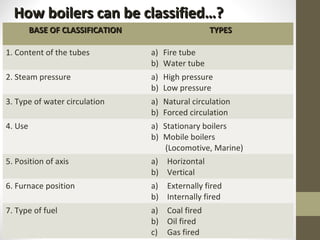
How boilers can be classified…?How boilers can be classified…?
BASE OF CLASSIFICATIONBASE OF CLASSIFICATION TYPESTYPES
1. Content of the tubes a) Fire tube
b) Water tube
2. Steam pressure a) High pressure
b) Low pressure
3. Type of water circulation a) Natural circulation
b) Forced circulation
4. Use a) Stationary boilers
b) Mobile boilers
(Locomotive, Marine)
5. Position of axis a) Horizontal
b) Vertical
6. Furnace position a) Externally fired
b) Internally fired
7. Type of fuel a) Coal fired
b) Oil fired
c) Gas fired
6
SteamBoilers
Cochran BoilerCochran Boiler
7
SteamBoilers
Characteristics :Characteristics :
•Vertical boiler
•Multi tube boiler
•Low pressure boiler
•Natural circulation boiler
•Stationary boiler
•Internally fired boiler
•Fire tube boiler
8
SteamBoilers
Construction :Construction :
Cochran boiler consists of a cylindrical shell with a dome shaped top
where the space is provided for steam. The furnace is one piece
construction and is seamless. Its crown has a hemispherical shape and
thus provides maximum volume of space.
Working :Working :
The fuel is burnt on the grate and ash is collected and disposed of
from ash pit. The gases of combustion produced by burning of fuel
enter the combustion chamber through the flue tube and strike
against fire brick lining which directs them to pass through number of
horizontal tubes, being surrounded by water. After which the gases
escape to the atmosphere through smoke box and chimney.
9
SteamBoilers
Advantages:Advantages:
The minimum floor area is required.
Cost of construction is low.
It can be moved and can be taken to a different location.
Boiler has self contained furnace . No brick work setting is
necessary.
Any type of flue can be used.
Disadvantages:Disadvantages:
Steam raising capacity is less due to vertical design.
Difficult in cleaning and inspection due to vertical design.
The capacity and pressure are limited.
The boiler requires high head room.
10
SteamBoilers
Babcock And Wilcox BoilerBabcock And Wilcox Boiler
11
SteamBoilers
Characteristics :Characteristics :
•Horizontal boiler
•Multi tube boiler
•High pressure boiler
•Natural circulation boiler
•Stationary boiler
•Externally fired boiler
•Water tube boiler
12
SteamBoilers
The hot flue gases rise upward and pass across the left-side portion of the
water tubes. The baffles deflect the flue gases and hence the flue gases
travel in the zig-zag manner (i.e., the hot gases are deflected by the baffles
to move in the upward direction, then downward and again in the upward
direction) over the water tubes and along the superheater. The flue gases
finally escape to atmosphere through chimney.
Working :Working :
1. It consist of inclined water tube, steam and water drum , a mud box
and super heater as shown in figure.
2. The drum is connected to uptake and down take header.
3. This headers are connected to a inclined water tubes
4. The water tube inclined to the horizontal about 15˚.
5. The baffles plates are provided in order to make circulation of hot
gases in sine wave form.
6. A damper is fitted at back of the boiler to regulate draught .
Construction :Construction :
13
SteamBoilers
Advantages :Advantages :
•The steam generation capacity of the boiler is very high about 2000
to 40000 kg/hr.
•Replacement of defective tubes is easy.
•Boiler is required less space area compared to fire tube boilers.
•It is used in power station for generating large quantity of steam.
Disadvantages :Disadvantages :
•There are sensible constructional limits for pressure with capability
which do not meet necessities.
•It cannot take high overload with not being damaged through
overheating.
•Due to accrual of sediments with the mud particles.
•It is difficult to clean inside.
•Large flat surface needed.
14
SteamBoilers
Lancashire BoilerLancashire Boiler
15
SteamBoilers
Characteristics :Characteristics :
• Horizontal boiler
• Multi tube boiler
• Low/Medium pressure boiler
• Natural circulation boiler
• Stationary boiler
• Internally fired boiler
• Fire tube boiler
16
SteamBoilers
Construction :Construction :
•A cylindrical shell is placed in horizontal position over a brick work. It
is partly filled up with water. The water level inside the shell is well
above the furnace tubes.
•The flues are built-up of ordinary brick lined with fire bricks. One
bottom flue and two side flues are formed by brick setting.
•
The grate is provided at the front end of the main flue tubes. Coal is
fed to the grate through the fire hole.
•A brickwork fire bridge is provided at the end of the grate to prevent
the flow of coal and ash particles into the interior of the furnace (flue)
tubes.
•
Dampers is in the form of sliding doors are placed at the end of the
side flues to control the flow of gases from side flues to the chimney
flue.
17
SteamBoilers
Working :Working :
• Coal is fed to the grate through the fire hole and is burnt. The
hot gases leaving the grate move along the flue tubes upto the
back end of the shell and then in the downward direction to
the bottom flue.
• The hot gases, passing through the bottom flue, travel upto
the front end of the boiler, where they divide into two streams
and pass to the side flues. The hot gases travel upto the back
end of the boiler and are then discharged into the atmosphere
through the chimney.
• The arrangement of flues increases the heating surface of the
boiler to a large extent.
• Dampers control the flow of hot gases and regulate the
combustion rate as well as steam generation rate.
18
SteamBoilers
Advantages :Advantages :
•It can be easily operated .
•Compactness and simple design.
•Easy construction and low maintenance cost .
•High overall efficiency (80% to 85%).
•Steam produce have excellent quality.
•Due to the large quantity of water available, it can easily
overcome the load fluctuation.
Disadvantages :Disadvantages :
•Corrosion in water legs .
•It is difficult to clean inside.
•Low steam production rate (9000kg/hr) .
•Horizontal structure cover more ground space .
•Maintenance of brick work is tedious.
•Have limited grate area because the fire tubes
have small diameter.
•It’s a low/medium pressure boiler maximum limit
is only 20 bars.
Boiler mountings
• Pressure gauge
• Fusible plug
• Steam stop valve
• Feed check valve
• Blow off cock
• Mud and man holes
19
SteamBoilers
Pressure gauge
• To record the steam pressure at which steam is
generated in the boiler
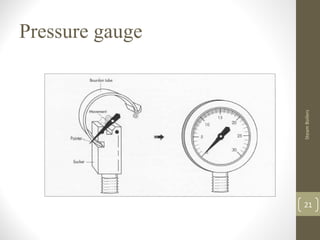
• A bourdon pressure gauge in its simplest form consists
of a simple elastic tube
• One end of the tube is fixed and connected to the
steam space in the boiler
• Other end is connected to a sector through a link
20
SteamBoilers
Pressure gauge
21
SteamBoilers
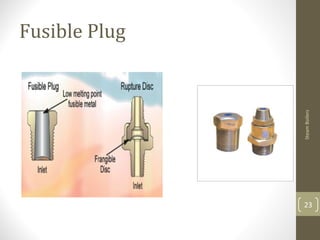
Fusible plug
• To extinguish fire in the event of water level in the boiler shell
falling below a certain specified limit
• It is installed below boiler’s water level
22
SteamBoilers
Fusible Plug
23
SteamBoilers
Steam stop valve
• A valve is a device that regulates the flow of a
fluid (gases , fluidized solids slurries or liquids) by
opening or closing or partially obstructing
various passageways
• Function : to shut off or regulate the flow of
steam from the boiler to the steam pipe or
steam from the steam pipe to the engine
24
SteamBoilers
Steam stop valve
Feed check valve
• To allow the feed water
to pass in to the boiler
• To prevent the back
flow of water from the
boiler in the event of
the failure of the feed
pump 26
SteamBoilers
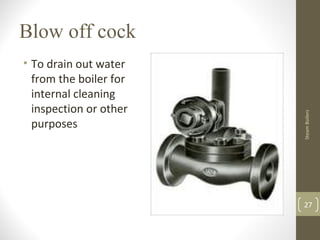
Blow off cock
• To drain out water
from the boiler for
internal cleaning
inspection or other
purposes
27
SteamBoilers
Mud and man holes
• To allow men to enter in to the boiler for
inspection and repair
28
SteamBoilers
Boiler accessories
• Feed pumps: Used to deliver feed water to the boiler. It is
desirable that the quantity of water supplied should be at
least equal to that evaporated and supplied to the engine
• Two types of which are commonly used as feed pumps are (1)
reciprocating pump (2) rotary pump
29
SteamBoilers
30
SteamBoilers

Steamboilers (elements of mechanical engineering)

  • 1.
  • 2.
    Subject: Elements ofMechanical Engineering Topic: Steam Boilers Name: Enrollment Number: Krunal Kedariya 150110106026 Shivani khetani 150110106027 Karan Ladani 150110106028 Rohan Lakhani 150110106029 Lalit Sharma 150110106030 2 SteamBoilers Guided By: Prof. Mitesh Vegad & Prof. Ravi Rathod
  • 3.
    SteamBoilers 3 What is aboiler/steamWhat is a boiler/steam generator..?generator..? A closed vessel made up of steel to transfer heat produced by combustion of fuel to water and ultimately generate steam . It can also be defined as: A steam generator or boiler is usually a closed vessel made of steel. Its function is to transfer the heat produced by the combustion of fuel to water and ultimately to generate steam.
  • 4.
    SteamBoilers 4 What should betheWhat should be the characteristics of a boiler..?characteristics of a boiler..?  Generate maximum steam.  Light in weight and should not occupy large space.  Proper safety regulations.  Cheaper in cost.  Easy cope up with fluctuating demands of requirements.  Easily accessible for inspection and repair.
  • 5.
    How boilers canbe classified…?How boilers can be classified…? BASE OF CLASSIFICATIONBASE OF CLASSIFICATION TYPESTYPES 1. Content of the tubes a) Fire tube b) Water tube 2. Steam pressure a) High pressure b) Low pressure 3. Type of water circulation a) Natural circulation b) Forced circulation 4. Use a) Stationary boilers b) Mobile boilers (Locomotive, Marine) 5. Position of axis a) Horizontal b) Vertical 6. Furnace position a) Externally fired b) Internally fired 7. Type of fuel a) Coal fired b) Oil fired c) Gas fired
  • 6.
  • 7.
    7 SteamBoilers Characteristics :Characteristics : •Verticalboiler •Multi tube boiler •Low pressure boiler •Natural circulation boiler •Stationary boiler •Internally fired boiler •Fire tube boiler
  • 8.
    8 SteamBoilers Construction :Construction : Cochranboiler consists of a cylindrical shell with a dome shaped top where the space is provided for steam. The furnace is one piece construction and is seamless. Its crown has a hemispherical shape and thus provides maximum volume of space. Working :Working : The fuel is burnt on the grate and ash is collected and disposed of from ash pit. The gases of combustion produced by burning of fuel enter the combustion chamber through the flue tube and strike against fire brick lining which directs them to pass through number of horizontal tubes, being surrounded by water. After which the gases escape to the atmosphere through smoke box and chimney.
  • 9.
    9 SteamBoilers Advantages:Advantages: The minimum floorarea is required. Cost of construction is low. It can be moved and can be taken to a different location. Boiler has self contained furnace . No brick work setting is necessary. Any type of flue can be used. Disadvantages:Disadvantages: Steam raising capacity is less due to vertical design. Difficult in cleaning and inspection due to vertical design. The capacity and pressure are limited. The boiler requires high head room.
  • 10.
    10 SteamBoilers Babcock And WilcoxBoilerBabcock And Wilcox Boiler
  • 11.
    11 SteamBoilers Characteristics :Characteristics : •Horizontalboiler •Multi tube boiler •High pressure boiler •Natural circulation boiler •Stationary boiler •Externally fired boiler •Water tube boiler
  • 12.
    12 SteamBoilers The hot fluegases rise upward and pass across the left-side portion of the water tubes. The baffles deflect the flue gases and hence the flue gases travel in the zig-zag manner (i.e., the hot gases are deflected by the baffles to move in the upward direction, then downward and again in the upward direction) over the water tubes and along the superheater. The flue gases finally escape to atmosphere through chimney. Working :Working : 1. It consist of inclined water tube, steam and water drum , a mud box and super heater as shown in figure. 2. The drum is connected to uptake and down take header. 3. This headers are connected to a inclined water tubes 4. The water tube inclined to the horizontal about 15˚. 5. The baffles plates are provided in order to make circulation of hot gases in sine wave form. 6. A damper is fitted at back of the boiler to regulate draught . Construction :Construction :
  • 13.
    13 SteamBoilers Advantages :Advantages : •Thesteam generation capacity of the boiler is very high about 2000 to 40000 kg/hr. •Replacement of defective tubes is easy. •Boiler is required less space area compared to fire tube boilers. •It is used in power station for generating large quantity of steam. Disadvantages :Disadvantages : •There are sensible constructional limits for pressure with capability which do not meet necessities. •It cannot take high overload with not being damaged through overheating. •Due to accrual of sediments with the mud particles. •It is difficult to clean inside. •Large flat surface needed.
  • 14.
  • 15.
    15 SteamBoilers Characteristics :Characteristics : •Horizontal boiler • Multi tube boiler • Low/Medium pressure boiler • Natural circulation boiler • Stationary boiler • Internally fired boiler • Fire tube boiler
  • 16.
    16 SteamBoilers Construction :Construction : •Acylindrical shell is placed in horizontal position over a brick work. It is partly filled up with water. The water level inside the shell is well above the furnace tubes. •The flues are built-up of ordinary brick lined with fire bricks. One bottom flue and two side flues are formed by brick setting. • The grate is provided at the front end of the main flue tubes. Coal is fed to the grate through the fire hole. •A brickwork fire bridge is provided at the end of the grate to prevent the flow of coal and ash particles into the interior of the furnace (flue) tubes. • Dampers is in the form of sliding doors are placed at the end of the side flues to control the flow of gases from side flues to the chimney flue.
  • 17.
    17 SteamBoilers Working :Working : •Coal is fed to the grate through the fire hole and is burnt. The hot gases leaving the grate move along the flue tubes upto the back end of the shell and then in the downward direction to the bottom flue. • The hot gases, passing through the bottom flue, travel upto the front end of the boiler, where they divide into two streams and pass to the side flues. The hot gases travel upto the back end of the boiler and are then discharged into the atmosphere through the chimney. • The arrangement of flues increases the heating surface of the boiler to a large extent. • Dampers control the flow of hot gases and regulate the combustion rate as well as steam generation rate.
  • 18.
    18 SteamBoilers Advantages :Advantages : •Itcan be easily operated . •Compactness and simple design. •Easy construction and low maintenance cost . •High overall efficiency (80% to 85%). •Steam produce have excellent quality. •Due to the large quantity of water available, it can easily overcome the load fluctuation. Disadvantages :Disadvantages : •Corrosion in water legs . •It is difficult to clean inside. •Low steam production rate (9000kg/hr) . •Horizontal structure cover more ground space . •Maintenance of brick work is tedious. •Have limited grate area because the fire tubes have small diameter. •It’s a low/medium pressure boiler maximum limit is only 20 bars.
  • 19.
    Boiler mountings • Pressuregauge • Fusible plug • Steam stop valve • Feed check valve • Blow off cock • Mud and man holes 19 SteamBoilers
  • 20.
    Pressure gauge • Torecord the steam pressure at which steam is generated in the boiler • A bourdon pressure gauge in its simplest form consists of a simple elastic tube • One end of the tube is fixed and connected to the steam space in the boiler • Other end is connected to a sector through a link 20 SteamBoilers
  • 21.
  • 22.
    Fusible plug • Toextinguish fire in the event of water level in the boiler shell falling below a certain specified limit • It is installed below boiler’s water level 22 SteamBoilers
  • 23.
  • 24.
    Steam stop valve •A valve is a device that regulates the flow of a fluid (gases , fluidized solids slurries or liquids) by opening or closing or partially obstructing various passageways • Function : to shut off or regulate the flow of steam from the boiler to the steam pipe or steam from the steam pipe to the engine 24 SteamBoilers
  • 25.
  • 26.
    Feed check valve •To allow the feed water to pass in to the boiler • To prevent the back flow of water from the boiler in the event of the failure of the feed pump 26 SteamBoilers
  • 27.
    Blow off cock •To drain out water from the boiler for internal cleaning inspection or other purposes 27 SteamBoilers
  • 28.
    Mud and manholes • To allow men to enter in to the boiler for inspection and repair 28 SteamBoilers
  • 29.
    Boiler accessories • Feedpumps: Used to deliver feed water to the boiler. It is desirable that the quantity of water supplied should be at least equal to that evaporated and supplied to the engine • Two types of which are commonly used as feed pumps are (1) reciprocating pump (2) rotary pump 29 SteamBoilers
  • 30.