Enzyme-Linked ImmunoSorbant Assay … By Dr. Deshkar DW
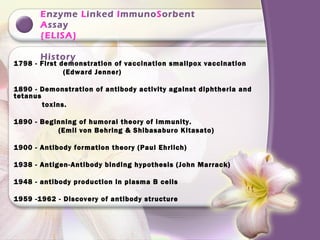
1798 - First demonstration of vaccination smallpox vaccination  (Edward Jenner) 1890 - Demonstration of antibody activity against diphtheria and tetanus  toxins. 1890 - Beginning of humoral theory of immunity.  (Emil von Behring & Shibasaburo Kitasato) 1900 - Antibody formation theory (Paul Ehrlich) 1938 - Antigen-Antibody binding hypothesis (John Marrack) 1948 - antibody production in plasma B cells 1959 -1962 - Discovery of antibody structure E nzyme  L inked  I mmuno S orbent  A ssay {ELISA}   History
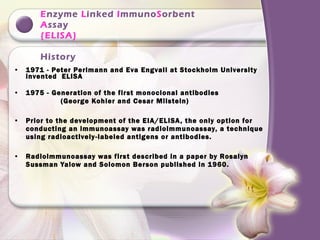
1971 - Peter Perlmann and Eva Engvall at Stockholm University invented  ELISA 1975 - Generation of the first monoclonal antibodies  (George Kohler and Cesar Milstein) Prior to the development of the EIA/ELISA, the only option for conducting an immunoassay was radioimmunoassay, a technique using radioactively-labeled antigens or antibodies.   Radioimmunoassay was first described in a paper by Rosalyn Sussman Yalow and Solomon Berson published in 1960.   E nzyme  L inked  I mmuno S orbent  A ssay {ELISA}   History
ELISA – an immunological test, using an enzyme as a label to determine presence of target protein. The enzyme linkage or labeling allows you to follow your target protein and if present (qualify) and at what amounts (quantify). An enzyme conjugate is an enzyme bound or joined with an antibody which binds with your target protein.  This enzyme labeling is a safe and effective way to track your antibody. E nzyme  L inked  I mmuno S orbent  A ssay {ELISA}
Components Antigen The antigen is your target protein which comes from your sample extract. The antigen binds to the antibody. Any substance that stimulates an immune response. Antibody An antibody is a protein made in response to an antigen. Each antibody binds only to its antigen.
Enzyme Conjugate An enzyme conjugate (EC) is an antibody joined with an enzyme. Enzyme labeling allows the researcher to follow the antibody. This joining of the enzyme to antibody is often called conjugation. Horse radish peroxidase (HRP) and Alkaline phosphatase (ALP) are the two most widely used enzymes employed in ELISA assay. Components
Enzyme Function Enzymes are proteins that speed up the rate of a chemical reaction without being used up and usually react only to particular substrates. The rate of this reaction is proportional to the amount of enzyme present. In the case of non-competitive ELISA, the more binding you have of the enzyme conjugate to the antigen, the stronger your color development will be. Components
Components Substrate ALP substrate - For most applications pNPP (p-Nitrophenyl-phosphate) is the most widely used substrate. HRP substrates–  Hydrogen peroxide. TMB (3,3’,5,5’-tetramethylbenzidine) OPD (o-phenylenediamine dihydrochloride) ABTS (2,2’-azino-di-[3-ethyl-benzothiazoline-6 sulfonic acid] diammonium salt Substrate Function A substrate is a compound or substance that undergoes change. Substrates bind to active sites on the surface of enzymes and are converted or changed. In ELISA the specific substrate used changes color.
Four major advantages of ELISA Data analysed statistically  ELISA  Enzyme Linked Immunosorbent Assay   Why ELISA? Versatile  Simple  Sensitive  Quantifiable  Many systems using different combinations of reagents are possible  Uses micro-titre plates and allied equipment  Enzyme catalyst amplification  Colour  Passive attachment to solid phase  High Capacity  Ideal range of sensitivity for diagnosis  Read by eye  Easy separation of bound and unbound reactants by washing step  Rapid Cheap  Kits feasible  Multi-channel spectrophotometers  Data can be stored
ELISA : Pros and Cons Pros:   1.No radioactivity needed : safe and inexpensive 2.Less expensive equipment 3.Huge capacity through  standard 96-microwell pattern: miniaturization and automation. 4.Equal or even better sensitivity than RIA 5.Versatility : same principle allows the use of different labels, incl. enzymes (colored end product or light) and fluorochromes. Cons:  Somewhat more difficult to develop, control and standardize than RIA.
General Procedure Of ELISA Coating with Capture antibody Coat the wells of a PVC micro-titer plate with the capture antibody Cover the plate with an adhesive plastic and incubate overnight at 4°C. Remove the coating solution and wash the plate twice by filling the wells with 200 μl PBS. Adding Samples 4.  Add 100 μl of appropriately diluted samples to each well, & Incubate for 90 min at 37°C. Remove the samples and wash the plate twice by filling the wells with 200 μl PBS. Incubation with Detection antibody Add 100 μl of detection antibody conjugated, diluted at the optimal concentration in blocking buffer immediately before use. Cover the plate with an adhesive plastic and incubate for 1-2 h at room temperature. Wash the plate four times with PBS. Detection 9.  Dispense 100 μl (or 50 μl) of the substrate solution per well with a multi-channel pipette or a multi-pipette.
A Microtiter plate (96-well) used for ELISA
General Procedure Of ELISA
Reading plates • Select proper wave-length on machine. •  Carefully wipe bottom of plate to remove excess moisture. Plates that are wet may diffuse your light source, giving inaccurate readings. • Mix the plate. This will distribute color evenly. Some machines have a ‘mix’ setting. General Procedure Of ELISA
HOMOGENOUS ELISA There is no need for phase separation. It is less sensitive than heterogenous  ELISA. Uses: It is suitable for determination of low molecular weight substances. e.g drug monitoring. PRINCIPAL: Enzyme labeled Ag & unknown Ag compete together for Ab-binding sites . The enzyme labeled Ag that remain free is enzymatically active & can be determined in the presence of the bound form.
HETEROGENOUS ELISA PRINCIPAL: An essential component of these assay is the separation of the bound enzyme labeled component from free labeled one after the immunological incubation. The assay can be : a) Competitive. b) Non Competitive
TYPES OF ELISA There are three main methods that form the basis to all ELISAs.  1. DIRECT ELISA  2. INDIRECT ELISA  3. SANDWICH ELISA  All these systems (1-3) can be used in assays called: 4. COMPETITION OR INHIBITION ELISA
DIRECT ELISA The direct ELISA uses the method of directly labeling the antibody itself. Microwell plates are coated with a sample  containing the target antigen, and the binding of labeled  antibody is quantitated by a colorimetric,  chemiluminescent, or fluorescent end-point.
DIRECT ELISA
DIRECT ELISA
DIRECT ELISA
Advantages of Direct Detection Quick methodology since only one antibody is used.  Cross-reactivity of secondary antibody is eliminated. Disadvantages of Direct Detection Immunoreactivity of the primary antibody may be reduced as a result of labeling.  Labeling of every primary antibody is time-consuming and expensive.  No flexibility in choice of primary antibody label from one experiment to another.  Little signal amplification.  DIRECT ELISA
The indirect ELISA utilizes an unlabeled primary antibody in conjunction with a labeled secondary antibody.  Since the labeled secondary antibody is directed against  all antibodies of a given species (e.g.anti-mouse), it can be used with a wide variety of primary antibodies (e.g. all  mouse monoclonal antibodies).  INDIRECT ELISA
INDIRECT ELISA
INDIRECT ELISA
Advantages of indirect detection Wide variety of labeled secondary antibodies are available commercially.  Versatile, since many primary antibodies can be made in one species and the same labeled secondary antibody can be used for detection.  Immunoreactivity of the primary antibody is not affected by labeling.  Sensitivity is increased because each primary antibody contains several epitopes that can be bound by the labeled secondary antibody, allowing for signal amplification.  INDIRECT ELISA
Disadvantages of indirect detection  Cross-reactivity may occur with the secondary antibody, resulting in nonspecific signal.  An extra incubation step is required in the procedure.  INDIRECT ELISA
SANDWICH ELISA Plate is coated with a capture antibody Sample is added, and any antigen present binds to capture antibody Detecting antibody is added, and binds to antigen Enzyme-linked secondary antibody is added, and binds to detecting antibody Substrate is added, and is converted by enzyme to detectable form.
SANDWICH ELISA
SANDWICH ELISA TYPES Sandwich Direct  Sandwich Indirect  Sandwich Direct  The detecting antibody is labelled (conjugate)  B. The capture and detecting antibodies can be from the same sample  C. The detecting antibody can be from different species  Sandwich Indirect  The detecting antibody is NOT labelled  B. The detecting antibody is not prepared in same species as capture antibody  C. The detecting antibody is detected using an anti-species conjugate
SANDWICH DIRECT
SANDWICH DIRECT
SANDWICH INDIRECT
SANDWICH INDIRECT
COMPETITIVE ELISA In this Unlabeled antibody is incubated in the presence of its antigen.  These bound antibody/antigen complexes are then added to an antigen coated well.  The plate is washed unbound antibody is removed.  The secondary antibody, specific to the primary antibody is added. This second antibody is coupled to the enzyme.  A substrate is added, and remaining enzymes elicit a chromogenic or fluorescent signal.  For competitive ELISA, the higher the original antigen concentration, the weaker the eventual signal.
COMPETITIVE ELISA
ELISA Reverse method & device  (ELISA-R m&d) A newer technique uses an solid phase made up of an immunosorbent polystyrene rod with 4-12 protruding  ogives. The entire device is immersed in a test tube  containing the collected sample and the following steps (washing, incubation in conjugate and incubation in  chromogenous) are carried out by dipping the ogives in  microwells of standard microplates pre-filled with reagents.
ADVANTAGES The ogives can each be sensitized to a different reagent, allowing the simultaneous detection of different antibodies and different antigens for multi-target assays.  The sample volume can be increased to improve the test sensitivity in clinical (saliva, urine), food (bulk milk, pooled eggs) and environmental (water) samples.  One ogive is left unsensitized to measure the non-specific reactions of the sample.  The use of laboratory supplies for dispensing sample aliquots, washing solution and reagents in microwells is not required, facilitating ready-to-use lab-kits and on-site kits.
PRECAUTIONS Negative control with strong signal  The excessive background signal can be caused by  inadequate rinsing of plates, reagents not sufficiently  diluted, inadequate blocking of plates or non-specific  binding of enzyme conjugate. The appearance of color in  negative control wells may also indicate cross-reactivity of  secondary antibody with components in the antigen  sample.
PRECAUTIONS  contd….. Negative control with strong signal  The excessive background signal can be caused by  inadequate rinsing of plates, reagents not sufficiently  diluted, inadequate blocking of plates or non-specific  binding of enzyme conjugate.  The appearance of color in negative control wells may also indicate cross-reactivity of secondary antibody with  components in the antigen sample.
ELISA with weak signal  Wash buffer not adequately drained after every wash step. Inadequate incubation times. Detection reagents too dilute. Perform checkerboard titrations. Enzyme conjugate defective or inhibited by contaminant. Substrate defective or contaminated. Microwell plates poorly coated. Loss of capture antibody during blocking/washing. Decrease or eliminate use of Tween-20.  PRECAUTIONS  contd…..
APPLICATIONS Screening donated blood for evidence of viral contamination by  HIV-1 and HIV-2 (presence of anti-HIV antibodies)  hepatitis C (presence of antibodies)  hepatitis B (testing for both antibodies and a viral antigen)  Measuring hormone levels  HCG (as a test for pregnancy)  LH (determining the time of ovulation)  TSH, T3 and T4 (for thyroid function)
APPLICATIONS  contd…. Detecting infections  sexually-transmitted agents like HIV, syphilis and chlamydia  hepatitis B and C  Toxoplasma gondii Detecting allergens in food and house dust  Measuring "rheumatoid factors" and other autoantibody in autoimmune diseases like lupus erythematosus Measuring toxins in contaminated food Detecting illicit drugs, e.g.,  cocaine  opiates
Thank You

Elisa seminar final2

  • 1.
    Enzyme-Linked ImmunoSorbant Assay… By Dr. Deshkar DW
  • 2.
    1798 - Firstdemonstration of vaccination smallpox vaccination (Edward Jenner) 1890 - Demonstration of antibody activity against diphtheria and tetanus toxins. 1890 - Beginning of humoral theory of immunity. (Emil von Behring & Shibasaburo Kitasato) 1900 - Antibody formation theory (Paul Ehrlich) 1938 - Antigen-Antibody binding hypothesis (John Marrack) 1948 - antibody production in plasma B cells 1959 -1962 - Discovery of antibody structure E nzyme L inked I mmuno S orbent A ssay {ELISA} History
  • 3.
    1971 - PeterPerlmann and Eva Engvall at Stockholm University invented ELISA 1975 - Generation of the first monoclonal antibodies (George Kohler and Cesar Milstein) Prior to the development of the EIA/ELISA, the only option for conducting an immunoassay was radioimmunoassay, a technique using radioactively-labeled antigens or antibodies. Radioimmunoassay was first described in a paper by Rosalyn Sussman Yalow and Solomon Berson published in 1960. E nzyme L inked I mmuno S orbent A ssay {ELISA} History
  • 4.
    ELISA – animmunological test, using an enzyme as a label to determine presence of target protein. The enzyme linkage or labeling allows you to follow your target protein and if present (qualify) and at what amounts (quantify). An enzyme conjugate is an enzyme bound or joined with an antibody which binds with your target protein. This enzyme labeling is a safe and effective way to track your antibody. E nzyme L inked I mmuno S orbent A ssay {ELISA}
  • 5.
    Components Antigen Theantigen is your target protein which comes from your sample extract. The antigen binds to the antibody. Any substance that stimulates an immune response. Antibody An antibody is a protein made in response to an antigen. Each antibody binds only to its antigen.
  • 6.
    Enzyme Conjugate Anenzyme conjugate (EC) is an antibody joined with an enzyme. Enzyme labeling allows the researcher to follow the antibody. This joining of the enzyme to antibody is often called conjugation. Horse radish peroxidase (HRP) and Alkaline phosphatase (ALP) are the two most widely used enzymes employed in ELISA assay. Components
  • 7.
    Enzyme Function Enzymesare proteins that speed up the rate of a chemical reaction without being used up and usually react only to particular substrates. The rate of this reaction is proportional to the amount of enzyme present. In the case of non-competitive ELISA, the more binding you have of the enzyme conjugate to the antigen, the stronger your color development will be. Components
  • 8.
    Components Substrate ALPsubstrate - For most applications pNPP (p-Nitrophenyl-phosphate) is the most widely used substrate. HRP substrates– Hydrogen peroxide. TMB (3,3’,5,5’-tetramethylbenzidine) OPD (o-phenylenediamine dihydrochloride) ABTS (2,2’-azino-di-[3-ethyl-benzothiazoline-6 sulfonic acid] diammonium salt Substrate Function A substrate is a compound or substance that undergoes change. Substrates bind to active sites on the surface of enzymes and are converted or changed. In ELISA the specific substrate used changes color.
  • 9.
    Four major advantagesof ELISA Data analysed statistically ELISA Enzyme Linked Immunosorbent Assay Why ELISA? Versatile Simple Sensitive Quantifiable Many systems using different combinations of reagents are possible Uses micro-titre plates and allied equipment Enzyme catalyst amplification Colour Passive attachment to solid phase High Capacity Ideal range of sensitivity for diagnosis Read by eye Easy separation of bound and unbound reactants by washing step Rapid Cheap Kits feasible Multi-channel spectrophotometers Data can be stored
  • 10.
    ELISA : Prosand Cons Pros: 1.No radioactivity needed : safe and inexpensive 2.Less expensive equipment 3.Huge capacity through standard 96-microwell pattern: miniaturization and automation. 4.Equal or even better sensitivity than RIA 5.Versatility : same principle allows the use of different labels, incl. enzymes (colored end product or light) and fluorochromes. Cons: Somewhat more difficult to develop, control and standardize than RIA.
  • 11.
    General Procedure OfELISA Coating with Capture antibody Coat the wells of a PVC micro-titer plate with the capture antibody Cover the plate with an adhesive plastic and incubate overnight at 4°C. Remove the coating solution and wash the plate twice by filling the wells with 200 μl PBS. Adding Samples 4. Add 100 μl of appropriately diluted samples to each well, & Incubate for 90 min at 37°C. Remove the samples and wash the plate twice by filling the wells with 200 μl PBS. Incubation with Detection antibody Add 100 μl of detection antibody conjugated, diluted at the optimal concentration in blocking buffer immediately before use. Cover the plate with an adhesive plastic and incubate for 1-2 h at room temperature. Wash the plate four times with PBS. Detection 9. Dispense 100 μl (or 50 μl) of the substrate solution per well with a multi-channel pipette or a multi-pipette.
  • 12.
    A Microtiter plate(96-well) used for ELISA
  • 13.
  • 14.
    Reading plates •Select proper wave-length on machine. • Carefully wipe bottom of plate to remove excess moisture. Plates that are wet may diffuse your light source, giving inaccurate readings. • Mix the plate. This will distribute color evenly. Some machines have a ‘mix’ setting. General Procedure Of ELISA
  • 15.
    HOMOGENOUS ELISA Thereis no need for phase separation. It is less sensitive than heterogenous ELISA. Uses: It is suitable for determination of low molecular weight substances. e.g drug monitoring. PRINCIPAL: Enzyme labeled Ag & unknown Ag compete together for Ab-binding sites . The enzyme labeled Ag that remain free is enzymatically active & can be determined in the presence of the bound form.
  • 16.
    HETEROGENOUS ELISA PRINCIPAL:An essential component of these assay is the separation of the bound enzyme labeled component from free labeled one after the immunological incubation. The assay can be : a) Competitive. b) Non Competitive
  • 17.
    TYPES OF ELISAThere are three main methods that form the basis to all ELISAs. 1. DIRECT ELISA 2. INDIRECT ELISA 3. SANDWICH ELISA All these systems (1-3) can be used in assays called: 4. COMPETITION OR INHIBITION ELISA
  • 18.
    DIRECT ELISA Thedirect ELISA uses the method of directly labeling the antibody itself. Microwell plates are coated with a sample containing the target antigen, and the binding of labeled antibody is quantitated by a colorimetric, chemiluminescent, or fluorescent end-point.
  • 19.
  • 20.
  • 21.
  • 22.
    Advantages of DirectDetection Quick methodology since only one antibody is used. Cross-reactivity of secondary antibody is eliminated. Disadvantages of Direct Detection Immunoreactivity of the primary antibody may be reduced as a result of labeling. Labeling of every primary antibody is time-consuming and expensive. No flexibility in choice of primary antibody label from one experiment to another. Little signal amplification. DIRECT ELISA
  • 23.
    The indirect ELISAutilizes an unlabeled primary antibody in conjunction with a labeled secondary antibody. Since the labeled secondary antibody is directed against all antibodies of a given species (e.g.anti-mouse), it can be used with a wide variety of primary antibodies (e.g. all mouse monoclonal antibodies). INDIRECT ELISA
  • 24.
  • 25.
  • 26.
    Advantages of indirectdetection Wide variety of labeled secondary antibodies are available commercially. Versatile, since many primary antibodies can be made in one species and the same labeled secondary antibody can be used for detection. Immunoreactivity of the primary antibody is not affected by labeling. Sensitivity is increased because each primary antibody contains several epitopes that can be bound by the labeled secondary antibody, allowing for signal amplification. INDIRECT ELISA
  • 27.
    Disadvantages of indirectdetection Cross-reactivity may occur with the secondary antibody, resulting in nonspecific signal. An extra incubation step is required in the procedure. INDIRECT ELISA
  • 28.
    SANDWICH ELISA Plateis coated with a capture antibody Sample is added, and any antigen present binds to capture antibody Detecting antibody is added, and binds to antigen Enzyme-linked secondary antibody is added, and binds to detecting antibody Substrate is added, and is converted by enzyme to detectable form.
  • 29.
  • 30.
    SANDWICH ELISA TYPESSandwich Direct Sandwich Indirect Sandwich Direct The detecting antibody is labelled (conjugate) B. The capture and detecting antibodies can be from the same sample C. The detecting antibody can be from different species Sandwich Indirect The detecting antibody is NOT labelled B. The detecting antibody is not prepared in same species as capture antibody C. The detecting antibody is detected using an anti-species conjugate
  • 31.
  • 32.
  • 33.
  • 34.
  • 35.
    COMPETITIVE ELISA Inthis Unlabeled antibody is incubated in the presence of its antigen. These bound antibody/antigen complexes are then added to an antigen coated well. The plate is washed unbound antibody is removed. The secondary antibody, specific to the primary antibody is added. This second antibody is coupled to the enzyme. A substrate is added, and remaining enzymes elicit a chromogenic or fluorescent signal. For competitive ELISA, the higher the original antigen concentration, the weaker the eventual signal.
  • 36.
  • 37.
    ELISA Reverse method& device (ELISA-R m&d) A newer technique uses an solid phase made up of an immunosorbent polystyrene rod with 4-12 protruding ogives. The entire device is immersed in a test tube containing the collected sample and the following steps (washing, incubation in conjugate and incubation in chromogenous) are carried out by dipping the ogives in microwells of standard microplates pre-filled with reagents.
  • 38.
    ADVANTAGES The ogivescan each be sensitized to a different reagent, allowing the simultaneous detection of different antibodies and different antigens for multi-target assays. The sample volume can be increased to improve the test sensitivity in clinical (saliva, urine), food (bulk milk, pooled eggs) and environmental (water) samples. One ogive is left unsensitized to measure the non-specific reactions of the sample. The use of laboratory supplies for dispensing sample aliquots, washing solution and reagents in microwells is not required, facilitating ready-to-use lab-kits and on-site kits.
  • 39.
    PRECAUTIONS Negative controlwith strong signal The excessive background signal can be caused by inadequate rinsing of plates, reagents not sufficiently diluted, inadequate blocking of plates or non-specific binding of enzyme conjugate. The appearance of color in negative control wells may also indicate cross-reactivity of secondary antibody with components in the antigen sample.
  • 40.
    PRECAUTIONS contd…..Negative control with strong signal The excessive background signal can be caused by inadequate rinsing of plates, reagents not sufficiently diluted, inadequate blocking of plates or non-specific binding of enzyme conjugate. The appearance of color in negative control wells may also indicate cross-reactivity of secondary antibody with components in the antigen sample.
  • 41.
    ELISA with weaksignal Wash buffer not adequately drained after every wash step. Inadequate incubation times. Detection reagents too dilute. Perform checkerboard titrations. Enzyme conjugate defective or inhibited by contaminant. Substrate defective or contaminated. Microwell plates poorly coated. Loss of capture antibody during blocking/washing. Decrease or eliminate use of Tween-20. PRECAUTIONS contd…..
  • 42.
    APPLICATIONS Screening donatedblood for evidence of viral contamination by HIV-1 and HIV-2 (presence of anti-HIV antibodies) hepatitis C (presence of antibodies) hepatitis B (testing for both antibodies and a viral antigen) Measuring hormone levels HCG (as a test for pregnancy) LH (determining the time of ovulation) TSH, T3 and T4 (for thyroid function)
  • 43.
    APPLICATIONS contd….Detecting infections sexually-transmitted agents like HIV, syphilis and chlamydia hepatitis B and C Toxoplasma gondii Detecting allergens in food and house dust Measuring "rheumatoid factors" and other autoantibody in autoimmune diseases like lupus erythematosus Measuring toxins in contaminated food Detecting illicit drugs, e.g., cocaine opiates
  • 44.