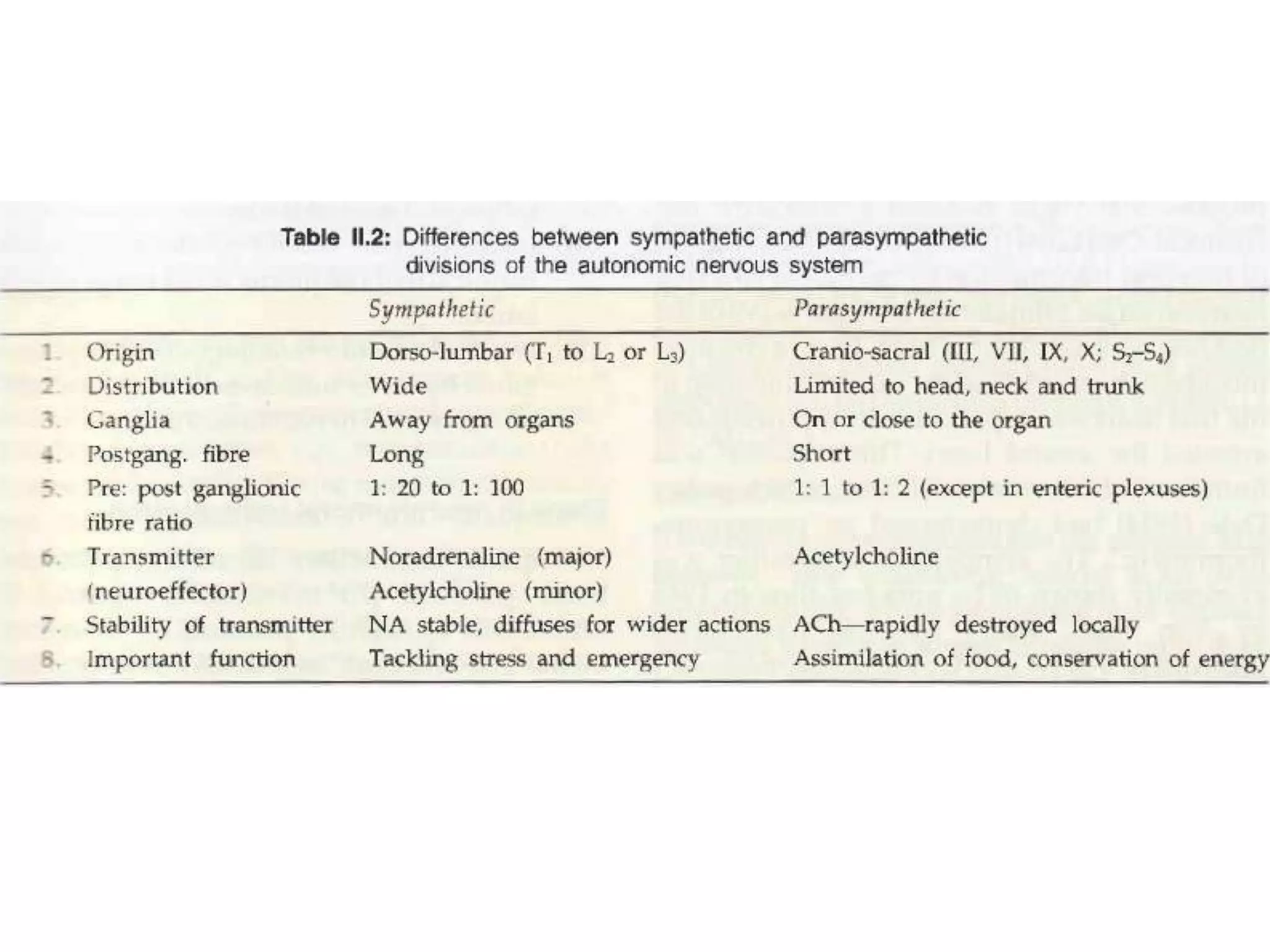
Autonomic Nervous System
ORGANIZATION AND FUNCTION
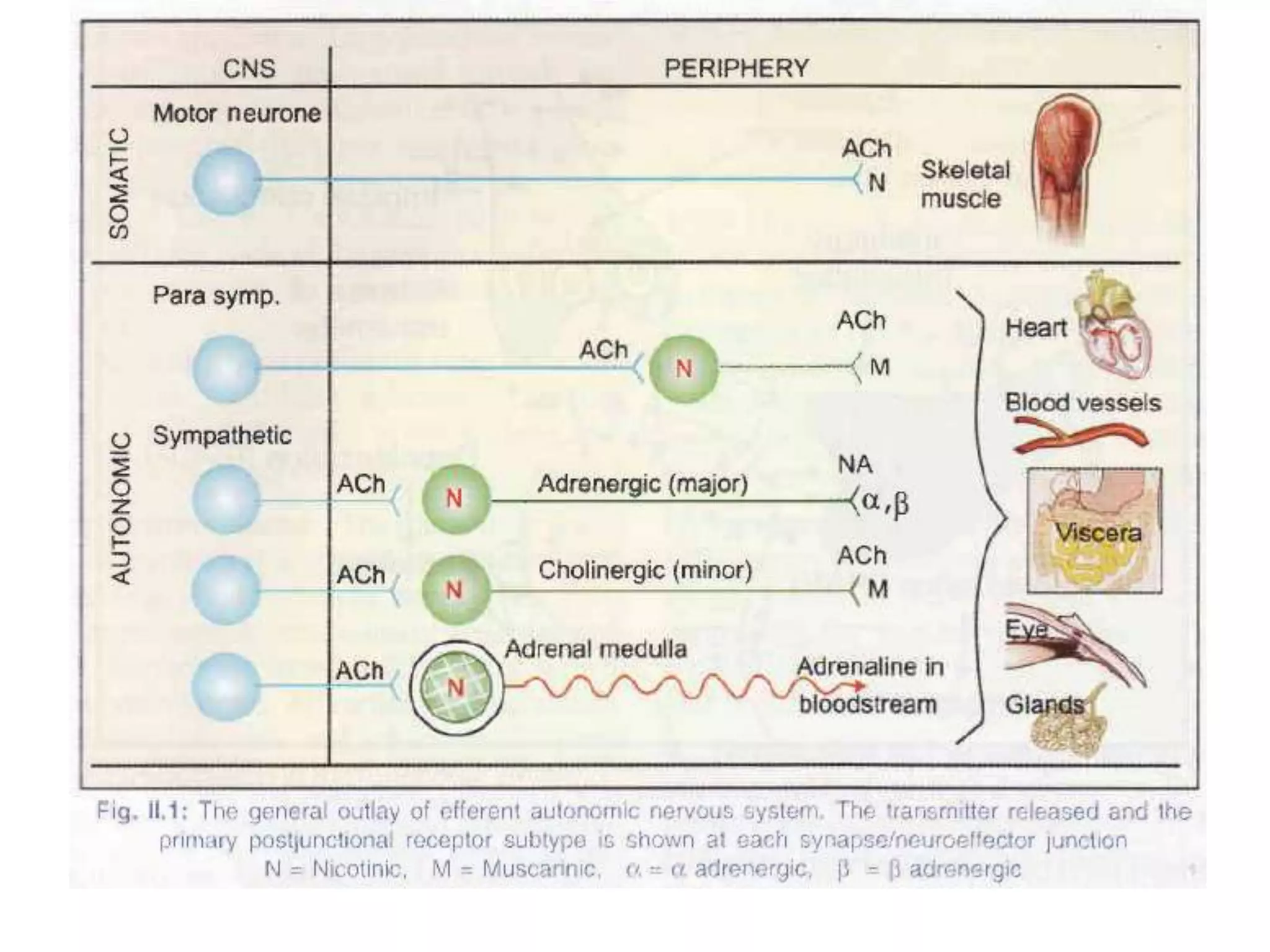
• The autonomic nervous system (ANS)
  functions largely below the level of
  consciousness and controls visceral functions.
• The ANS consists of afferents, centre and
  efferents nerves.
NEUROHOMORAL TRANSMISSION
• Neurohumonal transmission implies that
  nerves transmit their message across synapses
  and neuroeffector junctions by the release of
  humoral (chemical) messengers.
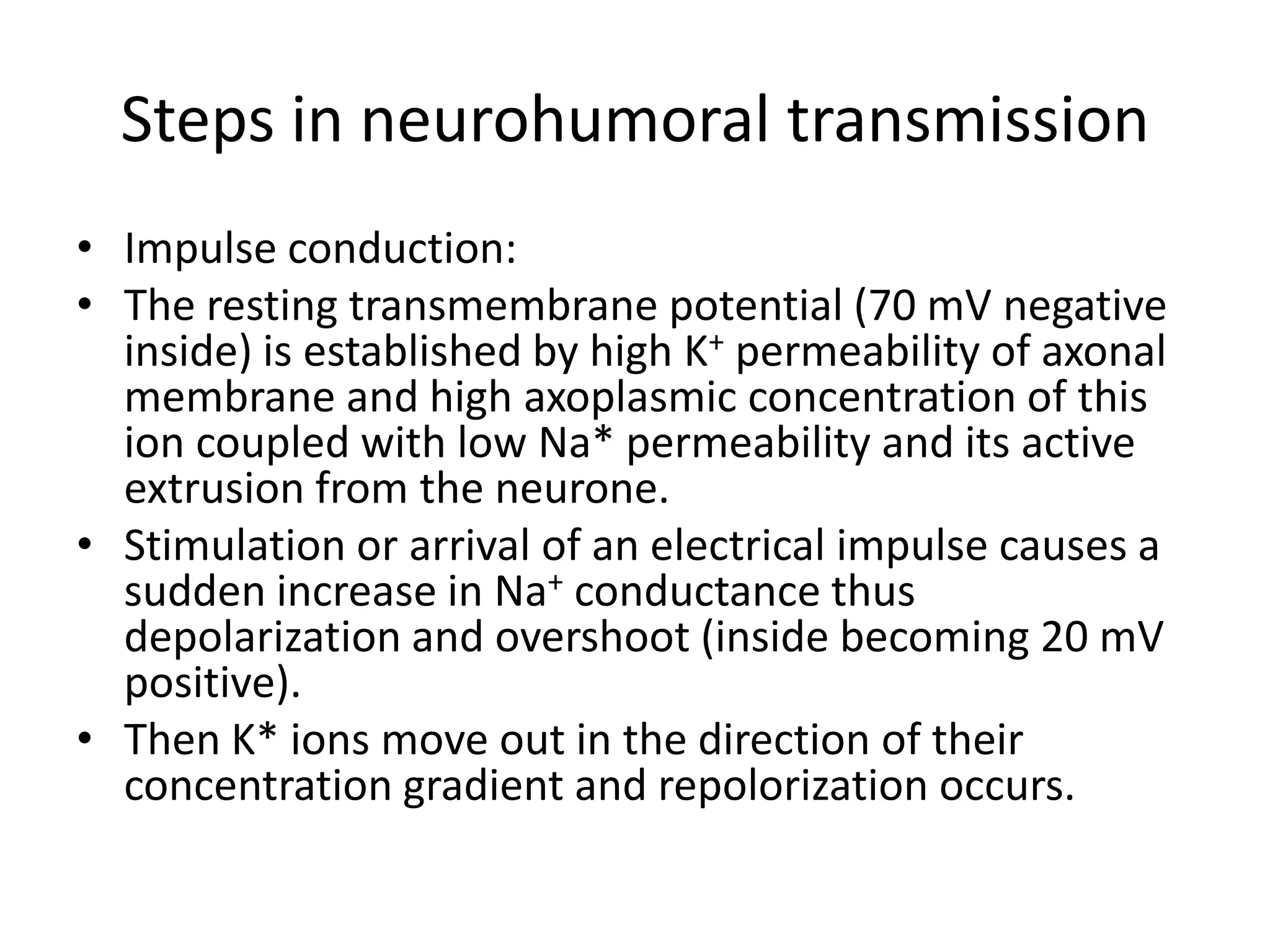
Steps in neurohumoral transmission
• Impulse conduction:
• The resting transmembrane potential (70 mV negative
  inside) is established by high K+ permeability of axonal
  membrane and high axoplasmic concentration of this
  ion coupled with low Na* permeability and its active
  extrusion from the neurone.
• Stimulation or arrival of an electrical impulse causes a
  sudden increase in Na+ conductance thus
  depolarization and overshoot (inside becoming 20 mV
  positive).
• Then K* ions move out in the direction of their
  concentration gradient and repolorization occurs.
• Tetrodotoxin (from puffer fish) and saxitoxin
  (from certain shell-fish) selectively abolish
  release in Na+ conductance in nerve fibres and
  thus block impulse conduction.
• Transmitter release
  – The transmitter(excitatory or inhibitory) is stored
    in prejunctional nerve endings within synaptic
    vesicles.
  – Nerve impulse promotes fusion of vesicular and
    axonal membranes through Ca+2 entry which
    fluidizes membranes.
  – All contents of the vesicle transmitter, enzymes
    and other proteins) are extruded (exocytosis) in
    the junctional cleft.
• The release process can be modulated by the
  transmitter itself and by other agents through
  activation of specific receptors located on the pre-
  junctional membrane.
• e.g. noradrenaline (NA) release is inhibited by NA (alfa-
  2 receptor),
• Dopamine, adenosine, prostaglandins and enkephalins
  -,While isoprenaline (B2 receptor) and angiotensin (AT1
  receptor) increase NA release.
• Similarly, alfa-2 and muscarinic agonists inhibit
  acetylcholine release at autonomic neuroeffector sites
  (but not in ganglia and skeletal muscles)
• Transmitter action on postiunctional membrane
  – The released transmitter combines with specific
    receptors on the postjunctional membrane and
    depending on its nature induces an excitatory
    postsynaptic potential (EPSP) or an inhibitory
    postsynaptic potential (IPSP).
     • EPSP Increase in permeability of all cations so there is Na+ or
       Ca+2 influx (through fast or slow channels) causes
       depolarization followed by K+ efflux.
     • These ionic movements are passive as the flow is down the
       concentration gradients.
• IPSP Increase in permeability to smaller
  ions, i.e. K+ and Cl- only, so that K+ moves out
  and Cl- moves in (in the direction of their
  concentration      gradients)      resulting  in
  hyperpolarization.
• Postjunctional activity
  – A suprathreshold EPSP generates a propagated
    postjunctional AP which results in nerve impulse
    (in neurone), contraction (in muscle) or secretion
    (in gland).
  – An IPSP stabilizes the postjunctional membrane
    and resists depolarizing stimuli.
• Termination of transmitter action
• Following its combination with the receptor, the
  transmitter is either locally degraded (e.g. ACh) or is
  taken back into the prejunctional neurone by active
  uptake or diffuses away (e.g. NA,GABA).
• Specific carrier proteins like norepinephrine
  transporter       (NET),     dopamine       transporter
  (DAT), serotonin transporter (SERT) are expressed on
  the axonal membrane for this purpose.
• The rate of termination of transmitter action govems
  the rate at which responses can be transmitted across
  a junction (1 to 1000/sec)

Ans

  • 1.
  • 2.
    ORGANIZATION AND FUNCTION •The autonomic nervous system (ANS) functions largely below the level of consciousness and controls visceral functions. • The ANS consists of afferents, centre and efferents nerves.
  • 6.
    NEUROHOMORAL TRANSMISSION • Neurohumonaltransmission implies that nerves transmit their message across synapses and neuroeffector junctions by the release of humoral (chemical) messengers.
  • 7.
    Steps in neurohumoraltransmission • Impulse conduction: • The resting transmembrane potential (70 mV negative inside) is established by high K+ permeability of axonal membrane and high axoplasmic concentration of this ion coupled with low Na* permeability and its active extrusion from the neurone. • Stimulation or arrival of an electrical impulse causes a sudden increase in Na+ conductance thus depolarization and overshoot (inside becoming 20 mV positive). • Then K* ions move out in the direction of their concentration gradient and repolorization occurs.
  • 8.
    • Tetrodotoxin (frompuffer fish) and saxitoxin (from certain shell-fish) selectively abolish release in Na+ conductance in nerve fibres and thus block impulse conduction.
  • 9.
    • Transmitter release – The transmitter(excitatory or inhibitory) is stored in prejunctional nerve endings within synaptic vesicles. – Nerve impulse promotes fusion of vesicular and axonal membranes through Ca+2 entry which fluidizes membranes. – All contents of the vesicle transmitter, enzymes and other proteins) are extruded (exocytosis) in the junctional cleft.
  • 10.
    • The releaseprocess can be modulated by the transmitter itself and by other agents through activation of specific receptors located on the pre- junctional membrane. • e.g. noradrenaline (NA) release is inhibited by NA (alfa- 2 receptor), • Dopamine, adenosine, prostaglandins and enkephalins -,While isoprenaline (B2 receptor) and angiotensin (AT1 receptor) increase NA release. • Similarly, alfa-2 and muscarinic agonists inhibit acetylcholine release at autonomic neuroeffector sites (but not in ganglia and skeletal muscles)
  • 11.
    • Transmitter actionon postiunctional membrane – The released transmitter combines with specific receptors on the postjunctional membrane and depending on its nature induces an excitatory postsynaptic potential (EPSP) or an inhibitory postsynaptic potential (IPSP). • EPSP Increase in permeability of all cations so there is Na+ or Ca+2 influx (through fast or slow channels) causes depolarization followed by K+ efflux. • These ionic movements are passive as the flow is down the concentration gradients.
  • 12.
    • IPSP Increasein permeability to smaller ions, i.e. K+ and Cl- only, so that K+ moves out and Cl- moves in (in the direction of their concentration gradients) resulting in hyperpolarization.
  • 13.
    • Postjunctional activity – A suprathreshold EPSP generates a propagated postjunctional AP which results in nerve impulse (in neurone), contraction (in muscle) or secretion (in gland). – An IPSP stabilizes the postjunctional membrane and resists depolarizing stimuli.
  • 14.
    • Termination oftransmitter action • Following its combination with the receptor, the transmitter is either locally degraded (e.g. ACh) or is taken back into the prejunctional neurone by active uptake or diffuses away (e.g. NA,GABA). • Specific carrier proteins like norepinephrine transporter (NET), dopamine transporter (DAT), serotonin transporter (SERT) are expressed on the axonal membrane for this purpose. • The rate of termination of transmitter action govems the rate at which responses can be transmitted across a junction (1 to 1000/sec)