ABBREVIATED NEW
DRUG APPLICATION
     (ANDA)
ABBREVIATED NEW DRUG APPLICATION

    INTRODUCTION

    “ANDA” is the abbreviation for “Abbreviated New Drug
     Application”. It contains data which when submitted to FDA’s
     Center for Drug Evaluation & Research, Office of Generic
     Drug, provides for the review & ultimate approval of a generic
     drug product.

    Once approved an applicant may manufacture & market the
     generic drug product provided all issues related to patent
     protection, safe, effectiveness, low cost alternative to the
     public.

    Generic drug applications are termed “abbreviated” because
     they are generally not required to include preclinical (animal)
     & clinical (human) data to establish safety & effectiveness.
   A generic drug product is one that is comparable to an
    innovator drug product in dosage form, strength, route of
    administration, quality, performance characteristics &
    intended use.

   All approved products, both innovator & generic, are listed in
    FDA’s Approved Drug Products with Therapeutic Equivalence
    Evaluations.

   Generic applicants must scientifically demonstrate that their
    product is bioequivalent (i.e. performs in the same manner as
    the innovator drug).

   The rate of absorption or bioavailability of the generic drug, is
    compared to that of the innovator drug.

   The generic version must deliver the same amount of active
    ingredients into a patient’s bloodstream in the same amount
    as that in the innovator drug.
 Using bioequivalence as the basis for approving generic copies
  of the drug products was established by the “Drug Price
  Competition & Patent Term Restoration Act of 1984”, also
  known as the Waxman-Hatch Act.

 At the same time, the branded name companies can apply for
  up to five additional years longer patent protection for the new
  medicines they developed to make up for time lost while their
  products were going through FDA’s approval process.

 Generic drug application reviewers focus on bioequivalence
  data, chemistry & microbiology data, request for plant
  inspection, & drug labeling information.
ANDA REQUIREMENT

1)   Signed FDA form 356h. Provides information regarding the
     applicants name & address, name of the drug product, the
     product strength & route of administration, indication of drug
     master files cited, proposed indications, a statement
     regarding whether the product is for prescription or over the
     counter.

2)   An index should specify volume & page number for each
     complete & detailed item.

3)   Information on the basis for which the ANDA is being
     submitted.
      a) Name of the reference drug, its dosage form & strength.
      b) Information on exclusively for the listed drug.
      c) If a suitability petition is approved a reference to the FDA
         number that was assigned to that suitability petition.
4) Condition for use, including,
   a) A statement regarding the condition for which the drug will be
   used.
   b) A reference to the annoted labeling for the product & the
   currently approved labeling for the listed drug product.

5)   A statement that active ingredient is the same as for that of the
     reference drug. For the combination product this must be shown for
     both active ingredient.

6) Route of administration, dosage form & strength. This should include
    a statement that the route of administration, dosage form & strength
    are same as the reference drug.
   Bioequivalence. This should include information to demonstrate that
    the proposed drug is bioequivalent to the listed drug product.
7) Labeling. Include a copy of currently approved labeling for the
   listed drug as well as the proposed labeling for the drug being
   provided for in the ANDA. A side by side comparison of two sets of
   labeling is also necessary.

8) Chemistry, Manufacturing & Controls. Describe the composition,
  manufacture, specifications & analytical procedures for the drug
  substance & drug product.

9) Human Pharmacokinetics & Bioavailability.

  This include information concerning
   • The Design
   • The Dosing procedure
   • The number & frequency of blood & urine collection &
     Methodology for the assay.
10) Samples.
  The sample of the Drug substance & finished product should be
  provided four individuals units with sufficient quantities in each unit to
  permit the FDA       to perform all the tests included in the
  specifications at least three times

11) Analytical method for drug substance & drug product. This section
   should consists of the specifications, analytical method, certificates of
   analysis, method of analysis, method validation & stability indicating
   data as contained in the chemistry, manufacturing & control part of
   the application.

12) Labeling. 12 specimen of the final printed label & all labeling for the
  drug product are to be included.

13) Case report forms & tabulations. The need for these should be
  discussed with appropriate personnel of the division of
  bioequivalence prior to submission of the ANDA.
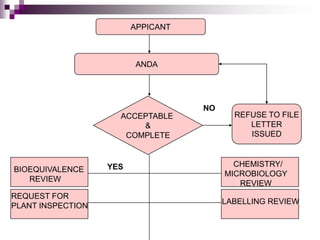
APPICANT


                         ANDA


                                    NO
                     ACCEPTABLE            REFUSE TO FILE
                         &                    LETTER
                      COMPLETE                ISSUED


                   YES                     CHEMISTRY/
BIOEQUIVALENCE
                                         MICROBIOLOGY
   REVIEW
                                            REVIEW
REQUEST FOR
                                         LABELLING REVIEW
PLANT INSPECTION
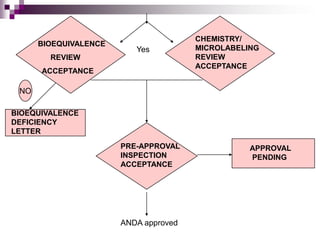
CHEMISTRY/
      BIOEQUIVALENCE
                          Yes          MICROLABELING
        REVIEW                         REVIEW
                                       ACCEPTANCE
      ACCEPTANCE

 NO

BIOEQUIVALENCE
DEFICIENCY
LETTER
                       PRE-APPROVAL               APPROVAL
                       INSPECTION                 PENDING
                       ACCEPTANCE


                       ANDA approved
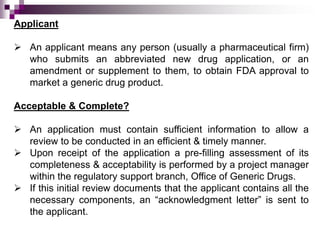
Applicant

 An applicant means any person (usually a pharmaceutical firm)
  who submits an abbreviated new drug application, or an
  amendment or supplement to them, to obtain FDA approval to
  market a generic drug product.

Acceptable & Complete?

 An application must contain sufficient information to allow a
  review to be conducted in an efficient & timely manner.
 Upon receipt of the application a pre-filling assessment of its
  completeness & acceptability is performed by a project manager
  within the regulatory support branch, Office of Generic Drugs.
 If this initial review documents that the applicant contains all the
  necessary components, an “acknowledgment letter” is sent to
  the applicant.
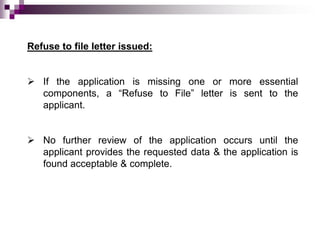
Refuse to file letter issued:


 If the application is missing one or more essential
  components, a “Refuse to File” letter is sent to the
  applicant.


 No further review of the application occurs until the
  applicant provides the requested data & the application is
  found acceptable & complete.
Bioequivalence Review:

 The Bioequivalence Review process established that the
  proposed generic drug is bioequivalent to the reference listed
  drug, based upon a demonstration that both the rate & extent of
  absorption of the active ingredient of the generic drug fall within
  established parameters when compared to that of the reference
  listed drug.

 Applicants may request a waiver from performing in vivo (testing
  done in humans) bioequivalence studies for certain drug
  products where bioavailability may be demonstrated by
  submitting data such as 1) a formulation comparison for products
  whose bioavailability is self evident, for example, oral solutions,
  injectables, or ophthalmic solutions where the formulations are
  identical, or 2) comparative dissolution.
 Alternatively, in vivo bioequivalence testing comparing the rate &
  extent of absorption of the generic vs. the reference product is
  required for most tablet & capsule dosage forms. For certain
  products, a head to head evaluation of comparative efficacy
  based upon clinical endpoints may be required.

Chemistry/Microbiology Review:

 The Chemistry/Microbiology review process provides assurance
  that the generic drug will be manufactured in a reproducible
  manner under controlled conditions.

 Areas such as the applicant’s manufacturing procedures, raw
  material specifications & controls, sterilization process,
  container & closure systems, accelerated & room temperature
  stability data are reviewed to assure that the drug will perform in
  an acceptable manner.
Labeling Review:

 The labeling review process ensures that the proposed generic
  drug labeling (package insert, container, package label & patient
  information) is identical to that of the reference listed drug
  except for differences due to changes in the manufacturer,
  distributor, pending exclusively issues, or other characteristics
  inherent to the generic drug product (tablet size, shape or color,
  etc.).

 Furthermore, the labeling review serves to identify & resolve
  issues that may contribute to medication errors such as similar
  sounding or appearing drug names, & the legibility or
  prominence of the name or strength.
Bioequivalence Review Acceptable?

 If at the conclusion of the Bioequivalence Review, it is
  determined that there are deficiencies in the bioequivalence
  portion of the application, a bioequivalence Deficiency Letter is
  issued by the division of Bioequivalence to the applicant.

 This deficiency letter details the deficiencies & requests
  information & data to resolve them.
Chemistry/Microbiology/Labeling Review Acceptable?

 If     there      are     deficiencies     involved    in    the
  Chemistry/Manufacturing/Controls, Microbiology or Labeling
  portions of the application, these deficiencies are communicated
  to the applicant in a facsimile.

 The facsimile instructs the applicant to provide information &
  data to address the deficiencies & provides regulatory direction
  on how to amend the application.

 Once the above sections are found to be acceptable, as well as,
  the pre-approval inspection & bioequivalence portion of the
  application, then the application moves toward approval.
Pre-approval Inspection Acceptable?

 The pre-approval inspection determines compliance with Current
  Good Manufacturing Practices (cGMPs) as well as a product
  specific evaluation concerning the manufacturing process of the
  application involved.

 If an unsatisfactory recommendation is received, a not
  approvable letter may be issued.
ANDA Approved:

 After all components of the application are found to be
  acceptable an approval or tentative approval letter is issued to
  the applicant.

 If the approval occurs prior to the expiration of any patents or
  exclusivities accorded to the reference listed drug product, a
  tentative approval letter is issued to the applicant which details
  the circumstances associated with the tentative approval of the
  generic drug product & delays approval until all patent/exclusivity
  issues have expired.

 A tentative approval does not allow the applicant to market the
  generic drug product.
REFERENCES:

   1.   New Drug Approval Process,
        Richard Gaurino, Marcel DekkerINC,
        New York, 2nd Edition, Vol.56, 189-212.

   2.    www.fda.gov.
Anda

Anda

  • 1.
  • 2.
    ABBREVIATED NEW DRUGAPPLICATION INTRODUCTION  “ANDA” is the abbreviation for “Abbreviated New Drug Application”. It contains data which when submitted to FDA’s Center for Drug Evaluation & Research, Office of Generic Drug, provides for the review & ultimate approval of a generic drug product.  Once approved an applicant may manufacture & market the generic drug product provided all issues related to patent protection, safe, effectiveness, low cost alternative to the public.  Generic drug applications are termed “abbreviated” because they are generally not required to include preclinical (animal) & clinical (human) data to establish safety & effectiveness.
  • 3.
    A generic drug product is one that is comparable to an innovator drug product in dosage form, strength, route of administration, quality, performance characteristics & intended use.  All approved products, both innovator & generic, are listed in FDA’s Approved Drug Products with Therapeutic Equivalence Evaluations.  Generic applicants must scientifically demonstrate that their product is bioequivalent (i.e. performs in the same manner as the innovator drug).  The rate of absorption or bioavailability of the generic drug, is compared to that of the innovator drug.  The generic version must deliver the same amount of active ingredients into a patient’s bloodstream in the same amount as that in the innovator drug.
  • 4.
     Using bioequivalenceas the basis for approving generic copies of the drug products was established by the “Drug Price Competition & Patent Term Restoration Act of 1984”, also known as the Waxman-Hatch Act.  At the same time, the branded name companies can apply for up to five additional years longer patent protection for the new medicines they developed to make up for time lost while their products were going through FDA’s approval process.  Generic drug application reviewers focus on bioequivalence data, chemistry & microbiology data, request for plant inspection, & drug labeling information.
  • 5.
    ANDA REQUIREMENT 1) Signed FDA form 356h. Provides information regarding the applicants name & address, name of the drug product, the product strength & route of administration, indication of drug master files cited, proposed indications, a statement regarding whether the product is for prescription or over the counter. 2) An index should specify volume & page number for each complete & detailed item. 3) Information on the basis for which the ANDA is being submitted. a) Name of the reference drug, its dosage form & strength. b) Information on exclusively for the listed drug. c) If a suitability petition is approved a reference to the FDA number that was assigned to that suitability petition.
  • 6.
    4) Condition foruse, including, a) A statement regarding the condition for which the drug will be used. b) A reference to the annoted labeling for the product & the currently approved labeling for the listed drug product. 5) A statement that active ingredient is the same as for that of the reference drug. For the combination product this must be shown for both active ingredient. 6) Route of administration, dosage form & strength. This should include a statement that the route of administration, dosage form & strength are same as the reference drug. Bioequivalence. This should include information to demonstrate that the proposed drug is bioequivalent to the listed drug product.
  • 7.
    7) Labeling. Includea copy of currently approved labeling for the listed drug as well as the proposed labeling for the drug being provided for in the ANDA. A side by side comparison of two sets of labeling is also necessary. 8) Chemistry, Manufacturing & Controls. Describe the composition, manufacture, specifications & analytical procedures for the drug substance & drug product. 9) Human Pharmacokinetics & Bioavailability. This include information concerning • The Design • The Dosing procedure • The number & frequency of blood & urine collection & Methodology for the assay.
  • 8.
    10) Samples. The sample of the Drug substance & finished product should be provided four individuals units with sufficient quantities in each unit to permit the FDA to perform all the tests included in the specifications at least three times 11) Analytical method for drug substance & drug product. This section should consists of the specifications, analytical method, certificates of analysis, method of analysis, method validation & stability indicating data as contained in the chemistry, manufacturing & control part of the application. 12) Labeling. 12 specimen of the final printed label & all labeling for the drug product are to be included. 13) Case report forms & tabulations. The need for these should be discussed with appropriate personnel of the division of bioequivalence prior to submission of the ANDA.
  • 9.
    APPICANT ANDA NO ACCEPTABLE REFUSE TO FILE & LETTER COMPLETE ISSUED YES CHEMISTRY/ BIOEQUIVALENCE MICROBIOLOGY REVIEW REVIEW REQUEST FOR LABELLING REVIEW PLANT INSPECTION
  • 10.
    CHEMISTRY/ BIOEQUIVALENCE Yes MICROLABELING REVIEW REVIEW ACCEPTANCE ACCEPTANCE NO BIOEQUIVALENCE DEFICIENCY LETTER PRE-APPROVAL APPROVAL INSPECTION PENDING ACCEPTANCE ANDA approved
  • 11.
    Applicant  An applicantmeans any person (usually a pharmaceutical firm) who submits an abbreviated new drug application, or an amendment or supplement to them, to obtain FDA approval to market a generic drug product. Acceptable & Complete?  An application must contain sufficient information to allow a review to be conducted in an efficient & timely manner.  Upon receipt of the application a pre-filling assessment of its completeness & acceptability is performed by a project manager within the regulatory support branch, Office of Generic Drugs.  If this initial review documents that the applicant contains all the necessary components, an “acknowledgment letter” is sent to the applicant.
  • 12.
    Refuse to fileletter issued:  If the application is missing one or more essential components, a “Refuse to File” letter is sent to the applicant.  No further review of the application occurs until the applicant provides the requested data & the application is found acceptable & complete.
  • 13.
    Bioequivalence Review:  TheBioequivalence Review process established that the proposed generic drug is bioequivalent to the reference listed drug, based upon a demonstration that both the rate & extent of absorption of the active ingredient of the generic drug fall within established parameters when compared to that of the reference listed drug.  Applicants may request a waiver from performing in vivo (testing done in humans) bioequivalence studies for certain drug products where bioavailability may be demonstrated by submitting data such as 1) a formulation comparison for products whose bioavailability is self evident, for example, oral solutions, injectables, or ophthalmic solutions where the formulations are identical, or 2) comparative dissolution.
  • 14.
     Alternatively, invivo bioequivalence testing comparing the rate & extent of absorption of the generic vs. the reference product is required for most tablet & capsule dosage forms. For certain products, a head to head evaluation of comparative efficacy based upon clinical endpoints may be required. Chemistry/Microbiology Review:  The Chemistry/Microbiology review process provides assurance that the generic drug will be manufactured in a reproducible manner under controlled conditions.  Areas such as the applicant’s manufacturing procedures, raw material specifications & controls, sterilization process, container & closure systems, accelerated & room temperature stability data are reviewed to assure that the drug will perform in an acceptable manner.
  • 15.
    Labeling Review:  Thelabeling review process ensures that the proposed generic drug labeling (package insert, container, package label & patient information) is identical to that of the reference listed drug except for differences due to changes in the manufacturer, distributor, pending exclusively issues, or other characteristics inherent to the generic drug product (tablet size, shape or color, etc.).  Furthermore, the labeling review serves to identify & resolve issues that may contribute to medication errors such as similar sounding or appearing drug names, & the legibility or prominence of the name or strength.
  • 16.
    Bioequivalence Review Acceptable? If at the conclusion of the Bioequivalence Review, it is determined that there are deficiencies in the bioequivalence portion of the application, a bioequivalence Deficiency Letter is issued by the division of Bioequivalence to the applicant.  This deficiency letter details the deficiencies & requests information & data to resolve them.
  • 17.
    Chemistry/Microbiology/Labeling Review Acceptable? If there are deficiencies involved in the Chemistry/Manufacturing/Controls, Microbiology or Labeling portions of the application, these deficiencies are communicated to the applicant in a facsimile.  The facsimile instructs the applicant to provide information & data to address the deficiencies & provides regulatory direction on how to amend the application.  Once the above sections are found to be acceptable, as well as, the pre-approval inspection & bioequivalence portion of the application, then the application moves toward approval.
  • 18.
    Pre-approval Inspection Acceptable? The pre-approval inspection determines compliance with Current Good Manufacturing Practices (cGMPs) as well as a product specific evaluation concerning the manufacturing process of the application involved.  If an unsatisfactory recommendation is received, a not approvable letter may be issued.
  • 19.
    ANDA Approved:  Afterall components of the application are found to be acceptable an approval or tentative approval letter is issued to the applicant.  If the approval occurs prior to the expiration of any patents or exclusivities accorded to the reference listed drug product, a tentative approval letter is issued to the applicant which details the circumstances associated with the tentative approval of the generic drug product & delays approval until all patent/exclusivity issues have expired.  A tentative approval does not allow the applicant to market the generic drug product.
  • 20.
    REFERENCES: 1. New Drug Approval Process, Richard Gaurino, Marcel DekkerINC, New York, 2nd Edition, Vol.56, 189-212. 2. www.fda.gov.