Basic Neurochemistry


       Presented by:-
       Mr. Dharmesh Kheni
       Training team
                            1
CONTENTS
•   Organization of NS
•   Brain
•   Spinal cord
•   Peripheral nervous system
•   Autonomic nervous system
•   Neurotransmission
•   Major neurotransmitters and
    receptors
                                  2
ORGANIZATION OF
            NERVOUS SYSTEM
                         NERVOUS SYSTEM


         PERIPHERAL NERVOUS SYSTEM CENTRAL NERVOUS SYSTEM


AUTONOMIC NERVOUS SYSTEM SOMATIC NERVOUS SYSTEM


                                       BRAIN       SPINAL CORD

PARASYMPATHETIC          SYMPATHETIC


                                                       3
Brain
        4
The Neuron


             5
The Neuron
Soma    Dendrites


                    Myelin
                    Sheath


                             Axon
                     Axon    Terminals


                                   6
The Neuron
• Soma (cell body) – contains nucleus,
  cytoplasm, organelles
• Dendrites – receive info
• Axon – transmits info
• Myelin sheath – covers the axon to
  increase transmission speed (cause
  of sensory and motor disturbances in
  multiple sclerosis)

                                    7
Neuron
• Basic functional unit of nervous system

• Unique features of neuron:

  – Excitability

  – Conductivity


                                      8
What is a synapse?
• A synapse is the junction between 2
  neurones.
• There is a very narrow gap of about
  20nm between neurones called the
  synaptic cleft.
• A nerve impulse cannot cross the
  synaptic cleft, so nerve impulses are
  carried by chemicals called
  neurotransmitters.

                                          9
SYNAPSE

          10
Action Potential/Impulse conduction
• The information in neuron is passed from one to
  another in the form of nerve signal i.e. Action
  potential, which is due to its unique features of
  excitability and conductivity.


                                              11
Action Potential
• Nerve signals are transmitted by action
  potential
• Any stimulus - Mechanical
                  Physical
                  Biochemical


 Sudden change in resting membrane
  potential
                                        C
                                            12
13
Resting membrane potential
•  Normally there is an excess of positive charges
  outside the cell
• Inside of the cell is negative with respect to
  outside
• Called as Resting membrane potential
 Normal Resting Membrane Potential is -70mv
 Due to unequal no. of ions on either side of the
  membrane

                                           14
Resting membrane
              potential

• Following are the ions which play
  important role in generating resting
  membrane potential :
   - Sodium ions ( +vely charged)
   - Potassium ions ( +vely charged)
   - Chloride ions ( -vely charged)
   - Organic ions ( e.g. proteins) :-vely
  charged
                                            15
Resting membrane potential
• Na+K+Pump actively pump 3 Na+ outside
  the neuron for each 2 K+ inside the neuron.
• Thus Most of the sodium ions remain
  outside of the cell and Potassium ions are
   inside the cell.
• This creates negative potential inside the
  resting neuron -70mv


                                          16
17
Action Potential
Resting stage : - 70mv
           Any stimulus – Mechanical, Physical or
           Biochemical

          Change in resting membrane potential
          (from -70mv to +30mv)

         This change in RMP causes opening of
         voltage gated Na+ channel

         More entry of Na+ inside the neuron

      Reaches Maximum electropotential +30 to 35mv
   This gradual increase in charge is called as
   depolarization
                                                    18
•   Depolarization:
    Each action potential begins with a sudden
    change from the normal resting negative
    membrane potential to a positive potential
•   Repolarization :
    After depolarization the action potential ends
    with equally rapid change back to negative
    potential


                                             19
20
The Synapse
      • Axon        terminal
        releases
        neurotransmitters.
      • Neurotransmitters
        cross the synapse
        and      bind      to
        receptors         on
        another neuron.
      • Neurotransmitters
        released, taken up
        again     by    first
        neuron.
                         21
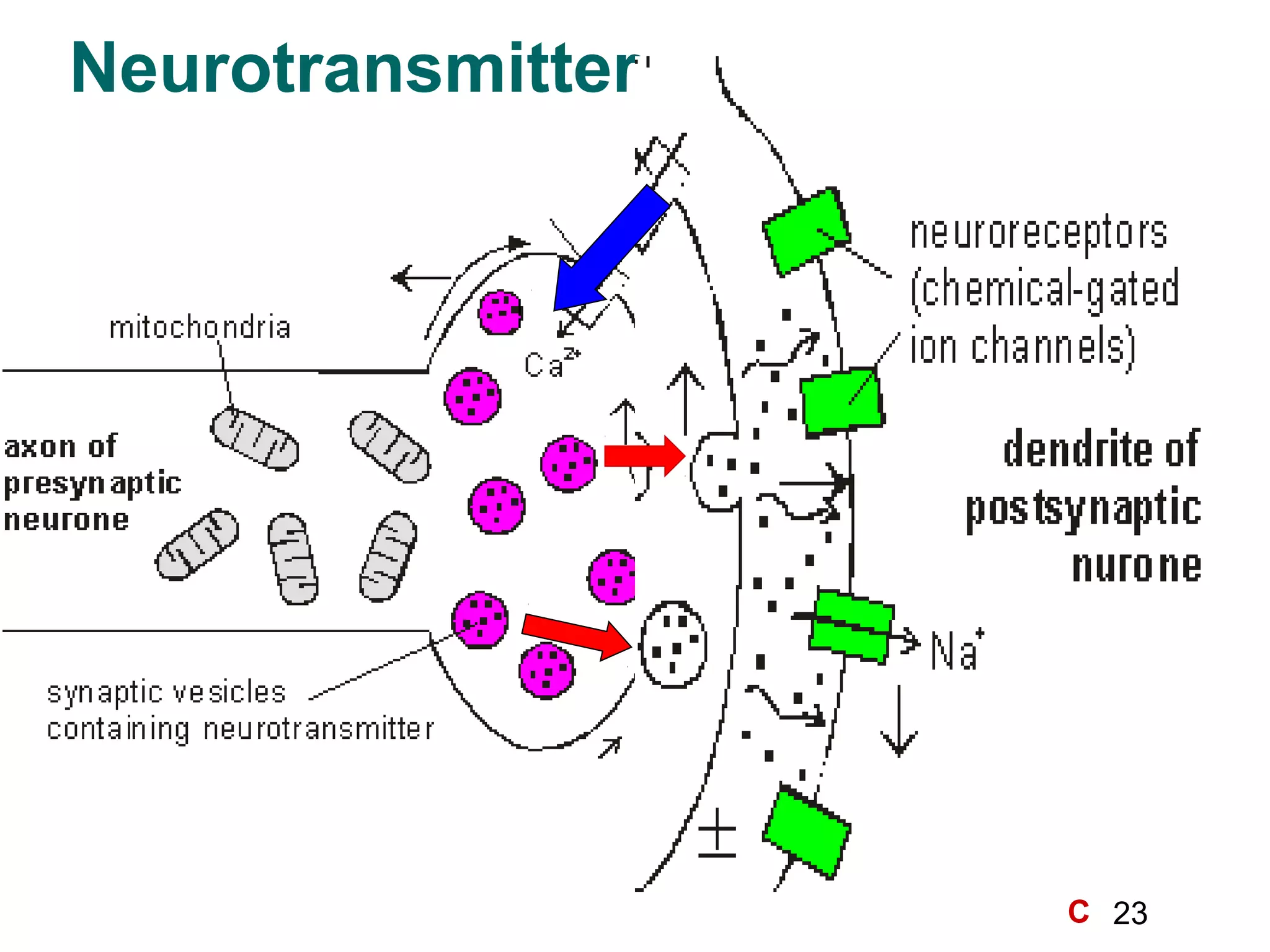
NEUROTRANSMITTERS

• Chemicals produced by the body that
  are released from the nerve endings
• Enable passage of impulses from one
  neuron to another across the synapse
• Act on their specific receptors
  (glycoprotein structures on the cell
  membrane)

                                   22
Neurotransmitter


                   C 23
Fate of Neurotransmitter
                   Pre Synaptic neuron
Re
   u
  pt
   ak


                                                          rs
     e


                                                     it te
       Ch


                                                sm
          a


                                              n
         nn


                                        tra
            e


                                       o
                                    ur
              ls


                       MAO        Ne
                                                     Auto Receptor

                                          Vesicles

                                                            tors
COMT                                           apt ic Recep
                                      Post Syn


                   Post Synaptic neuron                  Diffusio
                                                                 n   of NTs


                                                                       24
1.Fate of Neurotransmitter
        Pre Synaptic neuron


       Post Synaptic neuron


                              25
2.Fate of Neurotransmitter
           Pre Synaptic neuron


Reuptake
channel


           Post Synaptic neuron


                                  26
3.Fate of Neurotransmitter
        Pre Synaptic neuron


                              Auto Receptor
                              prevents further
                              release


       Post Synaptic neuron


                                           27
4.Fate of Neurotransmitter
           Pre Synaptic neuron


Reuptake
                MAO               Auto Receptor
channel                           prevents further
                                  release


COMT


           Post Synaptic neuron


                                               28
5.Fate of Neurotransmitter
           Pre Synaptic neuron


Reuptake                          Auto Receptor
channel                           prevents further
                                  release


COMT


           Post Synaptic neuron


                                               29
6.Fate of Neurotransmitter
           Pre Synaptic neuron


Reuptake                          Auto Receptor
channel                           prevents further
                                  release


           Post Synaptic neuron    Diffusio
                                           n   of NTs


                                                 30
Neurotransmitters
•  Excitatory :
    - Stimulate neurons
    e.g. Noradrenaline, Dopamine,
  Histamine, Serotonin, Glutamate etc.
Acetyl-choline (neuromodulator)

•   Inhibitory :
     - Suppress the neurons
     e.g. GABA (Gamma-Amino-Butyric-
    Acid)                        31
Neurotransmitters
• Acetylcholine – movement (respiratory
  paralysis)
• Serotonin – mood, sleep, appetite, anxiety
  (depression, obsessive-compulsive
  disorder, panic disorder)
• Dopamine – motivation, pleasure
  (schizophrenia, Parkinson’s)
• Epinephrine and Norepinephrine –
  attention, anxiety, stress (epilepsy, mania in
  bipolar disorder)
                                            32
Serotonin
• Serotonin - 5-Hydroxytriptamine
• Also known as 5-HT
• Known to control impulse, emotion &
  behaviour
• Increased levels leads to aggression
• Reduced level may induce suicidal
  thoughts
• Involved in sleep & depression
                                    33
Serotonin Receptors
• The serotonin receptors are called
  5HT1, 5HT2, 5HT3, 5HT4, 5HT5, 5HT6 &
  5HT7.
• These are further subdivided as 5HT 1A,
  5HT2A,5HT1B, 5HT1D etc.


                                     34
Serotonin Receptors


                      35
Serotonergic
pathways


       36
AcetylCholine
•    Acetylcholine     is    the  major
     neurotransmitter which controls
     various activities like
1.   contraction of skeletal muscles,
2.   relaxation of cardiac muscles,
     arousal,
3.   reward,
4.   memory,
5.   short term learning
                                    37
Acetylcholine

• Found       in
  neuromuscular
  junction
• Involved    in
  muscle
  movements


                       38
Receptors of Acetylcholine
• The receptors of Ach are of various
  types & are complicated in nature
• Muscarinic & nicotinic receptors are
  important
• Muscarinic receptors M1, M2, M3 …M5
• Binding of Ach with M1 M3 M5 causes
  stimulatory effects whereas binding
  with M2 & M4 Causes inhibitory
  action.
                                     39
Muscarinic
receptor


       40
Nicotinic
Receptor

 N1, N2


    41
Cholinergic
pathways


        42
Norepinephrine/Noradrenaline

• Noradrenaline normally produces
  effects such as increased heart rate,
  increased blood pressure, dilation of
  pupils, dilation of air passages in the
  lungs and narrowing of blood vessels
  in non-essential organs. This enables
  the body to perform well in stressful
  situations. Increases levels of energy,
  interest & Mood.
                                      43
Norepinephrine/Noradrenaline
• Receptors :
   Alpha receptors:
         - α1 receptors
         Found in the blood vessels
         - α2 receptors (Auto receptor)
    Beta receptors:
        - β 1 receptors
           Mainly found in heart
        - β 2 receptors
           Mainly found in bronchi

                                          44
Noradrenergic
pathways


       45
DOPAMINE
• Dopamine interacts with receptors on
  some peripheral nerve fibers and many
  central neurons (eg, in the substantia
  nigra, midbrain, ventral tegmental area,
  and hypothalamus).
• After release and interaction with
  receptors, dopamine is actively pumped
  back (reuptake) into the nerve terminal.


                                       46
Dopamine
• Involved in movement, attention and
  learning, drive, desire motivation &
  pleasure/reward
• Dopamine imbalance also involved in
  schizophrenia
• Loss of dopamine- producing
  neurons is cause of Parkinson’s
  Disease

                                   47
DOPAMINE RECEPTORS
• Dopaminergic receptors are
  classified as D1 through D5.
• D3 and D4 receptors play a role
  in thought control (limiting the
  negative symptoms of
  schizophrenia); D2 receptor
  activation controls the
  extrapyramidal system.

                                     48
D2 is primarily a post synaptic receptor
whereas D3 is believed
To be a autoreceptor

                                    49
Dopaminergic
pathways


      50
Gama Amino Butyric Acid
• It is primarily an inhibitory
  neurotransmitter responsible for
  Sleep, prevents anxiety & stress
  signals & has an overall calming effect
  on the brain.
• It has three receptors GABAA, GABAB
 & GABAC


                                     51
GABA receptor
complex


        52
Gabanergic
pathways


      53
SUBSTANCE-P
• Substance P, a peptide, occurs
  in central neurons (habenula,
  substantia nigra, basal ganglia,
  medulla, and hypothalamus) and
  is highly concentrated in the
  dorsal root ganglia.
• Its release is triggered by
  intense afferent painful stimuli.

                                      54
NITRIC OXIDE
• Nitric oxide (NO) is a labile gas that mediates
  many neuronal processes.
• It is generated from arginine by NO synthase,
  an enzyme that activates soluble guanylate
  cyclase by binding to Ca/calmodulin
  complexes.
• Thus, neurotransmitters that increase
  intracellular Ca (eg, substance P, glutamate,
  acetylcholine) stimulate NO synthesis in
  neurons that express NO synthetase.
• NO may be an intracellular messenger; it may
  diffuse out of a cell into a 2nd neuron and
  produce physiologic responses (eg, long-term
  potentiation [a form of learning],
  neurotransmitter release and reuptake) or
  enhance glutamate (NMDA) receptor-mediated
  neurotoxicity.
                                                    55
Glutamate & Aspartate

• They are excitatory neurotransmitters.
• Their receptors are of 2 types.
   – Ionotropic
   – N- Methyl D- Aspartate. (NMDA)
Alpha-amino-3-hydroxyl-5-methyl-4-isoxozole
  propionic acid (AMPA)
   – Metabotropic
Trans-1-aminoclycopentane1,3Dicarboxylicacid.
  (Trans- ACPD)
                                       56
Drugs
• Drugs which have molecules of
  similar shape to transmitter
  substances can affect protein
  receptors in postsynaptic
  membranes.
• Drugs that stimulate a nervous
  system are called AGONISTS
• Drugs that inhibit a nervous
  system are called
  ANTAGONISTS.
                                   57
NEUROTRASMISSION
• A neuron generates and propagates an
  action potential along its axon, then
  transmits this signal across a synapse by
  releasing     neurotransmitters,    which
  trigger a reaction in another neuron or an
  effector cell (eg, muscle cells; most
  exocrine and endocrine cells).
• The signal may stimulate or inhibit the
  receiving cell, depending on the
  neurotransmitter and receptor involved.


                                          58
Blood brain barrier: A mechanism that
creates a barrier between brain tissues and
circulating blood; serves to protect the central
nervous system.

 Propagation: passing of electrical impulse
 within neuron by exchange of Na+ and K+
 across the axonal membrane.


                                                   59
BASIC PHARMACOLOGY


                60
Receptors
• Specific macromolecular components of
  the cell which act as a binding site with
  functional correlate to produce effect

• Situated - on the surface / inside the cell


                                           61
Drug at Receptor
• Agonist : It activates a receptor to produce an effect
  similar to that of the physiological signal molecule

• Antagonist : It prevents the action of an agonist on a
  receptor but does not have any effect of its own


• Partial agonist : It activates a receptor to produce sub
  maximal effect but antagonises the action of full
  agonist.

                                                   62
63
64
Competitive antagonist
– Competes with an agonist for receptors
– High doses of an agonist can generally overcome antagonist


                                                     65
PHARMACODYNAMICS
• It it the quantitative study of the biological
  and therapeutic effects of drugs.


• “What Drug does to the body”


                                          66
PHARMACOKINETICS

• It    is the study      of
  absorption,  distribution,
  metabolism and excretion
  of drugs

• “What Body does to the
  Drug”
                         67
Pharmacokinetics
• Absorption
  How the drug is moved into blood stream from the site
   of administration ?

• Distribution
  How much drug is moved to various body tissues /
   organs ? Depends on blood flow through tissue

• Metabolism
  How the drug is altered – broken down ?

• Elimination
  How much of the drug is removed from the body ?

                                                   68
Absorption and Bioavailability
• Absorption is the movement of drug from its
  site of administration into the circulation.

• Bioavailability : Fraction of administered dose
  of a drug that reaches the systemic circulation
  in the unchanged form.
  – Bioavailability of IV route : 100 %


                                            69
Bioavailability


                  70
Half-Life

• It is a time required for 50% of
  elimination   of    the    plasma
  concentration of the administered
  drug.


                               71
Half Life (t1/2)
110
100
 90
 80
 70
 60
 50
 40
 30
 20
 10
  0
      0   1   2   3    4           5     6   7   8   9
                      T ime (ho ur s )


                                                         72
DRUG EXCRETION

•   Kidneys
•   Lungs
•   Skin
•   Bile
•   Milk and Saliva


                      73
FACTORS MODIFYING THE
   EFFECTS OF DRUG
 •   Body weight
 •   Age
 •   Gender.
 •   Diet & environment
 •   Route of administration
 •   Emotional Factors


                               74
FACTORS MODIFYING
THE EFFECTS OF DRUG
•   Genetic factors
•   metabolic disturbances
•   Presence of disease
•   Other drug therapy
•   Additive effect
•   Antagonism - chemical
    antagonism
                             75
76
Effect of nicotine and
       atropine


                         77
The Blood-Brain Barrier


                      78
The Blood-Brain Barrier
• Endothelial cells in blood vessels in
  the brain fit closely together
• Only some molecules can pass
  through
• Protects the brain from foreign
  molecules and hormones and
  neurotransmitters from other parts of
  the body
• Can be damaged by infections, head
  trauma, high blood pressure, etc.
                                     79
The Brain


            80
The Brain


            81
The Brain
• Cerebral Cortex – thought, language,
  reasoning, movement, sensation
• Corpus Callosum – connects the right
  and left hemispheres
• Cerebellum – movement, balance
• Brainstem – breathing, heart rate


                                   82
Lobes of the Brain


                     83
Lobes of the Brain
• Frontal Lobe – personality, planning,
  emotion, problem solving
  – Motor cortex - movement
  – Broca’s area – speech production
• Parietal Lobe - touch
• Temporal Lobe – hearing
  – Inferotemporal Cortex – object
    recognition
  – Wernicke’s area – language
    comprehension
• Occipital Lobe - vision
                                       84
85

Basic neurochemistry

  • 1.
    Basic Neurochemistry Presented by:- Mr. Dharmesh Kheni Training team 1
  • 2.
    CONTENTS • Organization of NS • Brain • Spinal cord • Peripheral nervous system • Autonomic nervous system • Neurotransmission • Major neurotransmitters and receptors 2
  • 3.
    ORGANIZATION OF NERVOUS SYSTEM NERVOUS SYSTEM PERIPHERAL NERVOUS SYSTEM CENTRAL NERVOUS SYSTEM AUTONOMIC NERVOUS SYSTEM SOMATIC NERVOUS SYSTEM BRAIN SPINAL CORD PARASYMPATHETIC SYMPATHETIC 3
  • 4.
  • 5.
  • 6.
    The Neuron Soma Dendrites Myelin Sheath Axon Axon Terminals 6
  • 7.
    The Neuron • Soma(cell body) – contains nucleus, cytoplasm, organelles • Dendrites – receive info • Axon – transmits info • Myelin sheath – covers the axon to increase transmission speed (cause of sensory and motor disturbances in multiple sclerosis) 7
  • 8.
    Neuron • Basic functionalunit of nervous system • Unique features of neuron: – Excitability – Conductivity 8
  • 9.
    What is asynapse? • A synapse is the junction between 2 neurones. • There is a very narrow gap of about 20nm between neurones called the synaptic cleft. • A nerve impulse cannot cross the synaptic cleft, so nerve impulses are carried by chemicals called neurotransmitters. 9
  • 10.
  • 11.
    Action Potential/Impulse conduction •The information in neuron is passed from one to another in the form of nerve signal i.e. Action potential, which is due to its unique features of excitability and conductivity. 11
  • 12.
    Action Potential • Nervesignals are transmitted by action potential • Any stimulus - Mechanical Physical Biochemical Sudden change in resting membrane potential C 12
  • 13.
  • 14.
    Resting membrane potential • Normally there is an excess of positive charges outside the cell • Inside of the cell is negative with respect to outside • Called as Resting membrane potential Normal Resting Membrane Potential is -70mv Due to unequal no. of ions on either side of the membrane 14
  • 15.
    Resting membrane potential • Following are the ions which play important role in generating resting membrane potential : - Sodium ions ( +vely charged) - Potassium ions ( +vely charged) - Chloride ions ( -vely charged) - Organic ions ( e.g. proteins) :-vely charged 15
  • 16.
    Resting membrane potential •Na+K+Pump actively pump 3 Na+ outside the neuron for each 2 K+ inside the neuron. • Thus Most of the sodium ions remain outside of the cell and Potassium ions are inside the cell. • This creates negative potential inside the resting neuron -70mv 16
  • 17.
  • 18.
    Action Potential Resting stage: - 70mv Any stimulus – Mechanical, Physical or Biochemical Change in resting membrane potential (from -70mv to +30mv) This change in RMP causes opening of voltage gated Na+ channel More entry of Na+ inside the neuron Reaches Maximum electropotential +30 to 35mv This gradual increase in charge is called as depolarization 18
  • 19.
    Depolarization: Each action potential begins with a sudden change from the normal resting negative membrane potential to a positive potential • Repolarization : After depolarization the action potential ends with equally rapid change back to negative potential 19
  • 20.
  • 21.
    The Synapse • Axon terminal releases neurotransmitters. • Neurotransmitters cross the synapse and bind to receptors on another neuron. • Neurotransmitters released, taken up again by first neuron. 21
  • 22.
    NEUROTRANSMITTERS • Chemicals producedby the body that are released from the nerve endings • Enable passage of impulses from one neuron to another across the synapse • Act on their specific receptors (glycoprotein structures on the cell membrane) 22
  • 23.
  • 24.
    Fate of Neurotransmitter Pre Synaptic neuron Re u pt ak rs e it te Ch sm a n nn tra e o ur ls MAO Ne Auto Receptor Vesicles tors COMT apt ic Recep Post Syn Post Synaptic neuron Diffusio n of NTs 24
  • 25.
    1.Fate of Neurotransmitter Pre Synaptic neuron Post Synaptic neuron 25
  • 26.
    2.Fate of Neurotransmitter Pre Synaptic neuron Reuptake channel Post Synaptic neuron 26
  • 27.
    3.Fate of Neurotransmitter Pre Synaptic neuron Auto Receptor prevents further release Post Synaptic neuron 27
  • 28.
    4.Fate of Neurotransmitter Pre Synaptic neuron Reuptake MAO Auto Receptor channel prevents further release COMT Post Synaptic neuron 28
  • 29.
    5.Fate of Neurotransmitter Pre Synaptic neuron Reuptake Auto Receptor channel prevents further release COMT Post Synaptic neuron 29
  • 30.
    6.Fate of Neurotransmitter Pre Synaptic neuron Reuptake Auto Receptor channel prevents further release Post Synaptic neuron Diffusio n of NTs 30
  • 31.
    Neurotransmitters • Excitatory: - Stimulate neurons e.g. Noradrenaline, Dopamine, Histamine, Serotonin, Glutamate etc. Acetyl-choline (neuromodulator) • Inhibitory : - Suppress the neurons e.g. GABA (Gamma-Amino-Butyric- Acid) 31
  • 32.
    Neurotransmitters • Acetylcholine –movement (respiratory paralysis) • Serotonin – mood, sleep, appetite, anxiety (depression, obsessive-compulsive disorder, panic disorder) • Dopamine – motivation, pleasure (schizophrenia, Parkinson’s) • Epinephrine and Norepinephrine – attention, anxiety, stress (epilepsy, mania in bipolar disorder) 32
  • 33.
    Serotonin • Serotonin -5-Hydroxytriptamine • Also known as 5-HT • Known to control impulse, emotion & behaviour • Increased levels leads to aggression • Reduced level may induce suicidal thoughts • Involved in sleep & depression 33
  • 34.
    Serotonin Receptors • Theserotonin receptors are called 5HT1, 5HT2, 5HT3, 5HT4, 5HT5, 5HT6 & 5HT7. • These are further subdivided as 5HT 1A, 5HT2A,5HT1B, 5HT1D etc. 34
  • 35.
  • 36.
  • 37.
    AcetylCholine • Acetylcholine is the major neurotransmitter which controls various activities like 1. contraction of skeletal muscles, 2. relaxation of cardiac muscles, arousal, 3. reward, 4. memory, 5. short term learning 37
  • 38.
    Acetylcholine • Found in neuromuscular junction • Involved in muscle movements 38
  • 39.
    Receptors of Acetylcholine •The receptors of Ach are of various types & are complicated in nature • Muscarinic & nicotinic receptors are important • Muscarinic receptors M1, M2, M3 …M5 • Binding of Ach with M1 M3 M5 causes stimulatory effects whereas binding with M2 & M4 Causes inhibitory action. 39
  • 40.
  • 41.
  • 42.
  • 43.
    Norepinephrine/Noradrenaline • Noradrenaline normallyproduces effects such as increased heart rate, increased blood pressure, dilation of pupils, dilation of air passages in the lungs and narrowing of blood vessels in non-essential organs. This enables the body to perform well in stressful situations. Increases levels of energy, interest & Mood. 43
  • 44.
    Norepinephrine/Noradrenaline • Receptors : Alpha receptors: - α1 receptors Found in the blood vessels - α2 receptors (Auto receptor) Beta receptors: - β 1 receptors Mainly found in heart - β 2 receptors Mainly found in bronchi 44
  • 45.
  • 46.
    DOPAMINE • Dopamine interactswith receptors on some peripheral nerve fibers and many central neurons (eg, in the substantia nigra, midbrain, ventral tegmental area, and hypothalamus). • After release and interaction with receptors, dopamine is actively pumped back (reuptake) into the nerve terminal. 46
  • 47.
    Dopamine • Involved inmovement, attention and learning, drive, desire motivation & pleasure/reward • Dopamine imbalance also involved in schizophrenia • Loss of dopamine- producing neurons is cause of Parkinson’s Disease 47
  • 48.
    DOPAMINE RECEPTORS • Dopaminergicreceptors are classified as D1 through D5. • D3 and D4 receptors play a role in thought control (limiting the negative symptoms of schizophrenia); D2 receptor activation controls the extrapyramidal system. 48
  • 49.
    D2 is primarilya post synaptic receptor whereas D3 is believed To be a autoreceptor 49
  • 50.
  • 51.
    Gama Amino ButyricAcid • It is primarily an inhibitory neurotransmitter responsible for Sleep, prevents anxiety & stress signals & has an overall calming effect on the brain. • It has three receptors GABAA, GABAB & GABAC 51
  • 52.
  • 53.
  • 54.
    SUBSTANCE-P • Substance P,a peptide, occurs in central neurons (habenula, substantia nigra, basal ganglia, medulla, and hypothalamus) and is highly concentrated in the dorsal root ganglia. • Its release is triggered by intense afferent painful stimuli. 54
  • 55.
    NITRIC OXIDE • Nitricoxide (NO) is a labile gas that mediates many neuronal processes. • It is generated from arginine by NO synthase, an enzyme that activates soluble guanylate cyclase by binding to Ca/calmodulin complexes. • Thus, neurotransmitters that increase intracellular Ca (eg, substance P, glutamate, acetylcholine) stimulate NO synthesis in neurons that express NO synthetase. • NO may be an intracellular messenger; it may diffuse out of a cell into a 2nd neuron and produce physiologic responses (eg, long-term potentiation [a form of learning], neurotransmitter release and reuptake) or enhance glutamate (NMDA) receptor-mediated neurotoxicity. 55
  • 56.
    Glutamate & Aspartate •They are excitatory neurotransmitters. • Their receptors are of 2 types. – Ionotropic – N- Methyl D- Aspartate. (NMDA) Alpha-amino-3-hydroxyl-5-methyl-4-isoxozole propionic acid (AMPA) – Metabotropic Trans-1-aminoclycopentane1,3Dicarboxylicacid. (Trans- ACPD) 56
  • 57.
    Drugs • Drugs whichhave molecules of similar shape to transmitter substances can affect protein receptors in postsynaptic membranes. • Drugs that stimulate a nervous system are called AGONISTS • Drugs that inhibit a nervous system are called ANTAGONISTS. 57
  • 58.
    NEUROTRASMISSION • A neurongenerates and propagates an action potential along its axon, then transmits this signal across a synapse by releasing neurotransmitters, which trigger a reaction in another neuron or an effector cell (eg, muscle cells; most exocrine and endocrine cells). • The signal may stimulate or inhibit the receiving cell, depending on the neurotransmitter and receptor involved. 58
  • 59.
    Blood brain barrier:A mechanism that creates a barrier between brain tissues and circulating blood; serves to protect the central nervous system. Propagation: passing of electrical impulse within neuron by exchange of Na+ and K+ across the axonal membrane. 59
  • 60.
  • 61.
    Receptors • Specific macromolecularcomponents of the cell which act as a binding site with functional correlate to produce effect • Situated - on the surface / inside the cell 61
  • 62.
    Drug at Receptor •Agonist : It activates a receptor to produce an effect similar to that of the physiological signal molecule • Antagonist : It prevents the action of an agonist on a receptor but does not have any effect of its own • Partial agonist : It activates a receptor to produce sub maximal effect but antagonises the action of full agonist. 62
  • 63.
  • 64.
  • 65.
    Competitive antagonist – Competeswith an agonist for receptors – High doses of an agonist can generally overcome antagonist 65
  • 66.
    PHARMACODYNAMICS • It itthe quantitative study of the biological and therapeutic effects of drugs. • “What Drug does to the body” 66
  • 67.
    PHARMACOKINETICS • It is the study of absorption, distribution, metabolism and excretion of drugs • “What Body does to the Drug” 67
  • 68.
    Pharmacokinetics • Absorption How the drug is moved into blood stream from the site of administration ? • Distribution How much drug is moved to various body tissues / organs ? Depends on blood flow through tissue • Metabolism How the drug is altered – broken down ? • Elimination How much of the drug is removed from the body ? 68
  • 69.
    Absorption and Bioavailability •Absorption is the movement of drug from its site of administration into the circulation. • Bioavailability : Fraction of administered dose of a drug that reaches the systemic circulation in the unchanged form. – Bioavailability of IV route : 100 % 69
  • 70.
  • 71.
    Half-Life • It isa time required for 50% of elimination of the plasma concentration of the administered drug. 71
  • 72.
    Half Life (t1/2) 110 100 90 80 70 60 50 40 30 20 10 0 0 1 2 3 4 5 6 7 8 9 T ime (ho ur s ) 72
  • 73.
    DRUG EXCRETION • Kidneys • Lungs • Skin • Bile • Milk and Saliva 73
  • 74.
    FACTORS MODIFYING THE EFFECTS OF DRUG • Body weight • Age • Gender. • Diet & environment • Route of administration • Emotional Factors 74
  • 75.
    FACTORS MODIFYING THE EFFECTSOF DRUG • Genetic factors • metabolic disturbances • Presence of disease • Other drug therapy • Additive effect • Antagonism - chemical antagonism 75
  • 76.
  • 77.
    Effect of nicotineand atropine 77
  • 78.
  • 79.
    The Blood-Brain Barrier •Endothelial cells in blood vessels in the brain fit closely together • Only some molecules can pass through • Protects the brain from foreign molecules and hormones and neurotransmitters from other parts of the body • Can be damaged by infections, head trauma, high blood pressure, etc. 79
  • 80.
  • 81.
  • 82.
    The Brain • CerebralCortex – thought, language, reasoning, movement, sensation • Corpus Callosum – connects the right and left hemispheres • Cerebellum – movement, balance • Brainstem – breathing, heart rate 82
  • 83.
    Lobes of theBrain 83
  • 84.
    Lobes of theBrain • Frontal Lobe – personality, planning, emotion, problem solving – Motor cortex - movement – Broca’s area – speech production • Parietal Lobe - touch • Temporal Lobe – hearing – Inferotemporal Cortex – object recognition – Wernicke’s area – language comprehension • Occipital Lobe - vision 84
  • 85.