INTRODUCTION
Mr. Vijay Balu Raskar
           B.E. Electrical
          Autocad-2D+3D
         Mumbai University
Electronic
 Instruments
      and
Measurements
Electronic
Derived = Greek word ‘Elektron’ &
      ‘Electron mechanism’

Electron mechanism= “Study of
behavior of the electrons under
different conditions of externally
          applied fields”.
Instruments
A device that requires
 skill for proper use.
Measurements
Measurement is the process
or the result of determining
the ratio of a physical
quantity, such as a length,
time, temperature etc.
Refer for EMI
Kalsi –Tata Mc Grow Hill
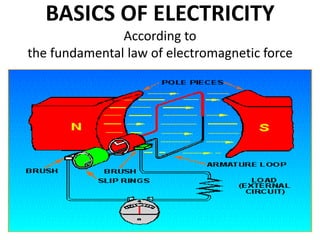
BASICS OF ELECTRICITY
               According to
the fundamental law of electromagnetic force
Video Time
PRACTICAL - 01
In electromechanical
systems, energy is
stored in magnetic and
electric fields.
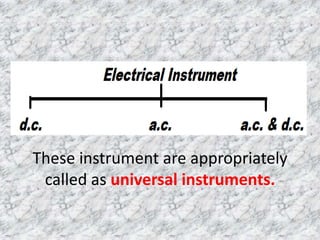
These instrument are appropriately
 called as universal instruments.
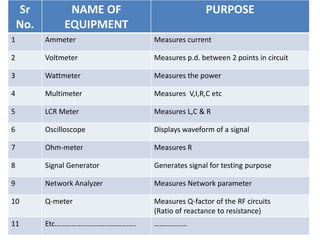
Sr          NAME OF                        PURPOSE
    No.        EQUIPMENT
1         Ammeter               Measures current

2         Voltmeter             Measures p.d. between 2 points in circuit

3         Wattmeter             Measures the power

4         Multimeter            Measures V,I,R,C etc

5         LCR Meter             Measures L,C & R

6         Oscilloscope          Displays waveform of a signal

7         Ohm-meter             Measures R

8         Signal Generator      Generates signal for testing purpose

9         Network Analyzer      Measures Network parameter

10        Q-meter               Measures Q-factor of the RF circuits
                                (Ratio of reactance to resistance)
11        Etc……………………………………..   ………………
AMMETER
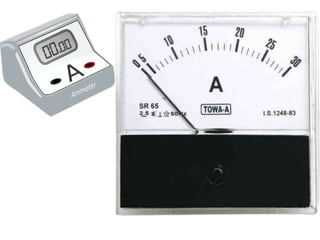
An ammeter is a measuring
instrument used to measure
the electric current in a circuit.
UNIT= Amperes (A)
Instruments used to measure smaller
currents, in the milliampere or
microampere range, are designated
as milliammeters or microammeters.
WORKING PRINCIPLE OF
     AMMETER
  An ammeter consists of a
coil with very low resistance.
 when electric current flows
  through the coil, the coil
  induces a magnetic field
   which turns the needle.
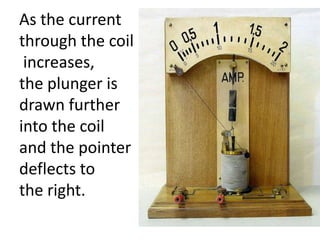
As the current
through the coil
 increases,
the plunger is
drawn further
into the coil
and the pointer
deflects to
the right.
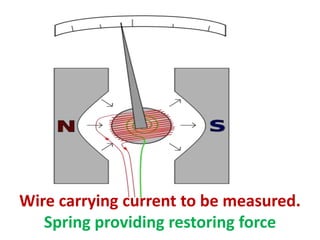
Wire carrying current to be measured.
   Spring providing restoring force
Basic Function of Moving Ammeters
With both moving coil and moving iron
 ammeters, an electric current is used
  to create magnetic energy, which in
 turn causes a moving part within the
   ammeter to shift in response. The
amount of the shift moves a needle on
  the display, which in turn measures
       the amount of the current.
USE IT ?????

  HOW TO USE AMMETER?
 HOW TO USE VOLTMETER?
 HOW TO USE WATTMETER?

HOW TO USE MULTIMETER?
 Calculation of R, L, C etc..
 HOW TO USE LCR METER?
HOW TO USE OSCILLOSCOPE?
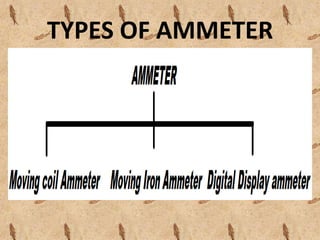
TYPES OF AMMETER
Moving Coil Ammeters
In a moving coil ammeter, the magnet
stimulates a coil that has the opposite
polarity, causing it to be repelled from
              the magnet.

 Moving coil ammeters have a linear
              display.
Moving Iron Ammeters
In a moving iron ammeter, two
pieces of iron are housed inside
     of a coil that becomes
magnetized and repels the two
    pieces of iron from one
     another. The result is a
nonlinear, arced measurement.
Digital Display Ammeters
 A digital display has no moving parts,
and instead measures the proportional
 drop across a reader located inside of
the ammeter. Digital ammeters are far
   more accurate than their moving
              counterparts.
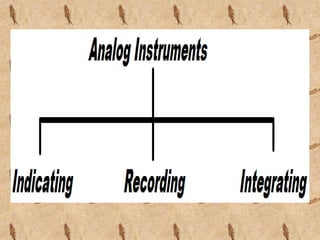
Indicating:- Indicates magnitude of
      quantity being measured.
            E.g.- Ordinary
 voltmeter, ammeter, wattmeter etc

Recording:- Recording over a specified
 period. E.g.- Recording voltages in a
     sub-station during the day.
Integrating:- Totalize events over a
specified period of time. E.g.-Ampere
        Hour Meter (Energy).
There are two types of moving coil
instruments.
1. permanent magnet moving coil
type which can only be used for direct
current, voltage measurements.

2.The dynamometer type
which can be used on either direct or
alternating current, voltage
measurements.
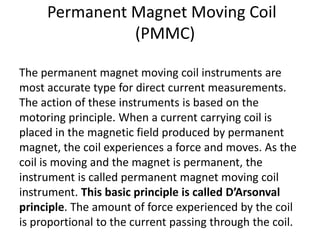
Permanent Magnet Moving Coil
               (PMMC)

The permanent magnet moving coil instruments are
most accurate type for direct current measurements.
The action of these instruments is based on the
motoring principle. When a current carrying coil is
placed in the magnetic field produced by permanent
magnet, the coil experiences a force and moves. As the
coil is moving and the magnet is permanent, the
instrument is called permanent magnet moving coil
instrument. This basic principle is called D’Arsonval
principle. The amount of force experienced by the coil
is proportional to the current passing through the coil.
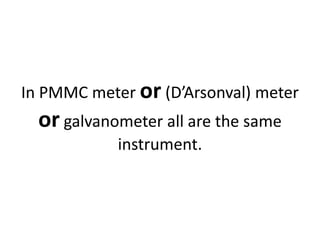
In PMMC meter or (D’Arsonval) meter
  or galvanometer all are the same
            instrument.
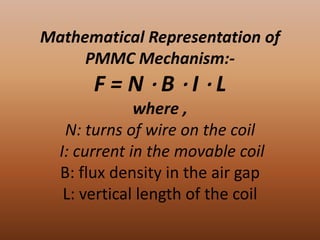
Mathematical Representation of
     PMMC Mechanism:-
       F=N⋅B⋅I⋅L
              where ,
   N: turns of wire on the coil
  I: current in the movable coil
  B: flux density in the air gap
   L: vertical length of the coil
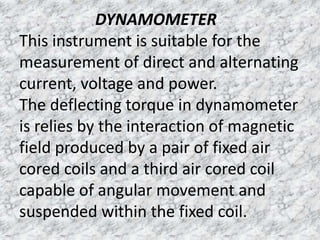
DYNAMOMETER
This instrument is suitable for the
measurement of direct and alternating
current, voltage and power.
The deflecting torque in dynamometer
is relies by the interaction of magnetic
field produced by a pair of fixed air
cored coils and a third air cored coil
capable of angular movement and
suspended within the fixed coil.
For small current measurement (5mA
to 100mA), fixed and moving coils are
connected in series.

 While larger current measurement
(up to 20A) , the moving coil is shunted
by a small resistance.
VOLTMETER
 A voltmeter is an instrument
 used for measuring electrical
 potential difference between
two points in an electric circuit.
Working Principle of Voltmeter
The moving coil galvanometer is a
type of voltmeter working on this
principle.
The voltmeter measures voltage by
passing current through a resistance.
It is designed in such a way so as to
offer minimum disturbance to the
circuit. This is made possible by using a
sensitive ammeter in series with a high
resistance.
Technically specified, all types of
  voltmeters are Ammeters because
they measure current rather than the
voltage. A voltmeter measures voltage
 only when current is transmitted in a
  circuit through a resistance. Due to
this reason, voltmeters are sometimes
     referred to as high resistance
             Ammeters too.
Uses of Voltmeters
    Voltage Sensing
 Voltage Measurement
    Electrical Testing
 Educational Laboratory
  Electronics Industry
Types of Voltmeters
1.Digital Voltmeters
2.Analog Voltmeters
3.Electrostatic Voltmeters (measure voltages
                     without any charge transfer)
4.Oscilloscope Voltmeter(react fast enough
                 to follow rapid voltage changes)
5. Microvoltmeters
6. Electronic voltage meter or
   vacuum tube voltmeter (VTVM)
Oscilloscope
Allows the amplitude of electrical
signals, whether they are
voltage, current; power, etc., to be
displayed primarily as a function of
time.
Depends on the movement of an
electron beam.
Beam to impinge on a phosphor
surface
Transducers
Non-electrical quantity is
converted into an electrical signal by a
device called electrical transducer.

Non-electrical = electrical, mechanical,
chemical, optical (radiant), or thermal.
Types of Transducers
 1. Primary & Secondary
    2.Active & Passive
    3.Analog & Digital
Primary Transducer
 Converts energy from one form to
 electrical form (photovoltaic cell)


   Secondary transducer
 Coverts any form to non electrical or
signal form.(displacement transducer)
Active (self generating) transducers:-
    without any source of electrical
               excitation.
  (thermocouples, tacho generator)

        passive transducers:
            in connection
    with electrical power source.
    (a potentiometer, thermistor)
Analog transducer converts input
 signal into output signal, which is a
        continuous function of
                 time.
  Digital transducer converts input
signal into output signal in a discrete
                forms.
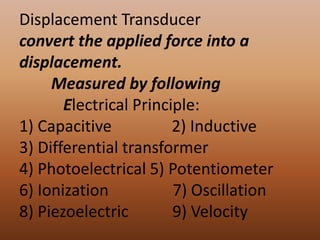
Displacement Transducer
convert the applied force into a
displacement.
     Measured by following
       Electrical Principle:
1) Capacitive           2) Inductive
3) Differential transformer
4) Photoelectrical 5) Potentiometer
6) Ionization           7) Oscillation
8) Piezoelectric        9) Velocity
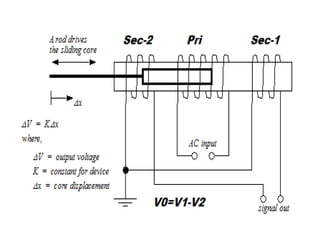
LVDT
(Linear Variable Differential Transformer)
It is produces an electrical signal
  that is linearly proportional to
     mechanical displacement.
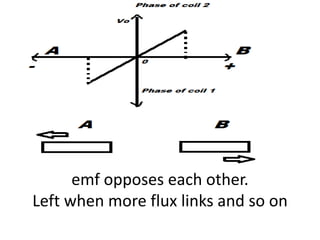
emf opposes each other.
Left when more flux links and so on
I am adding more slides.
   So, wait and watch…
      keep in touch.
THANK YOU
CONTACT
   vijayraskar2003@yahoo.co.in
   vijay.raskar1986@gmail.com

www.slideshare.net/vijayraskar2003

http://in.linkedin.com/in/vijayraskar

EMI-SUBJEST-VBR

  • 1.
    INTRODUCTION Mr. Vijay BaluRaskar B.E. Electrical Autocad-2D+3D Mumbai University
  • 2.
    Electronic Instruments and Measurements
  • 3.
    Electronic Derived = Greekword ‘Elektron’ & ‘Electron mechanism’ Electron mechanism= “Study of behavior of the electrons under different conditions of externally applied fields”.
  • 4.
    Instruments A device thatrequires skill for proper use.
  • 5.
    Measurements Measurement is theprocess or the result of determining the ratio of a physical quantity, such as a length, time, temperature etc.
  • 6.
    Refer for EMI Kalsi–Tata Mc Grow Hill
  • 7.
    BASICS OF ELECTRICITY According to the fundamental law of electromagnetic force
  • 8.
  • 9.
    In electromechanical systems, energyis stored in magnetic and electric fields.
  • 10.
    These instrument areappropriately called as universal instruments.
  • 11.
    Sr NAME OF PURPOSE No. EQUIPMENT 1 Ammeter Measures current 2 Voltmeter Measures p.d. between 2 points in circuit 3 Wattmeter Measures the power 4 Multimeter Measures V,I,R,C etc 5 LCR Meter Measures L,C & R 6 Oscilloscope Displays waveform of a signal 7 Ohm-meter Measures R 8 Signal Generator Generates signal for testing purpose 9 Network Analyzer Measures Network parameter 10 Q-meter Measures Q-factor of the RF circuits (Ratio of reactance to resistance) 11 Etc…………………………………….. ………………
  • 13.
    AMMETER An ammeter isa measuring instrument used to measure the electric current in a circuit. UNIT= Amperes (A) Instruments used to measure smaller currents, in the milliampere or microampere range, are designated as milliammeters or microammeters.
  • 14.
    WORKING PRINCIPLE OF AMMETER An ammeter consists of a coil with very low resistance. when electric current flows through the coil, the coil induces a magnetic field which turns the needle.
  • 15.
    As the current throughthe coil increases, the plunger is drawn further into the coil and the pointer deflects to the right.
  • 16.
    Wire carrying currentto be measured. Spring providing restoring force
  • 17.
    Basic Function ofMoving Ammeters With both moving coil and moving iron ammeters, an electric current is used to create magnetic energy, which in turn causes a moving part within the ammeter to shift in response. The amount of the shift moves a needle on the display, which in turn measures the amount of the current.
  • 18.
    USE IT ????? HOW TO USE AMMETER? HOW TO USE VOLTMETER? HOW TO USE WATTMETER? HOW TO USE MULTIMETER? Calculation of R, L, C etc.. HOW TO USE LCR METER? HOW TO USE OSCILLOSCOPE?
  • 19.
  • 20.
    Moving Coil Ammeters Ina moving coil ammeter, the magnet stimulates a coil that has the opposite polarity, causing it to be repelled from the magnet. Moving coil ammeters have a linear display.
  • 21.
    Moving Iron Ammeters Ina moving iron ammeter, two pieces of iron are housed inside of a coil that becomes magnetized and repels the two pieces of iron from one another. The result is a nonlinear, arced measurement.
  • 22.
    Digital Display Ammeters A digital display has no moving parts, and instead measures the proportional drop across a reader located inside of the ammeter. Digital ammeters are far more accurate than their moving counterparts.
  • 24.
    Indicating:- Indicates magnitudeof quantity being measured. E.g.- Ordinary voltmeter, ammeter, wattmeter etc Recording:- Recording over a specified period. E.g.- Recording voltages in a sub-station during the day.
  • 25.
    Integrating:- Totalize eventsover a specified period of time. E.g.-Ampere Hour Meter (Energy).
  • 26.
    There are twotypes of moving coil instruments. 1. permanent magnet moving coil type which can only be used for direct current, voltage measurements. 2.The dynamometer type which can be used on either direct or alternating current, voltage measurements.
  • 27.
    Permanent Magnet MovingCoil (PMMC) The permanent magnet moving coil instruments are most accurate type for direct current measurements. The action of these instruments is based on the motoring principle. When a current carrying coil is placed in the magnetic field produced by permanent magnet, the coil experiences a force and moves. As the coil is moving and the magnet is permanent, the instrument is called permanent magnet moving coil instrument. This basic principle is called D’Arsonval principle. The amount of force experienced by the coil is proportional to the current passing through the coil.
  • 28.
    In PMMC meteror (D’Arsonval) meter or galvanometer all are the same instrument.
  • 29.
    Mathematical Representation of PMMC Mechanism:- F=N⋅B⋅I⋅L where , N: turns of wire on the coil I: current in the movable coil B: flux density in the air gap L: vertical length of the coil
  • 30.
    DYNAMOMETER This instrument issuitable for the measurement of direct and alternating current, voltage and power. The deflecting torque in dynamometer is relies by the interaction of magnetic field produced by a pair of fixed air cored coils and a third air cored coil capable of angular movement and suspended within the fixed coil.
  • 31.
    For small currentmeasurement (5mA to 100mA), fixed and moving coils are connected in series. While larger current measurement (up to 20A) , the moving coil is shunted by a small resistance.
  • 32.
    VOLTMETER A voltmeteris an instrument used for measuring electrical potential difference between two points in an electric circuit.
  • 33.
    Working Principle ofVoltmeter The moving coil galvanometer is a type of voltmeter working on this principle. The voltmeter measures voltage by passing current through a resistance. It is designed in such a way so as to offer minimum disturbance to the circuit. This is made possible by using a sensitive ammeter in series with a high resistance.
  • 34.
    Technically specified, alltypes of voltmeters are Ammeters because they measure current rather than the voltage. A voltmeter measures voltage only when current is transmitted in a circuit through a resistance. Due to this reason, voltmeters are sometimes referred to as high resistance Ammeters too.
  • 35.
    Uses of Voltmeters Voltage Sensing Voltage Measurement Electrical Testing Educational Laboratory Electronics Industry
  • 36.
    Types of Voltmeters 1.DigitalVoltmeters 2.Analog Voltmeters 3.Electrostatic Voltmeters (measure voltages without any charge transfer) 4.Oscilloscope Voltmeter(react fast enough to follow rapid voltage changes) 5. Microvoltmeters 6. Electronic voltage meter or vacuum tube voltmeter (VTVM)
  • 37.
    Oscilloscope Allows the amplitudeof electrical signals, whether they are voltage, current; power, etc., to be displayed primarily as a function of time. Depends on the movement of an electron beam. Beam to impinge on a phosphor surface
  • 38.
    Transducers Non-electrical quantity is convertedinto an electrical signal by a device called electrical transducer. Non-electrical = electrical, mechanical, chemical, optical (radiant), or thermal.
  • 39.
    Types of Transducers 1. Primary & Secondary 2.Active & Passive 3.Analog & Digital
  • 40.
    Primary Transducer Convertsenergy from one form to electrical form (photovoltaic cell) Secondary transducer Coverts any form to non electrical or signal form.(displacement transducer)
  • 41.
    Active (self generating)transducers:- without any source of electrical excitation. (thermocouples, tacho generator) passive transducers: in connection with electrical power source. (a potentiometer, thermistor)
  • 42.
    Analog transducer convertsinput signal into output signal, which is a continuous function of time. Digital transducer converts input signal into output signal in a discrete forms.
  • 43.
    Displacement Transducer convert theapplied force into a displacement. Measured by following Electrical Principle: 1) Capacitive 2) Inductive 3) Differential transformer 4) Photoelectrical 5) Potentiometer 6) Ionization 7) Oscillation 8) Piezoelectric 9) Velocity
  • 44.
    LVDT (Linear Variable DifferentialTransformer) It is produces an electrical signal that is linearly proportional to mechanical displacement.
  • 46.
    emf opposes eachother. Left when more flux links and so on
  • 47.
    I am addingmore slides. So, wait and watch… keep in touch.
  • 48.
  • 49.
    CONTACT vijayraskar2003@yahoo.co.in vijay.raskar1986@gmail.com www.slideshare.net/vijayraskar2003 http://in.linkedin.com/in/vijayraskar