1. Magnetic effect ( Eg. PMMC,PMMI)
2. Thermal Effect (Eg.Thermocouple)
3. Induction effect (Eg. Energy meter)
4. Electrostatic effect (Eg.Voltmeters)
5. Hall effect (Eg.Fluxmeters)
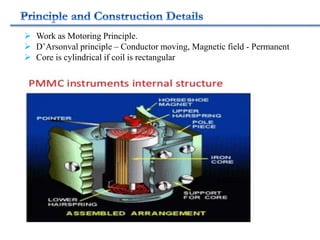
 Work as Motoring Principle.
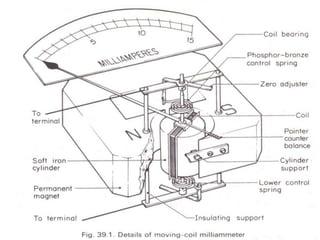
 D’Arsonval principle – Conductor moving, Magnetic field - Permanent
 Core is cylindrical if coil is rectangular
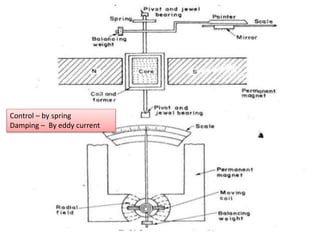
Control – by spring
Damping – By eddy current
Deflection torque, Td = NBAI
where,
N = number of turns of coil,
A = Effective coil area in m2
I = Current passing through the coil in Amp,
B = Flux density in wb/m2
Then G = NBA (constant)
Td = G.I
Then Controlling torque is Tc α Ө
Tc = Ks Ө
Under the equilibrium condition,
Tc = Td
Ks Ө = G.I
Ө = (G/ Ks ) .I
Ө α I
 Uniform scale.
 Low power consumption.
 Sensitivity is high.
 Effective damping is provided (due to Eddy Current)
 Applicable to only D.C measurements,
 Cost is high.
Weakening of Permanent magnet and Springs due to Ageing.
Moving Iron
type
Moving iron
attraction type
Moving iron
repulsion type
Radial vane
type
Co-axial vane
type
Classification
 C = fixed coil.
 D = soft iron piece (movable)
 Damping system as Air friction type
 Control –Spring control
 Gravity control - Panel type
instruments
 Soft iron piece gets attracted by the magnetic field produced by fixed coils.
 Consist of two vanes, one is fixed and another is movable.
 When current (I) is flow through the coil, both the vanes are magnetized.
 These magnetized vanes are repulsion of unlike polarities, since the force of
repulsion between the two vanes causes movement (deflection).
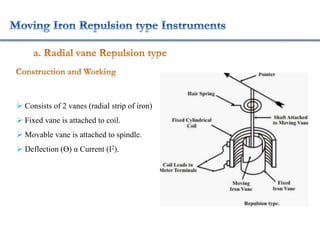
 Consists of 2 vanes (radial strip of iron)
 Fixed vane is attached to coil.
 Movable vane is attached to spindle.
 Deflection (Ө) α Current (I2).
 Vanes are the sections of coaxial cylinder
 Fixed vane is attached to coil.
 Movable vane is attached to spindle.
Coaxial vane
Radial Vane
 Deflection (Ө) α Current (I).
 Applicable for both A.C and D.C measurements,
 Available up to several ranges.
 Power consumption is on higher side.
 Temperature dependent.
 Errors due to temperature, Hysteresis, Frequency change, stray
magnetic fields and eddy current.
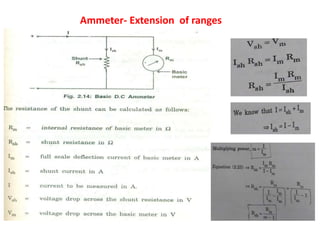
Ammeter- Extension of ranges
Universal or Ayrton shunt type
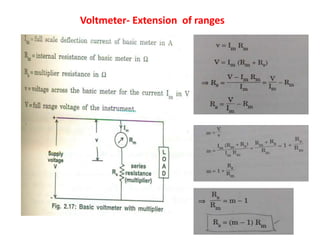
Voltmeter- Extension of ranges
Potential divider Arrangements
Multimeter (or) Volt-ohm milli Ammeter
DVM
Integrating
type
Non –
integrating type
V/F converter
type
Potentiometric
type
Dual slope
integrating type
Potentiometric
type
Ramp type
Linear type
Stair case
type
Servo Potentiometric
type
Null balance type
Successive
approximation type
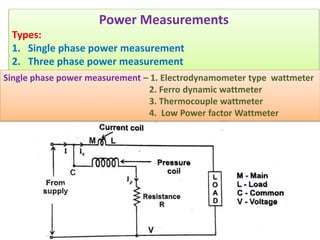
Power Measurements
Types:
1. Single phase power measurement
2. Three phase power measurement
Single phase power measurement – 1. Electrodynamometer type wattmeter
2. Ferro dynamic wattmeter
3. Thermocouple wattmeter
4. Low Power factor Wattmeter
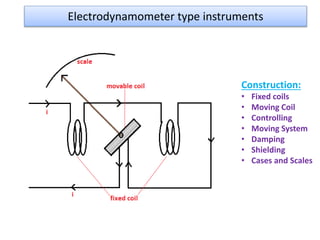
Electrodynamometer type instruments
Construction:
• Fixed coils
• Moving Coil
• Controlling
• Moving System
• Damping
• Shielding
• Cases and Scales
Torque Equation
Let i1 = Instantaneous value of current in fixed coil
i2 = Instantaneous value of current in moving coil
L1 = Self inductance of fixed coil
L2 = self inductance of moving coil
M = Mutual inductance between fixed and moving coils
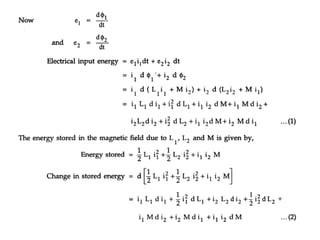
From the principle of conversation of energy,
Energy input = Energy stored + Mechanical energy
Mechanical energy = Energy input - Energy stored
Substraction (2) from equation (1),
The self inductance L1 and L2 are constant and hence dL1 and dL2 are zero.
Mechanical energy = i1 i2 dM
If Ti is the instantaneous deflecting torque and dθ is the change in the deflection then
Mechanical energy = Mechanical work done
= Ti dθ
i1 i2 d M = Ti dθ
D.C Operation:
For d.c current of I1 and I2,
The controlling torque is provided by springs hence
Thus the deflection is proportional to the product of the two currents and the rate of
change of mutual inductance.
A.C Operation:
In a.c. operation, the total deflecting torque over a cycle must be obtained by integrating Ti
over one period.
Average deflecting torque over one cycle is,
Now if two currents are sinusoidal and displaced by a phase angle then
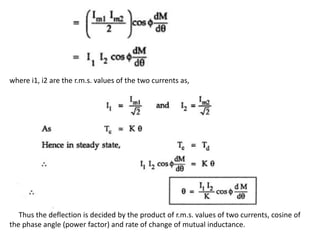
where i1, i2 are the r.m.s. values of the two currents as,
Thus the deflection is decided by the product of r.m.s. values of two currents, cosine of
the phase angle (power factor) and rate of change of mutual inductance.
Errors in Electrodynamometer type
Instruments
1. Torque to weight ratio
2. Frequency errors
3. Eddy current errors
4. Stray magnetic field errors
5. Temperature errors
Single Phase Power Measurement
1. By using 3- Single phase wattmeter – Three wattmeter method
2. By using 2- Single phase wattmeter – Two wattmeter method
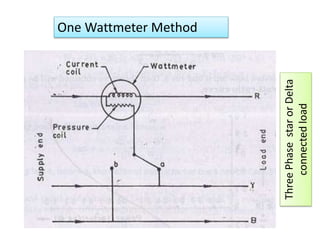
3. By using 1- Single phase wattmeter – One wattmeter method
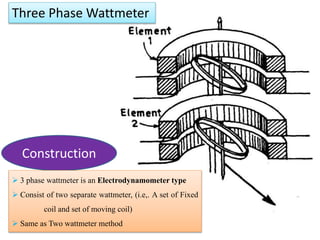
4. By using three phase wattmeter
Methods:
Three Wattmeter Method
Let
IR = instantaneous current flowing through R-phase in A
IY = instantaneous current flowing through Y-phase in A
IB = instantaneous current flowing through B-phase in A
VR = instantaneous Voltage across R-phase in V
VY = instantaneous Voltage across Y-phase in V
VB = instantaneous Voltage across B-phase in V
Instantaneous power consumed by the load
=
Sum of instantaneous readings of the wattmeter
PR = instantaneous reading of wattmeter 1 connected in R-phase in W
PY = instantaneous reading of wattmeter 2 connected in Y-phase in W
PB = instantaneous reading of wattmeter 3 connected in B phase in W
P = PR + PY + PB = vRIR + vyIy +vBIB
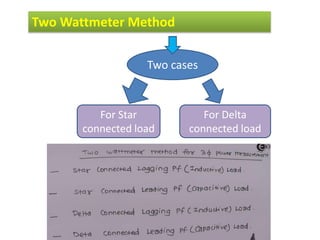
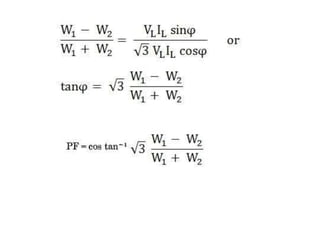
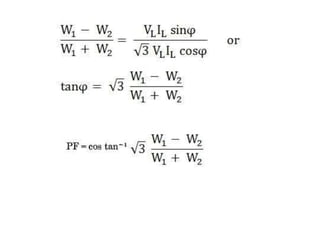
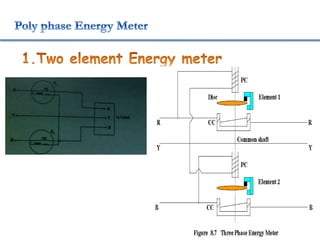
Two Wattmeter Method
Two cases
For Star
connected load
For Delta
connected load
STAR CONNECTED LOAD
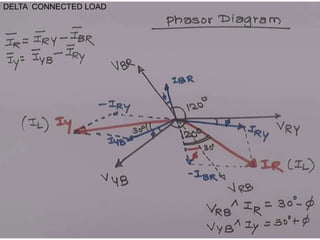
DELTA CONNECTED LOAD
One Wattmeter Method
ThreePhasestarorDelta
connectedload
Three Phase Wattmeter
Construction
 3 phase wattmeter is an Electrodynamometer type
 Consist of two separate wattmeter, (i.e,. A set of Fixed
coil and set of moving coil)
 Same as Two wattmeter method
Working
R’ to eliminate the errors due to mutual inductance
Used to measure energy, which is the total power consumed over a specific
interval of time
Unit of Energy is Kwh (or) unit.
It is the integrating type instrument.(records the total quantity of electricity
in a given time).
Energy
meter
Single phase
energy meter
Three phase
energy meter
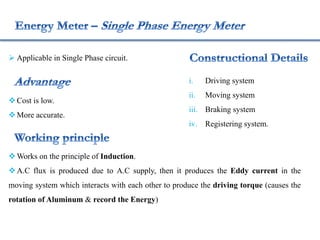
 Applicable in Single Phase circuit.
Cost is low.
More accurate.
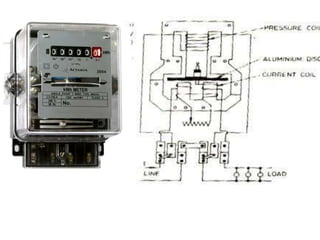
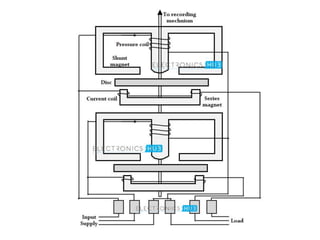
Works on the principle of Induction.
A.C flux is produced due to A.C supply, then it produces the Eddy current in the
moving system which interacts with each other to produce the driving torque (causes the
rotation of Aluminum & record the Energy)
i. Driving system
ii. Moving system
iii. Braking system
iv. Registering system.
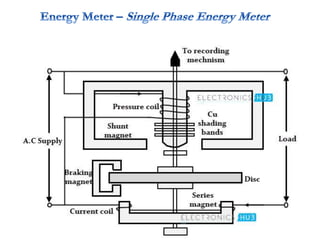
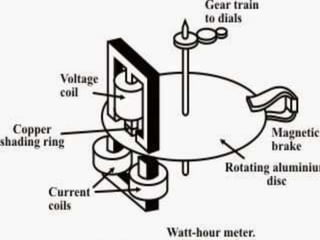
 Contains two electromagnet made up of silicon steel laminated.
 Coil 1 is excited by load (current coil) connected series to the load.
Coil 2 is excited by voltage (pressure coil (or) Voltage Coil), connected parallel
to the load (this magnet referred as shunt magnet).
 Contains aluminum disk.
 The disk is placed in the air gap between the series and shunt magnet.
 Contains Permanent magnet, positioned near the edge of the aluminum disk.
 by adjusting the position of permanent magnet, braking torque can be adjusted.
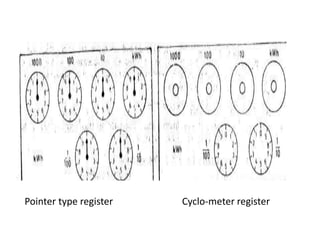
 Main function is to record continuously a number which is proportional to the
revolution made by the moving system.
Pointer type register Cyclo-meter register
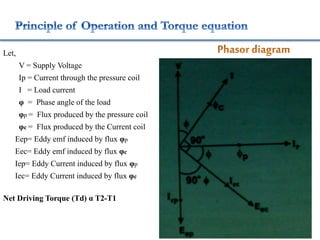
Let,
V = Supply Voltage
Ip = Current through the pressure coil
I = Load current
φ = Phase angle of the load
φp = Flux produced by the pressure coil
φc = Flux produced by the Current coil
Eep= Eddy emf induced by flux φp
Eec= Eddy emf induced by flux φc
Iep= Eddy Current induced by flux φp
Iec= Eddy Current induced by flux φc
Net Driving Torque (Td) α T2-T1
Magnetic Measurements
• Operating characteristics of electrical apparatus
and machines – influenced by ferromagnetic
property
• Hence this measurements are necessary
• Some of them are
– Measurement of flux density, B
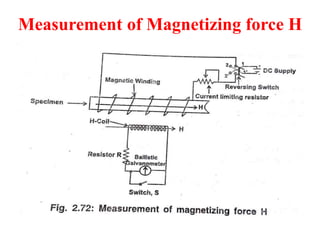
– Measurement of magnetizing force, H
– Determination of B-H curve
– Determination of eddy current and hysteresis loss
– Testing of permanent magnets
Types of Tests
• Ballistic Test : D.C –> FM Material -> To
determine B-H Curve and hysteresis losses
• A.C Tests : A.C -> FM Material -> To determine
eddy current and Hysteresis losses
• Steady State Test : To determine the steady state
flux density
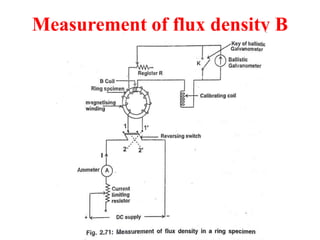
Measurement of flux density B
Measurement of Magnetizing force H
Determination of B-H Curve
• Two methods
– Method of Reversal
– Step by step Method
Method of Reversal
Step by Step Method
Measurement of Iron Losses
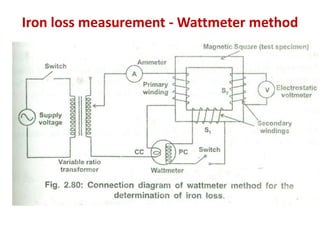
• Wattmeter Method
– Epstein Square
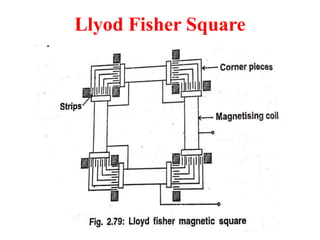
– Llyod Fisher Square
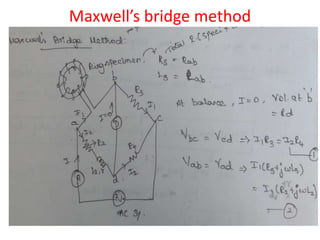
• Bridge Method
• Potentiometer Method
• Oscillographic method
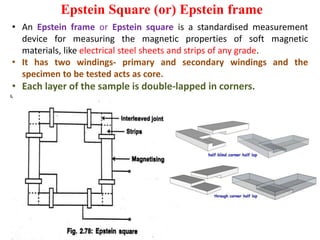
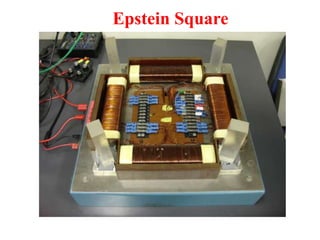
Epstein Square (or) Epstein frame
• An Epstein frame or Epstein square is a standardised measurement
device for measuring the magnetic properties of soft magnetic
materials, like electrical steel sheets and strips of any grade.
• It has two windings- primary and secondary windings and the
specimen to be tested acts as core.
• Each layer of the sample is double-lapped in corners.
Epstein Square
Llyod Fisher Square
Iron loss measurement - Wattmeter method
Total iron loss in the specimen is given by :
Weight of the specimen
Total iron loss in the specimen
Specific iron loss of the ring specimen =
Maxwell’s bridge method
 In power system the parameters like voltage, current, impedance, etc., are in
terms of high rating values (K) , it is not possible to measure the parameters
directly.
 So we move to Instrument Transformers.
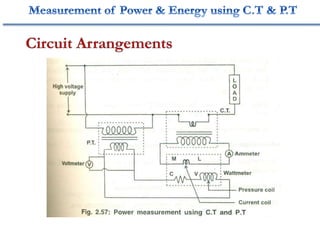
Transformers used in conjunction with measuring instruments for
measurement purpose is called Instrument transformers.
 The Transformers which is used to measure Current referred as Current
Transformers (C.T)
 The Transformers which is used to measure Voltage referred as Potential
Transformers (P.T)
 Current Transformers are series connected to the line whose current to be
measured..
 It is a step up transformers (reduces the current and increases the voltage).
 It has primary winding, & coil of secondary winding.
 Turns ratio (n) = N2/N1
 N1 = number of turns of Primary Winding,
 N2 = number of turns of Secondary Winding.
 C.T,
 Let Turns ratio as 500:5
 I1 =500
 I2 =5
 N2/N1 = 500/5 =100
Hence, N2 = 100 N1 and I1 = 100 I2
Also V2= 100 V1
n
V
V
I
I
N
N

1
2
2
1
1
2 Precautions:
• Secondary Winding cannot be open
at the time of primary is exercised.
• The Secondary Winding is
always short circuited.
 Potential Transformers are Parallel connected to the line.
 It is a step down transformers.
 P.T,
If range of P.T is
11KV:110 then turns
ratio is given by
V2 = 110 V
V1= 11000V
n = V1/V2 = 100
Also V1= 100 V2
N1 = 100 N2
n
V
V
N
N

2
1
2
1
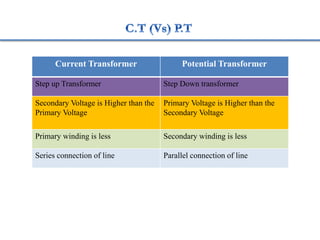
Current Transformer Potential Transformer
Step up Transformer Step Down transformer
Secondary Voltage is Higher than the
Primary Voltage
Primary Voltage is Higher than the
Secondary Voltage
Primary winding is less Secondary winding is less
Series connection of line Parallel connection of line
ADVANTAGES
 High Voltage & high current are directly measured in low
range of meters.
 Wide range of voltage and Current levels has been
measured.
 It can be act as protecting Devices.
DISADVANTAGE:
 Applicable only for A.C circuits
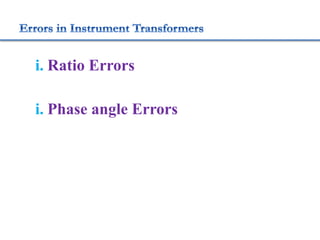
i. Ratio Errors
i. Phase angle Errors
1. Frequency Meters
2. Phase Meters
1. Analog phase meters
2. Digital phase meters
FluxMeters
Analog
Frequency meters
Mechanical
Resonance type
Electrical
Resonance type
Weston type
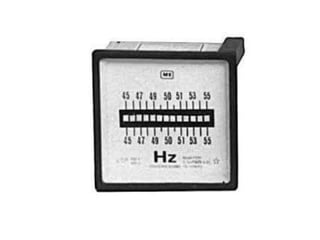
Frequency meter
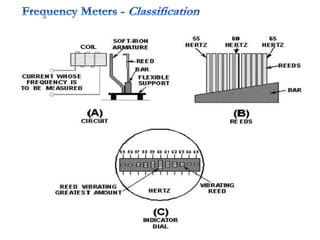
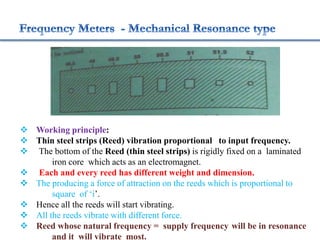
 Working principle:
 Thin steel strips (Reed) vibration proportional to input frequency.
 The bottom of the Reed (thin steel strips) is rigidly fixed on a laminated
iron core which acts as an electromagnet.
 Each and every reed has different weight and dimension.
 The producing a force of attraction on the reeds which is proportional to
square of ‘i’.
 Hence all the reeds will start vibrating.
 All the reeds vibrate with different force.
 Reed whose natural frequency = supply frequency will be in resonance
and it will vibrate most.
ADVANTAGES
 Simple in construction.
 Easy operating mechanism.
Disadvantage:
 Cannot be applicable for low voltage to find the frequency
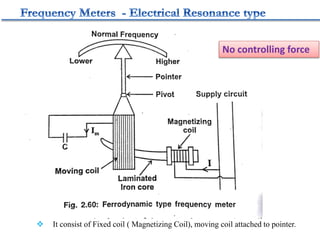
 It consist of Fixed coil ( Magnetizing Coil), moving coil attached to pointer.
No controlling force
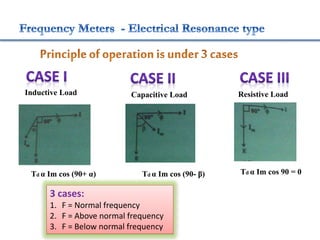
Inductive Load Capacitive Load Resistive Load
Td α Im cos (90+ α) Td α Im cos (90- β) Td α Im cos 90 = 0
3 cases:
1. F = Normal frequency
2. F = Above normal frequency
3. F = Below normal frequency
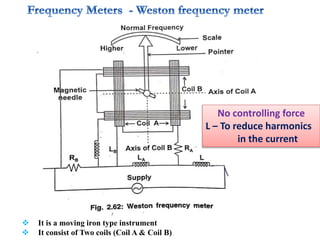
 It is a moving iron type instrument
 It consist of Two coils (Coil A & Coil B)
No controlling force
L – To reduce harmonics
in the current
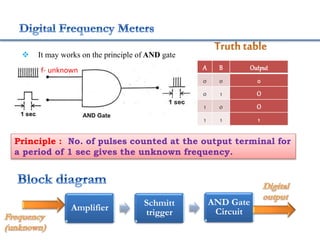
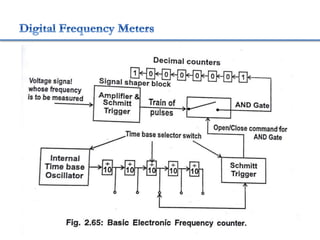
 It may works on the principle of AND gate
A B Output
0 0 0
0 1 O
1 0 O
1 1 1
Amplifier
Schmitt
trigger
AND Gate
Circuit
f- unknown
Principle : No. of pulses counted at the output terminal for
a period of 1 sec gives the unknown frequency.
 It is used to measure the phase difference between the two signals
At Vr is Positive Half Cycle At Vr is Negative Half Cycle
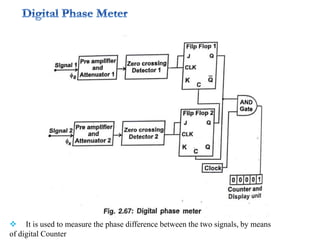
 It is used to measure the phase difference between the two signals, by means
of digital Counter
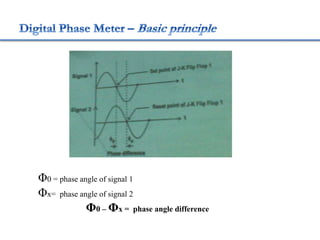
Φ0 = phase angle of signal 1
Φx= phase angle of signal 2
Φ0 – Φx = phase angle difference
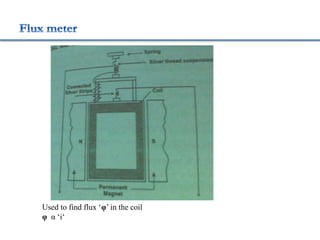
Used to find flux ‘φ’ in the coil
φ α ‘i‘
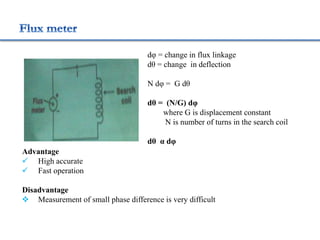
dφ = change in flux linkage
dθ = change in deflection
N dφ = G dθ
dθ = (N/G) dφ
where G is displacement constant
N is number of turns in the search coil
dθ α dφ
Advantage
 High accurate
 Fast operation
Disadvantage
 Measurement of small phase difference is very difficult

Electrical, electronics and magnetic instruments

  • 1.
    1. Magnetic effect( Eg. PMMC,PMMI) 2. Thermal Effect (Eg.Thermocouple) 3. Induction effect (Eg. Energy meter) 4. Electrostatic effect (Eg.Voltmeters) 5. Hall effect (Eg.Fluxmeters)
  • 2.
     Work asMotoring Principle.  D’Arsonval principle – Conductor moving, Magnetic field - Permanent  Core is cylindrical if coil is rectangular
  • 3.
    Control – byspring Damping – By eddy current
  • 4.
    Deflection torque, Td= NBAI where, N = number of turns of coil, A = Effective coil area in m2 I = Current passing through the coil in Amp, B = Flux density in wb/m2 Then G = NBA (constant) Td = G.I Then Controlling torque is Tc α Ө Tc = Ks Ө Under the equilibrium condition, Tc = Td Ks Ө = G.I Ө = (G/ Ks ) .I Ө α I
  • 5.
     Uniform scale. Low power consumption.  Sensitivity is high.  Effective damping is provided (due to Eddy Current)  Applicable to only D.C measurements,  Cost is high. Weakening of Permanent magnet and Springs due to Ageing.
  • 6.
    Moving Iron type Moving iron attractiontype Moving iron repulsion type Radial vane type Co-axial vane type Classification
  • 7.
     C =fixed coil.  D = soft iron piece (movable)  Damping system as Air friction type  Control –Spring control  Gravity control - Panel type instruments  Soft iron piece gets attracted by the magnetic field produced by fixed coils.
  • 8.
     Consist oftwo vanes, one is fixed and another is movable.  When current (I) is flow through the coil, both the vanes are magnetized.  These magnetized vanes are repulsion of unlike polarities, since the force of repulsion between the two vanes causes movement (deflection).
  • 9.
     Consists of2 vanes (radial strip of iron)  Fixed vane is attached to coil.  Movable vane is attached to spindle.  Deflection (Ө) α Current (I2).
  • 10.
     Vanes arethe sections of coaxial cylinder  Fixed vane is attached to coil.  Movable vane is attached to spindle. Coaxial vane Radial Vane
  • 11.
     Deflection (Ө)α Current (I).  Applicable for both A.C and D.C measurements,  Available up to several ranges.  Power consumption is on higher side.  Temperature dependent.  Errors due to temperature, Hysteresis, Frequency change, stray magnetic fields and eddy current.
  • 13.
  • 15.
  • 16.
  • 18.
  • 19.
  • 20.
    DVM Integrating type Non – integrating type V/Fconverter type Potentiometric type Dual slope integrating type Potentiometric type Ramp type Linear type Stair case type Servo Potentiometric type Null balance type Successive approximation type
  • 21.
    Power Measurements Types: 1. Singlephase power measurement 2. Three phase power measurement Single phase power measurement – 1. Electrodynamometer type wattmeter 2. Ferro dynamic wattmeter 3. Thermocouple wattmeter 4. Low Power factor Wattmeter
  • 22.
    Electrodynamometer type instruments Construction: •Fixed coils • Moving Coil • Controlling • Moving System • Damping • Shielding • Cases and Scales
  • 23.
    Torque Equation Let i1= Instantaneous value of current in fixed coil i2 = Instantaneous value of current in moving coil L1 = Self inductance of fixed coil L2 = self inductance of moving coil M = Mutual inductance between fixed and moving coils
  • 25.
    From the principleof conversation of energy, Energy input = Energy stored + Mechanical energy Mechanical energy = Energy input - Energy stored Substraction (2) from equation (1), Substraction (2) from equation (1), The self inductance L1 and L2 are constant and hence dL1 and dL2 are zero. Mechanical energy = i1 i2 dM If Ti is the instantaneous deflecting torque and dθ is the change in the deflection then Mechanical energy = Mechanical work done = Ti dθ i1 i2 d M = Ti dθ
  • 26.
    D.C Operation: For d.ccurrent of I1 and I2, The controlling torque is provided by springs hence Thus the deflection is proportional to the product of the two currents and the rate of change of mutual inductance.
  • 27.
    A.C Operation: In a.c.operation, the total deflecting torque over a cycle must be obtained by integrating Ti over one period. Average deflecting torque over one cycle is, Now if two currents are sinusoidal and displaced by a phase angle then
  • 28.
    where i1, i2are the r.m.s. values of the two currents as, Thus the deflection is decided by the product of r.m.s. values of two currents, cosine of the phase angle (power factor) and rate of change of mutual inductance.
  • 30.
    Errors in Electrodynamometertype Instruments 1. Torque to weight ratio 2. Frequency errors 3. Eddy current errors 4. Stray magnetic field errors 5. Temperature errors
  • 31.
    Single Phase PowerMeasurement
  • 32.
    1. By using3- Single phase wattmeter – Three wattmeter method 2. By using 2- Single phase wattmeter – Two wattmeter method 3. By using 1- Single phase wattmeter – One wattmeter method 4. By using three phase wattmeter Methods:
  • 33.
  • 34.
    Let IR = instantaneouscurrent flowing through R-phase in A IY = instantaneous current flowing through Y-phase in A IB = instantaneous current flowing through B-phase in A VR = instantaneous Voltage across R-phase in V VY = instantaneous Voltage across Y-phase in V VB = instantaneous Voltage across B-phase in V Instantaneous power consumed by the load = Sum of instantaneous readings of the wattmeter PR = instantaneous reading of wattmeter 1 connected in R-phase in W PY = instantaneous reading of wattmeter 2 connected in Y-phase in W PB = instantaneous reading of wattmeter 3 connected in B phase in W P = PR + PY + PB = vRIR + vyIy +vBIB
  • 35.
    Two Wattmeter Method Twocases For Star connected load For Delta connected load
  • 36.
  • 38.
  • 41.
  • 42.
    Three Phase Wattmeter Construction 3 phase wattmeter is an Electrodynamometer type  Consist of two separate wattmeter, (i.e,. A set of Fixed coil and set of moving coil)  Same as Two wattmeter method
  • 43.
    Working R’ to eliminatethe errors due to mutual inductance
  • 44.
    Used to measureenergy, which is the total power consumed over a specific interval of time Unit of Energy is Kwh (or) unit. It is the integrating type instrument.(records the total quantity of electricity in a given time). Energy meter Single phase energy meter Three phase energy meter
  • 45.
     Applicable inSingle Phase circuit. Cost is low. More accurate. Works on the principle of Induction. A.C flux is produced due to A.C supply, then it produces the Eddy current in the moving system which interacts with each other to produce the driving torque (causes the rotation of Aluminum & record the Energy) i. Driving system ii. Moving system iii. Braking system iv. Registering system.
  • 50.
     Contains twoelectromagnet made up of silicon steel laminated.  Coil 1 is excited by load (current coil) connected series to the load. Coil 2 is excited by voltage (pressure coil (or) Voltage Coil), connected parallel to the load (this magnet referred as shunt magnet).  Contains aluminum disk.  The disk is placed in the air gap between the series and shunt magnet.  Contains Permanent magnet, positioned near the edge of the aluminum disk.  by adjusting the position of permanent magnet, braking torque can be adjusted.  Main function is to record continuously a number which is proportional to the revolution made by the moving system.
  • 51.
    Pointer type registerCyclo-meter register
  • 52.
    Let, V = SupplyVoltage Ip = Current through the pressure coil I = Load current φ = Phase angle of the load φp = Flux produced by the pressure coil φc = Flux produced by the Current coil Eep= Eddy emf induced by flux φp Eec= Eddy emf induced by flux φc Iep= Eddy Current induced by flux φp Iec= Eddy Current induced by flux φc Net Driving Torque (Td) α T2-T1
  • 56.
    Magnetic Measurements • Operatingcharacteristics of electrical apparatus and machines – influenced by ferromagnetic property • Hence this measurements are necessary • Some of them are – Measurement of flux density, B – Measurement of magnetizing force, H – Determination of B-H curve – Determination of eddy current and hysteresis loss – Testing of permanent magnets
  • 57.
    Types of Tests •Ballistic Test : D.C –> FM Material -> To determine B-H Curve and hysteresis losses • A.C Tests : A.C -> FM Material -> To determine eddy current and Hysteresis losses • Steady State Test : To determine the steady state flux density
  • 58.
  • 59.
  • 60.
    Determination of B-HCurve • Two methods – Method of Reversal – Step by step Method
  • 61.
  • 62.
  • 63.
    Measurement of IronLosses • Wattmeter Method – Epstein Square – Llyod Fisher Square • Bridge Method • Potentiometer Method • Oscillographic method
  • 64.
    Epstein Square (or)Epstein frame • An Epstein frame or Epstein square is a standardised measurement device for measuring the magnetic properties of soft magnetic materials, like electrical steel sheets and strips of any grade. • It has two windings- primary and secondary windings and the specimen to be tested acts as core. • Each layer of the sample is double-lapped in corners.
  • 65.
  • 66.
  • 67.
    Iron loss measurement- Wattmeter method
  • 68.
    Total iron lossin the specimen is given by : Weight of the specimen Total iron loss in the specimen Specific iron loss of the ring specimen =
  • 69.
  • 71.
     In powersystem the parameters like voltage, current, impedance, etc., are in terms of high rating values (K) , it is not possible to measure the parameters directly.  So we move to Instrument Transformers. Transformers used in conjunction with measuring instruments for measurement purpose is called Instrument transformers.  The Transformers which is used to measure Current referred as Current Transformers (C.T)  The Transformers which is used to measure Voltage referred as Potential Transformers (P.T)
  • 72.
     Current Transformersare series connected to the line whose current to be measured..  It is a step up transformers (reduces the current and increases the voltage).  It has primary winding, & coil of secondary winding.
  • 73.
     Turns ratio(n) = N2/N1  N1 = number of turns of Primary Winding,  N2 = number of turns of Secondary Winding.  C.T,  Let Turns ratio as 500:5  I1 =500  I2 =5  N2/N1 = 500/5 =100 Hence, N2 = 100 N1 and I1 = 100 I2 Also V2= 100 V1 n V V I I N N  1 2 2 1 1 2 Precautions: • Secondary Winding cannot be open at the time of primary is exercised. • The Secondary Winding is always short circuited.
  • 74.
     Potential Transformersare Parallel connected to the line.  It is a step down transformers.  P.T, If range of P.T is 11KV:110 then turns ratio is given by V2 = 110 V V1= 11000V n = V1/V2 = 100 Also V1= 100 V2 N1 = 100 N2 n V V N N  2 1 2 1
  • 75.
    Current Transformer PotentialTransformer Step up Transformer Step Down transformer Secondary Voltage is Higher than the Primary Voltage Primary Voltage is Higher than the Secondary Voltage Primary winding is less Secondary winding is less Series connection of line Parallel connection of line
  • 77.
    ADVANTAGES  High Voltage& high current are directly measured in low range of meters.  Wide range of voltage and Current levels has been measured.  It can be act as protecting Devices. DISADVANTAGE:  Applicable only for A.C circuits
  • 78.
    i. Ratio Errors i.Phase angle Errors
  • 79.
    1. Frequency Meters 2.Phase Meters 1. Analog phase meters 2. Digital phase meters FluxMeters
  • 80.
  • 83.
     Working principle: Thin steel strips (Reed) vibration proportional to input frequency.  The bottom of the Reed (thin steel strips) is rigidly fixed on a laminated iron core which acts as an electromagnet.  Each and every reed has different weight and dimension.  The producing a force of attraction on the reeds which is proportional to square of ‘i’.  Hence all the reeds will start vibrating.  All the reeds vibrate with different force.  Reed whose natural frequency = supply frequency will be in resonance and it will vibrate most.
  • 84.
    ADVANTAGES  Simple inconstruction.  Easy operating mechanism. Disadvantage:  Cannot be applicable for low voltage to find the frequency
  • 85.
     It consistof Fixed coil ( Magnetizing Coil), moving coil attached to pointer. No controlling force
  • 86.
    Inductive Load CapacitiveLoad Resistive Load Td α Im cos (90+ α) Td α Im cos (90- β) Td α Im cos 90 = 0 3 cases: 1. F = Normal frequency 2. F = Above normal frequency 3. F = Below normal frequency
  • 87.
     It isa moving iron type instrument  It consist of Two coils (Coil A & Coil B) No controlling force L – To reduce harmonics in the current
  • 88.
     It mayworks on the principle of AND gate A B Output 0 0 0 0 1 O 1 0 O 1 1 1 Amplifier Schmitt trigger AND Gate Circuit f- unknown Principle : No. of pulses counted at the output terminal for a period of 1 sec gives the unknown frequency.
  • 90.
     It isused to measure the phase difference between the two signals At Vr is Positive Half Cycle At Vr is Negative Half Cycle
  • 91.
    At Vr isPositive Half Cycle At Vr is Negative Half Cycle
  • 92.
     It isused to measure the phase difference between the two signals, by means of digital Counter
  • 93.
    Φ0 = phaseangle of signal 1 Φx= phase angle of signal 2 Φ0 – Φx = phase angle difference
  • 94.
    Used to findflux ‘φ’ in the coil φ α ‘i‘
  • 95.
    dφ = changein flux linkage dθ = change in deflection N dφ = G dθ dθ = (N/G) dφ where G is displacement constant N is number of turns in the search coil dθ α dφ Advantage  High accurate  Fast operation Disadvantage  Measurement of small phase difference is very difficult