STRENGTH
DURATION
CURVE
Aditya Johan .R, M.Fis
STRENGTH DURATION
CURVE
 The strength (amplitude) and time (duration) of
current determine tissue excitability
 This is the law of excitation The strength-
duration curve (SDC) demonstrates the inverse
relationship between these two variables
 As phase duration increases, less peak
amplitude is required to achieve the desired
physiological response
– Shorter durations excite the large sensory afferents, whereas the longer durations are necessary
to excite the smaller A-delta and C fibers
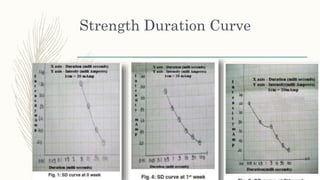
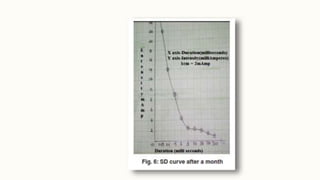
 The purpose of S-D curve plotting is to know whether the stimulated muscle is innervated,
denervated or partially denervated
 S-D curve should be plotted after 20th day of injury/lesion
 After 21st/22nd day, regeneration of nerve will start, generally it take about 270 days to
regenerate
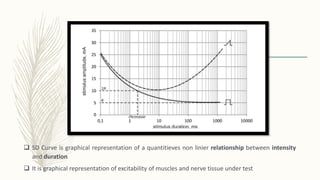
 SD Curve is graphical representation of a quantitieves non linier relationship between intensity
and duration
 It is graphical representation of excitability of muscles and nerve tissue under test
RHEOBASE
 The Rheobase is a measure of tissue
excitability represented by the minimum
amplitude of the rectangular current
impulse, of 1000 ms duration, eliciting the
minimal contraction (threshold) of an
excitable tissue
 The chronaxie is another measure of the tissue
excitability. It is the Duration of an impulse
heaving the amplitude of doubled rheobase
CHRONAXIE
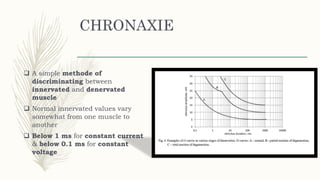
 A simple methode of
discriminating between
innervated and denervated
muscle
 Normal innervated values vary
somewhat from one muscle to
another
 Below 1 ms for constant current
& below 0.1 ms for constant
voltage
Chronaxie
TEMPS UTILE
 This is the minimum time needed for a rectangular pulse to produce a
just perceptible contraction at a current amplitude equal to the
rheobase
 For healthy muscle tissue, the temps utile is around 10 μs
ACCOMODATION TRESHOLD
– This is the current amplitude that a triangular pulse of ‘infinite’ duration
must have in order to produce a just perceptible contraction
OPTIMUM PHASE
 The phase time required for a triangular pulse at a minimum
current amplitude to produce a just perceptible contraction
 For healthy tissue the optimum phase time is around 20 ms
ACCOMODATION QUOTIENT
 Healthy nerve tissue has the ability to adapt to gradually increasing
pulses
 This causes a gradual increase in the triangular pulse curve with respect
respect to the rectangular pulse curve
 Accommodation quotient is determined by dividing the
accommodation threshold by the rheobase
 For healthy nerve tissue, the value lies between 2 and 6. A lower value
indicates degeneration of the nerve, while higher values may be a sign
of neurogenic dystonia
Accomodation Quotient
Strength Duration Curve
THANKS

Strength duration curve

  • 1.
  • 2.
    STRENGTH DURATION CURVE  Thestrength (amplitude) and time (duration) of current determine tissue excitability  This is the law of excitation The strength- duration curve (SDC) demonstrates the inverse relationship between these two variables  As phase duration increases, less peak amplitude is required to achieve the desired physiological response
  • 3.
    – Shorter durationsexcite the large sensory afferents, whereas the longer durations are necessary to excite the smaller A-delta and C fibers
  • 4.
     The purposeof S-D curve plotting is to know whether the stimulated muscle is innervated, denervated or partially denervated  S-D curve should be plotted after 20th day of injury/lesion  After 21st/22nd day, regeneration of nerve will start, generally it take about 270 days to regenerate
  • 5.
     SD Curveis graphical representation of a quantitieves non linier relationship between intensity and duration  It is graphical representation of excitability of muscles and nerve tissue under test
  • 6.
    RHEOBASE  The Rheobaseis a measure of tissue excitability represented by the minimum amplitude of the rectangular current impulse, of 1000 ms duration, eliciting the minimal contraction (threshold) of an excitable tissue  The chronaxie is another measure of the tissue excitability. It is the Duration of an impulse heaving the amplitude of doubled rheobase
  • 7.
    CHRONAXIE  A simplemethode of discriminating between innervated and denervated muscle  Normal innervated values vary somewhat from one muscle to another  Below 1 ms for constant current & below 0.1 ms for constant voltage
  • 8.
  • 9.
    TEMPS UTILE  Thisis the minimum time needed for a rectangular pulse to produce a just perceptible contraction at a current amplitude equal to the rheobase  For healthy muscle tissue, the temps utile is around 10 μs
  • 10.
    ACCOMODATION TRESHOLD – Thisis the current amplitude that a triangular pulse of ‘infinite’ duration must have in order to produce a just perceptible contraction
  • 11.
    OPTIMUM PHASE  Thephase time required for a triangular pulse at a minimum current amplitude to produce a just perceptible contraction  For healthy tissue the optimum phase time is around 20 ms
  • 12.
    ACCOMODATION QUOTIENT  Healthynerve tissue has the ability to adapt to gradually increasing pulses  This causes a gradual increase in the triangular pulse curve with respect respect to the rectangular pulse curve  Accommodation quotient is determined by dividing the accommodation threshold by the rheobase  For healthy nerve tissue, the value lies between 2 and 6. A lower value indicates degeneration of the nerve, while higher values may be a sign of neurogenic dystonia
  • 13.
  • 19.
  • 23.