Interpretation of
NCV and EMG
(Neurosurgeon’s View)
Mohamed Elsayed Elsebaey
(Nerve Surgery Team)
Neurosurgery Registrar
General Ismailia Hospital
May 2019
Items
1. The basics of NCV & EMG
2. When to require them and the optimum time
3. How to do them
4. What are the results
5. Clinical correlations
Anatomy
CNS
Spinal cord
PNS
(Roots, Plexus, trunks, nerves)
Muscles
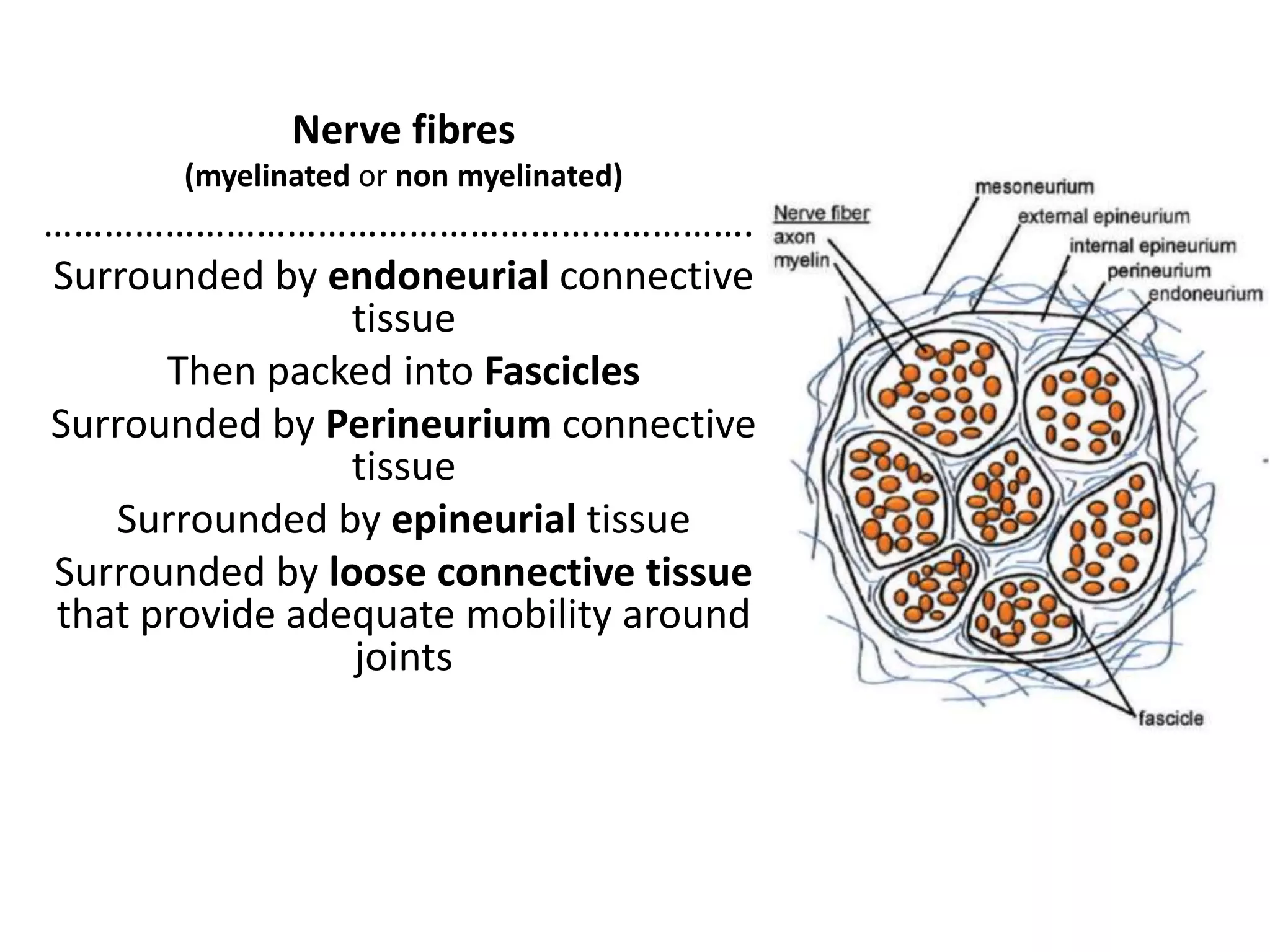
Nerve fibres
(myelinated or non myelinated)
……………………………………………………………..
Surrounded by endoneurial connective
tissue
Then packed into Fascicles
Surrounded by Perineurium connective
tissue
Surrounded by epineurial tissue
Surrounded by loose connective tissue
that provide adequate mobility around
joints
• The lesions are following any force that:
disrupt the myelin coating or
disrupt the nerve fiber.
• UL: Radial nerve is the commonest injured nerve
• LL: Sciatic nerve “”””””””””””””””””””.
Why we require?
• Assess function
• Assess integrity
of peripheral nervous system.
• Augment the detailed history and physical
examination.
• Also (Medico-legal)
Indications for testing
• Suspected neuromuscular disease
1. Nerve root pathology
2. Nerve / Plexus pathology
3. Neuromuscular junction (NMJ) pathology
4. Muscle pathology
• Follow up
• Differentiation between certain causes.
NCV/EMG results
• Normal
• Radicalopathy
• Plexopathy
• Neuropathy
• Myopathy
• Demyelination
• Neuromuscular junction block
How it works?
The electrical current
• Depolarizes the nerve membrane
• Initiates action potential in axon
The action potential travels along the nerve
depending on the integrity of the myelin
membrane that covering nerve fibers.
((conduction along the non-myelinated fibers is much slower))
What happens?
• Response happened
Response of nerve conduction studies
(NCSs)
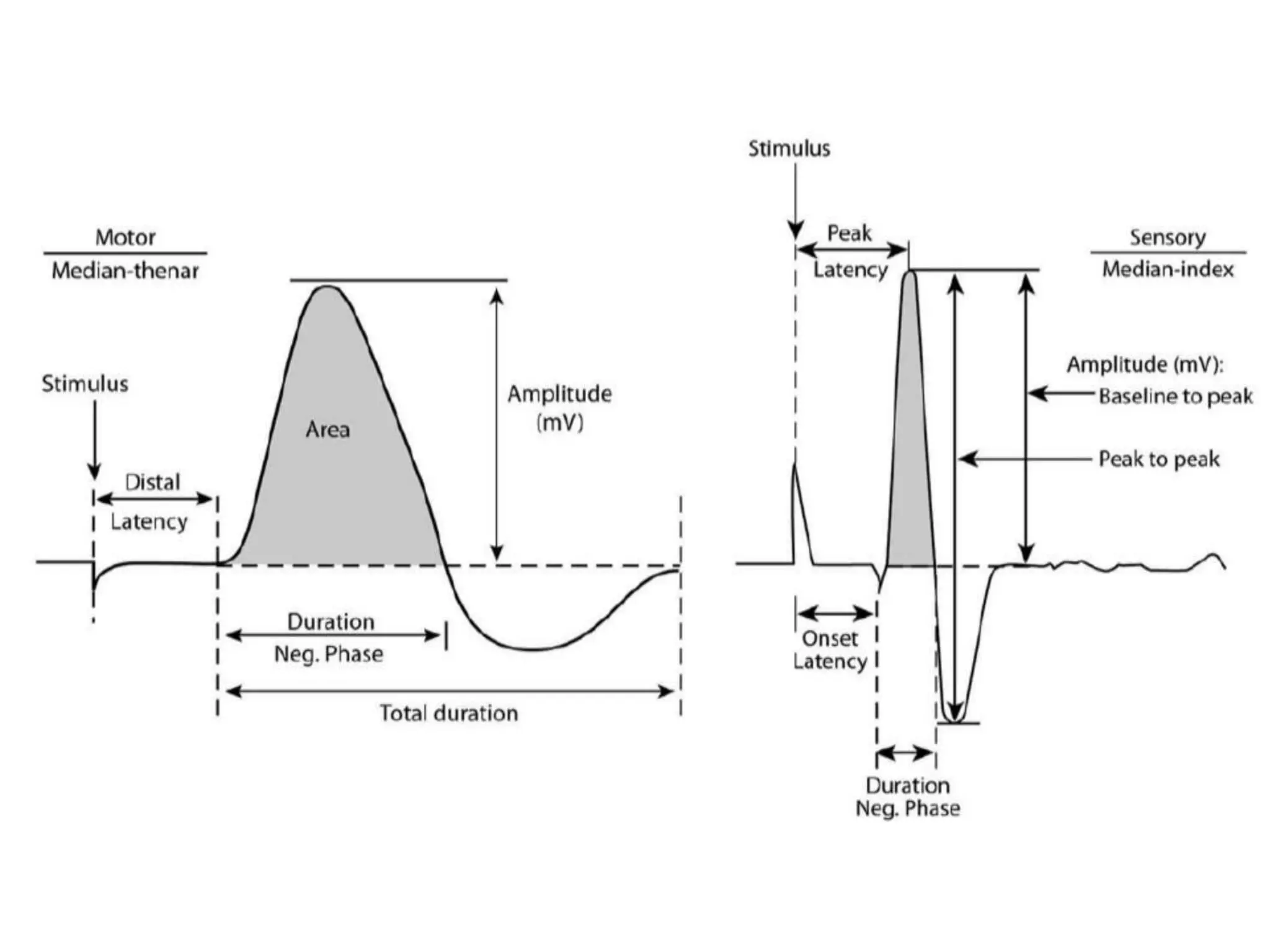
• Motor: compound motor action potential (CMAP)
millivolt-millisecond
• Sensory: sensory nerve action potential (SNAP)
microvolt-millisecond
Each Response has
• Amplitude
• Area
• Latency
• Conduction velocity
• Duration
Each item has its normal values
Best to be compared with the contralateral side
Amplitude
• Measured from trough of the initial positive
phase to peak of subsequent negative phase.
• Reflects the number of the functioning nerve
fibres.
• It is valuable in detecting motor weakness or
sensory loss.
Area
• Equals amplitude + duration
• Modern EMG machines calculate this value
automatically.
Latency
• Reflects conduction velocity over fixed distance.
• Measured in millisecond.
• Has two points of stimulation (proximal & distal )
• So, has proximal and distal CMAP
• Its value, to record the CV along the fastest
conducting motor nerve fibres.
• Distal motor latency reflects the NMJ and muscle
fiber action potential transmission times.
Conduction velocity CV
• reflects the speed of action potential propagation
along the fastest conducting nerve fibres in the
studied nerve segment.
• Expressed in meters per second (m/s)
• Many consider this parameter is the most
informative response, in fact, it is the least one.
As, CV value reflects CV rate and thus no information about
the number of functioning nerve fibres in the studied
segment.
Motor NCSs
• Orthodromic
• Two points are stimulated
• Proximal and distal (according to relation to the stimulus)
• So (2 CMAP) are generated
• Interpret both results
Motor NCS is also used
• to verify the suspected malingering from the
true weakness as,
True weakness is associated with EDX abnormalities,
while
malingering is not.
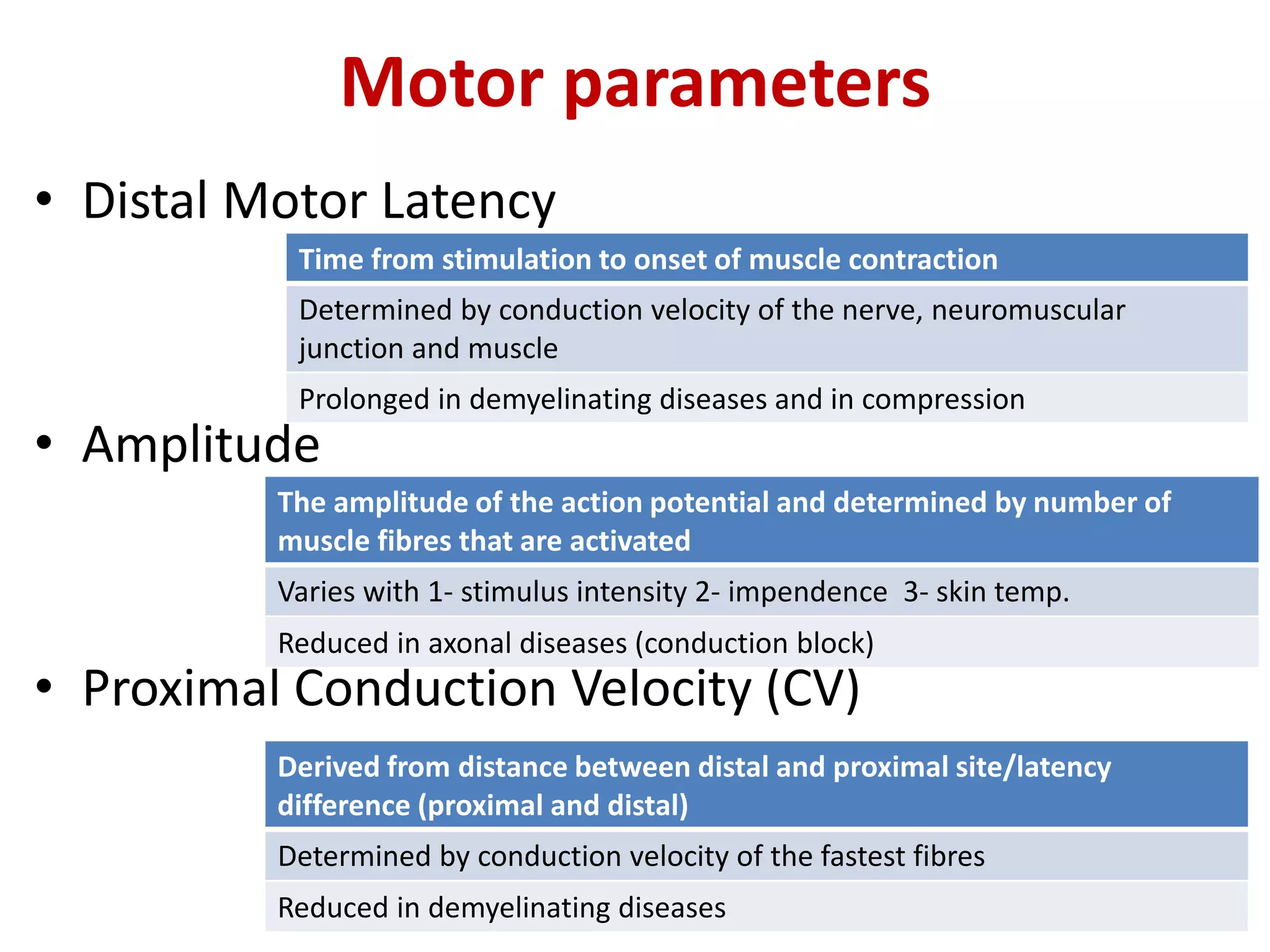
Motor parameters
• Distal Motor Latency
• Amplitude
• Proximal Conduction Velocity (CV)
Time from stimulation to onset of muscle contraction
Determined by conduction velocity of the nerve, neuromuscular
junction and muscle
Prolonged in demyelinating diseases and in compression
The amplitude of the action potential and determined by number of
muscle fibres that are activated
Varies with 1- stimulus intensity 2- impendence 3- skin temp.
Reduced in axonal diseases (conduction block)
Derived from distance between distal and proximal site/latency
difference (proximal and distal)
Determined by conduction velocity of the fastest fibres
Reduced in demyelinating diseases
• Supra-maximal stimulation gives “best”
amplitude CMAP.
• Amplitude gives idea about the number of
motor units that be activated while
stimulated.
• Distal latency, is prolonged when there is
problem in the segment of the nerve
Sensory nerve
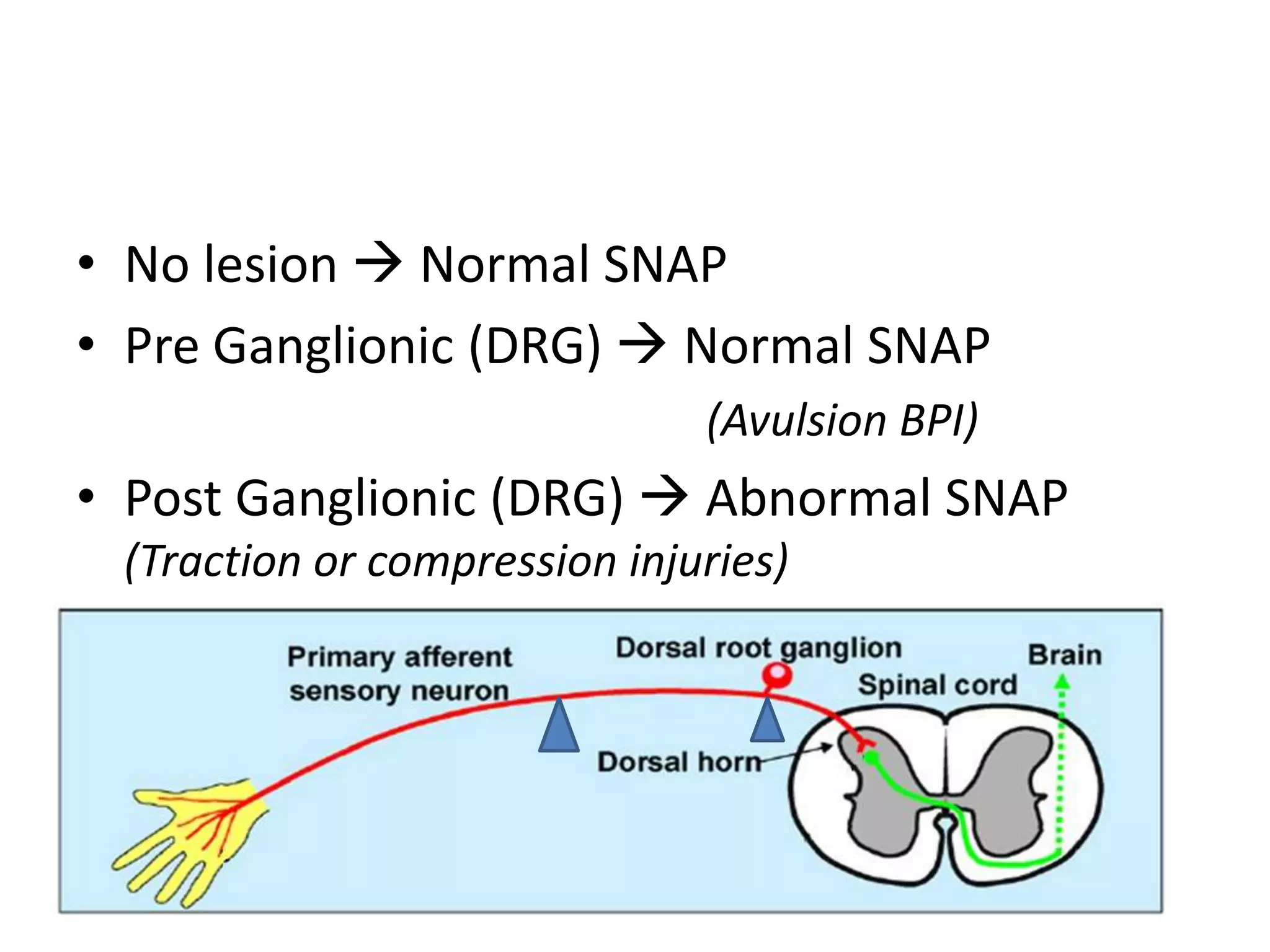
• No lesion  Normal SNAP
• Pre Ganglionic (DRG)  Normal SNAP
(Avulsion BPI)
• Post Ganglionic (DRG)  Abnormal SNAP
(Traction or compression injuries)
S-NCSs
• Generally only one stimulus site
• Its response is much smaller than motor
responses (microvolts)
And
more liable to artifact.
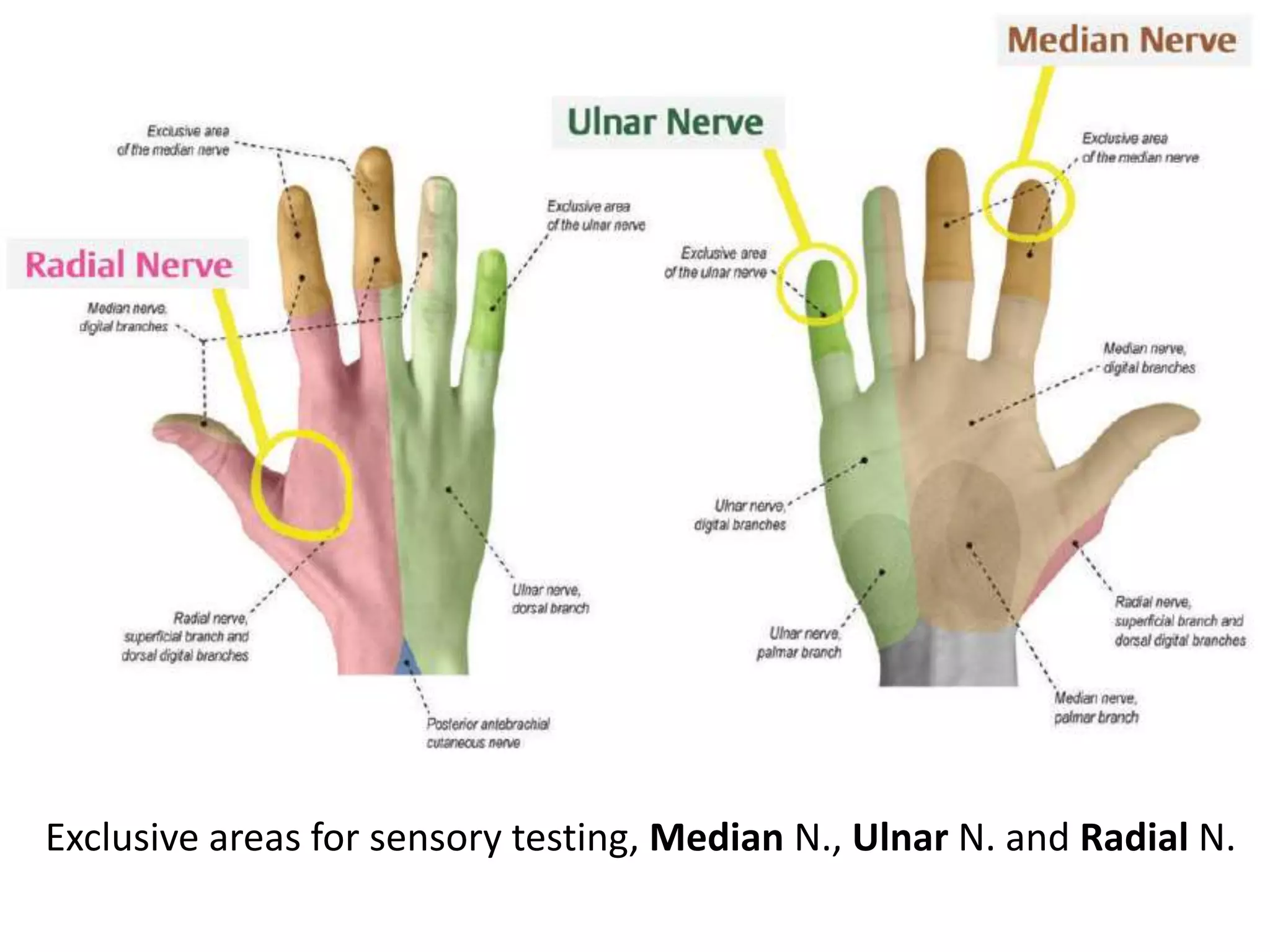
Exclusive areas for sensory testing, Median N., Ulnar N. and Radial N.
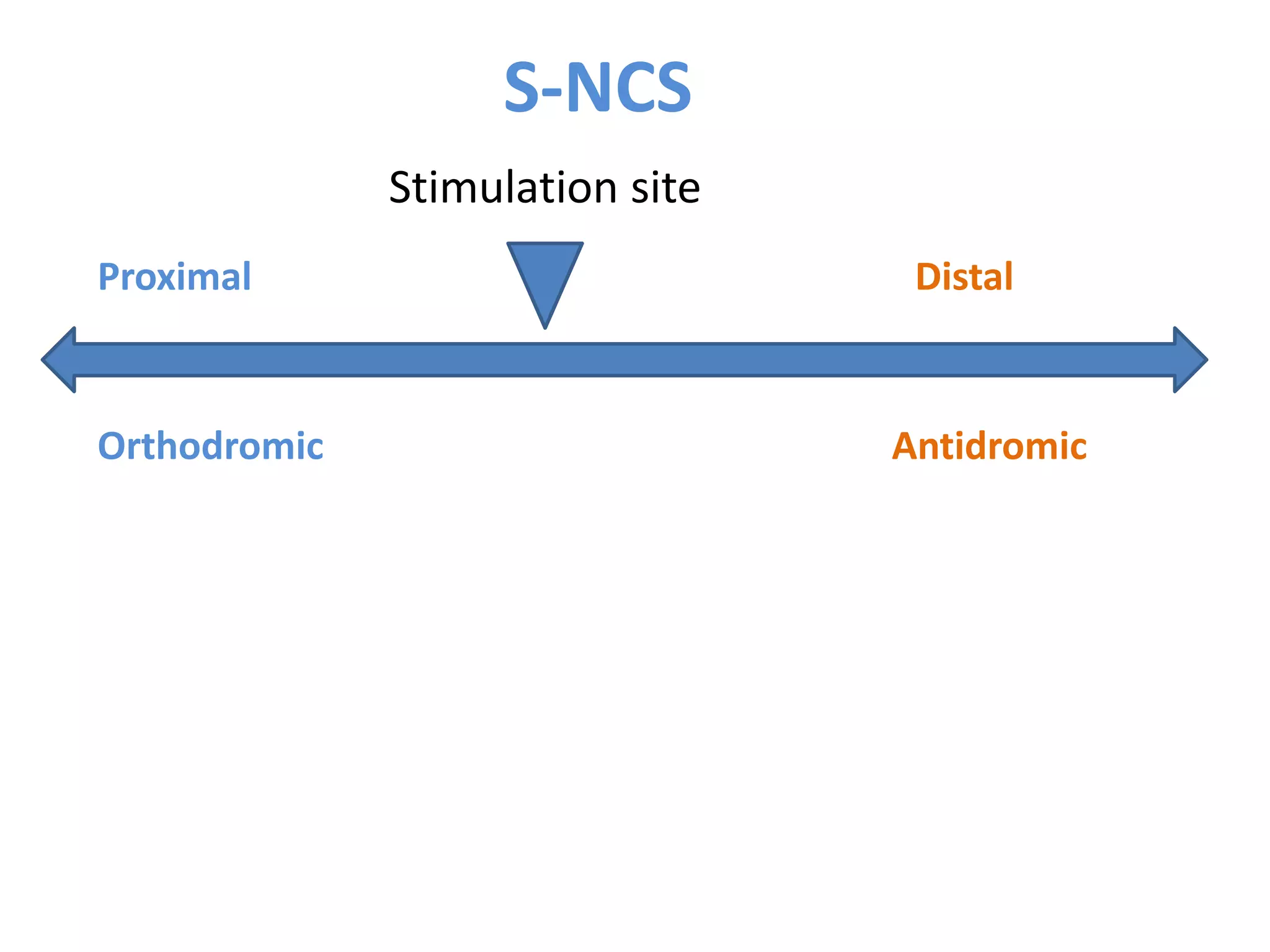
Stimulation site
Proximal
Orthodromic
Distal
Antidromic
S-NCS
Sensory NCV is main part why??
• 1st, they are the only abnormal portion with
disorders limited to sensory nerve fibres.
• 2nd, as only lesions at or distal to DRG affect
sensory NCV, they have localizing value.
They will localize ganglionic and post-ganglionic
ones.
• 3rd, they are more sensitive than motor NCSs at
identifying focal demyelination and axon loss
lesions.
• With mild lesions, SNAP abnormalities will be the only NCS
abnormality,
while
CMAP will be within normal range.
So logically,
• In severe lesions, they will be more pronounced than CMAP
• Example: early CT$
Conduction velocity will show slowing along the sensory nerve
fibres
• Major drawback of S-NCS is the small size of the
recorded responses.
• Easily affected by
1. Physiologic (Age)
2. Physical (temperature, obesity, edema)
3. Technical (electrode misplacement)
4. Individuals over the age of 60 years (may have
bilaterally absent LL SNAPs)
Late responses
Late responses
F – wave latency :
• Retrograde “rebound” motor impulse
• Travels full length of motor axon and back
• Gives information about the proximal nerve segments
• Helpful in evaluation of demyelinating neuropathies,
peripheral neuropathy, Guillian Barre Syndrome,
radiculopathy.
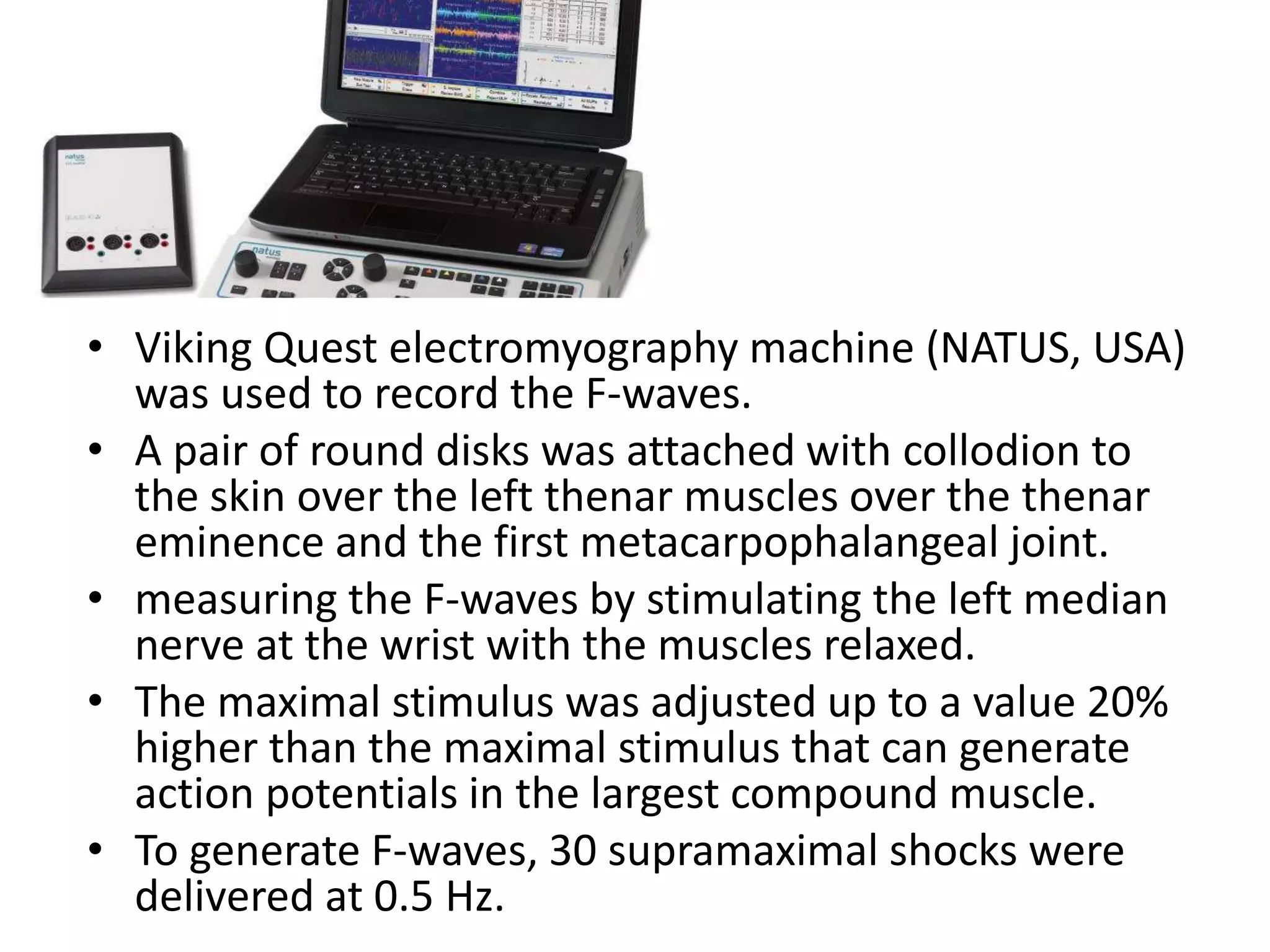
• Viking Quest electromyography machine (NATUS, USA)
was used to record the F-waves.
• A pair of round disks was attached with collodion to
the skin over the left thenar muscles over the thenar
eminence and the first metacarpophalangeal joint.
• measuring the F-waves by stimulating the left median
nerve at the wrist with the muscles relaxed.
• The maximal stimulus was adjusted up to a value 20%
higher than the maximal stimulus that can generate
action potentials in the largest compound muscle.
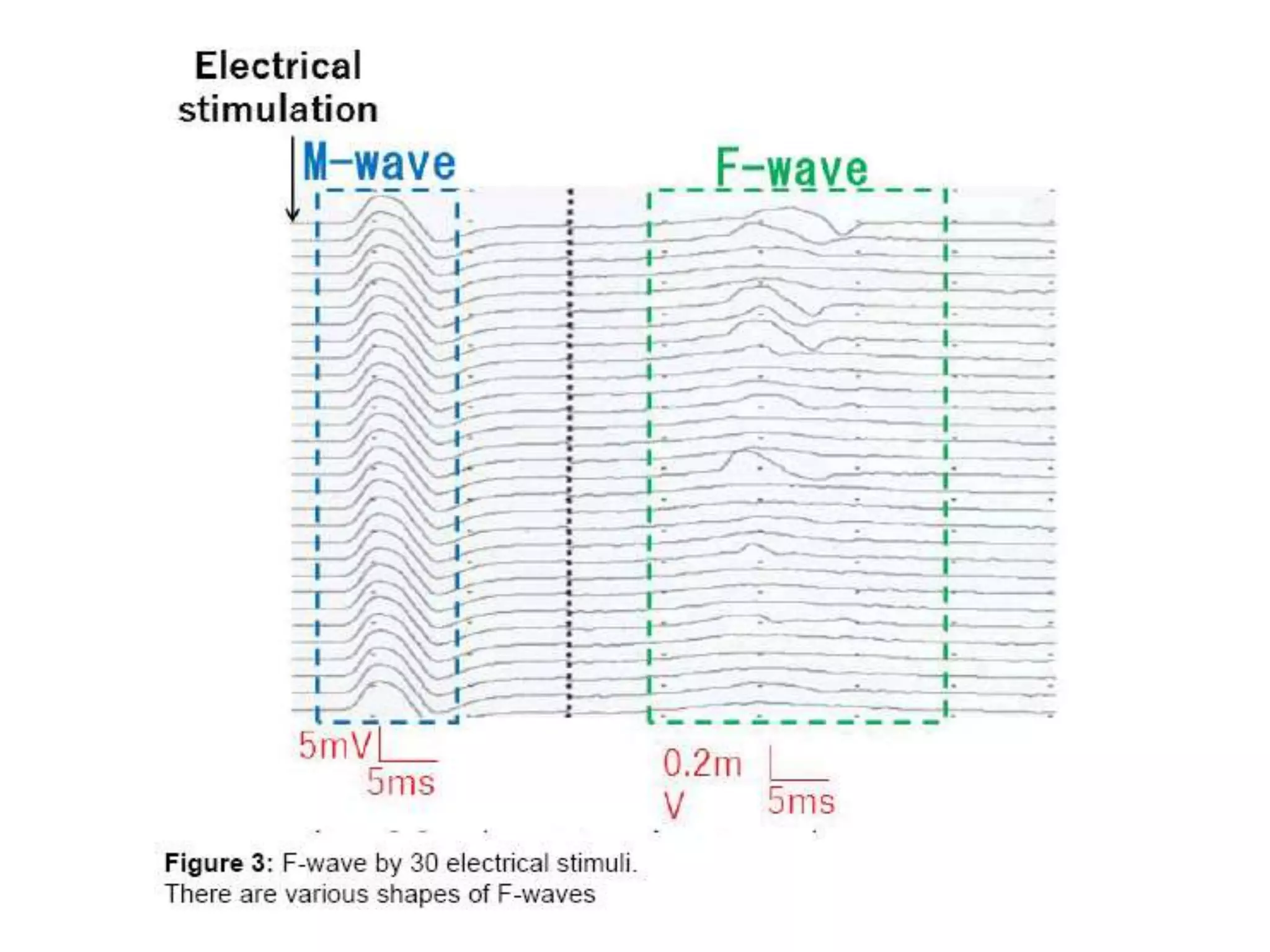
• To generate F-waves, 30 supramaximal shocks were
delivered at 0.5 Hz.
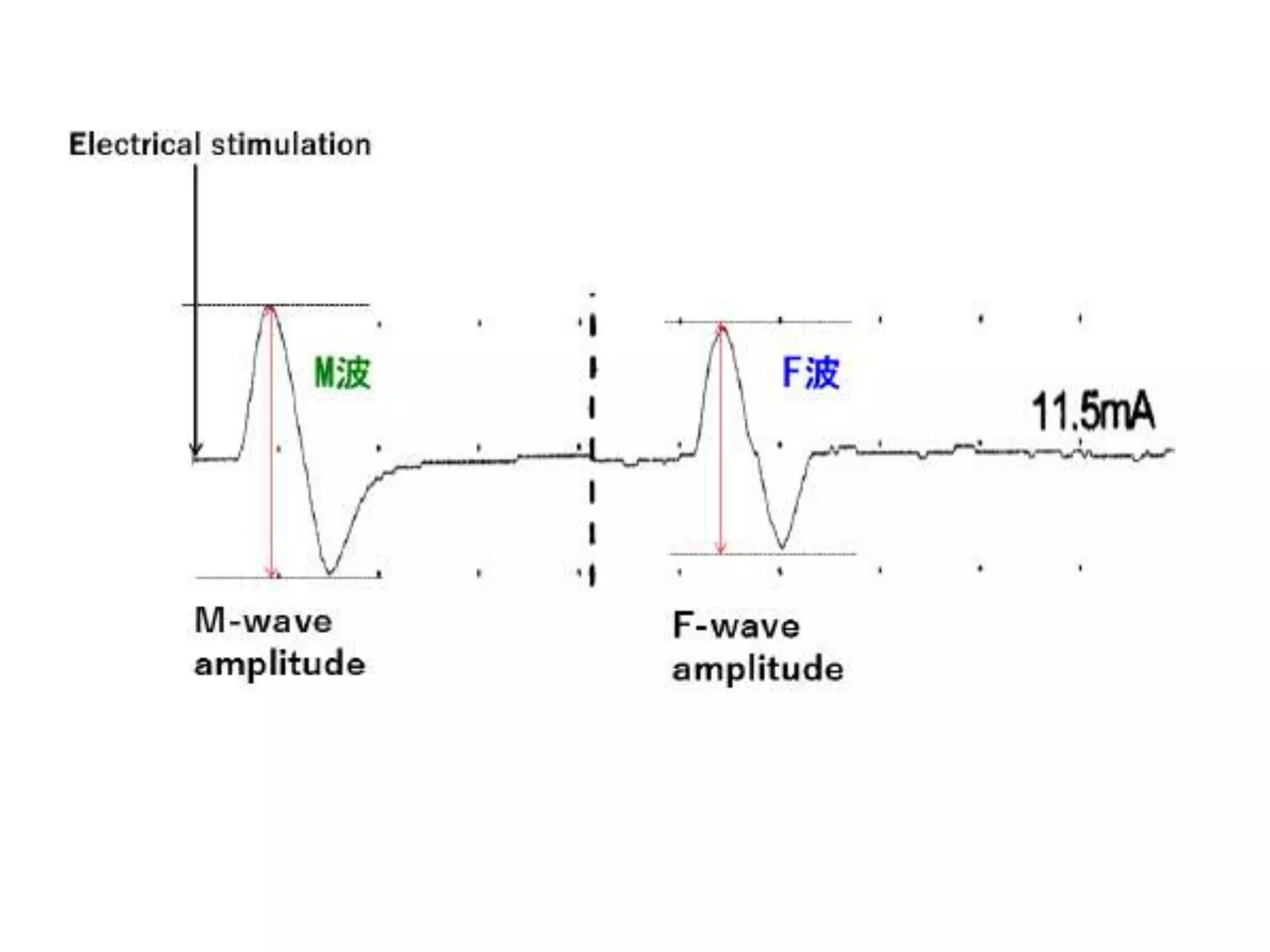
• The first wave is (M) wave
And
• The second wave is (F) wave
The magnitude and shape of the amplitude
depend on the type of exercise unit excited in
the spinal anterior horn cell.
H reflex:
• Follows muscle stretch reflex arc
• Side to side latency is valuable.
• Helpful in evaluation of polyneuropathy, upper motor neuron
lesions.
EMG
• Standard EMG access
1. Distal limb muscles
2. middle limb muscles
3. proximal limb muscles
• At each muscle, the electrical activity is
recorded during one of the 3 phases
1. insertion
2. rest
3. activation
Insertional phase
• After penetration of the skin
• The needle be in the substance of the muscle.
• Each advance of the needle is associated with
brief burst of electrical activity, termed,
Insertional activity.
• Related to the electrode induced mechanical
excitation of the encountered muscle fiber.
Insertional phase
• When fat or connective tissue replaces the
muscle fibers,
The amount of insertional activity Decreased.
• Within normal.
• Abnormal,
Brief trains of insertional positive waves
Rest phase
“time periods between electrode advancements”
normal activity & Abnormal activity happens.
• Normal activity: End plate noise when the
recording electrode is near an endplate
• Abnormal activity: termed spontaneous activity,
includes:
1. fibrillation potentials
2. fasciculation potentials
3. complex repetitive discharges (CRD)
4. myotonic discharges
5. grouped repetitive discharges (GRD)
6. cramp potentials
Rest phase
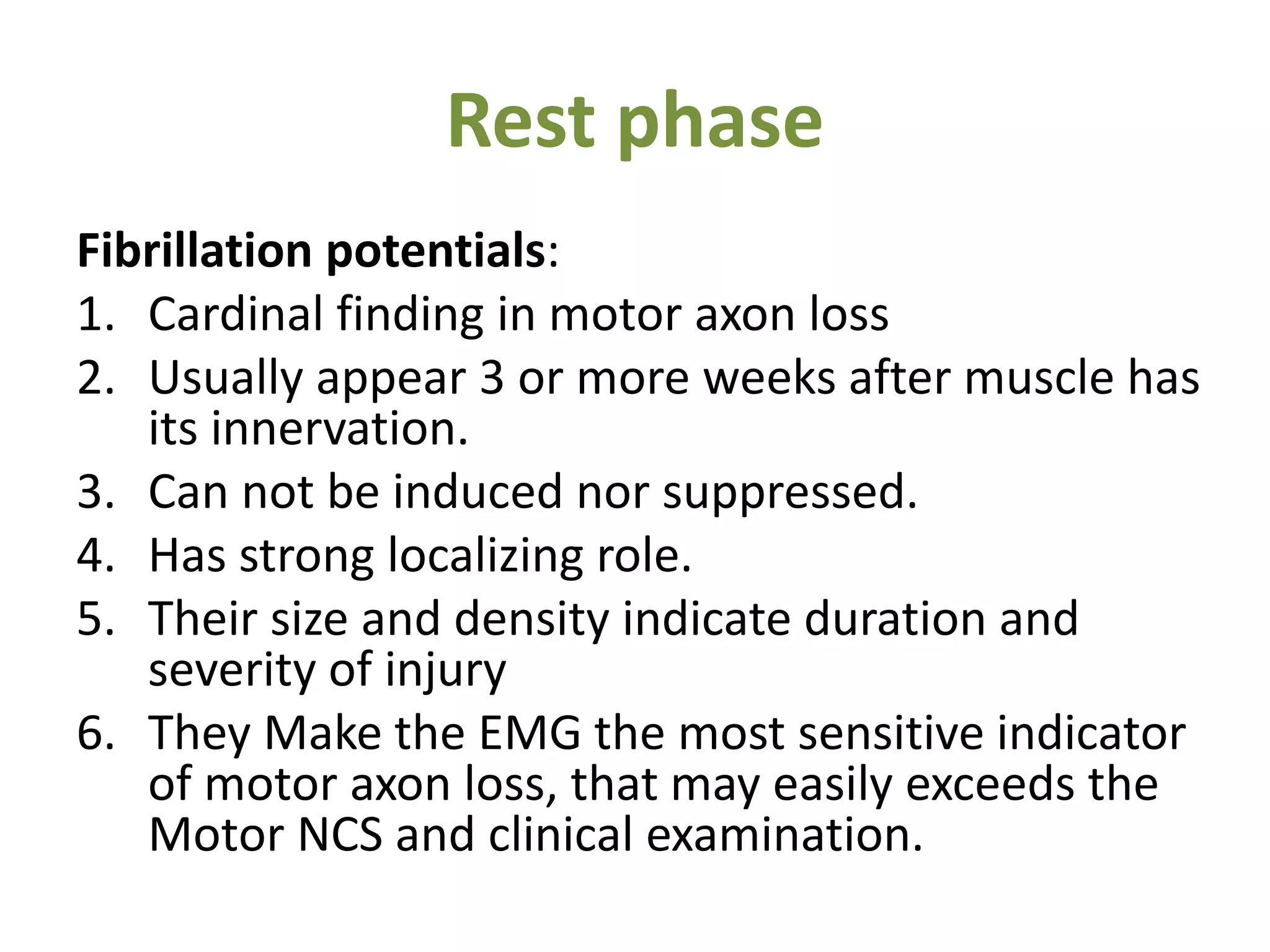
Fibrillation potentials:
Spontaneous muscle fibre action potentials that
repeat with regularity at 0.5 to 15 Hz, As a reflection
of autonomous ion channel changes, produces
spontaneous muscle fiber depolarization.
• Most common encountered type
Observed mainly in Peripheral nerve injuries
Rest phase
Fibrillation potentials:
1. Cardinal finding in motor axon loss
2. Usually appear 3 or more weeks after muscle has
its innervation.
3. Can not be induced nor suppressed.
4. Has strong localizing role.
5. Their size and density indicate duration and
severity of injury
6. They Make the EMG the most sensitive indicator
of motor axon loss, that may easily exceeds the
Motor NCS and clinical examination.
Rest phase
Fasciculation potentials:
“Irregular spontaneous firing of motor units or
portions of motor units”
• Indicate irritability (mainly)
• Little importance
• Seen typically in:
1. chronic demyelination (irradiation plexopathy)
2. thyrotoxicosis
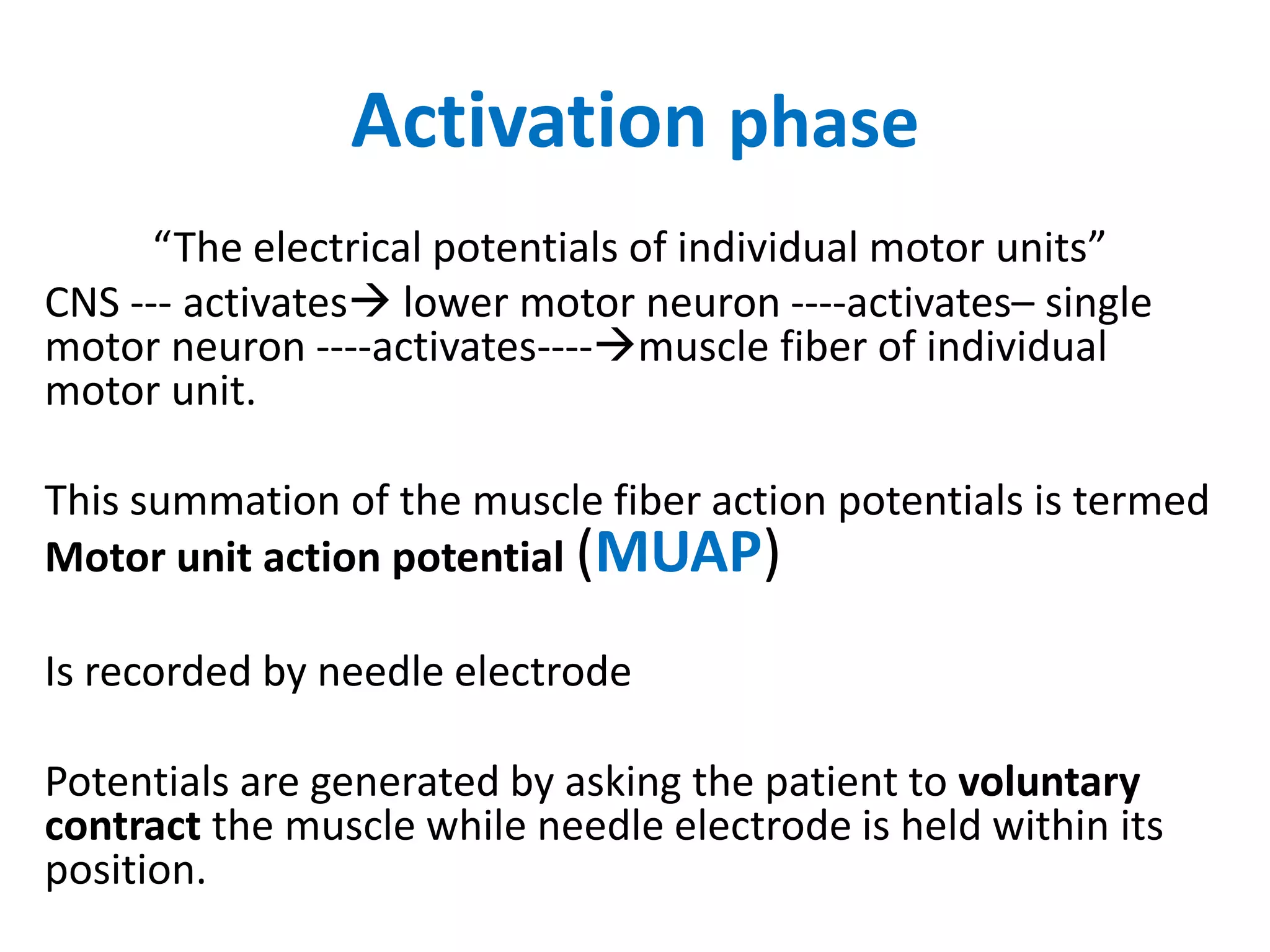
Activation phase
“The electrical potentials of individual motor units”
CNS --- activates lower motor neuron ----activates– single
motor neuron ----activates----muscle fiber of individual
motor unit.
This summation of the muscle fiber action potentials is termed
Motor unit action potential (MUAP)
Is recorded by needle electrode
Potentials are generated by asking the patient to voluntary
contract the muscle while needle electrode is held within its
position.
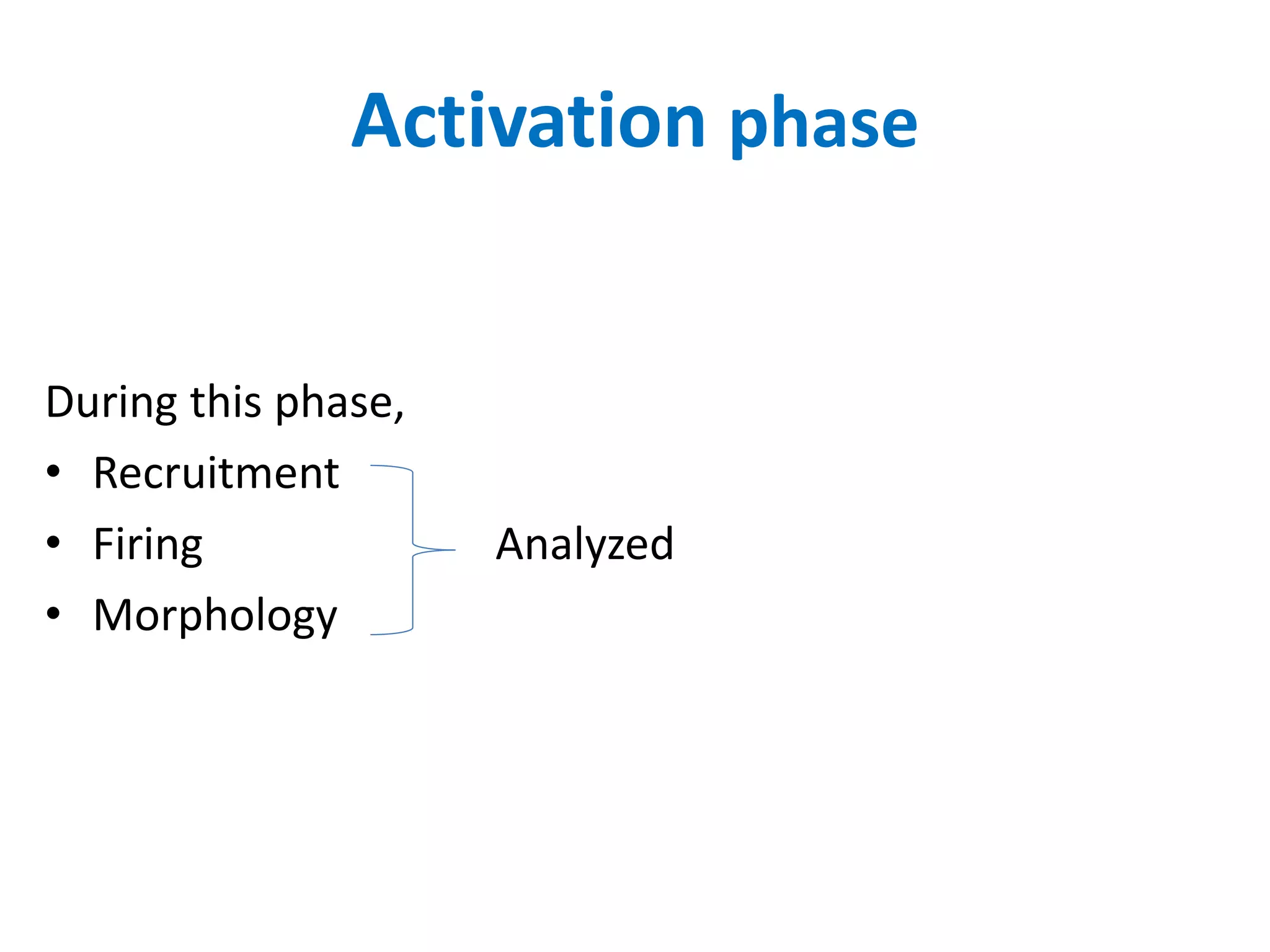
Activation phase
During this phase,
• Recruitment
• Firing Analyzed
• Morphology
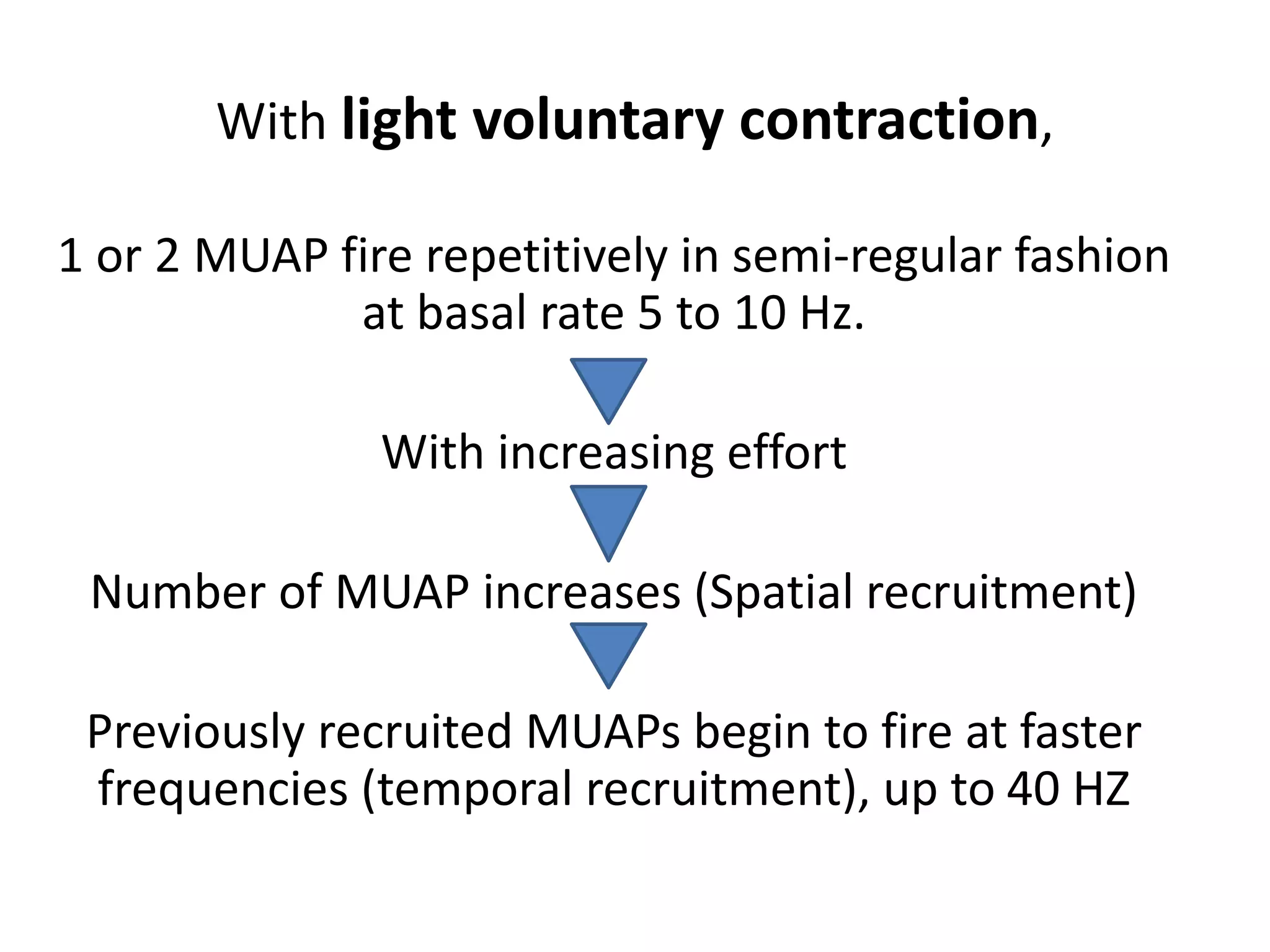
With light voluntary contraction,
1 or 2 MUAP fire repetitively in semi-regular fashion
at basal rate 5 to 10 Hz.
With increasing effort
Number of MUAP increases (Spatial recruitment)
Previously recruited MUAPs begin to fire at faster
frequencies (temporal recruitment), up to 40 HZ
• This pattern is called “full interference pattern”.
• Full temporal recruitment increases muscle
contraction force 3 or more above the level that
obtained by full spatial recruitment.
• Recruitment is abnormal when it is reduced or early.
• Early recruitment : in myopathies and NMJ
disorders.
• Reduced recruitment: in axon loss and
demyelinating conduction block lesions
In case of axon loss,
the available fewer non affected motor units fire.
Producing spatial recruitment (below than
normal).
But fire at faster rate.
Can be observed.
In non full pattern (discrete).
Indicates pathological insult,
Termed “neurogenic recruitment”
• Following muscle fiber denervation
• Reinnervation may occur via “collateral
sprouting”
_ Process in which the motor axons of unaffected
motor units sprout collateral brs. That grow
outward and adopt the denervated muscle fibres_
This supports the lost muscle contraction force.
So, innervation ratio increases.
On EMG: increase MUAP duration
Called _ chronic neurogenic changes _
Indicative of (remote axon loss)
• The sprouting is appearing also by increased
number of phases & turns.
• Phase: directional changes with baseline
crossing
• Turn: directional changes without baseline
crossing
PhaseTurn
In case of demyelinating conduction block
• The internal & external configurations do not
change and not affected as
Motor axons remain in continuity with
their muscle fibres.
Thus, no sprouting occurs.
• If the demyelination propagates and
affects the terminal nerve brs. or NMJ,
configuration may changes.
• Collateral sprouting cannot occur in
Complete motor axon loss lesions
As
There will not be Unaffected motor nerve fibres
that can be sprout
• In those complete motor loss,
Reinnervation can occur only via axonal regrowth
from the site of axon disruption
Configuration ??
Will be poly-phase + low amplitude
With reinnervation with axonal regrowth,
Affected MUAP can reach normal appearance
Limitations of EDX
1. Standard NCSs only assess the large more
myelinated nerve fibres such as conveying
vibratory, position and light touch sensation.
While
those conveying pain and temperature
have normal EDX even they are injured.
So,
patients with injuries of the nerve injuries can
not be identified by EDX testing.
Limitations of EDX
2. Pain & parasthesia don't have ideal
standard EDX parameters
So,
Patients with isolated parasthesia have normal
EDX examination.
Microneurography can detect abnormalities in
those patients but are only restricted to few
high equipped centres.
Limitations of EDX
3. Confouding factors:
I. Presence of 2 or more separate lesions situated
along the same nerve fibre.
II. Presence of underlying generalized perioheral
nervous system (PNS) disorder e.g.
polyneuropathy.
III. Presence of unrelated PNS disorder located in the
distribution of lesser injury located more
proximally eg. Severe CT$, upper trunk lesion.
IV. Unavailable sites for stimulation and recording
like, casts, bandages, IV lines, metal hard ware
stabilizing bones or joints , burn skin and edema.
4. Although the clinical manifestations are
maximal at onset , the EDX are still within normal
and need about 3 to 5 weeks to be full
established.
EDX manifestations
Axon loss
Most common type of nerve fiber pathology.
Depends on severity of the lesion and age.
In mild axon loss, only small number of fibrillation
potentials on EMG can be observed.
In greater degrees of axon loss, number of fibrillation
potentials increase
SNAP amplitude decrease
More Greater degree of axon loss, CMAP be affected.
In complete axonal injuries, no MUAP is recorded.
• No stimulation is passed and crossed beyond
the lesion site, termed
“Axon discontinuity conduction block”
• So, has merit of localizing the lesion.
• May persist for
7 days with motor axon loss.
11 days with sensory axon loss.
• Generally we wait to do the first EDX study at
4 to 6 weeks to allow fibrillation potentials
enough time to declare themselves.
• Latency and CV values that associated with
axon loss lesions are usually normal even
measured across the lesion site as they reflect
the surviving fibres rather than the affected
ones.
EDX manifestations
Focal demyelination
Areas that are lacking the myelin coverage
smaller number of sodium channels
the rate of action potential propagation is slow
Termed
“Demyelinating conduction slowing”
So,
Mild lesions do
“conduction slowing”
Severe lesions do
“conduction block”
Demyelinating conduction slowing
• Is divided into 2 types:
1. Uniform (action potential slowed to certain equal
degree)
2. Differential
(action potential slowed to different unequal degrees)
Demyelinating conduction slowing
• Associated with
No EMG abnormalities
Clinical Correlations
With axon loss lesions,
• Affected nerve fibres can not conduct action
potential.
• Motor involvement produces weakness and
muscle atrophy
• Sensory involvement produces impairment of
1. large diameter (vibration, proprioception &
light touch)
2. Small diameter (pain, temperature)
Clinical Correlations
With conduction slowing,
• Prolonged latencies
• Normal amplitude
• Normal EMG
• Sensory NCSs assess the sensory nerve fibres
and localize the lesion.
• Abnormal SNAP indicate that the lesion lies at
or distal to DRG.
• In cases of brachial plexus injuries, SNAP
abnormalities typically localize the lesion to
specific BP element.
• EMG is the most sensitive EDX for detection of
motor axon loss.
• Presence of MUAP identify the chronicity of
the lesion.
• EMG provide wider sampling of the PNS
because far more muscles can be assessed
than nerves.
• The timing of EDX in relation to the onset f the
lesion is crucial.
• The best time to perform an EDX is 3 to 6 weeks
after the injury.
Important data before EDX
• When the presence of pre existing
abnormalities is a concern,
The study be performed on days of injury
e.g.
When the patient complains of hand numbness
post op.
&
Pre op. neuropathy is suspected as a potential
predisposition.
Important data before EDX
• With sharp nerve injuries,
Immediate surgical repair is indicated typically.
e.g.
If the patient comes late, presence of volitional
MUAP in muscles innervated by the affected
nerve indicates an incomplete lesion.
Important data before EDX
• Example,
Patient awaken from hip surgery with ipsilateral foot
drop.
Q: whether the foot reflects a sciatic neuropathy at
the surgical site or compression at the fibular head?
A:
Peroneal CMAP
Records from the tibialis anterior muscle
by stimulation above and below the fibular
head.
Important data before EDX
• If the two responses are different (above and
below) , conduction block is identified.
• If not difference, so no conduction block , so
the pathology lies proximally, and the sciatic
neuropathy at the surgical site is be more
likely the cause.
• Lesion localization:
Location: pre or post ganglionic
Severity
Pathophysiology
Type of axons injured
Rate of progression
Best example for localization
• Radial N. & PIN
• Most of neuropathies affecting them are
originated between the origins of 2 of them.
• In the opposite side, the median and ulnar
nerve
Partial ulnar neuropathy at elbow presented.
• SNAP abnormalities, so, the lesion is located
at or distal to the DRG
• Absent SNAP abnormalities,
Absent median & ulnar CMAP and
Normal median SNAP, indicates that the lesion is
localizing proximal to the Ulnar N. e.g. medial
cord or lower trunk.
• Verifying between organic & non-organic
lesions:
I. Non organic: normal CMAP, reduction on
MUAP recruitment related to poor effort.
II. Organic: low amplitude recorded CMAP.
• Differentiating pathologic atrophy from disuse
atrophy.
.-.-.-. > Disuse atrophy does not produce EXD
abnormalities.
• Identify mechanical cause of weakness, e.g.
rupture tendon.
No action is observed + normal MUAP.
• Reinnervation occurs via 2 mechanisms:
1. Collateral sprouting:
quicker, as the unaffected motor nerve fibres
simply have to sprout collateral branches to
neighboring muscle fibres.
1. Axonal regrowth:
like “remyelination” occurs early within 3 to 4
months.
Reinnervation,
necessitates that the injury be incomplete,
as it requires unaffected motor nerve fibres.
• With axonal regrowth,
Nerve fibres sprout from the proximal axon
stump and grow toward the muscle fibre at a
rate just over 1 inch per month.
The shorter the distance between the injury site
and denervated muscle, the better the
reinnervation, why ?
As the muscle fibres remain denervated for a
prolonged period of time if not activated.
• Thus, the worst prognosis is associated with
the complete lesions that are located far from
the denervated muscle fibres.
&
• The best prognosis occurs in incomplete
lesions located near the denervated muscle
fibres.
• 1st degree lesions:
Functional neuronal block, excellent prognosis
• 2nd degree lesions:
Prognosis is excellent as the intact endoneurial tubes permit un-
obstructed axonal regrowth.
• 3rd degree lesions:
Prognosis is dependent on the ability of sprouting axons to cross the
lesion and enter the proper endoneurial tube.
• 4th degree lesions:
Marked internal disorganizationof the connective tissue elements, so
prognosis is poor.
• 5th degree lesions:
very very poor prognosis
4th &5th degrees need surgical exploration and repair
Denervated muscle fibres
Re-innervated replaced by fibro-fatty tissue
Clinical comments
• EDX is useful but does not replace the clinical
judgment.
• In Carpal tunnel syndrome,
11% of patients have normal EDX studies.
But,
When clinical is augmented by EDX, appropiate
decision is taken.
Carpal tunnel syndrome
• Normal median motor study
• Normal ulnar motor study
• In more affected cases, distal latency is Prolonged
• Generally demyelinating process occur due to
focal compression
• Changes happen in sensory study, First
• In more severe, secondary axonal damage occur
• If the patient complains that there is worse
sensation following the release process.
Typically, this reflects nerve fiber recovery with
resultant transition from numbness to tingling.
Repeat the EDX, you will notice improvement of the
previously abnormal values.
So the surgical procedure was successful.
Demyelinating neuropathy
• Prolonged distal latency
• Preserved distal amplitude
• Conduction slowing
• Conduction block
Causes:
 Immune
 Infections
 Drugs
 Hereditary
• EDX can be difficult to be interpreted by the
surgeon treating the patient.
• EDX is variable among the
electrodiagnosticians, and results vary.
• Surgeon should discuss results with the
electrodiagnosticians to clarify the results.
• If no recovery at 3 months by EDX following
the injury, it is time for surgery.
• Fibrillations appear at 3 to 6 weeks after injury.
• MUAP indicates recovery and good prognosis
with out surgical intervention.
• Early MUAP  (8 – 12 weeks) represent collateral
sprouting
• Late MUAP  actual regeneration of the injured
axons to end plates.
Intraoperative electrical stimulation,
Can help differentiate between
1. Ischemic conduction block
2. Focal demyelination
3. Axon loss
In both (1 & 2), nerve stimulation will produce
muscle contractions.
When compression is releases, stimulation proximal
to the compression site will improve the muscle
response,
I. Immediately if ischemia is the cause
II. Later if demyelination is the cause
NCS interpretation revision
take home message ……………..
• Distal amplitude
If reduced (absolute or relative to other side)
• Axonal loss/lesion of nerve
• Distal latency
If prolonged,
• Distal conduction block
• Severe axonal loss lesion
• Proximal amplitude
If reduced > 50% ,
• Conduction block
• Proximal conduction velocity
If reduced,
• Focal demyelination
• Duration of response
Prolonged,
• Conduction block
Pathology criteria
• Axonal process
Reduced distal amplitude
Preserved conduction velocity
Slowing due to loss of fastest fibers
• Demyelinating process
Preserved distal amplitude
Prolonged latencies
Reduced conduction velocities
Conduction block
Interpretation of NCS and EMG

Interpretation of NCS and EMG

  • 1.
    Interpretation of NCV andEMG (Neurosurgeon’s View) Mohamed Elsayed Elsebaey (Nerve Surgery Team) Neurosurgery Registrar General Ismailia Hospital May 2019
  • 3.
    Items 1. The basicsof NCV & EMG 2. When to require them and the optimum time 3. How to do them 4. What are the results 5. Clinical correlations
  • 4.
  • 5.
    Nerve fibres (myelinated ornon myelinated) …………………………………………………………….. Surrounded by endoneurial connective tissue Then packed into Fascicles Surrounded by Perineurium connective tissue Surrounded by epineurial tissue Surrounded by loose connective tissue that provide adequate mobility around joints
  • 6.
    • The lesionsare following any force that: disrupt the myelin coating or disrupt the nerve fiber. • UL: Radial nerve is the commonest injured nerve • LL: Sciatic nerve “”””””””””””””””””””.
  • 8.
    Why we require? •Assess function • Assess integrity of peripheral nervous system. • Augment the detailed history and physical examination. • Also (Medico-legal)
  • 9.
    Indications for testing •Suspected neuromuscular disease 1. Nerve root pathology 2. Nerve / Plexus pathology 3. Neuromuscular junction (NMJ) pathology 4. Muscle pathology • Follow up • Differentiation between certain causes.
  • 10.
    NCV/EMG results • Normal •Radicalopathy • Plexopathy • Neuropathy • Myopathy • Demyelination • Neuromuscular junction block
  • 11.
    How it works? Theelectrical current • Depolarizes the nerve membrane • Initiates action potential in axon The action potential travels along the nerve depending on the integrity of the myelin membrane that covering nerve fibers. ((conduction along the non-myelinated fibers is much slower))
  • 12.
  • 13.
    Response of nerveconduction studies (NCSs) • Motor: compound motor action potential (CMAP) millivolt-millisecond • Sensory: sensory nerve action potential (SNAP) microvolt-millisecond
  • 14.
    Each Response has •Amplitude • Area • Latency • Conduction velocity • Duration Each item has its normal values Best to be compared with the contralateral side
  • 15.
    Amplitude • Measured fromtrough of the initial positive phase to peak of subsequent negative phase. • Reflects the number of the functioning nerve fibres. • It is valuable in detecting motor weakness or sensory loss.
  • 17.
    Area • Equals amplitude+ duration • Modern EMG machines calculate this value automatically.
  • 18.
    Latency • Reflects conductionvelocity over fixed distance. • Measured in millisecond. • Has two points of stimulation (proximal & distal ) • So, has proximal and distal CMAP • Its value, to record the CV along the fastest conducting motor nerve fibres. • Distal motor latency reflects the NMJ and muscle fiber action potential transmission times.
  • 19.
    Conduction velocity CV •reflects the speed of action potential propagation along the fastest conducting nerve fibres in the studied nerve segment. • Expressed in meters per second (m/s) • Many consider this parameter is the most informative response, in fact, it is the least one. As, CV value reflects CV rate and thus no information about the number of functioning nerve fibres in the studied segment.
  • 20.
    Motor NCSs • Orthodromic •Two points are stimulated • Proximal and distal (according to relation to the stimulus) • So (2 CMAP) are generated • Interpret both results
  • 21.
    Motor NCS isalso used • to verify the suspected malingering from the true weakness as, True weakness is associated with EDX abnormalities, while malingering is not.
  • 22.
    Motor parameters • DistalMotor Latency • Amplitude • Proximal Conduction Velocity (CV) Time from stimulation to onset of muscle contraction Determined by conduction velocity of the nerve, neuromuscular junction and muscle Prolonged in demyelinating diseases and in compression The amplitude of the action potential and determined by number of muscle fibres that are activated Varies with 1- stimulus intensity 2- impendence 3- skin temp. Reduced in axonal diseases (conduction block) Derived from distance between distal and proximal site/latency difference (proximal and distal) Determined by conduction velocity of the fastest fibres Reduced in demyelinating diseases
  • 23.
    • Supra-maximal stimulationgives “best” amplitude CMAP. • Amplitude gives idea about the number of motor units that be activated while stimulated. • Distal latency, is prolonged when there is problem in the segment of the nerve
  • 24.
  • 25.
    • No lesion Normal SNAP • Pre Ganglionic (DRG)  Normal SNAP (Avulsion BPI) • Post Ganglionic (DRG)  Abnormal SNAP (Traction or compression injuries)
  • 26.
    S-NCSs • Generally onlyone stimulus site • Its response is much smaller than motor responses (microvolts) And more liable to artifact.
  • 27.
    Exclusive areas forsensory testing, Median N., Ulnar N. and Radial N.
  • 28.
  • 29.
    Sensory NCV ismain part why?? • 1st, they are the only abnormal portion with disorders limited to sensory nerve fibres. • 2nd, as only lesions at or distal to DRG affect sensory NCV, they have localizing value. They will localize ganglionic and post-ganglionic ones. • 3rd, they are more sensitive than motor NCSs at identifying focal demyelination and axon loss lesions.
  • 30.
    • With mildlesions, SNAP abnormalities will be the only NCS abnormality, while CMAP will be within normal range. So logically, • In severe lesions, they will be more pronounced than CMAP • Example: early CT$ Conduction velocity will show slowing along the sensory nerve fibres
  • 31.
    • Major drawbackof S-NCS is the small size of the recorded responses. • Easily affected by 1. Physiologic (Age) 2. Physical (temperature, obesity, edema) 3. Technical (electrode misplacement) 4. Individuals over the age of 60 years (may have bilaterally absent LL SNAPs)
  • 32.
  • 33.
    Late responses F –wave latency : • Retrograde “rebound” motor impulse • Travels full length of motor axon and back • Gives information about the proximal nerve segments • Helpful in evaluation of demyelinating neuropathies, peripheral neuropathy, Guillian Barre Syndrome, radiculopathy.
  • 34.
    • Viking Questelectromyography machine (NATUS, USA) was used to record the F-waves. • A pair of round disks was attached with collodion to the skin over the left thenar muscles over the thenar eminence and the first metacarpophalangeal joint. • measuring the F-waves by stimulating the left median nerve at the wrist with the muscles relaxed. • The maximal stimulus was adjusted up to a value 20% higher than the maximal stimulus that can generate action potentials in the largest compound muscle. • To generate F-waves, 30 supramaximal shocks were delivered at 0.5 Hz.
  • 35.
    • The firstwave is (M) wave And • The second wave is (F) wave The magnitude and shape of the amplitude depend on the type of exercise unit excited in the spinal anterior horn cell.
  • 38.
    H reflex: • Followsmuscle stretch reflex arc • Side to side latency is valuable. • Helpful in evaluation of polyneuropathy, upper motor neuron lesions.
  • 40.
    EMG • Standard EMGaccess 1. Distal limb muscles 2. middle limb muscles 3. proximal limb muscles • At each muscle, the electrical activity is recorded during one of the 3 phases 1. insertion 2. rest 3. activation
  • 41.
    Insertional phase • Afterpenetration of the skin • The needle be in the substance of the muscle. • Each advance of the needle is associated with brief burst of electrical activity, termed, Insertional activity. • Related to the electrode induced mechanical excitation of the encountered muscle fiber.
  • 42.
    Insertional phase • Whenfat or connective tissue replaces the muscle fibers, The amount of insertional activity Decreased. • Within normal. • Abnormal, Brief trains of insertional positive waves
  • 43.
    Rest phase “time periodsbetween electrode advancements” normal activity & Abnormal activity happens. • Normal activity: End plate noise when the recording electrode is near an endplate • Abnormal activity: termed spontaneous activity, includes: 1. fibrillation potentials 2. fasciculation potentials 3. complex repetitive discharges (CRD) 4. myotonic discharges 5. grouped repetitive discharges (GRD) 6. cramp potentials
  • 44.
    Rest phase Fibrillation potentials: Spontaneousmuscle fibre action potentials that repeat with regularity at 0.5 to 15 Hz, As a reflection of autonomous ion channel changes, produces spontaneous muscle fiber depolarization. • Most common encountered type Observed mainly in Peripheral nerve injuries
  • 45.
    Rest phase Fibrillation potentials: 1.Cardinal finding in motor axon loss 2. Usually appear 3 or more weeks after muscle has its innervation. 3. Can not be induced nor suppressed. 4. Has strong localizing role. 5. Their size and density indicate duration and severity of injury 6. They Make the EMG the most sensitive indicator of motor axon loss, that may easily exceeds the Motor NCS and clinical examination.
  • 46.
    Rest phase Fasciculation potentials: “Irregularspontaneous firing of motor units or portions of motor units” • Indicate irritability (mainly) • Little importance • Seen typically in: 1. chronic demyelination (irradiation plexopathy) 2. thyrotoxicosis
  • 47.
    Activation phase “The electricalpotentials of individual motor units” CNS --- activates lower motor neuron ----activates– single motor neuron ----activates----muscle fiber of individual motor unit. This summation of the muscle fiber action potentials is termed Motor unit action potential (MUAP) Is recorded by needle electrode Potentials are generated by asking the patient to voluntary contract the muscle while needle electrode is held within its position.
  • 48.
    Activation phase During thisphase, • Recruitment • Firing Analyzed • Morphology
  • 49.
    With light voluntarycontraction, 1 or 2 MUAP fire repetitively in semi-regular fashion at basal rate 5 to 10 Hz. With increasing effort Number of MUAP increases (Spatial recruitment) Previously recruited MUAPs begin to fire at faster frequencies (temporal recruitment), up to 40 HZ
  • 50.
    • This patternis called “full interference pattern”. • Full temporal recruitment increases muscle contraction force 3 or more above the level that obtained by full spatial recruitment. • Recruitment is abnormal when it is reduced or early.
  • 51.
    • Early recruitment: in myopathies and NMJ disorders. • Reduced recruitment: in axon loss and demyelinating conduction block lesions
  • 52.
    In case ofaxon loss, the available fewer non affected motor units fire. Producing spatial recruitment (below than normal). But fire at faster rate. Can be observed. In non full pattern (discrete). Indicates pathological insult, Termed “neurogenic recruitment”
  • 53.
    • Following musclefiber denervation • Reinnervation may occur via “collateral sprouting” _ Process in which the motor axons of unaffected motor units sprout collateral brs. That grow outward and adopt the denervated muscle fibres_ This supports the lost muscle contraction force. So, innervation ratio increases. On EMG: increase MUAP duration Called _ chronic neurogenic changes _ Indicative of (remote axon loss)
  • 54.
    • The sproutingis appearing also by increased number of phases & turns. • Phase: directional changes with baseline crossing • Turn: directional changes without baseline crossing PhaseTurn
  • 55.
    In case ofdemyelinating conduction block • The internal & external configurations do not change and not affected as Motor axons remain in continuity with their muscle fibres. Thus, no sprouting occurs. • If the demyelination propagates and affects the terminal nerve brs. or NMJ, configuration may changes.
  • 56.
    • Collateral sproutingcannot occur in Complete motor axon loss lesions As There will not be Unaffected motor nerve fibres that can be sprout
  • 57.
    • In thosecomplete motor loss, Reinnervation can occur only via axonal regrowth from the site of axon disruption Configuration ?? Will be poly-phase + low amplitude With reinnervation with axonal regrowth, Affected MUAP can reach normal appearance
  • 58.
    Limitations of EDX 1.Standard NCSs only assess the large more myelinated nerve fibres such as conveying vibratory, position and light touch sensation. While those conveying pain and temperature have normal EDX even they are injured. So, patients with injuries of the nerve injuries can not be identified by EDX testing.
  • 59.
    Limitations of EDX 2.Pain & parasthesia don't have ideal standard EDX parameters So, Patients with isolated parasthesia have normal EDX examination. Microneurography can detect abnormalities in those patients but are only restricted to few high equipped centres.
  • 60.
    Limitations of EDX 3.Confouding factors: I. Presence of 2 or more separate lesions situated along the same nerve fibre. II. Presence of underlying generalized perioheral nervous system (PNS) disorder e.g. polyneuropathy. III. Presence of unrelated PNS disorder located in the distribution of lesser injury located more proximally eg. Severe CT$, upper trunk lesion. IV. Unavailable sites for stimulation and recording like, casts, bandages, IV lines, metal hard ware stabilizing bones or joints , burn skin and edema.
  • 61.
    4. Although theclinical manifestations are maximal at onset , the EDX are still within normal and need about 3 to 5 weeks to be full established.
  • 62.
    EDX manifestations Axon loss Mostcommon type of nerve fiber pathology. Depends on severity of the lesion and age. In mild axon loss, only small number of fibrillation potentials on EMG can be observed. In greater degrees of axon loss, number of fibrillation potentials increase SNAP amplitude decrease More Greater degree of axon loss, CMAP be affected. In complete axonal injuries, no MUAP is recorded.
  • 63.
    • No stimulationis passed and crossed beyond the lesion site, termed “Axon discontinuity conduction block” • So, has merit of localizing the lesion. • May persist for 7 days with motor axon loss. 11 days with sensory axon loss.
  • 64.
    • Generally wewait to do the first EDX study at 4 to 6 weeks to allow fibrillation potentials enough time to declare themselves. • Latency and CV values that associated with axon loss lesions are usually normal even measured across the lesion site as they reflect the surviving fibres rather than the affected ones.
  • 65.
    EDX manifestations Focal demyelination Areasthat are lacking the myelin coverage smaller number of sodium channels the rate of action potential propagation is slow Termed “Demyelinating conduction slowing”
  • 66.
    So, Mild lesions do “conductionslowing” Severe lesions do “conduction block”
  • 67.
    Demyelinating conduction slowing •Is divided into 2 types: 1. Uniform (action potential slowed to certain equal degree) 2. Differential (action potential slowed to different unequal degrees)
  • 68.
    Demyelinating conduction slowing •Associated with No EMG abnormalities
  • 69.
    Clinical Correlations With axonloss lesions, • Affected nerve fibres can not conduct action potential. • Motor involvement produces weakness and muscle atrophy • Sensory involvement produces impairment of 1. large diameter (vibration, proprioception & light touch) 2. Small diameter (pain, temperature)
  • 70.
    Clinical Correlations With conductionslowing, • Prolonged latencies • Normal amplitude • Normal EMG
  • 71.
    • Sensory NCSsassess the sensory nerve fibres and localize the lesion. • Abnormal SNAP indicate that the lesion lies at or distal to DRG. • In cases of brachial plexus injuries, SNAP abnormalities typically localize the lesion to specific BP element.
  • 72.
    • EMG isthe most sensitive EDX for detection of motor axon loss. • Presence of MUAP identify the chronicity of the lesion. • EMG provide wider sampling of the PNS because far more muscles can be assessed than nerves.
  • 73.
    • The timingof EDX in relation to the onset f the lesion is crucial. • The best time to perform an EDX is 3 to 6 weeks after the injury.
  • 74.
    Important data beforeEDX • When the presence of pre existing abnormalities is a concern, The study be performed on days of injury e.g. When the patient complains of hand numbness post op. & Pre op. neuropathy is suspected as a potential predisposition.
  • 75.
    Important data beforeEDX • With sharp nerve injuries, Immediate surgical repair is indicated typically. e.g. If the patient comes late, presence of volitional MUAP in muscles innervated by the affected nerve indicates an incomplete lesion.
  • 76.
    Important data beforeEDX • Example, Patient awaken from hip surgery with ipsilateral foot drop. Q: whether the foot reflects a sciatic neuropathy at the surgical site or compression at the fibular head? A: Peroneal CMAP Records from the tibialis anterior muscle by stimulation above and below the fibular head.
  • 77.
    Important data beforeEDX • If the two responses are different (above and below) , conduction block is identified. • If not difference, so no conduction block , so the pathology lies proximally, and the sciatic neuropathy at the surgical site is be more likely the cause.
  • 78.
    • Lesion localization: Location:pre or post ganglionic Severity Pathophysiology Type of axons injured Rate of progression
  • 79.
    Best example forlocalization • Radial N. & PIN • Most of neuropathies affecting them are originated between the origins of 2 of them. • In the opposite side, the median and ulnar nerve
  • 80.
    Partial ulnar neuropathyat elbow presented. • SNAP abnormalities, so, the lesion is located at or distal to the DRG • Absent SNAP abnormalities, Absent median & ulnar CMAP and Normal median SNAP, indicates that the lesion is localizing proximal to the Ulnar N. e.g. medial cord or lower trunk.
  • 81.
    • Verifying betweenorganic & non-organic lesions: I. Non organic: normal CMAP, reduction on MUAP recruitment related to poor effort. II. Organic: low amplitude recorded CMAP.
  • 82.
    • Differentiating pathologicatrophy from disuse atrophy. .-.-.-. > Disuse atrophy does not produce EXD abnormalities. • Identify mechanical cause of weakness, e.g. rupture tendon. No action is observed + normal MUAP.
  • 83.
    • Reinnervation occursvia 2 mechanisms: 1. Collateral sprouting: quicker, as the unaffected motor nerve fibres simply have to sprout collateral branches to neighboring muscle fibres. 1. Axonal regrowth: like “remyelination” occurs early within 3 to 4 months.
  • 84.
    Reinnervation, necessitates that theinjury be incomplete, as it requires unaffected motor nerve fibres.
  • 85.
    • With axonalregrowth, Nerve fibres sprout from the proximal axon stump and grow toward the muscle fibre at a rate just over 1 inch per month. The shorter the distance between the injury site and denervated muscle, the better the reinnervation, why ? As the muscle fibres remain denervated for a prolonged period of time if not activated.
  • 86.
    • Thus, theworst prognosis is associated with the complete lesions that are located far from the denervated muscle fibres. & • The best prognosis occurs in incomplete lesions located near the denervated muscle fibres.
  • 87.
    • 1st degreelesions: Functional neuronal block, excellent prognosis • 2nd degree lesions: Prognosis is excellent as the intact endoneurial tubes permit un- obstructed axonal regrowth. • 3rd degree lesions: Prognosis is dependent on the ability of sprouting axons to cross the lesion and enter the proper endoneurial tube. • 4th degree lesions: Marked internal disorganizationof the connective tissue elements, so prognosis is poor. • 5th degree lesions: very very poor prognosis 4th &5th degrees need surgical exploration and repair
  • 88.
    Denervated muscle fibres Re-innervatedreplaced by fibro-fatty tissue
  • 89.
    Clinical comments • EDXis useful but does not replace the clinical judgment. • In Carpal tunnel syndrome, 11% of patients have normal EDX studies. But, When clinical is augmented by EDX, appropiate decision is taken.
  • 90.
    Carpal tunnel syndrome •Normal median motor study • Normal ulnar motor study • In more affected cases, distal latency is Prolonged • Generally demyelinating process occur due to focal compression • Changes happen in sensory study, First • In more severe, secondary axonal damage occur
  • 91.
    • If thepatient complains that there is worse sensation following the release process. Typically, this reflects nerve fiber recovery with resultant transition from numbness to tingling. Repeat the EDX, you will notice improvement of the previously abnormal values. So the surgical procedure was successful.
  • 92.
    Demyelinating neuropathy • Prolongeddistal latency • Preserved distal amplitude • Conduction slowing • Conduction block Causes:  Immune  Infections  Drugs  Hereditary
  • 93.
    • EDX canbe difficult to be interpreted by the surgeon treating the patient. • EDX is variable among the electrodiagnosticians, and results vary. • Surgeon should discuss results with the electrodiagnosticians to clarify the results. • If no recovery at 3 months by EDX following the injury, it is time for surgery.
  • 94.
    • Fibrillations appearat 3 to 6 weeks after injury. • MUAP indicates recovery and good prognosis with out surgical intervention. • Early MUAP  (8 – 12 weeks) represent collateral sprouting • Late MUAP  actual regeneration of the injured axons to end plates.
  • 95.
    Intraoperative electrical stimulation, Canhelp differentiate between 1. Ischemic conduction block 2. Focal demyelination 3. Axon loss In both (1 & 2), nerve stimulation will produce muscle contractions. When compression is releases, stimulation proximal to the compression site will improve the muscle response, I. Immediately if ischemia is the cause II. Later if demyelination is the cause
  • 96.
    NCS interpretation revision takehome message …………….. • Distal amplitude If reduced (absolute or relative to other side) • Axonal loss/lesion of nerve • Distal latency If prolonged, • Distal conduction block • Severe axonal loss lesion • Proximal amplitude If reduced > 50% , • Conduction block • Proximal conduction velocity If reduced, • Focal demyelination • Duration of response Prolonged, • Conduction block
  • 97.
    Pathology criteria • Axonalprocess Reduced distal amplitude Preserved conduction velocity Slowing due to loss of fastest fibers • Demyelinating process Preserved distal amplitude Prolonged latencies Reduced conduction velocities Conduction block