Agenda              Bell Work
                        • Pick up Static Electricity
• Balloons and            WS from front desk
  Travoltage Activity
                        • complete
• Notes: Static vs.
  Current Electricity

HW: Chp. 11 pg 174-
 182
April 30, 2012
1.   Define and describe static electricity
2.   Define and recognize the presence of a charge
3.   Distinguish between conductor’s and
     insulator’s
4.   Describe how static electricity is different than
     current electricity
   Movement of charged particles
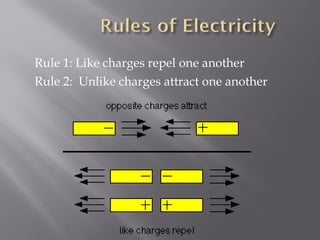
Rule 1: Like charges repel one another
Rule 2: Unlike charges attract one another
   Electrons carry negative charges
    and protons carry positive
    charges

   Electrons can move from atom to
    atom
   An atom that has more electrons
    is negative
   An atom that has less electrons is
    positive
   The imbalance of positive and negative
    charges

   So how do we move electrons from one
    place to another?

   By rubbing them together
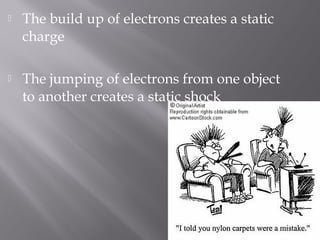
   The build up of electrons creates a static
    charge

   The jumping of electrons from one object
    to another creates a static shock
   When two objects are attracted the atoms
    don’t move, only their charges

   The positive part of one object will be
    attracted and move toward the negative
    charge of the other object
   TRIBOELECTRIC SERIES
   your hand
    glass
    your hair
    nylon
    wool
    fur
    silk
    paper
    cotton
    hard rubber
    polyester
    polyvinylchloride plastic
   Items near the bottom tend to gain
    negative charges when rubbed with
    something near the top
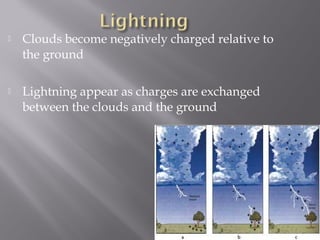
   Clouds become negatively charged relative to
    the ground

   Lightning appear as charges are exchanged
    between the clouds and the ground
   Currents made of flowing electrons, in one
    direction
   Ampere (A) – the rate of electrical flow

   1 C of charge (6.25 billion billion) per second

   So a wire that carries 5 A has 5 coulombs of
    charge per second
   Electrons flow only when there is a difference
    in electrical pressure – voltage
       Higher the pressure (V) stronger the flow


   Voltage = potential energy/charge

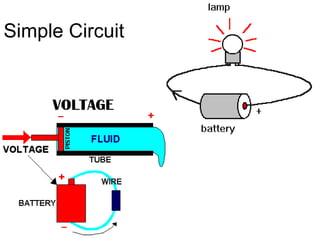
   Wires need a pump that provides the voltage to
    cause flow
Simple Circuit
   Have loosely held electrons that travel very
    easily
       Most metals
   Materials that do not allow electrons to travel
    freely

       Plastic, cloth, glass and dry air

Static electricity and electrical currants

  • 1.
    Agenda Bell Work • Pick up Static Electricity • Balloons and WS from front desk Travoltage Activity • complete • Notes: Static vs. Current Electricity HW: Chp. 11 pg 174- 182
  • 2.
  • 3.
    1. Define and describe static electricity 2. Define and recognize the presence of a charge 3. Distinguish between conductor’s and insulator’s 4. Describe how static electricity is different than current electricity
  • 4.
    Movement of charged particles
  • 5.
    Rule 1: Likecharges repel one another Rule 2: Unlike charges attract one another
  • 6.
    Electrons carry negative charges and protons carry positive charges  Electrons can move from atom to atom  An atom that has more electrons is negative  An atom that has less electrons is positive
  • 7.
    The imbalance of positive and negative charges  So how do we move electrons from one place to another?  By rubbing them together
  • 8.
    The build up of electrons creates a static charge  The jumping of electrons from one object to another creates a static shock
  • 9.
    When two objects are attracted the atoms don’t move, only their charges  The positive part of one object will be attracted and move toward the negative charge of the other object
  • 10.
    TRIBOELECTRIC SERIES  your hand glass your hair nylon wool fur silk paper cotton hard rubber polyester polyvinylchloride plastic  Items near the bottom tend to gain negative charges when rubbed with something near the top
  • 11.
    Clouds become negatively charged relative to the ground  Lightning appear as charges are exchanged between the clouds and the ground
  • 12.
    Currents made of flowing electrons, in one direction
  • 13.
    Ampere (A) – the rate of electrical flow  1 C of charge (6.25 billion billion) per second  So a wire that carries 5 A has 5 coulombs of charge per second
  • 14.
    Electrons flow only when there is a difference in electrical pressure – voltage  Higher the pressure (V) stronger the flow  Voltage = potential energy/charge  Wires need a pump that provides the voltage to cause flow
  • 15.
  • 16.
    Have loosely held electrons that travel very easily  Most metals
  • 17.
    Materials that do not allow electrons to travel freely  Plastic, cloth, glass and dry air