A metal is a material (an element, compound, or alloy) that is
typically hard, opaque, shiny and has good electrical and
thermal conductivity. Metals are generally malleable-that is, they
can be hammered or pressed permanently out of shape without
breaking or cracking-as well as fusible (able to be fused or
melted) and ductile (able to drawn out into a thin wire). About 91
of 118 element in the periodic table are metals. Some elements
appear in both metallic and non metallic forms. E.g. Gold, Silver,
Iron, Copper etc.
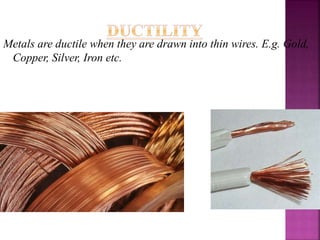
Metals are ductile when they are drawn into thin wires. E.g. Gold,
Copper, Silver, Iron etc.
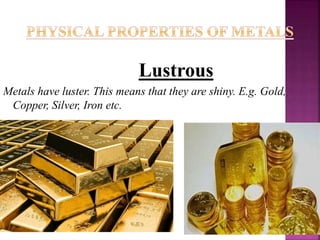
Lustrous
Metals have luster. This means that they are shiny. E.g. Gold,
Copper, Silver, Iron etc.
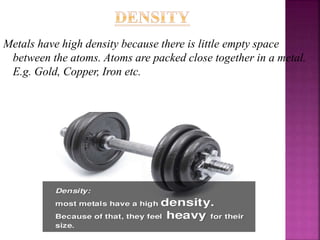
Metals have high density because there is little empty space
between the atoms. Atoms are packed close together in a metal.
E.g. Gold, Copper, Iron etc.
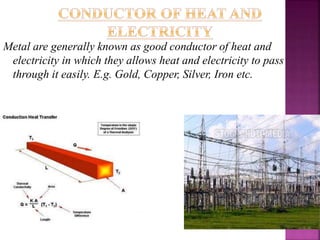
Metal are generally known as good conductor of heat and
electricity in which they allows heat and electricity to pass
through it easily. E.g. Gold, Copper, Silver, Iron etc.
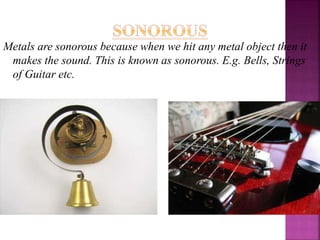
Metals are sonorous because when we hit any metal object then it
makes the sound. This is known as sonorous. E.g. Bells, Strings
of Guitar etc.
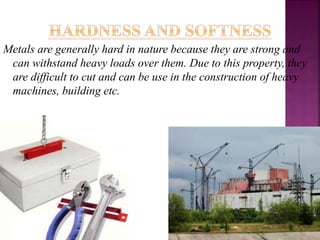
Metals are generally hard in nature because they are strong and
can withstand heavy loads over them. Due to this property, they
are difficult to cut and can be use in the construction of heavy
machines, building etc.
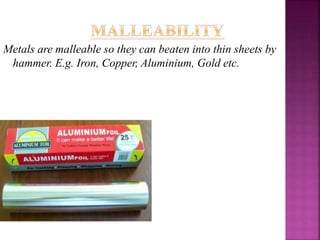
Metals are malleable so they can beaten into thin sheets by
hammer. E.g. Iron, Copper, Aluminium, Gold etc.
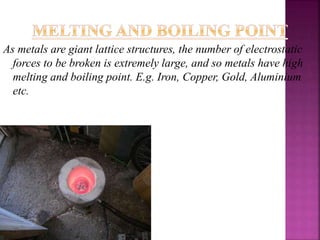
As metals are giant lattice structures, the number of electrostatic
forces to be broken is extremely large, and so metals have high
melting and boiling point. E.g. Iron, Copper, Gold, Aluminium
etc.
 Reaction of metals with oxygen.
Metals form their oxides when react with oxygen .
Metal oxides are basic in nature.
Example
Reaction of iron metal with oxygen:
4Fe+3022Fe20
When iron reacts with moist air, it forms rust. Rust is iron oxide.
Articles made up of iron, such as grills etc. are get rusted
because of reaction with moist air.
Rust is reddish brown in color and is iron oxide.
Iron oxide is basic in nature. It turns red litmus into blue.
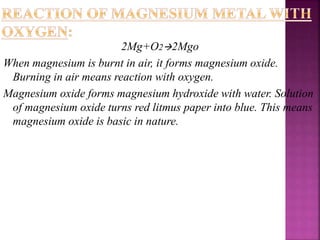
2Mg+O22Mgo
When magnesium is burnt in air, it forms magnesium oxide.
Burning in air means reaction with oxygen.
Magnesium oxide forms magnesium hydroxide with water. Solution
of magnesium oxide turns red litmus paper into blue. This means
magnesium oxide is basic in nature.
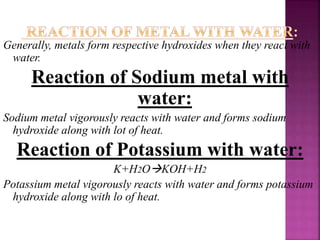
Generally, metals form respective hydroxides when they react with
water.
Reaction of Sodium metal with
water:
Sodium metal vigorously reacts with water and forms sodium
hydroxide along with lot of heat.
Reaction of Potassium with water:
K+H2OKOH+H2
Potassium metal vigorously reacts with water and forms potassium
hydroxide along with lo of heat.
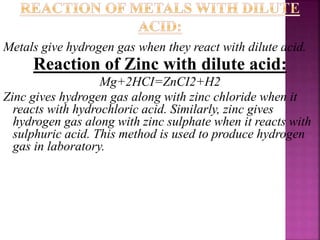
Metals give hydrogen gas when they react with dilute acid.
Reaction of Zinc with dilute acid:
Mg+2HCI=ZnCI2+H2
Zinc gives hydrogen gas along with zinc chloride when it
reacts with hydrochloric acid. Similarly, zinc gives
hydrogen gas along with zinc sulphate when it reacts with
sulphuric acid. This method is used to produce hydrogen
gas in laboratory.
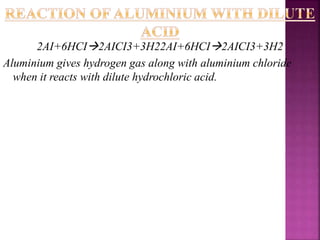
2AI+6HCI2AICI3+3H22AI+6HCI2AICI3+3H2
Aluminium gives hydrogen gas along with aluminium chloride
when it reacts with dilute hydrochloric acid.
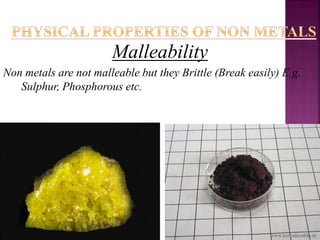
Malleability
Non metals are not malleable but they Brittle (Break easily) E.g.
Sulphur, Phosphorous etc.
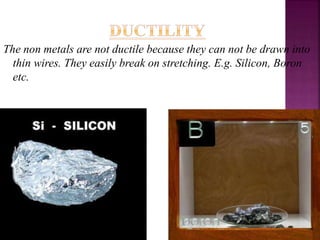
The non metals are not ductile because they can not be drawn into
thin wires. They easily break on stretching. E.g. Silicon, Boron
etc.
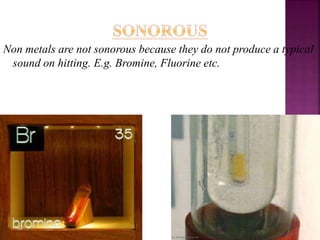
Non metals are not sonorous because they do not produce a typical
sound on hitting. E.g. Bromine, Fluorine etc.
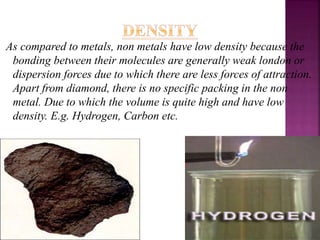
As compared to metals, non metals have low density because the
bonding between their molecules are generally weak london or
dispersion forces due to which there are less forces of attraction.
Apart from diamond, there is no specific packing in the non
metal. Due to which the volume is quite high and have low
density. E.g. Hydrogen, Carbon etc.
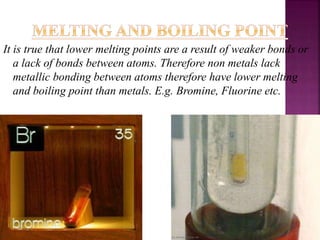
It is true that lower melting points are a result of weaker bonds or
a lack of bonds between atoms. Therefore non metals lack
metallic bonding between atoms therefore have lower melting
and boiling point than metals. E.g. Bromine, Fluorine etc.
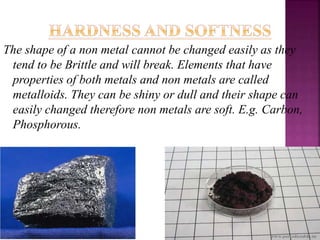
The shape of a non metal cannot be changed easily as they
tend to be Brittle and will break. Elements that have
properties of both metals and non metals are called
metalloids. They can be shiny or dull and their shape can
easily changed therefore non metals are soft. E.g. Carbon,
Phosphorous.
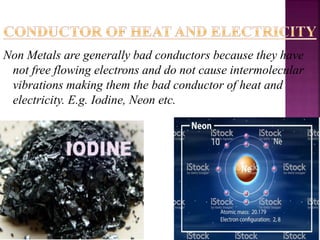
Non Metals are generally bad conductors because they have
not free flowing electrons and do not cause intermolecular
vibrations making them the bad conductor of heat and
electricity. E.g. Iodine, Neon etc.
Reaction of Non Metals with oxygen:
Non Metals form their oxides when react with oxygen.
Example
Reaction of Sulphur with oxygen:
When Sulphur is burnt in air, it forms sulphur dioxide.
Solution of Sulphur dioxide turns blue litmus red. Sulphur
Dioxide forms sulphurous acid when dissolved in water.
Thus, sulphur dioxide is Basic in nature.
 When Carbon is burnt in air, it forms carbon dioxide. You
can observe that when coal (Carbon) is burnt in form of
smoke, which contains Carbon Dioxide.
 Carbon Dioxide is Basic in nature. The solution of Carbon
Dioxide in water turns blue litmus paper red.
 Non Metals generally do not react with water. Rather some
Non Metals which react with air are vigorously stored in
water.
Reaction of Non Metal with Dilute acid
Generally, Non Metals do not react with Dilute acid.
PRESENTATION DONE BY
CHIRAG OF CLASS 8-B

PowerPoint Presentation on Metals and Non Metals

  • 2.
    A metal isa material (an element, compound, or alloy) that is typically hard, opaque, shiny and has good electrical and thermal conductivity. Metals are generally malleable-that is, they can be hammered or pressed permanently out of shape without breaking or cracking-as well as fusible (able to be fused or melted) and ductile (able to drawn out into a thin wire). About 91 of 118 element in the periodic table are metals. Some elements appear in both metallic and non metallic forms. E.g. Gold, Silver, Iron, Copper etc.
  • 3.
    Metals are ductilewhen they are drawn into thin wires. E.g. Gold, Copper, Silver, Iron etc.
  • 4.
    Lustrous Metals have luster.This means that they are shiny. E.g. Gold, Copper, Silver, Iron etc.
  • 5.
    Metals have highdensity because there is little empty space between the atoms. Atoms are packed close together in a metal. E.g. Gold, Copper, Iron etc.
  • 6.
    Metal are generallyknown as good conductor of heat and electricity in which they allows heat and electricity to pass through it easily. E.g. Gold, Copper, Silver, Iron etc.
  • 7.
    Metals are sonorousbecause when we hit any metal object then it makes the sound. This is known as sonorous. E.g. Bells, Strings of Guitar etc.
  • 8.
    Metals are generallyhard in nature because they are strong and can withstand heavy loads over them. Due to this property, they are difficult to cut and can be use in the construction of heavy machines, building etc.
  • 9.
    Metals are malleableso they can beaten into thin sheets by hammer. E.g. Iron, Copper, Aluminium, Gold etc.
  • 10.
    As metals aregiant lattice structures, the number of electrostatic forces to be broken is extremely large, and so metals have high melting and boiling point. E.g. Iron, Copper, Gold, Aluminium etc.
  • 11.
     Reaction ofmetals with oxygen. Metals form their oxides when react with oxygen . Metal oxides are basic in nature. Example Reaction of iron metal with oxygen: 4Fe+3022Fe20 When iron reacts with moist air, it forms rust. Rust is iron oxide. Articles made up of iron, such as grills etc. are get rusted because of reaction with moist air. Rust is reddish brown in color and is iron oxide. Iron oxide is basic in nature. It turns red litmus into blue.
  • 12.
    2Mg+O22Mgo When magnesium isburnt in air, it forms magnesium oxide. Burning in air means reaction with oxygen. Magnesium oxide forms magnesium hydroxide with water. Solution of magnesium oxide turns red litmus paper into blue. This means magnesium oxide is basic in nature.
  • 13.
    Generally, metals formrespective hydroxides when they react with water. Reaction of Sodium metal with water: Sodium metal vigorously reacts with water and forms sodium hydroxide along with lot of heat. Reaction of Potassium with water: K+H2OKOH+H2 Potassium metal vigorously reacts with water and forms potassium hydroxide along with lo of heat.
  • 14.
    Metals give hydrogengas when they react with dilute acid. Reaction of Zinc with dilute acid: Mg+2HCI=ZnCI2+H2 Zinc gives hydrogen gas along with zinc chloride when it reacts with hydrochloric acid. Similarly, zinc gives hydrogen gas along with zinc sulphate when it reacts with sulphuric acid. This method is used to produce hydrogen gas in laboratory.
  • 15.
    2AI+6HCI2AICI3+3H22AI+6HCI2AICI3+3H2 Aluminium gives hydrogengas along with aluminium chloride when it reacts with dilute hydrochloric acid.
  • 16.
    Malleability Non metals arenot malleable but they Brittle (Break easily) E.g. Sulphur, Phosphorous etc.
  • 17.
    The non metalsare not ductile because they can not be drawn into thin wires. They easily break on stretching. E.g. Silicon, Boron etc.
  • 18.
    Non metals arenot sonorous because they do not produce a typical sound on hitting. E.g. Bromine, Fluorine etc.
  • 19.
    As compared tometals, non metals have low density because the bonding between their molecules are generally weak london or dispersion forces due to which there are less forces of attraction. Apart from diamond, there is no specific packing in the non metal. Due to which the volume is quite high and have low density. E.g. Hydrogen, Carbon etc.
  • 20.
    It is truethat lower melting points are a result of weaker bonds or a lack of bonds between atoms. Therefore non metals lack metallic bonding between atoms therefore have lower melting and boiling point than metals. E.g. Bromine, Fluorine etc.
  • 21.
    The shape ofa non metal cannot be changed easily as they tend to be Brittle and will break. Elements that have properties of both metals and non metals are called metalloids. They can be shiny or dull and their shape can easily changed therefore non metals are soft. E.g. Carbon, Phosphorous.
  • 22.
    Non Metals aregenerally bad conductors because they have not free flowing electrons and do not cause intermolecular vibrations making them the bad conductor of heat and electricity. E.g. Iodine, Neon etc.
  • 23.
    Reaction of NonMetals with oxygen: Non Metals form their oxides when react with oxygen. Example Reaction of Sulphur with oxygen: When Sulphur is burnt in air, it forms sulphur dioxide. Solution of Sulphur dioxide turns blue litmus red. Sulphur Dioxide forms sulphurous acid when dissolved in water. Thus, sulphur dioxide is Basic in nature.
  • 24.
     When Carbonis burnt in air, it forms carbon dioxide. You can observe that when coal (Carbon) is burnt in form of smoke, which contains Carbon Dioxide.  Carbon Dioxide is Basic in nature. The solution of Carbon Dioxide in water turns blue litmus paper red.
  • 25.
     Non Metalsgenerally do not react with water. Rather some Non Metals which react with air are vigorously stored in water. Reaction of Non Metal with Dilute acid Generally, Non Metals do not react with Dilute acid.
  • 26.