Pace maker is a device that applies electric
impulses to the Rt. atrium or the Rt. Ventricle or
both to treat various electrophysiological disorders
related to conduction and arrhythmia of the heart.
In 1950 the initial pacing system was
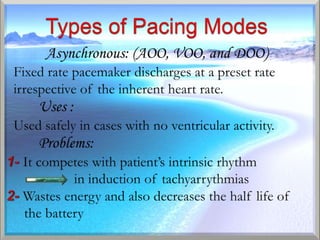
consisted of a single lead asynchronous pace maker,
which paced the heart at a fixed rate.

Over the years with advanced technology,
pacemakers are currently more sophisticated, with
the availability of a multi programmable devices, and
Automated Implantable Cardioverter Defibrillators
(AICD) designed to treat fatal tachyarrythmias.
Pulse Generator: It includes
Energy source and electric circuits for pacing and
sensory function.
      Leads:
Insulated wires connecting the pulse generator.
      Electrode:
It is an exposed metal end of the lead in contact
with:
Endocardium;                Endocardial Pacing
Epicardium;                 Epicardial Pacing
Unipolar Pacing:
Cathode or active lead stimulates the heart and
returns to anode on the casing of pulse generator via
the myocardium and adjacent tissue to complete the
circuit.
      Bipolar Leads:
Two separate electrodes located within the paced
chamber.
 The possibility of extraneous
              noise
R Wave Sensitivity:
It is the measure of minimal voltage of intrinsic
R wave, necessary to activate the sensing circuit of
the pulse generator and thus inhibit or trigger the
pacing circuit.
      It is about 3mV on an
           external pulse
      generator will Maintain
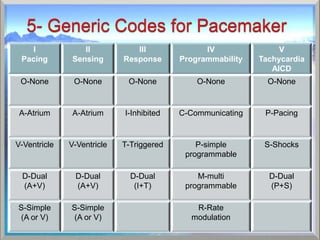
I             II           III              IV               V
 Pacing        Sensing      Response      Programmability   Tachycardia
                                                               AICD
 O-None        O-None        O-None           O-None          O-None


 A-Atrium      A-Atrium     I-Inhibited   C-Communicating    P-Pacing


V-Ventricle   V-Ventricle   T-Triggered       P-simple       S-Shocks
                                           programmable

 D-Dual        D-Dual         D-Dual          M-multi         D-Dual
 (A+V)         (A+V)           (I+T)       programmable       (P+S)

S-Simple      S-Simple                       R-Rate
 (A or V)      (A or V)                     modulation
Dual Chamber AV Sequential Pacing
            (DDD, DVI, DDI, and VDD)
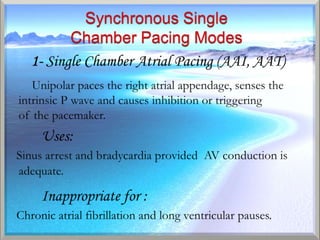
Unipolar or bipolar leads are used, for the right atrial
appendage and right ventricular apex.
Atrium is stimulated first to contract, then after an
adjustable PR interval ventricle is stimulated to contract.
     Uses:
Indicated in AV block, carotid sinus syncope, and sinus
node disease.
Advantages:
- Preserve the normal AV contraction sequence.
- Beneficial when atrial contraction is important for
- ventricular filling (e.g. aortic stenosis.)
      Disadvantage:
  Pacemaker-mediated tachycardia (PMT)
  Back conduction from the ventricle to the atrium is
  sensed by the atrial circuit, and triggers a ventricular
  depolarization leading to PMT.
Overcome by carful adjustment PR
It provides flexibility to correct abnormal device behavior.
 It adapts the device to patient’s specific and changing needs.
       Programmable Factors:
- Pacing rate.                - Hysteresis
- Pulse duration.              It is the difference between
- Voltage output.              intrinsic heart rate at which
- R wave sensitivity.          pacing begins (60 beats/min)
- Refractory periods.          and pacing rate (e.g.72
- PR interval.                 beats/min).
- Mode of pacing.                 It is useful in
- Atrial tracking rate.         patients with sick
                                 sinus syndrome.
Pacemakers, which not only sense the atrial or ventricular
 activity but also sense various other stimuli and thus,
 increase the pacemaker rate.
  Common sensors used in clinical practice:
- Vibration.                    - QT interval.
- Acceleration.                 - Preejection period.
- Minute ventilation.           - Rt.V. SV, & contractility.
- Respiratory rate and depth.   - Mixed venous oxygen
- CVP.                            saturation.
- CV pH.                        - Right atrial pressure.
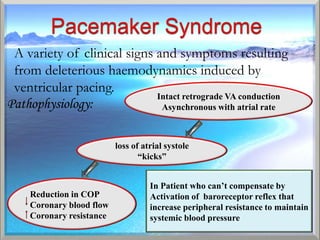
A variety of clinical signs and symptoms resulting
 from deleterious haemodynamics induced by
 ventricular pacing.
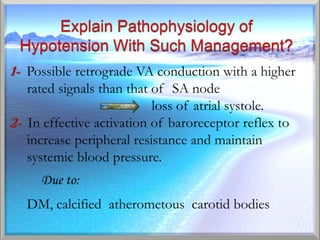
                             Intact retrograde VA conduction
Pathophysiology:              Asynchronous with atrial rate


                          loss of atrial systole
                                 “kicks”


                                    In Patient who can’t compensate by
    Reduction in COP                Activation of baroreceptor reflex that
    Coronary blood flow             increase peripheral resistance to maintain
    Coronary resistance             systemic blood pressure
Incidence:
    Retrograde VA conduction is present in about;
- 15% of patients with complete antegrade AV block.
- 67% of patients with intact antegrade AV
-   conduction paced for sinus node disease.
       Onset:
    May be acute to chronic.
Clinical signs and symptoms:
- Hypotension.     - Syncope.       - Vertigo.
- Headedness.      - Fatigue.       - Dyspnoea.
- Cough.           - CHF.
- Awareness of beat-to-beat variation of cardiac
  response from spontaneous to paced beats.
- Neck pulsation or pressure sensation in the chest,
  neck, or head, headache.
- Chest pain: loss of atrial kick, increases coronary
- resistance and decreases coronary blood flow.
Acceleration in paced rates due to aging of the
  pacemaker or damage produced by leakage of the
  tissue fluids into the pulse generator.
Treatment:
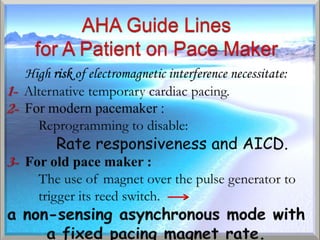
- Change the pacemaker to an asynchronous mode.
- Reprogram it to a lower outputs.
- Changing of pulse generator if patient was
  hemodynamically unstable.
         Treatment with
     antiarrhythmic drugs or
I - Evaluation of the Patient.

II- Evaluation of the pace maker.
 Evaluation of severity cardiac disease, & its
  current functional status responsible for the
  insertion of pacemaker.
 Associated medical problems:
 “CAD, DM, HTN, & CHF”
 Concurrent medical treatments.
 Preimplantation symptoms:

     Light headedness
     Dizziness               even after pace maker
     Fainting.               insertion ……. Why?
   Type of pacemaker “fixed or demand rate.”
   Time since it was implanted.
   Rate pacemaker at the time of implantation.
   Half life of the pacemaker battery.
           10% decrease in the rate from the time
      of implantation indicates power source depletion.
    These information can be taken from the
    manufacture’s book kept with the patient
It is important, to consider the location of an
    operative procedure in relation to:
•   The site of the plus generator.
•   When a sensor for rate modulation is in use.

     In our case plus generator is
Inappropriatel
        y
      inhibit
        or
     trigger
  stimulation
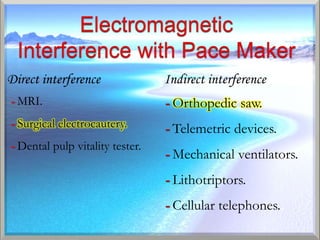
Direct interference              Indirect interference
- MRI.                           - Orthopedic saw.
- Surgical electrocautery.       - Telemetric devices.
- Dental pulp vitality tester.
                                 - Mechanical ventilators.
                                 - Lithotriptors.
                                 - Cellular telephones.,
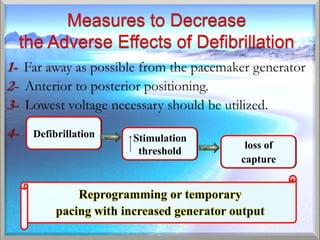
Defibrillation   Stimulation
                                loss of
                  threshold
                               capture
- Positive pressure ventilation.
- Nitrous oxide entrapment in the pacemaker
  pocket.
- Insertion of pulmonary artery or central venous
  catheter.
    Only multipurpose PA catheter with pacing
 facilities can also be used when highly indicated
The minimum amount of energy required to
 consistently cause depolarization and contraction
 of the heart.

     It is measured in terms of:

- Amplitude: programmed in volts or in milliampers.
- Duration: measured in milliseconds.
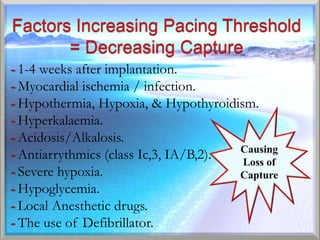
- 1-4 weeks after implantation.
- Myocardial ischemia / infection.
- Hypothermia, Hypoxia, & Hypothyroidism.
- Hyperkalaemia.
- Acidosis/Alkalosis.
- Antiarrythmics (class Ic,3, IA/B,2).
- Severe hypoxia.
- Hypoglycemia.
- Local Anesthetic drugs.
- The use of Defibrillator.
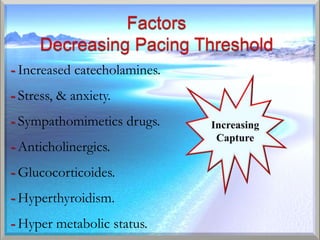
- Increased catecholamines.
- Stress, & anxiety.
- Sympathomimetics drugs.
- Anticholinergics.
- Glucocorticoides.
- Hyperthyroidism.
- Hyper metabolic status.
MR: 1002067625
Name: Samel Mahal Sayer
Date of birth: 9/5/1948
Date of admission: 13/12/12
CCU: bed 5
A known diabetic, HTN. Pt. presented to ER on
13/12/12 Pt complaining of un relieved chest pain
for the last 24 hr.
His ECG showed Q waves in leads II, & AVF
Patient was diagnosed as acute inferior MI.
Pt. received Aspirin, Plavix and was admitted to the
CCU, during which he suffered complete heart block
necessitated insertion of trans femoral pace maker
with the following setting: Rate: 70/min., mV: 2, IVV.
            Blood pressure was 110/68
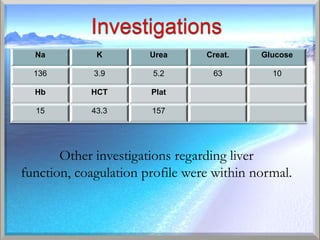
Na         K         Urea      Creat.    Glucose

  136        3.9       5.2        63         10

  Hb        HCT        Plat

  15        43.3       157


       Other investigations regarding liver
function, coagulation profile were within normal.
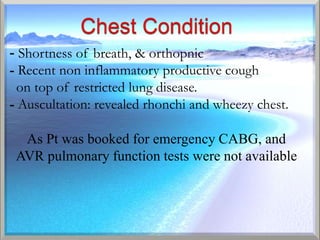
- Shortness of breath, & orthopnic
- Recent non inflammatory productive cough
- on top of restricted lung disease.
- Auscultation: revealed rhonchi and wheezy chest.

  As Pt was booked for emergency CABG, and
 AVR pulmonary function tests were not available
- Myoclonic movements of Etomidate and

ketamine
 should be avoided in vibration rate responsive PM.
- Even though, inhibition of myoclonic movements
by priming dose of NDMR, and Dormicum can
solve this problem in such PM.
Owing to close proximity of the pericardium to the
myocardium non pacing electric signals of the
unipolar surgical cautery coming from all directions
inhibited the pacemaker pacing signals of the plus
generator.
In addition, electric signals of the cautery resulted in
fatal arrhythmias in absent of internal AV conduction
or external pacing of the ventricle.
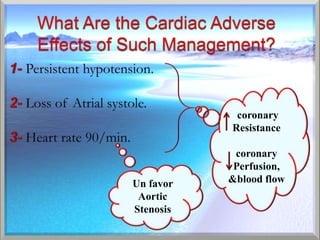
coronary
           Resistance

            coronary
            Perfusion,
Un favor   &blood flow
 Aortic
Stenosis
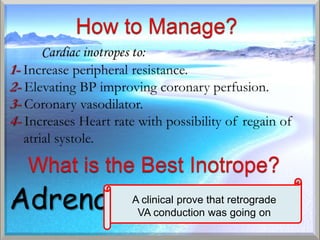
A clinical prove that retrograde
 VA conduction was going on
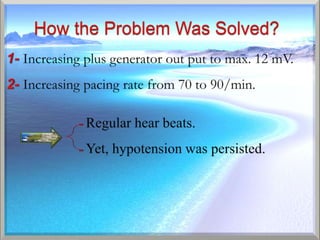
Under the effective management of adrenaline BP
was raised to 130/70.
At this good per fusing BP ischemia of Av node and
conducting system was decreased, resulted in a good
intrinsic conduction with an R wave > 2 mV thus
pacing was inhibited.
    This was a considerable
        prognostic singe
Unfortunately such BP could not be maintained for
It happened during prepartion for great vessels
cannulation and elevation of the LL for dressing
venous grafting site.

    Dislodgment of electrodes
    form its site of insertion
         A gentle tap on the Rt. Ventricle
       was able to retune pacing to the heart.
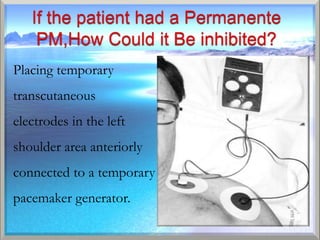
Placing temporary
transcutaneous
electrodes in the left
shoulder area anteriorly
connected to a temporary
pacemaker generator.
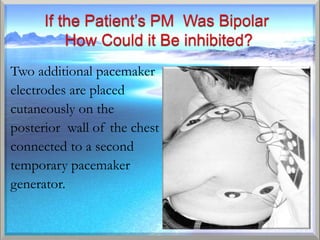
Two additional pacemaker
electrodes are placed
cutaneously on the
posterior wall of the chest and
connected to a second
temporary pacemaker
generator.
Increasing the rate of the temporary extra cardiac
tissue pacemaker above that of the permanent
cardiac pacemaker, results in;

     Inhibition of permanent demand activity.
Pacemaker & cabg

Pacemaker & cabg

  • 4.
    Pace maker isa device that applies electric impulses to the Rt. atrium or the Rt. Ventricle or both to treat various electrophysiological disorders related to conduction and arrhythmia of the heart.
  • 5.
    In 1950 theinitial pacing system was consisted of a single lead asynchronous pace maker, which paced the heart at a fixed rate. Over the years with advanced technology, pacemakers are currently more sophisticated, with the availability of a multi programmable devices, and Automated Implantable Cardioverter Defibrillators (AICD) designed to treat fatal tachyarrythmias.
  • 7.
    Pulse Generator: Itincludes Energy source and electric circuits for pacing and sensory function. Leads: Insulated wires connecting the pulse generator. Electrode: It is an exposed metal end of the lead in contact with: Endocardium; Endocardial Pacing Epicardium; Epicardial Pacing
  • 8.
    Unipolar Pacing: Cathode oractive lead stimulates the heart and returns to anode on the casing of pulse generator via the myocardium and adjacent tissue to complete the circuit. Bipolar Leads: Two separate electrodes located within the paced chamber. The possibility of extraneous noise
  • 9.
    R Wave Sensitivity: Itis the measure of minimal voltage of intrinsic R wave, necessary to activate the sensing circuit of the pulse generator and thus inhibit or trigger the pacing circuit. It is about 3mV on an external pulse generator will Maintain
  • 11.
    I II III IV V Pacing Sensing Response Programmability Tachycardia AICD O-None O-None O-None O-None O-None A-Atrium A-Atrium I-Inhibited C-Communicating P-Pacing V-Ventricle V-Ventricle T-Triggered P-simple S-Shocks programmable D-Dual D-Dual D-Dual M-multi D-Dual (A+V) (A+V) (I+T) programmable (P+S) S-Simple S-Simple R-Rate (A or V) (A or V) modulation
  • 15.
    Dual Chamber AVSequential Pacing (DDD, DVI, DDI, and VDD) Unipolar or bipolar leads are used, for the right atrial appendage and right ventricular apex. Atrium is stimulated first to contract, then after an adjustable PR interval ventricle is stimulated to contract. Uses: Indicated in AV block, carotid sinus syncope, and sinus node disease.
  • 16.
    Advantages: - Preserve thenormal AV contraction sequence. - Beneficial when atrial contraction is important for - ventricular filling (e.g. aortic stenosis.) Disadvantage: Pacemaker-mediated tachycardia (PMT) Back conduction from the ventricle to the atrium is sensed by the atrial circuit, and triggers a ventricular depolarization leading to PMT. Overcome by carful adjustment PR
  • 17.
    It provides flexibilityto correct abnormal device behavior. It adapts the device to patient’s specific and changing needs. Programmable Factors: - Pacing rate. - Hysteresis - Pulse duration. It is the difference between - Voltage output. intrinsic heart rate at which - R wave sensitivity. pacing begins (60 beats/min) - Refractory periods. and pacing rate (e.g.72 - PR interval. beats/min). - Mode of pacing. It is useful in - Atrial tracking rate. patients with sick sinus syndrome.
  • 18.
    Pacemakers, which notonly sense the atrial or ventricular activity but also sense various other stimuli and thus, increase the pacemaker rate. Common sensors used in clinical practice: - Vibration. - QT interval. - Acceleration. - Preejection period. - Minute ventilation. - Rt.V. SV, & contractility. - Respiratory rate and depth. - Mixed venous oxygen - CVP. saturation. - CV pH. - Right atrial pressure.
  • 19.
    A variety ofclinical signs and symptoms resulting from deleterious haemodynamics induced by ventricular pacing. Intact retrograde VA conduction Pathophysiology: Asynchronous with atrial rate loss of atrial systole “kicks” In Patient who can’t compensate by Reduction in COP Activation of baroreceptor reflex that Coronary blood flow increase peripheral resistance to maintain Coronary resistance systemic blood pressure
  • 20.
    Incidence: Retrograde VA conduction is present in about; - 15% of patients with complete antegrade AV block. - 67% of patients with intact antegrade AV - conduction paced for sinus node disease. Onset: May be acute to chronic.
  • 21.
    Clinical signs andsymptoms: - Hypotension. - Syncope. - Vertigo. - Headedness. - Fatigue. - Dyspnoea. - Cough. - CHF. - Awareness of beat-to-beat variation of cardiac response from spontaneous to paced beats. - Neck pulsation or pressure sensation in the chest, neck, or head, headache. - Chest pain: loss of atrial kick, increases coronary - resistance and decreases coronary blood flow.
  • 22.
    Acceleration in pacedrates due to aging of the pacemaker or damage produced by leakage of the tissue fluids into the pulse generator. Treatment: - Change the pacemaker to an asynchronous mode. - Reprogram it to a lower outputs. - Changing of pulse generator if patient was hemodynamically unstable. Treatment with antiarrhythmic drugs or
  • 23.
    I - Evaluationof the Patient. II- Evaluation of the pace maker.
  • 24.
     Evaluation ofseverity cardiac disease, & its current functional status responsible for the insertion of pacemaker.  Associated medical problems: “CAD, DM, HTN, & CHF”  Concurrent medical treatments.  Preimplantation symptoms: Light headedness Dizziness even after pace maker Fainting. insertion ……. Why?
  • 26.
    Type of pacemaker “fixed or demand rate.”  Time since it was implanted.  Rate pacemaker at the time of implantation.  Half life of the pacemaker battery. 10% decrease in the rate from the time of implantation indicates power source depletion. These information can be taken from the manufacture’s book kept with the patient
  • 29.
    It is important,to consider the location of an operative procedure in relation to: • The site of the plus generator. • When a sensor for rate modulation is in use. In our case plus generator is
  • 30.
    Inappropriatel y inhibit or trigger stimulation
  • 31.
    Direct interference Indirect interference - MRI. - Orthopedic saw. - Surgical electrocautery. - Telemetric devices. - Dental pulp vitality tester. - Mechanical ventilators. - Lithotriptors. - Cellular telephones.,
  • 35.
    Defibrillation Stimulation loss of threshold capture
  • 36.
    - Positive pressureventilation. - Nitrous oxide entrapment in the pacemaker pocket. - Insertion of pulmonary artery or central venous catheter. Only multipurpose PA catheter with pacing facilities can also be used when highly indicated
  • 37.
    The minimum amountof energy required to consistently cause depolarization and contraction of the heart. It is measured in terms of: - Amplitude: programmed in volts or in milliampers. - Duration: measured in milliseconds.
  • 38.
    - 1-4 weeksafter implantation. - Myocardial ischemia / infection. - Hypothermia, Hypoxia, & Hypothyroidism. - Hyperkalaemia. - Acidosis/Alkalosis. - Antiarrythmics (class Ic,3, IA/B,2). - Severe hypoxia. - Hypoglycemia. - Local Anesthetic drugs. - The use of Defibrillator.
  • 39.
    - Increased catecholamines. -Stress, & anxiety. - Sympathomimetics drugs. - Anticholinergics. - Glucocorticoides. - Hyperthyroidism. - Hyper metabolic status.
  • 41.
    MR: 1002067625 Name: SamelMahal Sayer Date of birth: 9/5/1948 Date of admission: 13/12/12 CCU: bed 5
  • 42.
    A known diabetic,HTN. Pt. presented to ER on 13/12/12 Pt complaining of un relieved chest pain for the last 24 hr. His ECG showed Q waves in leads II, & AVF Patient was diagnosed as acute inferior MI. Pt. received Aspirin, Plavix and was admitted to the CCU, during which he suffered complete heart block necessitated insertion of trans femoral pace maker with the following setting: Rate: 70/min., mV: 2, IVV. Blood pressure was 110/68
  • 46.
    Na K Urea Creat. Glucose 136 3.9 5.2 63 10 Hb HCT Plat 15 43.3 157 Other investigations regarding liver function, coagulation profile were within normal.
  • 47.
    - Shortness ofbreath, & orthopnic - Recent non inflammatory productive cough - on top of restricted lung disease. - Auscultation: revealed rhonchi and wheezy chest. As Pt was booked for emergency CABG, and AVR pulmonary function tests were not available
  • 50.
    - Myoclonic movementsof Etomidate and ketamine should be avoided in vibration rate responsive PM. - Even though, inhibition of myoclonic movements by priming dose of NDMR, and Dormicum can solve this problem in such PM.
  • 52.
    Owing to closeproximity of the pericardium to the myocardium non pacing electric signals of the unipolar surgical cautery coming from all directions inhibited the pacemaker pacing signals of the plus generator. In addition, electric signals of the cautery resulted in fatal arrhythmias in absent of internal AV conduction or external pacing of the ventricle.
  • 55.
    coronary Resistance coronary Perfusion, Un favor &blood flow Aortic Stenosis
  • 56.
    A clinical provethat retrograde VA conduction was going on
  • 57.
    Under the effectivemanagement of adrenaline BP was raised to 130/70. At this good per fusing BP ischemia of Av node and conducting system was decreased, resulted in a good intrinsic conduction with an R wave > 2 mV thus pacing was inhibited. This was a considerable prognostic singe Unfortunately such BP could not be maintained for
  • 58.
    It happened duringprepartion for great vessels cannulation and elevation of the LL for dressing venous grafting site. Dislodgment of electrodes form its site of insertion A gentle tap on the Rt. Ventricle was able to retune pacing to the heart.
  • 62.
    Placing temporary transcutaneous electrodes inthe left shoulder area anteriorly connected to a temporary pacemaker generator.
  • 63.
    Two additional pacemaker electrodesare placed cutaneously on the posterior wall of the chest and connected to a second temporary pacemaker generator.
  • 64.
    Increasing the rateof the temporary extra cardiac tissue pacemaker above that of the permanent cardiac pacemaker, results in; Inhibition of permanent demand activity.