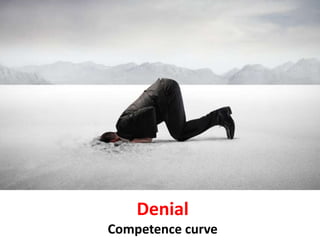


Denial
Competence curve
Prepared By
Manu Melwin Joy
Research Scholar
School of Management Studies
CUSAT, Kerala, India.
Phone – 9744551114
Mail – manu_melwinjoy@yahoo.com
Kindly restrict the use of slides for personal purpose.
Please seek permission to reproduce the same in public
forms and presentations.
Introduction
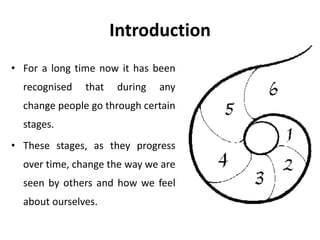
• For a long time now it has been
recognised that during any
change people go through certain
stages.
• These stages, as they progress
over time, change the way we are
seen by others and how we feel
about ourselves.
Introduction
• These stages can be plotted on
a graph known as the Change
or Competence Curve.
• Julie Hay matched stages in
the competence curve against
stages in the developmental
cycle (Hay 1992).
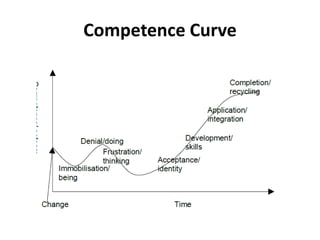
Competence Curve
Cycles of development
Stage 2
• Stage : Doing.
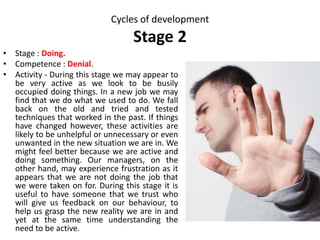
• Competence : Denial.
• Activity - During this stage we may appear to
be very active as we look to be busily
occupied doing things. In a new job we may
find that we do what we used to do. We fall
back on the old and tried and tested
techniques that worked in the past. If things
have changed however, these activities are
likely to be unhelpful or unnecessary or even
unwanted in the new situation we are in. We
might feel better because we are active and
doing something. Our managers, on the
other hand, may experience frustration as it
appears that we are not doing the job that
we were taken on for. During this stage it is
useful to have someone that we trust who
will give us feedback on our behaviour, to
help us grasp the new reality we are in and
yet at the same time understanding the
need to be active.
References
Thank You
Other TA topics available on slideshare
1. Strokes - http://www.slideshare.net/manumjoy/strokes-24081607.
2. Games People Play - http://www.slideshare.net/manumjoy/psychological-
games-people-play.
3. Structural Analysis - http://www.slideshare.net/manumjoy/the-ego-state-model.
4. What is TA? - http://www.slideshare.net/manumjoy/what-ta-is
5. Cycles of Development - http://www.slideshare.net/manumjoy/cycles-of-
developement-pamela-levin-transactional-analysis.
6. Stages of Cure - http://www.slideshare.net/manumjoy/stages-of-cure.
7. Transactions - http://www.slideshare.net/manumjoy/transactions-33677298.
8. Time Structuring - http://www.slideshare.net/manumjoy/time-structuring.
9. Life Position - http://www.slideshare.net/manumjoy/life-position.
10. Autonomy - http://www.slideshare.net/manumjoy/autonomy-33690557.
11. Structural Pathology - http://www.slideshare.net/manumjoy/structural-pathology.
12. Game Analysis - http://www.slideshare.net/manumjoy/game-analysis-33725636.
13. Integrated Adult - http://www.slideshare.net/manumjoy/integrated-adult.
14. Stroke Economy - http://www.slideshare.net/manumjoy/stroke-economy-
33826702.

Denial competence curve

  • 1.
  • 2.
    Prepared By Manu MelwinJoy Research Scholar School of Management Studies CUSAT, Kerala, India. Phone – 9744551114 Mail – manu_melwinjoy@yahoo.com Kindly restrict the use of slides for personal purpose. Please seek permission to reproduce the same in public forms and presentations.
  • 3.
    Introduction • For along time now it has been recognised that during any change people go through certain stages. • These stages, as they progress over time, change the way we are seen by others and how we feel about ourselves.
  • 4.
    Introduction • These stagescan be plotted on a graph known as the Change or Competence Curve. • Julie Hay matched stages in the competence curve against stages in the developmental cycle (Hay 1992).
  • 5.
  • 6.
    Cycles of development Stage2 • Stage : Doing. • Competence : Denial. • Activity - During this stage we may appear to be very active as we look to be busily occupied doing things. In a new job we may find that we do what we used to do. We fall back on the old and tried and tested techniques that worked in the past. If things have changed however, these activities are likely to be unhelpful or unnecessary or even unwanted in the new situation we are in. We might feel better because we are active and doing something. Our managers, on the other hand, may experience frustration as it appears that we are not doing the job that we were taken on for. During this stage it is useful to have someone that we trust who will give us feedback on our behaviour, to help us grasp the new reality we are in and yet at the same time understanding the need to be active.
  • 7.
  • 8.
  • 9.
    Other TA topicsavailable on slideshare 1. Strokes - http://www.slideshare.net/manumjoy/strokes-24081607. 2. Games People Play - http://www.slideshare.net/manumjoy/psychological- games-people-play. 3. Structural Analysis - http://www.slideshare.net/manumjoy/the-ego-state-model. 4. What is TA? - http://www.slideshare.net/manumjoy/what-ta-is 5. Cycles of Development - http://www.slideshare.net/manumjoy/cycles-of- developement-pamela-levin-transactional-analysis. 6. Stages of Cure - http://www.slideshare.net/manumjoy/stages-of-cure. 7. Transactions - http://www.slideshare.net/manumjoy/transactions-33677298. 8. Time Structuring - http://www.slideshare.net/manumjoy/time-structuring. 9. Life Position - http://www.slideshare.net/manumjoy/life-position. 10. Autonomy - http://www.slideshare.net/manumjoy/autonomy-33690557. 11. Structural Pathology - http://www.slideshare.net/manumjoy/structural-pathology. 12. Game Analysis - http://www.slideshare.net/manumjoy/game-analysis-33725636. 13. Integrated Adult - http://www.slideshare.net/manumjoy/integrated-adult. 14. Stroke Economy - http://www.slideshare.net/manumjoy/stroke-economy- 33826702.