BizLibrary	helps	organizations	succeed	by	improving	the	way	employees	learn.	
www.bizlibrary.com/free-trial
What	we	hope	you’ll	take-away:
Time	Management	might	be	an	oxymoron,	however	we	can	make	smarter	choices	to	
gain	productivity.
Some	ideas	you	can	implement	right	away	to	get	more	productive	time	out	of	your	
already	busy	day.
Time	Management
The	ability	to	use	one’s	time	effectively	and	
productively.
Our	focus	is	“time	management”	in	a	work	context.
There	is	no	time	management,	only	choice	
management.	
Kevin	Eikenberry
Multi-Tasking
The	term	Information	Overload	was	first	
coined	in	1970	by	Alvin	Toffler,	American	
sociologist,	futurologist	and	author	of	the	
book	Future	Shock.
If	he	only	knew…
Stress.	Good	or	Bad?
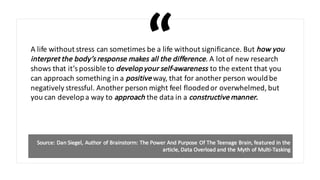
A life	without	stress	can	sometimes	be	a	life	without	significance.	But	how	you	
interpret	the	body’s	response	makes	all	the	difference.	A	lot	of	new	research	
shows	that	it’s	possible	to	develop	your	self-awareness	to	the	extent	that	you	
can	approach	something	in	a	positive way,	that	for	another	person	would	be	
negatively	stressful.	Another	person	might	feel	flooded	or	overwhelmed,	but	
you	can	develop	a	way	to	approach the	data	in	a	constructive	manner.
Source:	Dan	Siegel,	Author	of	Brainstorm:	The	Power	And	Purpose	Of	The	Teenage	Brain,	featured	in	the	
article,	Data	Overload	and	the	Myth	of	Multi-Tasking
Can	we	keep	up?
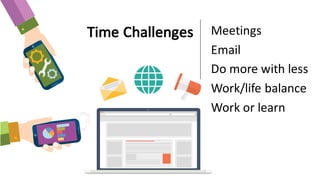
Time	Challenges Meetings
Email
Do	more	with	less
Work/life	balance
Work	or	learn
Meetings
Stand	up	and	get	moving!
À
Email
OMG	my	inbox!
Doing	more	with	less
You’ve	heard	it…	over	and	over	and	over	and	over	
and	over	and	over	and	over	and	over	and	over	and	
over and	over	and	over	and	over.
Work	/	Life	Balance
Constant	adjustments	based	on	what	balance	looks	
like	to	you.	
…
Work	or	Learn
“Work	is	learning	and	learning	is	the	work.”	
- Harold	Jarche
ë
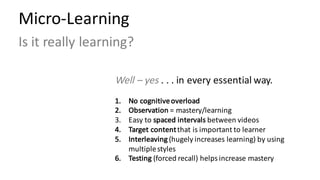
Micro-Learning	
Is	it	really	learning?
Well	– yes	.	.	.	in	every	essential	way.
1. No	cognitive	overload
2. Observation =	mastery/learning
3. Easy	to	spaced	intervals	between	videos
4. Target	content	that	is	important	to	learner
5. Interleaving (hugely	increases	learning)	by	using	
multiple	styles
6. Testing (forced	recall)	helps	increase	mastery
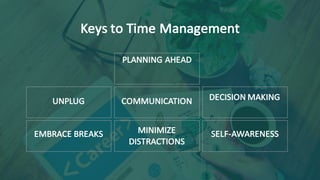
PLANNING	AHEAD
Keys	to	Time	Management
UNPLUG COMMUNICATION DECISION	MAKING
EMBRACE	BREAKS MINIMIZE	
DISTRACTIONS
SELF-AWARENESS
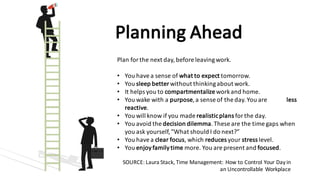
Plan	for	the	next	day,	before	leaving	work.
• You	have	a	sense	of	what	to	expect	tomorrow.
• You	sleep	better	without	thinking	about	work.
• It	helps	you	to	compartmentalize work	and	home.
• You	wake	with	a	purpose,	a	sense	of	the	day.	You	are	 less	
reactive.
• You	will	know	if	you	made	realistic	plans	for	the	day.
• You	avoid	the	decision	dilemma.	These	are	the	time	gaps	when	
you	ask	yourself,	”What	should	I	do	next?”
• You	have	a	clear	focus,	which	reduces your	stress level.
• You	enjoy	family	time	more.	You	are	present	and	focused.
Planning	Ahead
SOURCE:	Laura	Stack,	Time	Management:	How	to	Control	Your	Day	in	
an	Uncontrollable	Workplace
Unplug
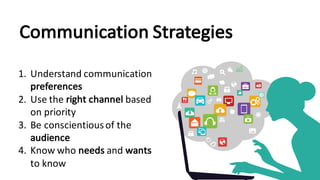
Communication	Strategies
1. Understand	communication	
preferences
2. Use	the	right	channel	based	
on	priority
3. Be	conscientious	of	the	
audience
4. Know	who	needs and	wants
to	know
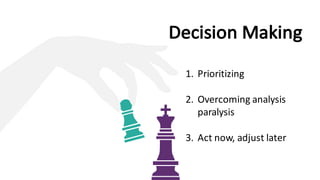
Decision	Making
1. Prioritizing
2. Overcoming	analysis	
paralysis
3. Act	now,	adjust	later
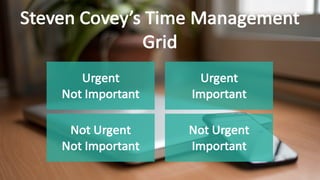
Urgent
Not	Important
Urgent
Important
Not	Urgent
Not	Important
Not	Urgent
Important
Steven	Covey’s	Time	Management	
Grid
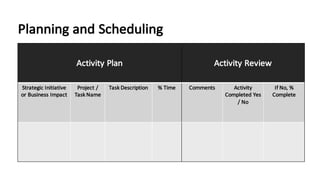
Activity	Plan Activity Review
Strategic	Initiative	
or	Business	Impact
Project /	
Task	Name
Task	Description %	Time Comments Activity
Completed	Yes	
/	No
If	No,	%	
Complete
Planning	and	Scheduling
11	
minutes
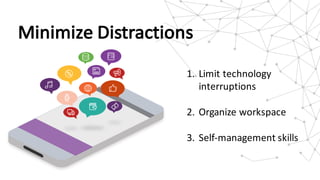
Minimize	Distractions
1. Limit	technology	
interruptions
2. Organize	workspace	
3. Self-management	skills
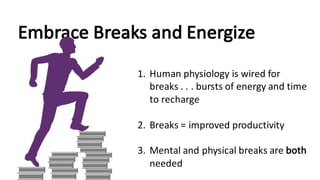
Embrace	Breaks	and	Energize
1. Human	physiology	is	wired	for	
breaks	.	.	.	bursts	of	energy	and	time	
to	recharge
2. Breaks	=	improved	productivity
3. Mental	and	physical	breaks	are	both
needed
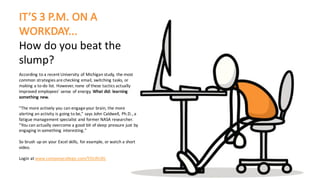
IT’S	3	P.M.	ON	A	
WORKDAY...	
How	do	you	beat	the	
slump?
According	to	a	recent	University	of	Michigan	study,	the	most	
common	strategies	are	checking	email,	switching	tasks,	or	
making	a	to-do	list.	However,	none	of	these	tactics	actually	
improved	employees'	sense	of	energy.	What	did:	learning	
something	new.	
"The	more	actively	you	can	engage	your	brain,	the	more	
alerting	an	activity	is	going	to	be,"	says	John	Caldwell,	Ph.D.,	a	
fatigue	management	specialist	and	former	NASA	researcher.	
"You	can	actually	overcome	a	good	bit	of	sleep	pressure	just	by	
engaging	in	something	interesting."	
So	brush	up	on	your	Excel	skills,	 for	example,	or	watch	a	short	
video.
Login	at	www.companycollege.com/YOURURL
Develop	Self	Awareness
What	motivates	me?	Why?
What	does	not	motivate	me?	Why?
What	do	I	need personally	and	professionally	
now?
Key	Take-Aways
Time	is	finite.	We	can’t	really	manage	it.	Instead	we	need	to	focus	on	our	choices	and	
mindset.
Key	techniques	you	can	use	and	teach	your	employee	to	improve	time	management:	
planning	ahead,	unplug,	communication,	decision	making,	embrace	breaks,	minimize	
distractions,	develop	self	awareness
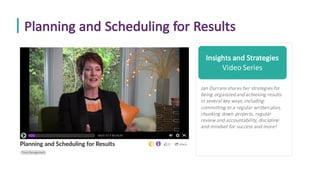
Planning	and	Scheduling	for	Results
Insights	and	Strategies
Video	Series
Jan	Durrans	shares	her	strategies	for	
being	organized	and	achieving	results	
in	several	key	ways,	including:	
committing	to	a	regular	written	plan,	
chunking	down	projects,	regular	
review	and	accountability,	discipline	
and	mindset	for	success	and	more!
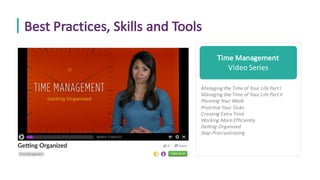
Best	Practices,	Skills	and	Tools	
Time	Management
Video	Series
Managing	the	Time	of	Your	Life	Part	I
Managing	the	Time	of	Your	Life	Part	II
Planning	Your	Week
Prioritize	Your	Tasks
Creating	Extra	Time
Working	More	Efficiently
Getting	Organized
Stop	Procrastinating
Try	out	these	video	lessons	and	
more!
Let	us	know	through	the	poll	if	you’d	like	a	free	trial	of	
BizLibrary’s	online	course	collection.
www.bizlibrary.com/free-trial

Effective Time Management Techniques to Teach Your Employees