Urgent 
    vs. 
Important 
Use Time Effectively, 
 Not Just Efficiently
 Not Just Efficiently
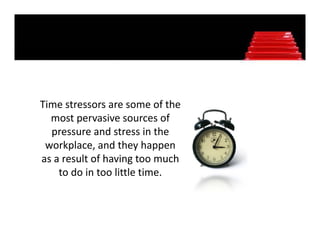
Time stressors are some of the 
Time stressors are some of the
  most pervasive sources of 
  pressure and stress in the 
 workplace, and they happen 
as a result of having too much 
    to do in too little time.
    t d i t littl ti
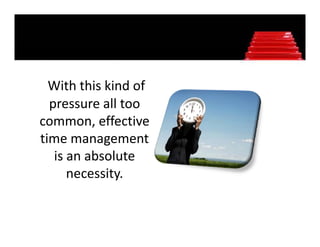
With this kind of 
  pressure all too 
  pressure all too
common, effective 
time management 
time management
   is an absolute 
      necessity. 
            it
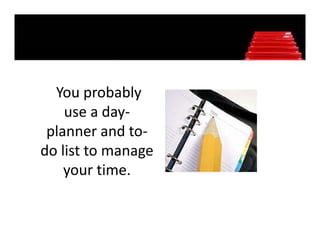
You probably 
    use a day‐
           d
 planner and to‐
 p
do list to manage 
    your time. 
    your time
These tools are certainly helpful, 
 but they don't allow you to drill 
down to one of the most essential 
down to one of the most essential
      elements of good time 
Management
Management: 
distinguishing between what is 
di i    i hi b          h i
important and what is urgent. 
   p                    g
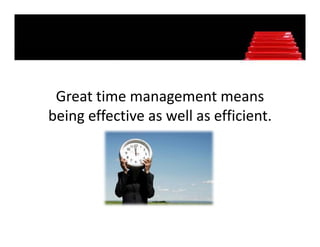
Great time management means 
being effective as well as efficient. 
Managing time effectively, and 
achieving the things that you want 
achieving the things that you want
 to achieve, means spending your 
time on things that are important 
       a d ot just u ge t
       and not just urgent. 
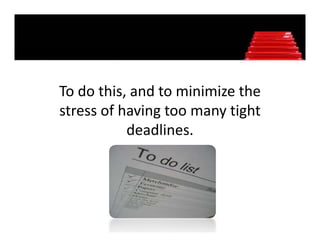
To do this, and to minimize the 
stress of having too many tight 
 t      fh i t            ti ht
           deadlines.
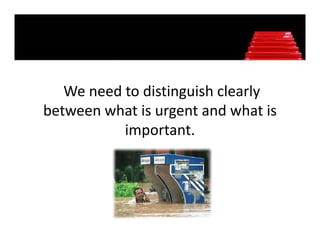
We need to distinguish clearly 
between what is urgent and what is 
b t      h ti         t d h ti
           important.
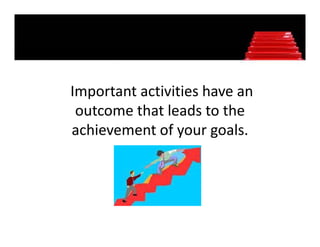
Important activities have an 
 outcome that leads to the 
   t     th t l d t th
achievement of your goals. 
Urgent activities demand immediate 
  Urgent activities demand immediate
  attention, and are usually associated 
with the achievement of someone else's 
                        f
goals, or with an uncomfortable problem 
 or situation that needs to be resolved.
Urgent activities are often the ones 
  g
       we concentrate on. 
These are the 
"squeaky wheels that get the grease." 
They demand attention because the 
 consequences of not dealing with 
                f t d li      ith
       them are immediate. 
The Urgent vs. Important 
Matrix is a useful tool for thinking 
M ti i         f l t l f thi ki
            about this. 
How to Use the Tool
Ho to Use the Tool
The Urgent/Important Matrix 
Th U       /I           M i
is a powerful way of thinking 
     p           y          g
       about priorities. 
Using it helps you overcome the 
natural tendency to focus on urgent 
natural tendency to focus on urgent
  activities, so that you can keep 
   enough time clear to focus on 
      what s really important.
      what's really important.
This is the way you move from 
"firefighting", into a position where 
 firefighting into a position where
  you can grow your business and 
             your career. 
How to use this matrix 
to prioritize your activities: 
Firstly, list all of the activities and 
      y,
projects you feel you have to do. 
Try to include everything that takes 
  up your time at work, however 
           ti    t    k h
            unimportant. 
If you manage your time using an 
Action Program, you'll already have 
A ti P             'll l d h
            done this.
Next, assign importance to each of 
N t      i i       t       t  h f
           the activities 
You can do this on, say, a scale of 1 
                   , y,
to 5: Remember, this is a measure of 
   how important the activity is in 
   how important the activity is in
  helping you meet your goals and 
            objectives. 
Try not to worry about urgency 
at this stage, as this helps get to 
at this stage as this helps get to
      the true importance.
                   p
Once you have assigned 
importance to each activity, 
importance to each activity
evaluate the urgency of each 
                g y
           activity.
As you do this, you can plot the 
   y          ,y        p
  listed items on the matrix 
   according to the assigned 
        di t th        i d
   importance and urgency.
      p               g y
Now study the matrix using the 
  Now study the matrix using the
guidelines below, and schedule your 
 work according to your priorities.
     k      di t          i iti
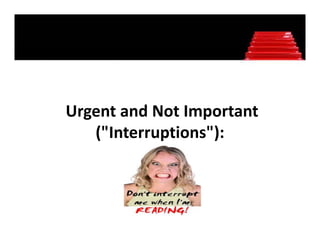
Urgent and Not Important 
U    t dN tI          t t
   (
   ("Interruptions"):
            p      )
Urgent and Not Important 
        Urgent and Not Important
            ("Interruptions"):


Urgent but not important activities can 
 be a constant source of interruption.
 b        t t          fi t      ti
Urgent and Not Important 
         Urgent and Not Important
             ("Interruptions"):

   Ask yourself whether these tasks can be 
rescheduled, or whether someone else could 
rescheduled, or whether someone else could
                  do them. 
Urgent and Not Important 
        Urgent and Not Important
            ("Interruptions"):

Sometimes it's appropriate to say "No" to 
 people, or encourage them to solve the 
 people, or encourage them to solve the
          problem themselves. 
Urgent and Not Important 
           Urgent and Not Important
               ("Interruptions"):
  Alternatively, try allocating time when you are 
  Alternatively try allocating time when you are
   available, so that people only interrupt you at 
    certain times (a good way of doing this is to 
    certain times (a good way of doing this is to
schedule a regular meeting so that all issues can be 
            dealt with at the same time). 
Urgent and Not Important 
         Urgent and Not Important
             ("Interruptions"):


 By doing this, the flow of work on your 
important activities will be less disrupted.
Not Urgent, but Important 
          Not Urgent, but Important
            ("Important Goals"):

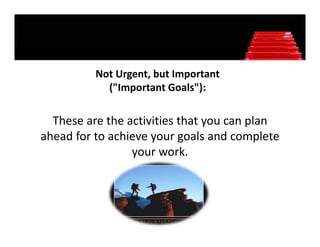
  These are the activities that you can plan 
ahead for to achieve your goals and complete
ahead for to achieve your goals and complete 
                 your work. 
Not Urgent, but Important 
        Not Urgent, but Important
          ("Important Goals"):

Make sure that you have plenty of time to 
achieve these, so that they do not become 
achieve these, so that they do not become
                  urgent. 
Not Urgent, but Important 
         Not Urgent, but Important
           ("Important Goals"):


 Remember to leave enough time in your 
schedule to deal with unforeseen problems. 
Not Urgent, but Important 
          Not Urgent, but Important
            ("Important Goals"):

This will maximize your chances of keeping on 
  schedule, and help you avoid the stress of 
  schedule, and help you avoid the stress of
 work becoming more urgent that necessary.
Not Urgent and Not Important 
      Not Urgent and Not Important
            ("Distractions"):


These activities are just a distraction, and 
     should be avoided if possible. 
Not Urgent and Not Important 
       Not Urgent and Not Important
             ("Distractions"):

  Some can simply be ignored. Others are 
activities that other people want you to do, 
  but they do not contribute to your own 
              desired outcomes. 
Not Urgent and Not Important 
        Not Urgent and Not Important
              ("Distractions"):


Again, say "No" politely and firmly where this 
               is appropriate. 
If people see you are clear about your 
objectives and boundaries, they will often not 
  ask you to do "not important" activities in 
                    future.
Thank you, 
         Thank you

   amirsaiftaz@gmail.com
     i if @       il

www.amirsaiftaz.blogspot.com

Urgent Vs Important