Presenting Today
Katie Miller
Marketing Events Strategist
BizLibrary
www.bizlibrary.com/demo
Poll Question
What method/s have you tried to fill the soft skills gap at
your organization?
A. Hiring sprees
B. Brought in outside help (consultants)
C. Administered pre-hire assessments
D. All (A-C)
E. Other (type in the chat)
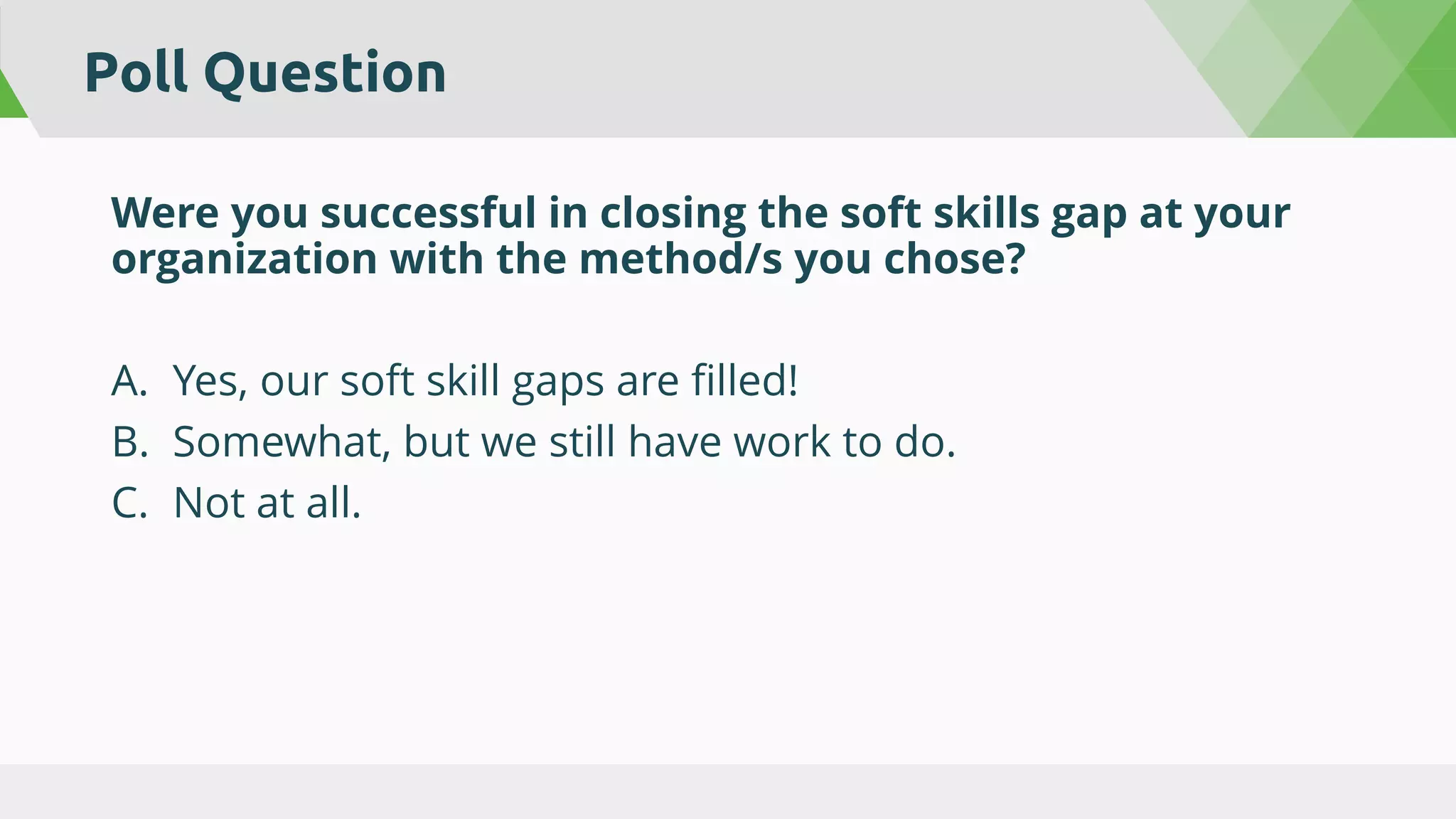
Poll Question
Were you successful in closing the soft skills gap at your
organization with the method/s you chose?
A. Yes, our soft skill gaps are filled!
B. Somewhat, but we still have work to do.
C. Not at all.
During the webinar today, you’ll learn:
• The common mistakes companies make when trying to close
their soft skills gap.
• How to conduct assessments of current soft skills and bring
your whole company on board with training.
• Ways to implement training strategies that will help close
your soft skills gap.
The Skills Gap
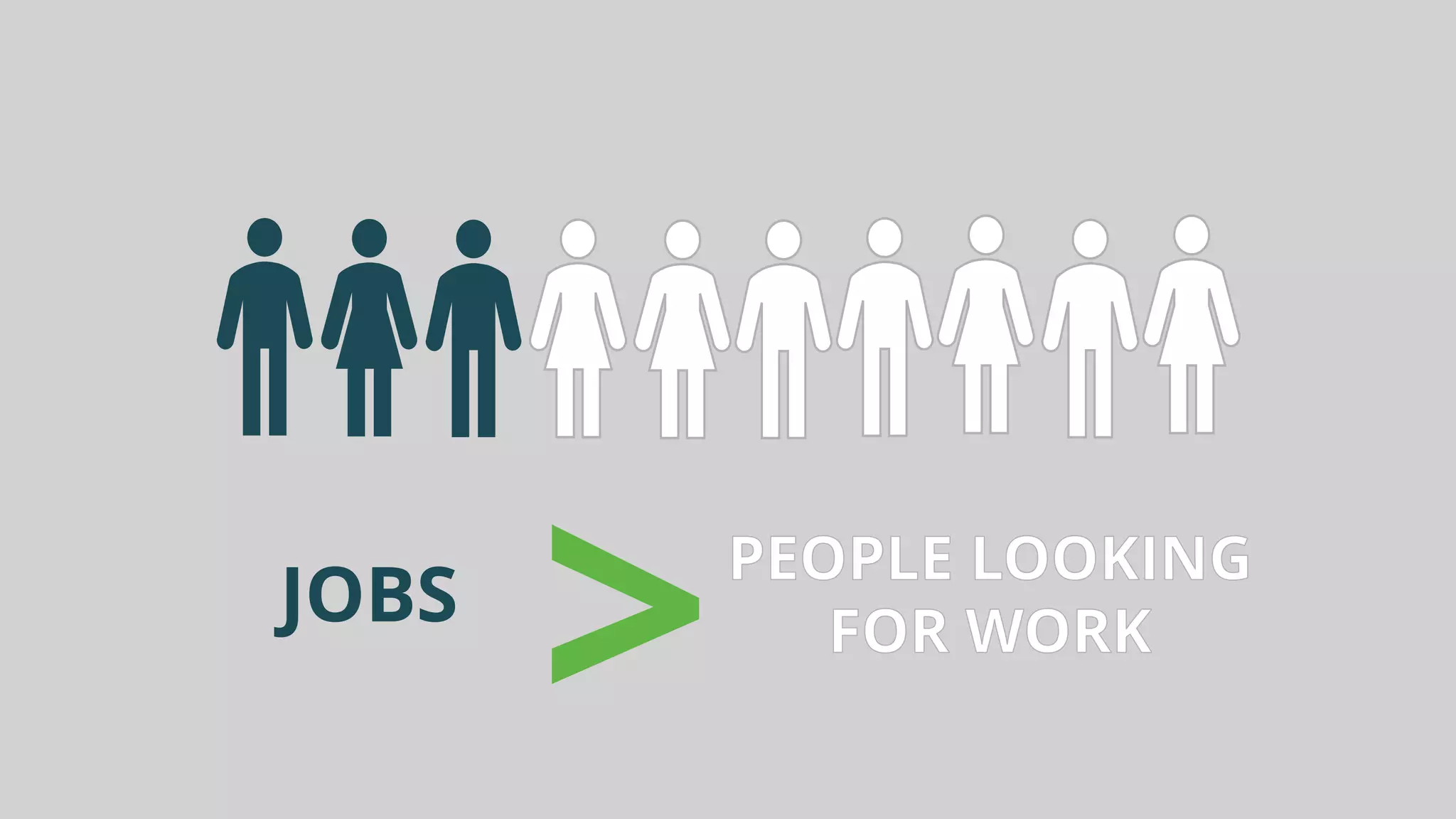
JOBS
>
83%
HR PROFESSIONALS REPORTED HAVING
DIFFICULTY RECRUITING SUITABLE JOB
CANDIDATES IN THE PAST 12 MONTHS
75%
HR PROFESSIONALS SAID THERE ARE
SKILLS GAPS IN JOB CANDIDATES
SHRM 2019, The Global Skills Shortage
https://www.shrm.org/hr-today/trends-and-forecasting/research-and-surveys/Documents/SHRM%20Skills%20Gap%202019.pdf
What are Soft Skills?
Emotional
Intelligence
Critical
Thinking
Creativity
People Management
Decision
Making
Soft Skills
Soft skills are the competencies that
allow your employees to interact
effectively and productively with
others, no matter the role or the
setting.
12
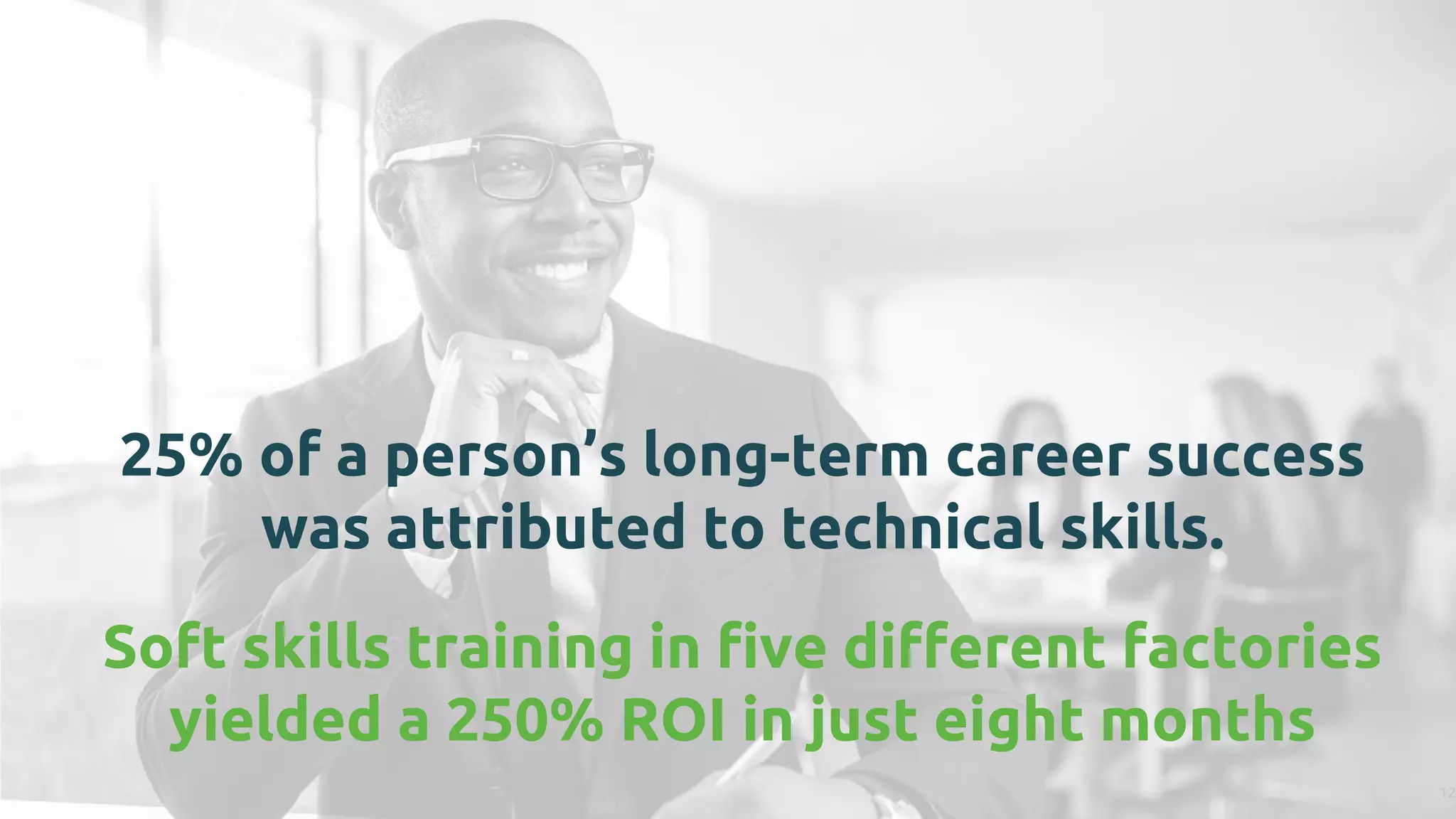
25% of a person’s long-term career success
was attributed to technical skills.
Soft skills training in five different factories
yielded a 250% ROI in just eight months
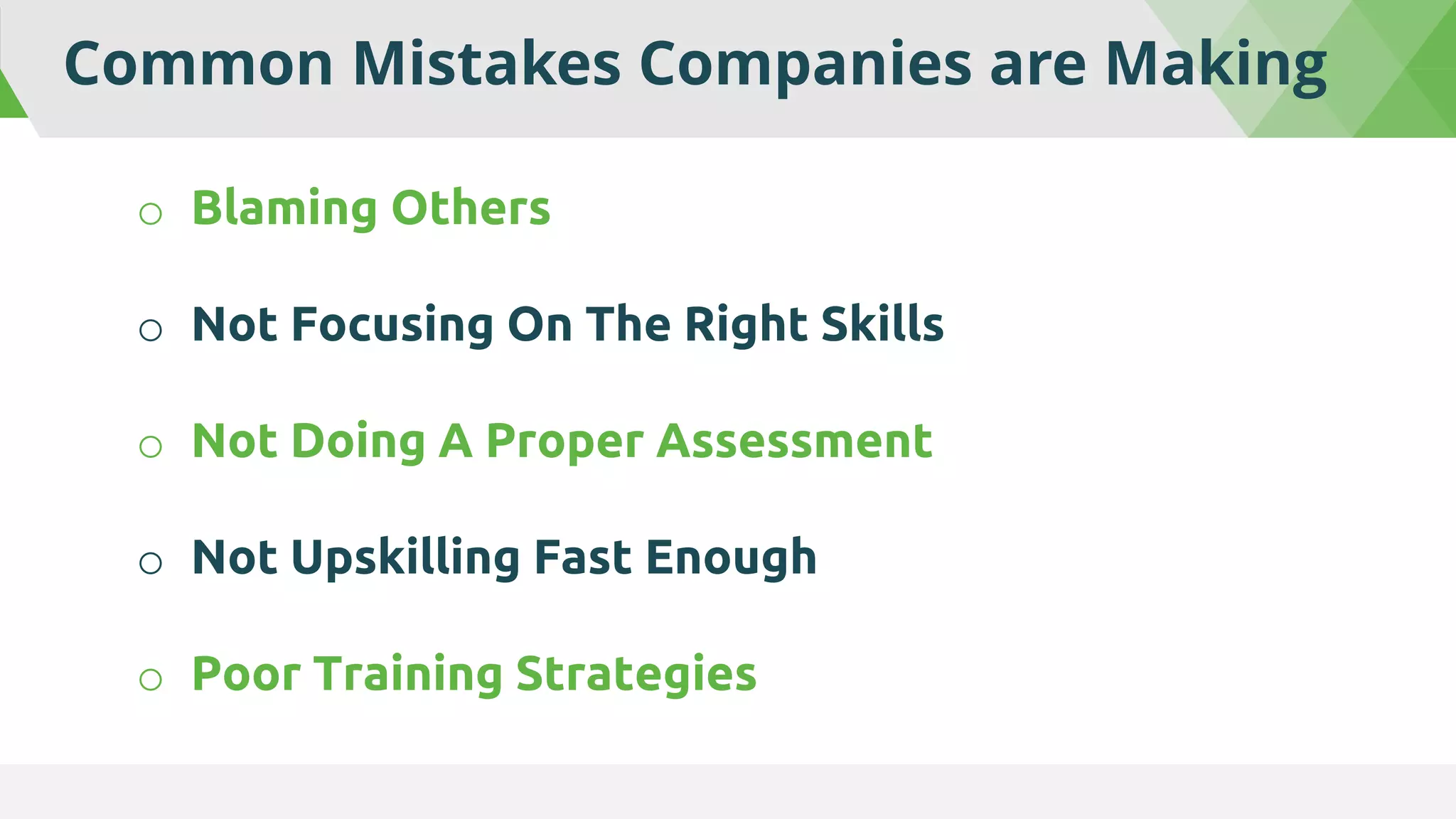
Common Mistakes Companies are Making
o Blaming Others
o Not Focusing On The Right Skills
o Not Doing A Proper Assessment
o Not Upskilling Fast Enough
o Poor Training Strategies
Blaming Others
bizlibrary.com | YOUR ONLINE LEARNING PARTNER 14
Not Focusing on the Right Skills
75%of 2,000 full-time workers plan to learn new
skills because they want to advance in their
careers.
https://www.shrm.org/resourcesandtools/hr-topics/organizational-and-employee-development/pages/employers-need-to-broaden-strategies-to-close-skills-gap.aspx
bizlibrary.com | YOUR ONLINE LEARNING PARTNER 16
FEEDBACK FREEDOM TO FAIL
• 1:1’s
• Company-wide surveys
• Intranet
• Nobody likes feeling incompetent
• Managers and supervisors are
important in achieving a “Freedom
to Fail” culture
Not Doing a Proper Assessment
bizlibrary.com | YOUR ONLINE LEARNING PARTNER 17
• Make it easy to understand, not too long
• Keep it consistent (Scale 1-5)
• Know your audience
Plan
Identify important skills
Measure current skills
Analyze the data
Create a plan
The Soft Skills Gap Analysis
Sources: derived from workable.com and peoplemattersglobal.com
STEP 1: PLAN
TWO GROUPS YOU CAN CONDUCT THE ANALYSIS ON:
Individual
Scope
Who is in charge of
the process
When to conduct a
soft skills gap analysis
How to respond
to soft skill gaps
Individual level
Team/company
level
Manager
Manager
HR/L&D
Directors/C-suite
- Changes in employee’s duties
- Poor performance review
- Need for new skills for a
promotion or new project
- Problems meeting business goals
- Strategy shifts
- New technologies
- When a team is exceeding their goals
Training
Succession planning
Mentoring initiatives
Hiring
Training programs
Mentoring initiatives
Team/company
STEP 2: IDENTIFY IMPORTANT SKILLS
TWO QUESTIONS:
What skills do you value as a company?
What soft skills do our employees need to do their jobs well now and in the future?
Importance
Leadership High Excellent
Skill level required
Low Average
Presenting Moderate Good
Initiative
STEP 3: MEASURE CURRENT SKILLS
THREE WAYS TO MEASURE:
Surveys and assessments
Interviews with employees
Feedback
Importance
Creativity High 5
Required level
Moderate 4
Collaboration High 3
Persuasion
4
Actual level
2
3
STEP 3: MEASURE CURRENT SKILLS
Skill Type
Functional
Business
Leadership
Skills
Site
Leadership
Middle
Management
Frontline
Supervisor
Health, Safety, & Environment
Six Sigma Competencies
Computer-Aided Design
Functional Specification
Decision Making
Customer Orientation
Adaptability
Time Management
People Management
Effective Communication
Creativity & Innovation
Digital Vision
More improvement required
Improvement required
Less improvement required
COMPARE
The established IDEAL state
The analyzed CURRENT state
STEP 4: ANALYZE THE DATA
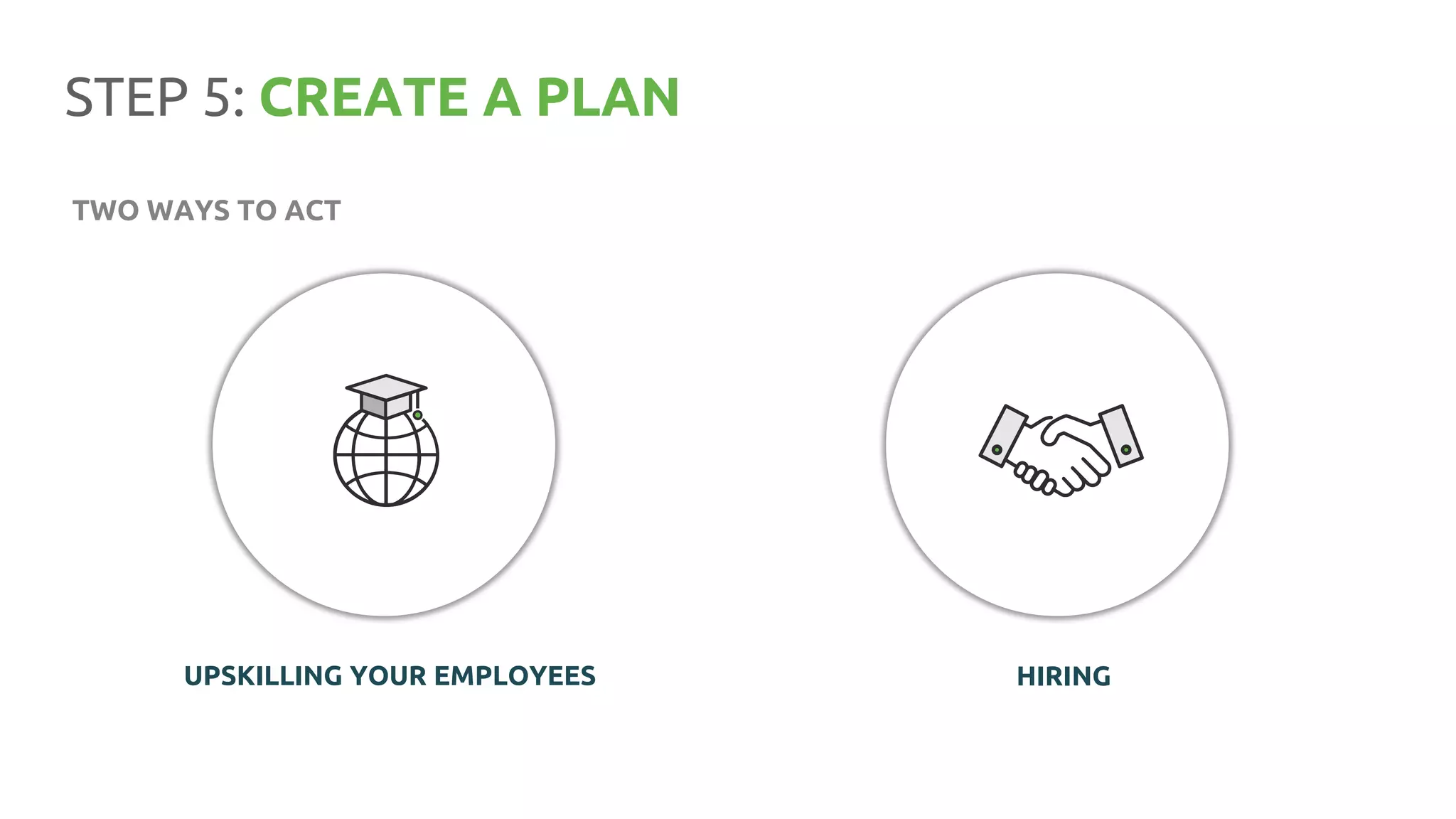
STEP 5: CREATE A PLAN
UPSKILLING YOUR EMPLOYEES HIRING
TWO WAYS TO ACT
Training vs. Hiring
More respondents lean toward training than toward hiring
Given the choice between accessing new talent and training existing employees, where are you leaning?
Strongly toward training
Moderately toward training
Moderately toward new talent
Strongly toward new talent
31%
46%
17%
7%
Source: Deloitte‘s 2019 Global Human Capital Trends Report
By 2030, as many as 375 million workers – or
roughly 14 percent of the global workforce – may need
to switch occupational categories…
- McKinsey Global Institute
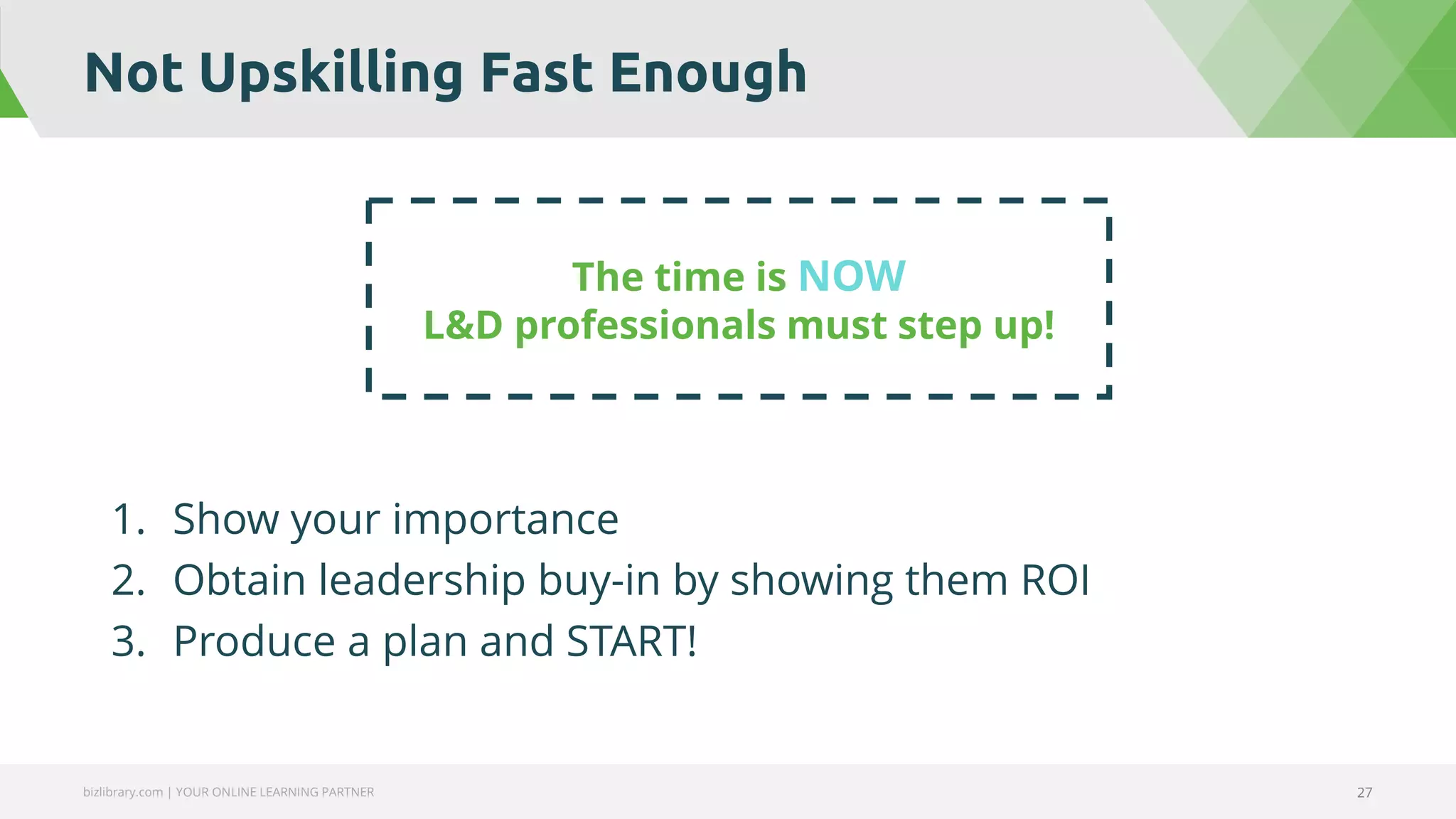
Not Upskilling Fast Enough
bizlibrary.com | YOUR ONLINE LEARNING PARTNER 27
1. Show your importance
2. Obtain leadership buy-in by showing them ROI
3. Produce a plan and START!
The time is NOW
L&D professionals must step up!
bizlibrary.com | YOUR ONLINE LEARNING PARTNER 28
How did you convince your boss/executives to
see the benefits of upskilling your employees?
GROUP CHAT QUESTION
Poor Training Strategies
bizlibrary.com | YOUR ONLINE LEARNING PARTNER 29
If your training content is boring, presenters are monotone, and the content is not interesting to
the audience – it’s time to rethink your strategy.
Not Engaging
Your company is spending good time and money on employee learning and development all to
forget everything after a few days.
No Reinforcement of Learning
If you’re sending the same content to everyone, the topics are not what your audience are
looking for, or the content is outdated.
Not Relevant
There are so many ways to train your employees, but if you are only offering in-person-
mandatory training, you could be hurting the productivity of your employees and the company.
Not Easily Accessible
Training Strategies that Will Help Close Your Soft Skills Gap
bizlibrary.com | YOUR ONLINE LEARNING PARTNER 30
Online Classroom
Coaching
1. Multiple Modalities
3. Interactive
Gamification
Reinforcements
4. Find a
Supportive
Partner
Microlearning Accessibility
Variety Diversity
2. Engaging and
Relevant
Client Success
Key Takeaways
bizlibrary.com | YOUR ONLINE LEARNING PARTNER 31
• The common mistakes companies make when trying to close
their soft skills gap.
• How to conduct assessments of current soft skills and bring
your whole company on board with training.
• Ways to implement training strategies that will help close
your soft skills gap.
Questions?
Thank you for attending!
Katie Miller
Marketing Events Strategist
BizLibrary

L&D's Role in Closing the Soft Skills Gap

  • 2.
    Presenting Today Katie Miller MarketingEvents Strategist BizLibrary
  • 3.
  • 5.
    Poll Question What method/shave you tried to fill the soft skills gap at your organization? A. Hiring sprees B. Brought in outside help (consultants) C. Administered pre-hire assessments D. All (A-C) E. Other (type in the chat)
  • 6.
    Poll Question Were yousuccessful in closing the soft skills gap at your organization with the method/s you chose? A. Yes, our soft skill gaps are filled! B. Somewhat, but we still have work to do. C. Not at all.
  • 7.
    During the webinartoday, you’ll learn: • The common mistakes companies make when trying to close their soft skills gap. • How to conduct assessments of current soft skills and bring your whole company on board with training. • Ways to implement training strategies that will help close your soft skills gap.
  • 8.
  • 9.
  • 10.
    83% HR PROFESSIONALS REPORTEDHAVING DIFFICULTY RECRUITING SUITABLE JOB CANDIDATES IN THE PAST 12 MONTHS 75% HR PROFESSIONALS SAID THERE ARE SKILLS GAPS IN JOB CANDIDATES SHRM 2019, The Global Skills Shortage https://www.shrm.org/hr-today/trends-and-forecasting/research-and-surveys/Documents/SHRM%20Skills%20Gap%202019.pdf
  • 11.
    What are SoftSkills? Emotional Intelligence Critical Thinking Creativity People Management Decision Making Soft Skills Soft skills are the competencies that allow your employees to interact effectively and productively with others, no matter the role or the setting.
  • 12.
    12 25% of aperson’s long-term career success was attributed to technical skills. Soft skills training in five different factories yielded a 250% ROI in just eight months
  • 13.
    Common Mistakes Companiesare Making o Blaming Others o Not Focusing On The Right Skills o Not Doing A Proper Assessment o Not Upskilling Fast Enough o Poor Training Strategies
  • 14.
    Blaming Others bizlibrary.com |YOUR ONLINE LEARNING PARTNER 14
  • 15.
    Not Focusing onthe Right Skills 75%of 2,000 full-time workers plan to learn new skills because they want to advance in their careers. https://www.shrm.org/resourcesandtools/hr-topics/organizational-and-employee-development/pages/employers-need-to-broaden-strategies-to-close-skills-gap.aspx
  • 16.
    bizlibrary.com | YOURONLINE LEARNING PARTNER 16 FEEDBACK FREEDOM TO FAIL • 1:1’s • Company-wide surveys • Intranet • Nobody likes feeling incompetent • Managers and supervisors are important in achieving a “Freedom to Fail” culture
  • 17.
    Not Doing aProper Assessment bizlibrary.com | YOUR ONLINE LEARNING PARTNER 17 • Make it easy to understand, not too long • Keep it consistent (Scale 1-5) • Know your audience
  • 18.
    Plan Identify important skills Measurecurrent skills Analyze the data Create a plan The Soft Skills Gap Analysis Sources: derived from workable.com and peoplemattersglobal.com
  • 19.
    STEP 1: PLAN TWOGROUPS YOU CAN CONDUCT THE ANALYSIS ON: Individual Scope Who is in charge of the process When to conduct a soft skills gap analysis How to respond to soft skill gaps Individual level Team/company level Manager Manager HR/L&D Directors/C-suite - Changes in employee’s duties - Poor performance review - Need for new skills for a promotion or new project - Problems meeting business goals - Strategy shifts - New technologies - When a team is exceeding their goals Training Succession planning Mentoring initiatives Hiring Training programs Mentoring initiatives Team/company
  • 20.
    STEP 2: IDENTIFYIMPORTANT SKILLS TWO QUESTIONS: What skills do you value as a company? What soft skills do our employees need to do their jobs well now and in the future? Importance Leadership High Excellent Skill level required Low Average Presenting Moderate Good Initiative
  • 21.
    STEP 3: MEASURECURRENT SKILLS THREE WAYS TO MEASURE: Surveys and assessments Interviews with employees Feedback Importance Creativity High 5 Required level Moderate 4 Collaboration High 3 Persuasion 4 Actual level 2 3
  • 22.
    STEP 3: MEASURECURRENT SKILLS Skill Type Functional Business Leadership Skills Site Leadership Middle Management Frontline Supervisor Health, Safety, & Environment Six Sigma Competencies Computer-Aided Design Functional Specification Decision Making Customer Orientation Adaptability Time Management People Management Effective Communication Creativity & Innovation Digital Vision More improvement required Improvement required Less improvement required
  • 23.
    COMPARE The established IDEALstate The analyzed CURRENT state STEP 4: ANALYZE THE DATA
  • 24.
    STEP 5: CREATEA PLAN UPSKILLING YOUR EMPLOYEES HIRING TWO WAYS TO ACT
  • 25.
    Training vs. Hiring Morerespondents lean toward training than toward hiring Given the choice between accessing new talent and training existing employees, where are you leaning? Strongly toward training Moderately toward training Moderately toward new talent Strongly toward new talent 31% 46% 17% 7% Source: Deloitte‘s 2019 Global Human Capital Trends Report
  • 26.
    By 2030, asmany as 375 million workers – or roughly 14 percent of the global workforce – may need to switch occupational categories… - McKinsey Global Institute
  • 27.
    Not Upskilling FastEnough bizlibrary.com | YOUR ONLINE LEARNING PARTNER 27 1. Show your importance 2. Obtain leadership buy-in by showing them ROI 3. Produce a plan and START! The time is NOW L&D professionals must step up!
  • 28.
    bizlibrary.com | YOURONLINE LEARNING PARTNER 28 How did you convince your boss/executives to see the benefits of upskilling your employees? GROUP CHAT QUESTION
  • 29.
    Poor Training Strategies bizlibrary.com| YOUR ONLINE LEARNING PARTNER 29 If your training content is boring, presenters are monotone, and the content is not interesting to the audience – it’s time to rethink your strategy. Not Engaging Your company is spending good time and money on employee learning and development all to forget everything after a few days. No Reinforcement of Learning If you’re sending the same content to everyone, the topics are not what your audience are looking for, or the content is outdated. Not Relevant There are so many ways to train your employees, but if you are only offering in-person- mandatory training, you could be hurting the productivity of your employees and the company. Not Easily Accessible
  • 30.
    Training Strategies thatWill Help Close Your Soft Skills Gap bizlibrary.com | YOUR ONLINE LEARNING PARTNER 30 Online Classroom Coaching 1. Multiple Modalities 3. Interactive Gamification Reinforcements 4. Find a Supportive Partner Microlearning Accessibility Variety Diversity 2. Engaging and Relevant Client Success
  • 31.
    Key Takeaways bizlibrary.com |YOUR ONLINE LEARNING PARTNER 31 • The common mistakes companies make when trying to close their soft skills gap. • How to conduct assessments of current soft skills and bring your whole company on board with training. • Ways to implement training strategies that will help close your soft skills gap.
  • 32.
  • 33.
    Thank you forattending! Katie Miller Marketing Events Strategist BizLibrary