Manage Time Priorities Protect Sherry Prindle the Heartfelt Tornado and Motivational Mastermind
Sherry Prindle Your Presenter: Sherry Prindle the Heartfelt Tornado and Motivational Mastermind
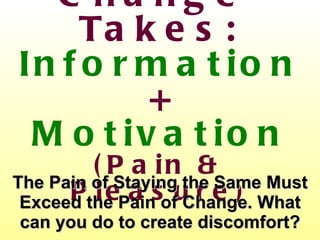
Change  Takes: Information + Motivation (Pain & Pleasure) The Pain of Staying the Same Must Exceed the Pain of Change. What can you do to create discomfort?
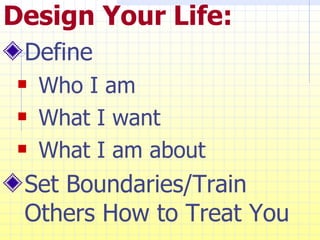
Design Your Life: Define Who I am What I want What I am about Set Boundaries/Train Others How to Treat You
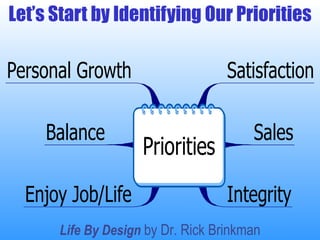
Let’s Start by Identifying Our Priorities Life By Design  by Dr. Rick Brinkman
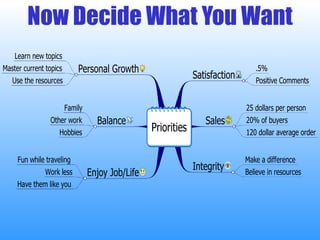
Now Decide What You Want
Mind Mapping Break goals down into tasks
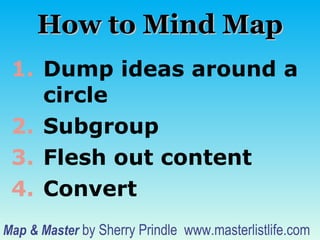
How to Mind Map Dump ideas around a circle Subgroup Flesh out content Convert Map & Master  by Sherry Prindle  www.masterlistlife.com
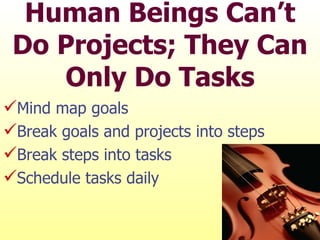
Human Beings Can’t Do Projects; They Can Only Do Tasks Mind map goals Break goals and projects into steps Break steps into tasks Schedule tasks daily
Keeping things in your head is an inefficiency
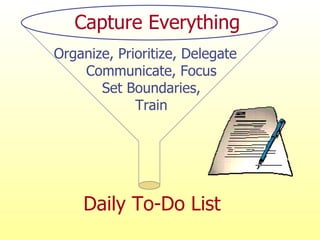
Capture Everything Organize, Prioritize, Delegate Communicate, Focus Set Boundaries, Train Daily To-Do List
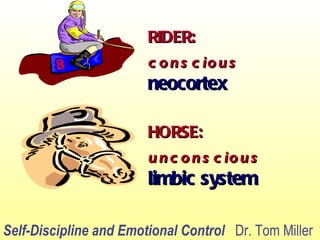
RIDER: conscious neocortex HORSE: unconscious limbic system Self-Discipline and Emotional Control   Dr. Tom Miller
Your Horse is your survival mechanism. Same = Safe Different = Dangerous How many things have you actually ever  managed to change?
“ That’s stupid; that won’t work” Watch the 8-Minute Video at www.SherryPrindle.com
What’s working? Managing Multiple Priorities What’s NOT  working? Organizing from the Inside Out   Julie Morgenstern ( book)
Managing Multiple Priorities
What would you do if you could not fail? What would make you most excited to get up and face the day?  If you had $100 million in the bank, what would you do every day? The New Psychology of Achievement  by Brian Tracy
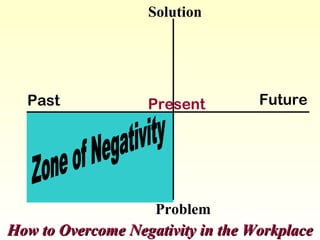
Solution  Problem Past Future Zone of Negativity Present How to Overcome Negativity in the Workplace
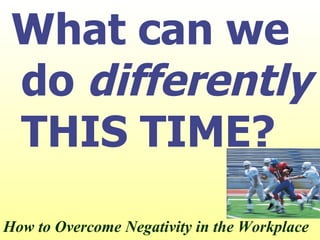
How to Overcome Negativity in the Workplace What can we do  differently  THIS TIME?
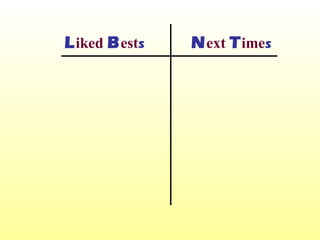
L iked  B est s N ext  T ime s
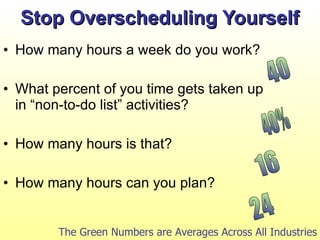
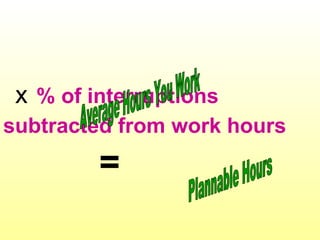
Stop Overscheduling Yourself How many hours a week do you work? What percent of you time gets taken up  in “non-to-do list” activities? How many hours is that? How many hours can you plan? 40 40% 24 16 The Green Numbers are Averages Across All Industries
x   % of interruptions subtracted from work hours = Average Hours You Work Plannable Hours
“ What’s the best use of my time now?” Brian   Tracy —The New Psychology of Achievement
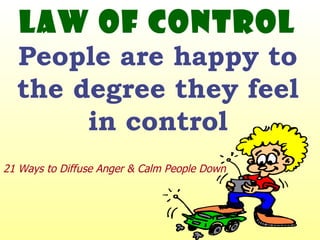
Law of Control People are happy to the degree they feel in control 21 Ways to Diffuse Anger & Calm People Down
If someone is a jerk, whose problem is that? Why do people behave as they do?  It works for them BUT it only works if you buy into it We give in to others’ manipulation when they hit on an area where we have a seed of self doubt.  Jack Canfield,   Self-Esteem & Peak Performance
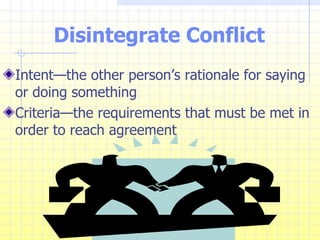
Disintegrate Conflict Intent—the other person’s rationale for saying or doing something Criteria—the requirements that must be met in order to reach agreement
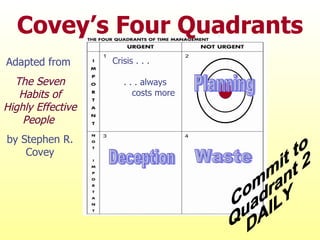
Covey’s Four Quadrants Adapted from  The Seven Habits of Highly Effective People   by Stephen R. Covey Crisis . . . . . . always costs more Waste Deception Commit to Quadrant 2 DAILY Planning
Live Without Regret Deathbed
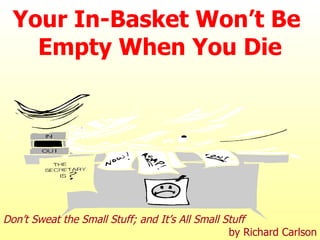
Your In-Basket Won’t Be  Empty When You Die Don’t Sweat the Small Stuff; and It’s All Small Stuff  by Richard Carlson
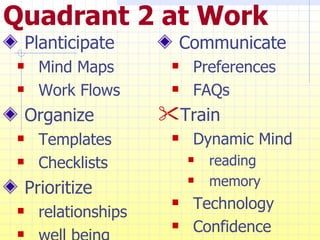
Quadrant 2 at Work Planticipate Mind Maps Work Flows Organize Templates Checklists Prioritize relationships well being Communicate Preferences FAQs Train Dynamic Mind reading memory Technology Confidence
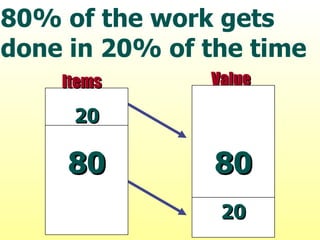
80% of the work gets  done in 20% of the time 80 Items Value 80 20 20
Everything You Do Which of your responsibilities has the greatest impact on the bottom line? Which do you think most helps the customer? Which do you enjoy the most?
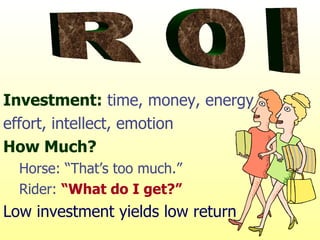
Investment:  time, money, energy effort, intellect, emotion How Much? Horse: “That’s too much.” Rider:  “What do I get?”   Low investment yields low return R O I
What if I do it? Managing Multiple Priorities What if I don’t?
Practice and Repetition Visual/Audio Reminders Coaches and Mentors Accountability Partner Audio Learning Daily Rituals
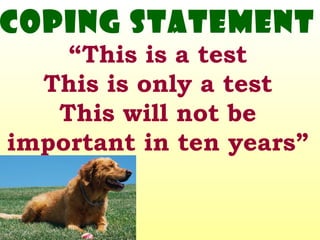
Coping Statement “ This is a test This is only a test This will not be important in ten years”
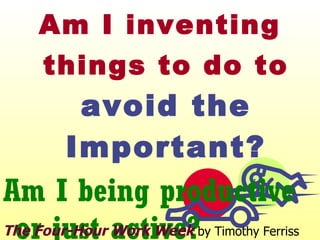
Am I inventing things to do to  avoid the Important? Am I being productive or just active? The Four-Hour Work Week  by Timothy Ferriss
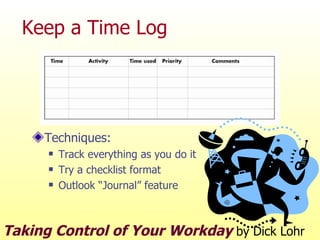
Keep a Time Log Techniques: Track everything as you do it Try a checklist format Outlook “Journal” feature Taking Control of Your Workday  by Dick Lohr
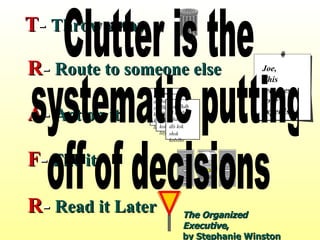
The Organized Executive ,  by Stephanie Winston   Clutter is the systematic putting  off of decisions T -  Throw away R -  Route to someone else Joe, This  requires  your  expertise  A -  Act on it lkdf dkdh dlkfhj  slkdh skdls  ksk shsk sks  kolslhs  lityys lthls  lkdf dkdh  dlkfhj  slkdh skdls  ksk shsk sks  kolslhs  lityys lthls  lkdf dkdh ld dlkfhj  slkdh sk dls ksk  shsk  kolslhs  F -  File it R -  Read it Later
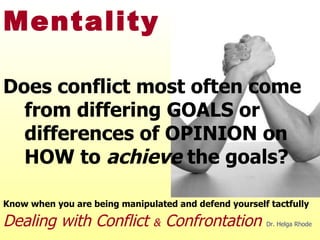
Win-Lose Mentality Does conflict most often come from differing GOALS or differences of OPINION on HOW to  achieve  the goals? Know when you are being manipulated and defend yourself tactfully Dealing with Conflict  &  Confrontation   Dr. Helga Rhode
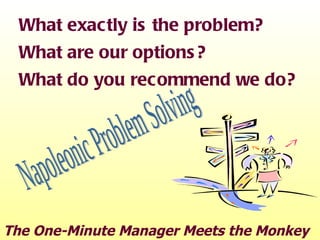
What exactly is the problem? What are our options? What do you recommend we do? Napoleonic Problem Solving The One-Minute Manager Meets the Monkey
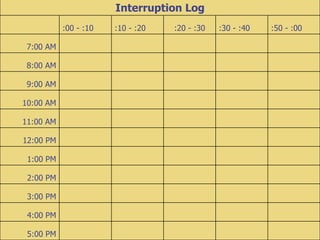
Interruption Log Interruption Log   :00 - :10 :10 - :20 :20 - :30 :30 - :40 :50 - :00 7:00 AM           8:00 AM           9:00 AM           10:00 AM           11:00 AM           12:00 PM           1:00 PM           2:00 PM           3:00 PM           4:00 PM           5:00 PM          
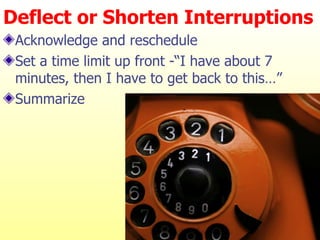
Deflect or Shorten Interruptions Acknowledge and reschedule Set a time limit up front -“I have about 7 minutes, then I have to get back to this…”  Summarize
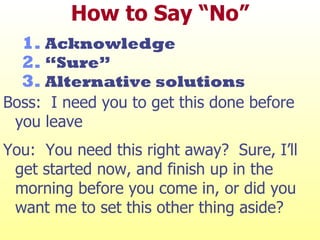
How to Say “No” Acknowledge “ Sure”  Alternative solutions Boss:  I need you to get this done before you leave You:  You need this right away?  Sure, I’ll get started now, and finish up in the morning before you come in, or did you want me to set this other thing aside?
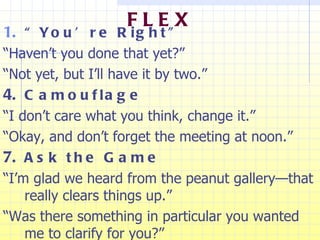
FLEX “ You’re Right” “ Haven’t you done that yet?” “ Not yet, but I’ll have it by two.” Camouflage “ I don’t care what you think, change it.” “ Okay, and don’t forget the meeting at noon.” Ask the Game “ I’m glad we heard from the peanut gallery—that really clears things up.” “ Was there something in particular you wanted me to clarify for you?”
ASAP Hurry Right Away Offer Definitions “ If I were __ what would I  be doing?” Life By Design  by Dr. Rick Brinkman
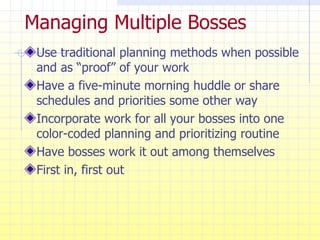
Managing Multiple Bosses Use traditional planning methods when possible and as “proof” of your work Have a five-minute morning huddle or share schedules and priorities some other way Incorporate work for all your bosses into one color-coded planning and prioritizing routine Have bosses work it out among themselves First in, first out
Steps to Staying Calm Breathe Time Out Switch to Left Brain
Bring Sherry Prindle in to Train Your Group

Time and Priority Management

  • 1.
    Manage Time PrioritiesProtect Sherry Prindle the Heartfelt Tornado and Motivational Mastermind
  • 2.
    Sherry Prindle YourPresenter: Sherry Prindle the Heartfelt Tornado and Motivational Mastermind
  • 3.
    Change Takes:Information + Motivation (Pain & Pleasure) The Pain of Staying the Same Must Exceed the Pain of Change. What can you do to create discomfort?
  • 4.
    Design Your Life:Define Who I am What I want What I am about Set Boundaries/Train Others How to Treat You
  • 5.
    Let’s Start byIdentifying Our Priorities Life By Design by Dr. Rick Brinkman
  • 6.
  • 7.
    Mind Mapping Breakgoals down into tasks
  • 8.
    How to MindMap Dump ideas around a circle Subgroup Flesh out content Convert Map & Master by Sherry Prindle www.masterlistlife.com
  • 9.
    Human Beings Can’tDo Projects; They Can Only Do Tasks Mind map goals Break goals and projects into steps Break steps into tasks Schedule tasks daily
  • 10.
    Keeping things inyour head is an inefficiency
  • 11.
    Capture Everything Organize,Prioritize, Delegate Communicate, Focus Set Boundaries, Train Daily To-Do List
  • 12.
    RIDER: conscious neocortexHORSE: unconscious limbic system Self-Discipline and Emotional Control Dr. Tom Miller
  • 13.
    Your Horse isyour survival mechanism. Same = Safe Different = Dangerous How many things have you actually ever managed to change?
  • 14.
    “ That’s stupid;that won’t work” Watch the 8-Minute Video at www.SherryPrindle.com
  • 15.
    What’s working? ManagingMultiple Priorities What’s NOT working? Organizing from the Inside Out Julie Morgenstern ( book)
  • 16.
  • 17.
    What would youdo if you could not fail? What would make you most excited to get up and face the day? If you had $100 million in the bank, what would you do every day? The New Psychology of Achievement by Brian Tracy
  • 18.
    Solution ProblemPast Future Zone of Negativity Present How to Overcome Negativity in the Workplace
  • 19.
    How to OvercomeNegativity in the Workplace What can we do differently THIS TIME?
  • 20.
    L iked B est s N ext T ime s
  • 21.
    Stop Overscheduling YourselfHow many hours a week do you work? What percent of you time gets taken up in “non-to-do list” activities? How many hours is that? How many hours can you plan? 40 40% 24 16 The Green Numbers are Averages Across All Industries
  • 22.
    x % of interruptions subtracted from work hours = Average Hours You Work Plannable Hours
  • 23.
    “ What’s thebest use of my time now?” Brian Tracy —The New Psychology of Achievement
  • 24.
    Law of ControlPeople are happy to the degree they feel in control 21 Ways to Diffuse Anger & Calm People Down
  • 25.
    If someone isa jerk, whose problem is that? Why do people behave as they do? It works for them BUT it only works if you buy into it We give in to others’ manipulation when they hit on an area where we have a seed of self doubt. Jack Canfield, Self-Esteem & Peak Performance
  • 26.
    Disintegrate Conflict Intent—theother person’s rationale for saying or doing something Criteria—the requirements that must be met in order to reach agreement
  • 27.
    Covey’s Four QuadrantsAdapted from The Seven Habits of Highly Effective People by Stephen R. Covey Crisis . . . . . . always costs more Waste Deception Commit to Quadrant 2 DAILY Planning
  • 28.
  • 29.
    Your In-Basket Won’tBe Empty When You Die Don’t Sweat the Small Stuff; and It’s All Small Stuff by Richard Carlson
  • 30.
    Quadrant 2 atWork Planticipate Mind Maps Work Flows Organize Templates Checklists Prioritize relationships well being Communicate Preferences FAQs Train Dynamic Mind reading memory Technology Confidence
  • 31.
    80% of thework gets done in 20% of the time 80 Items Value 80 20 20
  • 32.
    Everything You DoWhich of your responsibilities has the greatest impact on the bottom line? Which do you think most helps the customer? Which do you enjoy the most?
  • 33.
    Investment: time,money, energy effort, intellect, emotion How Much? Horse: “That’s too much.” Rider: “What do I get?” Low investment yields low return R O I
  • 34.
    What if Ido it? Managing Multiple Priorities What if I don’t?
  • 35.
    Practice and RepetitionVisual/Audio Reminders Coaches and Mentors Accountability Partner Audio Learning Daily Rituals
  • 36.
    Coping Statement “This is a test This is only a test This will not be important in ten years”
  • 37.
    Am I inventingthings to do to avoid the Important? Am I being productive or just active? The Four-Hour Work Week by Timothy Ferriss
  • 38.
    Keep a TimeLog Techniques: Track everything as you do it Try a checklist format Outlook “Journal” feature Taking Control of Your Workday by Dick Lohr
  • 39.
    The Organized Executive, by Stephanie Winston Clutter is the systematic putting off of decisions T - Throw away R - Route to someone else Joe, This requires your expertise A - Act on it lkdf dkdh dlkfhj slkdh skdls ksk shsk sks kolslhs lityys lthls lkdf dkdh dlkfhj slkdh skdls ksk shsk sks kolslhs lityys lthls lkdf dkdh ld dlkfhj slkdh sk dls ksk shsk kolslhs F - File it R - Read it Later
  • 40.
    Win-Lose Mentality Doesconflict most often come from differing GOALS or differences of OPINION on HOW to achieve the goals? Know when you are being manipulated and defend yourself tactfully Dealing with Conflict & Confrontation Dr. Helga Rhode
  • 41.
    What exactly isthe problem? What are our options? What do you recommend we do? Napoleonic Problem Solving The One-Minute Manager Meets the Monkey
  • 42.
    Interruption Log InterruptionLog   :00 - :10 :10 - :20 :20 - :30 :30 - :40 :50 - :00 7:00 AM           8:00 AM           9:00 AM           10:00 AM           11:00 AM           12:00 PM           1:00 PM           2:00 PM           3:00 PM           4:00 PM           5:00 PM          
  • 43.
    Deflect or ShortenInterruptions Acknowledge and reschedule Set a time limit up front -“I have about 7 minutes, then I have to get back to this…” Summarize
  • 44.
    How to Say“No” Acknowledge “ Sure” Alternative solutions Boss: I need you to get this done before you leave You: You need this right away? Sure, I’ll get started now, and finish up in the morning before you come in, or did you want me to set this other thing aside?
  • 45.
    FLEX “ You’reRight” “ Haven’t you done that yet?” “ Not yet, but I’ll have it by two.” Camouflage “ I don’t care what you think, change it.” “ Okay, and don’t forget the meeting at noon.” Ask the Game “ I’m glad we heard from the peanut gallery—that really clears things up.” “ Was there something in particular you wanted me to clarify for you?”
  • 46.
    ASAP Hurry RightAway Offer Definitions “ If I were __ what would I be doing?” Life By Design by Dr. Rick Brinkman
  • 47.
    Managing Multiple BossesUse traditional planning methods when possible and as “proof” of your work Have a five-minute morning huddle or share schedules and priorities some other way Incorporate work for all your bosses into one color-coded planning and prioritizing routine Have bosses work it out among themselves First in, first out
  • 48.
    Steps to StayingCalm Breathe Time Out Switch to Left Brain
  • 49.
    Bring Sherry Prindlein to Train Your Group