Source: Time Doctor’s Blog - “ABC Method Time Management : What it is & How to Implement”
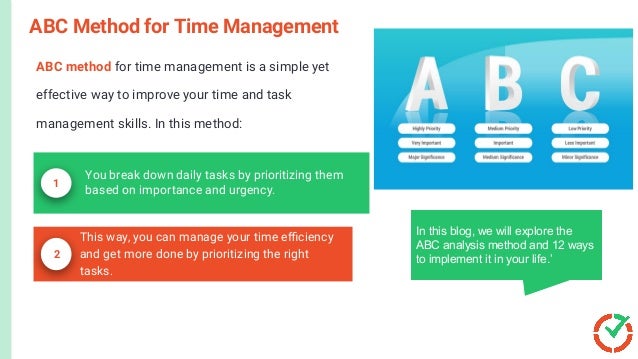
ABC method for time management is a simple yet
effective way to improve your time and task
management skills. In this method:
ABC Method for Time Management
In this blog, we will explore the
ABC analysis method and 12 ways
to implement it in your life.’
This way, you can manage your time efficiency
and get more done by prioritizing the right
tasks.
1
You break down daily tasks by prioritizing them
based on importance and urgency.
2
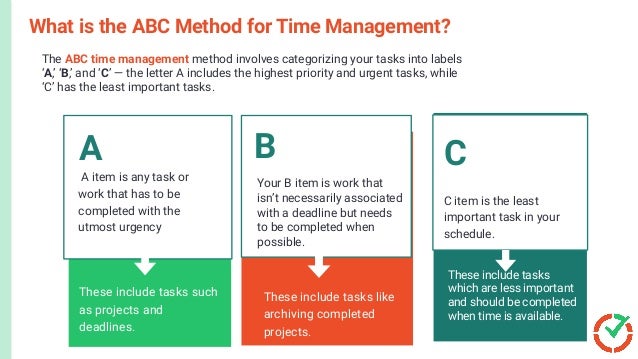
The ABC time management method involves categorizing your tasks into labels
‘A,’ ‘B,’ and ‘C’ — the letter A includes the highest priority and urgent tasks, while
‘C’ has the least important tasks.
What is the ABC Method for Time Management?
You break down daily tasks by prioritizing them
based on importance and urgency.
A item is any task or
work that has to be
completed with the
utmost urgency
A
These include tasks such
as projects and
deadlines.
Your B item is work that
isn’t necessarily associated
with a deadline but needs
to be completed when
possible.
B
These include tasks like
archiving completed
projects.
C item is the least
important task in your
schedule.
C
These include tasks
which are less important
and should be completed
when time is available.
12 Key Ways to
Implement the ABC
Method of Time
Management
Let’s look at the 12 best ways to utilize the ABC
method of time management.
1.Understand the Importance of Various Tasks
It’s essential to categorize your projects
and tasks bases on importance since
different taske may require varying
amounts of time and resource.
These tasks can range from necessary
business development to organizing an
office get-together.
Understanding how each
task is important can help
you delegate tasks
effectively, improve
employee engagement and
provide consistent
customer service.
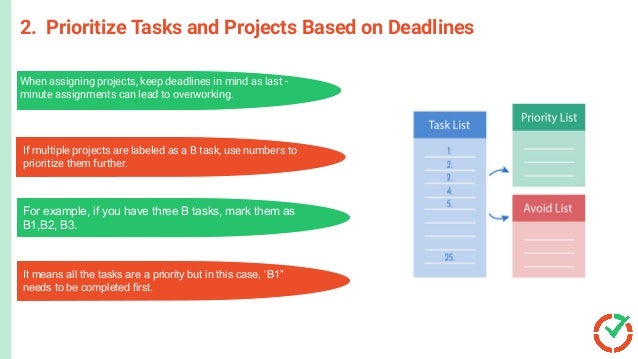
2. Prioritize Tasks and Projects Based on Deadlines
When assigning projects, keep deadlines in mind as last -
minute assignments can lead to overworking.
If multiple projects are labeled as a B task, use numbers to
prioritize them further.
For example, if you have three B tasks, mark them as
B1,B2, B3.
It means all the tasks are a priority but in this case, ‘B1”
needs to be completed first.
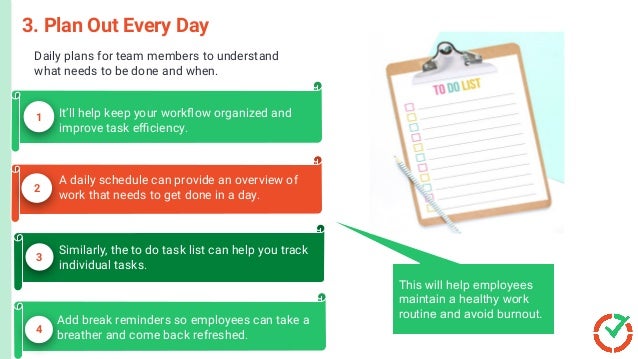
3. Plan Out Every Day
Excellent project time management leads to
efficient use of one’s time.
1
2
It’ll help keep your workflow organized and
improve task efficiency.
A daily schedule can provide an overview of
work that needs to get done in a day.
3
Similarly, the to do task list can help you track
individual tasks.
Daily plans for team members to understand
what needs to be done and when.
4
Add break reminders so employees can take a
breather and come back refreshed.
This will help employees
maintain a healthy work
routine and avoid burnout.
4. Estimate Time Required for Each Task
It’s essential to determine achievable time estimates
for each task
However, when dealing with new projects, its better to
overestimate how long the first few tasks will take
This gives your team enough time to learn and
understand the best way to approach these tasks.
1
2
.
3
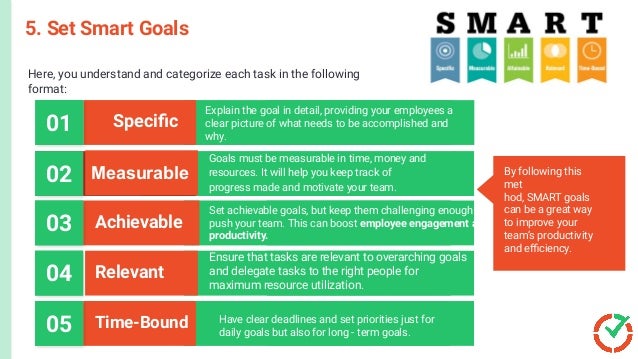
Here, you understand and categorize each task in the following
format:
5. Set Smart Goals
This activates the shipment process.
The customer receives the product.
The order is closed.
T
Identify the employees, tools, materials and
other resources required for each project task.
You could use Pareto Principle,
also known as the 80-20 rule. It states that 80%
of the results should come from 20% of your
effort. It means you need to prioritize the 20% of
tasks that will achieve the highest outputs.
Measurable
02
Goals must be measurable in time, money and
resources. It will help you keep track of
progress made and motivate your team.
Specific
01
Explain the goal in detail, providing your employees a
clear picture of what needs to be accomplished and
why.
Measurable
Achievable
03
Set achievable goals, but keep them challenging enough to
push your team. This can boost employee engagement and
productivity.
Relevant
04
Ensure that tasks are relevant to overarching goals
and delegate tasks to the right people for
maximum resource utilization.
Time-Bound
05 Have clear deadlines and set priorities just for
daily goals but also for long - term goals.
By following this
met
hod, SMART goals
can be a great way
to improve your
team’s productivity
and efficiency.
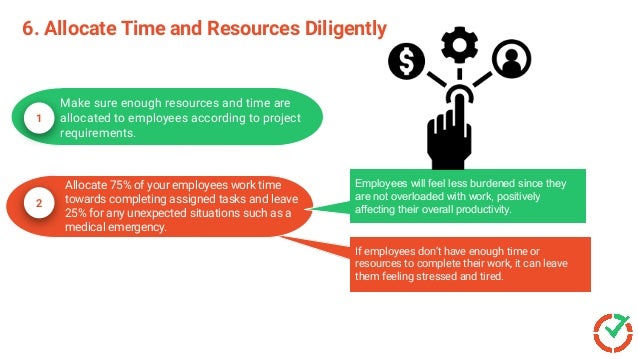
6. Allocate Time and Resources Diligently
1
Make sure enough resources and time are
allocated to employees according to project
requirements.
If employees don’t have enough time or
resources to complete their work, it can
leave them feeling stressed and tired.
If employees don’t have enough time or
resources to complete their work, it can leave
them feeling stressed and tired.
2
Allocate 75% of your employees work time
towards completing assigned tasks and leave
25% for any unexpected situations such as a
medical emergency.
Employees will feel less burdened since they
are not overloaded with work, positively
affecting their overall productivity.
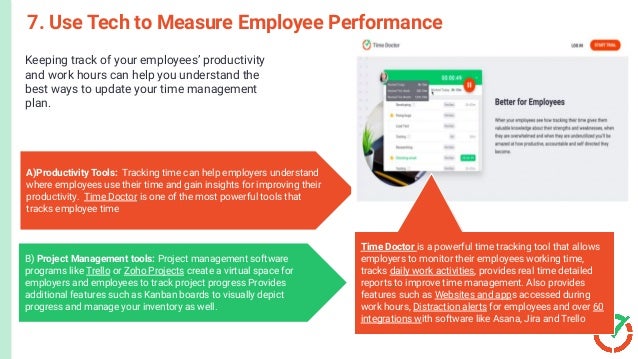
Keeping track of your employees’ productivity
and work hours can help you understand the
best ways to update your time management
plan.
7. Use Tech to Measure Employee Performance
A)Productivity Tools: Tracking time can help employers understand
where employees use their time and gain insights for improving their
productivity. Time Doctor is one of the most powerful tools that
tracks employee time
B) Project Management tools: Project management software
programs like Trello or Zoho Projects create a virtual space for
employers and employees to track project progress Provides
additional features such as Kanban boards to visually depict
progress and manage your inventory as well.
Time Doctor is a powerful time tracking tool that allows
employers to monitor their employees working time,
tracks daily work activities, provides real time detailed
reports to improve time management. Also provides
features such as Websites and apps accessed during
work hours, Distraction alerts for employees and over 60
integrations with software like Asana, Jira and Trello
Microsoft
PowerPoint
C
r
e
a
t
e
l
y
a
n
d
C
o
n
c
e
p
t
D
r
a
w
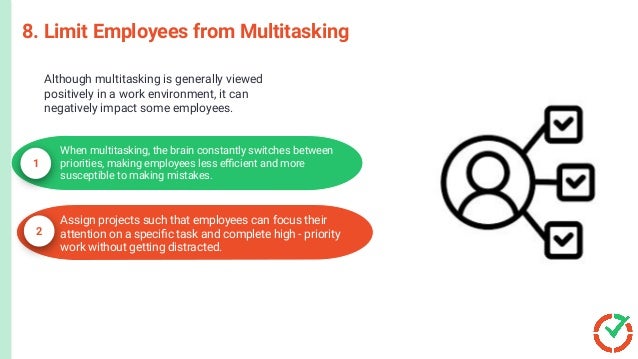
8. Limit Employees from Multitasking
When multitasking, the brain constantly switches between
priorities, making employees less efficient and more
susceptible to making mistakes.
1
2
Assign projects such that employees can focus their
attention on a specific task and complete high - priority
work without getting distracted.
Although multitasking is generally viewed
positively in a work environment, it can
negatively impact some employees.
9. Keep Distractions Away
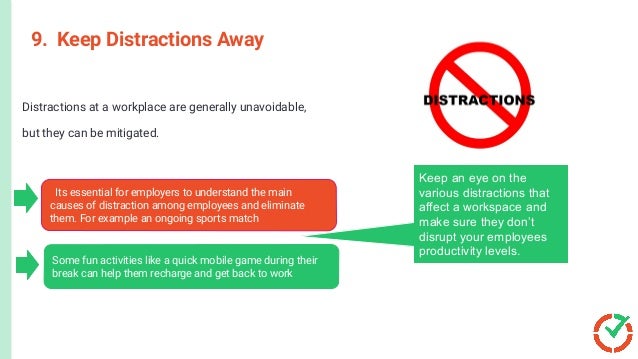
Distractions at a workplace are generally unavoidable,
but they can be mitigated.
Its essential for employers to understand the main
causes of distraction among employees and eliminate
them. For example an ongoing sports match
Some fun activities like a quick mobile game during their
break can help them recharge and get back to work
Keep an eye on the
various distractions that
affect a workspace and
make sure they don’t
disrupt your employees
productivity levels.
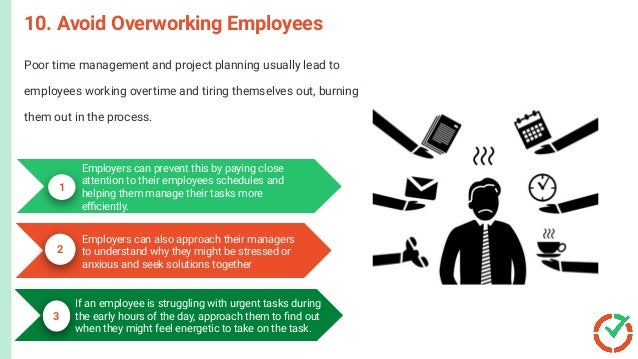
Poor time management and project planning usually lead to
employees working overtime and tiring themselves out, burning
them out in the process.
10. Avoid Overworking Employees
This activates the shipment process.
The customer receives the product.
The order is closed.
T
Customer orders a product or a
service.
Want to determine how long it should take to
complete each activity.
Accounting for work capacity and delegating
tasks efficiently will help boost quality
management and work productivity.
1
2
Employers can prevent this by paying close
attention to their employees schedules and
helping them manage their tasks more
efficiently.
Employers can also approach their managers
to understand why they might be stressed or
anxious and seek solutions together
3
If an employee is struggling with urgent tasks during
the early hours of the day, approach them to find out
when they might feel energetic to take on the task.
11. Encourage Employees to Take Breaks
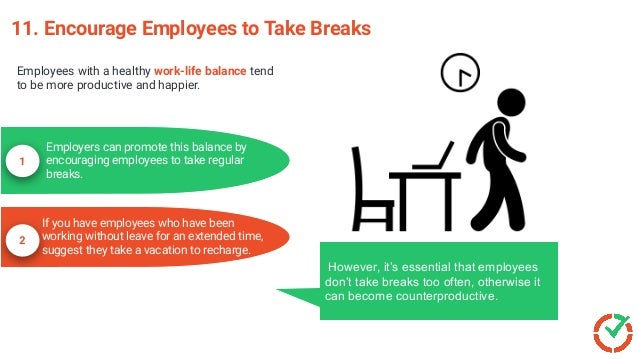
Employees with a healthy work-life balance tend
to be more productive and happier.
1
Employers can promote this balance by
encouraging employees to take regular
breaks.
2
If you have employees who have been
working without leave for an extended time,
suggest they take a vacation to recharge.
However, it’s essential that employees
don’t take breaks too often, otherwise it
can become counterproductive.
12. Assess Your Team’s Time Management Regularly
Employers can promote this balance by
encouraging employees to take regular
breaks.
If you have employees who have been
working without leave for an extended time,
suggest they take a vacation to recharge.
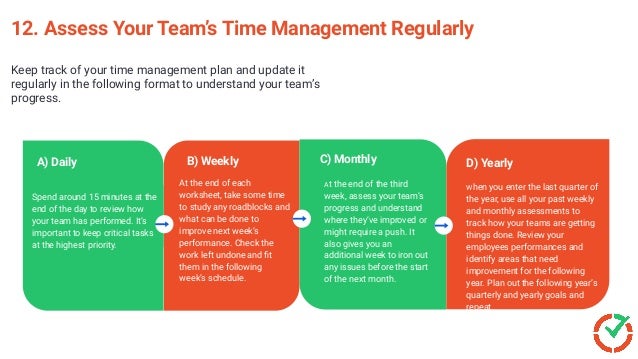
Keep track of your time management plan and update it
regularly in the following format to understand your team’s
progress.
B) Weekly
At the end of each
worksheet, take some time
to study any roadblocks and
what can be done to
improve next week’s
performance. Check the
work left undone and fit
them in the following
week’s schedule.
A) Daily
Spend around 15 minutes at the
end of the day to review how
your team has performed. It’s
important to keep critical tasks
at the highest priority.
C) Monthly
At the end of the third
week, assess your team’s
progress and understand
where they’ve improved or
might require a push. It
also gives you an
additional week to iron out
any issues before the start
of the next month.
When you enter the last quarter of
the year, use all your past weekly
and monthly assessments to
track how your teams are getting
things done. Review your
employees performances and
identify areas that need
improvement for the following
year. Plan out the following year’s
quarterly and yearly goals and
repeat.
D) Yearly
3 Alternative Time
Management
Strategies
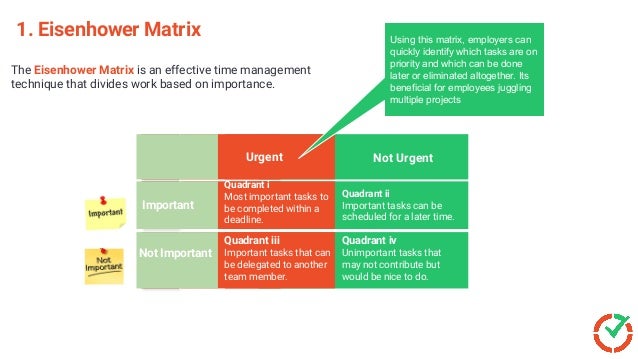
1. Eisenhower Matrix
Employers can promote this balance by
encouraging employees to take regular
breaks.
If you have employees who have been
working without leave for an extended time,
suggest they take a vacation to recharge.
The Eisenhower Matrix is an effective time management
technique that divides work based on importance.
Important
Not Important
Urgent Not Urgent
Quadrant i
Most important tasks to
be completed within a
deadline.
Quadrant ii
Important tasks can be
scheduled for a later time.
Quadrant iii
Important tasks that can
be delegated to another
team member.
Quadrant iv
Unimportant tasks that
may not contribute but
would be nice to do.
Using this matrix, employers can
quickly identify which tasks are on
priority and which can be done
later or eliminated altogether. Its
beneficial for employees juggling
multiple projects
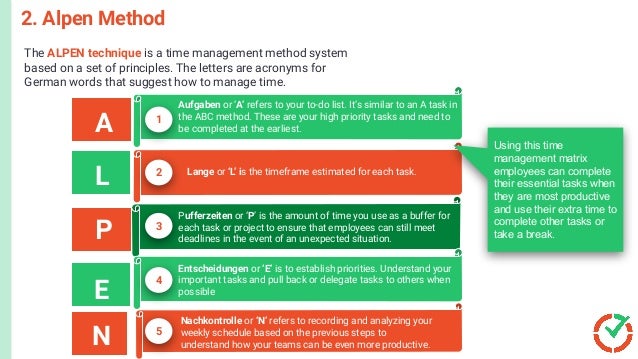
The ALPEN technique is a time management method system
based on a set of principles. The letters are acronyms for
German words that suggest how to manage time.
2. Alpen Method
1
2
Aufgaben or ‘A’ refers to your to-do list. It’s similar to an A task in
the ABC method. These are your high priority tasks and need to
be completed at the earliest.
Lange or ‘L’ is the timeframe estimated for each task.
3
Pufferzeiten or ‘P’ is the amount of time you use as a buffer for
each task or project to ensure that employees can still meet
deadlines in the event of an unexpected situation.
4
Entscheidungen or ‘E’ is to establish priorities. Understand your
important tasks and pull back or delegate tasks to others when
possible
5
Nachkontrolle or ‘N’ refers to recording and analyzing your
weekly schedule based on the previous steps to
understand how your teams can be even more productive.
Using this time
management matrix
employees can complete
their essential tasks when
they are most productive
and use their extra time to
complete other tasks or
take a break.
P
A
L
E
N
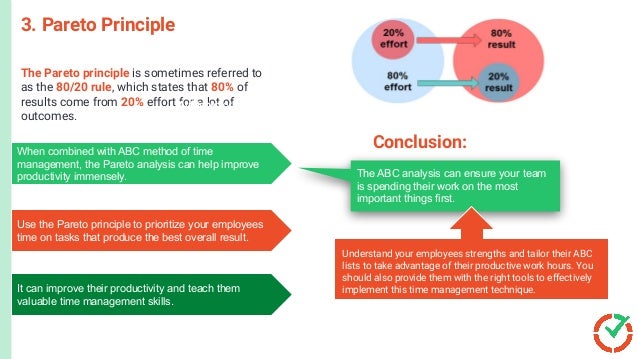
The Pareto principle is sometimes referred to
as the 80/20 rule, which states that 80% of
results come from 20% effort for a lot of
outcomes.
3. Pareto Principle
Aufgaben or ‘A’ refers to your to-do list. It’s similar to an A task in
the ABC method. These are your high priority tasks and need to
be completed at the earliest.
Lange or ‘L’ is the timeframe estimated for each task.
Nachkontrolle or ‘N’ refers to recording and analyzing your
weekly schedule based on the previous steps to
understand how your teams can be even more productive.
The ABC analysis can ensure your team
is spending their work on the most
important things first.
When combined with ABC method of time
management, the Pareto analysis can help improve
productivity immensely.
Use the Pareto principle to prioritize your employees
time on tasks that produce the best overall result.
It can improve their productivity and teach them
valuable time management skills.
Conclusion:
Understand your employees strengths and tailor their ABC
lists to take advantage of their productive work hours. You
should also provide them with the right tools to effectively
implement this time management technique.
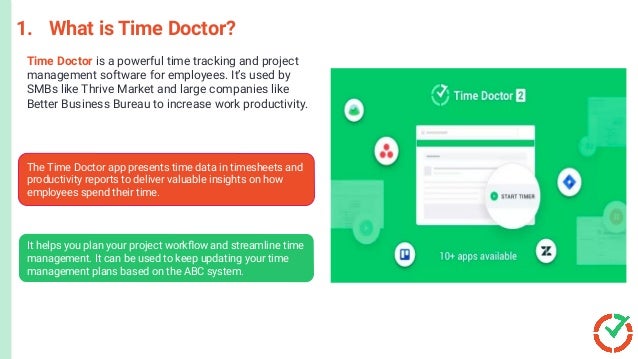
Time Doctor is a powerful time tracking and project
management software for employees. It’s used by
SMBs like Thrive Market and large companies like
Better Business Bureau to increase work productivity.
The Time Doctor app presents time data in timesheets and
productivity reports to deliver valuable insights on how
employees spend their time.
1. What is Time Doctor?
It helps you plan your project workflow and streamline time
management. It can be used to keep updating your time
management plans based on the ABC system.
Establish Accountability
Escalate Issues Faster
Blog Post source
To read more content
from Time Doctor,
visit our blog page:
Related Blog Post
https://biz30.timedoctor.com/abc-metho
d-time-management/
https://biz30.timedoctor.com/

ABC Method Time Management - What It Is & How to Implement

  • 1.
    Source: Time Doctor’sBlog - “ABC Method Time Management : What it is & How to Implement”
  • 2.
    ABC method fortime management is a simple yet effective way to improve your time and task management skills. In this method: ABC Method for Time Management In this blog, we will explore the ABC analysis method and 12 ways to implement it in your life.’ This way, you can manage your time efficiency and get more done by prioritizing the right tasks. 1 You break down daily tasks by prioritizing them based on importance and urgency. 2
  • 3.
    The ABC timemanagement method involves categorizing your tasks into labels ‘A,’ ‘B,’ and ‘C’ — the letter A includes the highest priority and urgent tasks, while ‘C’ has the least important tasks. What is the ABC Method for Time Management? You break down daily tasks by prioritizing them based on importance and urgency. A item is any task or work that has to be completed with the utmost urgency A These include tasks such as projects and deadlines. Your B item is work that isn’t necessarily associated with a deadline but needs to be completed when possible. B These include tasks like archiving completed projects. C item is the least important task in your schedule. C These include tasks which are less important and should be completed when time is available.
  • 4.
    12 Key Waysto Implement the ABC Method of Time Management Let’s look at the 12 best ways to utilize the ABC method of time management.
  • 5.
    1.Understand the Importanceof Various Tasks It’s essential to categorize your projects and tasks bases on importance since different taske may require varying amounts of time and resource. These tasks can range from necessary business development to organizing an office get-together. Understanding how each task is important can help you delegate tasks effectively, improve employee engagement and provide consistent customer service.
  • 6.
    2. Prioritize Tasksand Projects Based on Deadlines When assigning projects, keep deadlines in mind as last - minute assignments can lead to overworking. If multiple projects are labeled as a B task, use numbers to prioritize them further. For example, if you have three B tasks, mark them as B1,B2, B3. It means all the tasks are a priority but in this case, ‘B1” needs to be completed first.
  • 7.
    3. Plan OutEvery Day Excellent project time management leads to efficient use of one’s time. 1 2 It’ll help keep your workflow organized and improve task efficiency. A daily schedule can provide an overview of work that needs to get done in a day. 3 Similarly, the to do task list can help you track individual tasks. Daily plans for team members to understand what needs to be done and when. 4 Add break reminders so employees can take a breather and come back refreshed. This will help employees maintain a healthy work routine and avoid burnout.
  • 8.
    4. Estimate TimeRequired for Each Task It’s essential to determine achievable time estimates for each task However, when dealing with new projects, its better to overestimate how long the first few tasks will take This gives your team enough time to learn and understand the best way to approach these tasks. 1 2 . 3
  • 9.
    Here, you understandand categorize each task in the following format: 5. Set Smart Goals This activates the shipment process. The customer receives the product. The order is closed. T Identify the employees, tools, materials and other resources required for each project task. You could use Pareto Principle, also known as the 80-20 rule. It states that 80% of the results should come from 20% of your effort. It means you need to prioritize the 20% of tasks that will achieve the highest outputs. Measurable 02 Goals must be measurable in time, money and resources. It will help you keep track of progress made and motivate your team. Specific 01 Explain the goal in detail, providing your employees a clear picture of what needs to be accomplished and why. Measurable Achievable 03 Set achievable goals, but keep them challenging enough to push your team. This can boost employee engagement and productivity. Relevant 04 Ensure that tasks are relevant to overarching goals and delegate tasks to the right people for maximum resource utilization. Time-Bound 05 Have clear deadlines and set priorities just for daily goals but also for long - term goals. By following this met hod, SMART goals can be a great way to improve your team’s productivity and efficiency.
  • 10.
    6. Allocate Timeand Resources Diligently 1 Make sure enough resources and time are allocated to employees according to project requirements. If employees don’t have enough time or resources to complete their work, it can leave them feeling stressed and tired. If employees don’t have enough time or resources to complete their work, it can leave them feeling stressed and tired. 2 Allocate 75% of your employees work time towards completing assigned tasks and leave 25% for any unexpected situations such as a medical emergency. Employees will feel less burdened since they are not overloaded with work, positively affecting their overall productivity.
  • 11.
    Keeping track ofyour employees’ productivity and work hours can help you understand the best ways to update your time management plan. 7. Use Tech to Measure Employee Performance A)Productivity Tools: Tracking time can help employers understand where employees use their time and gain insights for improving their productivity. Time Doctor is one of the most powerful tools that tracks employee time B) Project Management tools: Project management software programs like Trello or Zoho Projects create a virtual space for employers and employees to track project progress Provides additional features such as Kanban boards to visually depict progress and manage your inventory as well. Time Doctor is a powerful time tracking tool that allows employers to monitor their employees working time, tracks daily work activities, provides real time detailed reports to improve time management. Also provides features such as Websites and apps accessed during work hours, Distraction alerts for employees and over 60 integrations with software like Asana, Jira and Trello
  • 12.
    Microsoft PowerPoint C r e a t e l y a n d C o n c e p t D r a w 8. Limit Employeesfrom Multitasking When multitasking, the brain constantly switches between priorities, making employees less efficient and more susceptible to making mistakes. 1 2 Assign projects such that employees can focus their attention on a specific task and complete high - priority work without getting distracted. Although multitasking is generally viewed positively in a work environment, it can negatively impact some employees.
  • 13.
    9. Keep DistractionsAway Distractions at a workplace are generally unavoidable, but they can be mitigated. Its essential for employers to understand the main causes of distraction among employees and eliminate them. For example an ongoing sports match Some fun activities like a quick mobile game during their break can help them recharge and get back to work Keep an eye on the various distractions that affect a workspace and make sure they don’t disrupt your employees productivity levels.
  • 14.
    Poor time managementand project planning usually lead to employees working overtime and tiring themselves out, burning them out in the process. 10. Avoid Overworking Employees This activates the shipment process. The customer receives the product. The order is closed. T Customer orders a product or a service. Want to determine how long it should take to complete each activity. Accounting for work capacity and delegating tasks efficiently will help boost quality management and work productivity. 1 2 Employers can prevent this by paying close attention to their employees schedules and helping them manage their tasks more efficiently. Employers can also approach their managers to understand why they might be stressed or anxious and seek solutions together 3 If an employee is struggling with urgent tasks during the early hours of the day, approach them to find out when they might feel energetic to take on the task.
  • 15.
    11. Encourage Employeesto Take Breaks Employees with a healthy work-life balance tend to be more productive and happier. 1 Employers can promote this balance by encouraging employees to take regular breaks. 2 If you have employees who have been working without leave for an extended time, suggest they take a vacation to recharge. However, it’s essential that employees don’t take breaks too often, otherwise it can become counterproductive.
  • 16.
    12. Assess YourTeam’s Time Management Regularly Employers can promote this balance by encouraging employees to take regular breaks. If you have employees who have been working without leave for an extended time, suggest they take a vacation to recharge. Keep track of your time management plan and update it regularly in the following format to understand your team’s progress. B) Weekly At the end of each worksheet, take some time to study any roadblocks and what can be done to improve next week’s performance. Check the work left undone and fit them in the following week’s schedule. A) Daily Spend around 15 minutes at the end of the day to review how your team has performed. It’s important to keep critical tasks at the highest priority. C) Monthly At the end of the third week, assess your team’s progress and understand where they’ve improved or might require a push. It also gives you an additional week to iron out any issues before the start of the next month. When you enter the last quarter of the year, use all your past weekly and monthly assessments to track how your teams are getting things done. Review your employees performances and identify areas that need improvement for the following year. Plan out the following year’s quarterly and yearly goals and repeat. D) Yearly
  • 17.
  • 18.
    1. Eisenhower Matrix Employerscan promote this balance by encouraging employees to take regular breaks. If you have employees who have been working without leave for an extended time, suggest they take a vacation to recharge. The Eisenhower Matrix is an effective time management technique that divides work based on importance. Important Not Important Urgent Not Urgent Quadrant i Most important tasks to be completed within a deadline. Quadrant ii Important tasks can be scheduled for a later time. Quadrant iii Important tasks that can be delegated to another team member. Quadrant iv Unimportant tasks that may not contribute but would be nice to do. Using this matrix, employers can quickly identify which tasks are on priority and which can be done later or eliminated altogether. Its beneficial for employees juggling multiple projects
  • 19.
    The ALPEN techniqueis a time management method system based on a set of principles. The letters are acronyms for German words that suggest how to manage time. 2. Alpen Method 1 2 Aufgaben or ‘A’ refers to your to-do list. It’s similar to an A task in the ABC method. These are your high priority tasks and need to be completed at the earliest. Lange or ‘L’ is the timeframe estimated for each task. 3 Pufferzeiten or ‘P’ is the amount of time you use as a buffer for each task or project to ensure that employees can still meet deadlines in the event of an unexpected situation. 4 Entscheidungen or ‘E’ is to establish priorities. Understand your important tasks and pull back or delegate tasks to others when possible 5 Nachkontrolle or ‘N’ refers to recording and analyzing your weekly schedule based on the previous steps to understand how your teams can be even more productive. Using this time management matrix employees can complete their essential tasks when they are most productive and use their extra time to complete other tasks or take a break. P A L E N
  • 20.
    The Pareto principleis sometimes referred to as the 80/20 rule, which states that 80% of results come from 20% effort for a lot of outcomes. 3. Pareto Principle Aufgaben or ‘A’ refers to your to-do list. It’s similar to an A task in the ABC method. These are your high priority tasks and need to be completed at the earliest. Lange or ‘L’ is the timeframe estimated for each task. Nachkontrolle or ‘N’ refers to recording and analyzing your weekly schedule based on the previous steps to understand how your teams can be even more productive. The ABC analysis can ensure your team is spending their work on the most important things first. When combined with ABC method of time management, the Pareto analysis can help improve productivity immensely. Use the Pareto principle to prioritize your employees time on tasks that produce the best overall result. It can improve their productivity and teach them valuable time management skills. Conclusion: Understand your employees strengths and tailor their ABC lists to take advantage of their productive work hours. You should also provide them with the right tools to effectively implement this time management technique.
  • 21.
    Time Doctor isa powerful time tracking and project management software for employees. It’s used by SMBs like Thrive Market and large companies like Better Business Bureau to increase work productivity. The Time Doctor app presents time data in timesheets and productivity reports to deliver valuable insights on how employees spend their time. 1. What is Time Doctor? It helps you plan your project workflow and streamline time management. It can be used to keep updating your time management plans based on the ABC system.
  • 22.
    Establish Accountability Escalate IssuesFaster Blog Post source To read more content from Time Doctor, visit our blog page: Related Blog Post https://biz30.timedoctor.com/abc-metho d-time-management/ https://biz30.timedoctor.com/