Time Management www.lawrencefine.com Lawrence Fine Conducted by
No one has enough   time ,   but everyone has all there is. www.lawrencefine.com “
Despite the many issues surrounding poor time management,  many students fail to take the time to implement a time management and scheduling program into their own lives They  fail  to see the  advantages  of such a program www.lawrencefine.com
While it does  require time   to set up and continually maintain a time management program, the most important advantage of doing so is that you will immediately  gain time . www.lawrencefine.com
Do you make a  to-do  list? Are you  flexible  with your plans? How often do you  accomplish  what you   plan? Do you plan for things that are   personally  important  to you?  www.lawrencefine.com Managing your  time Ask yourself:
Do you make plans in order to keep   things in your life  under control ?  How often are your plans hindered by   interruptions ?  www.lawrencefine.com Managing your  time Ask yourself:
Basics of  time  management Step one: S et  specific  and  definable  goals for yourself. These goals should be both academic and personal.  Step two: Create a calendar that is  reflective  of your school terms. Begin by drafting a term calendar; making sure you have reflected any  major   events  like projects, term papers, etc.  www.lawrencefine.com
Basics of  time  management Step three: Drill the schedule down some by creating a  weekly   schedule  that reflect all activities that you are  responsible  for on a weekly basis; including classes, meetings, labs, club activities, meetings, etc.  Step four: Create a  to-do   list  for each day. This list should ideally be created the night before so that there is no doubt about how the following day should  take shape .  www.lawrencefine.com
One of the most common mistakes of scheduling is ironically trying to plan  too far ahead . This can be a serious temptation. Whenever possible, it is always best to plan for only what  already exists  and then to add to your schedule only as events and activities pop up and become known.  www.lawrencefine.com
A schedule will only work if you  utilize  it. Simply committing a list of activities to paper will not suddenly create a situation in which you can manage your time better. Keep your schedule in a  prominent  location where you can see it daily and refer to several times throughout the day.  www.lawrencefine.com

Avoiding time management  traps Get into the habit of thinking of   your time  as a  precious commodity .  Even mundane, routine tasks can be   easier to handle  when you find at   least one thing enjoyable about it. www.lawrencefine.com
www.lawrencefine.com Don’t forget to  plan ahead .  Reward yourself  for important tasks   accomplished.  Don’t make  exceptions  and don’t   skip around.  Avoiding time management  traps
Avoiding time management  traps If you find yourself avoiding a task or   activity,  face it head on  and get it   over with.  Whenever possible,  set deadlines . If you need help or advice,  ask for it .  Work on having an  optimistic   attitude . www.lawrencefine.com
www.lawrencefine.com Always be on the look out for ways   to  expand  upon your successes.  Don’t cry over  spilled milk !  It’s  important  to you; it’s important   to find the time to do it.  Avoiding time management  traps
Avoiding time management  traps Always be on the lookout for ways   to  free up  your time.  Make a habit of periodically   reviewing  your habits.  Always  carry  a small notepad or   calendar with you.  www.lawrencefine.com
Avoiding time management  traps www.lawrencefine.com Take the time to review your lifetime   goals. Make a note of your progress   and  congratulate yourself .  At the end of each day, review the   tasks you needed to accomplish and   evaluate your progress .
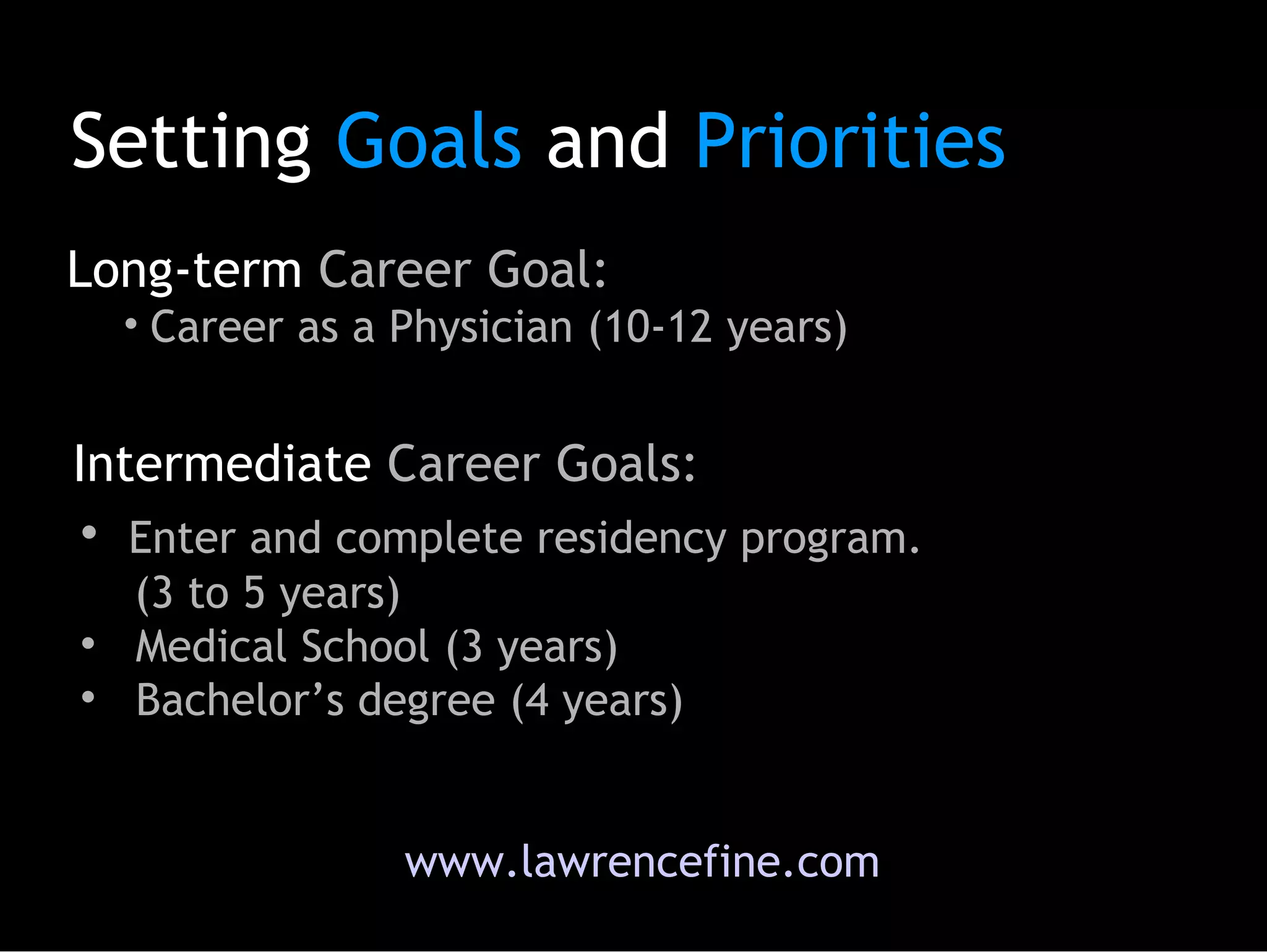
Setting  Goals  and  Priorities Long-term  Career Goal:  Career as a Physician (10-12 years)‏ Enter and complete residency program.    (3 to 5 years)  Medical School (3 years)‏ Bachelor’s degree (4 years)  Intermediate  Career Goals:  www.lawrencefine.com
Major in Biology  Courses in biology, chemistry and   anatomy and physiology At least a 3.5 average for medical   school Volunteer work at local hospital Short-Term  Personal Goals: (Present):  www.lawrencefine.com Setting  Goals  and  Priorities
www.lawrencefine.com Setting  Goals  and  Priorities Volunteer or paid work as a research   assistant  Study skills course to improve grades   and study habits Find a part time job this summer to   begin saving for medical school
Priority   can be handled in a number of ways; such as either numerically or alphabetically. For example:  1 –  Highest   Priority 2 – Moderate Priority 3 –   Lowest   Priority   www.lawrencefine.com
Every schedule, regardless of style or design, must have  balance . Every student, no matter what their personal desires and goals may happen to be, need a balanced life-style in order to be efficient, successful and  happy .  www.lawrencefine.com
Keep your  balance Physical Intellectual Social Career Emotional Spiritual exercise, nutrition, sleep cultural, aesthetic intimate and social relationships school and career directed work expression of feelings, desires quest for meaning www.lawrencefine.com
Procrastination, Distractions, and Other  Problems A big problem with the  success  of many time management and scheduling plans occurs when distractions intervene and students allow themselves to procrastinate to the point that not only are their short term goals  compromised , but their intermediate and long term goals as well. www.lawrencefine.com
Overcoming  distractions Ask for help and  cooperation  from   those around you Allow time to be  spontaneous Be  realistic  in your planning,   approach and do not set yourself   up to fail www.lawrencefine.com
www.lawrencefine.com Overcoming  distractions Make sure you  jot down  your   schedules and priorities on paper Review  your long-term and    intermediate goals often. Keep a list   where you will see it often
Continually try to  eliminate   unnecessary tasks Take advantage of your  natural   cycles , schedule the most difficult   activities when you are at your best  www.lawrencefine.com Overcoming  distractions
www.lawrencefine.com Overcoming  distractions Learn to say " No " to people,   including spouses, friends, children,   and parents  Reward  yourself for effective time    management
It is critical to take advantage of your own  natural  time management. You may have heard of the term  biological   rhythms . This term refers to the times of day when your energy levels are at their  highest  and when you can accomplish your most  important  work. www.lawrencefine.com
myth “ I need to be able to do everything everyone expects of me ” www.lawrencefine.com
www.lawrencefine.com fact You simply can’t be  everything  to everyone. The needs and demands of others may not be timed right in order for you to meet them or they simply be  impossible  for you to meet at this time. While important to others, they may not be a priority to you. By attempting to meet all the needs and demands of other people, you will create a situation in which you  fall short  of meeting the goals that are important to you.
myth “ Events outside my power control  my life. ” www.lawrencefine.com
www.lawrencefine.com fact You always have at least some  control  over certain events in your life. Furthermore, you and only you have the  responsibility  for exerting that control. Make a point to learn what you can control and  what you can’t . Look ahead to the future to  anticipate  demands on your time that you can’t control. This will help you to determine what you can do within a  reasonable  amount of time; regardless of external events.
Developing  priorities  is critical to any  successful  time management technique. Without priorities it can be  difficult  to get anything accomplished or focus on the most  critical  tasks.  www.lawrencefine.com
What is the purpose of the job?  What are the measures of success? What is exceptional performance?  How do you achieve it? www.lawrencefine.com
www.lawrencefine.com What are the priorities and deadlines?  What resources are available? What costs are acceptable? How does this relate to other people?  What is the broader picture?
Always allow room for  flexibility . Some things are just  inevitably  going to occur that you have no control over and while you cannot plan for those exact circumstances you can leave enough room in your schedule to  adjust  your plans for  unexpected  events.  www.lawrencefine.com
“ One more day won't make any difference; I'll just put that off until tomorrow. ” “ It won't matter if I'm a few minutes late; no one else will be on time. ” “ I work best under pressure. ” “ I can't start on this paper until I know just how I want the first paragraph to read. ” “ I'll watch just 15 more minutes of TV. ” www.lawrencefine.com
Avoiding procrastination is as  simple  as developing good decision making skills and techniques. Decision making can appear to be a  complex  issue and skill on the surface, but in reality it is nothing more than  choosing  one course of action from several  possibilities . www.lawrencefine.com
Delegation  isn’t just for corporate executives. Everyone needs to learn how to  effectively  delegate. Successful managers and leaders make it an  art form .  www.lawrencefine.com
Ask yourself: Can someone else could do the job at least as well as  80%  as you would? www.lawrencefine.com
“ Right now; what is the most important way I can  utilize  my time? ” www.lawrencefine.com
You can’t put an  end  to all problems, but good time management will enable you to respond  appropriately  and be  flexible  enough to ensure that even problems won’t completely  derail  your goals.  www.lawrencefine.com
Using  waiting time Always  confirm  your appointment the day before. Don’t arrive more than  5  minutes early.  Always have something with you to  work  on during unavoidable delays.  As much as we try to avoid it and as much as we plan, life is going to involve a certain amount of  waiting . www.lawrencefine.com
Never  give into the  pressure  to be placed on hold. Instead, ask for a time when you can  call back  or leave your name and telephone number for them to return your call. www.lawrencefine.com
Many people fail to realize how much  inefficiently  handling their time can actually  cost  them. They assume that if they are not actively employed in an outside job, their time is their own. They fail to calculate the real cost of  wasting  time.  www.lawrencefine.com
The same can also be true when you’re pressed to the wall for a  deadline . If you find that you frequently encounter a pressing deadline with no idea where the  allotted  time for the project went, it’s a good idea to begin keeping track of how you  use  your time.   Time  flies  when you’re having  fun www.lawrencefine.com
How many hours do you sleep? How many hours per day do you spend on activities? How many hours per day do you spend on meals? How many hours per day do you spend on errands?  How many hours per day do you spend in class?  www.lawrencefine.com
Plan ahead. Avoid last minute  cramming www.lawrencefine.com

Effective Time Management Strategies

  • 1.
    Time Management www.lawrencefine.comLawrence Fine Conducted by
  • 2.
    No one hasenough time , but everyone has all there is. www.lawrencefine.com “
  • 3.
    Despite the manyissues surrounding poor time management, many students fail to take the time to implement a time management and scheduling program into their own lives They fail to see the advantages of such a program www.lawrencefine.com
  • 4.
    While it does require time to set up and continually maintain a time management program, the most important advantage of doing so is that you will immediately gain time . www.lawrencefine.com
  • 5.
    Do you makea to-do list? Are you flexible with your plans? How often do you accomplish what you plan? Do you plan for things that are personally important to you? www.lawrencefine.com Managing your time Ask yourself:
  • 6.
    Do you makeplans in order to keep things in your life under control ? How often are your plans hindered by interruptions ? www.lawrencefine.com Managing your time Ask yourself:
  • 7.
    Basics of time management Step one: S et specific and definable goals for yourself. These goals should be both academic and personal. Step two: Create a calendar that is reflective of your school terms. Begin by drafting a term calendar; making sure you have reflected any major events like projects, term papers, etc. www.lawrencefine.com
  • 8.
    Basics of time management Step three: Drill the schedule down some by creating a weekly schedule that reflect all activities that you are responsible for on a weekly basis; including classes, meetings, labs, club activities, meetings, etc. Step four: Create a to-do list for each day. This list should ideally be created the night before so that there is no doubt about how the following day should take shape . www.lawrencefine.com
  • 9.
    One of themost common mistakes of scheduling is ironically trying to plan too far ahead . This can be a serious temptation. Whenever possible, it is always best to plan for only what already exists and then to add to your schedule only as events and activities pop up and become known. www.lawrencefine.com
  • 10.
    A schedule willonly work if you utilize it. Simply committing a list of activities to paper will not suddenly create a situation in which you can manage your time better. Keep your schedule in a prominent location where you can see it daily and refer to several times throughout the day. www.lawrencefine.com
  • 11.
    Avoiding time management traps Get into the habit of thinking of your time as a precious commodity . Even mundane, routine tasks can be easier to handle when you find at least one thing enjoyable about it. www.lawrencefine.com
  • 12.
    www.lawrencefine.com Don’t forgetto plan ahead . Reward yourself for important tasks accomplished. Don’t make exceptions and don’t skip around. Avoiding time management traps
  • 13.
    Avoiding time management traps If you find yourself avoiding a task or activity, face it head on and get it over with. Whenever possible, set deadlines . If you need help or advice, ask for it . Work on having an optimistic attitude . www.lawrencefine.com
  • 14.
    www.lawrencefine.com Always beon the look out for ways to expand upon your successes. Don’t cry over spilled milk ! It’s important to you; it’s important to find the time to do it. Avoiding time management traps
  • 15.
    Avoiding time management traps Always be on the lookout for ways to free up your time. Make a habit of periodically reviewing your habits. Always carry a small notepad or calendar with you. www.lawrencefine.com
  • 16.
    Avoiding time management traps www.lawrencefine.com Take the time to review your lifetime goals. Make a note of your progress and congratulate yourself . At the end of each day, review the tasks you needed to accomplish and evaluate your progress .
  • 17.
    Setting Goals and Priorities Long-term Career Goal: Career as a Physician (10-12 years)‏ Enter and complete residency program. (3 to 5 years) Medical School (3 years)‏ Bachelor’s degree (4 years) Intermediate Career Goals: www.lawrencefine.com
  • 18.
    Major in Biology Courses in biology, chemistry and anatomy and physiology At least a 3.5 average for medical school Volunteer work at local hospital Short-Term Personal Goals: (Present): www.lawrencefine.com Setting Goals and Priorities
  • 19.
    www.lawrencefine.com Setting Goals and Priorities Volunteer or paid work as a research assistant Study skills course to improve grades and study habits Find a part time job this summer to begin saving for medical school
  • 20.
    Priority can be handled in a number of ways; such as either numerically or alphabetically. For example: 1 – Highest Priority 2 – Moderate Priority 3 – Lowest Priority www.lawrencefine.com
  • 21.
    Every schedule, regardlessof style or design, must have balance . Every student, no matter what their personal desires and goals may happen to be, need a balanced life-style in order to be efficient, successful and happy . www.lawrencefine.com
  • 22.
    Keep your balance Physical Intellectual Social Career Emotional Spiritual exercise, nutrition, sleep cultural, aesthetic intimate and social relationships school and career directed work expression of feelings, desires quest for meaning www.lawrencefine.com
  • 23.
    Procrastination, Distractions, andOther Problems A big problem with the success of many time management and scheduling plans occurs when distractions intervene and students allow themselves to procrastinate to the point that not only are their short term goals compromised , but their intermediate and long term goals as well. www.lawrencefine.com
  • 24.
    Overcoming distractionsAsk for help and cooperation from those around you Allow time to be spontaneous Be realistic in your planning, approach and do not set yourself up to fail www.lawrencefine.com
  • 25.
    www.lawrencefine.com Overcoming distractions Make sure you jot down your schedules and priorities on paper Review your long-term and intermediate goals often. Keep a list where you will see it often
  • 26.
    Continually try to eliminate unnecessary tasks Take advantage of your natural cycles , schedule the most difficult activities when you are at your best www.lawrencefine.com Overcoming distractions
  • 27.
    www.lawrencefine.com Overcoming distractions Learn to say " No " to people, including spouses, friends, children, and parents Reward yourself for effective time management
  • 28.
    It is criticalto take advantage of your own natural time management. You may have heard of the term biological rhythms . This term refers to the times of day when your energy levels are at their highest and when you can accomplish your most important work. www.lawrencefine.com
  • 29.
    myth “ Ineed to be able to do everything everyone expects of me ” www.lawrencefine.com
  • 30.
    www.lawrencefine.com fact Yousimply can’t be everything to everyone. The needs and demands of others may not be timed right in order for you to meet them or they simply be impossible for you to meet at this time. While important to others, they may not be a priority to you. By attempting to meet all the needs and demands of other people, you will create a situation in which you fall short of meeting the goals that are important to you.
  • 31.
    myth “ Eventsoutside my power control my life. ” www.lawrencefine.com
  • 32.
    www.lawrencefine.com fact Youalways have at least some control over certain events in your life. Furthermore, you and only you have the responsibility for exerting that control. Make a point to learn what you can control and what you can’t . Look ahead to the future to anticipate demands on your time that you can’t control. This will help you to determine what you can do within a reasonable amount of time; regardless of external events.
  • 33.
    Developing priorities is critical to any successful time management technique. Without priorities it can be difficult to get anything accomplished or focus on the most critical tasks. www.lawrencefine.com

  • 34.
    What is thepurpose of the job? What are the measures of success? What is exceptional performance? How do you achieve it? www.lawrencefine.com
  • 35.
    www.lawrencefine.com What arethe priorities and deadlines? What resources are available? What costs are acceptable? How does this relate to other people? What is the broader picture?
  • 36.
    Always allow roomfor flexibility . Some things are just inevitably going to occur that you have no control over and while you cannot plan for those exact circumstances you can leave enough room in your schedule to adjust your plans for unexpected events. www.lawrencefine.com
  • 37.
    “ One moreday won't make any difference; I'll just put that off until tomorrow. ” “ It won't matter if I'm a few minutes late; no one else will be on time. ” “ I work best under pressure. ” “ I can't start on this paper until I know just how I want the first paragraph to read. ” “ I'll watch just 15 more minutes of TV. ” www.lawrencefine.com
  • 38.
    Avoiding procrastination isas simple as developing good decision making skills and techniques. Decision making can appear to be a complex issue and skill on the surface, but in reality it is nothing more than choosing one course of action from several possibilities . www.lawrencefine.com
  • 39.
    Delegation isn’tjust for corporate executives. Everyone needs to learn how to effectively delegate. Successful managers and leaders make it an art form . www.lawrencefine.com
  • 40.
    Ask yourself: Cansomeone else could do the job at least as well as 80% as you would? www.lawrencefine.com
  • 41.
    “ Right now;what is the most important way I can utilize my time? ” www.lawrencefine.com
  • 42.
    You can’t putan end to all problems, but good time management will enable you to respond appropriately and be flexible enough to ensure that even problems won’t completely derail your goals. www.lawrencefine.com
  • 43.
    Using waitingtime Always confirm your appointment the day before. Don’t arrive more than 5 minutes early. Always have something with you to work on during unavoidable delays. As much as we try to avoid it and as much as we plan, life is going to involve a certain amount of waiting . www.lawrencefine.com
  • 44.
    Never giveinto the pressure to be placed on hold. Instead, ask for a time when you can call back or leave your name and telephone number for them to return your call. www.lawrencefine.com
  • 45.
    Many people failto realize how much inefficiently handling their time can actually cost them. They assume that if they are not actively employed in an outside job, their time is their own. They fail to calculate the real cost of wasting time. www.lawrencefine.com
  • 46.
    The same canalso be true when you’re pressed to the wall for a deadline . If you find that you frequently encounter a pressing deadline with no idea where the allotted time for the project went, it’s a good idea to begin keeping track of how you use your time. Time flies when you’re having fun www.lawrencefine.com
  • 47.
    How many hoursdo you sleep? How many hours per day do you spend on activities? How many hours per day do you spend on meals? How many hours per day do you spend on errands? How many hours per day do you spend in class? www.lawrencefine.com
  • 48.
    Plan ahead. Avoidlast minute cramming www.lawrencefine.com