1
Parul Institute Of Engineering and Technology
Effective Presentation Strategies
Prepared By
Ms. Dipali Pandya
2Topic: Presentation Skills
Let’s know the Topic
• Presentation Skills
• Purpose
• Audience
• 10 Tips for effective presentation
• Content
• Visual Aids
• Kinesics
• Proxemics
• Paralinguistic
• Chronemics
• Conclusion
3Topic: Presentation Skills
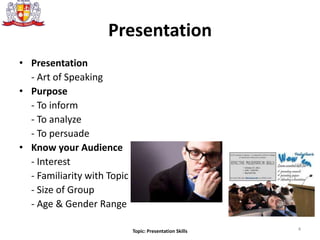
Presentation
• Presentation
- Art of Speaking
• Purpose
- To inform
- To analyze
- To persuade
• Know your Audience
- Interest
- Familiarity with Topic
- Size of Group
- Age & Gender Range
4Topic: Presentation Skills
10 ways for Effective Presentation
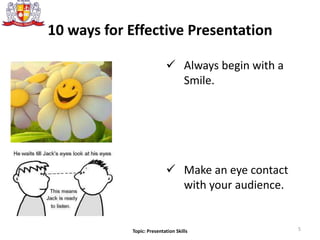
 Always begin with a
Smile.
 Make an eye contact
with your audience.
5Topic: Presentation Skills
10 ways for Effective Presentation
 Begin with anecdotes or video clip.
 Be Clear about the Topic.
 Emphasize Key points.
 Use Visual Aids.
 Speak with confidence.
 Make your points clear and easy.
 Dress for Success
 Encourage questions from
audience.
6Topic: Presentation Skills
 Be Confident.
 Have Positive Approach
7Topic: Presentation Skills
Content
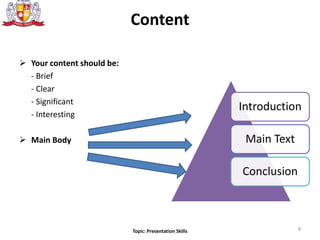
 Your content should be:
- Brief
- Clear
- Significant
- Interesting
 Main Body
Introduction
Main Text
Conclusion
8Topic: Presentation Skills
 Introduction:
• Question
– How important is this topic?
– When will it be useful?
• A sincere greeting
– Warm welcome to my enthusiastic friends
• Starting statement
– I am here to brief you about …
• Quotation
– First impression is …
• Anecdote / Experience
– Story / incident
9
Organizing content
Topic: Presentation Skills
Organizing content
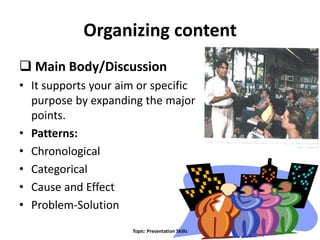
 Main Body/Discussion
• It supports your aim or specific
purpose by expanding the major
points.
• Patterns:
• Chronological
• Categorical
• Cause and Effect
• Problem-Solution
10Topic: Presentation Skills
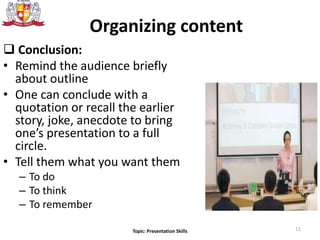
 Conclusion:
• Remind the audience briefly
about outline
• One can conclude with a
quotation or recall the earlier
story, joke, anecdote to bring
one’s presentation to a full
circle.
• Tell them what you want them
– To do
– To think
– To remember
11
Organizing content
Topic: Presentation Skills
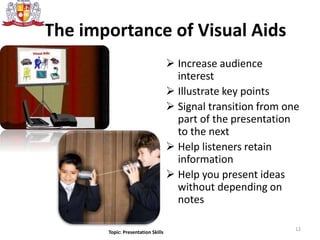
The importance of Visual Aids
 Increase audience
interest
 Illustrate key points
 Signal transition from one
part of the presentation
to the next
 Help listeners retain
information
 Help you present ideas
without depending on
notes
12
Topic: Presentation Skills
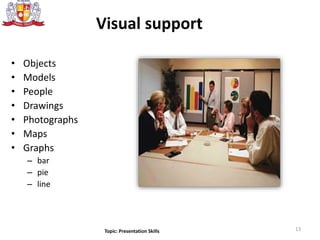
Visual support
• Objects
• Models
• People
• Drawings
• Photographs
• Maps
• Graphs
– bar
– pie
– line
13Topic: Presentation Skills
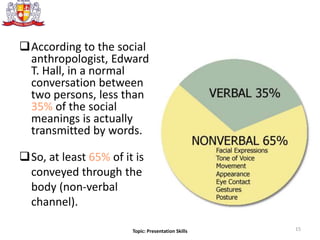
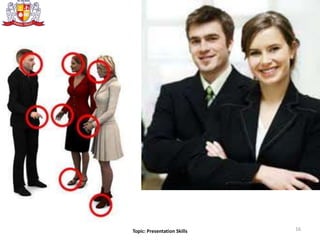
Kinesics
• Kinesics is known as the study of physical movement of body.
It is the way body communicates without words, i.e., through
various parts of the body.
• Body language is a form of mental and physical ability of
human non-verbal communication, which consists of body
posture, gestures, facial expressions, and eye movements.
 ‘Nobility and dignity; self-abasement and servility, insolence
and vulgarity, are reflected in the face and in the attitudes of
the body whether still or in motion.’
- Socrates
14Topic: Presentation Skills
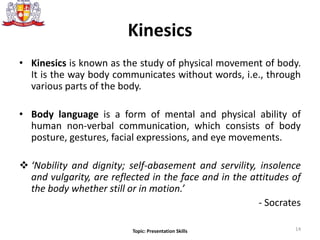
According to the social
anthropologist, Edward
T. Hall, in a normal
conversation between
two persons, less than
35% of the social
meanings is actually
transmitted by words.
So, at least 65% of it is
conveyed through the
body (non-verbal
channel).
15Topic: Presentation Skills
16Topic: Presentation Skills
Posture
17Topic: Presentation Skills
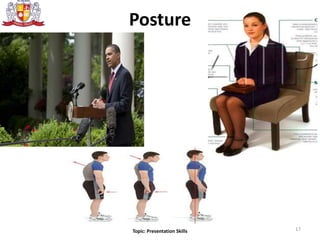
Posture
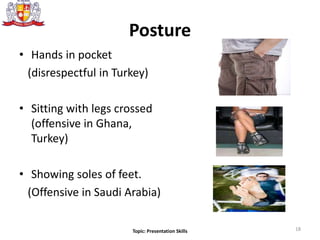
• Hands in pocket
(disrespectful in Turkey)
• Sitting with legs crossed
(offensive in Ghana,
Turkey)
• Showing soles of feet.
(Offensive in Saudi Arabia)
18Topic: Presentation Skills
Gesture
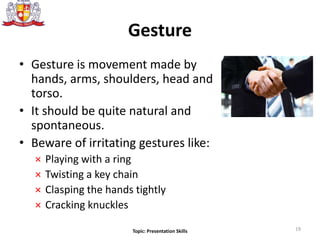
• Gesture is movement made by
hands, arms, shoulders, head and
torso.
• It should be quite natural and
spontaneous.
• Beware of irritating gestures like:
× Playing with a ring
× Twisting a key chain
× Clasping the hands tightly
× Cracking knuckles
19Topic: Presentation Skills
Facial Expressions
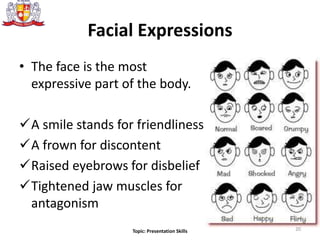
• The face is the most
expressive part of the body.
A smile stands for friendliness
A frown for discontent
Raised eyebrows for disbelief
Tightened jaw muscles for
antagonism
20Topic: Presentation Skills
Five Basic Expressions
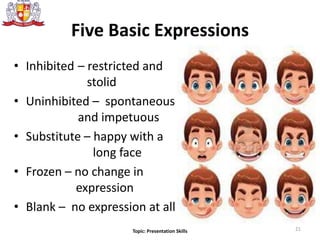
• Inhibited – restricted and
stolid
• Uninhibited – spontaneous
and impetuous
• Substitute – happy with a
long face
• Frozen – no change in
expression
• Blank – no expression at all
21Topic: Presentation Skills
Proxemics
• Proxemics is the study of physical space in
interpersonal relations. In a professional setting,
space is used to signal power and status.
• Four distinct zones of space
• Intimate
• Personal
• Social
• Public
22Topic: Presentation Skills
Paralinguistics and Chronemics
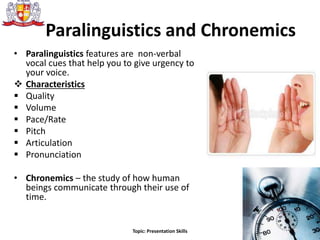
• Paralinguistics features are non-verbal
vocal cues that help you to give urgency to
your voice.
 Characteristics
 Quality
 Volume
 Pace/Rate
 Pitch
 Articulation
 Pronunciation
• Chronemics – the study of how human
beings communicate through their use of
time.
23Topic: Presentation Skills
Things You
Shouldn’t Do
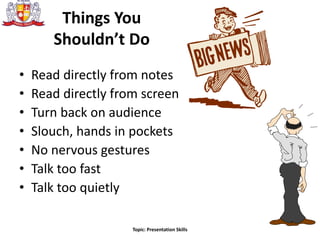
• Read directly from notes
• Read directly from screen
• Turn back on audience
• Slouch, hands in pockets
• No nervous gestures
• Talk too fast
• Talk too quietly
Topic: Presentation Skills
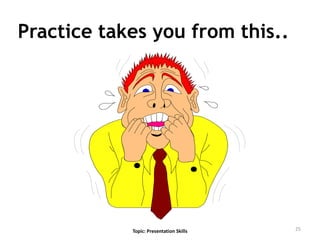
Practice takes you from this..
25Topic: Presentation Skills
To this….
26Topic: Presentation Skills
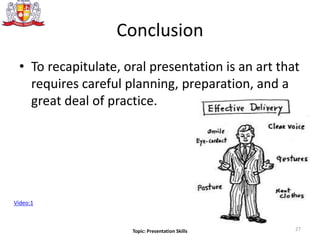
Conclusion
• To recapitulate, oral presentation is an art that
requires careful planning, preparation, and a
great deal of practice.
Video:1
27Topic: Presentation Skills
References
• Raman Minakshi & Sharma Sangeeta, ‘Technical
Communication: Principles and Practice’, 2008. New Delhi :
Oxford University Press.
• http://www.youtube.com/watch?v=wXILI9Q1jIw
• http://www.youtube.com/watch?v=BBthvuOQpKc
28Topic: Presentation Skills
29Topic: Presentation Skills

Effective Presentation skills

  • 1.
  • 2.
    Parul Institute OfEngineering and Technology Effective Presentation Strategies Prepared By Ms. Dipali Pandya 2Topic: Presentation Skills
  • 3.
    Let’s know theTopic • Presentation Skills • Purpose • Audience • 10 Tips for effective presentation • Content • Visual Aids • Kinesics • Proxemics • Paralinguistic • Chronemics • Conclusion 3Topic: Presentation Skills
  • 4.
    Presentation • Presentation - Artof Speaking • Purpose - To inform - To analyze - To persuade • Know your Audience - Interest - Familiarity with Topic - Size of Group - Age & Gender Range 4Topic: Presentation Skills
  • 5.
    10 ways forEffective Presentation  Always begin with a Smile.  Make an eye contact with your audience. 5Topic: Presentation Skills
  • 6.
    10 ways forEffective Presentation  Begin with anecdotes or video clip.  Be Clear about the Topic.  Emphasize Key points.  Use Visual Aids.  Speak with confidence.  Make your points clear and easy.  Dress for Success  Encourage questions from audience. 6Topic: Presentation Skills
  • 7.
     Be Confident. Have Positive Approach 7Topic: Presentation Skills
  • 8.
    Content  Your contentshould be: - Brief - Clear - Significant - Interesting  Main Body Introduction Main Text Conclusion 8Topic: Presentation Skills
  • 9.
     Introduction: • Question –How important is this topic? – When will it be useful? • A sincere greeting – Warm welcome to my enthusiastic friends • Starting statement – I am here to brief you about … • Quotation – First impression is … • Anecdote / Experience – Story / incident 9 Organizing content Topic: Presentation Skills
  • 10.
    Organizing content  MainBody/Discussion • It supports your aim or specific purpose by expanding the major points. • Patterns: • Chronological • Categorical • Cause and Effect • Problem-Solution 10Topic: Presentation Skills
  • 11.
     Conclusion: • Remindthe audience briefly about outline • One can conclude with a quotation or recall the earlier story, joke, anecdote to bring one’s presentation to a full circle. • Tell them what you want them – To do – To think – To remember 11 Organizing content Topic: Presentation Skills
  • 12.
    The importance ofVisual Aids  Increase audience interest  Illustrate key points  Signal transition from one part of the presentation to the next  Help listeners retain information  Help you present ideas without depending on notes 12 Topic: Presentation Skills
  • 13.
    Visual support • Objects •Models • People • Drawings • Photographs • Maps • Graphs – bar – pie – line 13Topic: Presentation Skills
  • 14.
    Kinesics • Kinesics isknown as the study of physical movement of body. It is the way body communicates without words, i.e., through various parts of the body. • Body language is a form of mental and physical ability of human non-verbal communication, which consists of body posture, gestures, facial expressions, and eye movements.  ‘Nobility and dignity; self-abasement and servility, insolence and vulgarity, are reflected in the face and in the attitudes of the body whether still or in motion.’ - Socrates 14Topic: Presentation Skills
  • 15.
    According to thesocial anthropologist, Edward T. Hall, in a normal conversation between two persons, less than 35% of the social meanings is actually transmitted by words. So, at least 65% of it is conveyed through the body (non-verbal channel). 15Topic: Presentation Skills
  • 16.
  • 17.
  • 18.
    Posture • Hands inpocket (disrespectful in Turkey) • Sitting with legs crossed (offensive in Ghana, Turkey) • Showing soles of feet. (Offensive in Saudi Arabia) 18Topic: Presentation Skills
  • 19.
    Gesture • Gesture ismovement made by hands, arms, shoulders, head and torso. • It should be quite natural and spontaneous. • Beware of irritating gestures like: × Playing with a ring × Twisting a key chain × Clasping the hands tightly × Cracking knuckles 19Topic: Presentation Skills
  • 20.
    Facial Expressions • Theface is the most expressive part of the body. A smile stands for friendliness A frown for discontent Raised eyebrows for disbelief Tightened jaw muscles for antagonism 20Topic: Presentation Skills
  • 21.
    Five Basic Expressions •Inhibited – restricted and stolid • Uninhibited – spontaneous and impetuous • Substitute – happy with a long face • Frozen – no change in expression • Blank – no expression at all 21Topic: Presentation Skills
  • 22.
    Proxemics • Proxemics isthe study of physical space in interpersonal relations. In a professional setting, space is used to signal power and status. • Four distinct zones of space • Intimate • Personal • Social • Public 22Topic: Presentation Skills
  • 23.
    Paralinguistics and Chronemics •Paralinguistics features are non-verbal vocal cues that help you to give urgency to your voice.  Characteristics  Quality  Volume  Pace/Rate  Pitch  Articulation  Pronunciation • Chronemics – the study of how human beings communicate through their use of time. 23Topic: Presentation Skills
  • 24.
    Things You Shouldn’t Do •Read directly from notes • Read directly from screen • Turn back on audience • Slouch, hands in pockets • No nervous gestures • Talk too fast • Talk too quietly Topic: Presentation Skills
  • 25.
    Practice takes youfrom this.. 25Topic: Presentation Skills
  • 26.
  • 27.
    Conclusion • To recapitulate,oral presentation is an art that requires careful planning, preparation, and a great deal of practice. Video:1 27Topic: Presentation Skills
  • 28.
    References • Raman Minakshi& Sharma Sangeeta, ‘Technical Communication: Principles and Practice’, 2008. New Delhi : Oxford University Press. • http://www.youtube.com/watch?v=wXILI9Q1jIw • http://www.youtube.com/watch?v=BBthvuOQpKc 28Topic: Presentation Skills
  • 29.