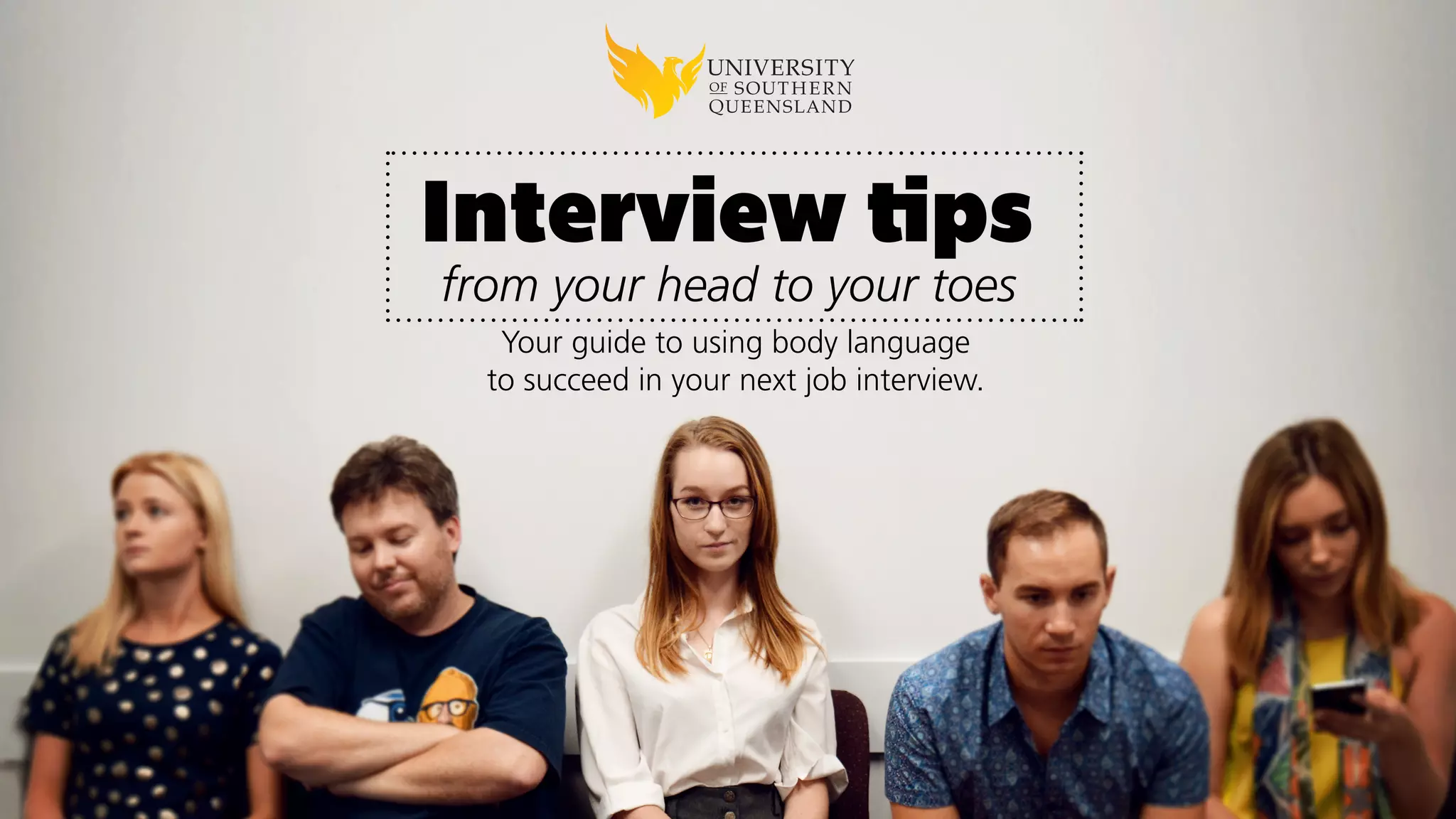






Your guide to using body language
to succeed in your next job interview.
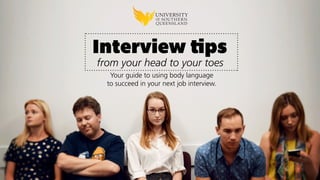
from your head to your toes
Interview tips
Many job applicants spend hours writing their résumé,
rehearsing their interview responses and polishing their
appearance, but very few spend time refining their most
important communicative tool, their body language!
Don’t let a slack handshake or poorly timed smile undo all your
hard work. Learn how to master your body language from top to
toe with these 7 great tips!
Your handshake is a great way to
make a solid first impression.
1.
Impress them with
your handshake
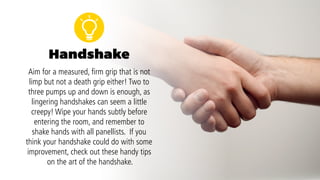
Handshake
Wipe your hands subtly before entering the room,
and remember to shake hands with all panellists.
Aim for a measured, firm grip that is not limp but
not a death grip either!
Two to 3 pumps up and down is enough, as
lingering handshakes can seem a little creepy! If
you think your handshake could do with some
improvement, check out these handy tips on the
art of the handshake.
2.
Be conscious of your
eye contact
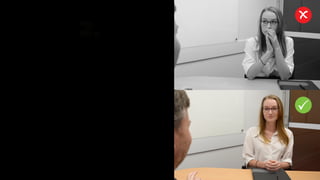
We all know that looking someone
in the eye is a great way to engage
in the conversation, but how much
eye contact is too much?
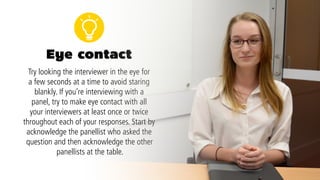
Eye contact
Try looking the interviewer in the eye for a few
seconds at a time to avoid staring blankly. If
you’re interviewing with a panel, try to make
eye contact with all your interviewers at
least once or twice throughout each of your
responses. Start by acknowledging the panellist
who asked the question and then acknowledge
the other panellists at the table.
From head to toe,
effective body language can help you
send the right message in an interview.
Smiling is a great way to show
friendliness and build rapport, but be
careful not to sit through the whole
interview grinning from ear to ear.
This can actually be a little off-putting
for the interviewer!
3.
Think about the
timing of your smile
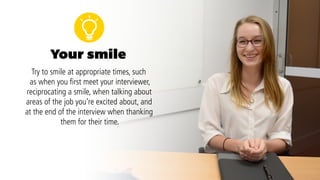
Your smile
Try to smile at appropriate times, such as when
you first meet your interviewer, reciprocating a
smile, when talking about areas of the job you’re
excited about, and at the end of the interview
when thanking them for their time.
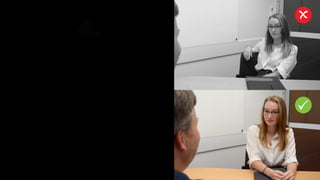
Getting the balance right between
looking stiff and uptight or slack and
slouchy can be tricky.
4.
What message is your
posture sending?
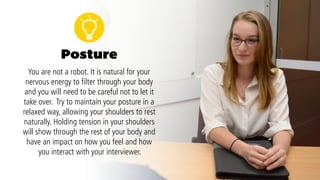
Posture
You are not a robot. It is natural for your nervous
energy to filter through your body and you will
need to be careful not to let it take over.Try to
maintain your posture in a relaxed way, allowing
your shoulders to rest naturally. Holding tension in
your shoulders will show through the rest of your
body and have an impact on how you feel and how
you interact with your interviewer.An open posture
will send a positive message to your interviewers.
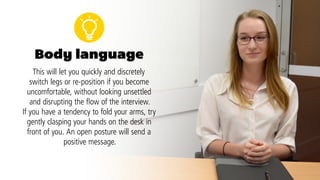
Posture
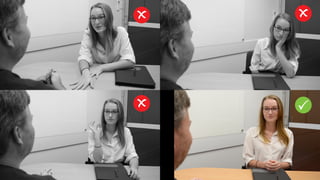
Try not to cross your legs or fold your arms, as
this can make you appear closed off or defensive.
If this is something you tend to do out of habit,
try crossing your legs at the ankle instead of the
knees.This will let you quickly and discretely
switch legs or re-position if you become
uncomfortable, without looking unsettled and
disrupting the flow of the interview. If you have
a tendency to fold your arms, try gently clasping
your hands on the desk in front of you.
From head to toe,
effective body language can help you
send the right message in an interview.
Using hand gestures is a great way
to reinforce key points you want
to make and to show that you feel
comfortable and confident in what
you’re saying.
5.
Back yourself with
hand gestures
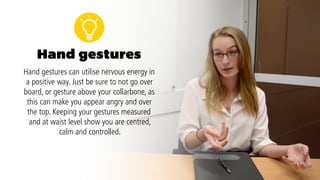
Hand gestures
Hand gestures can utilise nervous energy in a
positive way. Just be sure not to go overboard, or
gesture above your collarbone, as this can make
you appear angry and over the top. Keeping your
gestures measured and at waist level shows you
are centred, calm and controlled.
We all have our habits when it comes to
fidgeting, whether it’s clicking a pen, playing
with your hair or jewellery or even tapping on
the desk.While in an everyday setting these
small gestures might not seem important, in a
job interview they can quickly become distracting
and give the impression that you’re nervous,
disinterested or under-prepared.
6.
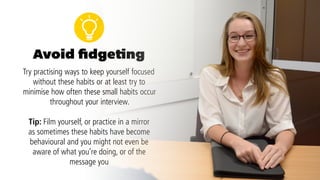
Avoid fidgeting
Avoid fidgeting
Try practising ways to keep yourself focused
without these habits or at least try to minimise
how often these small habits occur throughout
your interview.
Tip: Film yourself or practice in a mirror, as
sometimes these habits have become behavioural
and you might not even be aware of what you’re
doing, or of the message you may be projecting.
From head to toe,
effective body language can help you
send the right message in an interview.
Sometimes you might not get the
chance to meet your interviewer in
person, but body language is still
important during phone interviews.
7.
Phone interview? How
you look is still important
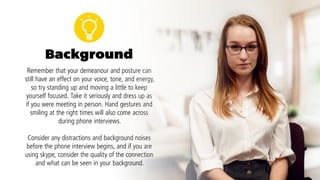
Background
Your demeanour and posture can still have an effect on your voice, tone
and energy, so try standing up and moving around a little to keep yourself
focused. Take your interview seriously and dress up as if you were meeting
in person. Using hand gestures and smiling at the right times will also
come across during phone interviews, so it’s still important to use them.
Consider any distractions and background noises before the phone
interview begins and if you are using Skype, consider the quality of the
connection and what can be seen in your background. If possible, using
Skype is a good alternative to phone interviews because it gives you the
opportunity to read the interviewer’s body language and to demonstrate
your eagerness with good posture and a smile.
From head to toe,
effective body language can help you
send the right message in an interview.
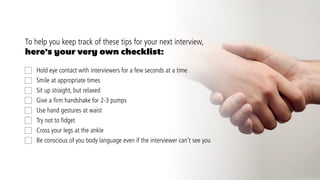
To help you keep track of these tips for your next interview,
here’s your very own checklist:
	 Hold eye contact with interviewers for a few seconds at a time
	 Smile at appropriate times
	 Sit up straight, but relaxed
	 Give a firm handshake for 2–3 pumps
	 Use hand gestures at waist level
	 Try not to fidget
	 Cross your legs at the ankle
	 Be conscious of your body language even if the interviewer can’t see you
Be yourself
While these tips are a great place to start, the key to
effective non-verbal communication is understanding
your body language habits and then refining them so
that you can be yourself in a job interview without
undermining your skills or professionalism.
CRICOS: QLD00244B  NSW02225M  TEQSA: PRV12081  29.2.2  11.2016  Graphics © Shutterstock  Photos © USQ Online Marketing
social.usq.edu.au
By being mindful of your movements, both big and small, you’ll be able to use body
language effectively to send the right message and succeed in your next job interview. Now
that you’ve got the job interview body language down pat, check out these tips on how to
dress to impress.
For more on how to succeed during your next interview, contact the
Career Development team at Student Services.
Online
usq.edu.au or visit the CareerHub
On-campus
Toowoomba 	 +61 7 4631 2372		 stsv@usq.edu.au	
Springfield 			 +61 7 3470 4400		 studentservicesspringfield@usq.edu.au
Ipswich 			 +61 7 3470 4400		 studentservicesspringfield@usq.edu.au

Interview tips: from your head to your toes

  • 1.
    Your guide tousing body language to succeed in your next job interview. from your head to your toes Interview tips
  • 2.
    Many job applicantsspend hours writing their résumé, rehearsing their interview responses and polishing their appearance, but very few spend time refining their most important communicative tool, their body language! Don’t let a slack handshake or poorly timed smile undo all your hard work. Learn how to master your body language from top to toe with these 7 great tips!
  • 3.
    Your handshake isa great way to make a solid first impression. 1. Impress them with your handshake
  • 4.
    Handshake Wipe your handssubtly before entering the room, and remember to shake hands with all panellists. Aim for a measured, firm grip that is not limp but not a death grip either! Two to 3 pumps up and down is enough, as lingering handshakes can seem a little creepy! If you think your handshake could do with some improvement, check out these handy tips on the art of the handshake.
  • 5.
    2. Be conscious ofyour eye contact We all know that looking someone in the eye is a great way to engage in the conversation, but how much eye contact is too much?
  • 6.
    Eye contact Try lookingthe interviewer in the eye for a few seconds at a time to avoid staring blankly. If you’re interviewing with a panel, try to make eye contact with all your interviewers at least once or twice throughout each of your responses. Start by acknowledging the panellist who asked the question and then acknowledge the other panellists at the table.
  • 7.
    From head totoe, effective body language can help you send the right message in an interview.
  • 8.
    Smiling is agreat way to show friendliness and build rapport, but be careful not to sit through the whole interview grinning from ear to ear. This can actually be a little off-putting for the interviewer! 3. Think about the timing of your smile
  • 9.
    Your smile Try tosmile at appropriate times, such as when you first meet your interviewer, reciprocating a smile, when talking about areas of the job you’re excited about, and at the end of the interview when thanking them for their time.
  • 10.
    Getting the balanceright between looking stiff and uptight or slack and slouchy can be tricky. 4. What message is your posture sending?
  • 11.
    Posture You are nota robot. It is natural for your nervous energy to filter through your body and you will need to be careful not to let it take over.Try to maintain your posture in a relaxed way, allowing your shoulders to rest naturally. Holding tension in your shoulders will show through the rest of your body and have an impact on how you feel and how you interact with your interviewer.An open posture will send a positive message to your interviewers.
  • 12.
    Posture Try not tocross your legs or fold your arms, as this can make you appear closed off or defensive. If this is something you tend to do out of habit, try crossing your legs at the ankle instead of the knees.This will let you quickly and discretely switch legs or re-position if you become uncomfortable, without looking unsettled and disrupting the flow of the interview. If you have a tendency to fold your arms, try gently clasping your hands on the desk in front of you.
  • 13.
    From head totoe, effective body language can help you send the right message in an interview.
  • 14.
    Using hand gesturesis a great way to reinforce key points you want to make and to show that you feel comfortable and confident in what you’re saying. 5. Back yourself with hand gestures
  • 15.
    Hand gestures Hand gesturescan utilise nervous energy in a positive way. Just be sure not to go overboard, or gesture above your collarbone, as this can make you appear angry and over the top. Keeping your gestures measured and at waist level shows you are centred, calm and controlled.
  • 16.
    We all haveour habits when it comes to fidgeting, whether it’s clicking a pen, playing with your hair or jewellery or even tapping on the desk.While in an everyday setting these small gestures might not seem important, in a job interview they can quickly become distracting and give the impression that you’re nervous, disinterested or under-prepared. 6. Avoid fidgeting
  • 17.
    Avoid fidgeting Try practisingways to keep yourself focused without these habits or at least try to minimise how often these small habits occur throughout your interview. Tip: Film yourself or practice in a mirror, as sometimes these habits have become behavioural and you might not even be aware of what you’re doing, or of the message you may be projecting.
  • 18.
    From head totoe, effective body language can help you send the right message in an interview.
  • 19.
    Sometimes you mightnot get the chance to meet your interviewer in person, but body language is still important during phone interviews. 7. Phone interview? How you look is still important
  • 20.
    Background Your demeanour andposture can still have an effect on your voice, tone and energy, so try standing up and moving around a little to keep yourself focused. Take your interview seriously and dress up as if you were meeting in person. Using hand gestures and smiling at the right times will also come across during phone interviews, so it’s still important to use them. Consider any distractions and background noises before the phone interview begins and if you are using Skype, consider the quality of the connection and what can be seen in your background. If possible, using Skype is a good alternative to phone interviews because it gives you the opportunity to read the interviewer’s body language and to demonstrate your eagerness with good posture and a smile.
  • 21.
    From head totoe, effective body language can help you send the right message in an interview.
  • 22.
    To help youkeep track of these tips for your next interview, here’s your very own checklist: Hold eye contact with interviewers for a few seconds at a time Smile at appropriate times Sit up straight, but relaxed Give a firm handshake for 2–3 pumps Use hand gestures at waist level Try not to fidget Cross your legs at the ankle Be conscious of your body language even if the interviewer can’t see you
  • 23.
    Be yourself While thesetips are a great place to start, the key to effective non-verbal communication is understanding your body language habits and then refining them so that you can be yourself in a job interview without undermining your skills or professionalism.
  • 24.
    CRICOS: QLD00244B  NSW02225M TEQSA: PRV12081  29.2.2  11.2016  Graphics © Shutterstock  Photos © USQ Online Marketing social.usq.edu.au By being mindful of your movements, both big and small, you’ll be able to use body language effectively to send the right message and succeed in your next job interview. Now that you’ve got the job interview body language down pat, check out these tips on how to dress to impress. For more on how to succeed during your next interview, contact the Career Development team at Student Services. Online usq.edu.au or visit the CareerHub On-campus Toowoomba +61 7 4631 2372 stsv@usq.edu.au Springfield +61 7 3470 4400 studentservicesspringfield@usq.edu.au Ipswich +61 7 3470 4400 studentservicesspringfield@usq.edu.au