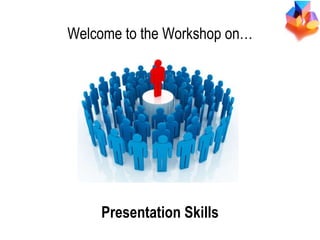
Presentation Skills Welcome to the Workshop on… Presentation Skills
Introductions Let’s get to know each other !
Your Expectations Tell me your expectations  from this workshop
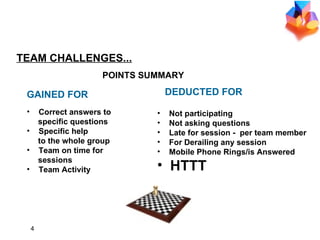
TEAM CHALLENGES... POINTS SUMMARY GAINED FOR DEDUCTED FOR Correct answers to  specific questions Specific help  to the whole group Team on time for sessions Team Activity Not participating Not asking questions Late for session -  per team member For Derailing any session Mobile Phone Rings/is Answered HTTT
OBJECTIVES Understand the art of giving presentations. Be aware of your own individual strengths and weaknesses in presenting and of how you can use your own style to best advantage. Understand the importance of the presentation techniques, which can be used to increase its effectiveness. Be able to identify the effects of ‘nerves’ on your ability to present. Be aware of the issues involved in working with an audience. Be able to select and use visual aids appropriately.
Key Issues What are the key Issues if asked to give a presentation? * Nervousness *  I don’t know my  Existing Strengths *  Cant  Free up Body Language * What  am I supposed  and Not  supposed  To Do *  Cant  Develop an Individual Presentation Style * How to Stimulate Easy Interaction with an Audience * Ways of Getting Ideas Across * How to be Entertaining and Stimulating * How to Create Effective Support Materials
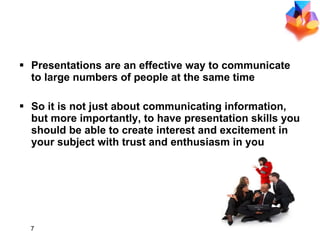
Why Presentation? Presentations are an effective way to communicate to large numbers of people at the same time So  it is not just about communicating information, but   more importantly, to have   presentation skills you should be able to create interest and excitement in your subject  with  trust and enthusiasm in you
Many presentations fail because people try too hard  to achieve perfection in the content of the presentation As opposed to spending time, rehearsing the delivery of the message
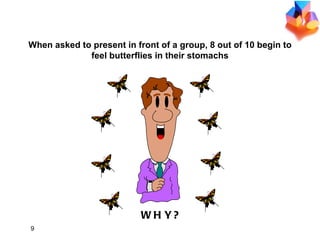
When asked to present in front of a group, 8 out of 10 begin to feel butterflies in their stomachs WHY?
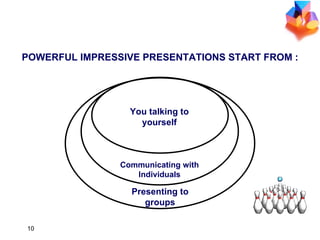
You talking to yourself Communicating with Individuals Presenting to groups POWERFUL IMPRESSIVE PRESENTATIONS START FROM :
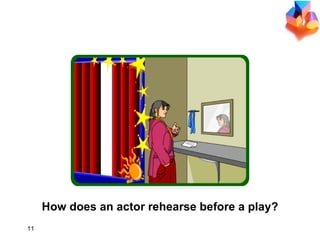
How does an actor rehearse before a play?
REHEARSE Rehearse in the actual room if possible Use the actual visuals Go through the actual movements and gestures Visualize the audiences’ reaction Act out your response(s)
TOP SIX INTRODUCTIONS TO AVOID The apology The cliché The con-man (or woman) The nerd The space-case The pest
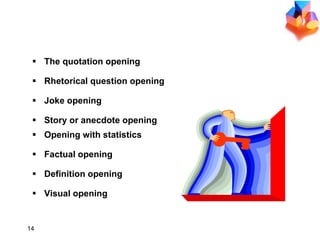
WAYS TO BEGIN The quotation opening Rhetorical question opening Joke opening Story or anecdote opening Opening with statistics Factual opening Definition opening Visual opening
BODY LANGUAGE
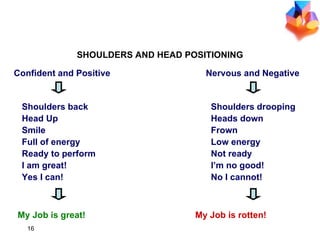
SHOULDERS AND HEAD POSITIONING Shoulders back Head Up Smile Full of energy Ready to perform I am great! Yes I can! My Job is great! Shoulders drooping Heads down Frown Low energy Not ready I’m no good! No I cannot! Confident and Positive My Job is rotten! Nervous and Negative
SOME COMMON GESTURES The scratcher The over groomed person The handcuff syndrome The adjuster The pocket finder
The pen-clicker The personal hygiene expert The stimulator The throat clearing syndrome The fig-leaf position SOME COMMON GESTURES
So how do I compose myself?
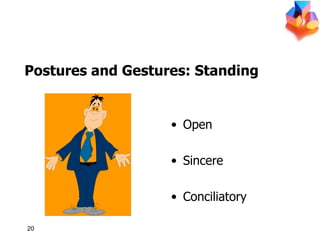
Open Sincere Conciliatory Postures and Gestures: Standing
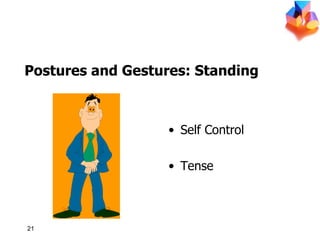
Self Control Tense Postures and Gestures: Standing
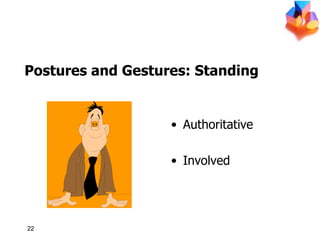
Authoritative Involved Postures and Gestures: Standing
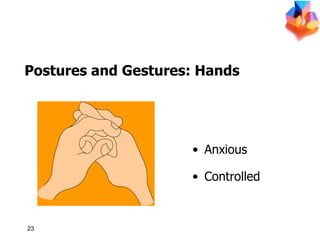
Postures and Gestures: Hands Anxious Controlled
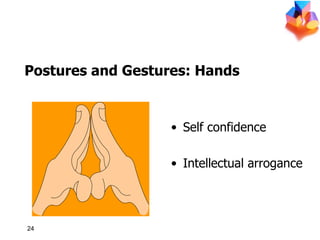
Self confidence Intellectual arrogance Postures and Gestures: Hands
WHERE TO PUT YOUR HANDS Let your hands and arms drop naturally to your side. Gently fold your index fingers together without wringing or gripping the hands in any way. Start your presentation and let your hands do what they want to do – as long as they do not want to go into your pockets or make obscene gestures to your audience!
HOW YOU STAND IS EVERYTHING Tilt your head slightly upward Stick your chin out Drain the air from your cheeks.Exhale Smile softly Let your eyes shine,sparkling and clear Move your eyes slowly,but surely and look at each participant as you go around the room
Stand with your shoulders back Stand erect Hold your hands open,relaxed.Do not stick them in your pockets Have your knees relaxed and not locked Your spine should be straight- Do not slouch! Stand with your feet slightly apart –  both  men and women! Breathe slowly,deeply  and evenly HOW YOU STAND IS EVERYTHING
Hands in pockets Increased blinking of eyes Failure to make eye contact Looking at the floor Shaking legs Licking and biting of the lips Clenching teeth Finger tapping Jittery hands Fist clenching Faster jerkier gestures SIGNS OF NERVOUSNESS
Sweaty hands and armpits Cracking voice Increased rate of speech Clearing of the throat Pulling at skin Frequent smoothing of hair Standing on sides of feet rather than flat on the floor Toes wiggling Dry mouth Buttocks clamped tightly together SIGNS OF NERVOUSNESS
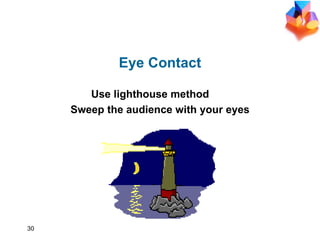
Eye Contact Use lighthouse method Sweep the audience with your eyes
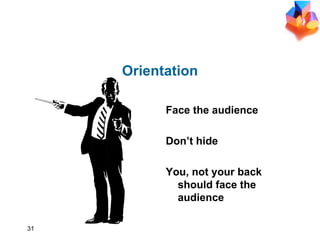
Orientation Face the audience Don’t hide You, not your back should face the audience
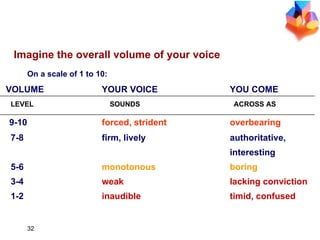
VOLUME YOUR VOICE YOU COME LEVEL   SOUNDS   ACROSS AS 9-10 forced, strident overbearing 7-8 firm, lively authoritative, interesting 5-6 monotonous boring 3-4 weak lacking conviction 1-2 inaudible timid, confused Imagine the overall volume of your voice  On a scale of 1 to 10:
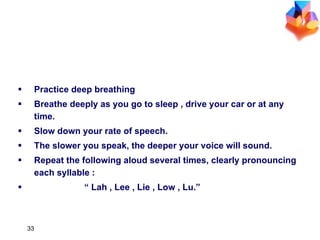
Practice deep breathing Breathe deeply as you go to sleep , drive your car or at any time. Slow down your rate of speech. The slower you speak, the deeper your voice will sound. Repeat the following aloud several times, clearly pronouncing each syllable :  “  Lah , Lee , Lie , Low , Lu.” IMPROVE YOUR VOCAL CHORDS
What is a STAR Presentation? The A B C D E of a STAR Presentation?
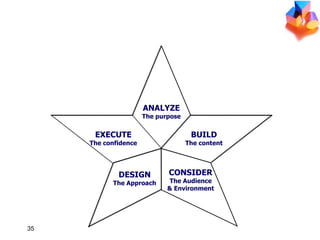
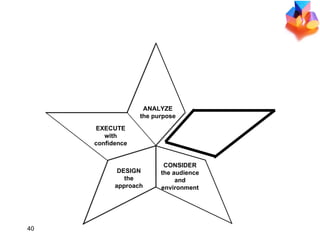
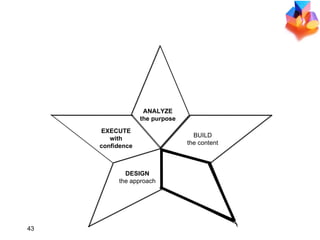
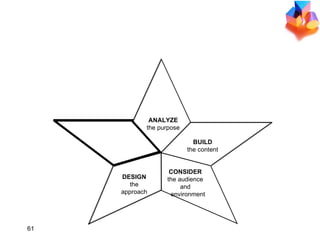
MAKING A STAR PRESENTATION ANALYZE The purpose BUILD The content EXECUTE The confidence CONSIDER The Audience & Environment DESIGN The Approach
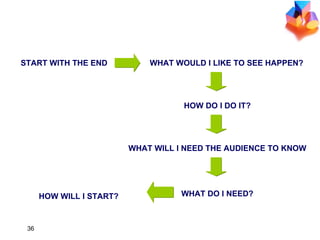
START WITH THE END WHAT WOULD I LIKE TO SEE HAPPEN? HOW DO I DO IT? WHAT WILL I NEED THE AUDIENCE TO KNOW WHAT DO I NEED? HOW WILL I START? PREPARING THE PROCESS
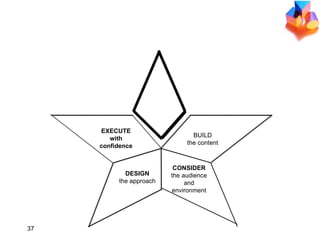
ANALYZE THE PURPOSE DESIGN the approach CONSIDER the audience and environment BUILD the content EXECUTE with confidence
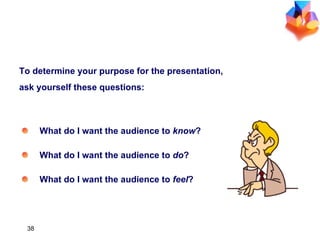
ANALYZE THE PURPOSE What do I want the audience to  know ? What do I want the audience to  do ? What do I want the audience to  feel ? To determine your purpose for the presentation,  ask yourself these questions:
THE 3 Ws WHY am I going to give this presentation? WHAT is the objective? WHO are the participants? Level? Background? Keep asking these questions until it becomes obvious WHAT your essential message must be.
BUILD THE CONTENT CONSIDER the audience and environment DESIGN the approach ANALYZE the purpose EXECUTE with confidence
HOW TO BUILD THE CONTENT Brainstorm of ideas - accumulate them on paper, index cards or post -its. Use headings,key words or phrases to label each page. Create your own “STRAWBOOK ”. Decide the sequence or flow.
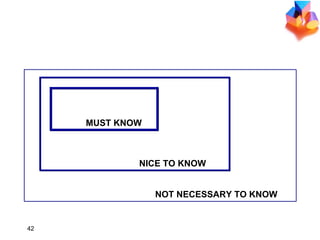
IN / OUT BOX NOT NECESSARY TO KNOW NICE TO KNOW MUST KNOW
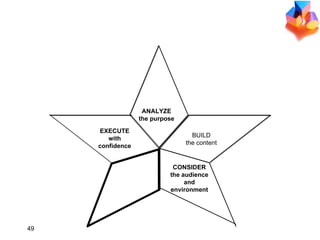
CONSIDER THE AUDIENCE  AND ENVIRONMENT DESIGN the approach BUILD the content EXECUTE with confidence ANALYZE the purpose
CONSIDER THE AUDIENCE The speaker is clearly the central figure in any presentation and conveys to the audience: Knowledge Experience Reliability Friendliness Cooperation Confidence Energy Helpfulness
CONSIDER THE AUDIENCE We give presentations to and for an audience, not for ourselves. The speakers adapt presentations to their audiences whose reactions are influenced by their: Knowledge Experiences Expectations Concerns Positions Involvement Interests
Time of the day Day of the week Occasion Physical setting Facilities CONSIDER THE ENVIRONMENT
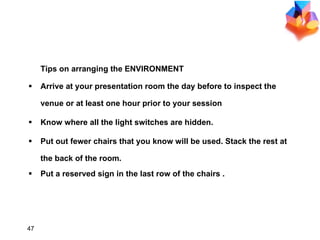
Arrive at your presentation room the day before to inspect the venue or at least one hour prior to your session  Know where all the light switches are hidden.  Put out fewer chairs that you know will be used. Stack the rest at the back of the room. Put a reserved sign in the last row of the chairs . Tips on arranging the ENVIRONMENT
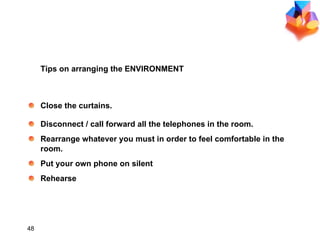
Close the curtains. Disconnect / call forward all the telephones in the room. Rearrange whatever you must in order to feel comfortable in the room. Put your own phone on silent Rehearse  Tips on arranging the ENVIRONMENT
DESIGN THE APPROACH BUILD the content EXECUTE with confidence ANALYZE the purpose CONSIDER the audience and environment
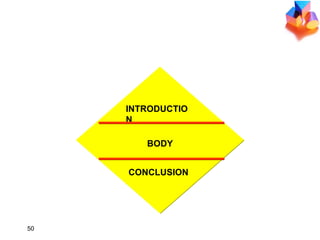
DESIGN THE APPROACH BODY INTRODUCTION CONCLUSION
ORGANIZING YOUR PRESENTATION THE STRUCTURE TELL THEM WHAT YOU ARE GOING TO TELL THEM TELL THEM!! TELL THEM THAT YOU HAVE TOLD THEM
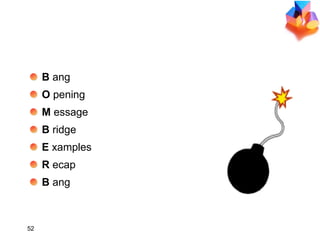
STRUCTURE OF YOUR PRESENTATION B  ang O  pening M  essage B  ridge E  xamples R  ecap B  ang
DEVELOP MAIN BODY In designing the structure and outline of  the body, some of the approaches could be : Chronological Topical Categorical Problem - Solution Compare - Contrast
DEVELOP MAIN BODY In designing the structure and outline of  the body, some of the approaches could be : Ideal – Reality Feature & Benefit Old – New Advantages – Disadvantages Goal – Roadmap Objectives - Answers
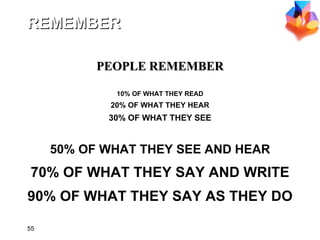
10% OF WHAT THEY READ 20% OF WHAT THEY HEAR 30% OF WHAT THEY SEE PEOPLE REMEMBER 50% OF WHAT THEY SEE AND HEAR 70% OF WHAT THEY SAY AND WRITE 90% OF WHAT THEY SAY AS THEY DO REMEMBER
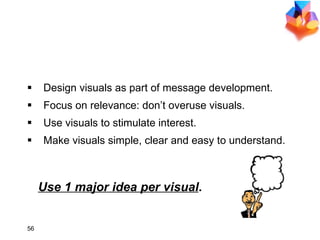
GUIDELINES FOR VISUALS Design visuals as part of message development. Focus on relevance: don’t overuse visuals. Use visuals to stimulate interest. Make visuals simple, clear and easy to understand. Use 1 major idea per visual .
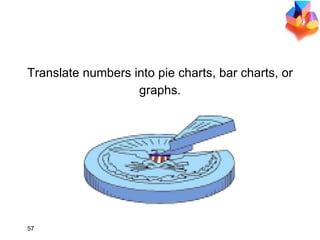
Translate numbers into pie charts, bar charts, or graphs. GUIDELINES FOR VISUALS
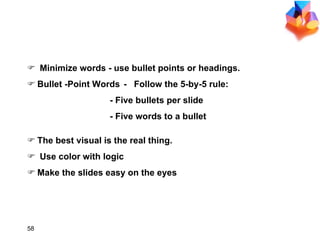
GUIDELINES FOR VISUALS Minimize words - use bullet points or headings. Bullet -Point Words  -    Follow the 5-by-5 rule: - Five bullets per slide -  Five words to a bullet The best visual is the real thing. Use color with logic Make the slides easy on the eyes
VISUALS IN YOUR PRESENTATION Communicate ideas faster than the spoken word Arouse and hold interest of the audience Can explain complicated ideas more easily Reinforce and enhance your spoken word Add variety to otherwise serious or dull presentation They take the pressure off the presenter by diverting the audience’s  attention Cut across language barriers Help to clarify different viewpoints / opinions in a controversial subject area Makes the presentation look more professional
CONSTRUCT A CONCLUSION Summary Positive vs. Negative Worst case scenario vs. Best that could happen Cost - Benefit Analysis Now vs. Future Motivational Quote / Video
EXECUTE WITH CONFIDENCE DESIGN the approach CONSIDER the audience and environment ANALYZE the purpose BUILD the content
The 6  P ’s of Presentation P erfect  P rior  P reparation  P revents P oor  P erformance
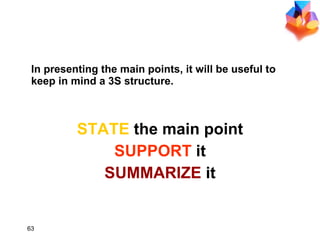
3 S OF PRESENTING In presenting the main points, it will be useful to keep in mind a 3S structure. STATE  the main point SUPPORT  it SUMMARIZE  it
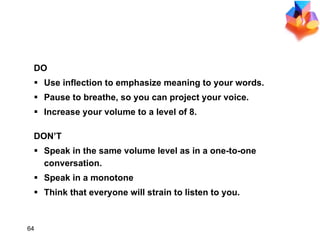
REMEMBER DO Use inflection to emphasize meaning to your words. Pause to breathe, so you can project your voice. Increase your volume to a level of 8. DON’T Speak in the same volume level as in a one-to-one conversation. Speak in a monotone Think that everyone will strain to listen to you.
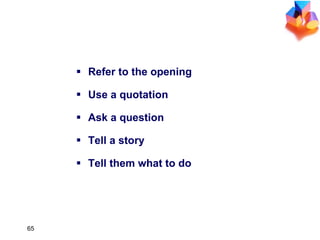
WRAPPING IT UP IN STYLE Refer to the opening Use a quotation Ask a question Tell a story  Tell them what to do
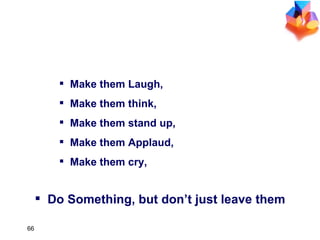
Make them Laugh, Make them think, Make them stand up, Make them Applaud, Make them cry, Do Something, but don’t just leave them END OF THE DAY….
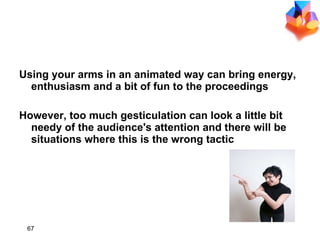
Using your arms in an animated way can bring energy, enthusiasm and a bit of fun to the proceedings However, too much gesticulation can look a little bit needy of the audience's attention and there will be situations where this is the wrong tactic
THANK YOU

Presentation skills

  • 1.
    Presentation Skills Welcometo the Workshop on… Presentation Skills
  • 2.
    Introductions Let’s getto know each other !
  • 3.
    Your Expectations Tellme your expectations from this workshop
  • 4.
    TEAM CHALLENGES... POINTSSUMMARY GAINED FOR DEDUCTED FOR Correct answers to specific questions Specific help to the whole group Team on time for sessions Team Activity Not participating Not asking questions Late for session - per team member For Derailing any session Mobile Phone Rings/is Answered HTTT
  • 5.
    OBJECTIVES Understand theart of giving presentations. Be aware of your own individual strengths and weaknesses in presenting and of how you can use your own style to best advantage. Understand the importance of the presentation techniques, which can be used to increase its effectiveness. Be able to identify the effects of ‘nerves’ on your ability to present. Be aware of the issues involved in working with an audience. Be able to select and use visual aids appropriately.
  • 6.
    Key Issues Whatare the key Issues if asked to give a presentation? * Nervousness * I don’t know my Existing Strengths * Cant Free up Body Language * What am I supposed and Not supposed To Do * Cant Develop an Individual Presentation Style * How to Stimulate Easy Interaction with an Audience * Ways of Getting Ideas Across * How to be Entertaining and Stimulating * How to Create Effective Support Materials
  • 7.
    Why Presentation? Presentationsare an effective way to communicate to large numbers of people at the same time So it is not just about communicating information, but more importantly, to have presentation skills you should be able to create interest and excitement in your subject with trust and enthusiasm in you
  • 8.
    Many presentations failbecause people try too hard to achieve perfection in the content of the presentation As opposed to spending time, rehearsing the delivery of the message
  • 9.
    When asked topresent in front of a group, 8 out of 10 begin to feel butterflies in their stomachs WHY?
  • 10.
    You talking toyourself Communicating with Individuals Presenting to groups POWERFUL IMPRESSIVE PRESENTATIONS START FROM :
  • 11.
    How does anactor rehearse before a play?
  • 12.
    REHEARSE Rehearse inthe actual room if possible Use the actual visuals Go through the actual movements and gestures Visualize the audiences’ reaction Act out your response(s)
  • 13.
    TOP SIX INTRODUCTIONSTO AVOID The apology The cliché The con-man (or woman) The nerd The space-case The pest
  • 14.
    WAYS TO BEGINThe quotation opening Rhetorical question opening Joke opening Story or anecdote opening Opening with statistics Factual opening Definition opening Visual opening
  • 15.
  • 16.
    SHOULDERS AND HEADPOSITIONING Shoulders back Head Up Smile Full of energy Ready to perform I am great! Yes I can! My Job is great! Shoulders drooping Heads down Frown Low energy Not ready I’m no good! No I cannot! Confident and Positive My Job is rotten! Nervous and Negative
  • 17.
    SOME COMMON GESTURESThe scratcher The over groomed person The handcuff syndrome The adjuster The pocket finder
  • 18.
    The pen-clicker Thepersonal hygiene expert The stimulator The throat clearing syndrome The fig-leaf position SOME COMMON GESTURES
  • 19.
    So how doI compose myself?
  • 20.
    Open Sincere ConciliatoryPostures and Gestures: Standing
  • 21.
    Self Control TensePostures and Gestures: Standing
  • 22.
    Authoritative Involved Posturesand Gestures: Standing
  • 23.
    Postures and Gestures:Hands Anxious Controlled
  • 24.
    Self confidence Intellectualarrogance Postures and Gestures: Hands
  • 25.
    WHERE TO PUTYOUR HANDS Let your hands and arms drop naturally to your side. Gently fold your index fingers together without wringing or gripping the hands in any way. Start your presentation and let your hands do what they want to do – as long as they do not want to go into your pockets or make obscene gestures to your audience!
  • 26.
    HOW YOU STANDIS EVERYTHING Tilt your head slightly upward Stick your chin out Drain the air from your cheeks.Exhale Smile softly Let your eyes shine,sparkling and clear Move your eyes slowly,but surely and look at each participant as you go around the room
  • 27.
    Stand with yourshoulders back Stand erect Hold your hands open,relaxed.Do not stick them in your pockets Have your knees relaxed and not locked Your spine should be straight- Do not slouch! Stand with your feet slightly apart – both men and women! Breathe slowly,deeply and evenly HOW YOU STAND IS EVERYTHING
  • 28.
    Hands in pocketsIncreased blinking of eyes Failure to make eye contact Looking at the floor Shaking legs Licking and biting of the lips Clenching teeth Finger tapping Jittery hands Fist clenching Faster jerkier gestures SIGNS OF NERVOUSNESS
  • 29.
    Sweaty hands andarmpits Cracking voice Increased rate of speech Clearing of the throat Pulling at skin Frequent smoothing of hair Standing on sides of feet rather than flat on the floor Toes wiggling Dry mouth Buttocks clamped tightly together SIGNS OF NERVOUSNESS
  • 30.
    Eye Contact Uselighthouse method Sweep the audience with your eyes
  • 31.
    Orientation Face theaudience Don’t hide You, not your back should face the audience
  • 32.
    VOLUME YOUR VOICEYOU COME LEVEL SOUNDS ACROSS AS 9-10 forced, strident overbearing 7-8 firm, lively authoritative, interesting 5-6 monotonous boring 3-4 weak lacking conviction 1-2 inaudible timid, confused Imagine the overall volume of your voice On a scale of 1 to 10:
  • 33.
    Practice deep breathingBreathe deeply as you go to sleep , drive your car or at any time. Slow down your rate of speech. The slower you speak, the deeper your voice will sound. Repeat the following aloud several times, clearly pronouncing each syllable : “ Lah , Lee , Lie , Low , Lu.” IMPROVE YOUR VOCAL CHORDS
  • 34.
    What is aSTAR Presentation? The A B C D E of a STAR Presentation?
  • 35.
    MAKING A STARPRESENTATION ANALYZE The purpose BUILD The content EXECUTE The confidence CONSIDER The Audience & Environment DESIGN The Approach
  • 36.
    START WITH THEEND WHAT WOULD I LIKE TO SEE HAPPEN? HOW DO I DO IT? WHAT WILL I NEED THE AUDIENCE TO KNOW WHAT DO I NEED? HOW WILL I START? PREPARING THE PROCESS
  • 37.
    ANALYZE THE PURPOSEDESIGN the approach CONSIDER the audience and environment BUILD the content EXECUTE with confidence
  • 38.
    ANALYZE THE PURPOSEWhat do I want the audience to know ? What do I want the audience to do ? What do I want the audience to feel ? To determine your purpose for the presentation, ask yourself these questions:
  • 39.
    THE 3 WsWHY am I going to give this presentation? WHAT is the objective? WHO are the participants? Level? Background? Keep asking these questions until it becomes obvious WHAT your essential message must be.
  • 40.
    BUILD THE CONTENTCONSIDER the audience and environment DESIGN the approach ANALYZE the purpose EXECUTE with confidence
  • 41.
    HOW TO BUILDTHE CONTENT Brainstorm of ideas - accumulate them on paper, index cards or post -its. Use headings,key words or phrases to label each page. Create your own “STRAWBOOK ”. Decide the sequence or flow.
  • 42.
    IN / OUTBOX NOT NECESSARY TO KNOW NICE TO KNOW MUST KNOW
  • 43.
    CONSIDER THE AUDIENCE AND ENVIRONMENT DESIGN the approach BUILD the content EXECUTE with confidence ANALYZE the purpose
  • 44.
    CONSIDER THE AUDIENCEThe speaker is clearly the central figure in any presentation and conveys to the audience: Knowledge Experience Reliability Friendliness Cooperation Confidence Energy Helpfulness
  • 45.
    CONSIDER THE AUDIENCEWe give presentations to and for an audience, not for ourselves. The speakers adapt presentations to their audiences whose reactions are influenced by their: Knowledge Experiences Expectations Concerns Positions Involvement Interests
  • 46.
    Time of theday Day of the week Occasion Physical setting Facilities CONSIDER THE ENVIRONMENT
  • 47.
    Arrive at yourpresentation room the day before to inspect the venue or at least one hour prior to your session Know where all the light switches are hidden. Put out fewer chairs that you know will be used. Stack the rest at the back of the room. Put a reserved sign in the last row of the chairs . Tips on arranging the ENVIRONMENT
  • 48.
    Close the curtains.Disconnect / call forward all the telephones in the room. Rearrange whatever you must in order to feel comfortable in the room. Put your own phone on silent Rehearse Tips on arranging the ENVIRONMENT
  • 49.
    DESIGN THE APPROACHBUILD the content EXECUTE with confidence ANALYZE the purpose CONSIDER the audience and environment
  • 50.
    DESIGN THE APPROACHBODY INTRODUCTION CONCLUSION
  • 51.
    ORGANIZING YOUR PRESENTATIONTHE STRUCTURE TELL THEM WHAT YOU ARE GOING TO TELL THEM TELL THEM!! TELL THEM THAT YOU HAVE TOLD THEM
  • 52.
    STRUCTURE OF YOURPRESENTATION B ang O pening M essage B ridge E xamples R ecap B ang
  • 53.
    DEVELOP MAIN BODYIn designing the structure and outline of the body, some of the approaches could be : Chronological Topical Categorical Problem - Solution Compare - Contrast
  • 54.
    DEVELOP MAIN BODYIn designing the structure and outline of the body, some of the approaches could be : Ideal – Reality Feature & Benefit Old – New Advantages – Disadvantages Goal – Roadmap Objectives - Answers
  • 55.
    10% OF WHATTHEY READ 20% OF WHAT THEY HEAR 30% OF WHAT THEY SEE PEOPLE REMEMBER 50% OF WHAT THEY SEE AND HEAR 70% OF WHAT THEY SAY AND WRITE 90% OF WHAT THEY SAY AS THEY DO REMEMBER
  • 56.
    GUIDELINES FOR VISUALSDesign visuals as part of message development. Focus on relevance: don’t overuse visuals. Use visuals to stimulate interest. Make visuals simple, clear and easy to understand. Use 1 major idea per visual .
  • 57.
    Translate numbers intopie charts, bar charts, or graphs. GUIDELINES FOR VISUALS
  • 58.
    GUIDELINES FOR VISUALSMinimize words - use bullet points or headings. Bullet -Point Words -   Follow the 5-by-5 rule: - Five bullets per slide - Five words to a bullet The best visual is the real thing. Use color with logic Make the slides easy on the eyes
  • 59.
    VISUALS IN YOURPRESENTATION Communicate ideas faster than the spoken word Arouse and hold interest of the audience Can explain complicated ideas more easily Reinforce and enhance your spoken word Add variety to otherwise serious or dull presentation They take the pressure off the presenter by diverting the audience’s attention Cut across language barriers Help to clarify different viewpoints / opinions in a controversial subject area Makes the presentation look more professional
  • 60.
    CONSTRUCT A CONCLUSIONSummary Positive vs. Negative Worst case scenario vs. Best that could happen Cost - Benefit Analysis Now vs. Future Motivational Quote / Video
  • 61.
    EXECUTE WITH CONFIDENCEDESIGN the approach CONSIDER the audience and environment ANALYZE the purpose BUILD the content
  • 62.
    The 6 P ’s of Presentation P erfect P rior P reparation P revents P oor P erformance
  • 63.
    3 S OFPRESENTING In presenting the main points, it will be useful to keep in mind a 3S structure. STATE the main point SUPPORT it SUMMARIZE it
  • 64.
    REMEMBER DO Useinflection to emphasize meaning to your words. Pause to breathe, so you can project your voice. Increase your volume to a level of 8. DON’T Speak in the same volume level as in a one-to-one conversation. Speak in a monotone Think that everyone will strain to listen to you.
  • 65.
    WRAPPING IT UPIN STYLE Refer to the opening Use a quotation Ask a question Tell a story Tell them what to do
  • 66.
    Make them Laugh,Make them think, Make them stand up, Make them Applaud, Make them cry, Do Something, but don’t just leave them END OF THE DAY….
  • 67.
    Using your armsin an animated way can bring energy, enthusiasm and a bit of fun to the proceedings However, too much gesticulation can look a little bit needy of the audience's attention and there will be situations where this is the wrong tactic
  • 68.

Editor's Notes

  • #2 Tell Welcome the participants to the workshop on group discussion skills.
  • #3 Show The Introduction Slide Tell Initiate the introduction round. You must first describe yourself before asking the participants to introduce themselves
  • #4 Show The Your Expectations Slide Tell Ask participants about their expectations from this programme. Explain the methodology that you will follow for this programme. This program will consists of activities, roles plays, and demonstrations, and practice for the purpose for providing a cohesive and structured learning so that you are well versed with all aspects of resume development. Do Note down the expectations on the flip chart or white board Cancel out the topics that is not being covered in this workshop
  • #5 Show The Advanced Organizer Slide Tell Describe the course map and the sessions that are going to be covered in this course. Provide an overview of the sessions in this course.
  • #6 Show The Advanced Organizer Slide Tell Describe the course map and the sessions that are going to be covered in this course. Provide an overview of the sessions in this course.
  • #7 Show The Advanced Organizer Slide Tell Describe the course map and the sessions that are going to be covered in this course. Provide an overview of the sessions in this course.
  • #8 Show The Advanced Organizer Slide Tell Describe the course map and the sessions that are going to be covered in this course. Provide an overview of the sessions in this course.
  • #9 Show The Advanced Organizer Slide Tell Describe the course map and the sessions that are going to be covered in this course. Provide an overview of the sessions in this course.
  • #10 Show The Advanced Organizer Slide Tell Describe the course map and the sessions that are going to be covered in this course. Provide an overview of the sessions in this course.
  • #11 Show The Advanced Organizer Slide Tell Describe the course map and the sessions that are going to be covered in this course. Provide an overview of the sessions in this course.
  • #12 Show The Advanced Organizer Slide Tell Describe the course map and the sessions that are going to be covered in this course. Provide an overview of the sessions in this course.
  • #13 Show The Advanced Organizer Slide Tell Describe the course map and the sessions that are going to be covered in this course. Provide an overview of the sessions in this course.
  • #14 Show The Advanced Organizer Slide Tell Describe the course map and the sessions that are going to be covered in this course. Provide an overview of the sessions in this course.
  • #15 Show The Advanced Organizer Slide Tell Describe the course map and the sessions that are going to be covered in this course. Provide an overview of the sessions in this course.
  • #16 Show The Programme Objectives Slide Tell At the end of this programme, you will be able to; Recognize the need for skills to succeed in group discussions (GD) Identify the various Group Discussion styles Recognize the importance of body language in a GD List the dos and don’ts in a GD
  • #17 Show The Advanced Organizer Slide Tell Describe the course map and the sessions that are going to be covered in this course. Provide an overview of the sessions in this course.
  • #18 Show The Advanced Organizer Slide Tell Describe the course map and the sessions that are going to be covered in this course. Provide an overview of the sessions in this course.
  • #19 Show The Advanced Organizer Slide Tell Describe the course map and the sessions that are going to be covered in this course. Provide an overview of the sessions in this course.
  • #20 Show The Advanced Organizer Slide Tell Describe the course map and the sessions that are going to be covered in this course. Provide an overview of the sessions in this course.
  • #21 Show The Programme Objectives Slide Tell At the end of this programme, you will be able to; Recognize the need for skills to succeed in group discussions (GD) Identify the various Group Discussion styles Recognize the importance of body language in a GD List the dos and don’ts in a GD
  • #22 Show The Programme Objectives Slide Tell At the end of this programme, you will be able to; Recognize the need for skills to succeed in group discussions (GD) Identify the various Group Discussion styles Recognize the importance of body language in a GD List the dos and don’ts in a GD
  • #23 Show The Programme Objectives Slide Tell At the end of this programme, you will be able to; Recognize the need for skills to succeed in group discussions (GD) Identify the various Group Discussion styles Recognize the importance of body language in a GD List the dos and don’ts in a GD
  • #24 Show The Programme Objectives Slide Tell At the end of this programme, you will be able to; Recognize the need for skills to succeed in group discussions (GD) Identify the various Group Discussion styles Recognize the importance of body language in a GD List the dos and don’ts in a GD
  • #25 Show The Programme Objectives Slide Tell At the end of this programme, you will be able to; Recognize the need for skills to succeed in group discussions (GD) Identify the various Group Discussion styles Recognize the importance of body language in a GD List the dos and don’ts in a GD
  • #26 Show The Advanced Organizer Slide Tell Describe the course map and the sessions that are going to be covered in this course. Provide an overview of the sessions in this course.
  • #27 Show The Advanced Organizer Slide Tell Describe the course map and the sessions that are going to be covered in this course. Provide an overview of the sessions in this course.
  • #28 Show The Advanced Organizer Slide Tell Describe the course map and the sessions that are going to be covered in this course. Provide an overview of the sessions in this course.
  • #29 Show The Advanced Organizer Slide Tell Describe the course map and the sessions that are going to be covered in this course. Provide an overview of the sessions in this course.
  • #30 Show The Advanced Organizer Slide Tell Describe the course map and the sessions that are going to be covered in this course. Provide an overview of the sessions in this course.
  • #31 Show The Programme Objectives Slide Tell At the end of this programme, you will be able to; Recognize the need for skills to succeed in group discussions (GD) Identify the various Group Discussion styles Recognize the importance of body language in a GD List the dos and don’ts in a GD
  • #32 Show The Programme Objectives Slide Tell At the end of this programme, you will be able to; Recognize the need for skills to succeed in group discussions (GD) Identify the various Group Discussion styles Recognize the importance of body language in a GD List the dos and don’ts in a GD
  • #33 Show The Advanced Organizer Slide Tell Describe the course map and the sessions that are going to be covered in this course. Provide an overview of the sessions in this course.
  • #34 Show The Advanced Organizer Slide Tell Describe the course map and the sessions that are going to be covered in this course. Provide an overview of the sessions in this course.
  • #35 Show The Advanced Organizer Slide Tell Describe the course map and the sessions that are going to be covered in this course. Provide an overview of the sessions in this course.
  • #36 Show The Advanced Organizer Slide Tell Describe the course map and the sessions that are going to be covered in this course. Provide an overview of the sessions in this course.
  • #37 Show The Advanced Organizer Slide Tell Describe the course map and the sessions that are going to be covered in this course. Provide an overview of the sessions in this course.
  • #38 Show The Advanced Organizer Slide Tell Describe the course map and the sessions that are going to be covered in this course. Provide an overview of the sessions in this course.
  • #39 Show The Advanced Organizer Slide Tell Describe the course map and the sessions that are going to be covered in this course. Provide an overview of the sessions in this course.
  • #40 Show The Advanced Organizer Slide Tell Describe the course map and the sessions that are going to be covered in this course. Provide an overview of the sessions in this course.
  • #41 Show The Advanced Organizer Slide Tell Describe the course map and the sessions that are going to be covered in this course. Provide an overview of the sessions in this course.
  • #42 Show The Advanced Organizer Slide Tell Describe the course map and the sessions that are going to be covered in this course. Provide an overview of the sessions in this course.
  • #43 Show The Advanced Organizer Slide Tell Describe the course map and the sessions that are going to be covered in this course. Provide an overview of the sessions in this course.
  • #44 Show The Advanced Organizer Slide Tell Describe the course map and the sessions that are going to be covered in this course. Provide an overview of the sessions in this course.
  • #45 Show The Advanced Organizer Slide Tell Describe the course map and the sessions that are going to be covered in this course. Provide an overview of the sessions in this course.
  • #46 Show The Advanced Organizer Slide Tell Describe the course map and the sessions that are going to be covered in this course. Provide an overview of the sessions in this course.
  • #47 Show The Advanced Organizer Slide Tell Describe the course map and the sessions that are going to be covered in this course. Provide an overview of the sessions in this course.
  • #48 Show The Advanced Organizer Slide Tell Describe the course map and the sessions that are going to be covered in this course. Provide an overview of the sessions in this course.
  • #49 Show The Advanced Organizer Slide Tell Describe the course map and the sessions that are going to be covered in this course. Provide an overview of the sessions in this course.
  • #50 Show The Advanced Organizer Slide Tell Describe the course map and the sessions that are going to be covered in this course. Provide an overview of the sessions in this course.
  • #51 Show The Advanced Organizer Slide Tell Describe the course map and the sessions that are going to be covered in this course. Provide an overview of the sessions in this course.
  • #52 Show The Advanced Organizer Slide Tell Describe the course map and the sessions that are going to be covered in this course. Provide an overview of the sessions in this course.
  • #53 Show The Advanced Organizer Slide Tell Describe the course map and the sessions that are going to be covered in this course. Provide an overview of the sessions in this course.
  • #54 Show The Advanced Organizer Slide Tell Describe the course map and the sessions that are going to be covered in this course. Provide an overview of the sessions in this course.
  • #55 Show The Advanced Organizer Slide Tell Describe the course map and the sessions that are going to be covered in this course. Provide an overview of the sessions in this course.
  • #56 Show The Advanced Organizer Slide Tell Describe the course map and the sessions that are going to be covered in this course. Provide an overview of the sessions in this course.
  • #57 Show The Advanced Organizer Slide Tell Describe the course map and the sessions that are going to be covered in this course. Provide an overview of the sessions in this course.
  • #58 Show The Advanced Organizer Slide Tell Describe the course map and the sessions that are going to be covered in this course. Provide an overview of the sessions in this course.
  • #59 Show The Advanced Organizer Slide Tell Describe the course map and the sessions that are going to be covered in this course. Provide an overview of the sessions in this course.
  • #60 Show The Advanced Organizer Slide Tell Describe the course map and the sessions that are going to be covered in this course. Provide an overview of the sessions in this course.
  • #61 Show The Advanced Organizer Slide Tell Describe the course map and the sessions that are going to be covered in this course. Provide an overview of the sessions in this course.
  • #62 Show The Advanced Organizer Slide Tell Describe the course map and the sessions that are going to be covered in this course. Provide an overview of the sessions in this course.
  • #63 Show The Advanced Organizer Slide Tell Describe the course map and the sessions that are going to be covered in this course. Provide an overview of the sessions in this course.
  • #64 Show The Advanced Organizer Slide Tell Describe the course map and the sessions that are going to be covered in this course. Provide an overview of the sessions in this course.
  • #65 Show The Advanced Organizer Slide Tell Describe the course map and the sessions that are going to be covered in this course. Provide an overview of the sessions in this course.
  • #66 Show The Advanced Organizer Slide Tell Describe the course map and the sessions that are going to be covered in this course. Provide an overview of the sessions in this course.
  • #67 Show The Advanced Organizer Slide Tell Describe the course map and the sessions that are going to be covered in this course. Provide an overview of the sessions in this course.
  • #69 Show The Advanced Organizer Slide Tell Describe the course map and the sessions that are going to be covered in this course. Provide an overview of the sessions in this course.