VO2max and its Determinants
Baneet Sharma
Contents
 Introduction
 Definition
 VO2max and performance
 Normal values
 Determinants
Introduction
 Fitness can be measured by the
volume of oxygen consumed while
exercising.
 Done at your maximum capacity.
DEFINITION
 "the highest rate of oxygen
consumption attainable during
maximal or exhaustive exercise"
Wilmore JH and Costill DL. (2005)
Physiology of Sport and Exercise: 5th
Edition. Champaign, IL: Human
Kinetics 1
What is VO2max ?
 VO2max is the maximum amount of
oxygen – in milliliters – one can
consume per kilogram of body weight.
 The point at which oxygen
consumption plateaus defines the
VO2max or an individual's maximal
aerobic capacity.
 It is the best indicator of cardio
respiratory endurance and aerobic
fitness.
Also known as
 Aerobic power
 Aerobic capacity
 Maximal oxygen uptake.
 A fit person will have a high VO2max as
compare those who are not well
conditioned.
Literature reviews
 Study done by: French & Long (2012)
 Showed that one can increase their
VO2max by working out at an intensity
that raises their heart rate to between
65% - 85% of its maximum.
 For AT LEAST 20minutes, 3-5times a
week.
VO2max Values
 Male athletes : 3.5 liters/minute
 Female athletes: 2.7 liters/minute.
Units
 VO2max is expressed either as an
Absolute rate in e.g. Liters of oxygen
per minute(L/min)
 OR as a Relative rate in (e.g. milliliters
of oxygen per kilogram of body mass
per minuets (ml.kg-1.min-1)
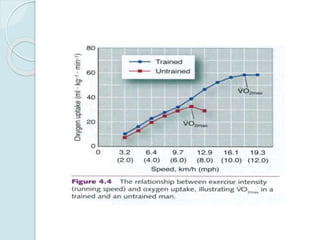
Trained vs Untrained
 Genetics also plays a major role in a
persons VO2 max 4
Highest recorded VO2max
• 94 ml/kg/min in men
• 77 ml/kg/min in women
• Both were cross-country skiers.5
Determinants of VO2max
Determinants
Gender
Training
AgingSmoking
Altitude
Gender
 Untrained girls and women typically
have a maximal oxygen uptake 20-
25% lower than untrained men.1
 Highly conditioned female endurance
athletes have much closer value to
highly trained male endurance
athletes.
VO2max at Altitude
 Decreases as altitude rises
 Due to a decrease in maximal cardiac
output.
 C.O = H.R * S.V
 Stoke volume decreases due to the
immediate decrease in blood plasma
volume.
 Maximal heart rate may also decrease
 The net effect is that less oxygen is
"pushed" from the blood into the
muscles
Effects of Aging on
VO2max
 VO2max decreases with an increase in
age
 The average rate of decline is
generally accepted to be about 1% per
year or 10% per decade after the age
of 25.
 According to a Literature study 10,11 it
was found that the average decrease
was:
 0.46 ml/kg/min per year in men (1.2%)
 0.54 ml/kg/min in women (1.7%)
Smoking
 VO2max of heavy smokers is lower than
that of non smoker.
 The effect of habitual smoking on
VO2max is minimal - about 0.85 ml.kg-
1.min-1
 heavy smokers - additional decrease
of 1.71ml.kg-1.min-1 has been noted. 7
Training and VO2max
 A study was done in which:
 Sedentary people,
 trained at 75% of aerobic power.
 For 30minutes, 3 time a week over 6
months
 Results: an increased VO2max with an
average of 15-20% 11
Study 2
 According to this study, the training
protocol was divide the individuals into
two categories.
 Responder: those who make a large
gain
 Non-responders : those who make a
little or no gain 12 ,13
 The results showed that genetics
plays a role in how well any one
individual responds to endurance
training.
 Once a plateau in VO2max has been
reached, a further improvement in
performance is still seen with training.
 Resistance training and intense burst
type anaerobic training have little
effect on VO2max
 Resistance training alone does not
increase VO2max
VO2max &
Performance
 Is VO2max a predictor of
performance?
 NO
 Why?
 VO2max is not a good predictor of
performance.
 But using the velocity (v VO2max) and
duration (tlimv VO2max) they will
provide a better indication of
performance.
Methods to measure VO2max
 Direct method
 Indirect method
Direct testing Indirect testing
Requires sophisticated equipments
to measure the volume and gas
concentration
Does not required any specific
equipments.
Treadmills, cycle ergo meters and
other exercise equipments are
used to measure VO2max
Simple reliable and accurate tests
are used.
Bruce Protocol is often used for
testing VO2max in athletes or for
signs of coronary heart disease.
Multistage shuttle run , 12 minutes
walk test ,1.5 mile run tests are
used.
REFERENCES
 1) Wilmore JH and Costill DL. (2005) Physiology of Sport and Exercise: 3rd
Edition. Champaign, IL: Human Kinetics
 2)FRENCH, J. and LONG, M. (2012) How to improve your VO2max. Athletics
Weekly, November 8 2012, p.53
 3) Sjodin B, Svedenhag J. Oxygen uptake during running as related to body mass
in circumpubertal boys: a longitudinal study. Eur J Appl Physiol Occup
Physiol. 1992;65(2):150-7
 4) Bouchard C, Dionne FT, Simoneau JA, Boulay MR. Genetics of aerobic and
anaerobic performances. Exerc Sport Sci Rev. 1992;20:27-58
 5) Astrand P-O and Rodahl K. (1986) The Textbook of Work Physiology:
Physiological Bases of Exercise (3rd ed.). New York: McGraw-Hill
 6) Cureton KJ, Sparling PB. Distance running performance and metabolic
responses to running in men and women with excess weight experimentally
equated. Med Sci Sports Exerc. 1980;12(4):288-94
 7) http://webcache.googleusercontent.com/search?q=cache:0G9z-
tOY9hIJ:ntrs.nasa.gov/archive/nasa/casi.ntrs.nasa.gov/20080014280.pdf+&cd=4&
hl=en&ct=clnk&gl=in
 9) Costill DL, Thomas R, Robergs RA, Pascoe D, Lambert C,
Barr S, Fink WJ. Adaptations to swimming training: influence
of training volume. Med Sci Sports Exerc. 1991
Mar;23(3):371-7
 10) Jackson AS, Beard EF, Wier LT, Ross RM, Stuteville JE,
Blair SN. Changes in aerobic power of men, ages 25-70
yr. Med Sci Sports Exerc. 1995 Jan;27(1):113-20
11) Jackson AS, Wier LT, Ayers GW, Beard EF, Stuteville JE,
Blair SN. Changes in aerobic power of women, ages 20-64
yr. Med Sci Sports Exerc. 1996 Jul;28(7):884-91
 11) Pollock ML. (1973). Quantification of endurance training
programs. Exercise and Sport Sciences Reviews. 1,155-188
 12) Green HJ, Jones S, Ball-Burnett M,
Farrance B, Ranney D. Adaptations in
muscle metabolism to prolonged
voluntary exercise and training. J Appl
Physiol. 1995 Jan;78(1):138-45
 13) Saltin B, Nazar K, Costill DL, Stein E,
Jansson E, Essen B, Gollnick D. The
nature of the training response;
peripheral and central adaptations of
one-legged exercise. Acta Physiol
Scand. 1976 Mar;96(3):289-305
Vo2

Vo2

  • 1.
    VO2max and itsDeterminants Baneet Sharma
  • 2.
    Contents  Introduction  Definition VO2max and performance  Normal values  Determinants
  • 3.
    Introduction  Fitness canbe measured by the volume of oxygen consumed while exercising.  Done at your maximum capacity.
  • 4.
    DEFINITION  "the highestrate of oxygen consumption attainable during maximal or exhaustive exercise" Wilmore JH and Costill DL. (2005) Physiology of Sport and Exercise: 5th Edition. Champaign, IL: Human Kinetics 1
  • 5.
    What is VO2max?  VO2max is the maximum amount of oxygen – in milliliters – one can consume per kilogram of body weight.
  • 7.
     The pointat which oxygen consumption plateaus defines the VO2max or an individual's maximal aerobic capacity.  It is the best indicator of cardio respiratory endurance and aerobic fitness.
  • 8.
    Also known as Aerobic power  Aerobic capacity  Maximal oxygen uptake.
  • 9.
     A fitperson will have a high VO2max as compare those who are not well conditioned.
  • 10.
    Literature reviews  Studydone by: French & Long (2012)  Showed that one can increase their VO2max by working out at an intensity that raises their heart rate to between 65% - 85% of its maximum.  For AT LEAST 20minutes, 3-5times a week.
  • 11.
    VO2max Values  Maleathletes : 3.5 liters/minute  Female athletes: 2.7 liters/minute.
  • 12.
    Units  VO2max isexpressed either as an Absolute rate in e.g. Liters of oxygen per minute(L/min)  OR as a Relative rate in (e.g. milliliters of oxygen per kilogram of body mass per minuets (ml.kg-1.min-1)
  • 13.
  • 15.
     Genetics alsoplays a major role in a persons VO2 max 4
  • 16.
    Highest recorded VO2max •94 ml/kg/min in men • 77 ml/kg/min in women • Both were cross-country skiers.5
  • 17.
  • 18.
    Gender  Untrained girlsand women typically have a maximal oxygen uptake 20- 25% lower than untrained men.1  Highly conditioned female endurance athletes have much closer value to highly trained male endurance athletes.
  • 19.
    VO2max at Altitude Decreases as altitude rises  Due to a decrease in maximal cardiac output.  C.O = H.R * S.V
  • 20.
     Stoke volumedecreases due to the immediate decrease in blood plasma volume.  Maximal heart rate may also decrease  The net effect is that less oxygen is "pushed" from the blood into the muscles
  • 21.
  • 22.
     VO2max decreaseswith an increase in age  The average rate of decline is generally accepted to be about 1% per year or 10% per decade after the age of 25.
  • 23.
     According toa Literature study 10,11 it was found that the average decrease was:  0.46 ml/kg/min per year in men (1.2%)  0.54 ml/kg/min in women (1.7%)
  • 24.
    Smoking  VO2max ofheavy smokers is lower than that of non smoker.  The effect of habitual smoking on VO2max is minimal - about 0.85 ml.kg- 1.min-1  heavy smokers - additional decrease of 1.71ml.kg-1.min-1 has been noted. 7
  • 25.
    Training and VO2max A study was done in which:  Sedentary people,  trained at 75% of aerobic power.  For 30minutes, 3 time a week over 6 months  Results: an increased VO2max with an average of 15-20% 11
  • 26.
    Study 2  Accordingto this study, the training protocol was divide the individuals into two categories.  Responder: those who make a large gain  Non-responders : those who make a little or no gain 12 ,13
  • 27.
     The resultsshowed that genetics plays a role in how well any one individual responds to endurance training.
  • 28.
     Once aplateau in VO2max has been reached, a further improvement in performance is still seen with training.  Resistance training and intense burst type anaerobic training have little effect on VO2max  Resistance training alone does not increase VO2max
  • 29.
    VO2max & Performance  IsVO2max a predictor of performance?  NO  Why?
  • 30.
     VO2max isnot a good predictor of performance.  But using the velocity (v VO2max) and duration (tlimv VO2max) they will provide a better indication of performance.
  • 31.
  • 32.
     Direct method Indirect method
  • 33.
    Direct testing Indirecttesting Requires sophisticated equipments to measure the volume and gas concentration Does not required any specific equipments. Treadmills, cycle ergo meters and other exercise equipments are used to measure VO2max Simple reliable and accurate tests are used. Bruce Protocol is often used for testing VO2max in athletes or for signs of coronary heart disease. Multistage shuttle run , 12 minutes walk test ,1.5 mile run tests are used.
  • 35.
    REFERENCES  1) WilmoreJH and Costill DL. (2005) Physiology of Sport and Exercise: 3rd Edition. Champaign, IL: Human Kinetics  2)FRENCH, J. and LONG, M. (2012) How to improve your VO2max. Athletics Weekly, November 8 2012, p.53  3) Sjodin B, Svedenhag J. Oxygen uptake during running as related to body mass in circumpubertal boys: a longitudinal study. Eur J Appl Physiol Occup Physiol. 1992;65(2):150-7  4) Bouchard C, Dionne FT, Simoneau JA, Boulay MR. Genetics of aerobic and anaerobic performances. Exerc Sport Sci Rev. 1992;20:27-58  5) Astrand P-O and Rodahl K. (1986) The Textbook of Work Physiology: Physiological Bases of Exercise (3rd ed.). New York: McGraw-Hill  6) Cureton KJ, Sparling PB. Distance running performance and metabolic responses to running in men and women with excess weight experimentally equated. Med Sci Sports Exerc. 1980;12(4):288-94  7) http://webcache.googleusercontent.com/search?q=cache:0G9z- tOY9hIJ:ntrs.nasa.gov/archive/nasa/casi.ntrs.nasa.gov/20080014280.pdf+&cd=4& hl=en&ct=clnk&gl=in
  • 36.
     9) CostillDL, Thomas R, Robergs RA, Pascoe D, Lambert C, Barr S, Fink WJ. Adaptations to swimming training: influence of training volume. Med Sci Sports Exerc. 1991 Mar;23(3):371-7  10) Jackson AS, Beard EF, Wier LT, Ross RM, Stuteville JE, Blair SN. Changes in aerobic power of men, ages 25-70 yr. Med Sci Sports Exerc. 1995 Jan;27(1):113-20 11) Jackson AS, Wier LT, Ayers GW, Beard EF, Stuteville JE, Blair SN. Changes in aerobic power of women, ages 20-64 yr. Med Sci Sports Exerc. 1996 Jul;28(7):884-91  11) Pollock ML. (1973). Quantification of endurance training programs. Exercise and Sport Sciences Reviews. 1,155-188
  • 37.
     12) GreenHJ, Jones S, Ball-Burnett M, Farrance B, Ranney D. Adaptations in muscle metabolism to prolonged voluntary exercise and training. J Appl Physiol. 1995 Jan;78(1):138-45  13) Saltin B, Nazar K, Costill DL, Stein E, Jansson E, Essen B, Gollnick D. The nature of the training response; peripheral and central adaptations of one-legged exercise. Acta Physiol Scand. 1976 Mar;96(3):289-305

Editor's Notes

  • #4 Fitness can be measured by the volume of oxygen you can consume while exercising at your maximum capacity. VO2 max is the maximum amount of oxygen in millilitres, one can use in one minute per kilogram of body weight. Those who are fit have higher VO2 max values and can exercise more intensely than those who are not as well conditioned.
  • #7 As exercise intensity increases so does oxygen consumption. However, a point is reached where exercise intensity can continue to increase without the associated rise in oxygen consumption.
  • #11 VO2 max is usually expressed relative to bodyweight because oxygen and energy needs differ relative to size. It can also be expressed relative to body surface area and this may be a more accurate when comparing children and oxygen uptake between sexes. One study 3 followed a group of 12-year-old boys through to the age of 20 - half of which were trained, the other half untrained but active. Relative to bodyweight no differences in VO2 max were found between the groups suggesting that training had no influence on maximal oxygen uptake. However, when VO2 max was expressed relative to body surface area, there was a significant difference between groups and maximal oxygen uptake did indeed increase in proportion to training.
  • #19  Taking it step further, if VO2 max is adjusted to account for fat free mass in elite male and female athletes, the differences disappear in some studies. Cureton and Collins suggest that sex-specific essential fat stores account for the majority of metabolic differences in running between men and women.
  • #31 tlimvVO2max :