EXERCISE
Dr. Rasha Mohamed Atta
CLASS/8B
OBJECTIVES
 Identify types of exercise
 Muscle metabolism during exercise
 Plasma hormones levels during exercise
 Oxygen consumption and ventilation during exercise
 Cardiovascular response exercise
 Thermoregulation during exercise
Definition of
exercise:
it a planned , structured , repetitive
and purposeful subset of physical
activity
01
1-endurance exercise
which improves muscle endurance by
low intensity ,high repetition exercise
2-strength exercise
which improves muscle strength by high
intensity ,low repetition exercise
3- Dynamic Exercise
IT IS A RHYTHMIC MUSCULAR ACTIVITY CAN INDUCED BY LARGE
MUSCLE GROUP NORIUSHED BY O2 FROM BLOOD VESSELES AND THIS
NEEDS
1-CARDIOVASCULAR FLEXIBILITY
2-RESPIRATORY FLEXIBILITY
3-MUSCULAR ENDURANCE , STRENGTH AND FLEXIBILITY
4-Isometric Exercise
IT IS EXERCISE INVOLVING MUSCULAR CONTRACTION WITHOUT
MOVEMENT OF THE INVOLVED PARTS OF THE BODY AND WITHOUT
LENGHTENING OR SHORTENING THE MUSCLES AS WEIGHTLIFTING
Muscle
Metabolism
02
Source of energy
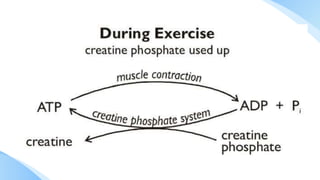
1-Phosphagen system
(ATP & phosphocreatine)
 Adenosine Triphosphate
(ATP)
 It is the currency of energy in the body .
 each bond stores 7300 calories .
 removal of the first phosphate converts ATP
into ADP and the second converts it into AMP
 Stored amount of ATP last only for 3 seconds
Phosphocreatine
 The high energy phosphate bond of phosphocreatine
has more energy than ATP bonds (10,300 calories per
mole )
 Therefore, phosphocreatine can provide energy for
reconstitute the high energy bond of ATP .
 Most muscle cells have two or four times as much
phosphocreatine as ATP .
 These substances can provide maximal muscle power
for 8 to 10 seconds , almost enough for the 100m run .
Metabolic
pathways
Anaerobic System
01
 Rapid mechanism to produce ATP, when there
is insufficient oxygen for the aerobic system to
occur.
 - most of the pyruvic acid then is converted into
lactic acid, which diffuses out of the muscle
cells into the interstitial fluid and blood.
 - Therefore, much of the muscle glycogen is
transformed to lactic acid, but in doing so,
considerable amounts of ATP are formed
entirely without consumption of oxygen.
Aerobic System
02
It is the oxidation of foodstuffs (glucose,
fatty acids, and amino acids) in the
mitochondria to provide energy -after some
intermediate processing- combine with
oxygen to release tremendous amounts of
energy that are used to convert AMP and ADP
into ATP .
Comparing the energy
supply of different
systems
Comparing endurance
of different systems
Muscles
recovery
03
Recovery of the muscle metabolic
after exercise
 Energy from the aerobic system can be used to
reconstitute all the other systems ( the ATP,
phosphocreatine, glycogen – lactic acid system )
 Energy from the (anaerobic system) can be used to
reconstitute both phosphocreatine and ATP
 Energy from phosphocreatine can be used to
reconstitute ATP
Reconstitution of the anaerobic
system
 Removal of the excess lactic acid that has accumulated in the body
fluids
 It is necessary because lactic acid causes extreme fatigue
 Removal of lactic acid is achieved in two ways:-
1. 1) Converted back into pyruvic acid and then aerobic system by the
body tissue
2. 2) Remaining lactic acid is reconverted into glucose in the liver,
the glucose in turn is used to replenish the glycogen stores of the
muscles
Recovery of the aerobic system
even during the early stages of heavy
exercise
2-This depletion results from two effects:
1) Oxygen dept.
2) Depletion of the glycogen stores of the muscles
Oxygen dept
 The body normally contains about 2 liters of stored oxygen
 this stored oxygen consists of the following :(1) 0.5 liter in the
air of the lungs , (2) 0.25 liter dissolved in the body fluids , (3) 1
liter combined with hemoglobin of the blood , and 0.3 liter
stored in the muscle fibers
 In heavy exercise, all stored oxygen is used for aerobic
metabolism
 after the exercise is over, stored oxygen replenishes by
breathing extra amount of oxygen over the normal
requirements
Recovery of muscle glycogen
This process often requires days and is not a simple matter.
Shows this recovery process under 3 conditions
1. In People who consume a high – carbohydrate diet(it
take about 2 days)
2. In People who consume a high – fat, high – protein diet (it
takes about 5 days)
3. In People who consume no food(shows the same result
as high fat or protein)
Plasma
hormones
04
insulin
01
03
02
it reduces blood glucose level by:
a- stimulating the cells to absorb it from blood stream and oxidation
of it .
b- converting glucose into glycogen to be stored in liver
storing fats in adipose tissues instead of being used in muscle
activity .
In rest state of muscle : insulin binds to insulin receptor on muscle to form
GLUt 4 that is responsible for uptake of glucose in muscle
During exercise :
SNS suppresses its release from beta cells so , cells other than muscle
reduce their glucose uptake , providing a sufficient amount of glucose for
muscle fibers
During exercise there is lack of insulin in the body ,
but active muscle cells are not affected by low
levels of insulin to uptake glucose . HOW?
Contraction stimulates insulin independent
translocation [ GLUT 4 ] to muscle membrane
, increase glucose uptake for contractile
activity
Glucagon
02 release FFA from adipose tissue
increase glucose level in the blood by breaking
down of glycogen in liver
Its role is very important during exercise
01
Another hormones
Growth Hormone (GH)
Released from anterior lobe of pituitary gland
• it’s role : promotes lipolysis ( fat metabolism )
• Increase muscle protein synthesis due to damage of muscle cells during
exercise
02
peptide hormone produced in liver
it’s role : support function of GH
INSULIN-LIKE GROWTH FACTOR ( IGF)
03 TESTOSTERONE
• steroid hormone in both gender from adrenal cortex
• It’s role : responsible for repair of muscle damaged by exercise
04
Another hormones
CORTISOL
released by adrenal cortex , in response to stress , exercise and low blood sugar
It’s role: it support energy metabolism by breaking down noncarbohydrate
molecules (proteins & fats)
05
released by adrenal medulla
Epinephrine ( adrenaline ) & Norepinephrine ( noradrenaline )
it’s role : it helps SNS to produce energy by :
[1] increase rate & force of heart contraction .
[2] increase blood glucose level by breaking down glycogen in liver &
increase fat metabolism .
[3] increase BP .
[4] increase respiration rate .
CATECHOLAMINES
Respiratory
response
05
Respiration During Exercise
As we all know our respiration during rest is different from
our respiration during exercise
Normal oxygen consumption for a young man at rest is
about 250 ml/min. However, under maximal conditions,
this consumption can be increased
oxygen consumption during
exercise
Untrained average male is 3600 ml/min.
Athletically trained average male is 4000
ml/min.
Male marathon runner is 5100 ml/min.
As these information show that there is a
relationship between the oxygen
consumption and total pulmonary
ventilation
So both the oxygen and pulmonary
ventilation increase about 20 times in
compared to the rest state
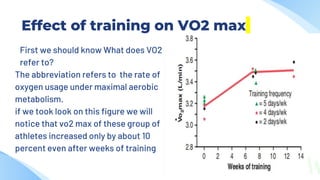
Effect of training on VO2 max
First we should know What does VO2
refer to?
The abbreviation refers to the rate of
oxygen usage under maximal aerobic
metabolism.
if we took look on this figure we will
notice that vo2 max of these group of
athletes increased only by about 10
percent even after weeks of training
Ventilation During Exercise
Exercise is associated with both increased
rate and increased depth of breathing,
resulting in enhanced alveolar ventilation
 The initial increase in ventilation is caused
by:
1. Sensory input from muscle mechanoreceptors
2. Descending pathways from the motor cortex to the
respiratory control centers
 Exercise hyperventilation maintains nearly
normal arterial PO2 and PCO2 by steadily
increasing alveolar ventilation in proportion to
the level of exercise
Blood gases
response
06
Blood gases during exercise
Both of oxygen of the arterial
blood and carbon dioxide
pressure of the venous blood
remain nearly normal during
strenuous exercise
demonstrating the extreme
ability of the respiratory system
to provide adequate aerationof
the blood even during heavy
exercise
In exercise respiration is stimulated mainly by neurogenic
mechanisms results from direct stimulation of the respiratory
center by the same nervous signals that are transmitted from
the brain to the muscles to cause the exercise
Acid base balance
Sources of H+ lons during exercise productionof carbondioxide
End product of carbohydrates,fat and protein
Metabolism productionof lactic acid and lactate form
carbohydratesand fat metabolism
ATP breakdown results in release of H+
1. Regulation of Acid-base balance during exercise •
 H+ production depend on
1. _ exerciseintensity •
2. _ duration of exercise •
■ blood PH
1. _ declines with increasing intensityexercise •
■ muscle PH
1. _ declines more dramatically than blood PH •
■ Muscle has lower buffering capacity
 At rest body
slightly
Alkaline 7.1 to 7.4
,higher PH =Alkalosis
 During exercise
Body slightly acidic
6.6 to 6.9
Lower PH = acidosis
cardiovascular
response
07
Cardiac output
Def:
is the amount of blood pumped by each ventricle/min at a rate of 5 L/min
During exercise:
more blood is sent to the active skeletal muscles, and, as body
temperature increases, more blood is sent to the skin. This process is
accomplished both by the increase in cardiac output and by the
redistribution of blood flow away from areas of low demand, such as the
splanchnic organs.
What are two factors that cause cardiac output to increase
during exercise?
-The cardiac output is increased by both a rise in the heart rate
and the stroke volume attributable to a more complete emptying
of the heart by a forcible systolic contraction.
What decreases cardiac output ?
-Conditions like myocardial infarction, hypertension, valvular
heart disease, congenital heart disease, cardiomyopathy, heart
failure, pulmonary disease, arrhythmias, drug effects, fluid
overload, decreased fluid volume, and electrolyte imbalance is
common causes of decreased cardiac
Mechanism of blood flow during
exercise
factors that affect blood flow:
blood pressure, blood volume, resistance, disease and
exercise.
1. The redistribution of blood
flow during exercise results
from a combination of
vasodilation in skeletal
muscle arterioles and
vasoconstriction in other
tissues.
1-From the figure above, we
summarize the blood flow in
the brain:
the amount of blood flow during rest = 0.75
and during exercise = 0.75.
So even after the percentage has gone down
exercise is not reducing and not change the
amount of blood flow in the brain.
2-Kidney and Gastrointestinal
track during exercise
through vasoconstricting the arterioles that feed
blood into the kidney and into GIT reducing the
volume of blood that the kidney and git require
because they are non essential for the fight or
fight (sympathetic) response.
3-Muscle Blood Flow Increases
during Exercise
At rest, skeletal muscles receive less than a
fourth of the cardiac
output, or about 1.2 L/min
During exercise the combination of increased cardiac output and
vasodilation can increase blood flow
As muscles become active, changes in the microenvironment of
muscle tissue take place: tissue O2 concentrations decrease,
while temperature,
CO2, and acid in the interstitial fluid around muscle fibers increase.
All these factors act as paracrines causing local vasodilation that
overrides the sympathetic
signal for vasoconstriction
Blood pressure during
exercise?
At first Let us know What is blood
pressure?
1. The force of circulating blood on the walls of the arteries. Blood
pressure is taken using two measurements: systolic (measured
when the heart beats, when blood pressure is at its highest) and
diastolic (measured between heart beats, when blood pressure is at
its lowest
2. What is systolic means
3. measures the pressure in your arteries when your heart beats
4. Diastolic means.
5. pressure in your arteries when your heart rests between beats
6. How to measure it
7. By this equation. :- MABP =diastolic +1/3(systolic –diastolic)
For example what happens to skeletal muscles
during exercise?
Vasodilation decreases peripheral resistance to blood
flow at the same time the sympathetic system induce
Vasoconstriction in non exercising tissue offsets the
vasodilation, but only partially. Consequently, total
peripheral resistance to blood flow falls dramatically as
exercise commences, reaching a minimum at about
75% of VO2max
 If no other compensation occurred, this decrease in
peripheral resistance would dramatically lower
arterial blood pressure. However, increased cardiac
output cancels out decreased peripheral resistance.
When blood pressure is monitored during exercise,
mean arterial blood pressure actually increases
slightly as exercise intensity increases
Baroreceptor
Reflex
Adjusts to
Exercise
Baroreceptor
●Very rapid negative feedback mechanism
●Found in the high-pressure areas of the
circulation (carotid and aortic bodies ).
●Stimulate by the rise of blood pressure
Normally, homeostasis of blood pressure is
regulated through peripheral baroreceptors in
the carotid and aortic bodies.
An increase in blood pressure initiates
responses that return blood pressure to normal
During exercise, blood pressure increases
without activating homeostatic compensation
What
happens to
the normal
Baroreceptor
reflex During
exercise??!
There are several theories to what happens
to the normal baroreceptor :-
1) Signals from the motor cortex during exercise reset
the arterial baroreceptor threshold to a higher
pressure. Blood pressure can then increase slightly
during exercise without triggering the homeostatic
counterregulatory responses .
2) Suggest that signals in baroreceptor
afferent neurons are blocked in the spinal cord
by presynaptic inhibition at some point before
the afferent neurons synapse with central
nervous system neurons. This central inhibition
inactivates the baroreceptor reflex during
exercise
3) Based on the postulated existence of muscle chemoreceptors
that are sensitive to metabolites (probably H+) produced during
strenuous exercise. When stimulated, these chemoreceptors
signal the CNS that tissue blood flow is not adequate to remove
muscle metabolites or keep the muscle in aerobic metabolism.
The chemoreceptor input is reinforced by sensory input from
mechanoreceptors in the working limbs. The CNS response to this
sensory input is to override the baroreceptor reflex and raise
blood pressure to enhance muscle perfusion. The same
hypothetical muscle chemoreceptors may play a role in ventilatory
responses to exercise.
THERMOREGULATION
response
08
Body heat
Almost all the energy released by the body’s metabolism of
nutrients is eventually converted into body heat.
1-First, the maximal efficiency for conversion of nutrient
energy into muscle work is only 20 to 25%
2- Second, almost all the energy that goes into creating
muscle work still becomes body heat .
why???
Because all but a small portion of
this energy is used for :
1. overcoming viscous resistance to the movement of the
muscles and joints
2. overcoming the friction of the blood flowing through
the blood vessels
• The oxygen consumption by the body can increase as
much as 20fold in the well-trained athlete and that the
amount of heat liberated in the body is almost exactly
proportional to the oxygen consumption
Thermoregulation
This rise in body temperature during exercise triggers two
thermoregulatory mechanisms:
1. Sweating
2. increased cutaneous blood flow
sweating
sweating lowers body temperature through evaporative
cooling, the loss of fluid from the extracellular
compartment can cause dehydration and significantly
reduce circulating blood volume
Increased cutaneous blood flow
• However, increased sympathetic output during exercise
tends to vasoconstrictor cutaneous blood vessels The
other thermoregulatory mechanism increased blood flow
to the skin causes body heat loss to the environment
through convection .
• On a very hot and humid day so that the sweating
mechanism cannot eliminate the heat, an intolerable and
even lethal condition called heat- stroke can easily
develop in the athlete
Lectured by :
1. Hussein Mohamed
2. Youssef Mohamed EL-Sayed
3. Youssef Mohamed Ibrahim
4. Mohamed Apd Elrahim
5. Mohamed Apd Elaty
6. Mohamed Ali Hassan
7. Mohamed Ali Mohamed
8. Mohamed Ali Fathy
9. Nora Ahmed
10. Aya Ahmed
11. Manar Mahmoud
12. Lugain Gaberalla
13. Malaz Madwi
14. Khawla Magdi
15. Duha Ali
Thanks

EXERCISE PRESENTATION.pptx

  • 1.
  • 2.
    OBJECTIVES  Identify typesof exercise  Muscle metabolism during exercise  Plasma hormones levels during exercise  Oxygen consumption and ventilation during exercise  Cardiovascular response exercise  Thermoregulation during exercise
  • 3.
    Definition of exercise: it aplanned , structured , repetitive and purposeful subset of physical activity 01
  • 5.
    1-endurance exercise which improvesmuscle endurance by low intensity ,high repetition exercise 2-strength exercise which improves muscle strength by high intensity ,low repetition exercise
  • 6.
    3- Dynamic Exercise ITIS A RHYTHMIC MUSCULAR ACTIVITY CAN INDUCED BY LARGE MUSCLE GROUP NORIUSHED BY O2 FROM BLOOD VESSELES AND THIS NEEDS 1-CARDIOVASCULAR FLEXIBILITY 2-RESPIRATORY FLEXIBILITY 3-MUSCULAR ENDURANCE , STRENGTH AND FLEXIBILITY 4-Isometric Exercise IT IS EXERCISE INVOLVING MUSCULAR CONTRACTION WITHOUT MOVEMENT OF THE INVOLVED PARTS OF THE BODY AND WITHOUT LENGHTENING OR SHORTENING THE MUSCLES AS WEIGHTLIFTING
  • 7.
  • 8.
    Source of energy 1-Phosphagensystem (ATP & phosphocreatine)
  • 9.
     Adenosine Triphosphate (ATP) It is the currency of energy in the body .  each bond stores 7300 calories .  removal of the first phosphate converts ATP into ADP and the second converts it into AMP  Stored amount of ATP last only for 3 seconds
  • 10.
    Phosphocreatine  The highenergy phosphate bond of phosphocreatine has more energy than ATP bonds (10,300 calories per mole )  Therefore, phosphocreatine can provide energy for reconstitute the high energy bond of ATP .  Most muscle cells have two or four times as much phosphocreatine as ATP .  These substances can provide maximal muscle power for 8 to 10 seconds , almost enough for the 100m run .
  • 12.
  • 13.
    Anaerobic System 01  Rapidmechanism to produce ATP, when there is insufficient oxygen for the aerobic system to occur.  - most of the pyruvic acid then is converted into lactic acid, which diffuses out of the muscle cells into the interstitial fluid and blood.  - Therefore, much of the muscle glycogen is transformed to lactic acid, but in doing so, considerable amounts of ATP are formed entirely without consumption of oxygen.
  • 14.
    Aerobic System 02 It isthe oxidation of foodstuffs (glucose, fatty acids, and amino acids) in the mitochondria to provide energy -after some intermediate processing- combine with oxygen to release tremendous amounts of energy that are used to convert AMP and ADP into ATP .
  • 16.
    Comparing the energy supplyof different systems Comparing endurance of different systems
  • 17.
  • 18.
    Recovery of themuscle metabolic after exercise  Energy from the aerobic system can be used to reconstitute all the other systems ( the ATP, phosphocreatine, glycogen – lactic acid system )  Energy from the (anaerobic system) can be used to reconstitute both phosphocreatine and ATP  Energy from phosphocreatine can be used to reconstitute ATP
  • 19.
    Reconstitution of theanaerobic system  Removal of the excess lactic acid that has accumulated in the body fluids  It is necessary because lactic acid causes extreme fatigue  Removal of lactic acid is achieved in two ways:- 1. 1) Converted back into pyruvic acid and then aerobic system by the body tissue 2. 2) Remaining lactic acid is reconverted into glucose in the liver, the glucose in turn is used to replenish the glycogen stores of the muscles
  • 20.
    Recovery of theaerobic system even during the early stages of heavy exercise 2-This depletion results from two effects: 1) Oxygen dept. 2) Depletion of the glycogen stores of the muscles
  • 21.
    Oxygen dept  Thebody normally contains about 2 liters of stored oxygen  this stored oxygen consists of the following :(1) 0.5 liter in the air of the lungs , (2) 0.25 liter dissolved in the body fluids , (3) 1 liter combined with hemoglobin of the blood , and 0.3 liter stored in the muscle fibers  In heavy exercise, all stored oxygen is used for aerobic metabolism  after the exercise is over, stored oxygen replenishes by breathing extra amount of oxygen over the normal requirements
  • 23.
    Recovery of muscleglycogen This process often requires days and is not a simple matter. Shows this recovery process under 3 conditions 1. In People who consume a high – carbohydrate diet(it take about 2 days) 2. In People who consume a high – fat, high – protein diet (it takes about 5 days) 3. In People who consume no food(shows the same result as high fat or protein)
  • 24.
  • 25.
    insulin 01 03 02 it reduces bloodglucose level by: a- stimulating the cells to absorb it from blood stream and oxidation of it . b- converting glucose into glycogen to be stored in liver storing fats in adipose tissues instead of being used in muscle activity . In rest state of muscle : insulin binds to insulin receptor on muscle to form GLUt 4 that is responsible for uptake of glucose in muscle During exercise : SNS suppresses its release from beta cells so , cells other than muscle reduce their glucose uptake , providing a sufficient amount of glucose for muscle fibers
  • 26.
    During exercise thereis lack of insulin in the body , but active muscle cells are not affected by low levels of insulin to uptake glucose . HOW? Contraction stimulates insulin independent translocation [ GLUT 4 ] to muscle membrane , increase glucose uptake for contractile activity
  • 27.
    Glucagon 02 release FFAfrom adipose tissue increase glucose level in the blood by breaking down of glycogen in liver Its role is very important during exercise
  • 29.
    01 Another hormones Growth Hormone(GH) Released from anterior lobe of pituitary gland • it’s role : promotes lipolysis ( fat metabolism ) • Increase muscle protein synthesis due to damage of muscle cells during exercise 02 peptide hormone produced in liver it’s role : support function of GH INSULIN-LIKE GROWTH FACTOR ( IGF) 03 TESTOSTERONE • steroid hormone in both gender from adrenal cortex • It’s role : responsible for repair of muscle damaged by exercise
  • 30.
    04 Another hormones CORTISOL released byadrenal cortex , in response to stress , exercise and low blood sugar It’s role: it support energy metabolism by breaking down noncarbohydrate molecules (proteins & fats) 05 released by adrenal medulla Epinephrine ( adrenaline ) & Norepinephrine ( noradrenaline ) it’s role : it helps SNS to produce energy by : [1] increase rate & force of heart contraction . [2] increase blood glucose level by breaking down glycogen in liver & increase fat metabolism . [3] increase BP . [4] increase respiration rate . CATECHOLAMINES
  • 33.
  • 35.
    Respiration During Exercise Aswe all know our respiration during rest is different from our respiration during exercise Normal oxygen consumption for a young man at rest is about 250 ml/min. However, under maximal conditions, this consumption can be increased
  • 36.
    oxygen consumption during exercise Untrainedaverage male is 3600 ml/min. Athletically trained average male is 4000 ml/min. Male marathon runner is 5100 ml/min. As these information show that there is a relationship between the oxygen consumption and total pulmonary ventilation So both the oxygen and pulmonary ventilation increase about 20 times in compared to the rest state
  • 37.
    Effect of trainingon VO2 max First we should know What does VO2 refer to? The abbreviation refers to the rate of oxygen usage under maximal aerobic metabolism. if we took look on this figure we will notice that vo2 max of these group of athletes increased only by about 10 percent even after weeks of training
  • 38.
    Ventilation During Exercise Exerciseis associated with both increased rate and increased depth of breathing, resulting in enhanced alveolar ventilation  The initial increase in ventilation is caused by: 1. Sensory input from muscle mechanoreceptors 2. Descending pathways from the motor cortex to the respiratory control centers  Exercise hyperventilation maintains nearly normal arterial PO2 and PCO2 by steadily increasing alveolar ventilation in proportion to the level of exercise
  • 39.
  • 40.
    Blood gases duringexercise Both of oxygen of the arterial blood and carbon dioxide pressure of the venous blood remain nearly normal during strenuous exercise demonstrating the extreme ability of the respiratory system to provide adequate aerationof the blood even during heavy exercise
  • 41.
    In exercise respirationis stimulated mainly by neurogenic mechanisms results from direct stimulation of the respiratory center by the same nervous signals that are transmitted from the brain to the muscles to cause the exercise Acid base balance Sources of H+ lons during exercise productionof carbondioxide End product of carbohydrates,fat and protein Metabolism productionof lactic acid and lactate form carbohydratesand fat metabolism ATP breakdown results in release of H+
  • 42.
    1. Regulation ofAcid-base balance during exercise •  H+ production depend on 1. _ exerciseintensity • 2. _ duration of exercise • ■ blood PH 1. _ declines with increasing intensityexercise • ■ muscle PH 1. _ declines more dramatically than blood PH • ■ Muscle has lower buffering capacity
  • 43.
     At restbody slightly Alkaline 7.1 to 7.4 ,higher PH =Alkalosis  During exercise Body slightly acidic 6.6 to 6.9 Lower PH = acidosis
  • 44.
  • 45.
    Cardiac output Def: is theamount of blood pumped by each ventricle/min at a rate of 5 L/min During exercise: more blood is sent to the active skeletal muscles, and, as body temperature increases, more blood is sent to the skin. This process is accomplished both by the increase in cardiac output and by the redistribution of blood flow away from areas of low demand, such as the splanchnic organs.
  • 46.
    What are twofactors that cause cardiac output to increase during exercise? -The cardiac output is increased by both a rise in the heart rate and the stroke volume attributable to a more complete emptying of the heart by a forcible systolic contraction. What decreases cardiac output ? -Conditions like myocardial infarction, hypertension, valvular heart disease, congenital heart disease, cardiomyopathy, heart failure, pulmonary disease, arrhythmias, drug effects, fluid overload, decreased fluid volume, and electrolyte imbalance is common causes of decreased cardiac
  • 47.
    Mechanism of bloodflow during exercise factors that affect blood flow: blood pressure, blood volume, resistance, disease and exercise.
  • 48.
    1. The redistributionof blood flow during exercise results from a combination of vasodilation in skeletal muscle arterioles and vasoconstriction in other tissues.
  • 51.
    1-From the figureabove, we summarize the blood flow in the brain: the amount of blood flow during rest = 0.75 and during exercise = 0.75. So even after the percentage has gone down exercise is not reducing and not change the amount of blood flow in the brain.
  • 52.
    2-Kidney and Gastrointestinal trackduring exercise through vasoconstricting the arterioles that feed blood into the kidney and into GIT reducing the volume of blood that the kidney and git require because they are non essential for the fight or fight (sympathetic) response.
  • 53.
    3-Muscle Blood FlowIncreases during Exercise At rest, skeletal muscles receive less than a fourth of the cardiac output, or about 1.2 L/min
  • 54.
    During exercise thecombination of increased cardiac output and vasodilation can increase blood flow As muscles become active, changes in the microenvironment of muscle tissue take place: tissue O2 concentrations decrease, while temperature, CO2, and acid in the interstitial fluid around muscle fibers increase. All these factors act as paracrines causing local vasodilation that overrides the sympathetic signal for vasoconstriction
  • 55.
  • 56.
    At first Letus know What is blood pressure? 1. The force of circulating blood on the walls of the arteries. Blood pressure is taken using two measurements: systolic (measured when the heart beats, when blood pressure is at its highest) and diastolic (measured between heart beats, when blood pressure is at its lowest 2. What is systolic means 3. measures the pressure in your arteries when your heart beats 4. Diastolic means. 5. pressure in your arteries when your heart rests between beats 6. How to measure it 7. By this equation. :- MABP =diastolic +1/3(systolic –diastolic)
  • 58.
    For example whathappens to skeletal muscles during exercise? Vasodilation decreases peripheral resistance to blood flow at the same time the sympathetic system induce Vasoconstriction in non exercising tissue offsets the vasodilation, but only partially. Consequently, total peripheral resistance to blood flow falls dramatically as exercise commences, reaching a minimum at about 75% of VO2max
  • 59.
     If noother compensation occurred, this decrease in peripheral resistance would dramatically lower arterial blood pressure. However, increased cardiac output cancels out decreased peripheral resistance. When blood pressure is monitored during exercise, mean arterial blood pressure actually increases slightly as exercise intensity increases
  • 60.
  • 61.
    Baroreceptor ●Very rapid negativefeedback mechanism ●Found in the high-pressure areas of the circulation (carotid and aortic bodies ). ●Stimulate by the rise of blood pressure
  • 62.
    Normally, homeostasis ofblood pressure is regulated through peripheral baroreceptors in the carotid and aortic bodies. An increase in blood pressure initiates responses that return blood pressure to normal During exercise, blood pressure increases without activating homeostatic compensation
  • 63.
  • 64.
    There are severaltheories to what happens to the normal baroreceptor :- 1) Signals from the motor cortex during exercise reset the arterial baroreceptor threshold to a higher pressure. Blood pressure can then increase slightly during exercise without triggering the homeostatic counterregulatory responses .
  • 65.
    2) Suggest thatsignals in baroreceptor afferent neurons are blocked in the spinal cord by presynaptic inhibition at some point before the afferent neurons synapse with central nervous system neurons. This central inhibition inactivates the baroreceptor reflex during exercise
  • 66.
    3) Based onthe postulated existence of muscle chemoreceptors that are sensitive to metabolites (probably H+) produced during strenuous exercise. When stimulated, these chemoreceptors signal the CNS that tissue blood flow is not adequate to remove muscle metabolites or keep the muscle in aerobic metabolism. The chemoreceptor input is reinforced by sensory input from mechanoreceptors in the working limbs. The CNS response to this sensory input is to override the baroreceptor reflex and raise blood pressure to enhance muscle perfusion. The same hypothetical muscle chemoreceptors may play a role in ventilatory responses to exercise.
  • 67.
  • 68.
    Body heat Almost allthe energy released by the body’s metabolism of nutrients is eventually converted into body heat. 1-First, the maximal efficiency for conversion of nutrient energy into muscle work is only 20 to 25% 2- Second, almost all the energy that goes into creating muscle work still becomes body heat . why???
  • 69.
    Because all buta small portion of this energy is used for : 1. overcoming viscous resistance to the movement of the muscles and joints 2. overcoming the friction of the blood flowing through the blood vessels • The oxygen consumption by the body can increase as much as 20fold in the well-trained athlete and that the amount of heat liberated in the body is almost exactly proportional to the oxygen consumption
  • 70.
    Thermoregulation This rise inbody temperature during exercise triggers two thermoregulatory mechanisms: 1. Sweating 2. increased cutaneous blood flow sweating sweating lowers body temperature through evaporative cooling, the loss of fluid from the extracellular compartment can cause dehydration and significantly reduce circulating blood volume
  • 71.
    Increased cutaneous bloodflow • However, increased sympathetic output during exercise tends to vasoconstrictor cutaneous blood vessels The other thermoregulatory mechanism increased blood flow to the skin causes body heat loss to the environment through convection . • On a very hot and humid day so that the sweating mechanism cannot eliminate the heat, an intolerable and even lethal condition called heat- stroke can easily develop in the athlete
  • 72.
    Lectured by : 1.Hussein Mohamed 2. Youssef Mohamed EL-Sayed 3. Youssef Mohamed Ibrahim 4. Mohamed Apd Elrahim 5. Mohamed Apd Elaty 6. Mohamed Ali Hassan 7. Mohamed Ali Mohamed 8. Mohamed Ali Fathy 9. Nora Ahmed 10. Aya Ahmed 11. Manar Mahmoud 12. Lugain Gaberalla 13. Malaz Madwi 14. Khawla Magdi 15. Duha Ali
  • 73.