Contents: -Definition, Principle, Advantages, Suspension instruments, Procedure, Types of suspension, Techniques.
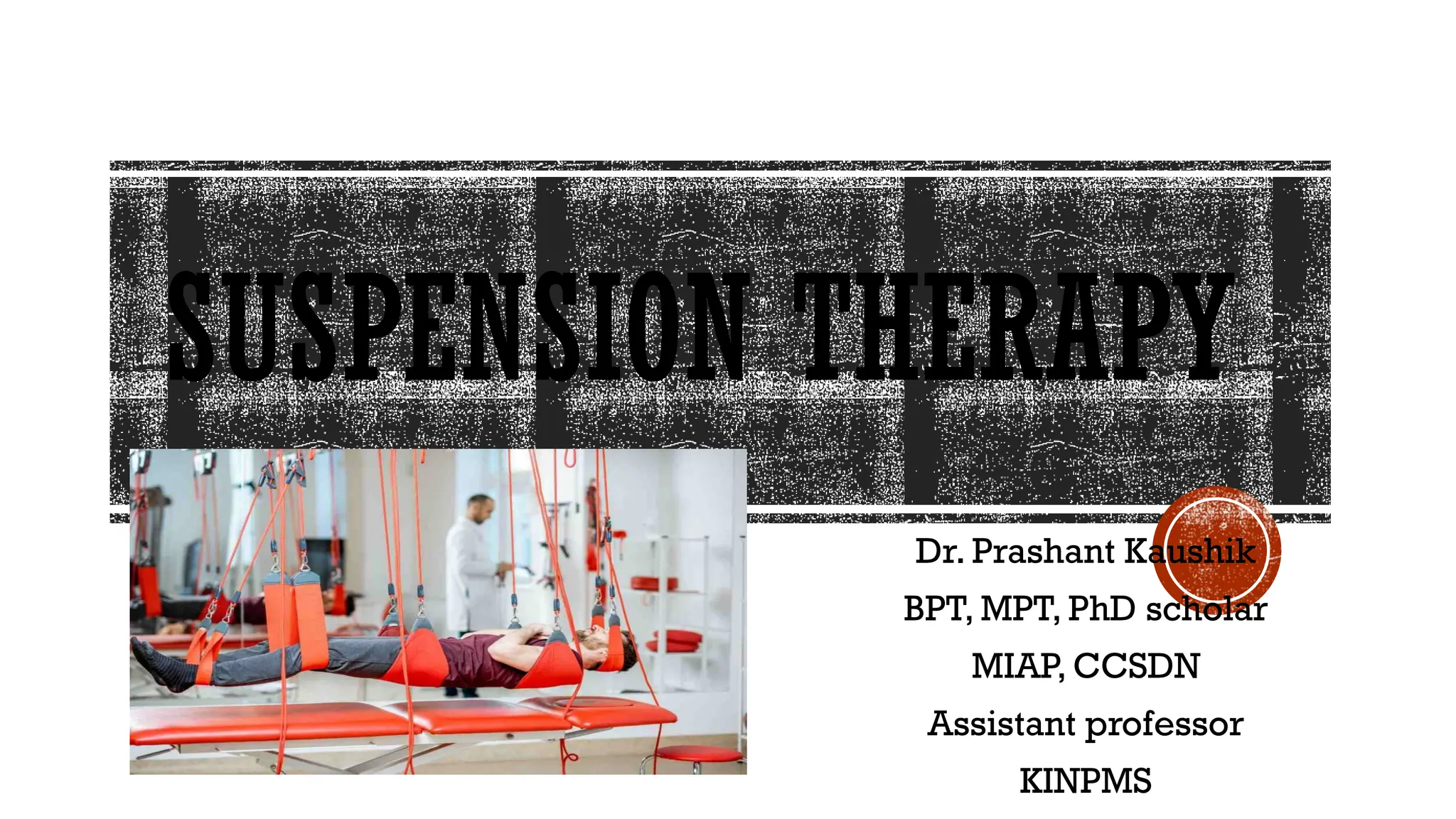
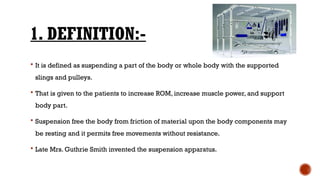
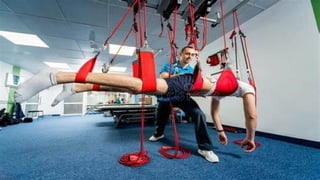
Definition: - It is defined as suspending a part of the body or whole body with the supported slings and pulleys. That is given to the patients to increase ROM, increase muscle power, and support body part. Suspension free the body from friction of material upon the body components may be resting and it permits free movements without resistance. Late Mrs. Guthrie Smith invented the suspension apparatus.
Principle: - It is working under three principle: -
Friction.
Pendulum.
Eliminating gravity.
(a) Friction: - It occurs during a particular surface move on another. It is the force, which restrict the movement of an object. If the surface are more smooth and slippery will have less friction, in that surface the movement will be more and will cause slippery. If the surface is hard or rough results in more friction and the movements are opposed by the friction force.
The same principle is used in the suspension which has less friction causes smooth and easy movements.
(b) Pendulum: - Pendulum is heavy material suspended by the weightless thread. The force is applied on the pendulum it results in to and fro movement.
One complete swing is called as Oscillation. The arc of movement of the pendulum forms a segment of base of the cone. In the human body the pendular motion occurs mainly in the shoulder joint and the hip joint, forward leg movement and the arm swing movement while walking. The simple muscular contraction is necessary to initiate the oscillation. The same mechanism is used in the suspension therapy to maintain the muscle property, increase the range of movement and strengthening the muscles.
(c) Eliminating Gravity Movement: - If the person has the muscle power 2 (gravity eliminated movement), can go for the suspension exercises.
The patients should have minimal muscle power of 2 to under go for suspension therapy exercise. If the muscle power is above 3, the patient can go for against the gravity exercise instead of suspension therapy exercise.
Advantages: - It reduces the burden for the therapist.
Easy to lift the limbs.
Active movement can be performed easily with minimum friction.
Easier to maintain the position of limbs with slings and pulleys in the required position.
Suspension instruments: -
Suspension frame.
Supporting ropes.
Pulleys.
Slings.
S-hook and dog clips.
Wooden cleat.
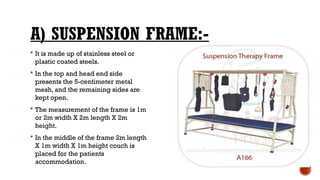
(a) Suspension Frame: - It is made up of stainless steel or plastic-coated steels. In the top and head end side presents the 5-centimeter metal mesh, and the remaining sides are kept open. The measurement of the frame is 1m or 2m width X 2m length X 2m height. In the middle of the frame 2m length X 1m width X 1m height couch is placed for the patient's accommodation.
(b)Supporting Ropes: - It is 1.5 meters length, and 3 ply hemp ropes are used for the suspension to avoid slipping.










![CASE_PRESENTATION_ON_subdural_hematoma(SDH)[1 FINAL PPT]-1.pptx](https://cdn.slidesharecdn.com/ss_thumbnails/casepresentationonsubduralhematomasdh1finalppt-1-260129172522-d405d375-thumbnail.jpg?width=640&height=640&fit=bounds)


