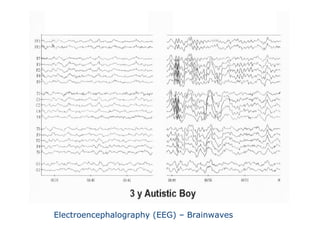
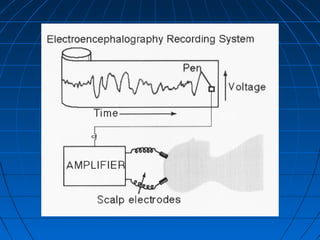
Electroencephalography (EEG) – Brainwaves
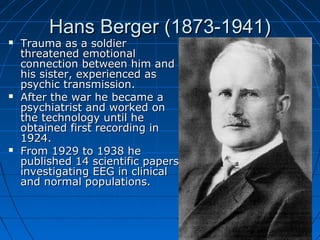
Hans Berger (1873-1941)Hans Berger (1873-1941)
 Trauma as a soldierTrauma as a soldier
threatened emotionalthreatened emotional
connection between him andconnection between him and
his sister, experienced ashis sister, experienced as
psychic transmission.psychic transmission.
 After the war he became aAfter the war he became a
psychiatrist and worked onpsychiatrist and worked on
the technology until hethe technology until he
obtained first recording inobtained first recording in
1924.1924.
 From 1929 to 1938 heFrom 1929 to 1938 he
published 14 scientific paperspublished 14 scientific papers
investigating EEG in clinicalinvestigating EEG in clinical
and normal populations.and normal populations.
Brain waves were first studied toBrain waves were first studied to
help explain a psychic experiencehelp explain a psychic experience
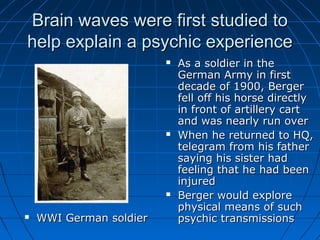
 WWI German soldierWWI German soldier
 As a soldier in theAs a soldier in the
German Army in firstGerman Army in first
decade of 1900, Bergerdecade of 1900, Berger
fell off his horse directlyfell off his horse directly
in front of artillery cartin front of artillery cart
and was nearly run overand was nearly run over
 When he returned to HQ,When he returned to HQ,
telegram from his fathertelegram from his father
saying his sister hadsaying his sister had
feeling that he had beenfeeling that he had been
injuredinjured
 Berger would exploreBerger would explore
physical means of suchphysical means of such
psychic transmissionspsychic transmissions
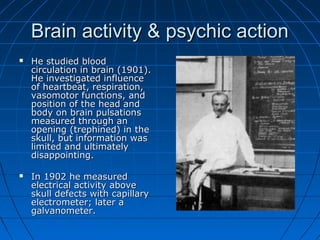
Brain activity & psychic actionBrain activity & psychic action
 He studied bloodHe studied blood
circulation in brain (1901).circulation in brain (1901).
He investigated influenceHe investigated influence
of heartbeat, respiration,of heartbeat, respiration,
vasomotor functions, andvasomotor functions, and
position of the head andposition of the head and
body on brain pulsationsbody on brain pulsations
measured through anmeasured through an
opening (trephined) in theopening (trephined) in the
skull, but information wasskull, but information was
limited and ultimatelylimited and ultimately
disappointing.disappointing.
 In 1902 he measuredIn 1902 he measured
electrical activity aboveelectrical activity above
skull defects with capillaryskull defects with capillary
electrometer; later aelectrometer; later a
galvanometer.galvanometer.
Previous Research leading to EEGPrevious Research leading to EEG
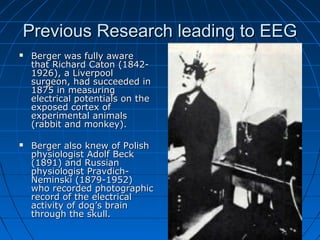
 Berger was fully awareBerger was fully aware
that Richard Caton (1842-that Richard Caton (1842-
1926), a Liverpool1926), a Liverpool
surgeon, had succeeded insurgeon, had succeeded in
1875 in measuring1875 in measuring
electrical potentials on theelectrical potentials on the
exposed cortex ofexposed cortex of
experimental animalsexperimental animals
(rabbit and monkey).(rabbit and monkey).
 Berger also knew of PolishBerger also knew of Polish
physiologist Adolf Beckphysiologist Adolf Beck
(1891) and Russian(1891) and Russian
physiologist Pravdich-physiologist Pravdich-
Neminski (1879-1952)Neminski (1879-1952)
who recorded photographicwho recorded photographic
record of the electricalrecord of the electrical
activity of dog’s brainactivity of dog’s brain
through the skull.through the skull.
SecrecySecrecy
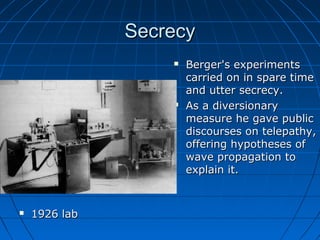
 1926 lab1926 lab
 Berger's experimentsBerger's experiments
carried on in spare timecarried on in spare time
and utter secrecy.and utter secrecy.
 As a diversionaryAs a diversionary
measure he gave publicmeasure he gave public
discourses on telepathy,discourses on telepathy,
offering hypotheses ofoffering hypotheses of
wave propagation towave propagation to
explain it.explain it.
First EEG (1924)First EEG (1924)
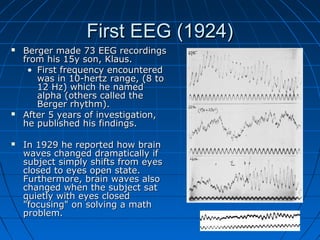
 Berger made 73 EEG recordingsBerger made 73 EEG recordings
from his 15y son, Klaus.from his 15y son, Klaus.
• First frequency encounteredFirst frequency encountered
was in 10-hertz range, (8 towas in 10-hertz range, (8 to
12 Hz) which he named12 Hz) which he named
alpha (others called thealpha (others called the
Berger rhythm).Berger rhythm).
 After 5 years of investigation,After 5 years of investigation,
he published his findings.he published his findings.
 In 1929 he reported how brainIn 1929 he reported how brain
waves changed dramatically ifwaves changed dramatically if
subject simply shifts from eyessubject simply shifts from eyes
closed to eyes open state.closed to eyes open state.
Furthermore, brain waves alsoFurthermore, brain waves also
changed when the subject satchanged when the subject sat
quietly with eyes closedquietly with eyes closed
"focusing" on solving a math"focusing" on solving a math
problem.problem.
Recognition came lateRecognition came late
He studied normal subjectsHe studied normal subjects
and brain-injured,and brain-injured,
thereby laying thethereby laying the
foundation for thefoundation for the
application of theapplication of the
technique to clinicaltechnique to clinical
technology.technology.
 In 1937 invited to presideIn 1937 invited to preside
with Adrian atwith Adrian at
symposium on electricalsymposium on electrical
activity in the nervousactivity in the nervous
system at the Congresssystem at the Congress
of Psychology in Paris.of Psychology in Paris.
They hailed Berger as theThey hailed Berger as the
most distinguished of allmost distinguished of all
the visitors.the visitors.
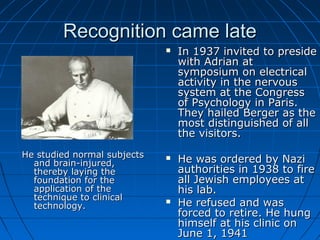
 He was ordered by NaziHe was ordered by Nazi
authorities in 1938 to fireauthorities in 1938 to fire
all Jewish employees atall Jewish employees at
his lab.his lab.
 He refused and wasHe refused and was
forced to retire. He hungforced to retire. He hung
himself at his clinic onhimself at his clinic on
June 1, 1941June 1, 1941
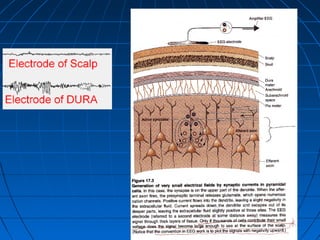
ElectrophysiologyElectrophysiology
 spontaneous activity,spontaneous activity,
 evoked potentials, andevoked potentials, and
 single neuron recordingssingle neuron recordings
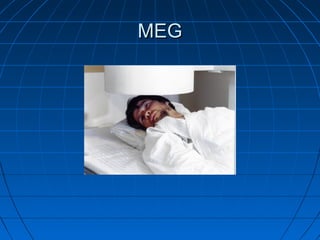
MEGMEG
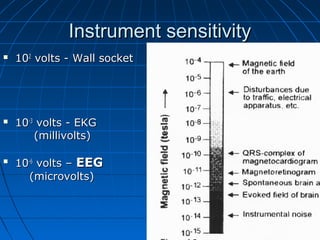
Instrument sensitivityInstrument sensitivity
 101022
volts - Wall socketvolts - Wall socket
 1010-3-3
volts - EKGvolts - EKG
(millivolts)(millivolts)

1010-6-6
volts –volts – EEGEEG
(microvolts)(microvolts)
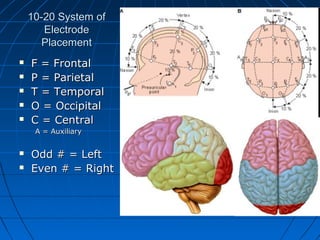
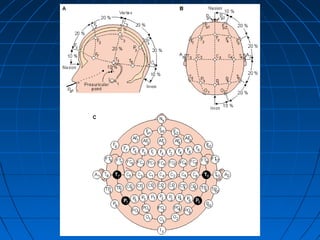
10-20 System of10-20 System of
ElectrodeElectrode
PlacementPlacement
 F = FrontalF = Frontal
 P = ParietalP = Parietal
 T = TemporalT = Temporal
 O = OccipitalO = Occipital
 C = CentralC = Central
A = AuxiliaryA = Auxiliary
 Odd # = LeftOdd # = Left
 Even # = RightEven # = Right
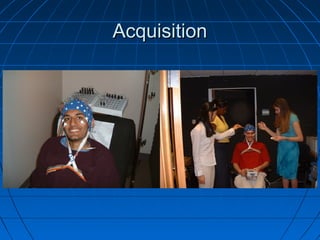
AcquisitionAcquisition
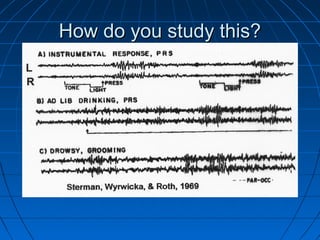
How do you study this?How do you study this?
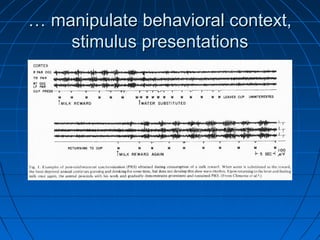
…… manipulate behavioral context,manipulate behavioral context,
stimulus presentationsstimulus presentations
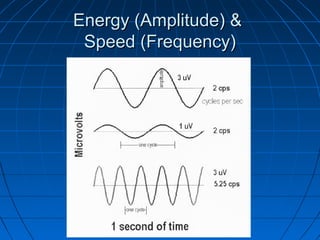
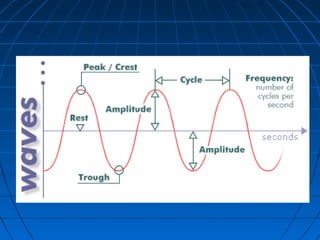
Energy (Amplitude) &Energy (Amplitude) &
Speed (Frequency)Speed (Frequency)
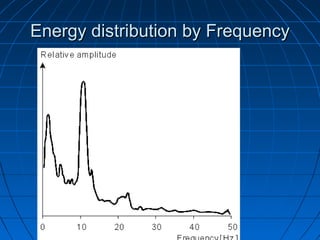
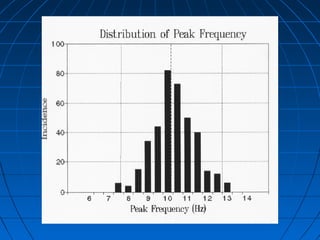
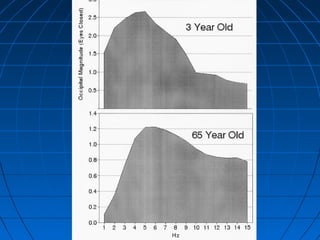
Energy distribution by FrequencyEnergy distribution by Frequency
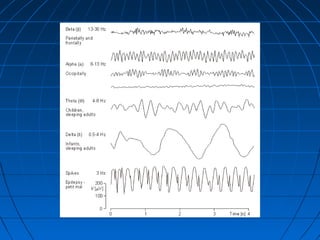
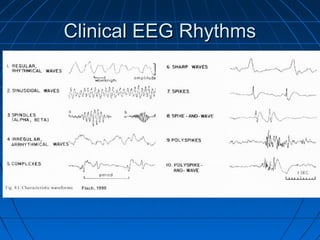
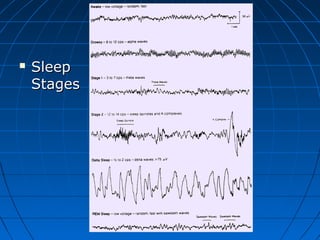
Clinical EEG RhythmsClinical EEG Rhythms
 SleepSleep
StagesStages
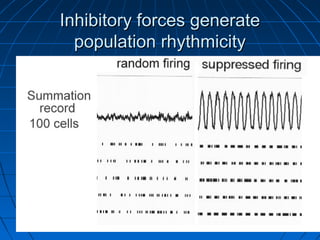
Inhibitory forces generateInhibitory forces generate
population rhythmicitypopulation rhythmicity
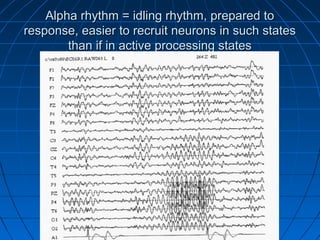
Alpha rhythm = idling rhythm, prepared toAlpha rhythm = idling rhythm, prepared to
response, easier to recruit neurons in such statesresponse, easier to recruit neurons in such states
than if in active processing statesthan if in active processing states
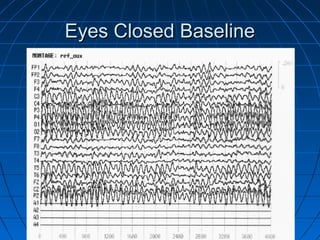
Eyes Closed BaselineEyes Closed Baseline
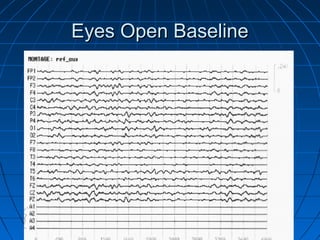
Eyes Open BaselineEyes Open Baseline
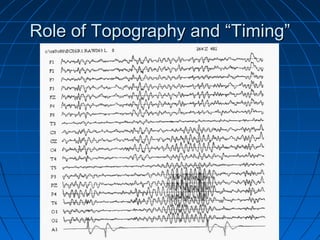
Role of Topography and “Timing”Role of Topography and “Timing”
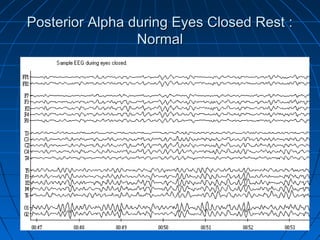
Posterior Alpha during Eyes Closed Rest :Posterior Alpha during Eyes Closed Rest :
NormalNormal
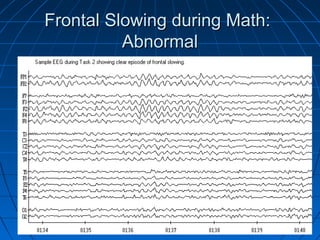
Frontal Slowing during Math:Frontal Slowing during Math:
AbnormalAbnormal
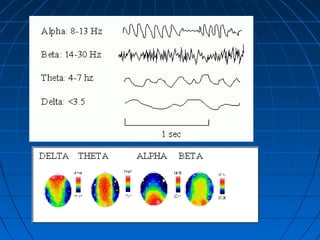
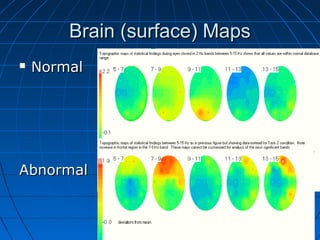
Brain (surface) MapsBrain (surface) Maps
 NormalNormal
AbnormalAbnormal
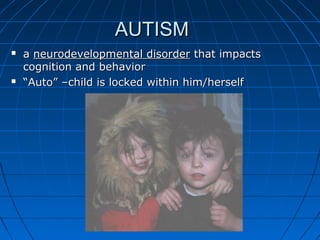
AUTISMAUTISM
 aa neurodevelopmental disorderneurodevelopmental disorder that impactsthat impacts
cognition and behaviorcognition and behavior
 ““Auto” –child is locked within him/herselfAuto” –child is locked within him/herself
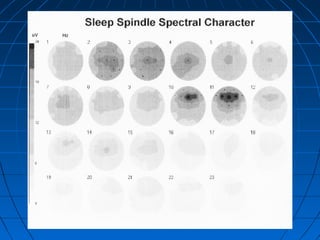
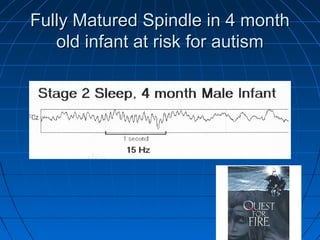
Sleep Spindle matures by 3 months of ageSleep Spindle matures by 3 months of age
1969 study where spindles in1969 study where spindles in
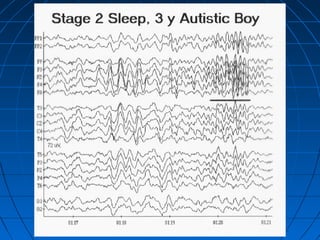
autistics ranged from 10.5-15 Hzautistics ranged from 10.5-15 Hz
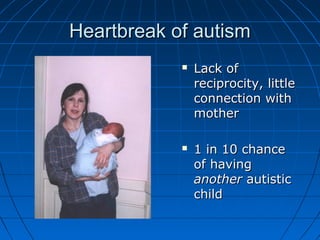
Heartbreak of autismHeartbreak of autism
 Lack ofLack of
reciprocity, littlereciprocity, little
connection withconnection with
mothermother
 1 in 10 chance1 in 10 chance
of havingof having
anotheranother autisticautistic
childchild
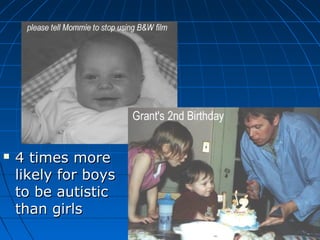
 4 times more4 times more
likely for boyslikely for boys
to be autisticto be autistic
than girlsthan girls
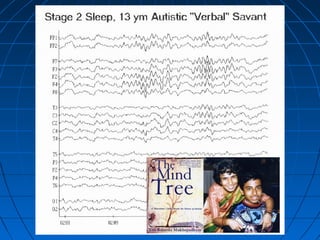
Fully Matured Spindle in 4 monthFully Matured Spindle in 4 month
old infant at risk for autismold infant at risk for autism
Perfectly Normal BoyPerfectly Normal Boy

547.02 intro to eeg

  • 1.
  • 2.
    Hans Berger (1873-1941)HansBerger (1873-1941)  Trauma as a soldierTrauma as a soldier threatened emotionalthreatened emotional connection between him andconnection between him and his sister, experienced ashis sister, experienced as psychic transmission.psychic transmission.  After the war he became aAfter the war he became a psychiatrist and worked onpsychiatrist and worked on the technology until hethe technology until he obtained first recording inobtained first recording in 1924.1924.  From 1929 to 1938 heFrom 1929 to 1938 he published 14 scientific paperspublished 14 scientific papers investigating EEG in clinicalinvestigating EEG in clinical and normal populations.and normal populations.
  • 3.
    Brain waves werefirst studied toBrain waves were first studied to help explain a psychic experiencehelp explain a psychic experience  WWI German soldierWWI German soldier  As a soldier in theAs a soldier in the German Army in firstGerman Army in first decade of 1900, Bergerdecade of 1900, Berger fell off his horse directlyfell off his horse directly in front of artillery cartin front of artillery cart and was nearly run overand was nearly run over  When he returned to HQ,When he returned to HQ, telegram from his fathertelegram from his father saying his sister hadsaying his sister had feeling that he had beenfeeling that he had been injuredinjured  Berger would exploreBerger would explore physical means of suchphysical means of such psychic transmissionspsychic transmissions
  • 4.
    Brain activity &psychic actionBrain activity & psychic action  He studied bloodHe studied blood circulation in brain (1901).circulation in brain (1901). He investigated influenceHe investigated influence of heartbeat, respiration,of heartbeat, respiration, vasomotor functions, andvasomotor functions, and position of the head andposition of the head and body on brain pulsationsbody on brain pulsations measured through anmeasured through an opening (trephined) in theopening (trephined) in the skull, but information wasskull, but information was limited and ultimatelylimited and ultimately disappointing.disappointing.  In 1902 he measuredIn 1902 he measured electrical activity aboveelectrical activity above skull defects with capillaryskull defects with capillary electrometer; later aelectrometer; later a galvanometer.galvanometer.
  • 5.
    Previous Research leadingto EEGPrevious Research leading to EEG  Berger was fully awareBerger was fully aware that Richard Caton (1842-that Richard Caton (1842- 1926), a Liverpool1926), a Liverpool surgeon, had succeeded insurgeon, had succeeded in 1875 in measuring1875 in measuring electrical potentials on theelectrical potentials on the exposed cortex ofexposed cortex of experimental animalsexperimental animals (rabbit and monkey).(rabbit and monkey).  Berger also knew of PolishBerger also knew of Polish physiologist Adolf Beckphysiologist Adolf Beck (1891) and Russian(1891) and Russian physiologist Pravdich-physiologist Pravdich- Neminski (1879-1952)Neminski (1879-1952) who recorded photographicwho recorded photographic record of the electricalrecord of the electrical activity of dog’s brainactivity of dog’s brain through the skull.through the skull.
  • 6.
    SecrecySecrecy  1926 lab1926lab  Berger's experimentsBerger's experiments carried on in spare timecarried on in spare time and utter secrecy.and utter secrecy.  As a diversionaryAs a diversionary measure he gave publicmeasure he gave public discourses on telepathy,discourses on telepathy, offering hypotheses ofoffering hypotheses of wave propagation towave propagation to explain it.explain it.
  • 7.
    First EEG (1924)FirstEEG (1924)  Berger made 73 EEG recordingsBerger made 73 EEG recordings from his 15y son, Klaus.from his 15y son, Klaus. • First frequency encounteredFirst frequency encountered was in 10-hertz range, (8 towas in 10-hertz range, (8 to 12 Hz) which he named12 Hz) which he named alpha (others called thealpha (others called the Berger rhythm).Berger rhythm).  After 5 years of investigation,After 5 years of investigation, he published his findings.he published his findings.  In 1929 he reported how brainIn 1929 he reported how brain waves changed dramatically ifwaves changed dramatically if subject simply shifts from eyessubject simply shifts from eyes closed to eyes open state.closed to eyes open state. Furthermore, brain waves alsoFurthermore, brain waves also changed when the subject satchanged when the subject sat quietly with eyes closedquietly with eyes closed "focusing" on solving a math"focusing" on solving a math problem.problem.
  • 8.
    Recognition came lateRecognitioncame late He studied normal subjectsHe studied normal subjects and brain-injured,and brain-injured, thereby laying thethereby laying the foundation for thefoundation for the application of theapplication of the technique to clinicaltechnique to clinical technology.technology.  In 1937 invited to presideIn 1937 invited to preside with Adrian atwith Adrian at symposium on electricalsymposium on electrical activity in the nervousactivity in the nervous system at the Congresssystem at the Congress of Psychology in Paris.of Psychology in Paris. They hailed Berger as theThey hailed Berger as the most distinguished of allmost distinguished of all the visitors.the visitors.  He was ordered by NaziHe was ordered by Nazi authorities in 1938 to fireauthorities in 1938 to fire all Jewish employees atall Jewish employees at his lab.his lab.  He refused and wasHe refused and was forced to retire. He hungforced to retire. He hung himself at his clinic onhimself at his clinic on June 1, 1941June 1, 1941
  • 9.
    ElectrophysiologyElectrophysiology  spontaneous activity,spontaneousactivity,  evoked potentials, andevoked potentials, and  single neuron recordingssingle neuron recordings
  • 10.
  • 12.
    Instrument sensitivityInstrument sensitivity 101022 volts - Wall socketvolts - Wall socket  1010-3-3 volts - EKGvolts - EKG (millivolts)(millivolts)  1010-6-6 volts –volts – EEGEEG (microvolts)(microvolts)
  • 14.
    10-20 System of10-20System of ElectrodeElectrode PlacementPlacement  F = FrontalF = Frontal  P = ParietalP = Parietal  T = TemporalT = Temporal  O = OccipitalO = Occipital  C = CentralC = Central A = AuxiliaryA = Auxiliary  Odd # = LeftOdd # = Left  Even # = RightEven # = Right
  • 17.
  • 18.
    How do youstudy this?How do you study this?
  • 19.
    …… manipulate behavioralcontext,manipulate behavioral context, stimulus presentationsstimulus presentations
  • 21.
    Energy (Amplitude) &Energy(Amplitude) & Speed (Frequency)Speed (Frequency)
  • 23.
    Energy distribution byFrequencyEnergy distribution by Frequency
  • 25.
  • 26.
  • 27.
    Inhibitory forces generateInhibitoryforces generate population rhythmicitypopulation rhythmicity
  • 28.
    Alpha rhythm =idling rhythm, prepared toAlpha rhythm = idling rhythm, prepared to response, easier to recruit neurons in such statesresponse, easier to recruit neurons in such states than if in active processing statesthan if in active processing states
  • 30.
    Eyes Closed BaselineEyesClosed Baseline
  • 31.
  • 33.
    Role of Topographyand “Timing”Role of Topography and “Timing”
  • 34.
    Posterior Alpha duringEyes Closed Rest :Posterior Alpha during Eyes Closed Rest : NormalNormal
  • 35.
    Frontal Slowing duringMath:Frontal Slowing during Math: AbnormalAbnormal
  • 37.
    Brain (surface) MapsBrain(surface) Maps  NormalNormal AbnormalAbnormal
  • 38.
    AUTISMAUTISM  aa neurodevelopmentaldisorderneurodevelopmental disorder that impactsthat impacts cognition and behaviorcognition and behavior  ““Auto” –child is locked within him/herselfAuto” –child is locked within him/herself
  • 41.
    Sleep Spindle maturesby 3 months of ageSleep Spindle matures by 3 months of age
  • 43.
    1969 study wherespindles in1969 study where spindles in autistics ranged from 10.5-15 Hzautistics ranged from 10.5-15 Hz
  • 44.
    Heartbreak of autismHeartbreakof autism  Lack ofLack of reciprocity, littlereciprocity, little connection withconnection with mothermother  1 in 10 chance1 in 10 chance of havingof having anotheranother autisticautistic childchild
  • 45.
     4 timesmore4 times more likely for boyslikely for boys to be autisticto be autistic than girlsthan girls
  • 46.
    Fully Matured Spindlein 4 monthFully Matured Spindle in 4 month old infant at risk for autismold infant at risk for autism
  • 47.