Introduction:
• Unwanted electrical activity arising from
different sources, other than cerebral
activity
• EEG -highly sensitive recording device,
easily interrupted by other electrical activity
of very high voltages
• Some readily distinguished, others closely
resemble cerebral activity .
Principles used to discriminate
artifacts from EEG signals:
• Physiological activity has a logical
topographic field of distribution with an
expected fall off of voltage potentials.
• Artifacts have an illogical distribution that
defies the principles of localization
Classification:
• Physiological : from patient’s own
physiological generator sources other than
the brain
• Extraphysiological : Externally generated
e.g. instrumental & environmental
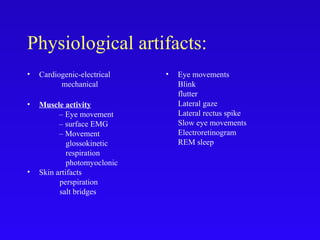
Physiological artifacts:
• Cardiogenic-electrical
mechanical
• Muscle activity
– Eye movement
– surface EMG
– Movement
glossokinetic
respiration
photomyoclonic
• Skin artifacts
perspiration
salt bridges
• Eye movements
Blink
flutter
Lateral gaze
Lateral rectus spike
Slow eye movements
Electroretinogram
REM sleep
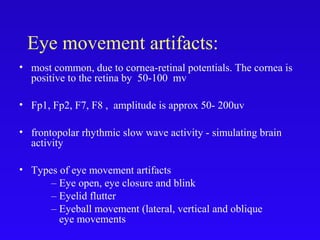
Eye movement artifacts:
• most common, due to cornea-retinal potentials. The cornea is
positive to the retina by 50-100 mv
• Fp1, Fp2, F7, F8 , amplitude is approx 50- 200uv
• frontopolar rhythmic slow wave activity - simulating brain
activity
• Types of eye movement artifacts
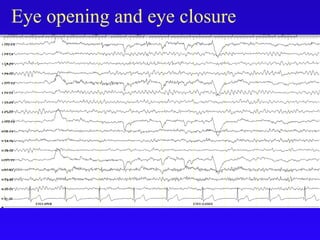
– Eye open, eye closure and blink
– Eyelid flutter
– Eyeball movement (lateral, vertical and oblique
eye movements
Eye opening and eye closure
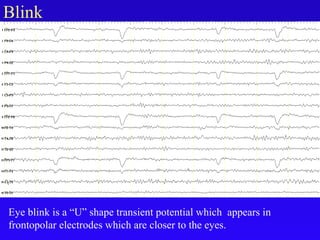
Blink
Eye blink is a “U” shape transient potential which appears in
frontopolar electrodes which are closer to the eyes.
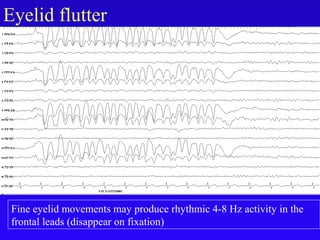
Eyelid flutter
Fine eyelid movements may produce rhythmic 4-8 Hz activity in the
frontal leads (disappear on fixation)
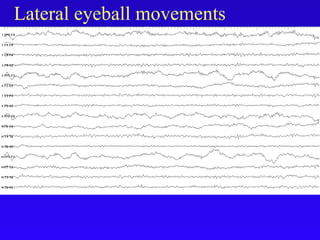
Lateral eyeball movements
Elimination:
• close the eyes or eye fixation
• close his eyes with his fingers or place a
soft cloth or a cotton pads over the closed
eyelids
• Monitoring eye movements by placing
extraocular electrodes will easily help to
distinguish from frontal slow waves
Muscle (EMG) artifacts:
• EMG artifacts are due to the muscle contraction
superimposed upon the EEG activity
• The motor unit potentials (MUPs) arising from
the scalp muscles may cause misinterpretation by
resembling spike or cortical β-activity
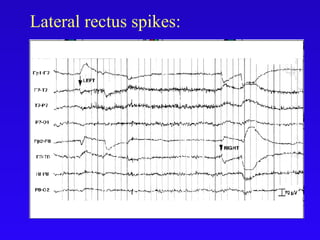
Lateral rectus spikes:
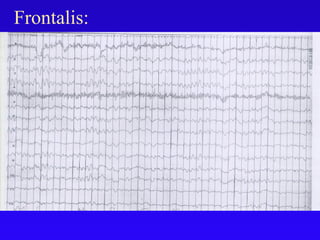
Frontalis:
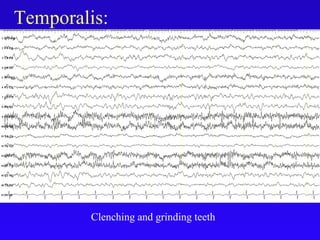
Temporalis:
Clenching and grinding teeth
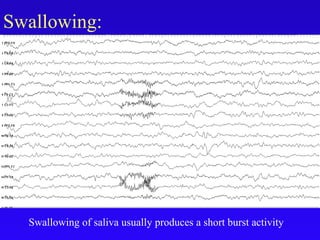
Swallowing:
Swallowing of saliva usually produces a short burst activity
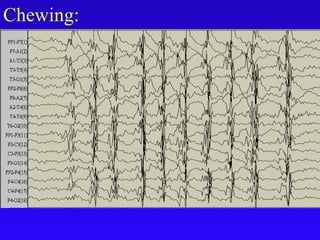
Chewing:
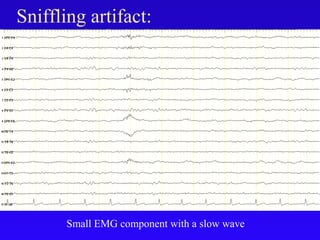
Sniffling artifact:
Small EMG component with a slow wave
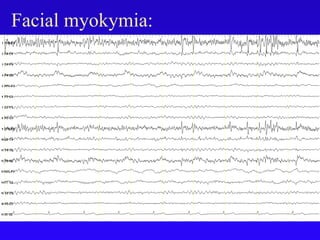
Facial myokymia:
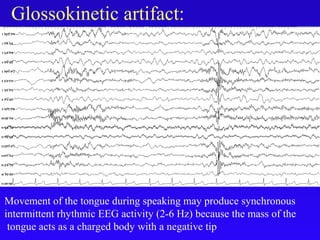
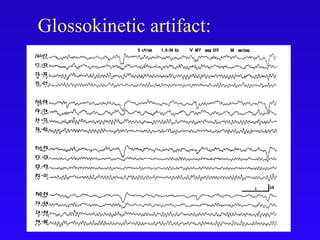
Glossokinetic artifact:
Movement of the tongue during speaking may produce synchronous
intermittent rhythmic EEG activity (2-6 Hz) because the mass of the
tongue acts as a charged body with a negative tip
Glossokinetic artifact:
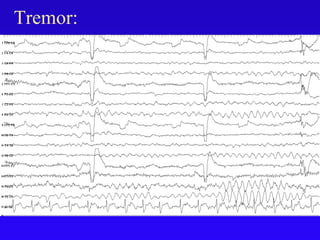
Tremor:
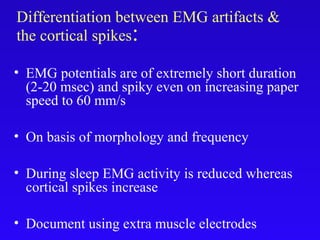
Differentiation between EMG artifacts &
the cortical spikes:
• EMG potentials are of extremely short duration
(2-20 msec) and spiky even on increasing paper
speed to 60 mm/s
• On basis of morphology and frequency
• During sleep EMG activity is reduced whereas
cortical spikes increase
• Document using extra muscle electrodes
Reduction/elimination:
• Frontalis - close eyelids lightly and relax
• Temporalis - opening the mouth
• Use of relaxation techniques (reassuring,
comforting the patient),Massaging the particular
muscle groups
• Occipitalis - putting the pillow under the neck
• As a last resort change the high frequency filter to
35/15 Hz
Cardiogenic artifacts:
• EP arising in the cardiac muscles, high in amplitude
• Spread to scalp by volume conduction
• Prominent in babies, obese, short – neck, cardiomegaly
• Referential montage picks up ECG artifact due to large
interelectrode distances and close proximity of ear
electrodes to the heart
• Equipotential on the scalp - not picked up in bipolar
montage
Types:
• ECG
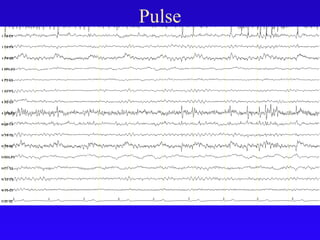
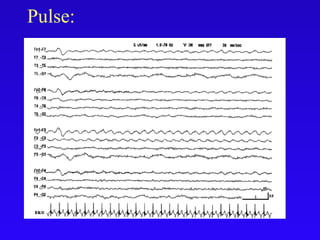
• Pulse
• Pacemaker
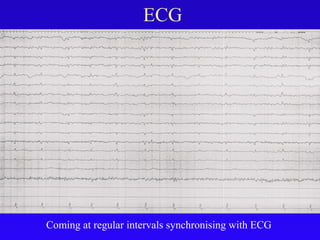
ECG
Coming at regular intervals synchronising with ECG
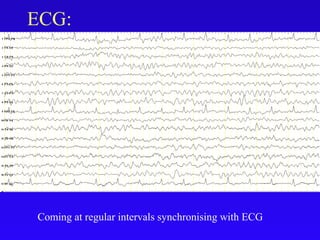
ECG:
Coming at regular intervals synchronising with ECG
Pulse
Pulse:
Elimination:
• Changing the head position relative to the
thorax
• Lower the electrode resistance (A1 and A2)
or use body earth (A1+A2)
• Change reference to Cz
• Shift the electrode a little - eliminate pulse
wave
Sweat artifact:
• Warm and humid recording room
• Anxiety and emotional tension
• Autonomic dysfunction
• Electrical potentials due to sweat glands
• Reduction in the skin resistance (GSR)
• NaCl and lactic acid of sweat may produce
large base line sways
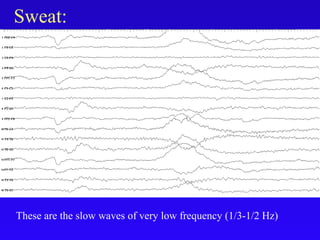
Sweat:
These are the slow waves of very low frequency (1/3-1/2 Hz)
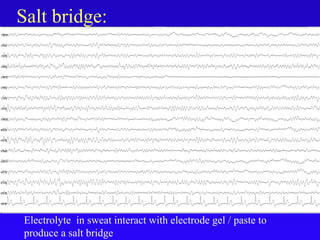
Salt bridge:
Electrolyte in sweat interact with electrode gel / paste to
produce a salt bridge
Elimination:
• Proper air conditioning
• Reducing emotional stress
• Sponging the patient’s face & forehead with
alcohol/spirit
• Setting the short time constant (LFF) if all the
efforts fail
Movement artifacts:
• Movement of head, body and limbs produce irregular
high voltage potentials
• Movement of the head during HV or respiration can
produce occipital electrode artifacts
• Movement associated with seizure may obscure
cerebral activity
• Artifacts may occur in essential tremors, Parkinson
disease and other movement disorders
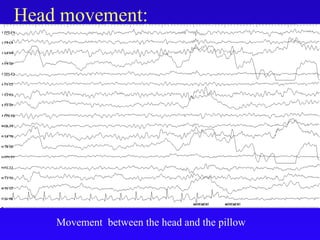
Head movement:
Movement between the head and the pillow
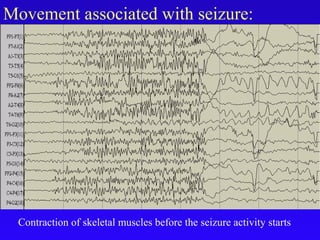
Movement associated with seizure:
Contraction of skeletal muscles before the seizure activity starts
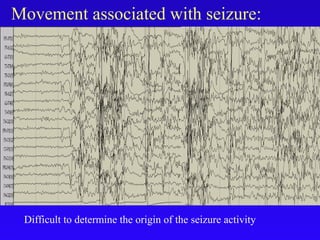
Movement associated with seizure:
Difficult to determine the origin of the seizure activity
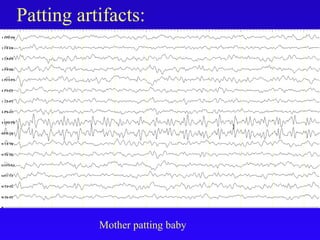
Patting artifacts:
Mother patting baby
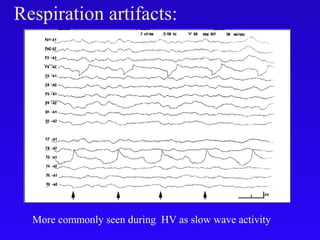
Respiration artifacts:
More commonly seen during HV as slow wave activity
Reduction/elimination:
• Solicit the co-operation of the patient to be calm
and still
• Changing the position or turning the patient over
will diminish tremor artifacts
• Placing a roll of towel or firm material under the
neck may do away with respiratory artifacts
Extra physiological artifacts:
– Electrode –electrode pop, contact
–Technical-lead movement, placement
–Instrumental –AC 60hz artifact
ventilator, circulatory pumps
–Iv fluids
– Environmental-mobile, TV, radio,
electromagnetic
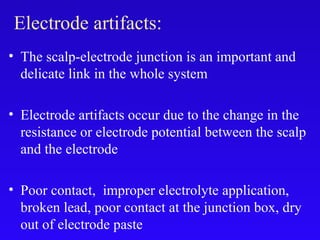
• The scalp-electrode junction is an important and
delicate link in the whole system
• Electrode artifacts occur due to the change in the
resistance or electrode potential between the scalp
and the electrode
• Poor contact, improper electrolyte application,
broken lead, poor contact at the junction box, dry
out of electrode paste
Electrode artifacts:
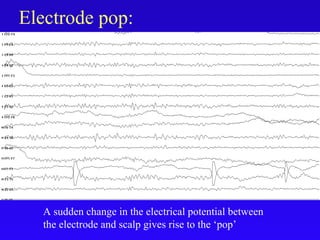
Electrode pop:
A sudden change in the electrical potential between
the electrode and scalp gives rise to the ‘pop’
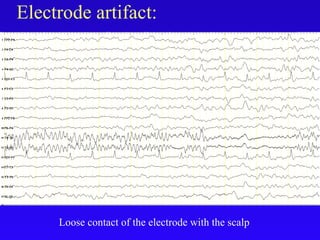
Electrode artifact:
Loose contact of the electrode with the scalp
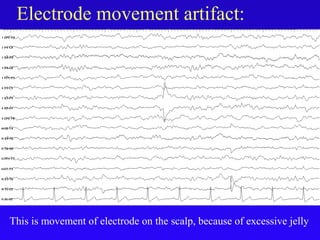
Electrode movement artifact:
This is movement of electrode on the scalp, because of excessive jelly
Recognition & differentiation from cerebral activity:
• Electrode artifact is strictly confined to one lead or channels
having input from this electrode, where as cerebral activity
would usually spread to the adjacent electrodes
• In a bipolar montage, the artifacts show mirror images
(like phase reversals) in two adjacent channels
• Wave morphology may change from time to time
Electrode artifacts:
Elimination
• Applying proper electrolyte
• Check electrode impedance & continuity
• Change the electrode
• If it still present change the position at a
distance of 0.5-1cm
Electrode artifacts:
• due to the malfunctioning of certain parts of the machine
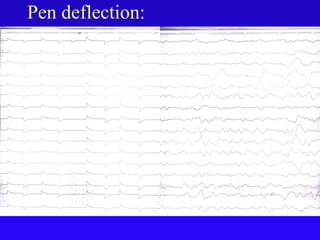
-Pen deflection
-Amplifier
-Galvanometer
-Faulty ground
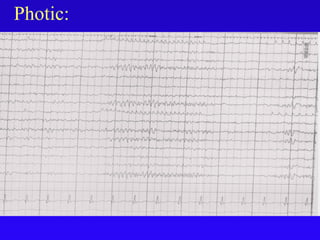
-Photic stimulator
Instrumental:
• Non-symmetrical electrode placement
• Erroneous settings of different channels
• Unequal electrode impedances result in loss of
common mode rejection and recording of AC
artifact
Technical artifacts:
Pen deflection:
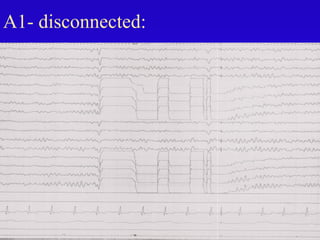
A1- disconnected:
Photic:
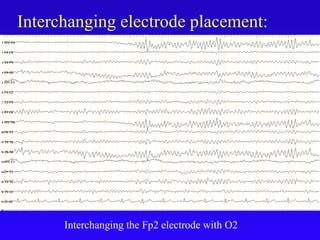
Interchanging electrode placement:
Interchanging the Fp2 electrode with O2
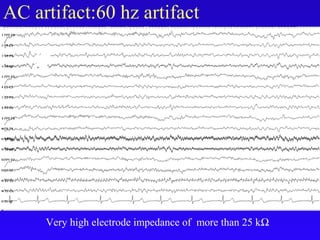
AC artifact:60 hz artifact
Very high electrode impedance of more than 25 kΩ
• troublesome as they cannot be easily controlled by the
technologist
• Movement of other persons
• Types of environmental artifacts:
– Electromagnetic Interference
– Electrostatic Induction
– Radio frequency Interference
• As technology expands – new artifacts appear
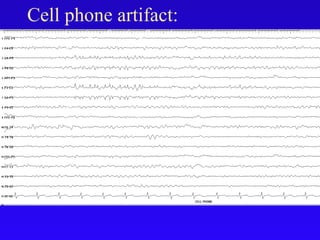
– Mobile phone artifacts
Environmental artifacts:
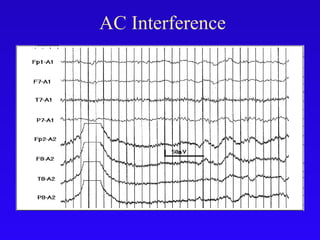
Electromagnetic interference:
• Current flowing through an electrical conductor (main
power supply), produces a magnetic lines of force around
the conductor
• The greater the current, the stronger the field
• Occurs between mains and patient or electrode attached to
the scalp or junction box
• Common sources – power transformers
– Electric motors in lifts, fans, air-conditioners
• AC interference (result of capacitance or inductive effects
on wires leading from the scalp to the junction box)
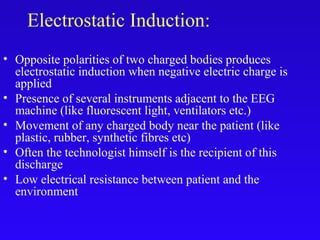
Electrostatic Induction:
• Opposite polarities of two charged bodies produces
electrostatic induction when negative electric charge is
applied
• Presence of several instruments adjacent to the EEG
machine (like fluorescent light, ventilators etc.)
• Movement of any charged body near the patient (like
plastic, rubber, synthetic fibres etc)
• Often the technologist himself is the recipient of this
discharge
• Low electrical resistance between patient and the
environment
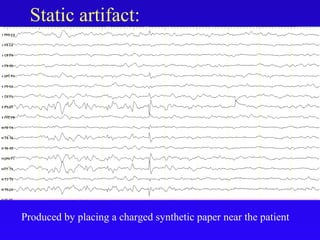
Static artifact:
Produced by placing a charged synthetic paper near the patient
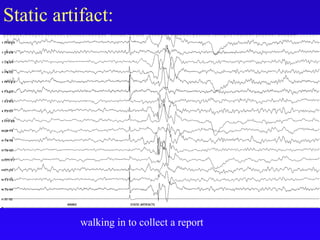
Static artifact:
walking in to collect a report
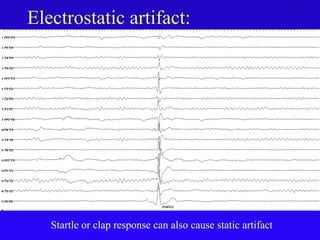
Electrostatic artifact:
Startle or clap response can also cause static artifact
AC Interference
Cell phone artifact:
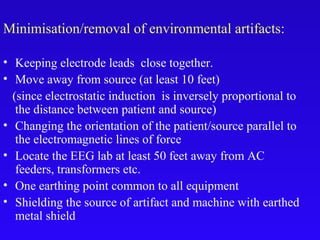
Minimisation/removal of environmental artifacts:
• Keeping electrode leads close together.
• Move away from source (at least 10 feet)
(since electrostatic induction is inversely proportional to
the distance between patient and source)
• Changing the orientation of the patient/source parallel to
the electromagnetic lines of force
• Locate the EEG lab at least 50 feet away from AC
feeders, transformers etc.
• One earthing point common to all equipment
• Shielding the source of artifact and machine with earthed
metal shield
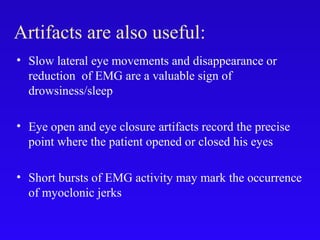
Artifacts are also useful:
• Slow lateral eye movements and disappearance or
reduction of EMG are a valuable sign of
drowsiness/sleep
• Eye open and eye closure artifacts record the precise
point where the patient opened or closed his eyes
• Short bursts of EMG activity may mark the occurrence
of myoclonic jerks
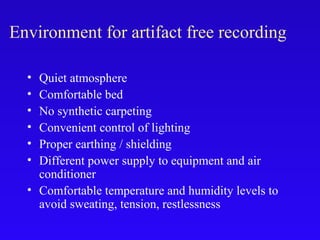
Environment for artifact free recording
• Quiet atmosphere
• Comfortable bed
• No synthetic carpeting
• Convenient control of lighting
• Proper earthing / shielding
• Different power supply to equipment and air
conditioner
• Comfortable temperature and humidity levels to
avoid sweating, tension, restlessness
Thank you

Artifacts in eeg final

  • 1.
    Introduction: • Unwanted electricalactivity arising from different sources, other than cerebral activity • EEG -highly sensitive recording device, easily interrupted by other electrical activity of very high voltages • Some readily distinguished, others closely resemble cerebral activity .
  • 2.
    Principles used todiscriminate artifacts from EEG signals: • Physiological activity has a logical topographic field of distribution with an expected fall off of voltage potentials. • Artifacts have an illogical distribution that defies the principles of localization
  • 3.
    Classification: • Physiological :from patient’s own physiological generator sources other than the brain • Extraphysiological : Externally generated e.g. instrumental & environmental
  • 4.
    Physiological artifacts: • Cardiogenic-electrical mechanical •Muscle activity – Eye movement – surface EMG – Movement glossokinetic respiration photomyoclonic • Skin artifacts perspiration salt bridges • Eye movements Blink flutter Lateral gaze Lateral rectus spike Slow eye movements Electroretinogram REM sleep
  • 5.
    Eye movement artifacts: •most common, due to cornea-retinal potentials. The cornea is positive to the retina by 50-100 mv • Fp1, Fp2, F7, F8 , amplitude is approx 50- 200uv • frontopolar rhythmic slow wave activity - simulating brain activity • Types of eye movement artifacts – Eye open, eye closure and blink – Eyelid flutter – Eyeball movement (lateral, vertical and oblique eye movements
  • 6.
    Eye opening andeye closure
  • 7.
    Blink Eye blink isa “U” shape transient potential which appears in frontopolar electrodes which are closer to the eyes.
  • 8.
    Eyelid flutter Fine eyelidmovements may produce rhythmic 4-8 Hz activity in the frontal leads (disappear on fixation)
  • 9.
  • 10.
    Elimination: • close theeyes or eye fixation • close his eyes with his fingers or place a soft cloth or a cotton pads over the closed eyelids • Monitoring eye movements by placing extraocular electrodes will easily help to distinguish from frontal slow waves
  • 11.
    Muscle (EMG) artifacts: •EMG artifacts are due to the muscle contraction superimposed upon the EEG activity • The motor unit potentials (MUPs) arising from the scalp muscles may cause misinterpretation by resembling spike or cortical β-activity
  • 12.
  • 13.
  • 14.
  • 15.
    Swallowing: Swallowing of salivausually produces a short burst activity
  • 16.
  • 17.
    Sniffling artifact: Small EMGcomponent with a slow wave
  • 18.
  • 19.
    Glossokinetic artifact: Movement ofthe tongue during speaking may produce synchronous intermittent rhythmic EEG activity (2-6 Hz) because the mass of the tongue acts as a charged body with a negative tip
  • 20.
  • 21.
  • 22.
    Differentiation between EMGartifacts & the cortical spikes: • EMG potentials are of extremely short duration (2-20 msec) and spiky even on increasing paper speed to 60 mm/s • On basis of morphology and frequency • During sleep EMG activity is reduced whereas cortical spikes increase • Document using extra muscle electrodes
  • 23.
    Reduction/elimination: • Frontalis -close eyelids lightly and relax • Temporalis - opening the mouth • Use of relaxation techniques (reassuring, comforting the patient),Massaging the particular muscle groups • Occipitalis - putting the pillow under the neck • As a last resort change the high frequency filter to 35/15 Hz
  • 24.
    Cardiogenic artifacts: • EParising in the cardiac muscles, high in amplitude • Spread to scalp by volume conduction • Prominent in babies, obese, short – neck, cardiomegaly • Referential montage picks up ECG artifact due to large interelectrode distances and close proximity of ear electrodes to the heart • Equipotential on the scalp - not picked up in bipolar montage
  • 25.
  • 26.
    ECG Coming at regularintervals synchronising with ECG
  • 27.
    ECG: Coming at regularintervals synchronising with ECG
  • 28.
  • 29.
  • 30.
    Elimination: • Changing thehead position relative to the thorax • Lower the electrode resistance (A1 and A2) or use body earth (A1+A2) • Change reference to Cz • Shift the electrode a little - eliminate pulse wave
  • 31.
    Sweat artifact: • Warmand humid recording room • Anxiety and emotional tension • Autonomic dysfunction • Electrical potentials due to sweat glands • Reduction in the skin resistance (GSR) • NaCl and lactic acid of sweat may produce large base line sways
  • 32.
    Sweat: These are theslow waves of very low frequency (1/3-1/2 Hz)
  • 33.
    Salt bridge: Electrolyte insweat interact with electrode gel / paste to produce a salt bridge
  • 34.
    Elimination: • Proper airconditioning • Reducing emotional stress • Sponging the patient’s face & forehead with alcohol/spirit • Setting the short time constant (LFF) if all the efforts fail
  • 35.
    Movement artifacts: • Movementof head, body and limbs produce irregular high voltage potentials • Movement of the head during HV or respiration can produce occipital electrode artifacts • Movement associated with seizure may obscure cerebral activity • Artifacts may occur in essential tremors, Parkinson disease and other movement disorders
  • 36.
    Head movement: Movement betweenthe head and the pillow
  • 37.
    Movement associated withseizure: Contraction of skeletal muscles before the seizure activity starts
  • 38.
    Movement associated withseizure: Difficult to determine the origin of the seizure activity
  • 39.
  • 40.
    Respiration artifacts: More commonlyseen during HV as slow wave activity
  • 41.
    Reduction/elimination: • Solicit theco-operation of the patient to be calm and still • Changing the position or turning the patient over will diminish tremor artifacts • Placing a roll of towel or firm material under the neck may do away with respiratory artifacts
  • 42.
    Extra physiological artifacts: –Electrode –electrode pop, contact –Technical-lead movement, placement –Instrumental –AC 60hz artifact ventilator, circulatory pumps –Iv fluids – Environmental-mobile, TV, radio, electromagnetic
  • 43.
    • The scalp-electrodejunction is an important and delicate link in the whole system • Electrode artifacts occur due to the change in the resistance or electrode potential between the scalp and the electrode • Poor contact, improper electrolyte application, broken lead, poor contact at the junction box, dry out of electrode paste Electrode artifacts:
  • 44.
    Electrode pop: A suddenchange in the electrical potential between the electrode and scalp gives rise to the ‘pop’
  • 45.
    Electrode artifact: Loose contactof the electrode with the scalp
  • 46.
    Electrode movement artifact: Thisis movement of electrode on the scalp, because of excessive jelly
  • 47.
    Recognition & differentiationfrom cerebral activity: • Electrode artifact is strictly confined to one lead or channels having input from this electrode, where as cerebral activity would usually spread to the adjacent electrodes • In a bipolar montage, the artifacts show mirror images (like phase reversals) in two adjacent channels • Wave morphology may change from time to time Electrode artifacts:
  • 48.
    Elimination • Applying properelectrolyte • Check electrode impedance & continuity • Change the electrode • If it still present change the position at a distance of 0.5-1cm Electrode artifacts:
  • 49.
    • due tothe malfunctioning of certain parts of the machine -Pen deflection -Amplifier -Galvanometer -Faulty ground -Photic stimulator Instrumental:
  • 50.
    • Non-symmetrical electrodeplacement • Erroneous settings of different channels • Unequal electrode impedances result in loss of common mode rejection and recording of AC artifact Technical artifacts:
  • 51.
  • 52.
  • 53.
  • 55.
  • 56.
    AC artifact:60 hzartifact Very high electrode impedance of more than 25 kΩ
  • 57.
    • troublesome asthey cannot be easily controlled by the technologist • Movement of other persons • Types of environmental artifacts: – Electromagnetic Interference – Electrostatic Induction – Radio frequency Interference • As technology expands – new artifacts appear – Mobile phone artifacts Environmental artifacts:
  • 58.
    Electromagnetic interference: • Currentflowing through an electrical conductor (main power supply), produces a magnetic lines of force around the conductor • The greater the current, the stronger the field • Occurs between mains and patient or electrode attached to the scalp or junction box • Common sources – power transformers – Electric motors in lifts, fans, air-conditioners • AC interference (result of capacitance or inductive effects on wires leading from the scalp to the junction box)
  • 59.
    Electrostatic Induction: • Oppositepolarities of two charged bodies produces electrostatic induction when negative electric charge is applied • Presence of several instruments adjacent to the EEG machine (like fluorescent light, ventilators etc.) • Movement of any charged body near the patient (like plastic, rubber, synthetic fibres etc) • Often the technologist himself is the recipient of this discharge • Low electrical resistance between patient and the environment
  • 60.
    Static artifact: Produced byplacing a charged synthetic paper near the patient
  • 61.
    Static artifact: walking into collect a report
  • 62.
    Electrostatic artifact: Startle orclap response can also cause static artifact
  • 63.
  • 64.
  • 65.
    Minimisation/removal of environmentalartifacts: • Keeping electrode leads close together. • Move away from source (at least 10 feet) (since electrostatic induction is inversely proportional to the distance between patient and source) • Changing the orientation of the patient/source parallel to the electromagnetic lines of force • Locate the EEG lab at least 50 feet away from AC feeders, transformers etc. • One earthing point common to all equipment • Shielding the source of artifact and machine with earthed metal shield
  • 66.
    Artifacts are alsouseful: • Slow lateral eye movements and disappearance or reduction of EMG are a valuable sign of drowsiness/sleep • Eye open and eye closure artifacts record the precise point where the patient opened or closed his eyes • Short bursts of EMG activity may mark the occurrence of myoclonic jerks
  • 67.
    Environment for artifactfree recording • Quiet atmosphere • Comfortable bed • No synthetic carpeting • Convenient control of lighting • Proper earthing / shielding • Different power supply to equipment and air conditioner • Comfortable temperature and humidity levels to avoid sweating, tension, restlessness
  • 68.