ARTIFACTS & NORMAL
VARIANTS
DR.SHAHANAZ AHAMED.M
PAEDIATRIC NEUROLOGIST
GMC,TVM
Artifacts
 Artifacts are pen deflections not caused by
cerebral activity.
 They may be due to
 1)physiological activity originating from the
patient
 2) Interference from power lines or other
electrical sources
 3)Malfunction of the recording system
which includes recording electrodes,
amplifiers, pen motors & paper drive.
Artifacts from patient
 Blinking & other eye movements
 Muscle artifacts
 Movement artifacts
 Heart beat artifacts
 Pulse wave artifact.
 Perspiration artifact
 oropharyngeal artifacts
Interference artifacts
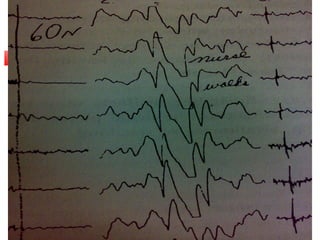
 60 HzArtifact
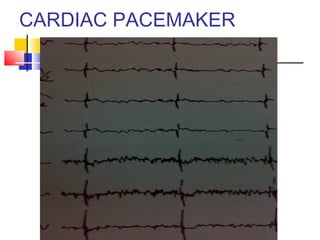
 cardiac pacemaker artifact
 mobile phone artifact
Artifacts from Equipment
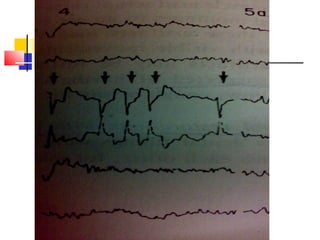
 Electrode poping
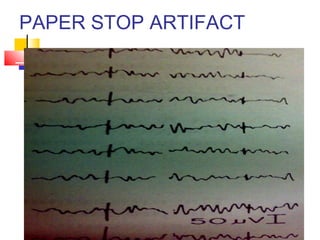
 Paper stop artifact
 Impedence artifact
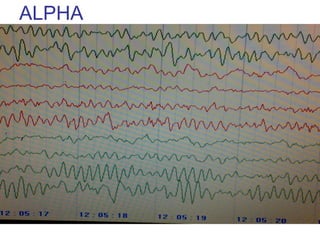
ALPHA
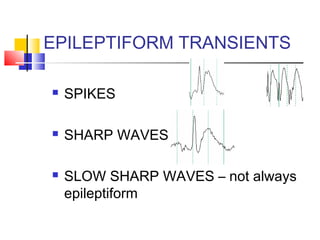
EPILEPTIFORM TRANSIENTS
 SPIKES
 SHARP WAVES
 SLOW SHARP WAVES – not always
epileptiform
Blinking & other eye movements
 These are picked up by frontal electrodes
 Vertical eye movements cause potentials in
electrode pairs in paramedical positions-Fp1-
F3, Fp2-f4 etc
 Lateral eye movements  Deflections in
transverse chains=Fp1-F7, Fp2-F8, F7-F3
 F8-F4 etc
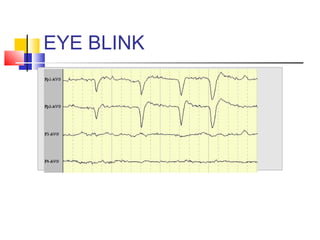
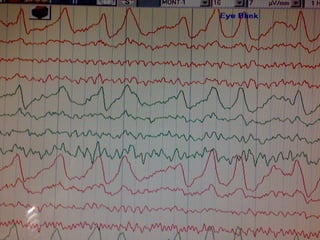
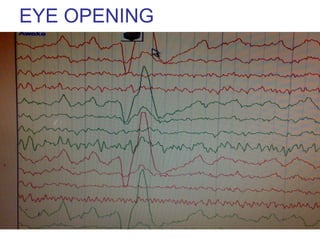
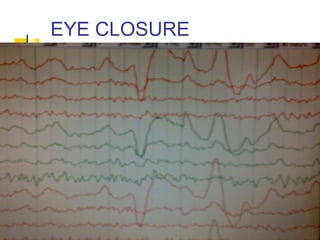
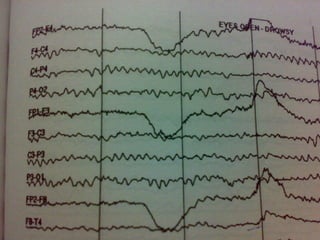
 Blinking or eye closure causes large down
going deflections,
 Eye opening produces upward deflections.
EYE BLINK
EYE OPENING
EYE CLOSURE
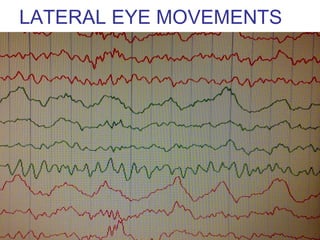
Lateral eye movements
 Lateral eye movements may be
preceded by a single sharp muscle
potential which may resemble a
cerebral spike & in combination with
eye movements form a spike & wave
artifact
LATERAL EYE MOVEMENTS
Eye movement artifacts
 Eye movement artifacts can be
identified by their
 frontal distribution,
 their symmetry on the 2 sides &
 their characteristic shape.
 Slow repetitive rhythmic eye
movements may closely resemble B/L
synchronous frontal slow waves like
FIRDA
 They are stopped by asking the patient
to place his fingertip on the
eyes,tapping cotton balls over the eyes
etc
Muscle artifacts
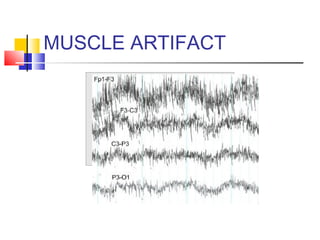
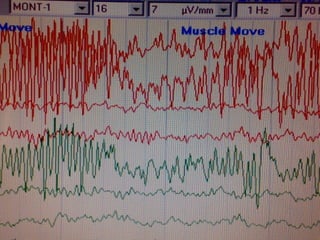
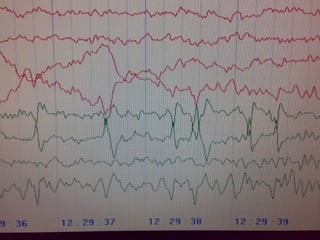
 Muscle activity causes very brief
potentials which usually recur.
 If they recur they resemble cerebral
discharges except that most cerebral
spikes are of much longer duration than
muscle potentials.
 Moreover epileptiform activity usually
has a aftercoming slow wave
associated with a spike.
MUSCLE ARTIFACT
MUSCLE ARTIFACT
 They are usually recorded
predominantly from frontal/ temporal
electrodes but can occur in any
electrodes
 They can be eliminated by asking the
patient to relax, drop the jaw or open
the mouth slightly/change position.
 Repetititive movements such as
chewing, blinking & tremor may give
rise to fast & slow artifacts which
Movement artifacts
 Movement of head /body or other
rhythmic movements such as chewing
& sucking can lead to irregular high
amplitude wave forms which can be
easily recognized.
 They do not have consistency &
characteristics of cerebral discharges
 They can occur in instances such as
restless/ confused patients,infants &
children , patients having
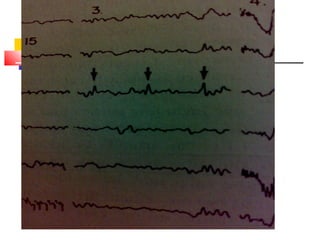
Heart beat artifacts
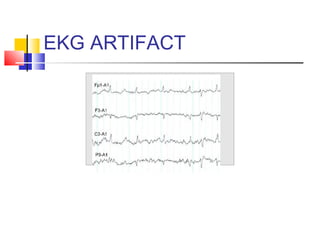
 Mainly in recording with wide
interelectrode distances& in subjects
with short necks.
 Small artifacts reflect mainly the Rwave
of ECG. Large artifacts may reflect
additional components of ecg
EKG ARTIFACT
Heart beat artifacts
 If necessary heart beat can be
eliminated by using a balanced
noncephalic reference.
 They can be identified by the equal
intervals & rate corresponding to heart
rate.
 Simultaneous recording of ecg can be
done in doubtful cases
Pulse wave artifact
 Periodic waves of smooth /triangular
shape may be picked up by electrode
on or near a scalp artery
 .More likely to occur in frontal/temporal
areas. It can be eliminated by
reapplying electrode
Perspiration artifact
 Sweating causes very slow drifting of
electrodes lasting several seconds .
 Usually common in frontal/temporal
electrodes & occurs in several channels
at the same time
Glossokinetic & oropharyngeal
artifacts.
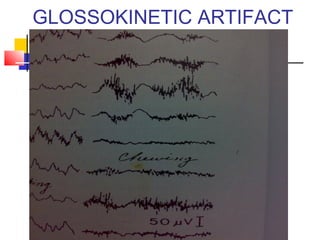
 They produce intermittent /repetitive
slow waves in a wide distribuition often
with a maximum in the middle of the
head
 They occur in speaking, chewing,
swallowing
,sucking,coughing,hiccoughs.
 Palatal myoclonus causes rhythmical
artifacts at the rates of 100-200 /mt.
 Dental spike like artifacts are produced
by dental fillings /dissimilar metals
rubbing against each other
GLOSSOKINETIC ARTIFACT
Interference artifacts
 Artifacts due to electrical interference from
power lines & equipments.
 60 Hz is the frequency. Appears in all
channels.
 Other types of interference include signals
from nearby TV stations,
 radiopaging,Mobile phones
 telephone ringing,cardiac pacemakers,
CARDIAC PACEMAKER
mobile phone artifact
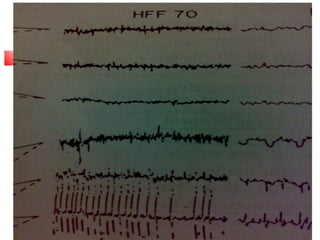
 Another confusing artifact is mobile
phone artifact which may look like a
epileptiform discharge but can be
distinguished by the lack of aftercoming
slow wave & positivity & raggedness of
the artifact wave
Artifacts from Equipment
 They are distinguished in that
 They differ radically from previously
recorded activity,
 Do not blend with other recorded
activity but seem to be superimposed
on it &
 Appear only in channels connected to
the faulty electrode.
Electrode poping
 Electrode poping is due to sudden
changes in electrode contact causing
spike artifact.
PAPER STOP ARTIFACT
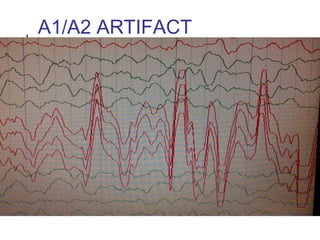
A1/A2 ARTIFACT
NORMAL VARIANTS
 Hyperventilation changes
 Hypnagogic hypersynchrony
 Mu rhythm
 Lambda
 Positive occipital sharp transients of sleep(POSTS}
 Posterior slow waves
 Ctenoids/14 & 6hz positive spikes
 6 hz spike wave
 Rhythmic midtemporal theta-Psychomotor variant
 Small sharp spikes
 Frontal arousal rhythm
HYPERVENTILLATION
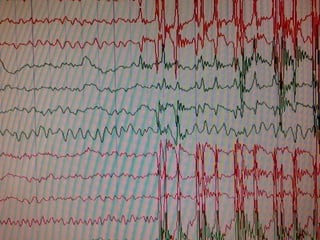
 HV produces bursts of 2—3 HZ
frontally dominant delta activity.
 Normal background in between.
 Can be admixed with sharper
components.
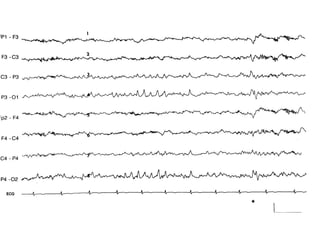
“ V” WAVES
VERTEX WAVES
 Bilaterally synchronous
 Maximum amplitude at vertex
 Extend to central, frontal & parietal
 May appear in sequence
 Shifting asymmetries may occur
 Higher amplitude in youth
 Principal component is sharply contoured
electronegative wave.
 Occurs in light sleep
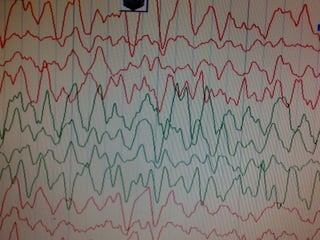
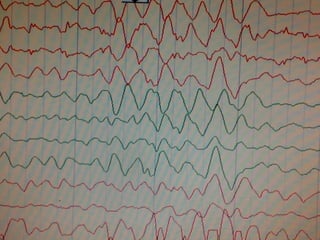
Hypnagogic hypersynchrony
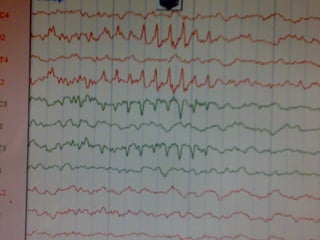
 Prominent bursts of rhythmic high
amplitude delta slowing maximum in the
parasagittal area are a normal finding in
the drowsy state in the first few years
of life
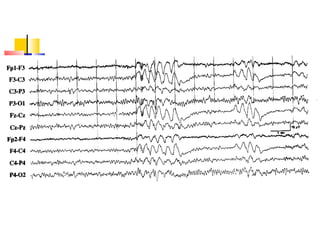
HYPNOGOGIC
HYPERSYNCHRONY
 Appears during transition from wakefulness
to drowsiness
 Seen in age group 5 months to 10 yrs.
 Bursts of 3-5 Hz , moderate to high
amplitude activity.
 Lasts for 1.5 to 3 secs.
 Can be mistaken for spike –wave
activity,when intermixed with faster
frequency components.
Mu rhythm
 It is a 7-11 hz saw tooth shaped rhythm
seen in 15 % recordings
 It can be unilateral/bilateral & seen in
central area
 It is attenuated by touch/ movement
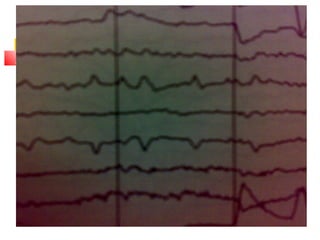
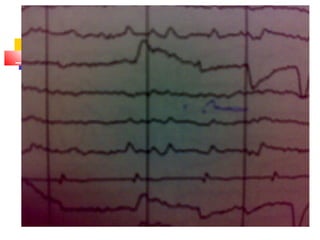
Lambda
 Lambda is low amplitude (< 20micv)
sharp transient bi/triphasic activity
which is surface positive
 It is seen in the waking state due to
visual exploration & attenuated by
closing the eyes
POSTS
( Positive Occipital Sharp Transients of
sleep)
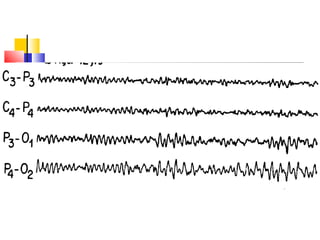
 Occur in NREM sleep ;Esp. stages - 2 & 3
 Occur in occipital region.
 Monophasic, sharp contoured, electropositive
waves.
 Similar to Lamda waves; higher in amplitude
& longer in duration.
 Occur singly or in trains of 4-6 Hz.
 Usually bisynchronous, but may be
asymmetric
POSTS
( Positive Occipital Sharp Transients of
sleep)
 Differentiating points from spikes:

Predominant phase is surface
positive

Monophasic

Occur in trains of 4-5 Hz.

Bilateral occurrence of POSTS
Posterior slow waves
 They are 1-4 hz slow waves seen
spreading from occipital to tremporal to
parietal which are prominent in first
decade.
Ctenoids/14 & 6hz positive
spikes
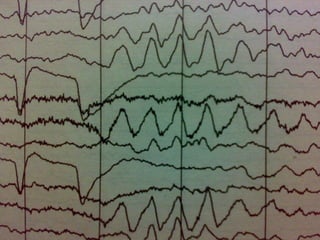
 Seen b/w 5-15 yrs in the posterior head
region as a surface positive comb
shaped rhythm
6 hz spike wave
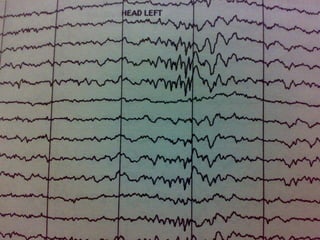
 It is a bisynchronous low amplitude
5-7hz spike wave rhythm most
prevalent in drowsiness & light
sleep.
 It is of gradual onset & offset &
maximal in midcentral/parietal
electrodes
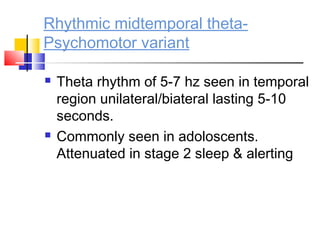
Rhythmic midtemporal theta-
Psychomotor variant
 Theta rhythm of 5-7 hz seen in temporal
region unilateral/biateral lasting 5-10
seconds.
 Commonly seen in adoloscents.
Attenuated in stage 2 sleep & alerting
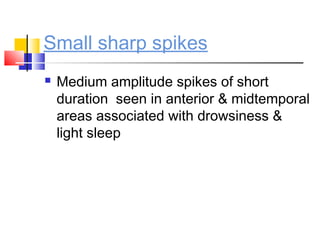
Small sharp spikes
 Medium amplitude spikes of short
duration seen in anterior & midtemporal
areas associated with drowsiness &
light sleep
Frontal arousal rhythm
 They are bursts of rhythmic notched
theta with superadded beta in
midfrontal regions on arising from
sleep,seen in 2-14 yrs lasts upto 20
sec.
 Can resemble ictal pattern. But there is
no evolution
Artifacts & Normal variants in EEG

Artifacts & Normal variants in EEG

  • 1.
    ARTIFACTS & NORMAL VARIANTS DR.SHAHANAZAHAMED.M PAEDIATRIC NEUROLOGIST GMC,TVM
  • 2.
    Artifacts  Artifacts arepen deflections not caused by cerebral activity.  They may be due to  1)physiological activity originating from the patient  2) Interference from power lines or other electrical sources  3)Malfunction of the recording system which includes recording electrodes, amplifiers, pen motors & paper drive.
  • 3.
    Artifacts from patient Blinking & other eye movements  Muscle artifacts  Movement artifacts  Heart beat artifacts  Pulse wave artifact.  Perspiration artifact  oropharyngeal artifacts
  • 4.
    Interference artifacts  60HzArtifact  cardiac pacemaker artifact  mobile phone artifact
  • 5.
    Artifacts from Equipment Electrode poping  Paper stop artifact  Impedence artifact
  • 6.
  • 8.
    EPILEPTIFORM TRANSIENTS  SPIKES SHARP WAVES  SLOW SHARP WAVES – not always epileptiform
  • 9.
    Blinking & othereye movements  These are picked up by frontal electrodes  Vertical eye movements cause potentials in electrode pairs in paramedical positions-Fp1- F3, Fp2-f4 etc  Lateral eye movements  Deflections in transverse chains=Fp1-F7, Fp2-F8, F7-F3  F8-F4 etc
  • 10.
     Blinking oreye closure causes large down going deflections,  Eye opening produces upward deflections.
  • 11.
  • 13.
  • 14.
  • 15.
    Lateral eye movements Lateral eye movements may be preceded by a single sharp muscle potential which may resemble a cerebral spike & in combination with eye movements form a spike & wave artifact
  • 16.
  • 17.
    Eye movement artifacts Eye movement artifacts can be identified by their  frontal distribution,  their symmetry on the 2 sides &  their characteristic shape.
  • 18.
     Slow repetitiverhythmic eye movements may closely resemble B/L synchronous frontal slow waves like FIRDA  They are stopped by asking the patient to place his fingertip on the eyes,tapping cotton balls over the eyes etc
  • 19.
    Muscle artifacts  Muscleactivity causes very brief potentials which usually recur.  If they recur they resemble cerebral discharges except that most cerebral spikes are of much longer duration than muscle potentials.  Moreover epileptiform activity usually has a aftercoming slow wave associated with a spike.
  • 20.
  • 22.
    MUSCLE ARTIFACT  Theyare usually recorded predominantly from frontal/ temporal electrodes but can occur in any electrodes  They can be eliminated by asking the patient to relax, drop the jaw or open the mouth slightly/change position.  Repetititive movements such as chewing, blinking & tremor may give rise to fast & slow artifacts which
  • 23.
    Movement artifacts  Movementof head /body or other rhythmic movements such as chewing & sucking can lead to irregular high amplitude wave forms which can be easily recognized.  They do not have consistency & characteristics of cerebral discharges  They can occur in instances such as restless/ confused patients,infants & children , patients having
  • 26.
    Heart beat artifacts Mainly in recording with wide interelectrode distances& in subjects with short necks.  Small artifacts reflect mainly the Rwave of ECG. Large artifacts may reflect additional components of ecg
  • 28.
  • 29.
    Heart beat artifacts If necessary heart beat can be eliminated by using a balanced noncephalic reference.  They can be identified by the equal intervals & rate corresponding to heart rate.  Simultaneous recording of ecg can be done in doubtful cases
  • 30.
    Pulse wave artifact Periodic waves of smooth /triangular shape may be picked up by electrode on or near a scalp artery  .More likely to occur in frontal/temporal areas. It can be eliminated by reapplying electrode
  • 31.
    Perspiration artifact  Sweatingcauses very slow drifting of electrodes lasting several seconds .  Usually common in frontal/temporal electrodes & occurs in several channels at the same time
  • 32.
    Glossokinetic & oropharyngeal artifacts. They produce intermittent /repetitive slow waves in a wide distribuition often with a maximum in the middle of the head  They occur in speaking, chewing, swallowing ,sucking,coughing,hiccoughs.
  • 33.
     Palatal myoclonuscauses rhythmical artifacts at the rates of 100-200 /mt.  Dental spike like artifacts are produced by dental fillings /dissimilar metals rubbing against each other
  • 34.
  • 35.
    Interference artifacts  Artifactsdue to electrical interference from power lines & equipments.  60 Hz is the frequency. Appears in all channels.  Other types of interference include signals from nearby TV stations,  radiopaging,Mobile phones  telephone ringing,cardiac pacemakers,
  • 38.
  • 39.
    mobile phone artifact Another confusing artifact is mobile phone artifact which may look like a epileptiform discharge but can be distinguished by the lack of aftercoming slow wave & positivity & raggedness of the artifact wave
  • 42.
    Artifacts from Equipment They are distinguished in that  They differ radically from previously recorded activity,  Do not blend with other recorded activity but seem to be superimposed on it &  Appear only in channels connected to the faulty electrode.
  • 43.
    Electrode poping  Electrodepoping is due to sudden changes in electrode contact causing spike artifact.
  • 46.
  • 47.
  • 48.
    NORMAL VARIANTS  Hyperventilationchanges  Hypnagogic hypersynchrony  Mu rhythm  Lambda  Positive occipital sharp transients of sleep(POSTS}  Posterior slow waves  Ctenoids/14 & 6hz positive spikes  6 hz spike wave  Rhythmic midtemporal theta-Psychomotor variant  Small sharp spikes  Frontal arousal rhythm
  • 49.
    HYPERVENTILLATION  HV producesbursts of 2—3 HZ frontally dominant delta activity.  Normal background in between.  Can be admixed with sharper components.
  • 51.
    “ V” WAVES VERTEXWAVES  Bilaterally synchronous  Maximum amplitude at vertex  Extend to central, frontal & parietal  May appear in sequence  Shifting asymmetries may occur  Higher amplitude in youth  Principal component is sharply contoured electronegative wave.  Occurs in light sleep
  • 53.
    Hypnagogic hypersynchrony  Prominentbursts of rhythmic high amplitude delta slowing maximum in the parasagittal area are a normal finding in the drowsy state in the first few years of life
  • 54.
    HYPNOGOGIC HYPERSYNCHRONY  Appears duringtransition from wakefulness to drowsiness  Seen in age group 5 months to 10 yrs.  Bursts of 3-5 Hz , moderate to high amplitude activity.  Lasts for 1.5 to 3 secs.  Can be mistaken for spike –wave activity,when intermixed with faster frequency components.
  • 57.
    Mu rhythm  Itis a 7-11 hz saw tooth shaped rhythm seen in 15 % recordings  It can be unilateral/bilateral & seen in central area  It is attenuated by touch/ movement
  • 59.
    Lambda  Lambda islow amplitude (< 20micv) sharp transient bi/triphasic activity which is surface positive  It is seen in the waking state due to visual exploration & attenuated by closing the eyes
  • 62.
    POSTS ( Positive OccipitalSharp Transients of sleep)  Occur in NREM sleep ;Esp. stages - 2 & 3  Occur in occipital region.  Monophasic, sharp contoured, electropositive waves.  Similar to Lamda waves; higher in amplitude & longer in duration.  Occur singly or in trains of 4-6 Hz.  Usually bisynchronous, but may be asymmetric
  • 63.
    POSTS ( Positive OccipitalSharp Transients of sleep)  Differentiating points from spikes:  Predominant phase is surface positive  Monophasic  Occur in trains of 4-5 Hz.  Bilateral occurrence of POSTS
  • 65.
    Posterior slow waves They are 1-4 hz slow waves seen spreading from occipital to tremporal to parietal which are prominent in first decade.
  • 67.
    Ctenoids/14 & 6hzpositive spikes  Seen b/w 5-15 yrs in the posterior head region as a surface positive comb shaped rhythm
  • 69.
    6 hz spikewave  It is a bisynchronous low amplitude 5-7hz spike wave rhythm most prevalent in drowsiness & light sleep.  It is of gradual onset & offset & maximal in midcentral/parietal electrodes
  • 71.
    Rhythmic midtemporal theta- Psychomotorvariant  Theta rhythm of 5-7 hz seen in temporal region unilateral/biateral lasting 5-10 seconds.  Commonly seen in adoloscents. Attenuated in stage 2 sleep & alerting
  • 73.
    Small sharp spikes Medium amplitude spikes of short duration seen in anterior & midtemporal areas associated with drowsiness & light sleep
  • 75.
    Frontal arousal rhythm They are bursts of rhythmic notched theta with superadded beta in midfrontal regions on arising from sleep,seen in 2-14 yrs lasts upto 20 sec.  Can resemble ictal pattern. But there is no evolution