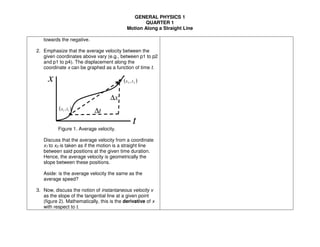
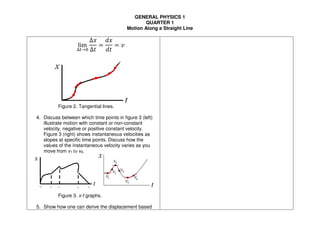
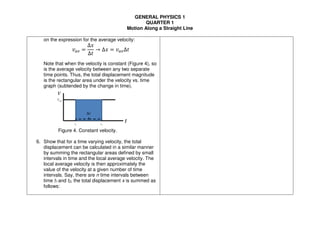
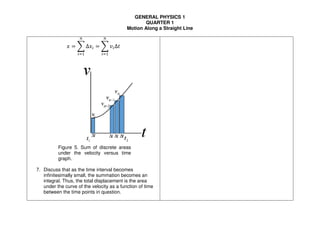
Teaching Guide for Senior High School
GENERAL PHYSICS 1
SPECIALIZED SUBJECT | ACADEMIC - STEM
This Teaching Guide was collaboratively developed and reviewed by educators from public and private schools, colleges, and universities. We
encourage teachers and other education stakeholders to email their feedback, comments, and recommendations to the Commission on
Higher Education, K to 12 Transition Program Management Unit - Senior High School Support Team at k12@ched.gov.ph. We value your
feedback and recommendations.
The Commission on Higher Education
in collaboration with the Philippine Normal University
INITIAL RELEASE: 13 JUNE 2016
This Teaching Guide by the
Commission on Higher Education is
licensed under a Creative
Commons Attribution-
NonCommercial-ShareAlike 4.0
International License. This means
you are free to:
Share — copy and redistribute the
material in any medium or format
Adapt — remix, transform, and
build upon the material.
The licensor, CHED, cannot revoke
these freedoms as long as you
follow the license terms. However,
under the following terms:
Attribution — You must give
appropriate credit, provide a link to
the license, and indicate if changes
were made. You may do so in any
reasonable manner, but not in any
way that suggests the licensor
endorses you or your use.
NonCommercial — You may not use
the material for commercial
purposes.
ShareAlike — If you remix,
transform, or build upon the
material, you must distribute your
contributions under the same license
as the original.
Development Team
Team Leader: Jose Perico H. Esguerra, Ph.D.
Writers: Kendrick A. Agapito, Rommel G. Bacabac,
Ph.D., Jo-Ann M. Cordovilla, John Keith V. Magali,
Ranzivelle Marianne Roxas-Villanueva, Ph.D.
Technical Editor: Eduardo C. Cuansing, Ph.D.,
Voltaire M. Mistades, Ph.D.
Copy Reader: Mariel A. Gabriel
Illustrators: Rachelle Ann J. Bantayan, Andrea Liza T.
Meneses, Danielle Christine Quing
Cover Artists: Paolo Kurtis N. Tan, Renan U. Ortiz
Published by the Commission on Higher Education, 2016

Chairperson: Patricia B. Licuanan, Ph.D.
Commission on Higher Education

K to 12 Transition Program Management Unit

Office Address: 4th Floor, Commission on Higher Education,
C.P. Garcia Ave., Diliman, Quezon City

Telefax: (02) 441-0927 / E-mail Address: k12@ched.gov.ph
Senior High School Support Team

CHED K to 12 Transition Program Management Unit
Program Director: Karol Mark R. Yee
Lead for Senior High School Support:

Gerson M. Abesamis
Course Development Officers:

John Carlo P. Fernando, Danie Son D. Gonzalvo
Lead for Policy Advocacy and Communications:

Averill M. Pizarro
Teacher Training Officers:

Ma. Theresa C. Carlos, Mylene E. Dones
Monitoring and Evaluation Officer:

Robert Adrian N. Daulat
Administrative Officers: 

Ma. Leana Paula B. Bato, Kevin Ross D. Nera,
Allison A. Danao, Ayhen Loisse B. Dalena
Printed in the Philippines by EC-TEC Commercial, No. 32 St.
Louis Compound 7, Baesa, Quezon City, ectec_com@yahoo.com
Consultants
THIS PROJECT WAS DEVELOPED WITH THE PHILIPPINE NORMAL UNIVERSITY.

University President: Ester B. Ogena, Ph.D.

VP for Academics: Ma. Antoinette C. Montealegre, Ph.D.

VP for University Relations & Advancement: Rosemarievic V. Diaz, Ph.D.
Ma. Cynthia Rose B. Bautista, Ph.D., CHED

Bienvenido F. Nebres, S.J., Ph.D., Ateneo de Manila University

Carmela C. Oracion, Ph.D., Ateneo de Manila University

Minella C. Alarcon, Ph.D., CHED
Gareth Price, Sheffield Hallam University

Stuart Bevins, Ph.D., Sheffield Hallam University
Introduction
As the Commission supports DepEd’s implementation of Senior High School (SHS), it upholds the vision
and mission of the K to 12 program, stated in Section 2 of Republic Act 10533, or the Enhanced Basic
Education Act of 2013, that “every graduate of basic education be an empowered individual, through a
program rooted on...the competence to engage in work and be productive, the ability to coexist in
fruitful harmony with local and global communities, the capability to engage in creative and critical
thinking, and the capacity and willingness to transform others and oneself.”
To accomplish this, the Commission partnered with the Philippine Normal University (PNU), the National
Center for Teacher Education, to develop Teaching Guides for Courses of SHS. Together with PNU, this
Teaching Guide was studied and reviewed by education and pedagogy experts, and was enhanced with
appropriate methodologies and strategies.
Furthermore, the Commission believes that teachers are the most important partners in attaining this
goal. Incorporated in this Teaching Guide is a framework that will guide them in creating lessons and
assessment tools, support them in facilitating activities and questions, and assist them towards deeper
content areas and competencies. Thus, the introduction of the SHS for SHS Framework.
The SHS for SHS Framework, which stands for “Saysay-Husay-Sarili for Senior High School,” is at the
core of this book. The lessons, which combine high-quality content with flexible elements to
accommodate diversity of teachers and environments, promote these three fundamental concepts:
SAYSAY: MEANING
Why is this important?
Through this Teaching Guide,
teachers will be able to facilitate
an understanding of the value
of the lessons, for each learner
to fully engage in the content
on both the cognitive and
affective levels.
HUSAY: MASTERY
How will I deeply understand this?
Given that developing mastery
goes beyond memorization,
teachers should also aim for
deep understanding of the
subject matter where they lead
learners to analyze and
synthesize knowledge.
SARILI: OWNERSHIP
What can I do with this?
When teachers empower
learners to take ownership of
their learning, they develop
independence and self-
direction, learning about both
the subject matter and
themselves.
SHS for SHS
Framework
Implementing this course at the senior high school level is subject to numerous challenges
with mastery of content among educators tapped to facilitate learning and a lack of
resources to deliver the necessary content and develop skills and attitudes in the learners,
being foremost among these.
In support of the SHS for SHS framework developed by CHED, these teaching guides were
crafted and refined by biologists and biology educators in partnership with educators from
focus groups all over the Philippines to provide opportunities to develop the following:
1. Saysay through meaningful, updated, and context-specific content that highlights
important points and common misconceptions so that learners can connect to their real-
world experiences and future careers;
2. Husay through diverse learning experiences that can be implemented in a resource-
poor classroom or makeshift laboratory that tap cognitive, affective, and psychomotor
domains are accompanied by field-tested teaching tips that aid in facilitating discovery and
development of higher-order thinking skills; and
3. Sarili through flexible and relevant content and performance standards allow
learners the freedom to innovate, make their own decisions, and initiate activities to fully
develop their academic and personal potential.
These ready-to-use guides are helpful to educators new to either the content or biologists
new to the experience of teaching Senior High School due to their enriched content
presented as lesson plans or guides. Veteran educators may also add ideas from these
guides to their repertoire. The Biology Team hopes that this resource may aid in easing the
transition of the different stakeholders into the new curriculum as we move towards the
constant improvement of Philippine education.
About this

Teaching Guide
This Teaching Guide is mapped and aligned to the DepEd SHS Curriculum, designed to be highly
usable for teachers. It contains classroom activities and pedagogical notes, and is integrated with
innovative pedagogies. All of these elements are presented in the following parts:
1. Introduction
• Highlight key concepts and identify the essential questions
• Show the big picture
• Connect and/or review prerequisite knowledge
• Clearly communicate learning competencies and objectives
• Motivate through applications and connections to real-life
2. Motivation
• Give local examples and applications
• Engage in a game or movement activity
• Provide a hands-on/laboratory activity
• Connect to a real-life problem
3. Instruction/Delivery
• Give a demonstration/lecture/simulation/hands-on activity
• Show step-by-step solutions to sample problems
• Give applications of the theory
• Connect to a real-life problem if applicable
4. Practice
• Discuss worked-out examples
• Provide easy-medium-hard questions
• Give time for hands-on unguided classroom work and discovery
• Use formative assessment to give feedback
5. Enrichment
• Provide additional examples and applications
• Introduce extensions or generalisations of concepts
• Engage in reflection questions
• Encourage analysis through higher order thinking prompts
6. Evaluation
• Supply a diverse question bank for written work and exercises
• Provide alternative formats for student work: written homework, journal, portfolio, group/individual
projects, student-directed research project
Parts of the

Teaching Guide
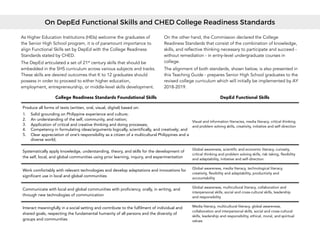
As Higher Education Institutions (HEIs) welcome the graduates of
the Senior High School program, it is of paramount importance to
align Functional Skills set by DepEd with the College Readiness
Standards stated by CHED.
The DepEd articulated a set of 21st century skills that should be
embedded in the SHS curriculum across various subjects and tracks.
These skills are desired outcomes that K to 12 graduates should
possess in order to proceed to either higher education,
employment, entrepreneurship, or middle-level skills development.
On the other hand, the Commission declared the College
Readiness Standards that consist of the combination of knowledge,
skills, and reflective thinking necessary to participate and succeed -
without remediation - in entry-level undergraduate courses in
college.
The alignment of both standards, shown below, is also presented in
this Teaching Guide - prepares Senior High School graduates to the
revised college curriculum which will initially be implemented by AY
2018-2019.
College Readiness Standards Foundational Skills DepEd Functional Skills
Produce all forms of texts (written, oral, visual, digital) based on:
1. Solid grounding on Philippine experience and culture;
2. An understanding of the self, community, and nation;
3. Application of critical and creative thinking and doing processes;
4. Competency in formulating ideas/arguments logically, scientifically, and creatively; and
5. Clear appreciation of one’s responsibility as a citizen of a multicultural Philippines and a
diverse world;
Visual and information literacies, media literacy, critical thinking
and problem solving skills, creativity, initiative and self-direction
Systematically apply knowledge, understanding, theory, and skills for the development of
the self, local, and global communities using prior learning, inquiry, and experimentation
Global awareness, scientific and economic literacy, curiosity,
critical thinking and problem solving skills, risk taking, flexibility
and adaptability, initiative and self-direction
Work comfortably with relevant technologies and develop adaptations and innovations for
significant use in local and global communities
Global awareness, media literacy, technological literacy,
creativity, flexibility and adaptability, productivity and
accountability
Communicate with local and global communities with proficiency, orally, in writing, and
through new technologies of communication
Global awareness, multicultural literacy, collaboration and
interpersonal skills, social and cross-cultural skills, leadership
and responsibility
Interact meaningfully in a social setting and contribute to the fulfilment of individual and
shared goals, respecting the fundamental humanity of all persons and the diversity of
groups and communities
Media literacy, multicultural literacy, global awareness,
collaboration and interpersonal skills, social and cross-cultural
skills, leadership and responsibility, ethical, moral, and spiritual
values
On DepEd Functional Skills and CHED College Readiness Standards
K to 12 BASIC EDUCATION CURRICULUM
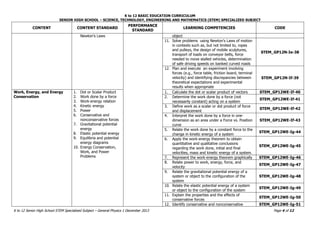
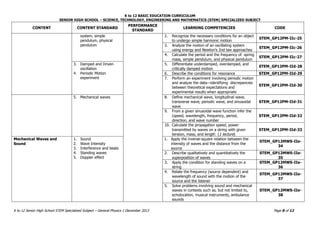
SENIOR HIGH SCHOOL – SCIENCE, TECHNOLOGY, ENGINEERING AND MATHEMATICS (STEM) SPECIALIZED SUBJECT
K to 12 Senior High School STEM Specialized Subject – General Physics 1 December 2013 Page 1 of 12
Grade: 12 Quarters: General Physics 1 (Q1&Q2)
Subject Title: General Physics 1 No. of Hours/ Quarters: 40 hours/ quarter
Prerequisite (if needed): Basic Calculus
Subject Description: Mechanics of particles, rigid bodies, and fluids; waves; and heat and thermodynamics using the methods and concepts of algebra, geometry,
trigonometry, graphical analysis, and basic calculus
CONTENT CONTENT STANDARD
PERFORMANCE
STANDARD
LEARNING COMPETENCIES CODE
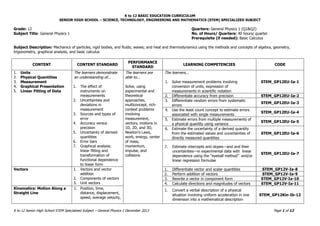
1. Units
2. Physical Quantities
3. Measurement
4. Graphical Presentation
5. Linear Fitting of Data
The learners demonstrate
an understanding of...
1. The effect of
instruments on
measurements
2. Uncertainties and
deviations in
measurement
3. Sources and types of
error
4. Accuracy versus
precision
5. Uncertainty of derived
quantities
6. Error bars
7. Graphical analysis:
linear fitting and
transformation of
functional dependence
to linear form
The learners are
able to...
Solve, using
experimental and
theoretical
approaches,
multiconcept, rich-
context problems
involving
measurement,
vectors, motions in
1D, 2D, and 3D,
Newton’s Laws,
work, energy, center
of mass,
momentum,
impulse, and
collisions
The learners...
1. Solve measurement problems involving
conversion of units, expression of
measurements in scientific notation
STEM_GP12EU-Ia-1
2. Differentiate accuracy from precision STEM_GP12EU-Ia-2
3. Differentiate random errors from systematic
errors
STEM_GP12EU-Ia-3
4. Use the least count concept to estimate errors
associated with single measurements
STEM_GP12EU-Ia-4
5. Estimate errors from multiple measurements of
a physical quantity using variance
STEM_GP12EU-Ia-5
6. Estimate the uncertainty of a derived quantity
from the estimated values and uncertainties of
directly measured quantities
STEM_GP12EU-Ia-6
7. Estimate intercepts and slopes—and and their
uncertainties—in experimental data with linear
dependence using the “eyeball method” and/or
linear regression formulae
STEM_GP12EU-Ia-7
Vectors 1. Vectors and vector
addition
2. Components of vectors
3. Unit vectors
1. Differentiate vector and scalar quantities STEM_GP12V-Ia-8
2. Perform addition of vectors STEM_GP12V-Ia-9
3. Rewrite a vector in component form STEM_GP12V-Ia-10
4. Calculate directions and magnitudes of vectors STEM_GP12V-Ia-11
Kinematics: Motion Along a
Straight Line
1. Position, time,
distance, displacement,
speed, average velocity,
1. Convert a verbal description of a physical
situation involving uniform acceleration in one
dimension into a mathematical description
STEM_GP12Kin-Ib-12
K to 12 BASIC EDUCATION CURRICULUM
SENIOR HIGH SCHOOL – SCIENCE, TECHNOLOGY, ENGINEERING AND MATHEMATICS (STEM) SPECIALIZED SUBJECT
K to 12 Senior High School STEM Specialized Subject – General Physics 1 December 2013 Page 2 of 12
CONTENT CONTENT STANDARD
PERFORMANCE
STANDARD
LEARNING COMPETENCIES CODE
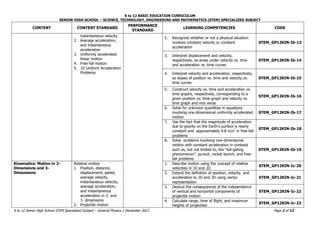
instantaneous velocity
2. Average acceleration,
and instantaneous
acceleration
3. Uniformly accelerated
linear motion
4. Free-fall motion
5. 1D Uniform Acceleration
Problems
2. Recognize whether or not a physical situation
involves constant velocity or constant
acceleration
STEM_GP12KIN-Ib-13
3. Interpret displacement and velocity,
respectively, as areas under velocity vs. time
and acceleration vs. time curves
STEM_GP12KIN-Ib-14
4. Interpret velocity and acceleration, respectively,
as slopes of position vs. time and velocity vs.
time curves
STEM_GP12KIN-Ib-15
5. Construct velocity vs. time and acceleration vs.
time graphs, respectively, corresponding to a
given position vs. time-graph and velocity vs.
time graph and vice versa
STEM_GP12KIN-Ib-16
6. Solve for unknown quantities in equations
involving one-dimensional uniformly accelerated
motion
STEM_GP12KIN-Ib-17
7. Use the fact that the magnitude of acceleration
due to gravity on the Earth’s surface is nearly
constant and approximately 9.8 m/s2
in free-fall
problems
STEM_GP12KIN-Ib-18
8. Solve problems involving one-dimensional
motion with constant acceleration in contexts
such as, but not limited to, the “tail-gating
phenomenon”, pursuit, rocket launch, and free-
fall problems
STEM_GP12KIN-Ib-19
Kinematics: Motion in 2-
Dimensions and 3-
Dimensions
Relative motion
1. Position, distance,
displacement, speed,
average velocity,
instantaneous velocity,
average acceleration,
and instantaneous
acceleration in 2- and
3- dimensions
2. Projectile motion
1. Describe motion using the concept of relative
velocities in 1D and 2D
STEM_GP12KIN-Ic-20
2. Extend the definition of position, velocity, and
acceleration to 2D and 3D using vector
representation
STEM_GP12KIN-Ic-21
3. Deduce the consequences of the independence
of vertical and horizontal components of
projectile motion
STEM_GP12KIN-Ic-22
4. Calculate range, time of flight, and maximum
heights of projectiles
STEM_GP12KIN-Ic-23
K to 12 BASIC EDUCATION CURRICULUM
SENIOR HIGH SCHOOL – SCIENCE, TECHNOLOGY, ENGINEERING AND MATHEMATICS (STEM) SPECIALIZED SUBJECT
K to 12 Senior High School STEM Specialized Subject – General Physics 1 December 2013 Page 3 of 12
CONTENT CONTENT STANDARD
PERFORMANCE
STANDARD
LEARNING COMPETENCIES CODE
3. Circular motion
4. Relative motion
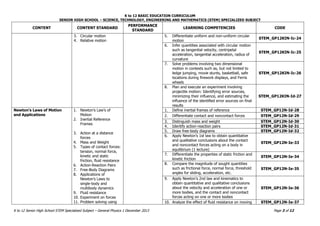
5. Differentiate uniform and non-uniform circular
motion
STEM_GP12KIN-Ic-24
6. Infer quantities associated with circular motion
such as tangential velocity, centripetal
acceleration, tangential acceleration, radius of
curvature
STEM_GP12KIN-Ic-25
7. Solve problems involving two dimensional
motion in contexts such as, but not limited to
ledge jumping, movie stunts, basketball, safe
locations during firework displays, and Ferris
wheels
STEM_GP12KIN-Ic-26
8. Plan and execute an experiment involving
projectile motion: Identifying error sources,
minimizing their influence, and estimating the
influence of the identified error sources on final
results
STEM_GP12KIN-Id-27
Newton’s Laws of Motion
and Applications
1. Newton’s Law’s of
Motion
2. Inertial Reference
Frames
3. Action at a distance
forces
4. Mass and Weight
5. Types of contact forces:
tension, normal force,
kinetic and static
friction, fluid resistance
6. Action-Reaction Pairs
7. Free-Body Diagrams
8. Applications of
Newton’s Laws to
single-body and
multibody dynamics
9. Fluid resistance
10. Experiment on forces
11. Problem solving using
1. Define inertial frames of reference STEM_GP12N-Id-28
2. Differentiate contact and noncontact forces STEM_GP12N-Id-29
3. Distinguish mass and weight STEM_GP12N-Id-30
4. Identify action-reaction pairs STEM_GP12N-Id-31
5. Draw free-body diagrams STEM_GP12N-Id-32
6. Apply Newton’s 1st law to obtain quantitative
and qualitative conclusions about the contact
and noncontact forces acting on a body in
equilibrium (1 lecture)
STEM_GP12N-Ie-33
7. Differentiate the properties of static friction and
kinetic friction
STEM_GP12N-Ie-34
8. Compare the magnitude of sought quantities
such as frictional force, normal force, threshold
angles for sliding, acceleration, etc.
STEM_GP12N-Ie-35
9. Apply Newton’s 2nd law and kinematics to
obtain quantitative and qualitative conclusions
about the velocity and acceleration of one or
more bodies, and the contact and noncontact
forces acting on one or more bodies
STEM_GP12N-Ie-36
10. Analyze the effect of fluid resistance on moving STEM_GP12N-Ie-37
K to 12 BASIC EDUCATION CURRICULUM
SENIOR HIGH SCHOOL – SCIENCE, TECHNOLOGY, ENGINEERING AND MATHEMATICS (STEM) SPECIALIZED SUBJECT
K to 12 Senior High School STEM Specialized Subject – General Physics 1 December 2013 Page 4 of 12
CONTENT CONTENT STANDARD
PERFORMANCE
STANDARD
LEARNING COMPETENCIES CODE
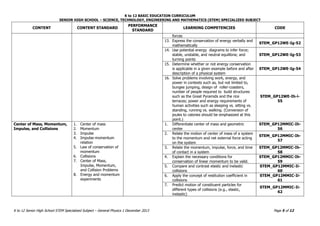
Newton’s Laws object
11. Solve problems using Newton’s Laws of motion
in contexts such as, but not limited to, ropes
and pulleys, the design of mobile sculptures,
transport of loads on conveyor belts, force
needed to move stalled vehicles, determination
of safe driving speeds on banked curved roads
STEM_GP12N-Ie-38
12. Plan and execute an experiment involving
forces (e.g., force table, friction board, terminal
velocity) and identifying discrepancies between
theoretical expectations and experimental
results when appropriate
STEM_GP12N-If-39
Work, Energy, and Energy
Conservation
1. Dot or Scalar Product
2. Work done by a force
3. Work-energy relation
4. Kinetic energy
5. Power
6. Conservative and
nonconservative forces
7. Gravitational potential
energy
8. Elastic potential energy
9. Equilibria and potential
energy diagrams
10. Energy Conservation,
Work, and Power
Problems
1. Calculate the dot or scalar product of vectors STEM_GP12WE-If-40
2. Determine the work done by a force (not
necessarily constant) acting on a system
STEM_GP12WE-If-41
3. Define work as a scalar or dot product of force
and displacement
STEM_GP12WE-If-42
4. Interpret the work done by a force in one-
dimension as an area under a Force vs. Position
curve
STEM_GP12WE-If-43
5. Relate the work done by a constant force to the
change in kinetic energy of a system
STEM_GP12WE-Ig-44
6. Apply the work-energy theorem to obtain
quantitative and qualitative conclusions
regarding the work done, initial and final
velocities, mass and kinetic energy of a system.
STEM_GP12WE-Ig-45
7. Represent the work-energy theorem graphically STEM_GP12WE-Ig-46
8. Relate power to work, energy, force, and
velocity
STEM_GP12WE-Ig-47
9. Relate the gravitational potential energy of a
system or object to the configuration of the
system
STEM_GP12WE-Ig-48
10. Relate the elastic potential energy of a system
or object to the configuration of the system
STEM_GP12WE-Ig-49
11. Explain the properties and the effects of
conservative forces
STEM_GP12WE-Ig-50
12. Identify conservative and nonconservative STEM_GP12WE-Ig-51
K to 12 BASIC EDUCATION CURRICULUM
SENIOR HIGH SCHOOL – SCIENCE, TECHNOLOGY, ENGINEERING AND MATHEMATICS (STEM) SPECIALIZED SUBJECT
K to 12 Senior High School STEM Specialized Subject – General Physics 1 December 2013 Page 5 of 12
CONTENT CONTENT STANDARD
PERFORMANCE
STANDARD
LEARNING COMPETENCIES CODE
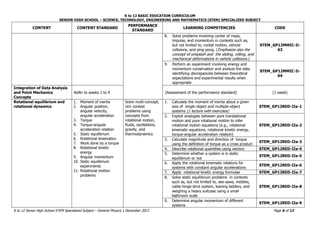
forces
13. Express the conservation of energy verbally and
mathematically
STEM_GP12WE-Ig-52
14. Use potential energy diagrams to infer force;
stable, unstable, and neutral equilibria; and
turning points
STEM_GP12WE-Ig-53
15. Determine whether or not energy conservation
is applicable in a given example before and after
description of a physical system
STEM_GP12WE-Ig-54
16. Solve problems involving work, energy, and
power in contexts such as, but not limited to,
bungee jumping, design of roller-coasters,
number of people required to build structures
such as the Great Pyramids and the rice
terraces; power and energy requirements of
human activities such as sleeping vs. sitting vs.
standing, running vs. walking. (Conversion of
joules to calories should be emphasized at this
point.)
STEM_GP12WE-Ih-i-
55
Center of Mass, Momentum,
Impulse, and Collisions
1. Center of mass
2. Momentum
3. Impulse
4. Impulse-momentum
relation
5. Law of conservation of
momentum
6. Collisions
7. Center of Mass,
Impulse, Momentum,
and Collision Problems
8. Energy and momentum
experiments
1. Differentiate center of mass and geometric
center
STEM_GP12MMIC-Ih-
56
2. Relate the motion of center of mass of a system
to the momentum and net external force acting
on the system
STEM_GP12MMIC-Ih-
57
3. Relate the momentum, impulse, force, and time
of contact in a system
STEM_GP12MMIC-Ih-
58
4. Explain the necessary conditions for
conservation of linear momentum to be valid.
STEM_GP12MMIC-Ih-
59
5. Compare and contrast elastic and inelastic
collisions
STEM_GP12MMIC-Ii-
60
6. Apply the concept of restitution coefficient in
collisions
STEM_GP12MMIC-Ii-
61
7. Predict motion of constituent particles for
different types of collisions (e.g., elastic,
inelastic)
STEM_GP12MMIC-Ii-
62
K to 12 BASIC EDUCATION CURRICULUM
SENIOR HIGH SCHOOL – SCIENCE, TECHNOLOGY, ENGINEERING AND MATHEMATICS (STEM) SPECIALIZED SUBJECT
K to 12 Senior High School STEM Specialized Subject – General Physics 1 December 2013 Page 6 of 12
CONTENT CONTENT STANDARD
PERFORMANCE
STANDARD
LEARNING COMPETENCIES CODE
8. Solve problems involving center of mass,
impulse, and momentum in contexts such as,
but not limited to, rocket motion, vehicle
collisions, and ping-pong. (Emphasize also the
concept of whiplash and the sliding, rolling, and
mechanical deformations in vehicle collisions.)
STEM_GP12MMIC-Ii-
63
9. Perform an experiment involving energy and
momentum conservation and analyze the data
identifying discrepancies between theoretical
expectations and experimental results when
appropriate
STEM_GP12MMIC-Ii-
64
Integration of Data Analysis
and Point Mechanics
Concepts
Refer to weeks 1 to 9 (Assessment of the performance standard) (1 week)
Rotational equilibrium and
rotational dynamics
1. Moment of inertia
2. Angular position,
angular velocity,
angular acceleration
3. Torque
4. Torque-angular
acceleration relation
5. Static equilibrium
6. Rotational kinematics
7. Work done by a torque
8. Rotational kinetic
energy
9. Angular momentum
10. Static equilibrium
experiments
11. Rotational motion
problems
Solve multi-concept,
rich context
problems using
concepts from
rotational motion,
fluids, oscillations,
gravity, and
thermodynamics
1. Calculate the moment of inertia about a given
axis of single-object and multiple-object
systems (1 lecture with exercises)
STEM_GP12RED-IIa-1
2. Exploit analogies between pure translational
motion and pure rotational motion to infer
rotational motion equations (e.g., rotational
kinematic equations, rotational kinetic energy,
torque-angular acceleration relation)
STEM_GP12RED-IIa-2
3. Calculate magnitude and direction of torque
using the definition of torque as a cross product
STEM_GP12RED-IIa-3
4. Describe rotational quantities using vectors STEM_GP12RED-IIa-4
5. Determine whether a system is in static
equilibrium or not
STEM_GP12RED-IIa-5
6. Apply the rotational kinematic relations for
systems with constant angular accelerations
STEM_GP12RED-IIa-6
7. Apply rotational kinetic energy formulae STEM_GP12RED-IIa-7
8. Solve static equilibrium problems in contexts
such as, but not limited to, see-saws, mobiles,
cable-hinge-strut system, leaning ladders, and
weighing a heavy suitcase using a small
bathroom scale
STEM_GP12RED-IIa-8
9. Determine angular momentum of different
systems
STEM_GP12RED-IIa-9
K to 12 BASIC EDUCATION CURRICULUM
SENIOR HIGH SCHOOL – SCIENCE, TECHNOLOGY, ENGINEERING AND MATHEMATICS (STEM) SPECIALIZED SUBJECT
K to 12 Senior High School STEM Specialized Subject – General Physics 1 December 2013 Page 7 of 12
CONTENT CONTENT STANDARD
PERFORMANCE
STANDARD
LEARNING COMPETENCIES CODE
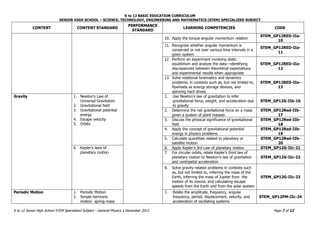
10. Apply the torque-angular momentum relation
STEM_GP12RED-IIa-
10
11. Recognize whether angular momentum is
conserved or not over various time intervals in a
given system
STEM_GP12RED-IIa-
11
12. Perform an experiment involving static
equilibrium and analyze the data—identifying
discrepancies between theoretical expectations
and experimental results when appropriate
STEM_GP12RED-IIa-
12
13. Solve rotational kinematics and dynamics
problems, in contexts such as, but not limited to,
flywheels as energy storage devices, and
spinning hard drives
STEM_GP12RED-IIa-
13
Gravity 1. Newton’s Law of
Universal Gravitation
2. Gravitational field
3. Gravitational potential
energy
4. Escape velocity
5. Orbits
1. Use Newton’s law of gravitation to infer
gravitational force, weight, and acceleration due
to gravity
STEM_GP12G-IIb-16
2. Determine the net gravitational force on a mass
given a system of point masses
STEM_GP12Red-IIb-
17
3. Discuss the physical significance of gravitational
field
STEM_GP12Red-IIb-
18
4. Apply the concept of gravitational potential
energy in physics problems
STEM_GP12Red-IIb-
19
5. Calculate quantities related to planetary or
satellite motion
STEM_GP12Red-IIb-
20
6. Kepler’s laws of
planetary motion
6. Apply Kepler’s 3rd Law of planetary motion STEM_GP12G-IIc-21
7. For circular orbits, relate Kepler’s third law of
planetary motion to Newton’s law of gravitation
and centripetal acceleration
STEM_GP12G-IIc-22
8. Solve gravity-related problems in contexts such
as, but not limited to, inferring the mass of the
Earth, inferring the mass of Jupiter from the
motion of its moons, and calculating escape
speeds from the Earth and from the solar system
STEM_GP12G-IIc-23
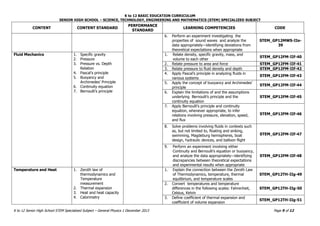
Periodic Motion 1. Periodic Motion
2. Simple harmonic
motion: spring-mass
1. Relate the amplitude, frequency, angular
frequency, period, displacement, velocity, and
acceleration of oscillating systems
STEM_GP12PM-IIc-24
K to 12 BASIC EDUCATION CURRICULUM
SENIOR HIGH SCHOOL – SCIENCE, TECHNOLOGY, ENGINEERING AND MATHEMATICS (STEM) SPECIALIZED SUBJECT
K to 12 Senior High School STEM Specialized Subject – General Physics 1 December 2013 Page 8 of 12
CONTENT CONTENT STANDARD
PERFORMANCE
STANDARD
LEARNING COMPETENCIES CODE
system, simple
pendulum, physical
pendulum
2. Recognize the necessary conditions for an object
to undergo simple harmonic motion
STEM_GP12PM-IIc-25
3. Analyze the motion of an oscillating system
using energy and Newton’s 2nd law approaches
STEM_GP12PM-IIc-26
4. Calculate the period and the frequency of spring
mass, simple pendulum, and physical pendulum
STEM_GP12PM-IIc-27
3. Damped and Driven
oscillation
4. Periodic Motion
experiment
5. Differentiate underdamped, overdamped, and
critically damped motion
STEM_GP12PM-IId-28
6. Describe the conditions for resonance STEM_GP12PM-IId-29
7. Perform an experiment involving periodic motion
and analyze the data—identifying discrepancies
between theoretical expectations and
experimental results when appropriate
STEM_GP12PM-IId-30
5. Mechanical waves 8. Define mechanical wave, longitudinal wave,
transverse wave, periodic wave, and sinusoidal
wave
STEM_GP12PM-IId-31
9. From a given sinusoidal wave function infer the
(speed, wavelength, frequency, period,
direction, and wave number
STEM_GP12PM-IId-32
10. Calculate the propagation speed, power
transmitted by waves on a string with given
tension, mass, and length (1 lecture)
STEM_GP12PM-IId-33
Mechanical Waves and
Sound
1. Sound
2. Wave Intensity
3. Interference and beats
4. Standing waves
5. Doppler effect
1. Apply the inverse-square relation between the
intensity of waves and the distance from the
source
STEM_GP12MWS-IIe-
34
2. Describe qualitatively and quantitatively the
superposition of waves
STEM_GP12MWS-IIe-
35
3. Apply the condition for standing waves on a
string
STEM_GP12MWS-IIe-
36
4. Relate the frequency (source dependent) and
wavelength of sound with the motion of the
source and the listener
STEM_GP12MWS-IIe-
37
5. Solve problems involving sound and mechanical
waves in contexts such as, but not limited to,
echolocation, musical instruments, ambulance
sounds
STEM_GP12MWS-IIe-
38
K to 12 BASIC EDUCATION CURRICULUM
SENIOR HIGH SCHOOL – SCIENCE, TECHNOLOGY, ENGINEERING AND MATHEMATICS (STEM) SPECIALIZED SUBJECT
K to 12 Senior High School STEM Specialized Subject – General Physics 1 December 2013 Page 9 of 12
CONTENT CONTENT STANDARD
PERFORMANCE
STANDARD
LEARNING COMPETENCIES CODE
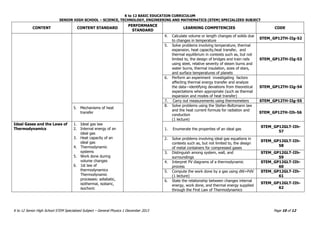
6. Perform an experiment investigating the
properties of sound waves and analyze the
data appropriately—identifying deviations from
theoretical expectations when appropriate
STEM_GP12MWS-IIe-
39
Fluid Mechanics 1. Specific gravity
2. Pressure
3. Pressure vs. Depth
Relation
4. Pascal’s principle
5. Buoyancy and
Archimedes’ Principle
6. Continuity equation
7. Bernoulli’s principle
1. Relate density, specific gravity, mass, and
volume to each other
STEM_GP12FM-IIf-40
2. Relate pressure to area and force STEM_GP12FM-IIf-41
3. Relate pressure to fluid density and depth STEM_GP12FM-IIf-42
4. Apply Pascal’s principle in analyzing fluids in
various systems
STEM_GP12FM-IIf-43
5. Apply the concept of buoyancy and Archimedes’
principle
STEM_GP12FM-IIf-44
6. Explain the limitations of and the assumptions
underlying Bernoulli’s principle and the
continuity equation
STEM_GP12FM-IIf-45
7. Apply Bernoulli’s principle and continuity
equation, whenever appropriate, to infer
relations involving pressure, elevation, speed,
and flux
STEM_GP12FM-IIf-46
8. Solve problems involving fluids in contexts such
as, but not limited to, floating and sinking,
swimming, Magdeburg hemispheres, boat
design, hydraulic devices, and balloon flight
STEM_GP12FM-IIf-47
9. Perform an experiment involving either
Continuity and Bernoulli’s equation or buoyancy,
and analyze the data appropriately—identifying
discrepancies between theoretical expectations
and experimental results when appropriate
STEM_GP12FM-IIf-48
Temperature and Heat 1. Zeroth law of
thermodynamics and
Temperature
measurement
2. Thermal expansion
3. Heat and heat capacity
4. Calorimetry
1. Explain the connection between the Zeroth Law
of Thermodynamics, temperature, thermal
equilibrium, and temperature scales
STEM_GP12TH-IIg-49
2. Convert temperatures and temperature
differences in the following scales: Fahrenheit,
Celsius, Kelvin
STEM_GP12TH-IIg-50
3. Define coefficient of thermal expansion and
coefficient of volume expansion
STEM_GP12TH-IIg-51
K to 12 BASIC EDUCATION CURRICULUM
SENIOR HIGH SCHOOL – SCIENCE, TECHNOLOGY, ENGINEERING AND MATHEMATICS (STEM) SPECIALIZED SUBJECT
K to 12 Senior High School STEM Specialized Subject – General Physics 1 December 2013 Page 10 of 12
CONTENT CONTENT STANDARD
PERFORMANCE
STANDARD
LEARNING COMPETENCIES CODE
4. Calculate volume or length changes of solids due
to changes in temperature
STEM_GP12TH-IIg-52
5. Solve problems involving temperature, thermal
expansion, heat capacity,heat transfer, and
thermal equilibrium in contexts such as, but not
limited to, the design of bridges and train rails
using steel, relative severity of steam burns and
water burns, thermal insulation, sizes of stars,
and surface temperatures of planets
STEM_GP12TH-IIg-53
6. Perform an experiment investigating factors
affecting thermal energy transfer and analyze
the data—identifying deviations from theoretical
expectations when appropriate (such as thermal
expansion and modes of heat transfer)
STEM_GP12TH-IIg-54
7. Carry out measurements using thermometers STEM_GP12TH-IIg-55
5. Mechanisms of heat
transfer
8. Solve problems using the Stefan-Boltzmann law
and the heat current formula for radiation and
conduction
(1 lecture)
STEM_GP12TH-IIh-56
Ideal Gases and the Laws of
Thermodynamics
1. Ideal gas law
2. Internal energy of an
ideal gas
3. Heat capacity of an
ideal gas
4. Thermodynamic
systems
5. Work done during
volume changes
6. 1st law of
thermodynamics
Thermodynamic
processes: adiabatic,
isothermal, isobaric,
isochoric
1. Enumerate the properties of an ideal gas
STEM_GP12GLT-IIh-
57
2. Solve problems involving ideal gas equations in
contexts such as, but not limited to, the design
of metal containers for compressed gases
STEM_GP12GLT-IIh-
58
3. Distinguish among system, wall, and
surroundings
STEM_GP12GLT-IIh-
59
4. Interpret PV diagrams of a thermodynamic
process
STEM_GP12GLT-IIh-
60
5. Compute the work done by a gas using dW=PdV
(1 lecture)
STEM_GP12GLT-IIh-
61
6. State the relationship between changes internal
energy, work done, and thermal energy supplied
through the First Law of Thermodynamics
STEM_GP12GLT-IIh-
62
K to 12 BASIC EDUCATION CURRICULUM
SENIOR HIGH SCHOOL – SCIENCE, TECHNOLOGY, ENGINEERING AND MATHEMATICS (STEM) SPECIALIZED SUBJECT
K to 12 Senior High School STEM Specialized Subject – General Physics 1 December 2013 Page 11 of 12
CONTENT CONTENT STANDARD
PERFORMANCE
STANDARD
LEARNING COMPETENCIES CODE
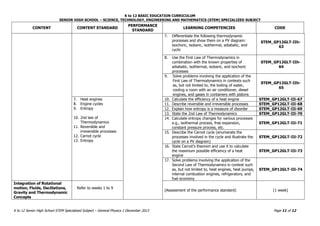
7. Differentiate the following thermodynamic
processes and show them on a PV diagram:
isochoric, isobaric, isothermal, adiabatic, and
cyclic
STEM_GP12GLT-IIh-
63
8. Use the First Law of Thermodynamics in
combination with the known properties of
adiabatic, isothermal, isobaric, and isochoric
processes
STEM_GP12GLT-IIh-
64
9. Solve problems involving the application of the
First Law of Thermodynamics in contexts such
as, but not limited to, the boiling of water,
cooling a room with an air conditioner, diesel
engines, and gases in containers with pistons
STEM_GP12GLT-IIh-
65
7. Heat engines
8. Engine cycles
9. Entropy
10. 2nd law of
Thermodynamics
11. Reversible and
irreversible processes
12. Carnot cycle
13. Entropy
10. Calculate the efficiency of a heat engine STEM_GP12GLT-IIi-67
11. Describe reversible and irreversible processes STEM_GP12GLT-IIi-68
12. Explain how entropy is a measure of disorder STEM_GP12GLT-IIi-69
13. State the 2nd Law of Thermodynamics STEM_GP12GLT-IIi-70
14. Calculate entropy changes for various processes
e.g., isothermal process, free expansion,
constant pressure process, etc.
STEM_GP12GLT-IIi-71
15. Describe the Carnot cycle (enumerate the
processes involved in the cycle and illustrate the
cycle on a PV diagram)
STEM_GP12GLT-IIi-72
16. State Carnot’s theorem and use it to calculate
the maximum possible efficiency of a heat
engine
STEM_GP12GLT-IIi-73
17. Solve problems involving the application of the
Second Law of Thermodynamics in context such
as, but not limited to, heat engines, heat pumps,
internal combustion engines, refrigerators, and
fuel economy
STEM_GP12GLT-IIi-74
Integration of Rotational
motion, Fluids, Oscillations,
Gravity and Thermodynamic
Concepts
Refer to weeks 1 to 9
(Assessment of the performance standard) (1 week)
K to 12 BASIC EDUCATION CURRICULUM
SENIOR HIGH SCHOOL – SCIENCE, TECHNOLOGY, ENGINEERING AND MATHEMATICS (STEM) SPECIALIZED SUBJECT
K to 12 Senior High School STEM Specialized Subject – General Physics 1 December 2013 Page 12 of 12
Code Book Legend
Sample: STEM_GP12GLT-IIi-73
DOMAIN/ COMPONENT CODE
Units and Measurement EU
Vectors V
Kinematics KIN
Newton’s Laws N
Work and Energy WE
Center of Mass, Momentum, Impulse and Collisions MMIC
Rotational Equilibrium and Rotational Dynamics RED
Gravity G
Periodic Motion PM
Mechanical Waves and Sounds MWS
Fluid Mechanics FM
Temperature and Heat TH
Ideal Gases and Laws of Thermodynamics GLT
LEGEND SAMPLE
First Entry
Learning Area and
Strand/ Subject or
Specialization
Science, Technology,
Engineering and Mathematics
General Physics
STEM_GP12GLTGrade Level Grade 12
Uppercase
Letter/s
Domain/Content/
Component/ Topic
Ideal Gases and Laws of
Thermodynamics
-
Roman Numeral
*Zero if no specific
quarter
Quarter Second Quarter II
Lowercase
Letter/s
*Put a hyphen (-) in
between letters to
indicate more than a
specific week
Week Week 9 i
-
Arabic Number Competency
State Carnot’s theorem and
use it to calculate the
maximum possible efficiency
of a heat engine
73
GENERAL PHYSICS 1
QUARTER 1
Units, Physical Quantities, Measurement, Errors and Uncertainties, Graphical Presentation, & Linear Fitting of
Data
GP1-01-1
TOPIC / LESSON NAME GP1 – 01: Units, Physical Quantities, Measurement, Errors and Uncertainties,
Graphical Presentation, and Linear Fitting of Data
CONTENT STANDARDS 1. The effect of instruments on measurements
2. Uncertainties and deviations in measurement
3. Sources and types of error
4. Accuracy versus precision
5. Uncertainty of derived quantities
6. Error bars
7. Graphical analysis: linear fitting and transformation of functional dependence to linear form
PERFORMANCE STANDARDS Solve, using experimental and theoretical approaches, multiconcept, rich-context problems
involving measurement, vectors, motions in 1D, 2D, and 3D, Newton’s Laws, work, energy,
center of mass, momentum, impulse, and collisions
LEARNING COMPETENCIES 1. Solve measurement problems involving conversion of units, expression of
measurements in scientific notation (STEM_GP12EU-Ia-1)
2. Differentiate accuracy from precision (STEM_GP12EU-Ia-2)
3. Differentiate random errors from systematic errors (STEM_GP12EU-Ia-3)
4. Use the least count concept to estimate errors associated with single
measurements (STEM_GP12EU-Ia-4)
5. Estimate errors from multiple measurements of a physical quantity using variance
(STEM_GP12EU-Ia-5)
6. Estimate the uncertainty of a derived quantity from the estimated values and
uncertainties of directly measured quantities (STEM_GP12EU-Ia-6)
7. Estimate intercepts and slopes—and their uncertainties—in experimental data with
linear dependence using the “eyeball method” and/or linear regression formula
(STEM_GP12EU-Ia-7)
SPECIFIC LEARNING OUTCOMES
TIME ALLOTMENT 180 minutes
Lesson Outline:
GENERAL PHYSICS 1
QUARTER 1
Units, Physical Quantities, Measurement, Errors and Uncertainties, Graphical Presentation, & Linear Fitting of
Data
GP1-01-2
1. Physical Quantities
Introduction/Motivation (10 minutes): Talk about the discipline of physics, and the discipline required to
understand physics.
Instruction / Delivery (30 minutes): Units, Conversion of Units, Rounding-Off Numbers
Evaluation (20 minutes)
2. Measurement Uncertainities
Motivation (15 minutes): Discuss the role of measurement and experimentation in physics; Illustrate issues
surrounding measurement through measurement activities involving pairs (e.g. bidy size and pulse rate
measurements)
Instruction/Delivery (30 minutes): Scientific notation and significant figures; Reporting measurements with
uncertainty; Significant figures; Scientific Notation ; Propagation of error; Statistical treatment of uncertainties
Enrichment (15 minutes ): Error propagation using differentials
3. Data Presentation and Report Writing Guidelines
Instruction/Delivery (60 minutes): Graphing; Advantages of converting relations to linear form; “Eye-ball” method
of determining the slope and y-intercept from data; Least squares method of determining the slope and y-intercept
from data; Purpose of a Lab Report; Parts of a Lab Report
MATERIALS ruler, meter stick, tape measure, weighing scale, timer (or watch)
RESOURCES University Physics by Young and Freedman (12th edition)
Physics by Resnick, Halliday, and Krane (4th edition)
PROCEDURE MEETING LEARNERS’
Part 1: Physical quantities
Introduction/Motivation (10 minutes)
1. Introduce the discipline of Physics:
- Invite students to give the first idea that come to their minds whenever
GENERAL PHYSICS 1
QUARTER 1
Units, Physical Quantities, Measurement, Errors and Uncertainties, Graphical Presentation, & Linear Fitting of
Data
GP1-01-3
they hear “Physics”
- Let some students explain why they have such impressions of the field.
- Emphasize that just as any other scholarly field, Physics helped in
shaping the modern world.
2. Steer the discussion towards the notable contributions of Physics to humanity:
- The laws of motion(providing fundamental definitions and concepts to
describe motion and derive the origins of interactions between objects in
the universe)
- Understanding of light, matter, and physical processes
- Quantum mechanics (towards inventions leading to the components in a
cell phone)
3. Physics is science. Physics is fun. It is an exciting adventure in the quest to find
out patterns in nature and find means of understanding phenomena through
careful deductions based on experimental verification. Explain that in order to
study physics, one requires a sense of discipline. That is, one needs to plan how
to study by:
- Understanding how one learns. Explain that everyone is capable of
learning Physics especially if one takes advantage of one’s unique way of
learning. (Those who learn by listening are good in sitting down and
taking notes during lectures; those who learn more by engaging others
and questioning can take advantage of discussion sessions in class or
group study outside classes.)
- Finding time to study. Explain that learning requires time. Easy concepts
require less time to learn compared to more difficult ones. Therefore, one
has to invest more time in topics one finds more difficult. (Do students
study Physics every day? Does one need to prepare before attending a
class? What are the difficult sections one find?)
Instruction / Delivery (30 minutes)
GENERAL PHYSICS 1
QUARTER 1
Units, Physical Quantities, Measurement, Errors and Uncertainties, Graphical Presentation, & Linear Fitting of
Data
GP1-01-4
1. Units
Explain that Physics is an experimental science. Physicists perform
experiments to test hypotheses. Conclusions in experiment are derived from
measurements. And physicists use numbers to describe measurements.
Such a number is called a physical quantity. However, a physical quantity
would make sense to everyone when compared to a reference standard. For
example, when one says, that his or her height is 1.5 meters, this means that
one’s height is 1.5 times a meter stick (or a tape measure that is one meter
long). The meter stick is here considered to be the reference standard. Thus,
stating that one’s height is 1.5 is not as informative.
Since 1960 the system of units used by scientists and engineers is the
“metric system”, which is officially known as the “International System” or SI
units (abbreviation for its French term, Système International).
To make sure that scientists from different parts of the world understand the
same thing when referring to a measurement, standards have been defined
for measurements of length, time, and mass.
Length – 1 meter is defined as the distance travelled by light in a vacuum in
1/299,792,458 second. Based on the definition that the speed of light is
exactly 299,792,458 m/s.
Time – 1 second is defined as 9,192,631,770 cycles of the microwave
radiation due to the transition between the two lowest energy states of the
cesium atom. This is measured from an atomic clock using this transition.
Mass – 1 kg is defined to be the mass of a cylinder of platinum-iridium alloy
at the International Bureau of weights and measures (Sèvres, France).
GENERAL PHYSICS 1
QUARTER 1
Units, Physical Quantities, Measurement, Errors and Uncertainties, Graphical Presentation, & Linear Fitting of
Data
GP1-01-5
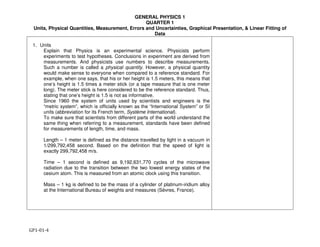
Figure 1. Length across the scales (adapted from University Physics by
Young and Freedman, 12th ed.).
2. Conversion of units
Discuss that a few countries use the British system of units (e.g., the United
States). However, the conversion between the British system of units and SI
units have been defined exactly as follows:
Length: 1 inch = 2.54 cm
Force: 1 pound = 4.448221615260 newtons
The second is exactly the same in both the British and the SI system of units.
How many inches are there in 3 meters?
How much time would it take for light to travel 10,000 feet?
How many inches would light travel in 10 fs? (Refer to Table 1 for the unit
prefix related to factors of 10).
How many newtons of force do you need to lift a 34 pound bag? (Intuitively,
just assume that you need exactly the same amount of force as the weight of
GENERAL PHYSICS 1
QUARTER 1
Units, Physical Quantities, Measurement, Errors and Uncertainties, Graphical Presentation, & Linear Fitting of
Data
GP1-01-6
the bag).
3. Rounding off numbers
Ask the students why one needs to round off numbers. Possible answers
may include reference to estimating a measurement, simplifying a report of a
measurement, etc.
Discuss the rules of rounding off numbers:
a. Know which last digit to keep
b. This last digit remains the same if the next digit is less than 5.
c. Increase this last digit if the next digit is 5 or more.
A rich farmer has 87 goats—round the number of goats to the nearest 10.
Round off to the nearest 10:
314234, 343, 5567, 245, 7891
Round off to the nearest tenths:
3.1416, 745.1324, 8.345, 67.47
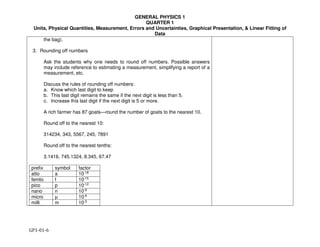
prefix symbol factor
atto a 10-18
femto f 10-15
pico p 10-12
nano n 10-9
micro μ 10-6
milli m 10-3
GENERAL PHYSICS 1
QUARTER 1
Units, Physical Quantities, Measurement, Errors and Uncertainties, Graphical Presentation, & Linear Fitting of
Data
GP1-01-7
sinsinscmscm
s
cm
s
in
cm
in
s
cm
/100.2/020.0/100.5/05.0
20
0.1
6063157480314993700787400.01968503
54.2
1
20
0.1
22
×==×==
=×
centi c 10-2
deci d 10-1
deka da 101
hecto h 102
kilo k 103
mega M 106
giga G 109
tera T 1012
peta P 1015
exa E 1018
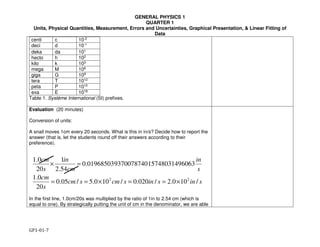
Table 1. Système International (SI) prefixes.
Evaluation (20 minutes)
Conversion of units:
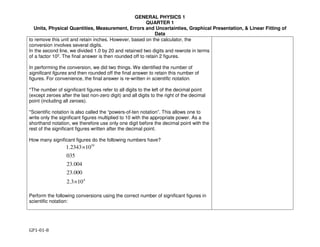
A snail moves 1cm every 20 seconds. What is this in in/s? Decide how to report the
answer (that is, let the students round off their answers according to their
preference).
In the first line, 1.0cm/20s was multiplied by the ratio of 1in to 2.54 cm (which is
equal to one). By strategically putting the unit of cm in the denominator, we are able
GENERAL PHYSICS 1
QUARTER 1
Units, Physical Quantities, Measurement, Errors and Uncertainties, Graphical Presentation, & Linear Fitting of
Data
GP1-01-8
4
10
103.2
000.23
004.23
035
102343.1
×
×
to remove this unit and retain inches. However, based on the calculator, the
conversion involves several digits.
In the second line, we divided 1.0 by 20 and retained two digits and rewrote in terms
of a factor 102. The final answer is then rounded off to retain 2 figures.
In performing the conversion, we did two things. We identified the number of
significant figures and then rounded off the final answer to retain this number of
figures. For convenience, the final answer is re-written in scientific notation.
*The number of significant figures refer to all digits to the left of the decimal point
(except zeroes after the last non-zero digit) and all digits to the right of the decimal
point (including all zeroes).
*Scientific notation is also called the “powers-of-ten notation”. This allows one to
write only the significant figures multiplied to 10 with the appropriate power. As a
shorthand notation, we therefore use only one digit before the decimal point with the
rest of the significant figures written after the decimal point.
How many significant figures do the following numbers have?
Perform the following conversions using the correct number of significant figures in
scientific notation:
GENERAL PHYSICS 1
QUARTER 1
Units, Physical Quantities, Measurement, Errors and Uncertainties, Graphical Presentation, & Linear Fitting of
Data
GP1-01-9
A jeepney tried to overtake a car. The jeepney moves at 75km/hour, convert this to
the British system (feet per second)?
It takes about 8.0 minutes for light to travel from the sun to the earth. How far is the
sun from the earth (in meters, in feet)?
Let students perform the calculations in groups (2-4 people per group). Let
volunteers show their answer on the board.
Part 2: Measurement uncertainties
Motivation for this section (15 minutes)
1. Measurement and experimentation is fundamental to Physics. To test
whether the recognized patterns are consistent, Physicists perform
experiments, leading to new ways of understanding observable phenomena
in nature.
2. Thus, measurement is a primary skill for all scientists. To illustrate issues
surrounding this skill, the following measurement activities can be performed
by volunteer pairs:
a. Body size: weight, height, waistline
From a volunteer pair, ask one to measure the suggested dimensions of
the other person with three trials using a weighing scale and a tape
measure.
Ask the class to express opinions on what the effect of the measurement
tool might have on the true value of a measured physical quantity. What
about the skill of the one measuring?
b. Pulse rate (http://www.webmd.com/heart-disease/pulse-measurement)
Measure the pulse rate 5 times on a single person. Is the measurement
GENERAL PHYSICS 1
QUARTER 1
Units, Physical Quantities, Measurement, Errors and Uncertainties, Graphical Presentation, & Linear Fitting of
Data
GP1-01-10
repeatable?
Instruction / Delivery (30 minutes)
1. Scientific notation and significant figures
Discuss that in reporting a measurement value, one often performs several
trials and calculates the average of the measurements to report a
representative value. The repeated measurements have a range of values
due to several possible sources. For instance, with the use of a tape
measure, a length measurement may vary due to the fact that the tape
measure is not stretched straight in the same manner in all trials.
So what is the height of a table?— A volunteer uses a tape measure to
estimate the height of the teacher’s table. Should this be reported in
millimeters? Centimeters? Meters? Kilometers?
The choice of units can be settled by agreement. However, there are times
when the unit chosen is considered most applicable when the choice allows
easy access to a mental estimate. Thus, a pencil is measured in centimeters
and roads are measured in kilometers.
How high is mount Apo? How many Filipinos are there in the world? How
many children are born every hour in the world?
2. Discuss the following:
a. When the length of a table is 1.51 ± 0.02 m, this means that the true value
is unlikely to be less than 1.49 m or more than 1.53 m. This is how we
report the accuracy of a measurement. The maximum and minimum
provides upper and lower bounds to the true value. The shorthand
notation is reported as 1.51(2) m. The number enclosed in parentheses
GENERAL PHYSICS 1
QUARTER 1
Units, Physical Quantities, Measurement, Errors and Uncertainties, Graphical Presentation, & Linear Fitting of
Data
GP1-01-11
indicates the uncertainty in the final digits of the number.
b. The measurement can also be presented or expressed in terms of the
maximum likely fractional or percent error. Thus, 52 s ± 10% means
that the maximum time is not more than 52 s plus 10% of 52 s (which is
57 s, when we round off 5.2 s to 5 s). Here, the fractional error is (5 s)/52
s.
c. Discuss that the uncertainty can then be expressed by the number of
meaningful digits included in the reported measurement. For instance, in
measuring the area of a rectangle, one may proceed by measuring the
length of its two sides and the area is calculated by the product of these
measurements.
Side 1 = 5.25 cm
Side 2 = 3.15 cm
Note that since the meterstick gives you a precision down to a single
millimeter, there is uncertainty in the measurement within a millimeter.
The side that is a little above 5.2 cm or a little below 5.3 cm is then
reported as 5.25 ± 0.05 cm. However, for this example only we will use
5.25 cm.
Area = 3.25 cm x 2.15 cm = 6.9875 cm2 or 6.99 cm2
Since the precision of the meterstick is only down to a millimeter, the
uncertainty is assumed to be half a millimeter. The area cannot be
reported with a precision lower than half a millimeter and is then rounded
off to the nearest 100th.
d. Review of significant figures
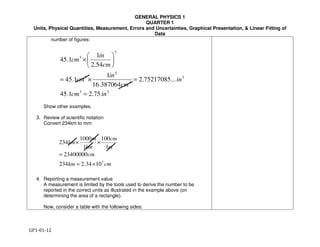
Convert 45.1 cubic cm to cubic inches. Note that since the original
number has 3 figures, the conversion to cubic inches should retain this
GENERAL PHYSICS 1
QUARTER 1
Units, Physical Quantities, Measurement, Errors and Uncertainties, Graphical Presentation, & Linear Fitting of
Data
GP1-01-12
cmkm
cm
m
cm
km
m
km
7
1034.2234
23400000
1
100
1
1000
234
×=
=
××
33
3
3
3
3
3
3
2.751.45
...2.75217085
387064.16
1
1.45
54.2
1
1.45
incm
in
cm
in
cm
cm
in
cm
=
=×=






×
number of figures:
Show other examples.
3. Review of scientific notation
Convert 234km to mm:
4. Reporting a measurement value
A measurement is limited by the tools used to derive the number to be
reported in the correct units as illustrated in the example above (on
determining the area of a rectangle).
Now, consider a table with the following sides:
GENERAL PHYSICS 1
QUARTER 1
Units, Physical Quantities, Measurement, Errors and Uncertainties, Graphical Presentation, & Linear Fitting of
Data
GP1-01-13
222
2
10863.83.886
3299.88613.3523.25
cmcm
cmcmcm
×=
=×
yy
xx
∆±
∆±
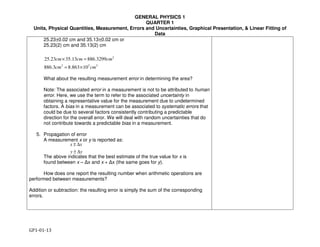
25.23±0.02 cm and 35.13±0.02 cm or
25.23(2) cm and 35.13(2) cm
What about the resulting measurement error in determining the area?
Note: The associated error in a measurement is not to be attributed to human
error. Here, we use the term to refer to the associated uncertainty in
obtaining a representative value for the measurement due to undetermined
factors. A bias in a measurement can be associated to systematic errors that
could be due to several factors consistently contributing a predictable
direction for the overall error. We will deal with random uncertainties that do
not contribute towards a predictable bias in a measurement.
5. Propagation of error
A measurement x or y is reported as:
The above indicates that the best estimate of the true value for x is
found between x – Δx and x + Δx (the same goes for y).
How does one report the resulting number when arithmetic operations are
performed between measurements?
Addition or subtraction: the resulting error is simply the sum of the corresponding
errors.
GENERAL PHYSICS 1
QUARTER 1
Units, Physical Quantities, Measurement, Errors and Uncertainties, Graphical Presentation, & Linear Fitting of
Data
GP1-01-14
yxz
yxz
yy
xx
∆+∆=∆
±=
∆±
∆±





 ∆
+
∆
=∆
∆
+
∆
=
∆
×=
∆±
∆±
y
y
x
x
zz
y
y
x
x
z
z
yxz
yy
xx





 ∆
+
∆
=∆
∆
+
∆
=
∆
=
∆±
∆±
y
y
x
x
zz
y
y
x
x
z
z
y
x
z
yy
xx
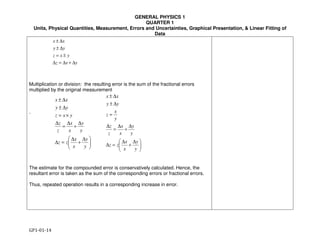
Multiplication or division: the resulting error is the sum of the fractional errors
multiplied by the original measurement
.
The estimate for the compounded error is conservatively calculated. Hence, the
resultant error is taken as the sum of the corresponding errors or fractional errors.
Thus, repeated operation results in a corresponding increase in error.
GENERAL PHYSICS 1
QUARTER 1
Units, Physical Quantities, Measurement, Errors and Uncertainties, Graphical Presentation, & Linear Fitting of
Data
GP1-01-15
xnznxz
x
x
nzzxz
xx
n
∆=∆→=
∆
=∆→=
∆±
( ) ( ) ( ) ( )2222
... qpyxz ∆+∆++∆+∆=∆
2222
... 




 ∆
+




 ∆
++




 ∆
+




 ∆
=∆
q
q
p
p
y
y
x
x
zz
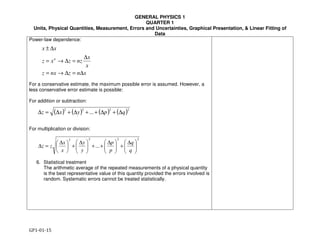
Power-law dependence:
For a conservative estimate, the maximum possible error is assumed. However, a
less conservative error estimate is possible:
For addition or subtraction:
For multiplication or division:
6. Statistical treatment
The arithmetic average of the repeated measurements of a physical quantity
is the best representative value of this quantity provided the errors involved is
random. Systematic errors cannot be treated statistically.
GENERAL PHYSICS 1
QUARTER 1
Units, Physical Quantities, Measurement, Errors and Uncertainties, Graphical Presentation, & Linear Fitting of
Data
GP1-01-16
∑=
=
N
i
im x
N
x
1
1
( )∑=
−
−
=
N
i
mi xx
N
sd
1
2
1
1
N
sd
sdmean =
mean:
standard deviation:
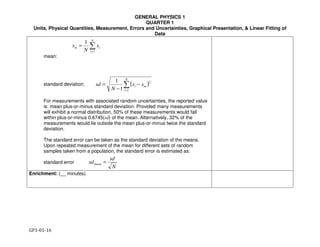
For measurements with associated random uncertainties, the reported value
is: mean plus-or-minus standard deviation. Provided many measurements
will exhibit a normal distribution, 50% of these measurements would fall
within plus-or-minus 0.6745(sd) of the mean. Alternatively, 32% of the
measurements would lie outside the mean plus-or-minus twice the standard
deviation.
The standard error can be taken as the standard deviation of the means.
Upon repeated measurement of the mean for different sets of random
samples taken from a population, the standard error is estimated as:
standard error
Enrichment: (__ minutes)
GENERAL PHYSICS 1
QUARTER 1
Units, Physical Quantities, Measurement, Errors and Uncertainties, Graphical Presentation, & Linear Fitting of
Data
GP1-01-17








∆≈∆
∆
∆
≈
= oxxdx
df
xf
x
f
dx
df
( )
[ ]
)cos(
)sin(
sin
o
xx
o
xxy
x
dx
d
xy
xxx
xy
o
∆≈∆






∆≈∆
∆±=
=
=
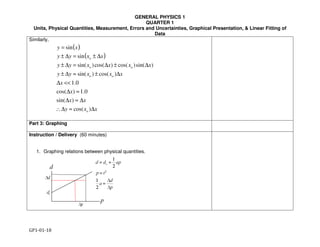
Figure 2. Function of one variable and its error Δf. Given a function f(x), the local
slope at xo is calculated as the first derivative at xo.
Example:
GENERAL PHYSICS 1
QUARTER 1
Units, Physical Quantities, Measurement, Errors and Uncertainties, Graphical Presentation, & Linear Fitting of
Data
GP1-01-18
( )
( )
xxy
xx
x
x
xxxyy
xxxxyy
xxyy
xy
o
oo
oo
o
∆≈∆∴
∆≈∆
≈∆
<<∆
∆±≈∆±
∆±∆=∆±
∆±=∆±
=
)cos(
)sin(
0.1)cos(
0.1
)cos()sin(
)sin()cos()cos()sin(
sin
sin
2
2
1
atdd o +=
Similarly,
Part 3: Graphing
Instruction / Delivery (60 minutes)
1. Graphing relations between physical quantities.
GENERAL PHYSICS 1
QUARTER 1
Units, Physical Quantities, Measurement, Errors and Uncertainties, Graphical Presentation, & Linear Fitting of
Data
GP1-01-19
L
gf
L
g
f
o
o
1
2
1
2
1






=
=
π
π
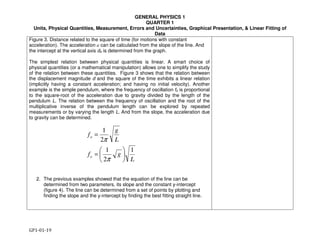
Figure 3. Distance related to the square of time (for motions with constant
acceleration). The acceleration a can be calculated from the slope of the line. And
the intercept at the vertical axis do is determined from the graph.
The simplest relation between physical quantities is linear. A smart choice of
physical quantities (or a mathematical manipulation) allows one to simplify the study
of the relation between these quantities. Figure 3 shows that the relation between
the displacement magnitude d and the square of the time exhibits a linear relation
(implicitly having a constant acceleration; and having no initial velocity). Another
example is the simple pendulum, where the frequency of oscillation fo is proportional
to the square-root of the acceleration due to gravity divided by the length of the
pendulum L. The relation between the frequency of oscillation and the root of the
multiplicative inverse of the pendulum length can be explored by repeated
measurements or by varying the length L. And from the slope, the acceleration due
to gravity can be determined.
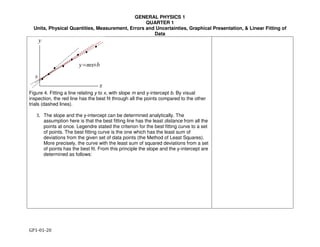
2. The previous examples showed that the equation of the line can be
determined from two parameters, its slope and the constant y-intercept
(figure 4). The line can be determined from a set of points by plotting and
finding the slope and the y-intercept by finding the best fitting straight line.
GENERAL PHYSICS 1
QUARTER 1
Units, Physical Quantities, Measurement, Errors and Uncertainties, Graphical Presentation, & Linear Fitting of
Data
GP1-01-20
Figure 4. Fitting a line relating y to x, with slope m and y-intercept b. By visual
inspection, the red line has the best fit through all the points compared to the other
trials (dashed lines).
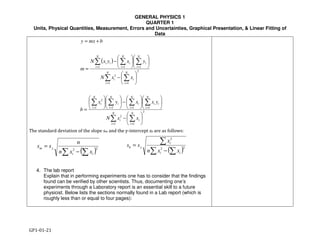
3. The slope and the y-intercept can be determined analytically. The
assumption here is that the best fitting line has the least distance from all the
points at once. Legendre stated the criterion for the best fitting curve to a set
of points. The best fitting curve is the one which has the least sum of
deviations from the given set of data points (the Method of Least Squares).
More precisely, the curve with the least sum of squared deviations from a set
of points has the best fit. From this principle the slope and the y-intercept are
determined as follows:
GENERAL PHYSICS 1
QUARTER 1
Units, Physical Quantities, Measurement, Errors and Uncertainties, Graphical Presentation, & Linear Fitting of
Data
GP1-01-21
( )∑ ∑
∑
−
= 22
2
ii
i
yb
xxn
x
ss
( )
∑ ∑
∑∑∑∑
∑ ∑
∑∑∑
= =
====
= =
===






−












−











=






−












−
=
+=
N
i
N
i
ii
N
i
ii
N
i
i
N
i
i
N
i
i
N
i
N
i
ii
N
i
i
N
i
i
N
i
ii
xxN
yxxyx
b
xxN
yxyxN
m
bmxy
1
2
1
2
1111
2
1
2
1
2
111
( )22
∑∑ −
=
ii
ym
xxn
n
ss
The standard deviation of the slope sm and the y-intercept sb are as follows:
4. The lab report
Explain that in performing experiments one has to consider that the findings
found can be verified by other scientists. Thus, documenting one’s
experiments through a Laboratory report is an essential skill to a future
physicist. Below lists the sections normally found in a Lab report (which is
roughly less than or equal to four pages):
GENERAL PHYSICS 1
QUARTER 1
Units, Physical Quantities, Measurement, Errors and Uncertainties, Graphical Presentation, & Linear Fitting of
Data
GP1-01-22
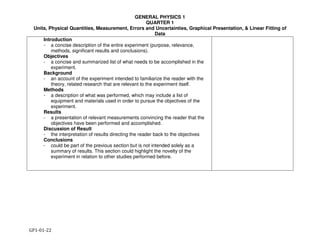
Introduction
- a concise description of the entire experiment (purpose, relevance,
methods, significant results and conclusions).
Objectives
- a concise and summarized list of what needs to be accomplished in the
experiment.
Background
- an account of the experiment intended to familiarize the reader with the
theory, related research that are relevant to the experiment itself.
Methods
- a description of what was performed, which may include a list of
equipment and materials used in order to pursue the objectives of the
experiment.
Results
- a presentation of relevant measurements convincing the reader that the
objectives have been performed and accomplished.
Discussion of Result
- the interpretation of results directing the reader back to the objectives
Conclusions
- could be part of the previous section but is not intended solely as a
summary of results. This section could highlight the novelty of the
experiment in relation to other studies performed before.
GENERAL PHYSICS 1
QUARTER 1
Vectors
GP1-02-1
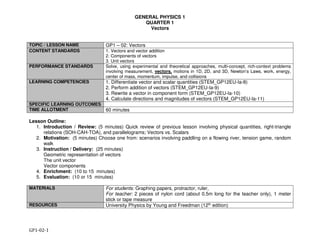
TOPIC / LESSON NAME GP1 – 02: Vectors
CONTENT STANDARDS 1. Vectors and vector addition
2. Components of vectors
3. Unit vectors
PERFORMANCE STANDARDS Solve, using experimental and theoretical approaches, multi-concept, rich-context problems
involving measurement, vectors, motions in 1D, 2D, and 3D, Newton’s Laws, work, energy,
center of mass, momentum, impulse, and collisions
LEARNING COMPETENCIES 1. Differentiate vector and scalar quantities (STEM_GP12EU-Ia-8)
2. Perform addition of vectors (STEM_GP12EU-Ia-9)
3. Rewrite a vector in component form (STEM_GP12EU-Ia-10)
4. Calculate directions and magnitudes of vectors (STEM_GP12EU-Ia-11)
SPECIFIC LEARNING OUTCOMES
TIME ALLOTMENT 60 minutes
Lesson Outline:
1. Introduction / Review: (5 minutes) Quick review of previous lesson involving physical quantities, right-triangle
relations (SOH-CAH-TOA), and parallelograms; Vectors vs. Scalars
2. Motivation: (5 minutes) Choose one from: scenarios involving paddling on a flowing river, tension game, random
walk
3. Instruction / Delivery: (25 minutes)
Geometric representation of vectors
The unit vector
Vector components
4. Enrichment: (10 to 15 minutes)
5. Evaluation: (10 or 15 minutes)
MATERIALS For students: Graphing papers, protractor, ruler,
For teacher: 2 pieces of nylon cord (about 0.5m long for the teacher only), 1 meter
stick or tape measure
RESOURCES University Physics by Young and Freedman (12th edition)
GENERAL PHYSICS 1
QUARTER 1
Vectors
GP1-02-2
Physics by Resnick, Halliday, and Krane (4th edition)
PROCEDURE MEETING LEARNERS’
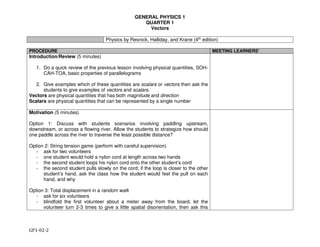
Introduction/Review (5 minutes)
1. Do a quick review of the previous lesson involving physical quantities, SOH-
CAH-TOA, basic properties of parallelograms
2. Give examples which of these quantities are scalars or vectors then ask the
students to give examples of vectors and scalars.
Vectors are physical quantities that has both magnitude and direction
Scalars are physical quantities that can be represented by a single number
Motivation (5 minutes)
Option 1: Discuss with students scenarios involving paddling upstream,
downstream, or across a flowing river. Allow the students to strategize how should
one paddle across the river to traverse the least possible distance?
Option 2: String tension game (perform with careful supervision)
- ask for two volunteers
- one student would hold a nylon cord at length across two hands
- the second student loops his nylon cord onto the other student’s cord
- the second student pulls slowly on the cord; if the loop is closer to the other
student’s hand, ask the class how the student would feel the pull on each
hand, and why
Option 3: Total displacement in a random walk
- ask for six volunteers
- blindfold the first volunteer about a meter away from the board, let the
volunteer turn 2-3 times to give a little spatial disorientation, then ask this
GENERAL PHYSICS 1
QUARTER 1
Vectors
GP1-02-3
student to walk towards the board and draw a dot on the board. Do the
same for the next volunteer then draw an arrow connecting the two
subsequent dots with the previous one as starting point and the current dot
with the arrow head. Do the same for the rest of the volunteers.
- after the exercise, indicate the vector of displacement (red arrow) by
connecting the first position with the last position. This vector is the sum of
all the drawn vectors by connecting the endpoint to the starting point of the
next.
Figure 1. Summing vectors by sequential connecting of
dots based on the random walk exercise.
Instruction / Delivery (25 minutes)
Part 1: Geometric representation of vectors
1. If option 3 above was performed, use the resulting diagram to introduce
displacement as a vector. Otherwise, illustrate on the board the magnitude
and direction of a vector using displacement (with a starting point and an
ending point, where the arrow head is at the ending point).
GENERAL PHYSICS 1
QUARTER 1
Vectors
GP1-02-4
Figure 2. Geometric sum of vectors example. The sum is
independent of the actual path but is subtended between
the starting and ending points of the displacement steps.
2. Illustrate the addition of vectors using perpendicular displacements as
shown below (where the red vector is the sum):
GENERAL PHYSICS 1
QUARTER 1
Vectors
GP1-02-5
Figure 3. Vector addition illustrated in a right triangle
configuration.
3. Explain how to calculate the magnitude of vector C by using the Pythagorian
theorem and its components as the magnitude of vector A and the
magnitude of vector B.
4. Explain how to calculate the components of vector C in general, from its
magnitude multiplied with the cosine of its angle from vector A (theta) and
the cosine of its angle from vector B (phi).
5. Use the parallelogram method to illustrate the sum of two vectors. Give
more examples for students to work with on the board.
GENERAL PHYSICS 1
QUARTER 1
Vectors
GP1-02-6
Figure 4. Vector addition using the parallelogram
method.
6. Illustrate vector subtraction by adding a vector to the negative direction of
another vector. Compare the direction of the difference and the sum of
vectors A and B. Indicate that vectors of the same magnitude but opposite
directions are anti-parallel vectors.
Figure 5. Subtraction of Vectors. Geometrically vector
subtraction is done by adding the vector minuend to the
GENERAL PHYSICS 1
QUARTER 1
Vectors
GP1-02-7
Aˆ
jiA ˆˆ
yx AA +=
r
anti-parallel vector of the subtrahend. Note: the
subtrahend is the quantity subtracted from the minuend.
7. Discuss when vectors are parallel and when they are equal.
Part 2: The unit vector
1. Explain that the direction of a vector can be represented by a unit vector that
is parallel to that vector.
2. Using the algebraic representation of a vector, calculate the components of
the unit vector parallel to that vector.
Figure 6. Unit vector.
3. Indicate how to write a unit vector by using a caret or a hat:
Part 3: Vector components
1. Discuss that vectors can be written by using its components multiplied by
unit vectors along the horizontal (x) and the vertical (y) axes.
2. Discuss vectors and their addition using the quadrant plane to illustrate how
the signs of the components vary depending on the location on the quadrant
GENERAL PHYSICS 1
QUARTER 1
Vectors
GP1-02-8
kjiA ˆˆˆ
zyx AAA ++=
r
( ) ( ) ( )kjiBAC
kjiB
kjiA
ˆˆˆ
ˆˆˆ
ˆˆˆ
zzyyxx
zyx
zyx
BABABA
BBB
AAA
±+±+±=±=
++=
++=
rrr
r
r
plane as sections in the 2-dimensional Cartesian coordinate system.
3. Extend discussion to include vectors in 3 dimensions.
4. Discuss how to sum (or subtract vectors) algebraically using the vector
components.
Tips –In paddling across the running river, you may introduce an initial angle or
velocity or let the students discuss their relation. An intuition on tension and length
relation can be discussed if necessary. Vectors can be drawn separately before
making their origins coincident in illustrating geometric addition.
Enrichment (10 or 15 minutes)
1. Illustrate on the board how the magnitude of the components of a uniformly
rotating unit vector change with time. Note that this magnitude varies as the
cosine and sine of the rotation angle (the angular velocity magnitude
multiplied with time).
2. Calculate the components of a rotated unit vector and introduce the rotation
matrix. This can be extended to vectors with arbitrary magnitude. Draw a
vector that is ө degrees from the horizontal. This vector is then rotated by Ф
degrees. Calculate the components of the new vector that is ө + Ф degrees
from the horizontal by using trigonometric identities as shown below.
The two equations can then be re-written using matrix notation where the
GENERAL PHYSICS 1
QUARTER 1
Vectors
GP1-02-9
2x2 (two rows by two columns) matrix is called the rotation matrix.
For now, it can simply be agreed that this way of writing simultaneous
equations is convenient. That is, a way to separate vector components (into
a column) and the 2x2 matrix that operates on this column of numbers to
yield a rotated vector, also written as a column of components.
The other column matrices are the rotated unit vector (ө + Ф degrees from
the horizontal) and the original vector (ө degrees from the horizontal) with
the indicated components. This can be generalized by multiplying both sides
with the same arbitrary length. Thus, the components of the rotated vector
(on 2D) can be calculated using the rotation matrix.
GENERAL PHYSICS 1
QUARTER 1
Vectors
GP1-02-10
GENERAL PHYSICS 1
QUARTER 1
Vectors
GP1-02-11
Figure 7. Rotating a vector using a matrix multiplication.
Evaluation (10 or 15 minutes)
Seatwork exercises using materials (include some questions related to the
motivation; no calculators allowed)
Sample exercise 1: involving calculation of vector magnitudes
Sample exercise 2: involving addition of vectors using components
Sample exercise 3: involving determination of vector components using triangles
GENERAL PHYSICS 1
QUARTER 1
Motion Along a Straight Line
TOPIC / LESSON NAME GP1 – 03: Displacement, time, average velocity, instantaneous velocity
CONTENT STANDARDS Position, time, distance, displacement, speed, average velocity, instantaneous velocity
PERFORMANCE STANDARDS Solve, using experimental and theoretical approaches, multiconcept, rich-context problems
involving measurement, vectors, motions in 1D, 2D, and 3D, Newton’s Laws, work, energy,
center of mass, momentum, impulse, and collisions
LEARNING COMPETENCIES 1. Convert a verbal description of a physical situation involving uniform acceleration in
one dimension into a mathematical description (STEM_GP12KIN-Ib-12)
2. Differentiate average velocity from instantaneous velocity
3. Introduce acceleration
4. Recognize whether or not a physical situation involves constant velocity or constant
acceleration (STEM_GP12KIN-Ib-13)
5. Interpret displacement and velocity , respectively, as areas under velocity vs. time
and acceleration vs. time curves (STEM_GP12KIN-Ib-14)
SPECIFIC LEARNING OUTCOMES
TIME ALLOTMENT 60 minutes
Lesson Outline:
1. Introduction / Review/Motivation: (15 minutes) Quick review of vectors and definition of displacement; use of
vectors to quantify motion with velocity and acceleration; walking activity; class discussion of speed vs velocity
2. Instruction / Delivery: (25 minutes)
Calculation of average velocities using positions on a number line
Average velocity as a slope of a line connecting two points on a postion vs. time graph
Instantaneous velocity as a derivative and as the slope of a tangent line
Inferring velocities from posion vs. time graphs
Displacement in terms of time-elapsed and average velocity
Displacement as an area under a velocity vs. time curve
Displacement as an integral
Introduce average/acceleration as change in velocity divided by elapsed time
3. Practice/Evaluation: (20 minutes) Seatwork
GENERAL PHYSICS 1
QUARTER 1
Motion Along a Straight Line
MATERIALS timer (or watch), meter stick (or tape measure)
RESOURCES University Physics by Young and Freedman (12th edition)
Physics by Resnick, Halliday, and Krane (4th edition)
PROCEDURE MEETING LEARNERS’
Introduction/Review/Motivation (15 minutes)
1. Do a quick review of the previous lesson in vectors
with some emphasis on the definition of
displacement.
2. In describing how objects move introduce how the
use of distance and time leads to the more precise
use by physicists of vectors to quantify motion with
velocity and acceleration (here, defined only as
requiring change in velocity)
3. Ask for two volunteers. Instruct one to walk in a
straight line but fast from one end of the classroom
to another as the other records the duration time
(using his or her watch or timer). The covered
distance is measured using the meter stick (or tape
measure). Repeat the activity but this time let the
volunteers switch tasks and ask the other volunteer
to walk as fast as the first volunteer from the same
ends of the classroom. Is the second volunteer able
to walk as fast as the first? Another pair of volunteers
might do better than the first pair.
4. Ask the class what the difference is between speed
and velocity.
GENERAL PHYSICS 1
QUARTER 1
Motion Along a Straight Line
Instruction / Delivery (25 minutes)
1. Discuss how to calculate the average velocity using
positions on a number line, with recorded arrival time
and covered distance (p1, p2, …, p5). For instance
at p1, x1 = 3m, t1 = 2s, etc.
The average velocity is calculated as the ratio
between the displacement and the time interval
during the displacement. Thus, the average velocity
between p1 and p2 can be calculated as:
!"# =
∆&
∆'
=
&( − &*
'( − '*
=
5 - − 3 -
10 1 − 2 1
= 0.25 -/1
What is the average velocity from position p2 to p5?
Note that the choice for a positive direction is not
necessarily referring to a displacement from left to
right. However, when the choice of the positive
direction is arbitrarily taken, the other direction is
p1 p2 p3 p4 p5
3m
2s
11m
50s
3m 8m
30s
5m
10s
20m
300s
GENERAL PHYSICS 1
QUARTER 1
Motion Along a Straight Line
towards the negative.
2. Emphasize that the average velocity between the
given coordinates above vary (e.g., between p1 to p2
and p1 to p4). The displacement along the
coordinate x can be graphed as a function of time t.
Figure 1. Average velocity.
Discuss that the average velocity from a coordinate
x1 to x2 is taken as if the motion is a straight line
between said positions at the given time duration.
Hence, the average velocity is geometrically the
slope between these positions.
Aside: is the average velocity the same as the
average speed?
3. Now, discuss the notion of instantaneous velocity v
as the slope of the tangential line at a given point
(figure 2). Mathematically, this is the derivative of x
with respect to t.
x
t
( )11 ,tx
( )22 ,tx
x∆
t∆
GENERAL PHYSICS 1
QUARTER 1
Motion Along a Straight Line
lim
∆%→'
∆(
∆)
=
+(
+)
= ,
Figure 2. Tangential lines.
4. Discuss between which time points in figure 3 (left)
illustrate motion with constant or non-constant
velocity, negative or positive constant velocity.
Figure 3 (right) shows instantaneous velocities as
slopes at specific time points. Discuss how the
values of the instantaneous velocity varies as you
move from v1 to v6.
Figure 3. x-t graphs.
5. Show how one can derive the displacement based
x
t0t 1t 2t 3t 4t
GENERAL PHYSICS 1
QUARTER 1
Motion Along a Straight Line
on the expression for the average velocity:
!"# =
∆&
∆'
→ ∆& = !"#∆'
Note that when the velocity is constant (Figure 4), so
is the average velocity between any two separate
time points. Thus, the total displacement magnitude
is the rectangular area under the velocity vs. time
graph (subtended by the change in time).
Figure 4. Constant velocity.
6. Show that for a time varying velocity, the total
displacement can be calculated in a similar manner
by summing the rectangular areas defined by small
intervals in time and the local average velocity. The
local average velocity is then approximately the
value of the velocity at a given number of time
intervals. Say, there are n time intervals between
time t1 and t2, the total displacement x is summed as
follows:
v
t1t 2t
avv
t∆
GENERAL PHYSICS 1
QUARTER 1
Motion Along a Straight Line
! = # ∆!%
&
%'(
= # )%∆*
&
%'(
Figure 5. Sum of discrete areas
under the velocity versus time
graph.
7. Discuss that as the time interval becomes
infinitesimally small, the summation becomes an
integral. Thus, the total displacement is the area
under the curve of the velocity as a function of time
between the time points in question.
GENERAL PHYSICS 1
QUARTER 1
Motion Along a Straight Line
! = # $%∆' = ( $)'*+'
,-
,.
/
%01
8. Introduce acceleration as the change in velocity
between a given time interval (in preparation for the
next lesson).
Practice/Evaluation (20 minutes)
Seatwork exercises
Sample exercise 1: involving calculation of average
velocities given initial and final position and time.
Sample exercise 2: Given x as a function of time, calculate
the instantaneous velocity at a specific time.
Sample exercise 3: Calculate the total displacement
between a time interval, given the velocity as a function of
time.
GENERAL PHYSICS 1
QUARTER 1
Motion Along a Straight Line
GP1-04-1
TOPIC / LESSON NAME GP1 – 04: Average and instantaneous acceleration
CONTENT STANDARDS Average acceleration, and instantaneous acceleration
PERFORMANCE STANDARDS Solve, using experimental and theoretical approaches, multiconcept, rich-context problems
involving measurement, vectors, motions in 1D, 2D, and 3D, Newton’s Laws, work, energy,
center of mass, momentum, impulse, and collisions
LEARNING COMPETENCIES 1. Convert a verbal description of a physical situation involving uniform acceleration in
one dimension into a mathematical description (STEM_GP12KIN-Ib-12)
2. Recognize whether or not a physical situation involves constant velocity or constant
acceleration (STEM_GP12KIN-Ib-13)
3. Interpret velocity and acceleration, respectively, as slopes of position vs. time and
velocity vs. time curves (STEM_GP12KIN-Ib-15)
4. Construct velocity vs. time and acceleration vs. time graphs, respectively,
corresponding to a given position vs. time-graph and velocity vs. time graph and vice
versa (STEM_GP12KIN-Ib-16)
SPECIFIC LEARNING OUTCOMES
TIME ALLOTMENT 60 minutes
Lesson Outline:
1. Introduction / Review: (5 minutes) Quick review of displacement, average velocity, and instantaneous velocity
2. Instruction / Delivery: (20 minutes)
Average acceleration as the ratio of the change in velocity to the elapsed time
Instantaneous acceleration as the time derivative of velocity
Instantaneous acceleration as the second time derivative of position
Change in velocity as product of average acceleration and time elapsed
Derivation of kinematic equations for 1d-motion under constant acceleration
Change in velocity as an area under the acceleration vs. time curve and as an integral
3. Enrichment: (20 minutes): Inferences from position vs. time, velocity vs. time, and acceleration vs. time curves
4. Evaluation: (15 minutes) Written exercise involving a sinusoidal displacement versus time graph
MATERIALS Graphing papers, protractor, ruler
GENERAL PHYSICS 1
QUARTER 1
Motion Along a Straight Line
GP1-04-2
RESOURCES University Physics by Young and Freedman (12th edition)
Physics by Resnick, Halliday, and Krane (4th edition)
PROCEDURE MEETING LEARNERS’
Introduction/Review (5 minutes)
1. Do a quick review of the previous lesson on
displacement, average velocity and instantaneous velocity.
Instruction / Delivery (20 minutes)
1. The acceleration of a moving object is a measure of
its change in velocity. Discuss how to calculate the
average acceleration from the ratio of the change in
velocity to the time duration of this change.
!"# =
∆&
∆'
=
&( − &*
'( − '*
2. Recall that the first derivative of the displacement
with respect to time is the instantaneous velocity.
Discuss that the instantaneous acceleration is the
first derivative of the velocity with respect to time:
! = lim
∆.→0
∆&
∆'
=
1&
1'
GENERAL PHYSICS 1
QUARTER 1
Motion Along a Straight Line
GP1-04-3
Figure 1. Average acceleration
Figure 2. Instantaneous
acceleration.
3. Thus, given the displacement as a function of time,
the acceleration can be calculated as a function of
time by successive derivations:
! =
#$
#%
=
#
#%
#&
#%
=
#'
&
#%'
4. Given a constant acceleration, the change in velocity
(from an initial velocity) can be calculated from the
GENERAL PHYSICS 1
QUARTER 1
Motion Along a Straight Line
GP1-04-4
constant average velocity multiplied by the time
interval.
!"# =
∆&
∆'
→ ∆& = !"#∆'
&) − &) = !"#∆'
Figure 3. Velocity as area under
the acceleration versus time
curve.
Special case: motion with constant acceleration
Derive the following relations (for constant
acceleration):
Based on the definitions of the average velocity and
average acceleration, we can derive an expression
for the total displacement traveled with known
acceleration and the initial and final velocities:
&"# =
∆+
∆'
→ ∆+ = &"#∆'
GENERAL PHYSICS 1
QUARTER 1
Motion Along a Straight Line
GP1-04-5
!"# =
#%&#'
(
Eqn1
)"# =
∆!
∆+
→ ∆! = )"#∆+
!( − !( = )"#∆+ Eqn2
∆. =
#%&#'
(
∆+ Eqn3
∆+ =
!( − !/
)
∆+
∆. =
!/ + !(
2
!( − !/
)
∆. =
#'
'2#%
'
("
Eqn4
The resulting expression for the total displacement
can be re-arranged to derive an expression for the
final velocity, given the initial velocity, acceleration
and the total displacement travelled:
∆. =
!(
(
− !/
(
2)
!(
(
= 2)∆. + !/
(
!( = 32)∆. + !/
(
Eqn5
From Eqn2 and Eqn3, the total displacement (from
an initial position to a final position) can be derived
as a function of the total time duration (from an initial
time to a final time) and the constant acceleration:
!/ = )∆+ − !(
GENERAL PHYSICS 1
QUARTER 1
Motion Along a Straight Line
GP1-04-6
∆" #
$∆% & '( ) '(
2
∆%
∆" #
1
2
$,∆%-(
"( & ". #
.
(
$,∆%-(
Eqn6
5. Discuss that with a time-varying acceleration, the
total change in velocity (from an initial velocity) can
be calculated as the area under the acceleration
versus time curve (at a given time duration). Given a
constant acceleration (figure 3), the velocity change
is defined by the rectangular area under the
acceleration vs. time curve subtended by the initial
and final time. Thus, with a continuously time varying
acceleration, the area under the curve is
approximated by the sum of the small rectangular
areas defined by the product of small time intervals
and the local average acceleration. This summation
becomes an integral when the time duration
increments become infinitesimally small.
! − !# = % &'∆%
/
01.
' & '2 # lim
∆6→8
9 $0∆%
/
01.
# : $,%-;%
6<
6=
Enrichment (20 minutes)
GENERAL PHYSICS 1
QUARTER 1
Motion Along a Straight Line
GP1-04-7
1. Review the relations between displacement and
velocity, velocity and acceleration in terms of first
derivative in terms of time and area under the curve
within a time interval.
2. Discuss how one can identify whether a velocity is
constant (zero, positive or negative), time varying
(slowing down or increasing) using figure 4.
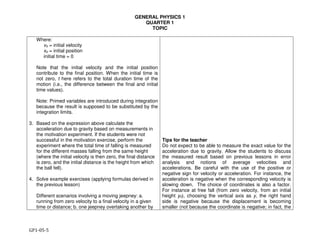
3. Replace the displacement variable with velocity in
figure 4 (figure 5) and discuss what the related
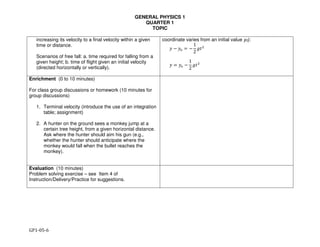
acceleration becomes (constant or time varying).
4. Discuss the inverse: deriving the shape of the
displacement curve based on the velocity versus
time graph; deriving the shape of the velocity curve
based on the acceleration versus time graph.
5. Displacement versus time:
- graph of a line with positive/negative slope !
positive/negative constant velocity
- graph with monotonically increasing slope !
increasing velocity
- graph with monotonically decreasing slope !
decreasing velocity
6. Velocity versus time:
- graph of a line with positive/negative slope !
positive/negative constant acceleration
- graph with monotonically increasing slope !
increasing acceleration
GENERAL PHYSICS 1
QUARTER 1
Motion Along a Straight Line
GP1-04-8
- graph with monotonically decreasing slope !
decreasing acceleration
warning: the non-linear parts of the graph were strategically
chosen as sections of a parabola—hence the
corresponding first derivate of these sections is either a
negatively sloping line (for a downward opening parabola)
or a positively sloping line (for an upward opening parabola)
Figure 4. Displacement versus time and the corresponding
velocity graphs.
GENERAL PHYSICS 1
QUARTER 1
Motion Along a Straight Line
GP1-04-9
Figure 5. Velocity versus time and the corresponding
acceleration graphs.
Evaluation (15 minutes)
Given a sinusoidal displacement versus time graph
(displacement = A sin(bt); b = 4π/s, A = 2 cm), ask the
class to graph the corresponding velocity versus time and
acceleration versus time graphs. Recall that the velocity is
the first derivative of the displacement with respect to time
and that the acceleration is the first derivative with respect
to time. At which parts of the graph would the velocity or
acceleration become zero or at maximum value (positive or
negative)? Discuss where the equilibrium position would be
based on the motion (as illustrated by the displacement
versus curve graph). What happens to the velocity and
acceleration at the equilibrium position?
GENERAL PHYSICS 1
QUARTER 1
TOPIC
GP1-05-1
TOPIC / LESSON NAME GP1 – 05: Motion with constant acceleration, freely falling bodies
CONTENT STANDARDS Uniformly accelerated linear motion
Free-fall motion
PERFORMANCE STANDARDS Solve, using experimental and theoretical approaches, multiconcept, rich-context problems
involving measurement, vectors, motions in 1D, 2D, and 3D, Newton’s Laws, work, energy,
center of mass, momentum, impulse, and collisions
LEARNING COMPETENCIES 1. Solve for unknown quantities in equations involving one-dimensional uniformly
accelerated motion (STEM_GP12KIN-Ib-17)
2. Use the fact that the magnitude of acceleration due to gravity on the Earth’s surface
is nearly constant and approximately 9.8m/s2 in free-fall problems (STEM_GP12KIN-
Ib-18)
SPECIFIC LEARNING OUTCOMES
TIME ALLOTMENT 60 minutes
Lesson Outline:
1. Introduction / Review: Review of differentiation and integration of polynomials (10 minutes)
2. Motivation: (15 minutes) Mini-experiment on free-frall motion of bodies with different masses
3. Instruction / Delivery/Practice: (25 to 35 minutes)
Derive the velocity and position formulas for one-dimensional uniformly accelerated motion using calculus
Use the data obtained in the mini-experiment and kinematic equations to calculate the local value of the
gravitational acceleration
Solve sample exercises
4. Enrichment: (0 to 10 minutes) Homework or group discussion on : a) Terminal velocity (Homework) or b) Hunter and
monkey problem
5. Evaluation: (10 minutes) Problem solving exercise
MATERIALS Rubber balls of varying mass (or equivalent objects)
Meter stick (or tape measure), Stop watch
RESOURCES University Physics by Young and Freedman (12th edition)
Physics by Resnick, Halliday, and Krane (4th edition)
GENERAL PHYSICS 1
QUARTER 1
TOPIC
GP1-05-2
PROCEDURE MEETING LEARNERS’
Introduction/Review (10 minutes)
1. Give a brief review of differentiation and integration
polynomials.
Motivation (15 minutes)
“Which object will fall faster?”
1. Divide the class into 2 groups and let them device a
simple experiment to test whether the object with
higher mass will fall faster (or whether two objects of
different masses will accelerate differently at free fall).
(3 minutes)
2. The 2 groups organize to perform their designed
experiments. (6 minutes)
3. The representative of each group reports their
observations and results. (6 minutes)
Possible execution:
An object is released from a specific height and the total
time of falling is recorded. This is repeated for another
object with a different mass falling from the same initial
height. Does the heavier object fall faster? The acceleration
is estimated from the calculated average speeds based on
the total time falling at different initial heights. Does this
acceleration equal the acceleration due to gravity?
Instruction / Delivery/Practice (25 minutes)
GENERAL PHYSICS 1
QUARTER 1
TOPIC
GP1-05-3
1. The acceleration (a) can be written as the time
derivative of the velocity (v):
! =
#$
#%
& =
#!
#%
& =
#'
$
#%'
- Since the velocity is the first derivative of the
displacement in terms of time, the acceleration is
then the second derivative of the displacement in
terms of time.
- Review the notion of time derivative using the ratio of
the change in the magnitude considered divided by
the corresponding change in time as the change in
time become infinitesimally small. Thus, the time
derivative gives the instantaneous rate of change of
the considered quantity varying in time
Figure. Variable s varies as a
GENERAL PHYSICS 1
QUARTER 1
TOPIC
GP1-05-4
function of time t. As Δt becomes
infinitesimally small, the average
slope Δs/Δt approaches the
instantaneous slope at time to.
The instantaneous slope is the
velocity at to when the variable s
is the displacement. The second
derivative of the velocity is the
acceleration, the rate of change
of velocity at a given time.
2. The displacement can then be derived by successive
integration:
!"
!#
= %
& !" = & %	!#	 → " ) "*	
+
*
,
,-
= %#
" = %# . "*
/0
/+
= %# . "*
& !1,
= & 3%#4
. "*5	!#	4
→ 1 ) 1*	
+
*
0
0-
=
1
2
%#8
. "*#
1 =
1
2
%#8
. "*# . 1*
GENERAL PHYSICS 1
QUARTER 1
TOPIC
GP1-05-5
Where:
vo = initial velocity
xo = initial position
initial time = 0
Note that the initial velocity and the initial position
contribute to the final position. When the initial time is
not zero, t here refers to the total duration time of the
motion (i.e., the difference between the final and initial
time values).
Note: Primed variables are introduced during integration
because the result is supposed to be substituted by the
integration limits.
3. Based on the expression above calculate the
acceleration due to gravity based on measurements in
the motivation experiment. If the students were not
successful in the motivation exercise, perform the
experiment where the total time of falling is measured
for the different masses falling from the same height
(where the initial velocity is then zero, the final distance
is zero, and the initial distance is the height from which
the ball fell).
4. Solve example exercises (applying formulas derived in
the previous lesson)
Different scenarios involving a moving jeepney: a.
running from zero velocity to a final velocity in a given
time or distance; b. one jeepney overtaking another by
Tips for the teacher
Do not expect to be able to measure the exact value for the
acceleration due to gravity. Allow the students to discuss
the measured result based on previous lessons in error
analysis and notions of average velocities and
accelerations. Be careful with the use of the positive or
negative sign for velocity or acceleration. For instance, the
acceleration is negative when the corresponding velocity is
slowing down. The choice of coordinates is also a factor.
For instance at free fall (from zero velocity, from an initial
height y0), choosing the vertical axis as y, the right hand
side is negative because the displacement is becoming
smaller (not because the coordinate is negative; in fact, the
GENERAL PHYSICS 1
QUARTER 1
TOPIC
GP1-05-6
increasing its velocity to a final velocity within a given
time or distance.
Scenarios of free fall: a. time required for falling from a
given height; b. time of flight given an initial velocity
(directed horizontally or vertically).
coordinate varies from an initial value y0):
! " !# = "
1
2
#$%
& = &( −
1
2
#$%
Enrichment (0 to 10 minutes)
For class group discussions or homework (10 minutes for
group discussions)
1. Terminal velocity (introduce the use of an integration
table; assignment)
2. A hunter on the ground sees a monkey jump at a
certain tree height, from a given horizontal distance.
Ask where the hunter should aim his gun (e.g.,
whether the hunter should anticipate where the
monkey would fall when the bullet reaches the
monkey).
Evaluation (10 minutes)
Problem solving exercise – see Item 4 of
Instruction/Delivery/Practice for suggestions.
GENERAL PHYSICS 1
QUARTER 1
TOPIC
GP1-06-1
TOPIC / LESSON NAME GP1 – 06: Context rich problems involving motion in one-dimension
CONTENT STANDARDS 1D Uniform Acceleration Problem
PERFORMANCE STANDARDS Solve, using experimental and theoretical approaches, multiconcept, rich-context problems
involving measurement, vectors, motions in 1D, 2D, and 3D, Newton’s Laws, work, energy,
center of mass, momentum, impulse, and collisions
LEARNING COMPETENCIES 1. Solve problems involving one-dimensional motion with constant acceleration in
contexts such as, but not limited to, the “tailgaiting phenomenon”, pursuit, rocket
launch, and free-fall problems (STEM_GP12KIN-Ib-19)
SPECIFIC LEARNING OUTCOMES
TIME ALLOTMENT 60 minutes
Lesson Outline:
1. Introduction / Review/Motivation: (15 minutes)
Reaction time experiment using ruler with discussion
Review of equations for 1D kinematics
2. Instruction / Delivery/Practice: (45 minutes) Assisted group problem solving (Suggested contexts: tail-gaiting
phenomenon and pursuit, rocket launch, free-fall without air resistance)
MATERIALS paper, ruler
RESOURCES University Physics by Young and Freedman (12th edition)
Physics by Resnick, Halliday, and Krane (4th edition)
http://www.physics.umd.edu/ripe/perg/abp/think/mech/mechki.htm
http://groups.physics.umn.edu/physed/Research/CRP/on-lineArchive/ola.html
PROCEDURE MEETING LEARNERS’
Introduction/Review/Motivation (15 minutes)
1. Ruler drop experiment to measure reaction time.
GENERAL PHYSICS 1
QUARTER 1
TOPIC
GP1-06-2
Ask pairs of students to measure their reaction time. One
volunteer holds the ruler with the thumb and forefinger on
the upper tip. While the lower tip of the ruler is just before
the open hand of the other volunteer.
Figure 1. Ruler drop experiment.
(redraw this figure)
The ruler is dropped from the tip by the first volunteer while
the other tries to catch it. Assuming the ruler falls freely due
to gravity. Determine the time the ruler fell by the
displacement of the ruler at free fall measured from the
lower tip of the ruler to where the second volunteer caught
the ruler. During this experiment, the volunteers should not
look at each other to ensure that the one trying to catch the
ruler reacts only from the moment it sees the ruler falling.
Repeat a few times to get an average. If there are several
pairs who performed the experiment, measure the total
average from all the pairs.
2. Allow the students to discuss what processes occurs
between seeing the ruler fall and the brain telling the hand
GENERAL PHYSICS 1
QUARTER 1
TOPIC
GP1-06-3
to catch the ruler.
For example, the eye first sends signals to the visual cortex
which then notifies the motor cortex that eventually sends a
signal via the spinal cord to the hand to catch the ruler.
Each takes some time to perform.
3. Review previous lessons on motion along a straight line,
speed, velocity, and motion with constant acceleration.
Eqn1 ∆" =
$%
%
− $'
%
2)
Displacement, given acceleration
a, initial and final velocities, v1
and v2, respectively.
Eqn2 $ = )* + $,
Velocity, given acceleration a,
time t, and initial velocity vo.
Eqn3 " =
1
2
)*% + $,* + ",
Displacement x, given acceleration
a, time t, initial velocity vo, and
initial displacement xo.
Eqn4 . = ., −
1
2
/*%
Free fall: vertical displacement y,
from an initial height yo, time t,
and acceleration due to gravity g.
Instruction/Delivery/Practice (45 minutes)
Let the students answer the problems below in groups with
your assistance:
1. Tailgaiting phenomenon and pursuit
Explain that tailgating is when a car follows another car
too closely, narrowing the distance between them.
Processes involved for 1a.(Keep these in mind while
guiding the students)
GENERAL PHYSICS 1
QUARTER 1
TOPIC
GP1-06-4
Choose the problems you will discuss with the students
and those you will let the students solve with your
guidance.
a. You are driving 2 m before another car. Both of you
run at 80 kph. Assume that your car can come to a
full stop from 80 kph within 3s (as well as the car in
front). However, it takes about 500ms for you to
perceive that the front car actually stopped
(perception time). And it will also take milliseconds
(measured in the ruler drop experiment) for you to
finally step on the breaks. And the car then takes 3s
to finally stop.
Will you be able to safely stop and not hit the car in
front if it suddenly stops? Your signal that the car in
front stopped is hearing the breaks screech. Note
that sound travels at 340m/s.
b. You are driving 100 m behind a car that is moving at
a constant velocity of 60 kph. From that distance
(100 m behind) how much should you accelerate to
overtake the other car within 20 s, if you are cruising
at 30 kph?
c. Consider instead that you want to tailgate the other
car, and maintain a distance of only 1 m behind it.
You accelerate in 5 s and come within 3 m of the
other car. How much deceleration (or another
- The front car stops—the screeching sound
travels for 1m taking some time before it reaches
your ears (signal travel time)
- The sound reaches your ears and it takes you
500ms to realize you have to stop (perception
time)
- In order to stop, your brain has to command your
foot to step on the breaks (reaction time)
- And the car finally takes 3s to a full stop.
- In the meantime, the car in front has come to a
full stop in 3s minus the time it took the sound to
arrive in your ears.
- Note that before all these, there is only 2 m
between the two cars.
Sample solution to Item 1b (Other approaches may also be
correct):
The car that is ahead would be moving farther in 20
s. So the total distance to cover by the car that want
to overtake is:
! =
1
2
%&'(
+ *+' + !+
%& = 0
! = -60 01ℎ3-20 43 + 100 5
GENERAL PHYSICS 1
QUARTER 1
TOPIC
GP1-06-5
acceleration) do you need in the next 5 s to ease into
60 kph and maintain a distance of 1 m behind the car
ahead of you from then on?
The trailing car should then accelerate at a2 (where x
is the same as above):
!" = 2
" # $%&
&'
$% ( 30	,-.
& ( 20	/
Sample solution to Item 1c (Other solutions may also be
correct):
In the first 5 s, the car ahead of you will cover the
distance x1:
"0 ( $%& 1 "%
"0 ( 260	,-.425	/4 1 100	7
But you would want to accelerate first so that you
can be 3 m behind the other car in those first 5 s.
Thus, you accelerated for 5 s, covering a distance of
x1 – 3m.
∆" ( "0 # 3	7 (	260	,-.425	/4 1 97	7
From eqn3, we can calculate the acceleration within
5s:
" (
1
2
;&'
1 $%& 1 "%
∆" (
1
2
;&'
1 $%&
; ( 2
∆" # $%&
&'
$% ( 30	,-.
& ( 5	/
GENERAL PHYSICS 1
QUARTER 1
TOPIC
GP1-06-6
∆" = "$ − 3 (
Using the derived value for the acceleration a (and
the given value of vo) we look for the final velocity v2
of the car in pursuit from eqn2:
)* = +, + ).
Thus, at exactly 3 m behind the car, you have to
decelerate (or accelerate) from v2 to 60 kph, so that
you are only 1m behind the car you want to tailgate.
However for that same amount of time t, the car
ahead would move farther (x):
" = ).,
). = 60 12ℎ
, = 5 5
∆" = " − 1 (
To tailgate 1m behind the car ahead you decelerate
(or accelerate) by a’ from an initial velocity v’1 (which
was solved as v2 earlier):
+7
=
)*
7*
− )$
7*
2∆"
)*
7
= 60 12ℎ
2. Rocket launch
You want to make measurements on the atmosphere by
putting a sensor on the tip of a rocket. You simulated
rocket flight by catapulting a model rocket with an initial
velocity vo and was on flight for a total of 1 min.
Sample Solution to Item 2 (Other approaches may
also be correct)
Assume that it took 30s to fly and half the time (30 s)
it spent falling back to the ground from the peak
height. Then the total distance covered from the
GENERAL PHYSICS 1
QUARTER 1
TOPIC
GP1-06-7
a. Assuming no airdrag (and wind), the rocket flew up
and directly downwards after reaching its peak
height. What is the initial velocity and the maximum
height?
peak height to the ground is:
∆" =
1
2
&'(
' = 30 ,
& = 9.8 0/,(
The initial velocity can be calculated from eqn3 and
Δy as determined above (replacing x with y):
" =
1
2
&'(
+ 34' + "4
∆" =
1
2
&'(
+ 34'
34 =
∆" −
1
2
&'(
'
' = 30 ,
& = 9.8 0/,(
3. Free fall (ignore air resistance)
a. A brick falls from a tall building of known height (150
m) and it hits the ground and shatters. You saw the
brick falling and timed the fall to be 10s. At what
velocity did the brick hit the ground?
b. Suppose the acceleration due to gravity is only 5
m/s2. How high could you throw a ball to let it stay on
flight for 3s? At what initial velocity did you throw this
ball?
c. You threw an object from a window of a high building
Sample solution to Item 3c (Other approaches may also be
correct):
3.0 , = '6 + '(
ℎ =
1
2
&'6
(
+ 34
ℎ = 3'(
h = is the unknown height of the building
t1 and t2 are the unknown time of free fall and time it
took for the sound to travel from the ground to your
GENERAL PHYSICS 1
QUARTER 1
TOPIC
GP1-06-8
and 3.0s later you heard it hit the ground. How high
are you from the ground if the speed of sound in air
is 340m/s. Ignore air resistance?
d. A car is moving slowly at 1.5 m/s on the street. You
are on the top of this building, which is 50 m high. If
you would like to drop an egg on the roof of this car
how far should the car be from the building the
moment you drop the egg? Note that the car is 2.5 m
high.
Determine the time when the egg would fall from the
top of the building to the roof of the car. Use this time
to determine where the car should be when you let
go of the egg.
location
v is the speed of sound in air
General Physics 1
QUARTER 1
Motion in 2D and 3D
GP1-07-1
TOPIC / LESSON NAME GP1-07 Position Displacement Distance Speed Velocity Acceleration in 2d and 3d
CONTENT STANDARDS Position, distance, displacement, speed, average velocity, instantaneous velocity, average
acceleration, and instantaneous acceleration in 2- and 3- dimensions
PERFORMANCE STANDARDS Solve using experimental and theoretical approaches, multiconcept, rich-context problems
involving measurement, vectors, motions in 1D, 2D, and 3D, Newton’s Laws, work, energy,
center of mass, momentum, impulse, and collisions
LEARNING COMPETENCIES STEM_GP12Kin-Ic-21 Extend the definition of position, velocity, and acceleration to 2D and
3D using vector representation
SPECIFIC LEARNING OUTCOMES • Differentiate displacement and distance traveled
• Apply the definition of position, distance traveled, displacement, average speed,
average velocity, instantaneous speed, instantaneous velocity, average acceleration,
and instantaneous acceleration in answering conceptual and computational questions
in 2D and 3D motion
TIME ALLOTMENT 1 hour
Lesson Outline:
1. Introduction / Review/Motivation ( 10 minutes): Students trace 1D and 2D paths; examples of 2D and 3D
motion; overview of current lesson and upcoming lessons; review of vectors and 1d motion if needed (5 to 10
minutes)
2. Instruction / Delivery/Practice (40 minutes):
Position vector (5 minutes)
Displacement and Position (15 minutes)
Average Speed, Average Velocity, Instantaneous Velocity, Instantaneous Speed, Average Acceleration,
Instantaneous Acceleration (20 minutes)
3. Evaluation (10 minutes): Written test combining conceptual and computational tasks (10 minutes)
MATERIALS 1.Chalk,
2. Watch with second hand or another equally accurate timing device
RESOURCES The following can be used for background reading and as additional sources for practice
exercises:
General Physics 1
QUARTER 1
Motion in 2D and 3D
GP1-07-2
Chapter 8 (Vectors and Mechanics) of Mechanics by Benjamin Crowell deals with Vectors
and Motion (This free textbook can be downloaded from:
http://www.lightandmatter.com/mechanics/ )
Khan Academy’s module on two-dimensional motion:
https://www.khanacademy.org/science/physics/two-dimensional-motion
PROCEDURE MEETING LEARNERS’
Introduction/Review/Motivation (5 minutes)
1. Mark two spots on the floor and label them as “Start”
and “End” – these spots should be 2 meters apart.
Ask students to trace paths on the floor similar to
those in the figure below:
Trajectory A: Straight path in 5 seconds
Trajectory B: Curved path in 5 seconds
Trajectory C: Straight path in 30 seconds
Trajectory D: Curved path in 30 seconds
2. Tell the students that they have just seen and
experienced examples of 1D and 2D mention. Cite
real-life examples of 2D and 3D motion and ask the
students to cite other examples.
General Physics 1
QUARTER 1
Motion in 2D and 3D
GP1-07-3
3. Tell the students that:
• the focus of this lesson is the description of
2D and 3D motion using vectors
• the topics in this lesson will be needed to
better understand circular motion, projectile
motion, and relative motion.
• the notions of position, speed, velocity, and
acceleration that they already encountered in
straight-line motion can be extended to 2D
and 3D using vector mathematics
4. If needed, give a quick review of position, velocity,
and acceleration in one-dimension.
5. If needed give a quick review of vectors, with
emphasis on the following topics:decomposition of
vectors into components, unit vectors, magnitude
and direction of vectors
Instruction/Delivery/Practice : 1. Position Vector (5
minutes)
1.1. Introduce the notion of a position vector.The
position vector is a vector that points from the
origin of a coordinate system to the position of
an object . Refer to the following diagram:
General Physics 1
QUARTER 1
Motion in 2D and 3D
GP1-07-4
(Please redraw, change the length, width, and height of the
parallelepiped)
1.2. Discuss examples of position vector
problems:
a. 2D: An ant is located at x = 1 m, y = 2 m. What is the
position vector of the ant?
Answer: The ant has position vector
!" # 1	&	'̂ ) 2	&	+̂
b. 3D: A fly is located at x = 3 m, y = 1 m, z =2 m. What
is the position vector of the fly?
Answer: The fly has position vector
!" # 3	&	'̂ ) 1	&	+̂ ) 2	&	-.
General Physics 1
QUARTER 1
Motion in 2D and 3D
GP1-07-5
1.3. Check for understanding using questions such
as:
a. A bird is located at x = 0 km, y =3 km, z =
4 km. What is the position vector of the
bird?
b. Why is 5 km considered an incorrect
answer to Question a?
Instruction / Delivery/Practice: 2. Displacement and
Distance traveled (15 minutes)
2.1. Introduce the concepts of distance and displacement,
emphasizing by considering the following scenario:
Suppose a particle is at position A at time t1 and at position
B at time t2 During the time interval from time t1 to time t2 ,
the particle moles along the curve ACB.
Emphasize the following points:
• The length of the path ACB is the distance traveled
by the particle during the time interval t1 to t2.
General Physics 1
QUARTER 1
Motion in 2D and 3D
GP1-07-6
• We can draw a vector with its tail at the initial
position, A, and head at the final position B. This
vector is the displacement vector of the particle
during the time interval t1 to t2. Mathematically, we
can express the displacement vector, ∆"#, as the
difference of between the final position vector, "$%%%# ,
and initial position vector, "&%%%# : ∆"# ≡ "$%%%# − "&%%%# .
2.2. Ask the student to attempt the following exercises.
(Discuss the solution afterwards):
If the time is limited, do Exercise C and and either Exercise
A or Exercise B.
Exercise A: A jogger runs along a semi-circular track with
radius 100 m. She starts from one end of the track and
finishes at the other end. What is the distance she traveled?
What is the magnitude of her displacement? What is the
direction of her displacement vector?
Target response to Exercise A:
i. The distance traveled is the length of the truck:
)*+,-./0 1 100 $ % ≈ 314 %
ii. The magnitude of the displacement is the length of
the straight line from the initial to the final position:
%)*+,-./0 12 /,345)60%0+- = 200 %
iii. The direction of the displacement is from the initial
point to the final point. The student should draw a
vector directed from one end of the semicircle to the
other end.
Exercise B: Consider the motion along the trajectories
traced by the students at the beginning of the lesson:
Target Response to Exercise B:
Task 1:
(Distance A = Distance C = 2 m) < (Distance B = Distance
D)
General Physics 1
QUARTER 1
Motion in 2D and 3D
GP1-07-7
Trajectory A: Straight path in 5 seconds
Trajectory B: Curved path in 5 seconds
Trajectoy C: Straight parth in 30 seconds
Trajectory D: Curved path in 30 seconds
Task 1: Arrange the distance traveled by the students from
highest to lowest.
Task 2: Arrange the magnitude of the displacement of the
students from highest to lowest.
Task 2: The magnitudes of the displacement of the
students are equal along all trajectories
Exercise C: At time t1 = 1.0 s an ant is located at the x-y
coordinates (3.0 m, 4.0 m). At time t2 = 3.0 s the same ant
is located at the x-y coordinates (5.0 m, 2.0 m). In the time
interval t1 to t2 determine the following: a. displacement, b.
magnitude of the displacement, and c. Distance traveled by
the ant
Target Response to Exercise C:
a. The displacement can be calculated as follows:
∆"# = "%&&&# ' "(&&&#
= )5.0	#	$̂ & 2.0	#	)̂* − ,3.0	#	$̂ & 4.0	#	)̂*
/ 	2.0	#	$̂ − 2.0	#	)̂
b. The magnitude of the displacement is:
∆"# = √2.00 & 2.00	# 1 2.8	#
c. The information given in the problem is insufficient
because we need the length of the actual path taken
by the ant.
2.3. Ask the students to differentiate displacement and
distance traveled.(Lead the students to the following target
General Physics 1
QUARTER 1
Motion in 2D and 3D
GP1-07-8
responses: 1. Displacement is a vector while distance is a
scalar, 2. The displacement can be obtained by knowing
the initial and final position but the actual path taken by the
object is needed to determine the distance traveled.
Instruction / Delivery/Practice: 3. Average Velocity,
Instantaneous Velocity, Instantaneous Speed, Average
Speed (15 minutes)
3.1. Introduce the concepts of average velocity,
instantaneous velocity, instantaneous speed, and
average speed, discussing the following points:
• The average speed of a particle in a time
interval, is defined as distance traveled
along the path, divided by the time
elapsed.
• The average velocity of a particle in a time
interval is just its net displacement per unit
time:
!"#$ ≡
"#$$$% & "'$$$%
(# & ('
=
∆"%
∆(
• The instantaneous velocity, or velocity, of
a particle is the instantaneous rate of
change of the position:
+% = lim
∆/→1
∆2%
∆/
=
32%
3/
It is tangent to the path at each point
Students are likely to find the following illustration useful:
Please redraw. Modify curved path but ensure that the
vectors are tangent to the path
General Physics 1
QUARTER 1
Motion in 2D and 3D
GP1-07-9
• The instantaneous speed or speed of a
particle is the magnitude of the velocity of
the particle
3.2. Introduce the concepts of average acceleration
and instantaneous acceleration emphasizing the
following points:
• The average acceleration of a particle in
an interval is the change in velocity divided
by the time elapsed:
"#$% ≡
'())))# * '+))))#
,( * ,+
=
∆'#
∆,
• The instantaneous acceleration, or acceleration, of a
particle is the instantaneous rate of change of its
velocity: "# = lim
∆2→4
∆%)#
∆2
=
5%)#
52
• In general the acceleration can have components
parallel and perpendicular to the path. The
component parallel to the path is associated with
changes in speed, while the component
perpendicular to the path is associated with changes
in direction.
Students are likely to find the following illustration useful:
Please redraw
3.3. Ask the students to attempt the following
exercises (Discuss the solution afterwards)
General Physics 1
QUARTER 1
Motion in 2D and 3D
GP1-07-10
Exercise D: A jogger runs along a semi-circular track with
radius 100 m for 3.00 minutes. She starts from one end of
the track and finishes at the other end. What is her average
speed? What is the magnitude of her average velocity?
Target response for Exercise D:
!"#$!%# "#$$% =
%'"()*+$ (,)-$..$%
('/$ $.)#"$%
=
100 2
180
/
"
= 1.75 %/'
%()*+,-./ 01 (2/3()/ 2/405+,6 = |29:;;;;;;<| = =
∆3<
∆,
= =
|∆3<|
∆,
=
%()*+,-./ 01 .+'?4(5/%/*,
,+%/ /4(?'/.
=
200
180
%
'
= 1.11
%
'
Exercise E: The position of a particle in 3-dimensions is
given by
D = cosH2I,J , 6 = sinH2I,J , N = ,
where x, y,and z are in meters while t is in seconds.
Determine the following quantities:
a) Position vector at , = 0 (*. , = 1/3 s
b) Average velocity in the time interval , = 0 ,0 , =
P
Q
s
c) Instantaneous velocity at time t=0 s
d) Instantaneous velocity at time 1/3 s
e) Average acceleration in the time interval , = 0 s to
, = 1/3 s
f) Instantaneous acceleration at time t= 1.0 s
Target response:
a) 3< H0J = 1 % R̂, 3< T
P
Q
'U =
V
W
% R̂ +
√Q
W
% Ẑ +
P
Q
% [
b) 29:;;;;;;< =
∆]<
∆^
= T−
Q
W
R̂ +
Q√Q
W
Ẑ + I [U %/'
c) 2<H,J =
`
`^
acosH2I,J R̂ + sinH2I,J Ẑ + , [b
= −2π sinH2I,J R̂ + 2I cosH2I,J Ẑ + [
∴ 2<H0 'J = e2I Ẑ + [f %/'
d) 2< T
V
Q
'U = g−2π sin T
WP
Q
U R̂ + 2I cos T
WP
Q
U Ẑ + [h
i
j
= a −√3π R̂ − I Ẑ + [b
%
'
e) (9:;;;;;;< =
∆:;<
∆^
= e −3√3π R̂ − 8I Ẑf %/'
f) (<H,J =
`
`^
2<H,J = −4IWHcosH2I,J R̂ + sinH2I,J ẐJ
∴ (<H1 'J = −4 IW
R̂ %/'W
Evaluation (10 minutes)
1. Consider the motion of the four students at the beginning
In case there is not enough time, ask only Item 1 Task 2
and Item 2a & 2d
General Physics 1
QUARTER 1
Motion in 2D and 3D
GP1-07-11
of the lesson:
Student A: Straight path in 5 seconds
Student B: Curved path in 5 seconds
Student C: Straight parth in 30 seconds
Student D: Curved path in 30 seconds
Task 1: Arrange the average speed of the students from
highest to lowest and justify your answer
Task 2: Arrange the magnitude of the average velocity of
the students from highest to lowest and justify your answer.
2. The 2D motion of a particle is characterized by the
equations !"#$ % & ' (# and )"#$ % * ' +# ' ,#-
.
Compute the following quantities:
a. Average velocity of the particle in the time interval
t1 to t2.
b. Velocity of the particle at time t.
c. Average acceleration of the particle in the time
interval t1 to t2.
d. Acceleration of the particle at time t.
General Physics 1
QUARTER 1
Motion in 2D and 3D
GP1-08-1
TOPIC / LESSON NAME GP1-08 Position Displacement Distance Speed Velocity Acceleration in 2d and 3d
CONTENT STANDARDS Projectile Motion
PERFORMANCE STANDARDS Solve using experimental and theoretical approaches, multiconcept, rich-context problems
involving measurement, vectors, motions in 1D, 2D, and 3D, Newton’s Laws, work,
energy, center of mass, momentum, impulse, and collisions
LEARNING COMPETENCIES Deduce the consequences of the independence of vertical and horizontal components of
projectile motion (STEM_GP12KIN-Ic-22)
Calculate range, time of flight, and maximum heights of projectiles (STEM_GP12KIN-Ic-23)
SPECIFIC LEARNING
OUTCOMES
TIME ALLOTMENT 1 hour
Lesson Outline:
1. Introduction /Motivation/Review ( 5 minutes): Throw several small objects; Give an overview of the lesson;
Review acceleration due to gravity by way of a demonstration
2. Instruction / Delivery/Practice (45 minutes):
What is “projectile motion”? (5 minutes)
Independence of vertical and horizontal components of projectile motion (20 minutes)
Range, time of flight, and maximum height of projectiles (20 minutes)
3. Evaluation (10 minutes): Written test (10 minutes)
MATERIALS 1. Chalk, 2. Cotton buds, 3. Drinking straws, 4. Coins, 5. Other small objects that can
be thrown
RESOURCES The following can be used for background reading and as sources for practice exercises:
Chapter 8 (Vectors and Mechanics) of Mechanics by Benjamin Crowell deals with Vectors
and Motion (This free textbook can be downloaded from:
http://www.lightandmatter.com/mechanics/ )
General Physics 1
QUARTER 1
Motion in 2D and 3D
GP1-08-2
Khan Academy’s module on two-dimensional motion:
https://www.khanacademy.org/science/physics/two-dimensional-motion
PROCEDURE MEETING LEARNERS’
Introduction/Motivation/Review (5 minutes)
1. Begin with a series of demonstrations:
Throw several small objects e.g. a piece of chalk, a
crumpled piece of paper, an eraser, coins, keys etc.
2. Tell the class that:
• They have just seen examples of projectile
motion
• They will apply what they have learned so far
about constant velocity motion, uniformly
accelerated motion, vectors, and 2D kinematics
to the study of projectiles
3. Break a piece of chalk into two pieces of unequal
length. Hold the two pieces of chalk between a thumb
and an index finger with the lower levels of the chalks at
the same level. Ask the students to predict which piece
will hit the floor first. Ask for predictions and reasons.
Then let go. Repeat until all observers agree.
Close the review by mentioning that Galileo discovered
around four centuries ago that in the absence of air
resistance:
• All objects fall to the ground with a uniform
acceleration
Please Redraw:
General Physics 1
QUARTER 1
Motion in 2D and 3D
GP1-08-3
• The acceleration is the the same for heavy and
light objects.
Instruction/Delivery/Practice : 1. What is projectile motion(
minutes)?
1.1. Effect of air resistance on motion
Hold a coin and a sheet of paper. Ask students to
predict which object will hit the floor first.Ask for
predictions and reasons. Drop the objects
simultaneously. (Expected result: the coin will hit the
floor first)
Crumple the paper. Hold the coin and the crumpled
paper. Ask students to predict which object will hit
the floor first. Ask for predictions and reasons. Drop
the objects simultaneously. (Expected result: the
coin and crumpled sheet will hit the floor at almost
the same time)
Lead a class discussion on the two demonstrations
with the goal of making the students realize that air
resistance alters the motion of objects.
1.2. Discuss what is meant by projectile motion,
emphasizing the following points:
General Physics 1
QUARTER 1
Motion in 2D and 3D
GP1-08-4
• A projectile is an object launched into unpowered
flight near the Earth’s surface
• While real projectiles have a finite size, an
internal structure, and may be affected by air
resistance, the term “projectile motion” is often
used in introductory physics textbooks to refer to
motion influenced by gravity only.
• Accounting for gravity only is often a good
approximation (e.g. coin, crumpled paper) but not
always (e.g. sheet of paper, badminton
shuttlecock, spinning pingpong ball)
• Unless otherwise specified, for the rest of this
course the term “projectile motion” will refer to
1D, 2D, or 3D motion near the Earth’s surface
that is influence by gravity only
1.3. Practice:
Using the abovementioned definition which of the
following motions can be described as “projectile
motion”:
• Falling coffee filter paper
• Rock thrown upward
• Baseball thrown forward
• Parachuter gliding down
• Ball on a rotating tabletop
• Satellite orbiting the earth
Target response:
Rock thrown upward and baseball thrown forward are
the only examples of projectile motion because air
resistance is often negligible compared to the
gravitational force in this case
The rest are not projectile motion:
• Air resistance is not negligible for the falling
coffee paper and the parachute.
General Physics 1
QUARTER 1
Motion in 2D and 3D
GP1-08-5
• Small pieces of paper attracted by a comb • Although te satellite orbiting the earth involves
gravity only, it is far from the Earth’s surface.
• In addition to gravity, friction and the normal
force also act on the ball on a rotating turntable
• In addition to gravity, the electrostatic force also
acts on the small pieces of paper
Instruction / Delivery/Practice: 2. Independence of Vertical
and Horizontal Components of Projectile Motion (15
minutes)
2.1. While standing throw a piece of chalk upward and catch it
on its way down. While walking at a constant velocity throw a
piece of chalk upward – the chalk will land in your hand, not
behind you. Discuss the demonstration and lead the class to
the following conclusions:
• The chalk’s velocity has a horizontal component.
• Your velocity and the horizontal component of the
chalk’s velocity are the same.
You may also mention that if you are a passenger in an
airplane moving at a constant velocity, an object you throw
upward will come back to you and not land behind you.
2.2. Throw the piece of chalk at an oblique angle – the class
should see a nice parabolic trajectory. Now ask the class to do
the following ‘gedanken’ or thought experiment. Imagine that
there is a bright source of light coming from above, and
another bright source of light coming from the side. There will
then be a shadow of the chalk projected on the wall, and
Note to the teacher: Please practice this demo
beforehand.
General Physics 1
QUARTER 1
Motion in 2D and 3D
GP1-08-6
another shadow projected on the floor. Ask the class to
describe the motion of the chalk’s shadow on the vertical wall,
and the motion of the chalk’s shadow on the floor. Moderate
the discussion until the class comes to the following
conclusions:
• The motion of the shadow projected on the wall will be
the same as the motion of a piece of chalk thrown
vertically upward by someone who’s standing.
• The motion of the shadow projected on the floor is
constant velocity motion.
• These imply that the horizontal and vertical components
of projectile motion are independent
2.3. Ask the students to answer at least one of the following
questions:
As teachers, it is sometimes very tempting for us to
assume that we can explain better than our students.
Sometimes however, a student who has just learned
something for the first time can be a more effective
‘explainer’. I therefore suggest that you try the
following sequence for these set of conceptual
questions:
1. Present the question.
2. Give the students about a minute to think.
3. Ask for a show of hands.
4. -If almost all the students answer the question
correctly, give the answer and a quick explanations.
-If the answers are well-distributed ask the students to
find another student who has another answer – the
students are supposed to argue with each other for
General Physics 1
QUARTER 1
Motion in 2D and 3D
GP1-08-7
about a minute until they arrive at an agreement. Ask
for a show of hands again.
-If very few students got the correct answer.
Nudge
the discussion by asking leading questions, and
then ask the students to discuss their answer
with
another student with a different answer until
they
arrive at an agreement. Ask for a show of
hands
again.
Walk around and listen while the students are
discussing.
5. Address the misconceptions you heard while
walking around. Give the correct answer. Give a quick
explanation, or if you heard a student give a very good
explanation while you were walking around, call the
student to explain the answer to the class.
Exercise A: Consider two identical coins 1 and 2. The coins
were initially at the same height. Simultaneously Coin 1 is
dropped while Coin 2 is given a horizontal velocity. Assuming
air resistance is negligible, which coin will hit the floor first?
a) Coin 1
b) Coin 2
c) Coin 1 and 2 will hit the floor at the same time
Although at this point in the lesson you have just
discussed the independence of the horizontal and
vertical components of projectile motion, some
students will not use it!
There will be students who will rely on the common-
sense heuristic “longer distance implies longer travel
General Physics 1
QUARTER 1
Motion in 2D and 3D
GP1-08-8
time”- these students will most probably have the
following wrong answer for Exercise A: a
The most importan take-away from the prior
discussion is that you can analyze both situations by
just looking at the vertical component of the motion!
Correct Answer to Exercise A: c
Exercise B: A tank fires artillery shells at two target
simultaneously. Which target will be hit first?
Please redraw, replace the battleship with a tank and ships A
and B with boxes A and B.
a) Target A
b) Target B
c) Targets A and B will be hit at the same time
Again, there might still be students who will rely on the
common-sense heuristic “longer distance implies
longer travel time”- these students will most probably
have the following likely wrong answer for Exercise B:
a
Again, you can analyze the situation by just looking at
the vertical component of the motion!
Correct Answer to Exercise B: b
General Physics 1
QUARTER 1
Motion in 2D and 3D
GP1-08-9
Instruction / Delivery/Practice: 3. Range, time of flight,
and maximum height of projectiles (20 minutes)
3.1. Take two drinking straws and two cotton buds.
Insert one cotton bud (A) in one straw near the mouth.
Insert the second cotton bud (B) in the the other straw
but far away from the mouth. Put the straws in your
mouth and blow. (One cotton bud (A) should go much
farther than the other (B)).
Please redraw
3.2. Take several cotton buds and one drinking straw.
Insert a cotton bud in the straw near the mouth and
blow. Do this, using different cotton buds for
a) Different angles of inclination of the straw.
b) for different initial heights of the straw/cotton bud
(e.g. try this when seating on a chair, standing on
the floor, standing on a sturdy table etc)
3.3. Elicit from the students that the maximum height,
maximum horizontal distance, and the time of flight
of a projectile are dependent on the initial velocity,
initial height, and initial angle of inclination of the
projectile.
Please draw another figure showing a cotton bud
inserted in an inclined straw
One should see a spread in the maximum heights,
maximum horizontal distance traveled, and time of
flights
General Physics 1
QUARTER 1
Motion in 2D and 3D
GP1-08-10
3.4. Present the following problem:
A projectile is launched from the ground with speed
!" at an angle #" above the horizontal. Assuming
the ground is flat and horizontal, determine the
following: a) Maximum height reached by the
projectile, b) time of flight of the projectile, c) range
of the projectile
3.5. Mention, immediately after presenting the problem,
that:
The maximum height, H, reached by the projectile is
given by: $ %
&'
()*+(,'
-.
The time of flight, T, is given by: / %
-&')*+,'
.
The range of the projectile, R, is given by:
0 %
&'
(123	5-,'6
.
and highlight the limitation that the above formulae
are valid only when the initial and final height of the
projectile are the same.
Please redraw, add a black circle on the tail of the
arrow
3.6. Ask the students to do the following exercise
Exercise C: Derive the above formulae for time of flight,
range, and maximum height. Use the following
conventions:
• the upward direction is the +y direction,
• the rightward direction is the +x direction,
Deriving the equations yourself may seem more
efficient but having the students themselves derive the
equations is more beneficial in the long run. Watch the
clock though to ensure that there is enough time left
for the next exercise. In case the time is insufficient,
assign parts of this exercise as a homework.
Sample Solution to exercise C:
General Physics 1
QUARTER 1
Motion in 2D and 3D
GP1-08-11
• g is the magnitude of the acceleration due to
gravity (g is positive and has the approximate
numerical value of 9.8 m/s2).
• The initial position coordinates of the
projectile are !" # 0 and %" # 0.
You may use the helping questions (HQ’s) to guide the
students.
HQ1: What are the initial velocity components
&"' "#$ %&' in terms of the initial speed speed %(
and angle )(
HQ2: What are the x- and y-components of the
acceleration? "*, "'
HQ3: What is x(t)? What is y(t)?
HQ4: What is %*(-)? What is %'(-)?
HQ5: What do we know about the velocity of the
projectile when it is at its maximum height?
HQ6: What do we know about the position of the
projectile when it returns to the ground?
It is convenient to:
• Let the the rightward and upward direction ,
respectively, be the +x and +y directions
• and choose the initial position of the projectile
as the origin of our coordinate system: /( =
0, 2( = 0
With these conventions, the initial components of the
velocity are
%(* = %(345)( (1),
and
%(' = %(56#)( (2)
The horizontal-component of the motion is constant
velocity motion. Hence, "* = 0.
The vertical component of the motion is, essentially,
free fall motion. Since the acceleration is downward
and the upward direction is the + y direction, the y-
component of the acceleration is "' = −8 .
The position and velocity components are therefore
given by:
/(-) = %(345)( - (3)
2(-) = %(56#)( - −
9
:
8-:
(4)
%*(-) = %(345)( (5)
%'(-) = %(56#)( − 8- (6)
It is useful to note that the horizontal component of the
velocity does not change.
When the projectile is at its maximum height,
General Physics 1
QUARTER 1
Motion in 2D and 3D
GP1-08-12
!"
!#
= 0, or equivalently &"(() = 0. The maximum
height, H, reached by the projectile is the value of y(t)
at the time when &"(() = 0 – this happens when ( =
*+,-./+
0
. A straightforward algebraic substitution will
yield:
1 =
*+
2,-.2/+
30
(7)
In calculating the time of flight and range, we note that
the y coordinate of the projectile when it hits the
ground is 0. The time of flight, T, is therefore a solution
to the equation 4(5) = 0 or
0 = &6789:6 5 −
=
3
>53
(8)
Eq.8 has two solutions: 5 = 0 or 5 =
3*+,-./+
0
. T=0 is
not the answer we want because this is just the time
when the projectile was launcehed. Hence, the time of
flight is
5 =
3*+,-./+
0
. (9)
The range of the projectile is the x-coordinate of the
projectile at the moment it hits the ground. This can be
obtained by substituting our expression for the time of
flight (eq.9) in the equation for x (eq.3)
General Physics 1
QUARTER 1
Motion in 2D and 3D
GP1-08-13
! =
#$%
&'()*% ,-'*%
.
=
$%
&'()(#*% )
.
(10)
Evaluation (10 minutes): Ask the students to answer either
Exercise D or Exercise E
Feel free to ask only a subset of these questions if
time is limited
Exercise D:
A projectile is launched from the ground with an initial speed v0
at an angle α0 with respect to the horizontal direction. For a
fixed value of the initial speed 12, what launching angle 32 will
give:
• the highest maximum height
• the longest range
• the largest time of flight
• equal values of the range and maximum height
Exercise E: The following projectiles are launched
simultaneously from the ground
Projectile Name Initial speed Launching angle,
A 1.0 m/s 90O (vertical)
B 2.0 m/s 60O
C 2.0 m/s 90O
D 2.0 m/s 45O
E 3.0 m/s 60O
Arrange the five projectiles A, B, C, D, and E in order of
increasing:
• time of flight
• range
• speed at the maximum height
• maximum height
• speed immediately before landing
Justify your answer.
General Physics 1
QUARTER 1
Motion in 2D and 3D
GP1-09-1
TOPIC / LESSON NAME GP1-09 Circular Motion
CONTENT STANDARDS Circular Motion
PERFORMANCE STANDARDS Solve, using experimental and theoretical approaches, multiconcept, rich-context problems
involving measurement, vectors, motions in 1D, 2D, and 3D, Newton’s Laws, work,
energy, center of mass, momentum, impulse, and collisions
LEARNING COMPETENCIES Differentiate uniform and non-uniform circular motion (STEM_GP12KIN-Ic-24)
Infer quantities associated with circular motion such as tangential velocity, centripetal
acceleration, tangential acceleration, radius of curvature (STEM_GP12KIN-Ic-25)
SPECIFIC LEARNING
OUTCOMES
TIME ALLOTMENT 1 hour
Lesson Outline:
1. Introduction / Motivation/Review (15 minutes): Tie up loose ends from circular motion discussion; Ask for
examples of circular motion; Give an overview of the lesson (15 minutes)
2. Instruction / Delivery/Practice (25 minutes):
Uniform Circular Motion (15 minutes)
Non-Uniform Circular Motion (10 minutes)
3. Enrichment (10 minutes): Calculus Derivation of the Centripetal Acceleration Formula (10 minutes)
4. Evaluation (10 minutes): Quiz (10 minutes)
MATERIALS See through food container with a circular cross-section, small plastic ball
RESOURCES University Physics by Young and Freedman (12th edition)
Physics by Resnick, Halliday, and Krane (4th edition)
PROCEDURE MEETING LEARNERS’
Introduction/Motivation/Review (15 minutes)
1. Tie-up loose ends from the previous lesson on
projectile motion
As this lesson is not as tightly packed as the previous
lesson (Projectile Motion), part of the time may be used to
tie-up loose-ends from the projectile motion lesson
General Physics 1
QUARTER 1
Motion in 2D and 3D
GP1-09-2
2. Mention that aside from projectile motion, there is
another type of 2D motion that is frequently
encountered. Ask for examples of objects that move
along circular paths (e.g. satellites, a stone being
whirled around a string, test-tube sample placed on
a centrifuge)
3. Mention that the lesson deals with circular motion
and quantities used to describe circular motion such
as radius of curvature, tangential velocity, tangential
acceleration, and centripetal acceleration.
Instruction / Delivery/Practice: 1. Uniform Circular
Motion (15 minutes)
1.1. Remind the class that in the previous meeting they
learned that:
• the direction of the velocity is always tangent
to the path of particle,
• the component of the acceleration in the
direction parallel to the path is associated
with changes speed,
• while the component of the acceleration in
the direction perpendicular to the path
associated with changes in direction
1.2. Discuss uniform circular motion, emphasizing the
following points:
• Uniform circular motion (UCM) is constant speed
motion along a circular path
If there is enough time, you may also include the following in
the discussion of uniform circular motion:
General Physics 1
QUARTER 1
Motion in 2D and 3D
GP1-09-3
• The radius of the circular path is also known as the
“radius of curvature”
• In uniform circular motion, a particle completes one
revolution every period, T
• The speed of the particle can be calculated from the
radius of curvature, R, and period T.
• Because the speed constant, the component of the
acceleration along the path – the tangential
acceleration – is zero
• Although the speed is constant, the acceleration is
not zero because the direction is continuously
changing –the component perpendicular to the
circular path, the radial acceleration or centripetal
acceleration, is not-zero
• It can be shown that the centripetal acceleration is
directed towards the center of the circular path and
has the magnitude !"#$ % &'
() where v is the
speed of the revolving body and R is the radius of
the circular path.
1. The figure on the left
shows the tangential velocity
and centripetal acceleration
vectors at one particular time.
Invite the students to draw the
tangent velocity, and
centripetal acceleration
vectors at other points of the
uniform circular motion.
2. Some students, may
ask why the
direction of the
acceleration vector
for uniform circular
motion is always
toward the center. A
quick way of
establishing this is
by invoking the
following definition
of instantaneous
acceleration and referring to the diagram.
!* % lim
∆/→1
∆&*
∆2)
(Note that the direction of∆&* is always toward the
center)
General Physics 1
QUARTER 1
Motion in 2D and 3D
GP1-09-4
1.3. Ask the students to do the following exercises:
Exercise A:
Recall that the period, T, is the time it takes for an object to
complete one circular path.
• Write the speed, v, of the object in terms of the
radius and the period.
• Write the magnitude of the centripetal acceleration
arad in terms of the radius and the period.
Target Response:
! " 2$%
&'
()*+ "
,4$.
%/
&.'
Exercise B:
A satellite moves at constant speed in a circular orbit
almost touching the surface of an Earth-like planet, where
the magnitude of the acceleration due to gravity is g =
9:81m/s2.
Find (a) speed of the satellite, and (b) its period.
(Radius of the panet is RE = 6370km)
Watch out for students who forget to convert units from km
to m.
Target response:
a) ()*+ " 0, % " %2 → " = $%&' = 7.91 × 10/
0/2
b) 3 =
25&'
"6 → 3 = 5.06 × 10/
2
Instruction / Delivery/Practice: 2. Non-Uniform Circular
Motion (10 minutes)
2.1. Transition to the discussion of non-uniform
circular motion by demonstrating with your fist
motion along a circular path that slows-down
sometimes and speeds up at other times. Point
out that this is circular motion but it is not
uniform circular motion because the speed is not
constant.
2.2. Discuss the following aspects of non-uniform:
It might be useful to refer to the following diagram while
discussing non-uniform circular motion:
General Physics 1
QUARTER 1
Motion in 2D and 3D
GP1-09-5
• Non-uniform circular motion is motion with varying
speed along a circular path
• Because the direction is continuously changing, the
acceleration has a component perpendicular path – this
is the radial or centripetal acceleration. The magnitude of
the radial acceleration is !" # $%
&'
• Because the speed is varying, the acceleration has a
component parallel to the circular path – this is the
tangential acceleration. The magnitude of the tangential
acceleration is !( # )*$
*+' )
• The object is speeding up when the direction of the
tangential acceleration and velocity are the same; the
object is slowing down when the direction of the
tangential acceleration and velocity are opposite
• The total acceleration is !, # !," - !,( and its magnitude is
! # .!"
% - !(
%
Please redraw without the gray background
2.3. Ask the students to attempt the following
problem (discuss the solution afterward):
A test-tube sample is placed on a centrifuge. The sample is
0.10m from the rotation axis. When the centrifuge is turned on,
the test-tube experiences a constant tangential acceleration of
1.0	 3 104
5/7%
so that it could spin from rest to its maximum
rate.What is the magnitude of the total acceleration of the test-
tube when its speed is 10	5/7%
?
Target response
! # 8!(
% - 9$%
&' :
%
# 1.4	 3 104
5/7
Enrichment (10 minutes)
The centripetal acceleration formula can be derived using
calculus as follows:
General Physics 1
QUARTER 1
Motion in 2D and 3D
GP1-09-6
1)Consider an object moving with constant speed v along
a circular path with radius R (Uniform Circular Motion). For
simplicity let’s locate the origin of our coordinate system at
the origin, and consider a counterclockwise motion. We
will assume that y=0 at time t=0. The position vector of the
object as a function of time is
!"#$% & '()*#+$%,̂ . '*/0#+$%1̂ where + & 2/"
2)Show (or let the students show) by taking time
derivatives, that the velocity and acceleration vectors are
given by
#$%&' = −*"+,-%*&'.̂ + *"12+%*&'3̂
and
4$%&' = −*5
["12+%*&'.̂ + "+,-%*&'3]8
3) Show that the magnitude of the acceleration is given by
4 = "*5
= #5
"9
4) Verify that the acceleration and velocity vectors are
always perpendicular by showing that the dot product is
zero: 4$ ∙ #$ = 0
Evaluation (10 minutes)
Ask for a written solution to one of the following questions
or a similar question:
Exercise C:
General Physics 1
QUARTER 1
Motion in 2D and 3D
GP1-09-7
Two cars are racing each other on a circular track. Car A is
twice as far from the center of the track as Car B is. They
started at the same time, and completed one revolution of
the the track at the same time. Assuming teach car moves
with constant speed, what is the ratio of the magnitude of
their accelerations?
Exercise D:
An ant is 0.100 m from the center of an electric fan. As the
fan is turned on, the ant experiences a tangential
acceleration of 2. 00 × 10&
'/)&
. At what speed would the
ant have a total acceleration of 3.00 × 10&
'/)&
?
General Physics 1
QUARTER 1
Motion in 2D and 3D
GP1-10-1
TOPIC / LESSON NAME GP1-10 Relative Motion
CONTENT STANDARDS Relative motion
PERFORMANCE STANDARDS Solve, using experimental and theoretical approaches, multiconcept, rich-context problems
involving measurement, vectors, motions in 1D, 2D, and 3D, Newton’s Laws, work,
energy, center of mass, momentum, impulse, and collisions
LEARNING COMPETENCIES Describe motion using the concept of relative velocities in 1D and 2D (STEM_GP12KIN-Ic-
20)
SPECIFIC LEARNING
OUTCOMES
TIME ALLOTMENT 1 hour
Lesson Outline:
1. Introduction / Review/Motivation (5 minutes): Demonstrate the concept of reference frames through a chalk
and walk demo; Give an overview of the lesson coverage(5 minutes)
2. Instruction / Delivery (25 minutes):
Remarks on relative motion and reference frames (3 minutes)
1D relative motion example (10 minutes)
Generalize 1D relative velocity equation to 2D ( 2 mintues)
2D relative motion example (10 minutes)
3. Practice (20 minutes): Assisted Problem Solving
4. Evaluation (10 minutes): Quiz involving conceptual and computational questions (10 minutes)
MATERIALS Chalk
RESOURCES University Physics by Young and Freedman (12th edition)
Physics by Resnick, Halliday, and Krane (4th edition)
PROCEDURE MEETING LEARNERS’
Introduction/Motivation/Review ( 3 minutes)
General Physics 1
QUARTER 1
Motion in 2D and 3D
GP1-10-2
1.Repeat the following demonstration done in Lesson 8:
While walking at a constant velocity throw a piece of chalk
upward – the chalk will land in your hand, not behind you.
2. Mention that from the point of view of someone seating
in class, the chalk followed a parabolic path. But from your
own point of view, the chalk just followed a straightline
motion. This demonstrates that the observed motion on an
object is dependent on the reference frame used by the
observer. This lesson will deal with relative motion in 1D
and 2D.
Instruction / Delivery (20 minutes)
1.1 Discuss relative motion, emphasizing the following
points:
• Relativity is about relating the measurements done
by two different observers, one moving with respect
to the other. (Note that the “observer” does not need
to be a person).
• The measurements depend on the reference frame
of the observer. Reference frames are just
coordinate systems that allow us to say where and
when something happened.
1.2 Discuss the following 1D relative motion problem:
At an airport Anna is stationary, Bert is walking at a speed
of 1.0 m/s, Carla is standing on a platform that moves with
a speed of 2.0 m/s, Dodong is walking, at his normal
General Physics 1
QUARTER 1
Motion in 2D and 3D
GP1-10-3
walking speed, on the same platform Carla is on. Anna
observes Bert, Carla, and Dodong to be all moving away
from him in the same direction. Anna observes Dodong to
be moving away from him at a speed of 3.0 m/s.
a) What is Anna velocity relative to the ground or
Earth?
b) What is Dodong’s velocity relative to Carla?
c) What is Dodong’s normal walking speed?
d) What is Carla’s velocity relative to Bert?
Solution
a) Anna is at rest relative to the ground. In symbols, we
represent this as !",$ = 0
b) The velocity of Dodong relative to Carla can be
obtained by substracting Carla’s velocity relative to
Anna from Dodong’s velocity relative to Anna. In
symbols: !',( = !'," − !(," = 3.0
,
-
− 2.0
,
-
= 1.0
,
-
c) Since it is stated that Dodong is walking at his normal
walking speed on the platform (P). His normal walking
speed is just 0!',10. We can calculate this because we
know how fast both the platform and Dodong are
moving away from Anna. The velocity of Dodong
relative to the platform is
!',1 = !'," − !1," = 3.0
,
-
− 2.0
,
-
= 1.0
,
-
. Dodong’s
normal walking speed is therefore 1.0 m/s
d) The velocity of Carla relative to Bert is !(,2 = !(," −
!2," = 2.0
,
-
− 1.0
,
-
= 1.0
,
-
General Physics 1
QUARTER 1
Motion in 2D and 3D
GP1-10-4
1.3. You can transition to the discussion of 2D relative
motion as follows:
In 1D the velocity of object C with respect to object B can
be inferred if we know both the velocity of C and B with
respect to an observer or frame of reference A. In
equation form, this can be stated as:
!",$ = !",& − !$,&
When more than 1-dimension is involved, the above
formula can be generalized to:
!(",$ = !(",& − !($,&
1.4. Discuss the following 2D relative motion problem:
A boat is heading north as it crosses a wide river with a
speed of 8.00 km/h relative to the water. The river has a
uniform velocity of 6.00 km/h due east. Determine the
magnitude and direction of the boat’s velocity with respect
to an observer on the riverbank.
Solution:
The velocity of the boat relative to the river, the velocity of
the boat relative to the Earth, and the velocity of the river
relative to the Earth are related through the relative velocity
equation: !($,) = !($,* − !(),*.
The velocity of the boat relative to the riverbank, !$,* can
be obtained through the rearranged equation:
!($,* = !($,) + !(),*.
General Physics 1
QUARTER 1
Motion in 2D and 3D
GP1-10-5
If the +x direction is East, and the +y direction is North, we
can write:
!"#,% = !"#,' + !"',% = 8.00
,-
ℎ
/̂ + 6.00
,-
ℎ
2̂
It can be shown that the magnitude and direction of the
boat’s velocity relative to the riverbank are !#,% = 10.00
45
6
and 7 = 89:;
<6.00
8.00= > = 36.9° North of East
Practice ( 20 minutes)
Ask student to answer the following problems. They may
discuss with each other and consult the teacher while
solving:
1. Fill in the blank: The answer to the previous
example can also be stated as “Relative to the
riverbank, the boat is moving at a speed of 10.00
km/hr due ____ East of North.
2. Suppose the river is flowing East at 3.0 m/s while
the boat is traveling south at 1.6 m/s relative to the
river. What is the magnitude and direction of the
velocity of the boat relative to the riverbank?
3. If the skipper of the boat in the example decides that
he wants to travel due north with the boat moving at
the same speed of 8.00 km/h relative to the water.
In what direction should he head? What is the
speed of the boat according to an observer on the
riverbank?
Evaluation (10_ minutes)
Ask the students to answer the following problems:
General Physics 1
QUARTER 1
Motion in 2D and 3D
GP1-10-6
1. A ball is dropped by a passenger on a train that is
moving with a constant velocity.
A)Describe the path of the ball as seen by the
passenger
B) Describe the path of the ball as seen by a
stationary observer outside the train.
2. Two boats are initially next to each other. Relative to
the riverbank, Boat A is moving 2.00 m/s North of
East while Boat B is moving 3.00 m/s South.
A) What is the velocity of boat B relative to boat A?
B) How far will the boats be from each other after
10.00 s?
General Physics 1
Quarter 1
2D and 3D Motion
GP1-11-1
TOPIC / LESSON NAME GP1-11 Context Rich Problems in 2d Motion
CONTENT STANDARDS
PERFORMANCE STANDARDS
LEARNING COMPETENCIES Solve problems involving two dimensional motion in contexts such as, but not limited to
ledge jumping, movie stunts, basketball, safe locations during firework displays, and Ferris
wheels
SPECIFIC LEARNING
OUTCOMES
TIME ALLOTMENT
Lesson Outline:
1. Group Problem Solving (40 minutes)
2. Presentation of Solutions (20 minutes)
MATERIALS
RESOURCES
PROCEDURE MEETING LEARNERS’
Group Problem Solving (40 minutes) + Presentation of
Solutions (20 minutes)
In groups of 2 to 4, ask the students to solve at most two of
the following problems in class (Select the problems. You
may also assign the other problems as Homework):
Note that the problems in this lesson are not as precisely
stated as standard textbook problems. Some data may
also be extraneous or missing. The students are free to
make more precise statements of the problem, and make
reasonable assumptions in case some information is
missing.
1. You have been hired as a consultant for a new
action movie. Because of your knowledge of
physics, you have been hired as a consultant for a
new Daniel Bernardo action movie. In one scene,
Daniel jumps off the top of a cliff at a 45o angle
General Physics 1
Quarter 1
2D and 3D Motion
GP1-11-2
above the horizontal. As part of a stunt, the director
wants to put a horizontal ledge of length L and at a
distance 5.0 m below the cliff. The stunt coordinator
tells you that Daniel is capable of a vertical jump of
1.5 meters.The stunt coordinator wants you to
determine the maximum length L so that Daniel has
a chance of clearing the edge of the ledge. What
will you tell the stunt director?
2. A child wishes to dunk a basketball but as he is not
tall yet you know he can only dunk if the elevation of
the basketball hoop is lower than the standard
elevation. He is not a point particle but you will learn
next quarter that his motion in space can be
modeled as that of a particle at his center of mass.
When he is standing, his center of mass is a
distance 0.8 m from the floor. When he jumps, his
center of mass can reach a distance 1.3 m above
the floor. When he touches down after jumping, his
center of mass is at a distance 0.7 m from the floor
(he has to bend). When his arms are fully extended
upward, the distance from the floor to the tip of his
fingers is 1.6 m. The fastest he can run is 6 m/s.
To what height must the basketball hoop be lowered
so that he can dunk?
3. A fireworks rocket is launched vertically with an
initial speed !" and explodes at height h, before it
reaches the peak of its vertical trajectory. It throws
out burning fragments in all directions,but all at the
same speed u relative to the rocket. Pellets of
General Physics 1
Quarter 1
2D and 3D Motion
GP1-11-3
solidified metal fall to the ground without air
resistance. A safety officer wants to find out the
speed of the slowest and fastest pellets that hit the
gound, and the safe distance (i.e. how far away
should the spectators be from the launching area so
that there is no danger of being hit by burning
fragments). Can you help the safety officer by
deriving formulas for these quantitites in terms of !",
u, h, and the magnitude of the gravitational
acceleration, g.
4. One weekend you and your best friend decide to
visit an amusement park. The Ferris wheel has
seats on the rim of a circle with a radius of 30 m,
rotates at a constant speed and makes one
complete revolution in 30 seconds.
a) Because the ride is taking so long, you decide to
get a sheet of paper and
i. Calculate your acceleration (both
magnitude and direction) when you are at
the highest point, at the bottom, and one-
quarter revolution past the bottom.
ii. Estimate the maximum horizontal
distance that can be reached by a
projectile launched from the highest point.
b) You found out that the period of revolution of the
Ferris wheel can also be varied and decided to
make a plot of the magnitude of your maximum
acceleration vs. period.
General Physics 1
QUARTER 1
2D and 3D Motion
GP1-12-1
TOPIC / LESSON NAME GP1-12 Experiment in Projectile Motion
CONTENT STANDARDS Projectile motion
PERFORMANCE STANDARDS Solve, using experimental and theoretical approaches, multiconcept, rich-context problems
involving measurement, vectors, motions in 1D, 2D, and 3D, Newton’s Laws, work, energy,
center of mass, momentum, impulse, and collisions
LEARNING COMPETENCIES Plan and execute an experiment involving projectile motion: Identifying error sources,
minimizing their influence, and estimating the influence of the identified error sources on
final results (STEM_GP12KIN-Id-27)
SPECIFIC LEARNING
OUTCOMES
TIME ALLOTMENT
Lesson Outline:
1. Introduction / Review: (5 minutes) Review data analysis methods and 2D kinematics
2. Motivation: (2 minutes) Demonstrate one particular realization of the projectile set-up for the experiment
3. Instruction / Delivery: (5 minutes)
• Let the students read the description of the experiment.
• Elicit questions from the student and answer them.
• Distribute the materials
4. Practice: (30 minutes) Let the students perform the experiment.
5. Enrichment: (): Groups that finish much faster than the other groups can also determine k for other shapes e.g.
disk, hollow cylinder.
6. Evaluation: (15 minutes) The students will report to class the results of the experiment.
MATERIALS • A variety of objects that can serve as ‘sphere’, ‘platform’, and inclined plane.
• Ruler, meterstick, tape measure or any other device for measuring length
• Graphing/cross-section paper
• Other materials (at the teacher’s discretion): e.g. protractor, modeling clay,
carbon paper
General Physics 1
QUARTER 1
2D and 3D Motion
GP1-12-2
RESOURCES
PROCEDURE MEETING LEARNERS’
Introduction/Review ( 5 minutes)
Review data analysis methods and 2D kinematics using
the following guide questions:
1. What are the equations for the position coodinates
and x- and y- components of the velocity in
projectile motion.
2. How is a best fit line obtained from a scatter-plot of
data points? How are the values and uncertainties
of the slope and y-intercept estimated?
3. How are functional relations transformed to linear
form?
Motivation ( 2 minutes)
Demonstrate one particular realization of the projectile
set-up for the experiment.
General Physics 1
QUARTER 1
2D and 3D Motion
GP1-12-3
Instruction / Delivery (5 minutes)
1. Let the students read the description of the experiment.
2. Elicit questions from the student and answer them.
Some things you may wish to emphasize are:
• Only the guidelines are specified. There will be
parts of the experiment and data analysis where
they have to make choices that they should
justify later.
• I they can’t do Task 1, they can still proceed to
Task 2 and Task 3.
• They can use eq.2 in Task 4 even if they can’t
derive it.
3. Distribute the materials
Suggestion: In case too many students can’t do Task 1,
you can devote around five minutes of the next meeting to
the derivation:
Practice (30 minutes)
Let the students perform the experiment
General Physics 1
QUARTER 1
2D and 3D Motion
GP1-12-4
Enrichment
Groups that finish much faster than the other groups can also
determine k for other shapes e.g. disk, hollow cylinder.
Evaluation ( 15 minutes)
The students will report to class the results of the experiment.
The students will submit a brief description of their
experimental set-ups, derivation of the theoretical basis (eq.2),
data tables, graphs, and data analysis with supporting
calculations.
General Physics 1
QUARTER 1
2D and 3D Motion
GP1-12-5
Determination of a Empirical Parameter Associated with the Motion of a Rolling Sphere Using a Projectile Motion
Set-Up
Objective: Use a projectile motion set-up to experimentally determine the value, with an uncertainty estimate, of an
empirical parameter, k, associated with the rolling of a spherical object.
Materials:
• Objects that can serve as ‘sphere’, ‘platform’, and inclined plane.
• Ruler, meterstick, tape measure or any other device for measuring length
• Graphing/cross-section paper
• Other materials (at the teacher’s discretion): e.g. protractor, modeling clay, carbon paper
Background:
The figure shows a sphere that initially rolls down over a
distance L on an incline with angle of inclination θ, and then
launched as a projectile with launching speed !" from a height H
above the floor, and travels a horizontal distance R. The only
quantities that can be measured directly using a meter stick are R,
H, and L. The angle # can either be measured directly using a
protractor or inferred by measuring the elevation of the sphere above
the platform and using right triangle relations. Had the projectile
been a point mass sliding down a frictionless incline, the launching
speed of the projectile would have been given by $2&'()*#. But
because we are dealing with a rolling sphere, instead of a sliding
point mass, we have to introduce a correction factor k so that the
equation for the launching speed is
!" + ,$2&'	()*# (1)
General Physics 1
QUARTER 1
2D and 3D Motion
GP1-12-6
Task 1 (Theoretical Basis) :
By using eq.(1) and 2D kinematics, the following equation can be derived:
!
"# $ %&'( +
*
+,-./0-10231
"
4# (2)
Derive this equation.
Task 2 (Data Collection)
While keeping constant the angle of inclination, (, and the rolling distance, L, measure the range, R, for different
values of the platform height H. Take as many data points as appropriate. The details of the experiment - e.g. choice of
spherical object, material to be used as an inclined plane, material to be used as a platform, strategies for minimizing
uncertainties – will be determined by you in consultation with your teacher and groupmates.
Summarize your data in a table with the format shown (the additional collumns may be used for the derived
quantities you are supposed to identify in Task 4 ). Note that the table entries, should be in the form: 56%78&%5 ±
#$%&'()*$(+
General Physics 1
QUARTER 1
2D and 3D Motion
GP1-12-7
Table 1: Place an Appropriate Title for Your Graph Here
!"#$% '( )"*$+",-+'", / = ____ ± ___ 3%#4%%5
6'$$+"# 7+5-,"*%, 8 = ___ ± ___ *9
Height, H (cm) Range, R (cm)
… … … …
Task 3 (Data Representation)
On a graphing paper or cross-section paper, plot the dependence of the range, R, of the projectile on the initial height,
H. The graph should have the following features:
• a title, or name of the graph
• minimum size is at least half A4
• proper aspect ratio
• axes with the quantity and unit
• visible dots representing the coordinates of the data
• error bars when appropriate
General Physics 1
QUARTER 1
2D and 3D Motion
GP1-12-8
Task 4 (Data Analysis: Estimation of the Experimental Value of k and Its Uncertainty )
Fully utilize the data in Table 1 to obtain an estimate for k and its uncertainty.
One approach that fully utilizes the data involves the following steps:
• Select a pair of derived variables that are linearly related (Hint: Look at eq. 2 and think.)
• Calculate the values of these derived variables – summarize you calculations in Collumn 3 and Collumn 4.
• Plot your data and obtain best fit lines that will allow you to estimate the numerical value and uncertainy of the
slope and/or intercepts. In your graph, follow the guidelines listed under Task 3.
• Finally calculate the experimental value of k and its uncertainty.

GENERAL PHYSICS 1 TEACHING GUIDE

  • 1.
    Teaching Guide forSenior High School GENERAL PHYSICS 1 SPECIALIZED SUBJECT | ACADEMIC - STEM This Teaching Guide was collaboratively developed and reviewed by educators from public and private schools, colleges, and universities. We encourage teachers and other education stakeholders to email their feedback, comments, and recommendations to the Commission on Higher Education, K to 12 Transition Program Management Unit - Senior High School Support Team at k12@ched.gov.ph. We value your feedback and recommendations. The Commission on Higher Education in collaboration with the Philippine Normal University INITIAL RELEASE: 13 JUNE 2016
  • 2.
    This Teaching Guideby the Commission on Higher Education is licensed under a Creative Commons Attribution- NonCommercial-ShareAlike 4.0 International License. This means you are free to: Share — copy and redistribute the material in any medium or format Adapt — remix, transform, and build upon the material. The licensor, CHED, cannot revoke these freedoms as long as you follow the license terms. However, under the following terms: Attribution — You must give appropriate credit, provide a link to the license, and indicate if changes were made. You may do so in any reasonable manner, but not in any way that suggests the licensor endorses you or your use. NonCommercial — You may not use the material for commercial purposes. ShareAlike — If you remix, transform, or build upon the material, you must distribute your contributions under the same license as the original. Development Team Team Leader: Jose Perico H. Esguerra, Ph.D. Writers: Kendrick A. Agapito, Rommel G. Bacabac, Ph.D., Jo-Ann M. Cordovilla, John Keith V. Magali, Ranzivelle Marianne Roxas-Villanueva, Ph.D. Technical Editor: Eduardo C. Cuansing, Ph.D., Voltaire M. Mistades, Ph.D. Copy Reader: Mariel A. Gabriel Illustrators: Rachelle Ann J. Bantayan, Andrea Liza T. Meneses, Danielle Christine Quing Cover Artists: Paolo Kurtis N. Tan, Renan U. Ortiz Published by the Commission on Higher Education, 2016
 Chairperson: Patricia B. Licuanan, Ph.D. Commission on Higher Education
 K to 12 Transition Program Management Unit
 Office Address: 4th Floor, Commission on Higher Education, C.P. Garcia Ave., Diliman, Quezon City
 Telefax: (02) 441-0927 / E-mail Address: k12@ched.gov.ph Senior High School Support Team
 CHED K to 12 Transition Program Management Unit Program Director: Karol Mark R. Yee Lead for Senior High School Support:
 Gerson M. Abesamis Course Development Officers:
 John Carlo P. Fernando, Danie Son D. Gonzalvo Lead for Policy Advocacy and Communications:
 Averill M. Pizarro Teacher Training Officers:
 Ma. Theresa C. Carlos, Mylene E. Dones Monitoring and Evaluation Officer:
 Robert Adrian N. Daulat Administrative Officers: 
 Ma. Leana Paula B. Bato, Kevin Ross D. Nera, Allison A. Danao, Ayhen Loisse B. Dalena Printed in the Philippines by EC-TEC Commercial, No. 32 St. Louis Compound 7, Baesa, Quezon City, ectec_com@yahoo.com Consultants THIS PROJECT WAS DEVELOPED WITH THE PHILIPPINE NORMAL UNIVERSITY.
 University President: Ester B. Ogena, Ph.D.
 VP for Academics: Ma. Antoinette C. Montealegre, Ph.D.
 VP for University Relations & Advancement: Rosemarievic V. Diaz, Ph.D. Ma. Cynthia Rose B. Bautista, Ph.D., CHED
 Bienvenido F. Nebres, S.J., Ph.D., Ateneo de Manila University
 Carmela C. Oracion, Ph.D., Ateneo de Manila University
 Minella C. Alarcon, Ph.D., CHED Gareth Price, Sheffield Hallam University
 Stuart Bevins, Ph.D., Sheffield Hallam University
  • 3.
    Introduction As the Commissionsupports DepEd’s implementation of Senior High School (SHS), it upholds the vision and mission of the K to 12 program, stated in Section 2 of Republic Act 10533, or the Enhanced Basic Education Act of 2013, that “every graduate of basic education be an empowered individual, through a program rooted on...the competence to engage in work and be productive, the ability to coexist in fruitful harmony with local and global communities, the capability to engage in creative and critical thinking, and the capacity and willingness to transform others and oneself.” To accomplish this, the Commission partnered with the Philippine Normal University (PNU), the National Center for Teacher Education, to develop Teaching Guides for Courses of SHS. Together with PNU, this Teaching Guide was studied and reviewed by education and pedagogy experts, and was enhanced with appropriate methodologies and strategies. Furthermore, the Commission believes that teachers are the most important partners in attaining this goal. Incorporated in this Teaching Guide is a framework that will guide them in creating lessons and assessment tools, support them in facilitating activities and questions, and assist them towards deeper content areas and competencies. Thus, the introduction of the SHS for SHS Framework. The SHS for SHS Framework, which stands for “Saysay-Husay-Sarili for Senior High School,” is at the core of this book. The lessons, which combine high-quality content with flexible elements to accommodate diversity of teachers and environments, promote these three fundamental concepts: SAYSAY: MEANING Why is this important? Through this Teaching Guide, teachers will be able to facilitate an understanding of the value of the lessons, for each learner to fully engage in the content on both the cognitive and affective levels. HUSAY: MASTERY How will I deeply understand this? Given that developing mastery goes beyond memorization, teachers should also aim for deep understanding of the subject matter where they lead learners to analyze and synthesize knowledge. SARILI: OWNERSHIP What can I do with this? When teachers empower learners to take ownership of their learning, they develop independence and self- direction, learning about both the subject matter and themselves. SHS for SHS Framework
  • 4.
    Implementing this courseat the senior high school level is subject to numerous challenges with mastery of content among educators tapped to facilitate learning and a lack of resources to deliver the necessary content and develop skills and attitudes in the learners, being foremost among these. In support of the SHS for SHS framework developed by CHED, these teaching guides were crafted and refined by biologists and biology educators in partnership with educators from focus groups all over the Philippines to provide opportunities to develop the following: 1. Saysay through meaningful, updated, and context-specific content that highlights important points and common misconceptions so that learners can connect to their real- world experiences and future careers; 2. Husay through diverse learning experiences that can be implemented in a resource- poor classroom or makeshift laboratory that tap cognitive, affective, and psychomotor domains are accompanied by field-tested teaching tips that aid in facilitating discovery and development of higher-order thinking skills; and 3. Sarili through flexible and relevant content and performance standards allow learners the freedom to innovate, make their own decisions, and initiate activities to fully develop their academic and personal potential. These ready-to-use guides are helpful to educators new to either the content or biologists new to the experience of teaching Senior High School due to their enriched content presented as lesson plans or guides. Veteran educators may also add ideas from these guides to their repertoire. The Biology Team hopes that this resource may aid in easing the transition of the different stakeholders into the new curriculum as we move towards the constant improvement of Philippine education. About this
 Teaching Guide
  • 5.
    This Teaching Guideis mapped and aligned to the DepEd SHS Curriculum, designed to be highly usable for teachers. It contains classroom activities and pedagogical notes, and is integrated with innovative pedagogies. All of these elements are presented in the following parts: 1. Introduction • Highlight key concepts and identify the essential questions • Show the big picture • Connect and/or review prerequisite knowledge • Clearly communicate learning competencies and objectives • Motivate through applications and connections to real-life 2. Motivation • Give local examples and applications • Engage in a game or movement activity • Provide a hands-on/laboratory activity • Connect to a real-life problem 3. Instruction/Delivery • Give a demonstration/lecture/simulation/hands-on activity • Show step-by-step solutions to sample problems • Give applications of the theory • Connect to a real-life problem if applicable 4. Practice • Discuss worked-out examples • Provide easy-medium-hard questions • Give time for hands-on unguided classroom work and discovery • Use formative assessment to give feedback 5. Enrichment • Provide additional examples and applications • Introduce extensions or generalisations of concepts • Engage in reflection questions • Encourage analysis through higher order thinking prompts 6. Evaluation • Supply a diverse question bank for written work and exercises • Provide alternative formats for student work: written homework, journal, portfolio, group/individual projects, student-directed research project Parts of the
 Teaching Guide
  • 6.
    As Higher EducationInstitutions (HEIs) welcome the graduates of the Senior High School program, it is of paramount importance to align Functional Skills set by DepEd with the College Readiness Standards stated by CHED. The DepEd articulated a set of 21st century skills that should be embedded in the SHS curriculum across various subjects and tracks. These skills are desired outcomes that K to 12 graduates should possess in order to proceed to either higher education, employment, entrepreneurship, or middle-level skills development. On the other hand, the Commission declared the College Readiness Standards that consist of the combination of knowledge, skills, and reflective thinking necessary to participate and succeed - without remediation - in entry-level undergraduate courses in college. The alignment of both standards, shown below, is also presented in this Teaching Guide - prepares Senior High School graduates to the revised college curriculum which will initially be implemented by AY 2018-2019. College Readiness Standards Foundational Skills DepEd Functional Skills Produce all forms of texts (written, oral, visual, digital) based on: 1. Solid grounding on Philippine experience and culture; 2. An understanding of the self, community, and nation; 3. Application of critical and creative thinking and doing processes; 4. Competency in formulating ideas/arguments logically, scientifically, and creatively; and 5. Clear appreciation of one’s responsibility as a citizen of a multicultural Philippines and a diverse world; Visual and information literacies, media literacy, critical thinking and problem solving skills, creativity, initiative and self-direction Systematically apply knowledge, understanding, theory, and skills for the development of the self, local, and global communities using prior learning, inquiry, and experimentation Global awareness, scientific and economic literacy, curiosity, critical thinking and problem solving skills, risk taking, flexibility and adaptability, initiative and self-direction Work comfortably with relevant technologies and develop adaptations and innovations for significant use in local and global communities Global awareness, media literacy, technological literacy, creativity, flexibility and adaptability, productivity and accountability Communicate with local and global communities with proficiency, orally, in writing, and through new technologies of communication Global awareness, multicultural literacy, collaboration and interpersonal skills, social and cross-cultural skills, leadership and responsibility Interact meaningfully in a social setting and contribute to the fulfilment of individual and shared goals, respecting the fundamental humanity of all persons and the diversity of groups and communities Media literacy, multicultural literacy, global awareness, collaboration and interpersonal skills, social and cross-cultural skills, leadership and responsibility, ethical, moral, and spiritual values On DepEd Functional Skills and CHED College Readiness Standards
  • 7.
    K to 12BASIC EDUCATION CURRICULUM SENIOR HIGH SCHOOL – SCIENCE, TECHNOLOGY, ENGINEERING AND MATHEMATICS (STEM) SPECIALIZED SUBJECT K to 12 Senior High School STEM Specialized Subject – General Physics 1 December 2013 Page 1 of 12 Grade: 12 Quarters: General Physics 1 (Q1&Q2) Subject Title: General Physics 1 No. of Hours/ Quarters: 40 hours/ quarter Prerequisite (if needed): Basic Calculus Subject Description: Mechanics of particles, rigid bodies, and fluids; waves; and heat and thermodynamics using the methods and concepts of algebra, geometry, trigonometry, graphical analysis, and basic calculus CONTENT CONTENT STANDARD PERFORMANCE STANDARD LEARNING COMPETENCIES CODE 1. Units 2. Physical Quantities 3. Measurement 4. Graphical Presentation 5. Linear Fitting of Data The learners demonstrate an understanding of... 1. The effect of instruments on measurements 2. Uncertainties and deviations in measurement 3. Sources and types of error 4. Accuracy versus precision 5. Uncertainty of derived quantities 6. Error bars 7. Graphical analysis: linear fitting and transformation of functional dependence to linear form The learners are able to... Solve, using experimental and theoretical approaches, multiconcept, rich- context problems involving measurement, vectors, motions in 1D, 2D, and 3D, Newton’s Laws, work, energy, center of mass, momentum, impulse, and collisions The learners... 1. Solve measurement problems involving conversion of units, expression of measurements in scientific notation STEM_GP12EU-Ia-1 2. Differentiate accuracy from precision STEM_GP12EU-Ia-2 3. Differentiate random errors from systematic errors STEM_GP12EU-Ia-3 4. Use the least count concept to estimate errors associated with single measurements STEM_GP12EU-Ia-4 5. Estimate errors from multiple measurements of a physical quantity using variance STEM_GP12EU-Ia-5 6. Estimate the uncertainty of a derived quantity from the estimated values and uncertainties of directly measured quantities STEM_GP12EU-Ia-6 7. Estimate intercepts and slopes—and and their uncertainties—in experimental data with linear dependence using the “eyeball method” and/or linear regression formulae STEM_GP12EU-Ia-7 Vectors 1. Vectors and vector addition 2. Components of vectors 3. Unit vectors 1. Differentiate vector and scalar quantities STEM_GP12V-Ia-8 2. Perform addition of vectors STEM_GP12V-Ia-9 3. Rewrite a vector in component form STEM_GP12V-Ia-10 4. Calculate directions and magnitudes of vectors STEM_GP12V-Ia-11 Kinematics: Motion Along a Straight Line 1. Position, time, distance, displacement, speed, average velocity, 1. Convert a verbal description of a physical situation involving uniform acceleration in one dimension into a mathematical description STEM_GP12Kin-Ib-12
  • 8.
    K to 12BASIC EDUCATION CURRICULUM SENIOR HIGH SCHOOL – SCIENCE, TECHNOLOGY, ENGINEERING AND MATHEMATICS (STEM) SPECIALIZED SUBJECT K to 12 Senior High School STEM Specialized Subject – General Physics 1 December 2013 Page 2 of 12 CONTENT CONTENT STANDARD PERFORMANCE STANDARD LEARNING COMPETENCIES CODE instantaneous velocity 2. Average acceleration, and instantaneous acceleration 3. Uniformly accelerated linear motion 4. Free-fall motion 5. 1D Uniform Acceleration Problems 2. Recognize whether or not a physical situation involves constant velocity or constant acceleration STEM_GP12KIN-Ib-13 3. Interpret displacement and velocity, respectively, as areas under velocity vs. time and acceleration vs. time curves STEM_GP12KIN-Ib-14 4. Interpret velocity and acceleration, respectively, as slopes of position vs. time and velocity vs. time curves STEM_GP12KIN-Ib-15 5. Construct velocity vs. time and acceleration vs. time graphs, respectively, corresponding to a given position vs. time-graph and velocity vs. time graph and vice versa STEM_GP12KIN-Ib-16 6. Solve for unknown quantities in equations involving one-dimensional uniformly accelerated motion STEM_GP12KIN-Ib-17 7. Use the fact that the magnitude of acceleration due to gravity on the Earth’s surface is nearly constant and approximately 9.8 m/s2 in free-fall problems STEM_GP12KIN-Ib-18 8. Solve problems involving one-dimensional motion with constant acceleration in contexts such as, but not limited to, the “tail-gating phenomenon”, pursuit, rocket launch, and free- fall problems STEM_GP12KIN-Ib-19 Kinematics: Motion in 2- Dimensions and 3- Dimensions Relative motion 1. Position, distance, displacement, speed, average velocity, instantaneous velocity, average acceleration, and instantaneous acceleration in 2- and 3- dimensions 2. Projectile motion 1. Describe motion using the concept of relative velocities in 1D and 2D STEM_GP12KIN-Ic-20 2. Extend the definition of position, velocity, and acceleration to 2D and 3D using vector representation STEM_GP12KIN-Ic-21 3. Deduce the consequences of the independence of vertical and horizontal components of projectile motion STEM_GP12KIN-Ic-22 4. Calculate range, time of flight, and maximum heights of projectiles STEM_GP12KIN-Ic-23
  • 9.
    K to 12BASIC EDUCATION CURRICULUM SENIOR HIGH SCHOOL – SCIENCE, TECHNOLOGY, ENGINEERING AND MATHEMATICS (STEM) SPECIALIZED SUBJECT K to 12 Senior High School STEM Specialized Subject – General Physics 1 December 2013 Page 3 of 12 CONTENT CONTENT STANDARD PERFORMANCE STANDARD LEARNING COMPETENCIES CODE 3. Circular motion 4. Relative motion 5. Differentiate uniform and non-uniform circular motion STEM_GP12KIN-Ic-24 6. Infer quantities associated with circular motion such as tangential velocity, centripetal acceleration, tangential acceleration, radius of curvature STEM_GP12KIN-Ic-25 7. Solve problems involving two dimensional motion in contexts such as, but not limited to ledge jumping, movie stunts, basketball, safe locations during firework displays, and Ferris wheels STEM_GP12KIN-Ic-26 8. Plan and execute an experiment involving projectile motion: Identifying error sources, minimizing their influence, and estimating the influence of the identified error sources on final results STEM_GP12KIN-Id-27 Newton’s Laws of Motion and Applications 1. Newton’s Law’s of Motion 2. Inertial Reference Frames 3. Action at a distance forces 4. Mass and Weight 5. Types of contact forces: tension, normal force, kinetic and static friction, fluid resistance 6. Action-Reaction Pairs 7. Free-Body Diagrams 8. Applications of Newton’s Laws to single-body and multibody dynamics 9. Fluid resistance 10. Experiment on forces 11. Problem solving using 1. Define inertial frames of reference STEM_GP12N-Id-28 2. Differentiate contact and noncontact forces STEM_GP12N-Id-29 3. Distinguish mass and weight STEM_GP12N-Id-30 4. Identify action-reaction pairs STEM_GP12N-Id-31 5. Draw free-body diagrams STEM_GP12N-Id-32 6. Apply Newton’s 1st law to obtain quantitative and qualitative conclusions about the contact and noncontact forces acting on a body in equilibrium (1 lecture) STEM_GP12N-Ie-33 7. Differentiate the properties of static friction and kinetic friction STEM_GP12N-Ie-34 8. Compare the magnitude of sought quantities such as frictional force, normal force, threshold angles for sliding, acceleration, etc. STEM_GP12N-Ie-35 9. Apply Newton’s 2nd law and kinematics to obtain quantitative and qualitative conclusions about the velocity and acceleration of one or more bodies, and the contact and noncontact forces acting on one or more bodies STEM_GP12N-Ie-36 10. Analyze the effect of fluid resistance on moving STEM_GP12N-Ie-37
  • 10.
    K to 12BASIC EDUCATION CURRICULUM SENIOR HIGH SCHOOL – SCIENCE, TECHNOLOGY, ENGINEERING AND MATHEMATICS (STEM) SPECIALIZED SUBJECT K to 12 Senior High School STEM Specialized Subject – General Physics 1 December 2013 Page 4 of 12 CONTENT CONTENT STANDARD PERFORMANCE STANDARD LEARNING COMPETENCIES CODE Newton’s Laws object 11. Solve problems using Newton’s Laws of motion in contexts such as, but not limited to, ropes and pulleys, the design of mobile sculptures, transport of loads on conveyor belts, force needed to move stalled vehicles, determination of safe driving speeds on banked curved roads STEM_GP12N-Ie-38 12. Plan and execute an experiment involving forces (e.g., force table, friction board, terminal velocity) and identifying discrepancies between theoretical expectations and experimental results when appropriate STEM_GP12N-If-39 Work, Energy, and Energy Conservation 1. Dot or Scalar Product 2. Work done by a force 3. Work-energy relation 4. Kinetic energy 5. Power 6. Conservative and nonconservative forces 7. Gravitational potential energy 8. Elastic potential energy 9. Equilibria and potential energy diagrams 10. Energy Conservation, Work, and Power Problems 1. Calculate the dot or scalar product of vectors STEM_GP12WE-If-40 2. Determine the work done by a force (not necessarily constant) acting on a system STEM_GP12WE-If-41 3. Define work as a scalar or dot product of force and displacement STEM_GP12WE-If-42 4. Interpret the work done by a force in one- dimension as an area under a Force vs. Position curve STEM_GP12WE-If-43 5. Relate the work done by a constant force to the change in kinetic energy of a system STEM_GP12WE-Ig-44 6. Apply the work-energy theorem to obtain quantitative and qualitative conclusions regarding the work done, initial and final velocities, mass and kinetic energy of a system. STEM_GP12WE-Ig-45 7. Represent the work-energy theorem graphically STEM_GP12WE-Ig-46 8. Relate power to work, energy, force, and velocity STEM_GP12WE-Ig-47 9. Relate the gravitational potential energy of a system or object to the configuration of the system STEM_GP12WE-Ig-48 10. Relate the elastic potential energy of a system or object to the configuration of the system STEM_GP12WE-Ig-49 11. Explain the properties and the effects of conservative forces STEM_GP12WE-Ig-50 12. Identify conservative and nonconservative STEM_GP12WE-Ig-51
  • 11.
    K to 12BASIC EDUCATION CURRICULUM SENIOR HIGH SCHOOL – SCIENCE, TECHNOLOGY, ENGINEERING AND MATHEMATICS (STEM) SPECIALIZED SUBJECT K to 12 Senior High School STEM Specialized Subject – General Physics 1 December 2013 Page 5 of 12 CONTENT CONTENT STANDARD PERFORMANCE STANDARD LEARNING COMPETENCIES CODE forces 13. Express the conservation of energy verbally and mathematically STEM_GP12WE-Ig-52 14. Use potential energy diagrams to infer force; stable, unstable, and neutral equilibria; and turning points STEM_GP12WE-Ig-53 15. Determine whether or not energy conservation is applicable in a given example before and after description of a physical system STEM_GP12WE-Ig-54 16. Solve problems involving work, energy, and power in contexts such as, but not limited to, bungee jumping, design of roller-coasters, number of people required to build structures such as the Great Pyramids and the rice terraces; power and energy requirements of human activities such as sleeping vs. sitting vs. standing, running vs. walking. (Conversion of joules to calories should be emphasized at this point.) STEM_GP12WE-Ih-i- 55 Center of Mass, Momentum, Impulse, and Collisions 1. Center of mass 2. Momentum 3. Impulse 4. Impulse-momentum relation 5. Law of conservation of momentum 6. Collisions 7. Center of Mass, Impulse, Momentum, and Collision Problems 8. Energy and momentum experiments 1. Differentiate center of mass and geometric center STEM_GP12MMIC-Ih- 56 2. Relate the motion of center of mass of a system to the momentum and net external force acting on the system STEM_GP12MMIC-Ih- 57 3. Relate the momentum, impulse, force, and time of contact in a system STEM_GP12MMIC-Ih- 58 4. Explain the necessary conditions for conservation of linear momentum to be valid. STEM_GP12MMIC-Ih- 59 5. Compare and contrast elastic and inelastic collisions STEM_GP12MMIC-Ii- 60 6. Apply the concept of restitution coefficient in collisions STEM_GP12MMIC-Ii- 61 7. Predict motion of constituent particles for different types of collisions (e.g., elastic, inelastic) STEM_GP12MMIC-Ii- 62
  • 12.
    K to 12BASIC EDUCATION CURRICULUM SENIOR HIGH SCHOOL – SCIENCE, TECHNOLOGY, ENGINEERING AND MATHEMATICS (STEM) SPECIALIZED SUBJECT K to 12 Senior High School STEM Specialized Subject – General Physics 1 December 2013 Page 6 of 12 CONTENT CONTENT STANDARD PERFORMANCE STANDARD LEARNING COMPETENCIES CODE 8. Solve problems involving center of mass, impulse, and momentum in contexts such as, but not limited to, rocket motion, vehicle collisions, and ping-pong. (Emphasize also the concept of whiplash and the sliding, rolling, and mechanical deformations in vehicle collisions.) STEM_GP12MMIC-Ii- 63 9. Perform an experiment involving energy and momentum conservation and analyze the data identifying discrepancies between theoretical expectations and experimental results when appropriate STEM_GP12MMIC-Ii- 64 Integration of Data Analysis and Point Mechanics Concepts Refer to weeks 1 to 9 (Assessment of the performance standard) (1 week) Rotational equilibrium and rotational dynamics 1. Moment of inertia 2. Angular position, angular velocity, angular acceleration 3. Torque 4. Torque-angular acceleration relation 5. Static equilibrium 6. Rotational kinematics 7. Work done by a torque 8. Rotational kinetic energy 9. Angular momentum 10. Static equilibrium experiments 11. Rotational motion problems Solve multi-concept, rich context problems using concepts from rotational motion, fluids, oscillations, gravity, and thermodynamics 1. Calculate the moment of inertia about a given axis of single-object and multiple-object systems (1 lecture with exercises) STEM_GP12RED-IIa-1 2. Exploit analogies between pure translational motion and pure rotational motion to infer rotational motion equations (e.g., rotational kinematic equations, rotational kinetic energy, torque-angular acceleration relation) STEM_GP12RED-IIa-2 3. Calculate magnitude and direction of torque using the definition of torque as a cross product STEM_GP12RED-IIa-3 4. Describe rotational quantities using vectors STEM_GP12RED-IIa-4 5. Determine whether a system is in static equilibrium or not STEM_GP12RED-IIa-5 6. Apply the rotational kinematic relations for systems with constant angular accelerations STEM_GP12RED-IIa-6 7. Apply rotational kinetic energy formulae STEM_GP12RED-IIa-7 8. Solve static equilibrium problems in contexts such as, but not limited to, see-saws, mobiles, cable-hinge-strut system, leaning ladders, and weighing a heavy suitcase using a small bathroom scale STEM_GP12RED-IIa-8 9. Determine angular momentum of different systems STEM_GP12RED-IIa-9
  • 13.
    K to 12BASIC EDUCATION CURRICULUM SENIOR HIGH SCHOOL – SCIENCE, TECHNOLOGY, ENGINEERING AND MATHEMATICS (STEM) SPECIALIZED SUBJECT K to 12 Senior High School STEM Specialized Subject – General Physics 1 December 2013 Page 7 of 12 CONTENT CONTENT STANDARD PERFORMANCE STANDARD LEARNING COMPETENCIES CODE 10. Apply the torque-angular momentum relation STEM_GP12RED-IIa- 10 11. Recognize whether angular momentum is conserved or not over various time intervals in a given system STEM_GP12RED-IIa- 11 12. Perform an experiment involving static equilibrium and analyze the data—identifying discrepancies between theoretical expectations and experimental results when appropriate STEM_GP12RED-IIa- 12 13. Solve rotational kinematics and dynamics problems, in contexts such as, but not limited to, flywheels as energy storage devices, and spinning hard drives STEM_GP12RED-IIa- 13 Gravity 1. Newton’s Law of Universal Gravitation 2. Gravitational field 3. Gravitational potential energy 4. Escape velocity 5. Orbits 1. Use Newton’s law of gravitation to infer gravitational force, weight, and acceleration due to gravity STEM_GP12G-IIb-16 2. Determine the net gravitational force on a mass given a system of point masses STEM_GP12Red-IIb- 17 3. Discuss the physical significance of gravitational field STEM_GP12Red-IIb- 18 4. Apply the concept of gravitational potential energy in physics problems STEM_GP12Red-IIb- 19 5. Calculate quantities related to planetary or satellite motion STEM_GP12Red-IIb- 20 6. Kepler’s laws of planetary motion 6. Apply Kepler’s 3rd Law of planetary motion STEM_GP12G-IIc-21 7. For circular orbits, relate Kepler’s third law of planetary motion to Newton’s law of gravitation and centripetal acceleration STEM_GP12G-IIc-22 8. Solve gravity-related problems in contexts such as, but not limited to, inferring the mass of the Earth, inferring the mass of Jupiter from the motion of its moons, and calculating escape speeds from the Earth and from the solar system STEM_GP12G-IIc-23 Periodic Motion 1. Periodic Motion 2. Simple harmonic motion: spring-mass 1. Relate the amplitude, frequency, angular frequency, period, displacement, velocity, and acceleration of oscillating systems STEM_GP12PM-IIc-24
  • 14.
    K to 12BASIC EDUCATION CURRICULUM SENIOR HIGH SCHOOL – SCIENCE, TECHNOLOGY, ENGINEERING AND MATHEMATICS (STEM) SPECIALIZED SUBJECT K to 12 Senior High School STEM Specialized Subject – General Physics 1 December 2013 Page 8 of 12 CONTENT CONTENT STANDARD PERFORMANCE STANDARD LEARNING COMPETENCIES CODE system, simple pendulum, physical pendulum 2. Recognize the necessary conditions for an object to undergo simple harmonic motion STEM_GP12PM-IIc-25 3. Analyze the motion of an oscillating system using energy and Newton’s 2nd law approaches STEM_GP12PM-IIc-26 4. Calculate the period and the frequency of spring mass, simple pendulum, and physical pendulum STEM_GP12PM-IIc-27 3. Damped and Driven oscillation 4. Periodic Motion experiment 5. Differentiate underdamped, overdamped, and critically damped motion STEM_GP12PM-IId-28 6. Describe the conditions for resonance STEM_GP12PM-IId-29 7. Perform an experiment involving periodic motion and analyze the data—identifying discrepancies between theoretical expectations and experimental results when appropriate STEM_GP12PM-IId-30 5. Mechanical waves 8. Define mechanical wave, longitudinal wave, transverse wave, periodic wave, and sinusoidal wave STEM_GP12PM-IId-31 9. From a given sinusoidal wave function infer the (speed, wavelength, frequency, period, direction, and wave number STEM_GP12PM-IId-32 10. Calculate the propagation speed, power transmitted by waves on a string with given tension, mass, and length (1 lecture) STEM_GP12PM-IId-33 Mechanical Waves and Sound 1. Sound 2. Wave Intensity 3. Interference and beats 4. Standing waves 5. Doppler effect 1. Apply the inverse-square relation between the intensity of waves and the distance from the source STEM_GP12MWS-IIe- 34 2. Describe qualitatively and quantitatively the superposition of waves STEM_GP12MWS-IIe- 35 3. Apply the condition for standing waves on a string STEM_GP12MWS-IIe- 36 4. Relate the frequency (source dependent) and wavelength of sound with the motion of the source and the listener STEM_GP12MWS-IIe- 37 5. Solve problems involving sound and mechanical waves in contexts such as, but not limited to, echolocation, musical instruments, ambulance sounds STEM_GP12MWS-IIe- 38
  • 15.
    K to 12BASIC EDUCATION CURRICULUM SENIOR HIGH SCHOOL – SCIENCE, TECHNOLOGY, ENGINEERING AND MATHEMATICS (STEM) SPECIALIZED SUBJECT K to 12 Senior High School STEM Specialized Subject – General Physics 1 December 2013 Page 9 of 12 CONTENT CONTENT STANDARD PERFORMANCE STANDARD LEARNING COMPETENCIES CODE 6. Perform an experiment investigating the properties of sound waves and analyze the data appropriately—identifying deviations from theoretical expectations when appropriate STEM_GP12MWS-IIe- 39 Fluid Mechanics 1. Specific gravity 2. Pressure 3. Pressure vs. Depth Relation 4. Pascal’s principle 5. Buoyancy and Archimedes’ Principle 6. Continuity equation 7. Bernoulli’s principle 1. Relate density, specific gravity, mass, and volume to each other STEM_GP12FM-IIf-40 2. Relate pressure to area and force STEM_GP12FM-IIf-41 3. Relate pressure to fluid density and depth STEM_GP12FM-IIf-42 4. Apply Pascal’s principle in analyzing fluids in various systems STEM_GP12FM-IIf-43 5. Apply the concept of buoyancy and Archimedes’ principle STEM_GP12FM-IIf-44 6. Explain the limitations of and the assumptions underlying Bernoulli’s principle and the continuity equation STEM_GP12FM-IIf-45 7. Apply Bernoulli’s principle and continuity equation, whenever appropriate, to infer relations involving pressure, elevation, speed, and flux STEM_GP12FM-IIf-46 8. Solve problems involving fluids in contexts such as, but not limited to, floating and sinking, swimming, Magdeburg hemispheres, boat design, hydraulic devices, and balloon flight STEM_GP12FM-IIf-47 9. Perform an experiment involving either Continuity and Bernoulli’s equation or buoyancy, and analyze the data appropriately—identifying discrepancies between theoretical expectations and experimental results when appropriate STEM_GP12FM-IIf-48 Temperature and Heat 1. Zeroth law of thermodynamics and Temperature measurement 2. Thermal expansion 3. Heat and heat capacity 4. Calorimetry 1. Explain the connection between the Zeroth Law of Thermodynamics, temperature, thermal equilibrium, and temperature scales STEM_GP12TH-IIg-49 2. Convert temperatures and temperature differences in the following scales: Fahrenheit, Celsius, Kelvin STEM_GP12TH-IIg-50 3. Define coefficient of thermal expansion and coefficient of volume expansion STEM_GP12TH-IIg-51
  • 16.
    K to 12BASIC EDUCATION CURRICULUM SENIOR HIGH SCHOOL – SCIENCE, TECHNOLOGY, ENGINEERING AND MATHEMATICS (STEM) SPECIALIZED SUBJECT K to 12 Senior High School STEM Specialized Subject – General Physics 1 December 2013 Page 10 of 12 CONTENT CONTENT STANDARD PERFORMANCE STANDARD LEARNING COMPETENCIES CODE 4. Calculate volume or length changes of solids due to changes in temperature STEM_GP12TH-IIg-52 5. Solve problems involving temperature, thermal expansion, heat capacity,heat transfer, and thermal equilibrium in contexts such as, but not limited to, the design of bridges and train rails using steel, relative severity of steam burns and water burns, thermal insulation, sizes of stars, and surface temperatures of planets STEM_GP12TH-IIg-53 6. Perform an experiment investigating factors affecting thermal energy transfer and analyze the data—identifying deviations from theoretical expectations when appropriate (such as thermal expansion and modes of heat transfer) STEM_GP12TH-IIg-54 7. Carry out measurements using thermometers STEM_GP12TH-IIg-55 5. Mechanisms of heat transfer 8. Solve problems using the Stefan-Boltzmann law and the heat current formula for radiation and conduction (1 lecture) STEM_GP12TH-IIh-56 Ideal Gases and the Laws of Thermodynamics 1. Ideal gas law 2. Internal energy of an ideal gas 3. Heat capacity of an ideal gas 4. Thermodynamic systems 5. Work done during volume changes 6. 1st law of thermodynamics Thermodynamic processes: adiabatic, isothermal, isobaric, isochoric 1. Enumerate the properties of an ideal gas STEM_GP12GLT-IIh- 57 2. Solve problems involving ideal gas equations in contexts such as, but not limited to, the design of metal containers for compressed gases STEM_GP12GLT-IIh- 58 3. Distinguish among system, wall, and surroundings STEM_GP12GLT-IIh- 59 4. Interpret PV diagrams of a thermodynamic process STEM_GP12GLT-IIh- 60 5. Compute the work done by a gas using dW=PdV (1 lecture) STEM_GP12GLT-IIh- 61 6. State the relationship between changes internal energy, work done, and thermal energy supplied through the First Law of Thermodynamics STEM_GP12GLT-IIh- 62
  • 17.
    K to 12BASIC EDUCATION CURRICULUM SENIOR HIGH SCHOOL – SCIENCE, TECHNOLOGY, ENGINEERING AND MATHEMATICS (STEM) SPECIALIZED SUBJECT K to 12 Senior High School STEM Specialized Subject – General Physics 1 December 2013 Page 11 of 12 CONTENT CONTENT STANDARD PERFORMANCE STANDARD LEARNING COMPETENCIES CODE 7. Differentiate the following thermodynamic processes and show them on a PV diagram: isochoric, isobaric, isothermal, adiabatic, and cyclic STEM_GP12GLT-IIh- 63 8. Use the First Law of Thermodynamics in combination with the known properties of adiabatic, isothermal, isobaric, and isochoric processes STEM_GP12GLT-IIh- 64 9. Solve problems involving the application of the First Law of Thermodynamics in contexts such as, but not limited to, the boiling of water, cooling a room with an air conditioner, diesel engines, and gases in containers with pistons STEM_GP12GLT-IIh- 65 7. Heat engines 8. Engine cycles 9. Entropy 10. 2nd law of Thermodynamics 11. Reversible and irreversible processes 12. Carnot cycle 13. Entropy 10. Calculate the efficiency of a heat engine STEM_GP12GLT-IIi-67 11. Describe reversible and irreversible processes STEM_GP12GLT-IIi-68 12. Explain how entropy is a measure of disorder STEM_GP12GLT-IIi-69 13. State the 2nd Law of Thermodynamics STEM_GP12GLT-IIi-70 14. Calculate entropy changes for various processes e.g., isothermal process, free expansion, constant pressure process, etc. STEM_GP12GLT-IIi-71 15. Describe the Carnot cycle (enumerate the processes involved in the cycle and illustrate the cycle on a PV diagram) STEM_GP12GLT-IIi-72 16. State Carnot’s theorem and use it to calculate the maximum possible efficiency of a heat engine STEM_GP12GLT-IIi-73 17. Solve problems involving the application of the Second Law of Thermodynamics in context such as, but not limited to, heat engines, heat pumps, internal combustion engines, refrigerators, and fuel economy STEM_GP12GLT-IIi-74 Integration of Rotational motion, Fluids, Oscillations, Gravity and Thermodynamic Concepts Refer to weeks 1 to 9 (Assessment of the performance standard) (1 week)
  • 18.
    K to 12BASIC EDUCATION CURRICULUM SENIOR HIGH SCHOOL – SCIENCE, TECHNOLOGY, ENGINEERING AND MATHEMATICS (STEM) SPECIALIZED SUBJECT K to 12 Senior High School STEM Specialized Subject – General Physics 1 December 2013 Page 12 of 12 Code Book Legend Sample: STEM_GP12GLT-IIi-73 DOMAIN/ COMPONENT CODE Units and Measurement EU Vectors V Kinematics KIN Newton’s Laws N Work and Energy WE Center of Mass, Momentum, Impulse and Collisions MMIC Rotational Equilibrium and Rotational Dynamics RED Gravity G Periodic Motion PM Mechanical Waves and Sounds MWS Fluid Mechanics FM Temperature and Heat TH Ideal Gases and Laws of Thermodynamics GLT LEGEND SAMPLE First Entry Learning Area and Strand/ Subject or Specialization Science, Technology, Engineering and Mathematics General Physics STEM_GP12GLTGrade Level Grade 12 Uppercase Letter/s Domain/Content/ Component/ Topic Ideal Gases and Laws of Thermodynamics - Roman Numeral *Zero if no specific quarter Quarter Second Quarter II Lowercase Letter/s *Put a hyphen (-) in between letters to indicate more than a specific week Week Week 9 i - Arabic Number Competency State Carnot’s theorem and use it to calculate the maximum possible efficiency of a heat engine 73
  • 19.
    GENERAL PHYSICS 1 QUARTER1 Units, Physical Quantities, Measurement, Errors and Uncertainties, Graphical Presentation, & Linear Fitting of Data GP1-01-1 TOPIC / LESSON NAME GP1 – 01: Units, Physical Quantities, Measurement, Errors and Uncertainties, Graphical Presentation, and Linear Fitting of Data CONTENT STANDARDS 1. The effect of instruments on measurements 2. Uncertainties and deviations in measurement 3. Sources and types of error 4. Accuracy versus precision 5. Uncertainty of derived quantities 6. Error bars 7. Graphical analysis: linear fitting and transformation of functional dependence to linear form PERFORMANCE STANDARDS Solve, using experimental and theoretical approaches, multiconcept, rich-context problems involving measurement, vectors, motions in 1D, 2D, and 3D, Newton’s Laws, work, energy, center of mass, momentum, impulse, and collisions LEARNING COMPETENCIES 1. Solve measurement problems involving conversion of units, expression of measurements in scientific notation (STEM_GP12EU-Ia-1) 2. Differentiate accuracy from precision (STEM_GP12EU-Ia-2) 3. Differentiate random errors from systematic errors (STEM_GP12EU-Ia-3) 4. Use the least count concept to estimate errors associated with single measurements (STEM_GP12EU-Ia-4) 5. Estimate errors from multiple measurements of a physical quantity using variance (STEM_GP12EU-Ia-5) 6. Estimate the uncertainty of a derived quantity from the estimated values and uncertainties of directly measured quantities (STEM_GP12EU-Ia-6) 7. Estimate intercepts and slopes—and their uncertainties—in experimental data with linear dependence using the “eyeball method” and/or linear regression formula (STEM_GP12EU-Ia-7) SPECIFIC LEARNING OUTCOMES TIME ALLOTMENT 180 minutes Lesson Outline:
  • 20.
    GENERAL PHYSICS 1 QUARTER1 Units, Physical Quantities, Measurement, Errors and Uncertainties, Graphical Presentation, & Linear Fitting of Data GP1-01-2 1. Physical Quantities Introduction/Motivation (10 minutes): Talk about the discipline of physics, and the discipline required to understand physics. Instruction / Delivery (30 minutes): Units, Conversion of Units, Rounding-Off Numbers Evaluation (20 minutes) 2. Measurement Uncertainities Motivation (15 minutes): Discuss the role of measurement and experimentation in physics; Illustrate issues surrounding measurement through measurement activities involving pairs (e.g. bidy size and pulse rate measurements) Instruction/Delivery (30 minutes): Scientific notation and significant figures; Reporting measurements with uncertainty; Significant figures; Scientific Notation ; Propagation of error; Statistical treatment of uncertainties Enrichment (15 minutes ): Error propagation using differentials 3. Data Presentation and Report Writing Guidelines Instruction/Delivery (60 minutes): Graphing; Advantages of converting relations to linear form; “Eye-ball” method of determining the slope and y-intercept from data; Least squares method of determining the slope and y-intercept from data; Purpose of a Lab Report; Parts of a Lab Report MATERIALS ruler, meter stick, tape measure, weighing scale, timer (or watch) RESOURCES University Physics by Young and Freedman (12th edition) Physics by Resnick, Halliday, and Krane (4th edition) PROCEDURE MEETING LEARNERS’ Part 1: Physical quantities Introduction/Motivation (10 minutes) 1. Introduce the discipline of Physics: - Invite students to give the first idea that come to their minds whenever
  • 21.
    GENERAL PHYSICS 1 QUARTER1 Units, Physical Quantities, Measurement, Errors and Uncertainties, Graphical Presentation, & Linear Fitting of Data GP1-01-3 they hear “Physics” - Let some students explain why they have such impressions of the field. - Emphasize that just as any other scholarly field, Physics helped in shaping the modern world. 2. Steer the discussion towards the notable contributions of Physics to humanity: - The laws of motion(providing fundamental definitions and concepts to describe motion and derive the origins of interactions between objects in the universe) - Understanding of light, matter, and physical processes - Quantum mechanics (towards inventions leading to the components in a cell phone) 3. Physics is science. Physics is fun. It is an exciting adventure in the quest to find out patterns in nature and find means of understanding phenomena through careful deductions based on experimental verification. Explain that in order to study physics, one requires a sense of discipline. That is, one needs to plan how to study by: - Understanding how one learns. Explain that everyone is capable of learning Physics especially if one takes advantage of one’s unique way of learning. (Those who learn by listening are good in sitting down and taking notes during lectures; those who learn more by engaging others and questioning can take advantage of discussion sessions in class or group study outside classes.) - Finding time to study. Explain that learning requires time. Easy concepts require less time to learn compared to more difficult ones. Therefore, one has to invest more time in topics one finds more difficult. (Do students study Physics every day? Does one need to prepare before attending a class? What are the difficult sections one find?) Instruction / Delivery (30 minutes)
  • 22.
    GENERAL PHYSICS 1 QUARTER1 Units, Physical Quantities, Measurement, Errors and Uncertainties, Graphical Presentation, & Linear Fitting of Data GP1-01-4 1. Units Explain that Physics is an experimental science. Physicists perform experiments to test hypotheses. Conclusions in experiment are derived from measurements. And physicists use numbers to describe measurements. Such a number is called a physical quantity. However, a physical quantity would make sense to everyone when compared to a reference standard. For example, when one says, that his or her height is 1.5 meters, this means that one’s height is 1.5 times a meter stick (or a tape measure that is one meter long). The meter stick is here considered to be the reference standard. Thus, stating that one’s height is 1.5 is not as informative. Since 1960 the system of units used by scientists and engineers is the “metric system”, which is officially known as the “International System” or SI units (abbreviation for its French term, Système International). To make sure that scientists from different parts of the world understand the same thing when referring to a measurement, standards have been defined for measurements of length, time, and mass. Length – 1 meter is defined as the distance travelled by light in a vacuum in 1/299,792,458 second. Based on the definition that the speed of light is exactly 299,792,458 m/s. Time – 1 second is defined as 9,192,631,770 cycles of the microwave radiation due to the transition between the two lowest energy states of the cesium atom. This is measured from an atomic clock using this transition. Mass – 1 kg is defined to be the mass of a cylinder of platinum-iridium alloy at the International Bureau of weights and measures (Sèvres, France).
  • 23.
    GENERAL PHYSICS 1 QUARTER1 Units, Physical Quantities, Measurement, Errors and Uncertainties, Graphical Presentation, & Linear Fitting of Data GP1-01-5 Figure 1. Length across the scales (adapted from University Physics by Young and Freedman, 12th ed.). 2. Conversion of units Discuss that a few countries use the British system of units (e.g., the United States). However, the conversion between the British system of units and SI units have been defined exactly as follows: Length: 1 inch = 2.54 cm Force: 1 pound = 4.448221615260 newtons The second is exactly the same in both the British and the SI system of units. How many inches are there in 3 meters? How much time would it take for light to travel 10,000 feet? How many inches would light travel in 10 fs? (Refer to Table 1 for the unit prefix related to factors of 10). How many newtons of force do you need to lift a 34 pound bag? (Intuitively, just assume that you need exactly the same amount of force as the weight of
  • 24.
    GENERAL PHYSICS 1 QUARTER1 Units, Physical Quantities, Measurement, Errors and Uncertainties, Graphical Presentation, & Linear Fitting of Data GP1-01-6 the bag). 3. Rounding off numbers Ask the students why one needs to round off numbers. Possible answers may include reference to estimating a measurement, simplifying a report of a measurement, etc. Discuss the rules of rounding off numbers: a. Know which last digit to keep b. This last digit remains the same if the next digit is less than 5. c. Increase this last digit if the next digit is 5 or more. A rich farmer has 87 goats—round the number of goats to the nearest 10. Round off to the nearest 10: 314234, 343, 5567, 245, 7891 Round off to the nearest tenths: 3.1416, 745.1324, 8.345, 67.47 prefix symbol factor atto a 10-18 femto f 10-15 pico p 10-12 nano n 10-9 micro μ 10-6 milli m 10-3
  • 25.
    GENERAL PHYSICS 1 QUARTER1 Units, Physical Quantities, Measurement, Errors and Uncertainties, Graphical Presentation, & Linear Fitting of Data GP1-01-7 sinsinscmscm s cm s in cm in s cm /100.2/020.0/100.5/05.0 20 0.1 6063157480314993700787400.01968503 54.2 1 20 0.1 22 ×==×== =× centi c 10-2 deci d 10-1 deka da 101 hecto h 102 kilo k 103 mega M 106 giga G 109 tera T 1012 peta P 1015 exa E 1018 Table 1. Système International (SI) prefixes. Evaluation (20 minutes) Conversion of units: A snail moves 1cm every 20 seconds. What is this in in/s? Decide how to report the answer (that is, let the students round off their answers according to their preference). In the first line, 1.0cm/20s was multiplied by the ratio of 1in to 2.54 cm (which is equal to one). By strategically putting the unit of cm in the denominator, we are able
  • 26.
    GENERAL PHYSICS 1 QUARTER1 Units, Physical Quantities, Measurement, Errors and Uncertainties, Graphical Presentation, & Linear Fitting of Data GP1-01-8 4 10 103.2 000.23 004.23 035 102343.1 × × to remove this unit and retain inches. However, based on the calculator, the conversion involves several digits. In the second line, we divided 1.0 by 20 and retained two digits and rewrote in terms of a factor 102. The final answer is then rounded off to retain 2 figures. In performing the conversion, we did two things. We identified the number of significant figures and then rounded off the final answer to retain this number of figures. For convenience, the final answer is re-written in scientific notation. *The number of significant figures refer to all digits to the left of the decimal point (except zeroes after the last non-zero digit) and all digits to the right of the decimal point (including all zeroes). *Scientific notation is also called the “powers-of-ten notation”. This allows one to write only the significant figures multiplied to 10 with the appropriate power. As a shorthand notation, we therefore use only one digit before the decimal point with the rest of the significant figures written after the decimal point. How many significant figures do the following numbers have? Perform the following conversions using the correct number of significant figures in scientific notation:
  • 27.
    GENERAL PHYSICS 1 QUARTER1 Units, Physical Quantities, Measurement, Errors and Uncertainties, Graphical Presentation, & Linear Fitting of Data GP1-01-9 A jeepney tried to overtake a car. The jeepney moves at 75km/hour, convert this to the British system (feet per second)? It takes about 8.0 minutes for light to travel from the sun to the earth. How far is the sun from the earth (in meters, in feet)? Let students perform the calculations in groups (2-4 people per group). Let volunteers show their answer on the board. Part 2: Measurement uncertainties Motivation for this section (15 minutes) 1. Measurement and experimentation is fundamental to Physics. To test whether the recognized patterns are consistent, Physicists perform experiments, leading to new ways of understanding observable phenomena in nature. 2. Thus, measurement is a primary skill for all scientists. To illustrate issues surrounding this skill, the following measurement activities can be performed by volunteer pairs: a. Body size: weight, height, waistline From a volunteer pair, ask one to measure the suggested dimensions of the other person with three trials using a weighing scale and a tape measure. Ask the class to express opinions on what the effect of the measurement tool might have on the true value of a measured physical quantity. What about the skill of the one measuring? b. Pulse rate (http://www.webmd.com/heart-disease/pulse-measurement) Measure the pulse rate 5 times on a single person. Is the measurement
  • 28.
    GENERAL PHYSICS 1 QUARTER1 Units, Physical Quantities, Measurement, Errors and Uncertainties, Graphical Presentation, & Linear Fitting of Data GP1-01-10 repeatable? Instruction / Delivery (30 minutes) 1. Scientific notation and significant figures Discuss that in reporting a measurement value, one often performs several trials and calculates the average of the measurements to report a representative value. The repeated measurements have a range of values due to several possible sources. For instance, with the use of a tape measure, a length measurement may vary due to the fact that the tape measure is not stretched straight in the same manner in all trials. So what is the height of a table?— A volunteer uses a tape measure to estimate the height of the teacher’s table. Should this be reported in millimeters? Centimeters? Meters? Kilometers? The choice of units can be settled by agreement. However, there are times when the unit chosen is considered most applicable when the choice allows easy access to a mental estimate. Thus, a pencil is measured in centimeters and roads are measured in kilometers. How high is mount Apo? How many Filipinos are there in the world? How many children are born every hour in the world? 2. Discuss the following: a. When the length of a table is 1.51 ± 0.02 m, this means that the true value is unlikely to be less than 1.49 m or more than 1.53 m. This is how we report the accuracy of a measurement. The maximum and minimum provides upper and lower bounds to the true value. The shorthand notation is reported as 1.51(2) m. The number enclosed in parentheses
  • 29.
    GENERAL PHYSICS 1 QUARTER1 Units, Physical Quantities, Measurement, Errors and Uncertainties, Graphical Presentation, & Linear Fitting of Data GP1-01-11 indicates the uncertainty in the final digits of the number. b. The measurement can also be presented or expressed in terms of the maximum likely fractional or percent error. Thus, 52 s ± 10% means that the maximum time is not more than 52 s plus 10% of 52 s (which is 57 s, when we round off 5.2 s to 5 s). Here, the fractional error is (5 s)/52 s. c. Discuss that the uncertainty can then be expressed by the number of meaningful digits included in the reported measurement. For instance, in measuring the area of a rectangle, one may proceed by measuring the length of its two sides and the area is calculated by the product of these measurements. Side 1 = 5.25 cm Side 2 = 3.15 cm Note that since the meterstick gives you a precision down to a single millimeter, there is uncertainty in the measurement within a millimeter. The side that is a little above 5.2 cm or a little below 5.3 cm is then reported as 5.25 ± 0.05 cm. However, for this example only we will use 5.25 cm. Area = 3.25 cm x 2.15 cm = 6.9875 cm2 or 6.99 cm2 Since the precision of the meterstick is only down to a millimeter, the uncertainty is assumed to be half a millimeter. The area cannot be reported with a precision lower than half a millimeter and is then rounded off to the nearest 100th. d. Review of significant figures Convert 45.1 cubic cm to cubic inches. Note that since the original number has 3 figures, the conversion to cubic inches should retain this
  • 30.
    GENERAL PHYSICS 1 QUARTER1 Units, Physical Quantities, Measurement, Errors and Uncertainties, Graphical Presentation, & Linear Fitting of Data GP1-01-12 cmkm cm m cm km m km 7 1034.2234 23400000 1 100 1 1000 234 ×= = ×× 33 3 3 3 3 3 3 2.751.45 ...2.75217085 387064.16 1 1.45 54.2 1 1.45 incm in cm in cm cm in cm = =×=       × number of figures: Show other examples. 3. Review of scientific notation Convert 234km to mm: 4. Reporting a measurement value A measurement is limited by the tools used to derive the number to be reported in the correct units as illustrated in the example above (on determining the area of a rectangle). Now, consider a table with the following sides:
  • 31.
    GENERAL PHYSICS 1 QUARTER1 Units, Physical Quantities, Measurement, Errors and Uncertainties, Graphical Presentation, & Linear Fitting of Data GP1-01-13 222 2 10863.83.886 3299.88613.3523.25 cmcm cmcmcm ×= =× yy xx ∆± ∆± 25.23±0.02 cm and 35.13±0.02 cm or 25.23(2) cm and 35.13(2) cm What about the resulting measurement error in determining the area? Note: The associated error in a measurement is not to be attributed to human error. Here, we use the term to refer to the associated uncertainty in obtaining a representative value for the measurement due to undetermined factors. A bias in a measurement can be associated to systematic errors that could be due to several factors consistently contributing a predictable direction for the overall error. We will deal with random uncertainties that do not contribute towards a predictable bias in a measurement. 5. Propagation of error A measurement x or y is reported as: The above indicates that the best estimate of the true value for x is found between x – Δx and x + Δx (the same goes for y). How does one report the resulting number when arithmetic operations are performed between measurements? Addition or subtraction: the resulting error is simply the sum of the corresponding errors.
  • 32.
    GENERAL PHYSICS 1 QUARTER1 Units, Physical Quantities, Measurement, Errors and Uncertainties, Graphical Presentation, & Linear Fitting of Data GP1-01-14 yxz yxz yy xx ∆+∆=∆ ±= ∆± ∆±       ∆ + ∆ =∆ ∆ + ∆ = ∆ ×= ∆± ∆± y y x x zz y y x x z z yxz yy xx       ∆ + ∆ =∆ ∆ + ∆ = ∆ = ∆± ∆± y y x x zz y y x x z z y x z yy xx Multiplication or division: the resulting error is the sum of the fractional errors multiplied by the original measurement . The estimate for the compounded error is conservatively calculated. Hence, the resultant error is taken as the sum of the corresponding errors or fractional errors. Thus, repeated operation results in a corresponding increase in error.
  • 33.
    GENERAL PHYSICS 1 QUARTER1 Units, Physical Quantities, Measurement, Errors and Uncertainties, Graphical Presentation, & Linear Fitting of Data GP1-01-15 xnznxz x x nzzxz xx n ∆=∆→= ∆ =∆→= ∆± ( ) ( ) ( ) ( )2222 ... qpyxz ∆+∆++∆+∆=∆ 2222 ...       ∆ +      ∆ ++      ∆ +      ∆ =∆ q q p p y y x x zz Power-law dependence: For a conservative estimate, the maximum possible error is assumed. However, a less conservative error estimate is possible: For addition or subtraction: For multiplication or division: 6. Statistical treatment The arithmetic average of the repeated measurements of a physical quantity is the best representative value of this quantity provided the errors involved is random. Systematic errors cannot be treated statistically.
  • 34.
    GENERAL PHYSICS 1 QUARTER1 Units, Physical Quantities, Measurement, Errors and Uncertainties, Graphical Presentation, & Linear Fitting of Data GP1-01-16 ∑= = N i im x N x 1 1 ( )∑= − − = N i mi xx N sd 1 2 1 1 N sd sdmean = mean: standard deviation: For measurements with associated random uncertainties, the reported value is: mean plus-or-minus standard deviation. Provided many measurements will exhibit a normal distribution, 50% of these measurements would fall within plus-or-minus 0.6745(sd) of the mean. Alternatively, 32% of the measurements would lie outside the mean plus-or-minus twice the standard deviation. The standard error can be taken as the standard deviation of the means. Upon repeated measurement of the mean for different sets of random samples taken from a population, the standard error is estimated as: standard error Enrichment: (__ minutes)
  • 35.
    GENERAL PHYSICS 1 QUARTER1 Units, Physical Quantities, Measurement, Errors and Uncertainties, Graphical Presentation, & Linear Fitting of Data GP1-01-17         ∆≈∆ ∆ ∆ ≈ = oxxdx df xf x f dx df ( ) [ ] )cos( )sin( sin o xx o xxy x dx d xy xxx xy o ∆≈∆       ∆≈∆ ∆±= = = Figure 2. Function of one variable and its error Δf. Given a function f(x), the local slope at xo is calculated as the first derivative at xo. Example:
  • 36.
    GENERAL PHYSICS 1 QUARTER1 Units, Physical Quantities, Measurement, Errors and Uncertainties, Graphical Presentation, & Linear Fitting of Data GP1-01-18 ( ) ( ) xxy xx x x xxxyy xxxxyy xxyy xy o oo oo o ∆≈∆∴ ∆≈∆ ≈∆ <<∆ ∆±≈∆± ∆±∆=∆± ∆±=∆± = )cos( )sin( 0.1)cos( 0.1 )cos()sin( )sin()cos()cos()sin( sin sin 2 2 1 atdd o += Similarly, Part 3: Graphing Instruction / Delivery (60 minutes) 1. Graphing relations between physical quantities.
  • 37.
    GENERAL PHYSICS 1 QUARTER1 Units, Physical Quantities, Measurement, Errors and Uncertainties, Graphical Presentation, & Linear Fitting of Data GP1-01-19 L gf L g f o o 1 2 1 2 1       = = π π Figure 3. Distance related to the square of time (for motions with constant acceleration). The acceleration a can be calculated from the slope of the line. And the intercept at the vertical axis do is determined from the graph. The simplest relation between physical quantities is linear. A smart choice of physical quantities (or a mathematical manipulation) allows one to simplify the study of the relation between these quantities. Figure 3 shows that the relation between the displacement magnitude d and the square of the time exhibits a linear relation (implicitly having a constant acceleration; and having no initial velocity). Another example is the simple pendulum, where the frequency of oscillation fo is proportional to the square-root of the acceleration due to gravity divided by the length of the pendulum L. The relation between the frequency of oscillation and the root of the multiplicative inverse of the pendulum length can be explored by repeated measurements or by varying the length L. And from the slope, the acceleration due to gravity can be determined. 2. The previous examples showed that the equation of the line can be determined from two parameters, its slope and the constant y-intercept (figure 4). The line can be determined from a set of points by plotting and finding the slope and the y-intercept by finding the best fitting straight line.
  • 38.
    GENERAL PHYSICS 1 QUARTER1 Units, Physical Quantities, Measurement, Errors and Uncertainties, Graphical Presentation, & Linear Fitting of Data GP1-01-20 Figure 4. Fitting a line relating y to x, with slope m and y-intercept b. By visual inspection, the red line has the best fit through all the points compared to the other trials (dashed lines). 3. The slope and the y-intercept can be determined analytically. The assumption here is that the best fitting line has the least distance from all the points at once. Legendre stated the criterion for the best fitting curve to a set of points. The best fitting curve is the one which has the least sum of deviations from the given set of data points (the Method of Least Squares). More precisely, the curve with the least sum of squared deviations from a set of points has the best fit. From this principle the slope and the y-intercept are determined as follows:
  • 39.
    GENERAL PHYSICS 1 QUARTER1 Units, Physical Quantities, Measurement, Errors and Uncertainties, Graphical Presentation, & Linear Fitting of Data GP1-01-21 ( )∑ ∑ ∑ − = 22 2 ii i yb xxn x ss ( ) ∑ ∑ ∑∑∑∑ ∑ ∑ ∑∑∑ = = ==== = = ===       −             −            =       −             − = += N i N i ii N i ii N i i N i i N i i N i N i ii N i i N i i N i ii xxN yxxyx b xxN yxyxN m bmxy 1 2 1 2 1111 2 1 2 1 2 111 ( )22 ∑∑ − = ii ym xxn n ss The standard deviation of the slope sm and the y-intercept sb are as follows: 4. The lab report Explain that in performing experiments one has to consider that the findings found can be verified by other scientists. Thus, documenting one’s experiments through a Laboratory report is an essential skill to a future physicist. Below lists the sections normally found in a Lab report (which is roughly less than or equal to four pages):
  • 40.
    GENERAL PHYSICS 1 QUARTER1 Units, Physical Quantities, Measurement, Errors and Uncertainties, Graphical Presentation, & Linear Fitting of Data GP1-01-22 Introduction - a concise description of the entire experiment (purpose, relevance, methods, significant results and conclusions). Objectives - a concise and summarized list of what needs to be accomplished in the experiment. Background - an account of the experiment intended to familiarize the reader with the theory, related research that are relevant to the experiment itself. Methods - a description of what was performed, which may include a list of equipment and materials used in order to pursue the objectives of the experiment. Results - a presentation of relevant measurements convincing the reader that the objectives have been performed and accomplished. Discussion of Result - the interpretation of results directing the reader back to the objectives Conclusions - could be part of the previous section but is not intended solely as a summary of results. This section could highlight the novelty of the experiment in relation to other studies performed before.
  • 41.
    GENERAL PHYSICS 1 QUARTER1 Vectors GP1-02-1 TOPIC / LESSON NAME GP1 – 02: Vectors CONTENT STANDARDS 1. Vectors and vector addition 2. Components of vectors 3. Unit vectors PERFORMANCE STANDARDS Solve, using experimental and theoretical approaches, multi-concept, rich-context problems involving measurement, vectors, motions in 1D, 2D, and 3D, Newton’s Laws, work, energy, center of mass, momentum, impulse, and collisions LEARNING COMPETENCIES 1. Differentiate vector and scalar quantities (STEM_GP12EU-Ia-8) 2. Perform addition of vectors (STEM_GP12EU-Ia-9) 3. Rewrite a vector in component form (STEM_GP12EU-Ia-10) 4. Calculate directions and magnitudes of vectors (STEM_GP12EU-Ia-11) SPECIFIC LEARNING OUTCOMES TIME ALLOTMENT 60 minutes Lesson Outline: 1. Introduction / Review: (5 minutes) Quick review of previous lesson involving physical quantities, right-triangle relations (SOH-CAH-TOA), and parallelograms; Vectors vs. Scalars 2. Motivation: (5 minutes) Choose one from: scenarios involving paddling on a flowing river, tension game, random walk 3. Instruction / Delivery: (25 minutes) Geometric representation of vectors The unit vector Vector components 4. Enrichment: (10 to 15 minutes) 5. Evaluation: (10 or 15 minutes) MATERIALS For students: Graphing papers, protractor, ruler, For teacher: 2 pieces of nylon cord (about 0.5m long for the teacher only), 1 meter stick or tape measure RESOURCES University Physics by Young and Freedman (12th edition)
  • 42.
    GENERAL PHYSICS 1 QUARTER1 Vectors GP1-02-2 Physics by Resnick, Halliday, and Krane (4th edition) PROCEDURE MEETING LEARNERS’ Introduction/Review (5 minutes) 1. Do a quick review of the previous lesson involving physical quantities, SOH- CAH-TOA, basic properties of parallelograms 2. Give examples which of these quantities are scalars or vectors then ask the students to give examples of vectors and scalars. Vectors are physical quantities that has both magnitude and direction Scalars are physical quantities that can be represented by a single number Motivation (5 minutes) Option 1: Discuss with students scenarios involving paddling upstream, downstream, or across a flowing river. Allow the students to strategize how should one paddle across the river to traverse the least possible distance? Option 2: String tension game (perform with careful supervision) - ask for two volunteers - one student would hold a nylon cord at length across two hands - the second student loops his nylon cord onto the other student’s cord - the second student pulls slowly on the cord; if the loop is closer to the other student’s hand, ask the class how the student would feel the pull on each hand, and why Option 3: Total displacement in a random walk - ask for six volunteers - blindfold the first volunteer about a meter away from the board, let the volunteer turn 2-3 times to give a little spatial disorientation, then ask this
  • 43.
    GENERAL PHYSICS 1 QUARTER1 Vectors GP1-02-3 student to walk towards the board and draw a dot on the board. Do the same for the next volunteer then draw an arrow connecting the two subsequent dots with the previous one as starting point and the current dot with the arrow head. Do the same for the rest of the volunteers. - after the exercise, indicate the vector of displacement (red arrow) by connecting the first position with the last position. This vector is the sum of all the drawn vectors by connecting the endpoint to the starting point of the next. Figure 1. Summing vectors by sequential connecting of dots based on the random walk exercise. Instruction / Delivery (25 minutes) Part 1: Geometric representation of vectors 1. If option 3 above was performed, use the resulting diagram to introduce displacement as a vector. Otherwise, illustrate on the board the magnitude and direction of a vector using displacement (with a starting point and an ending point, where the arrow head is at the ending point).
  • 44.
    GENERAL PHYSICS 1 QUARTER1 Vectors GP1-02-4 Figure 2. Geometric sum of vectors example. The sum is independent of the actual path but is subtended between the starting and ending points of the displacement steps. 2. Illustrate the addition of vectors using perpendicular displacements as shown below (where the red vector is the sum):
  • 45.
    GENERAL PHYSICS 1 QUARTER1 Vectors GP1-02-5 Figure 3. Vector addition illustrated in a right triangle configuration. 3. Explain how to calculate the magnitude of vector C by using the Pythagorian theorem and its components as the magnitude of vector A and the magnitude of vector B. 4. Explain how to calculate the components of vector C in general, from its magnitude multiplied with the cosine of its angle from vector A (theta) and the cosine of its angle from vector B (phi). 5. Use the parallelogram method to illustrate the sum of two vectors. Give more examples for students to work with on the board.
  • 46.
    GENERAL PHYSICS 1 QUARTER1 Vectors GP1-02-6 Figure 4. Vector addition using the parallelogram method. 6. Illustrate vector subtraction by adding a vector to the negative direction of another vector. Compare the direction of the difference and the sum of vectors A and B. Indicate that vectors of the same magnitude but opposite directions are anti-parallel vectors. Figure 5. Subtraction of Vectors. Geometrically vector subtraction is done by adding the vector minuend to the
  • 47.
    GENERAL PHYSICS 1 QUARTER1 Vectors GP1-02-7 Aˆ jiA ˆˆ yx AA += r anti-parallel vector of the subtrahend. Note: the subtrahend is the quantity subtracted from the minuend. 7. Discuss when vectors are parallel and when they are equal. Part 2: The unit vector 1. Explain that the direction of a vector can be represented by a unit vector that is parallel to that vector. 2. Using the algebraic representation of a vector, calculate the components of the unit vector parallel to that vector. Figure 6. Unit vector. 3. Indicate how to write a unit vector by using a caret or a hat: Part 3: Vector components 1. Discuss that vectors can be written by using its components multiplied by unit vectors along the horizontal (x) and the vertical (y) axes. 2. Discuss vectors and their addition using the quadrant plane to illustrate how the signs of the components vary depending on the location on the quadrant
  • 48.
    GENERAL PHYSICS 1 QUARTER1 Vectors GP1-02-8 kjiA ˆˆˆ zyx AAA ++= r ( ) ( ) ( )kjiBAC kjiB kjiA ˆˆˆ ˆˆˆ ˆˆˆ zzyyxx zyx zyx BABABA BBB AAA ±+±+±=±= ++= ++= rrr r r plane as sections in the 2-dimensional Cartesian coordinate system. 3. Extend discussion to include vectors in 3 dimensions. 4. Discuss how to sum (or subtract vectors) algebraically using the vector components. Tips –In paddling across the running river, you may introduce an initial angle or velocity or let the students discuss their relation. An intuition on tension and length relation can be discussed if necessary. Vectors can be drawn separately before making their origins coincident in illustrating geometric addition. Enrichment (10 or 15 minutes) 1. Illustrate on the board how the magnitude of the components of a uniformly rotating unit vector change with time. Note that this magnitude varies as the cosine and sine of the rotation angle (the angular velocity magnitude multiplied with time). 2. Calculate the components of a rotated unit vector and introduce the rotation matrix. This can be extended to vectors with arbitrary magnitude. Draw a vector that is ө degrees from the horizontal. This vector is then rotated by Ф degrees. Calculate the components of the new vector that is ө + Ф degrees from the horizontal by using trigonometric identities as shown below. The two equations can then be re-written using matrix notation where the
  • 49.
    GENERAL PHYSICS 1 QUARTER1 Vectors GP1-02-9 2x2 (two rows by two columns) matrix is called the rotation matrix. For now, it can simply be agreed that this way of writing simultaneous equations is convenient. That is, a way to separate vector components (into a column) and the 2x2 matrix that operates on this column of numbers to yield a rotated vector, also written as a column of components. The other column matrices are the rotated unit vector (ө + Ф degrees from the horizontal) and the original vector (ө degrees from the horizontal) with the indicated components. This can be generalized by multiplying both sides with the same arbitrary length. Thus, the components of the rotated vector (on 2D) can be calculated using the rotation matrix.
  • 50.
    GENERAL PHYSICS 1 QUARTER1 Vectors GP1-02-10
  • 51.
    GENERAL PHYSICS 1 QUARTER1 Vectors GP1-02-11 Figure 7. Rotating a vector using a matrix multiplication. Evaluation (10 or 15 minutes) Seatwork exercises using materials (include some questions related to the motivation; no calculators allowed) Sample exercise 1: involving calculation of vector magnitudes Sample exercise 2: involving addition of vectors using components Sample exercise 3: involving determination of vector components using triangles
  • 52.
    GENERAL PHYSICS 1 QUARTER1 Motion Along a Straight Line TOPIC / LESSON NAME GP1 – 03: Displacement, time, average velocity, instantaneous velocity CONTENT STANDARDS Position, time, distance, displacement, speed, average velocity, instantaneous velocity PERFORMANCE STANDARDS Solve, using experimental and theoretical approaches, multiconcept, rich-context problems involving measurement, vectors, motions in 1D, 2D, and 3D, Newton’s Laws, work, energy, center of mass, momentum, impulse, and collisions LEARNING COMPETENCIES 1. Convert a verbal description of a physical situation involving uniform acceleration in one dimension into a mathematical description (STEM_GP12KIN-Ib-12) 2. Differentiate average velocity from instantaneous velocity 3. Introduce acceleration 4. Recognize whether or not a physical situation involves constant velocity or constant acceleration (STEM_GP12KIN-Ib-13) 5. Interpret displacement and velocity , respectively, as areas under velocity vs. time and acceleration vs. time curves (STEM_GP12KIN-Ib-14) SPECIFIC LEARNING OUTCOMES TIME ALLOTMENT 60 minutes Lesson Outline: 1. Introduction / Review/Motivation: (15 minutes) Quick review of vectors and definition of displacement; use of vectors to quantify motion with velocity and acceleration; walking activity; class discussion of speed vs velocity 2. Instruction / Delivery: (25 minutes) Calculation of average velocities using positions on a number line Average velocity as a slope of a line connecting two points on a postion vs. time graph Instantaneous velocity as a derivative and as the slope of a tangent line Inferring velocities from posion vs. time graphs Displacement in terms of time-elapsed and average velocity Displacement as an area under a velocity vs. time curve Displacement as an integral Introduce average/acceleration as change in velocity divided by elapsed time 3. Practice/Evaluation: (20 minutes) Seatwork
  • 53.
    GENERAL PHYSICS 1 QUARTER1 Motion Along a Straight Line MATERIALS timer (or watch), meter stick (or tape measure) RESOURCES University Physics by Young and Freedman (12th edition) Physics by Resnick, Halliday, and Krane (4th edition) PROCEDURE MEETING LEARNERS’ Introduction/Review/Motivation (15 minutes) 1. Do a quick review of the previous lesson in vectors with some emphasis on the definition of displacement. 2. In describing how objects move introduce how the use of distance and time leads to the more precise use by physicists of vectors to quantify motion with velocity and acceleration (here, defined only as requiring change in velocity) 3. Ask for two volunteers. Instruct one to walk in a straight line but fast from one end of the classroom to another as the other records the duration time (using his or her watch or timer). The covered distance is measured using the meter stick (or tape measure). Repeat the activity but this time let the volunteers switch tasks and ask the other volunteer to walk as fast as the first volunteer from the same ends of the classroom. Is the second volunteer able to walk as fast as the first? Another pair of volunteers might do better than the first pair. 4. Ask the class what the difference is between speed and velocity.
  • 54.
    GENERAL PHYSICS 1 QUARTER1 Motion Along a Straight Line Instruction / Delivery (25 minutes) 1. Discuss how to calculate the average velocity using positions on a number line, with recorded arrival time and covered distance (p1, p2, …, p5). For instance at p1, x1 = 3m, t1 = 2s, etc. The average velocity is calculated as the ratio between the displacement and the time interval during the displacement. Thus, the average velocity between p1 and p2 can be calculated as: !"# = ∆& ∆' = &( − &* '( − '* = 5 - − 3 - 10 1 − 2 1 = 0.25 -/1 What is the average velocity from position p2 to p5? Note that the choice for a positive direction is not necessarily referring to a displacement from left to right. However, when the choice of the positive direction is arbitrarily taken, the other direction is p1 p2 p3 p4 p5 3m 2s 11m 50s 3m 8m 30s 5m 10s 20m 300s
  • 55.
    GENERAL PHYSICS 1 QUARTER1 Motion Along a Straight Line towards the negative. 2. Emphasize that the average velocity between the given coordinates above vary (e.g., between p1 to p2 and p1 to p4). The displacement along the coordinate x can be graphed as a function of time t. Figure 1. Average velocity. Discuss that the average velocity from a coordinate x1 to x2 is taken as if the motion is a straight line between said positions at the given time duration. Hence, the average velocity is geometrically the slope between these positions. Aside: is the average velocity the same as the average speed? 3. Now, discuss the notion of instantaneous velocity v as the slope of the tangential line at a given point (figure 2). Mathematically, this is the derivative of x with respect to t. x t ( )11 ,tx ( )22 ,tx x∆ t∆
  • 56.
    GENERAL PHYSICS 1 QUARTER1 Motion Along a Straight Line lim ∆%→' ∆( ∆) = +( +) = , Figure 2. Tangential lines. 4. Discuss between which time points in figure 3 (left) illustrate motion with constant or non-constant velocity, negative or positive constant velocity. Figure 3 (right) shows instantaneous velocities as slopes at specific time points. Discuss how the values of the instantaneous velocity varies as you move from v1 to v6. Figure 3. x-t graphs. 5. Show how one can derive the displacement based x t0t 1t 2t 3t 4t
  • 57.
    GENERAL PHYSICS 1 QUARTER1 Motion Along a Straight Line on the expression for the average velocity: !"# = ∆& ∆' → ∆& = !"#∆' Note that when the velocity is constant (Figure 4), so is the average velocity between any two separate time points. Thus, the total displacement magnitude is the rectangular area under the velocity vs. time graph (subtended by the change in time). Figure 4. Constant velocity. 6. Show that for a time varying velocity, the total displacement can be calculated in a similar manner by summing the rectangular areas defined by small intervals in time and the local average velocity. The local average velocity is then approximately the value of the velocity at a given number of time intervals. Say, there are n time intervals between time t1 and t2, the total displacement x is summed as follows: v t1t 2t avv t∆
  • 58.
    GENERAL PHYSICS 1 QUARTER1 Motion Along a Straight Line ! = # ∆!% & %'( = # )%∆* & %'( Figure 5. Sum of discrete areas under the velocity versus time graph. 7. Discuss that as the time interval becomes infinitesimally small, the summation becomes an integral. Thus, the total displacement is the area under the curve of the velocity as a function of time between the time points in question.
  • 59.
    GENERAL PHYSICS 1 QUARTER1 Motion Along a Straight Line ! = # $%∆' = ( $)'*+' ,- ,. / %01 8. Introduce acceleration as the change in velocity between a given time interval (in preparation for the next lesson). Practice/Evaluation (20 minutes) Seatwork exercises Sample exercise 1: involving calculation of average velocities given initial and final position and time. Sample exercise 2: Given x as a function of time, calculate the instantaneous velocity at a specific time. Sample exercise 3: Calculate the total displacement between a time interval, given the velocity as a function of time.
  • 60.
    GENERAL PHYSICS 1 QUARTER1 Motion Along a Straight Line GP1-04-1 TOPIC / LESSON NAME GP1 – 04: Average and instantaneous acceleration CONTENT STANDARDS Average acceleration, and instantaneous acceleration PERFORMANCE STANDARDS Solve, using experimental and theoretical approaches, multiconcept, rich-context problems involving measurement, vectors, motions in 1D, 2D, and 3D, Newton’s Laws, work, energy, center of mass, momentum, impulse, and collisions LEARNING COMPETENCIES 1. Convert a verbal description of a physical situation involving uniform acceleration in one dimension into a mathematical description (STEM_GP12KIN-Ib-12) 2. Recognize whether or not a physical situation involves constant velocity or constant acceleration (STEM_GP12KIN-Ib-13) 3. Interpret velocity and acceleration, respectively, as slopes of position vs. time and velocity vs. time curves (STEM_GP12KIN-Ib-15) 4. Construct velocity vs. time and acceleration vs. time graphs, respectively, corresponding to a given position vs. time-graph and velocity vs. time graph and vice versa (STEM_GP12KIN-Ib-16) SPECIFIC LEARNING OUTCOMES TIME ALLOTMENT 60 minutes Lesson Outline: 1. Introduction / Review: (5 minutes) Quick review of displacement, average velocity, and instantaneous velocity 2. Instruction / Delivery: (20 minutes) Average acceleration as the ratio of the change in velocity to the elapsed time Instantaneous acceleration as the time derivative of velocity Instantaneous acceleration as the second time derivative of position Change in velocity as product of average acceleration and time elapsed Derivation of kinematic equations for 1d-motion under constant acceleration Change in velocity as an area under the acceleration vs. time curve and as an integral 3. Enrichment: (20 minutes): Inferences from position vs. time, velocity vs. time, and acceleration vs. time curves 4. Evaluation: (15 minutes) Written exercise involving a sinusoidal displacement versus time graph MATERIALS Graphing papers, protractor, ruler
  • 61.
    GENERAL PHYSICS 1 QUARTER1 Motion Along a Straight Line GP1-04-2 RESOURCES University Physics by Young and Freedman (12th edition) Physics by Resnick, Halliday, and Krane (4th edition) PROCEDURE MEETING LEARNERS’ Introduction/Review (5 minutes) 1. Do a quick review of the previous lesson on displacement, average velocity and instantaneous velocity. Instruction / Delivery (20 minutes) 1. The acceleration of a moving object is a measure of its change in velocity. Discuss how to calculate the average acceleration from the ratio of the change in velocity to the time duration of this change. !"# = ∆& ∆' = &( − &* '( − '* 2. Recall that the first derivative of the displacement with respect to time is the instantaneous velocity. Discuss that the instantaneous acceleration is the first derivative of the velocity with respect to time: ! = lim ∆.→0 ∆& ∆' = 1& 1'
  • 62.
    GENERAL PHYSICS 1 QUARTER1 Motion Along a Straight Line GP1-04-3 Figure 1. Average acceleration Figure 2. Instantaneous acceleration. 3. Thus, given the displacement as a function of time, the acceleration can be calculated as a function of time by successive derivations: ! = #$ #% = # #% #& #% = #' & #%' 4. Given a constant acceleration, the change in velocity (from an initial velocity) can be calculated from the
  • 63.
    GENERAL PHYSICS 1 QUARTER1 Motion Along a Straight Line GP1-04-4 constant average velocity multiplied by the time interval. !"# = ∆& ∆' → ∆& = !"#∆' &) − &) = !"#∆' Figure 3. Velocity as area under the acceleration versus time curve. Special case: motion with constant acceleration Derive the following relations (for constant acceleration): Based on the definitions of the average velocity and average acceleration, we can derive an expression for the total displacement traveled with known acceleration and the initial and final velocities: &"# = ∆+ ∆' → ∆+ = &"#∆'
  • 64.
    GENERAL PHYSICS 1 QUARTER1 Motion Along a Straight Line GP1-04-5 !"# = #%&#' ( Eqn1 )"# = ∆! ∆+ → ∆! = )"#∆+ !( − !( = )"#∆+ Eqn2 ∆. = #%&#' ( ∆+ Eqn3 ∆+ = !( − !/ ) ∆+ ∆. = !/ + !( 2 !( − !/ ) ∆. = #' '2#% ' (" Eqn4 The resulting expression for the total displacement can be re-arranged to derive an expression for the final velocity, given the initial velocity, acceleration and the total displacement travelled: ∆. = !( ( − !/ ( 2) !( ( = 2)∆. + !/ ( !( = 32)∆. + !/ ( Eqn5 From Eqn2 and Eqn3, the total displacement (from an initial position to a final position) can be derived as a function of the total time duration (from an initial time to a final time) and the constant acceleration: !/ = )∆+ − !(
  • 65.
    GENERAL PHYSICS 1 QUARTER1 Motion Along a Straight Line GP1-04-6 ∆" # $∆% & '( ) '( 2 ∆% ∆" # 1 2 $,∆%-( "( & ". # . ( $,∆%-( Eqn6 5. Discuss that with a time-varying acceleration, the total change in velocity (from an initial velocity) can be calculated as the area under the acceleration versus time curve (at a given time duration). Given a constant acceleration (figure 3), the velocity change is defined by the rectangular area under the acceleration vs. time curve subtended by the initial and final time. Thus, with a continuously time varying acceleration, the area under the curve is approximated by the sum of the small rectangular areas defined by the product of small time intervals and the local average acceleration. This summation becomes an integral when the time duration increments become infinitesimally small. ! − !# = % &'∆% / 01. ' & '2 # lim ∆6→8 9 $0∆% / 01. # : $,%-;% 6< 6= Enrichment (20 minutes)
  • 66.
    GENERAL PHYSICS 1 QUARTER1 Motion Along a Straight Line GP1-04-7 1. Review the relations between displacement and velocity, velocity and acceleration in terms of first derivative in terms of time and area under the curve within a time interval. 2. Discuss how one can identify whether a velocity is constant (zero, positive or negative), time varying (slowing down or increasing) using figure 4. 3. Replace the displacement variable with velocity in figure 4 (figure 5) and discuss what the related acceleration becomes (constant or time varying). 4. Discuss the inverse: deriving the shape of the displacement curve based on the velocity versus time graph; deriving the shape of the velocity curve based on the acceleration versus time graph. 5. Displacement versus time: - graph of a line with positive/negative slope ! positive/negative constant velocity - graph with monotonically increasing slope ! increasing velocity - graph with monotonically decreasing slope ! decreasing velocity 6. Velocity versus time: - graph of a line with positive/negative slope ! positive/negative constant acceleration - graph with monotonically increasing slope ! increasing acceleration
  • 67.
    GENERAL PHYSICS 1 QUARTER1 Motion Along a Straight Line GP1-04-8 - graph with monotonically decreasing slope ! decreasing acceleration warning: the non-linear parts of the graph were strategically chosen as sections of a parabola—hence the corresponding first derivate of these sections is either a negatively sloping line (for a downward opening parabola) or a positively sloping line (for an upward opening parabola) Figure 4. Displacement versus time and the corresponding velocity graphs.
  • 68.
    GENERAL PHYSICS 1 QUARTER1 Motion Along a Straight Line GP1-04-9 Figure 5. Velocity versus time and the corresponding acceleration graphs. Evaluation (15 minutes) Given a sinusoidal displacement versus time graph (displacement = A sin(bt); b = 4π/s, A = 2 cm), ask the class to graph the corresponding velocity versus time and acceleration versus time graphs. Recall that the velocity is the first derivative of the displacement with respect to time and that the acceleration is the first derivative with respect to time. At which parts of the graph would the velocity or acceleration become zero or at maximum value (positive or negative)? Discuss where the equilibrium position would be based on the motion (as illustrated by the displacement versus curve graph). What happens to the velocity and acceleration at the equilibrium position?
  • 69.
    GENERAL PHYSICS 1 QUARTER1 TOPIC GP1-05-1 TOPIC / LESSON NAME GP1 – 05: Motion with constant acceleration, freely falling bodies CONTENT STANDARDS Uniformly accelerated linear motion Free-fall motion PERFORMANCE STANDARDS Solve, using experimental and theoretical approaches, multiconcept, rich-context problems involving measurement, vectors, motions in 1D, 2D, and 3D, Newton’s Laws, work, energy, center of mass, momentum, impulse, and collisions LEARNING COMPETENCIES 1. Solve for unknown quantities in equations involving one-dimensional uniformly accelerated motion (STEM_GP12KIN-Ib-17) 2. Use the fact that the magnitude of acceleration due to gravity on the Earth’s surface is nearly constant and approximately 9.8m/s2 in free-fall problems (STEM_GP12KIN- Ib-18) SPECIFIC LEARNING OUTCOMES TIME ALLOTMENT 60 minutes Lesson Outline: 1. Introduction / Review: Review of differentiation and integration of polynomials (10 minutes) 2. Motivation: (15 minutes) Mini-experiment on free-frall motion of bodies with different masses 3. Instruction / Delivery/Practice: (25 to 35 minutes) Derive the velocity and position formulas for one-dimensional uniformly accelerated motion using calculus Use the data obtained in the mini-experiment and kinematic equations to calculate the local value of the gravitational acceleration Solve sample exercises 4. Enrichment: (0 to 10 minutes) Homework or group discussion on : a) Terminal velocity (Homework) or b) Hunter and monkey problem 5. Evaluation: (10 minutes) Problem solving exercise MATERIALS Rubber balls of varying mass (or equivalent objects) Meter stick (or tape measure), Stop watch RESOURCES University Physics by Young and Freedman (12th edition) Physics by Resnick, Halliday, and Krane (4th edition)
  • 70.
    GENERAL PHYSICS 1 QUARTER1 TOPIC GP1-05-2 PROCEDURE MEETING LEARNERS’ Introduction/Review (10 minutes) 1. Give a brief review of differentiation and integration polynomials. Motivation (15 minutes) “Which object will fall faster?” 1. Divide the class into 2 groups and let them device a simple experiment to test whether the object with higher mass will fall faster (or whether two objects of different masses will accelerate differently at free fall). (3 minutes) 2. The 2 groups organize to perform their designed experiments. (6 minutes) 3. The representative of each group reports their observations and results. (6 minutes) Possible execution: An object is released from a specific height and the total time of falling is recorded. This is repeated for another object with a different mass falling from the same initial height. Does the heavier object fall faster? The acceleration is estimated from the calculated average speeds based on the total time falling at different initial heights. Does this acceleration equal the acceleration due to gravity? Instruction / Delivery/Practice (25 minutes)
  • 71.
    GENERAL PHYSICS 1 QUARTER1 TOPIC GP1-05-3 1. The acceleration (a) can be written as the time derivative of the velocity (v): ! = #$ #% & = #! #% & = #' $ #%' - Since the velocity is the first derivative of the displacement in terms of time, the acceleration is then the second derivative of the displacement in terms of time. - Review the notion of time derivative using the ratio of the change in the magnitude considered divided by the corresponding change in time as the change in time become infinitesimally small. Thus, the time derivative gives the instantaneous rate of change of the considered quantity varying in time Figure. Variable s varies as a
  • 72.
    GENERAL PHYSICS 1 QUARTER1 TOPIC GP1-05-4 function of time t. As Δt becomes infinitesimally small, the average slope Δs/Δt approaches the instantaneous slope at time to. The instantaneous slope is the velocity at to when the variable s is the displacement. The second derivative of the velocity is the acceleration, the rate of change of velocity at a given time. 2. The displacement can then be derived by successive integration: !" !# = % & !" = & % !# → " ) "* + * , ,- = %# " = %# . "* /0 /+ = %# . "* & !1, = & 3%#4 . "*5 !# 4 → 1 ) 1* + * 0 0- = 1 2 %#8 . "*# 1 = 1 2 %#8 . "*# . 1*
  • 73.
    GENERAL PHYSICS 1 QUARTER1 TOPIC GP1-05-5 Where: vo = initial velocity xo = initial position initial time = 0 Note that the initial velocity and the initial position contribute to the final position. When the initial time is not zero, t here refers to the total duration time of the motion (i.e., the difference between the final and initial time values). Note: Primed variables are introduced during integration because the result is supposed to be substituted by the integration limits. 3. Based on the expression above calculate the acceleration due to gravity based on measurements in the motivation experiment. If the students were not successful in the motivation exercise, perform the experiment where the total time of falling is measured for the different masses falling from the same height (where the initial velocity is then zero, the final distance is zero, and the initial distance is the height from which the ball fell). 4. Solve example exercises (applying formulas derived in the previous lesson) Different scenarios involving a moving jeepney: a. running from zero velocity to a final velocity in a given time or distance; b. one jeepney overtaking another by Tips for the teacher Do not expect to be able to measure the exact value for the acceleration due to gravity. Allow the students to discuss the measured result based on previous lessons in error analysis and notions of average velocities and accelerations. Be careful with the use of the positive or negative sign for velocity or acceleration. For instance, the acceleration is negative when the corresponding velocity is slowing down. The choice of coordinates is also a factor. For instance at free fall (from zero velocity, from an initial height y0), choosing the vertical axis as y, the right hand side is negative because the displacement is becoming smaller (not because the coordinate is negative; in fact, the
  • 74.
    GENERAL PHYSICS 1 QUARTER1 TOPIC GP1-05-6 increasing its velocity to a final velocity within a given time or distance. Scenarios of free fall: a. time required for falling from a given height; b. time of flight given an initial velocity (directed horizontally or vertically). coordinate varies from an initial value y0): ! " !# = " 1 2 #$% & = &( − 1 2 #$% Enrichment (0 to 10 minutes) For class group discussions or homework (10 minutes for group discussions) 1. Terminal velocity (introduce the use of an integration table; assignment) 2. A hunter on the ground sees a monkey jump at a certain tree height, from a given horizontal distance. Ask where the hunter should aim his gun (e.g., whether the hunter should anticipate where the monkey would fall when the bullet reaches the monkey). Evaluation (10 minutes) Problem solving exercise – see Item 4 of Instruction/Delivery/Practice for suggestions.
  • 75.
    GENERAL PHYSICS 1 QUARTER1 TOPIC GP1-06-1 TOPIC / LESSON NAME GP1 – 06: Context rich problems involving motion in one-dimension CONTENT STANDARDS 1D Uniform Acceleration Problem PERFORMANCE STANDARDS Solve, using experimental and theoretical approaches, multiconcept, rich-context problems involving measurement, vectors, motions in 1D, 2D, and 3D, Newton’s Laws, work, energy, center of mass, momentum, impulse, and collisions LEARNING COMPETENCIES 1. Solve problems involving one-dimensional motion with constant acceleration in contexts such as, but not limited to, the “tailgaiting phenomenon”, pursuit, rocket launch, and free-fall problems (STEM_GP12KIN-Ib-19) SPECIFIC LEARNING OUTCOMES TIME ALLOTMENT 60 minutes Lesson Outline: 1. Introduction / Review/Motivation: (15 minutes) Reaction time experiment using ruler with discussion Review of equations for 1D kinematics 2. Instruction / Delivery/Practice: (45 minutes) Assisted group problem solving (Suggested contexts: tail-gaiting phenomenon and pursuit, rocket launch, free-fall without air resistance) MATERIALS paper, ruler RESOURCES University Physics by Young and Freedman (12th edition) Physics by Resnick, Halliday, and Krane (4th edition) http://www.physics.umd.edu/ripe/perg/abp/think/mech/mechki.htm http://groups.physics.umn.edu/physed/Research/CRP/on-lineArchive/ola.html PROCEDURE MEETING LEARNERS’ Introduction/Review/Motivation (15 minutes) 1. Ruler drop experiment to measure reaction time.
  • 76.
    GENERAL PHYSICS 1 QUARTER1 TOPIC GP1-06-2 Ask pairs of students to measure their reaction time. One volunteer holds the ruler with the thumb and forefinger on the upper tip. While the lower tip of the ruler is just before the open hand of the other volunteer. Figure 1. Ruler drop experiment. (redraw this figure) The ruler is dropped from the tip by the first volunteer while the other tries to catch it. Assuming the ruler falls freely due to gravity. Determine the time the ruler fell by the displacement of the ruler at free fall measured from the lower tip of the ruler to where the second volunteer caught the ruler. During this experiment, the volunteers should not look at each other to ensure that the one trying to catch the ruler reacts only from the moment it sees the ruler falling. Repeat a few times to get an average. If there are several pairs who performed the experiment, measure the total average from all the pairs. 2. Allow the students to discuss what processes occurs between seeing the ruler fall and the brain telling the hand
  • 77.
    GENERAL PHYSICS 1 QUARTER1 TOPIC GP1-06-3 to catch the ruler. For example, the eye first sends signals to the visual cortex which then notifies the motor cortex that eventually sends a signal via the spinal cord to the hand to catch the ruler. Each takes some time to perform. 3. Review previous lessons on motion along a straight line, speed, velocity, and motion with constant acceleration. Eqn1 ∆" = $% % − $' % 2) Displacement, given acceleration a, initial and final velocities, v1 and v2, respectively. Eqn2 $ = )* + $, Velocity, given acceleration a, time t, and initial velocity vo. Eqn3 " = 1 2 )*% + $,* + ", Displacement x, given acceleration a, time t, initial velocity vo, and initial displacement xo. Eqn4 . = ., − 1 2 /*% Free fall: vertical displacement y, from an initial height yo, time t, and acceleration due to gravity g. Instruction/Delivery/Practice (45 minutes) Let the students answer the problems below in groups with your assistance: 1. Tailgaiting phenomenon and pursuit Explain that tailgating is when a car follows another car too closely, narrowing the distance between them. Processes involved for 1a.(Keep these in mind while guiding the students)
  • 78.
    GENERAL PHYSICS 1 QUARTER1 TOPIC GP1-06-4 Choose the problems you will discuss with the students and those you will let the students solve with your guidance. a. You are driving 2 m before another car. Both of you run at 80 kph. Assume that your car can come to a full stop from 80 kph within 3s (as well as the car in front). However, it takes about 500ms for you to perceive that the front car actually stopped (perception time). And it will also take milliseconds (measured in the ruler drop experiment) for you to finally step on the breaks. And the car then takes 3s to finally stop. Will you be able to safely stop and not hit the car in front if it suddenly stops? Your signal that the car in front stopped is hearing the breaks screech. Note that sound travels at 340m/s. b. You are driving 100 m behind a car that is moving at a constant velocity of 60 kph. From that distance (100 m behind) how much should you accelerate to overtake the other car within 20 s, if you are cruising at 30 kph? c. Consider instead that you want to tailgate the other car, and maintain a distance of only 1 m behind it. You accelerate in 5 s and come within 3 m of the other car. How much deceleration (or another - The front car stops—the screeching sound travels for 1m taking some time before it reaches your ears (signal travel time) - The sound reaches your ears and it takes you 500ms to realize you have to stop (perception time) - In order to stop, your brain has to command your foot to step on the breaks (reaction time) - And the car finally takes 3s to a full stop. - In the meantime, the car in front has come to a full stop in 3s minus the time it took the sound to arrive in your ears. - Note that before all these, there is only 2 m between the two cars. Sample solution to Item 1b (Other approaches may also be correct): The car that is ahead would be moving farther in 20 s. So the total distance to cover by the car that want to overtake is: ! = 1 2 %&'( + *+' + !+ %& = 0 ! = -60 01ℎ3-20 43 + 100 5
  • 79.
    GENERAL PHYSICS 1 QUARTER1 TOPIC GP1-06-5 acceleration) do you need in the next 5 s to ease into 60 kph and maintain a distance of 1 m behind the car ahead of you from then on? The trailing car should then accelerate at a2 (where x is the same as above): !" = 2 " # $%& &' $% ( 30 ,-. & ( 20 / Sample solution to Item 1c (Other solutions may also be correct): In the first 5 s, the car ahead of you will cover the distance x1: "0 ( $%& 1 "% "0 ( 260 ,-.425 /4 1 100 7 But you would want to accelerate first so that you can be 3 m behind the other car in those first 5 s. Thus, you accelerated for 5 s, covering a distance of x1 – 3m. ∆" ( "0 # 3 7 ( 260 ,-.425 /4 1 97 7 From eqn3, we can calculate the acceleration within 5s: " ( 1 2 ;&' 1 $%& 1 "% ∆" ( 1 2 ;&' 1 $%& ; ( 2 ∆" # $%& &' $% ( 30 ,-. & ( 5 /
  • 80.
    GENERAL PHYSICS 1 QUARTER1 TOPIC GP1-06-6 ∆" = "$ − 3 ( Using the derived value for the acceleration a (and the given value of vo) we look for the final velocity v2 of the car in pursuit from eqn2: )* = +, + ). Thus, at exactly 3 m behind the car, you have to decelerate (or accelerate) from v2 to 60 kph, so that you are only 1m behind the car you want to tailgate. However for that same amount of time t, the car ahead would move farther (x): " = )., ). = 60 12ℎ , = 5 5 ∆" = " − 1 ( To tailgate 1m behind the car ahead you decelerate (or accelerate) by a’ from an initial velocity v’1 (which was solved as v2 earlier): +7 = )* 7* − )$ 7* 2∆" )* 7 = 60 12ℎ 2. Rocket launch You want to make measurements on the atmosphere by putting a sensor on the tip of a rocket. You simulated rocket flight by catapulting a model rocket with an initial velocity vo and was on flight for a total of 1 min. Sample Solution to Item 2 (Other approaches may also be correct) Assume that it took 30s to fly and half the time (30 s) it spent falling back to the ground from the peak height. Then the total distance covered from the
  • 81.
    GENERAL PHYSICS 1 QUARTER1 TOPIC GP1-06-7 a. Assuming no airdrag (and wind), the rocket flew up and directly downwards after reaching its peak height. What is the initial velocity and the maximum height? peak height to the ground is: ∆" = 1 2 &'( ' = 30 , & = 9.8 0/,( The initial velocity can be calculated from eqn3 and Δy as determined above (replacing x with y): " = 1 2 &'( + 34' + "4 ∆" = 1 2 &'( + 34' 34 = ∆" − 1 2 &'( ' ' = 30 , & = 9.8 0/,( 3. Free fall (ignore air resistance) a. A brick falls from a tall building of known height (150 m) and it hits the ground and shatters. You saw the brick falling and timed the fall to be 10s. At what velocity did the brick hit the ground? b. Suppose the acceleration due to gravity is only 5 m/s2. How high could you throw a ball to let it stay on flight for 3s? At what initial velocity did you throw this ball? c. You threw an object from a window of a high building Sample solution to Item 3c (Other approaches may also be correct): 3.0 , = '6 + '( ℎ = 1 2 &'6 ( + 34 ℎ = 3'( h = is the unknown height of the building t1 and t2 are the unknown time of free fall and time it took for the sound to travel from the ground to your
  • 82.
    GENERAL PHYSICS 1 QUARTER1 TOPIC GP1-06-8 and 3.0s later you heard it hit the ground. How high are you from the ground if the speed of sound in air is 340m/s. Ignore air resistance? d. A car is moving slowly at 1.5 m/s on the street. You are on the top of this building, which is 50 m high. If you would like to drop an egg on the roof of this car how far should the car be from the building the moment you drop the egg? Note that the car is 2.5 m high. Determine the time when the egg would fall from the top of the building to the roof of the car. Use this time to determine where the car should be when you let go of the egg. location v is the speed of sound in air
  • 83.
    General Physics 1 QUARTER1 Motion in 2D and 3D GP1-07-1 TOPIC / LESSON NAME GP1-07 Position Displacement Distance Speed Velocity Acceleration in 2d and 3d CONTENT STANDARDS Position, distance, displacement, speed, average velocity, instantaneous velocity, average acceleration, and instantaneous acceleration in 2- and 3- dimensions PERFORMANCE STANDARDS Solve using experimental and theoretical approaches, multiconcept, rich-context problems involving measurement, vectors, motions in 1D, 2D, and 3D, Newton’s Laws, work, energy, center of mass, momentum, impulse, and collisions LEARNING COMPETENCIES STEM_GP12Kin-Ic-21 Extend the definition of position, velocity, and acceleration to 2D and 3D using vector representation SPECIFIC LEARNING OUTCOMES • Differentiate displacement and distance traveled • Apply the definition of position, distance traveled, displacement, average speed, average velocity, instantaneous speed, instantaneous velocity, average acceleration, and instantaneous acceleration in answering conceptual and computational questions in 2D and 3D motion TIME ALLOTMENT 1 hour Lesson Outline: 1. Introduction / Review/Motivation ( 10 minutes): Students trace 1D and 2D paths; examples of 2D and 3D motion; overview of current lesson and upcoming lessons; review of vectors and 1d motion if needed (5 to 10 minutes) 2. Instruction / Delivery/Practice (40 minutes): Position vector (5 minutes) Displacement and Position (15 minutes) Average Speed, Average Velocity, Instantaneous Velocity, Instantaneous Speed, Average Acceleration, Instantaneous Acceleration (20 minutes) 3. Evaluation (10 minutes): Written test combining conceptual and computational tasks (10 minutes) MATERIALS 1.Chalk, 2. Watch with second hand or another equally accurate timing device RESOURCES The following can be used for background reading and as additional sources for practice exercises:
  • 84.
    General Physics 1 QUARTER1 Motion in 2D and 3D GP1-07-2 Chapter 8 (Vectors and Mechanics) of Mechanics by Benjamin Crowell deals with Vectors and Motion (This free textbook can be downloaded from: http://www.lightandmatter.com/mechanics/ ) Khan Academy’s module on two-dimensional motion: https://www.khanacademy.org/science/physics/two-dimensional-motion PROCEDURE MEETING LEARNERS’ Introduction/Review/Motivation (5 minutes) 1. Mark two spots on the floor and label them as “Start” and “End” – these spots should be 2 meters apart. Ask students to trace paths on the floor similar to those in the figure below: Trajectory A: Straight path in 5 seconds Trajectory B: Curved path in 5 seconds Trajectory C: Straight path in 30 seconds Trajectory D: Curved path in 30 seconds 2. Tell the students that they have just seen and experienced examples of 1D and 2D mention. Cite real-life examples of 2D and 3D motion and ask the students to cite other examples.
  • 85.
    General Physics 1 QUARTER1 Motion in 2D and 3D GP1-07-3 3. Tell the students that: • the focus of this lesson is the description of 2D and 3D motion using vectors • the topics in this lesson will be needed to better understand circular motion, projectile motion, and relative motion. • the notions of position, speed, velocity, and acceleration that they already encountered in straight-line motion can be extended to 2D and 3D using vector mathematics 4. If needed, give a quick review of position, velocity, and acceleration in one-dimension. 5. If needed give a quick review of vectors, with emphasis on the following topics:decomposition of vectors into components, unit vectors, magnitude and direction of vectors Instruction/Delivery/Practice : 1. Position Vector (5 minutes) 1.1. Introduce the notion of a position vector.The position vector is a vector that points from the origin of a coordinate system to the position of an object . Refer to the following diagram:
  • 86.
    General Physics 1 QUARTER1 Motion in 2D and 3D GP1-07-4 (Please redraw, change the length, width, and height of the parallelepiped) 1.2. Discuss examples of position vector problems: a. 2D: An ant is located at x = 1 m, y = 2 m. What is the position vector of the ant? Answer: The ant has position vector !" # 1 & '̂ ) 2 & +̂ b. 3D: A fly is located at x = 3 m, y = 1 m, z =2 m. What is the position vector of the fly? Answer: The fly has position vector !" # 3 & '̂ ) 1 & +̂ ) 2 & -.
  • 87.
    General Physics 1 QUARTER1 Motion in 2D and 3D GP1-07-5 1.3. Check for understanding using questions such as: a. A bird is located at x = 0 km, y =3 km, z = 4 km. What is the position vector of the bird? b. Why is 5 km considered an incorrect answer to Question a? Instruction / Delivery/Practice: 2. Displacement and Distance traveled (15 minutes) 2.1. Introduce the concepts of distance and displacement, emphasizing by considering the following scenario: Suppose a particle is at position A at time t1 and at position B at time t2 During the time interval from time t1 to time t2 , the particle moles along the curve ACB. Emphasize the following points: • The length of the path ACB is the distance traveled by the particle during the time interval t1 to t2.
  • 88.
    General Physics 1 QUARTER1 Motion in 2D and 3D GP1-07-6 • We can draw a vector with its tail at the initial position, A, and head at the final position B. This vector is the displacement vector of the particle during the time interval t1 to t2. Mathematically, we can express the displacement vector, ∆"#, as the difference of between the final position vector, "$%%%# , and initial position vector, "&%%%# : ∆"# ≡ "$%%%# − "&%%%# . 2.2. Ask the student to attempt the following exercises. (Discuss the solution afterwards): If the time is limited, do Exercise C and and either Exercise A or Exercise B. Exercise A: A jogger runs along a semi-circular track with radius 100 m. She starts from one end of the track and finishes at the other end. What is the distance she traveled? What is the magnitude of her displacement? What is the direction of her displacement vector? Target response to Exercise A: i. The distance traveled is the length of the truck: )*+,-./0 1 100 $ % ≈ 314 % ii. The magnitude of the displacement is the length of the straight line from the initial to the final position: %)*+,-./0 12 /,345)60%0+- = 200 % iii. The direction of the displacement is from the initial point to the final point. The student should draw a vector directed from one end of the semicircle to the other end. Exercise B: Consider the motion along the trajectories traced by the students at the beginning of the lesson: Target Response to Exercise B: Task 1: (Distance A = Distance C = 2 m) < (Distance B = Distance D)
  • 89.
    General Physics 1 QUARTER1 Motion in 2D and 3D GP1-07-7 Trajectory A: Straight path in 5 seconds Trajectory B: Curved path in 5 seconds Trajectoy C: Straight parth in 30 seconds Trajectory D: Curved path in 30 seconds Task 1: Arrange the distance traveled by the students from highest to lowest. Task 2: Arrange the magnitude of the displacement of the students from highest to lowest. Task 2: The magnitudes of the displacement of the students are equal along all trajectories Exercise C: At time t1 = 1.0 s an ant is located at the x-y coordinates (3.0 m, 4.0 m). At time t2 = 3.0 s the same ant is located at the x-y coordinates (5.0 m, 2.0 m). In the time interval t1 to t2 determine the following: a. displacement, b. magnitude of the displacement, and c. Distance traveled by the ant Target Response to Exercise C: a. The displacement can be calculated as follows: ∆"# = "%&&&# ' "(&&&# = )5.0 # $̂ & 2.0 # )̂* − ,3.0 # $̂ & 4.0 # )̂* / 2.0 # $̂ − 2.0 # )̂ b. The magnitude of the displacement is: ∆"# = √2.00 & 2.00 # 1 2.8 # c. The information given in the problem is insufficient because we need the length of the actual path taken by the ant. 2.3. Ask the students to differentiate displacement and distance traveled.(Lead the students to the following target
  • 90.
    General Physics 1 QUARTER1 Motion in 2D and 3D GP1-07-8 responses: 1. Displacement is a vector while distance is a scalar, 2. The displacement can be obtained by knowing the initial and final position but the actual path taken by the object is needed to determine the distance traveled. Instruction / Delivery/Practice: 3. Average Velocity, Instantaneous Velocity, Instantaneous Speed, Average Speed (15 minutes) 3.1. Introduce the concepts of average velocity, instantaneous velocity, instantaneous speed, and average speed, discussing the following points: • The average speed of a particle in a time interval, is defined as distance traveled along the path, divided by the time elapsed. • The average velocity of a particle in a time interval is just its net displacement per unit time: !"#$ ≡ "#$$$% & "'$$$% (# & (' = ∆"% ∆( • The instantaneous velocity, or velocity, of a particle is the instantaneous rate of change of the position: +% = lim ∆/→1 ∆2% ∆/ = 32% 3/ It is tangent to the path at each point Students are likely to find the following illustration useful: Please redraw. Modify curved path but ensure that the vectors are tangent to the path
  • 91.
    General Physics 1 QUARTER1 Motion in 2D and 3D GP1-07-9 • The instantaneous speed or speed of a particle is the magnitude of the velocity of the particle 3.2. Introduce the concepts of average acceleration and instantaneous acceleration emphasizing the following points: • The average acceleration of a particle in an interval is the change in velocity divided by the time elapsed: "#$% ≡ '())))# * '+))))# ,( * ,+ = ∆'# ∆, • The instantaneous acceleration, or acceleration, of a particle is the instantaneous rate of change of its velocity: "# = lim ∆2→4 ∆%)# ∆2 = 5%)# 52 • In general the acceleration can have components parallel and perpendicular to the path. The component parallel to the path is associated with changes in speed, while the component perpendicular to the path is associated with changes in direction. Students are likely to find the following illustration useful: Please redraw 3.3. Ask the students to attempt the following exercises (Discuss the solution afterwards)
  • 92.
    General Physics 1 QUARTER1 Motion in 2D and 3D GP1-07-10 Exercise D: A jogger runs along a semi-circular track with radius 100 m for 3.00 minutes. She starts from one end of the track and finishes at the other end. What is her average speed? What is the magnitude of her average velocity? Target response for Exercise D: !"#$!%# "#$$% = %'"()*+$ (,)-$..$% ('/$ $.)#"$% = 100 2 180 / " = 1.75 %/' %()*+,-./ 01 (2/3()/ 2/405+,6 = |29:;;;;;;<| = = ∆3< ∆, = = |∆3<| ∆, = %()*+,-./ 01 .+'?4(5/%/*, ,+%/ /4(?'/. = 200 180 % ' = 1.11 % ' Exercise E: The position of a particle in 3-dimensions is given by D = cosH2I,J , 6 = sinH2I,J , N = , where x, y,and z are in meters while t is in seconds. Determine the following quantities: a) Position vector at , = 0 (*. , = 1/3 s b) Average velocity in the time interval , = 0 ,0 , = P Q s c) Instantaneous velocity at time t=0 s d) Instantaneous velocity at time 1/3 s e) Average acceleration in the time interval , = 0 s to , = 1/3 s f) Instantaneous acceleration at time t= 1.0 s Target response: a) 3< H0J = 1 % R̂, 3< T P Q 'U = V W % R̂ + √Q W % Ẑ + P Q % [ b) 29:;;;;;;< = ∆]< ∆^ = T− Q W R̂ + Q√Q W Ẑ + I [U %/' c) 2<H,J = ` `^ acosH2I,J R̂ + sinH2I,J Ẑ + , [b = −2π sinH2I,J R̂ + 2I cosH2I,J Ẑ + [ ∴ 2<H0 'J = e2I Ẑ + [f %/' d) 2< T V Q 'U = g−2π sin T WP Q U R̂ + 2I cos T WP Q U Ẑ + [h i j = a −√3π R̂ − I Ẑ + [b % ' e) (9:;;;;;;< = ∆:;< ∆^ = e −3√3π R̂ − 8I Ẑf %/' f) (<H,J = ` `^ 2<H,J = −4IWHcosH2I,J R̂ + sinH2I,J ẐJ ∴ (<H1 'J = −4 IW R̂ %/'W Evaluation (10 minutes) 1. Consider the motion of the four students at the beginning In case there is not enough time, ask only Item 1 Task 2 and Item 2a & 2d
  • 93.
    General Physics 1 QUARTER1 Motion in 2D and 3D GP1-07-11 of the lesson: Student A: Straight path in 5 seconds Student B: Curved path in 5 seconds Student C: Straight parth in 30 seconds Student D: Curved path in 30 seconds Task 1: Arrange the average speed of the students from highest to lowest and justify your answer Task 2: Arrange the magnitude of the average velocity of the students from highest to lowest and justify your answer. 2. The 2D motion of a particle is characterized by the equations !"#$ % & ' (# and )"#$ % * ' +# ' ,#- . Compute the following quantities: a. Average velocity of the particle in the time interval t1 to t2. b. Velocity of the particle at time t. c. Average acceleration of the particle in the time interval t1 to t2. d. Acceleration of the particle at time t.
  • 94.
    General Physics 1 QUARTER1 Motion in 2D and 3D GP1-08-1 TOPIC / LESSON NAME GP1-08 Position Displacement Distance Speed Velocity Acceleration in 2d and 3d CONTENT STANDARDS Projectile Motion PERFORMANCE STANDARDS Solve using experimental and theoretical approaches, multiconcept, rich-context problems involving measurement, vectors, motions in 1D, 2D, and 3D, Newton’s Laws, work, energy, center of mass, momentum, impulse, and collisions LEARNING COMPETENCIES Deduce the consequences of the independence of vertical and horizontal components of projectile motion (STEM_GP12KIN-Ic-22) Calculate range, time of flight, and maximum heights of projectiles (STEM_GP12KIN-Ic-23) SPECIFIC LEARNING OUTCOMES TIME ALLOTMENT 1 hour Lesson Outline: 1. Introduction /Motivation/Review ( 5 minutes): Throw several small objects; Give an overview of the lesson; Review acceleration due to gravity by way of a demonstration 2. Instruction / Delivery/Practice (45 minutes): What is “projectile motion”? (5 minutes) Independence of vertical and horizontal components of projectile motion (20 minutes) Range, time of flight, and maximum height of projectiles (20 minutes) 3. Evaluation (10 minutes): Written test (10 minutes) MATERIALS 1. Chalk, 2. Cotton buds, 3. Drinking straws, 4. Coins, 5. Other small objects that can be thrown RESOURCES The following can be used for background reading and as sources for practice exercises: Chapter 8 (Vectors and Mechanics) of Mechanics by Benjamin Crowell deals with Vectors and Motion (This free textbook can be downloaded from: http://www.lightandmatter.com/mechanics/ )
  • 95.
    General Physics 1 QUARTER1 Motion in 2D and 3D GP1-08-2 Khan Academy’s module on two-dimensional motion: https://www.khanacademy.org/science/physics/two-dimensional-motion PROCEDURE MEETING LEARNERS’ Introduction/Motivation/Review (5 minutes) 1. Begin with a series of demonstrations: Throw several small objects e.g. a piece of chalk, a crumpled piece of paper, an eraser, coins, keys etc. 2. Tell the class that: • They have just seen examples of projectile motion • They will apply what they have learned so far about constant velocity motion, uniformly accelerated motion, vectors, and 2D kinematics to the study of projectiles 3. Break a piece of chalk into two pieces of unequal length. Hold the two pieces of chalk between a thumb and an index finger with the lower levels of the chalks at the same level. Ask the students to predict which piece will hit the floor first. Ask for predictions and reasons. Then let go. Repeat until all observers agree. Close the review by mentioning that Galileo discovered around four centuries ago that in the absence of air resistance: • All objects fall to the ground with a uniform acceleration Please Redraw:
  • 96.
    General Physics 1 QUARTER1 Motion in 2D and 3D GP1-08-3 • The acceleration is the the same for heavy and light objects. Instruction/Delivery/Practice : 1. What is projectile motion( minutes)? 1.1. Effect of air resistance on motion Hold a coin and a sheet of paper. Ask students to predict which object will hit the floor first.Ask for predictions and reasons. Drop the objects simultaneously. (Expected result: the coin will hit the floor first) Crumple the paper. Hold the coin and the crumpled paper. Ask students to predict which object will hit the floor first. Ask for predictions and reasons. Drop the objects simultaneously. (Expected result: the coin and crumpled sheet will hit the floor at almost the same time) Lead a class discussion on the two demonstrations with the goal of making the students realize that air resistance alters the motion of objects. 1.2. Discuss what is meant by projectile motion, emphasizing the following points:
  • 97.
    General Physics 1 QUARTER1 Motion in 2D and 3D GP1-08-4 • A projectile is an object launched into unpowered flight near the Earth’s surface • While real projectiles have a finite size, an internal structure, and may be affected by air resistance, the term “projectile motion” is often used in introductory physics textbooks to refer to motion influenced by gravity only. • Accounting for gravity only is often a good approximation (e.g. coin, crumpled paper) but not always (e.g. sheet of paper, badminton shuttlecock, spinning pingpong ball) • Unless otherwise specified, for the rest of this course the term “projectile motion” will refer to 1D, 2D, or 3D motion near the Earth’s surface that is influence by gravity only 1.3. Practice: Using the abovementioned definition which of the following motions can be described as “projectile motion”: • Falling coffee filter paper • Rock thrown upward • Baseball thrown forward • Parachuter gliding down • Ball on a rotating tabletop • Satellite orbiting the earth Target response: Rock thrown upward and baseball thrown forward are the only examples of projectile motion because air resistance is often negligible compared to the gravitational force in this case The rest are not projectile motion: • Air resistance is not negligible for the falling coffee paper and the parachute.
  • 98.
    General Physics 1 QUARTER1 Motion in 2D and 3D GP1-08-5 • Small pieces of paper attracted by a comb • Although te satellite orbiting the earth involves gravity only, it is far from the Earth’s surface. • In addition to gravity, friction and the normal force also act on the ball on a rotating turntable • In addition to gravity, the electrostatic force also acts on the small pieces of paper Instruction / Delivery/Practice: 2. Independence of Vertical and Horizontal Components of Projectile Motion (15 minutes) 2.1. While standing throw a piece of chalk upward and catch it on its way down. While walking at a constant velocity throw a piece of chalk upward – the chalk will land in your hand, not behind you. Discuss the demonstration and lead the class to the following conclusions: • The chalk’s velocity has a horizontal component. • Your velocity and the horizontal component of the chalk’s velocity are the same. You may also mention that if you are a passenger in an airplane moving at a constant velocity, an object you throw upward will come back to you and not land behind you. 2.2. Throw the piece of chalk at an oblique angle – the class should see a nice parabolic trajectory. Now ask the class to do the following ‘gedanken’ or thought experiment. Imagine that there is a bright source of light coming from above, and another bright source of light coming from the side. There will then be a shadow of the chalk projected on the wall, and Note to the teacher: Please practice this demo beforehand.
  • 99.
    General Physics 1 QUARTER1 Motion in 2D and 3D GP1-08-6 another shadow projected on the floor. Ask the class to describe the motion of the chalk’s shadow on the vertical wall, and the motion of the chalk’s shadow on the floor. Moderate the discussion until the class comes to the following conclusions: • The motion of the shadow projected on the wall will be the same as the motion of a piece of chalk thrown vertically upward by someone who’s standing. • The motion of the shadow projected on the floor is constant velocity motion. • These imply that the horizontal and vertical components of projectile motion are independent 2.3. Ask the students to answer at least one of the following questions: As teachers, it is sometimes very tempting for us to assume that we can explain better than our students. Sometimes however, a student who has just learned something for the first time can be a more effective ‘explainer’. I therefore suggest that you try the following sequence for these set of conceptual questions: 1. Present the question. 2. Give the students about a minute to think. 3. Ask for a show of hands. 4. -If almost all the students answer the question correctly, give the answer and a quick explanations. -If the answers are well-distributed ask the students to find another student who has another answer – the students are supposed to argue with each other for
  • 100.
    General Physics 1 QUARTER1 Motion in 2D and 3D GP1-08-7 about a minute until they arrive at an agreement. Ask for a show of hands again. -If very few students got the correct answer. Nudge the discussion by asking leading questions, and then ask the students to discuss their answer with another student with a different answer until they arrive at an agreement. Ask for a show of hands again. Walk around and listen while the students are discussing. 5. Address the misconceptions you heard while walking around. Give the correct answer. Give a quick explanation, or if you heard a student give a very good explanation while you were walking around, call the student to explain the answer to the class. Exercise A: Consider two identical coins 1 and 2. The coins were initially at the same height. Simultaneously Coin 1 is dropped while Coin 2 is given a horizontal velocity. Assuming air resistance is negligible, which coin will hit the floor first? a) Coin 1 b) Coin 2 c) Coin 1 and 2 will hit the floor at the same time Although at this point in the lesson you have just discussed the independence of the horizontal and vertical components of projectile motion, some students will not use it! There will be students who will rely on the common- sense heuristic “longer distance implies longer travel
  • 101.
    General Physics 1 QUARTER1 Motion in 2D and 3D GP1-08-8 time”- these students will most probably have the following wrong answer for Exercise A: a The most importan take-away from the prior discussion is that you can analyze both situations by just looking at the vertical component of the motion! Correct Answer to Exercise A: c Exercise B: A tank fires artillery shells at two target simultaneously. Which target will be hit first? Please redraw, replace the battleship with a tank and ships A and B with boxes A and B. a) Target A b) Target B c) Targets A and B will be hit at the same time Again, there might still be students who will rely on the common-sense heuristic “longer distance implies longer travel time”- these students will most probably have the following likely wrong answer for Exercise B: a Again, you can analyze the situation by just looking at the vertical component of the motion! Correct Answer to Exercise B: b
  • 102.
    General Physics 1 QUARTER1 Motion in 2D and 3D GP1-08-9 Instruction / Delivery/Practice: 3. Range, time of flight, and maximum height of projectiles (20 minutes) 3.1. Take two drinking straws and two cotton buds. Insert one cotton bud (A) in one straw near the mouth. Insert the second cotton bud (B) in the the other straw but far away from the mouth. Put the straws in your mouth and blow. (One cotton bud (A) should go much farther than the other (B)). Please redraw 3.2. Take several cotton buds and one drinking straw. Insert a cotton bud in the straw near the mouth and blow. Do this, using different cotton buds for a) Different angles of inclination of the straw. b) for different initial heights of the straw/cotton bud (e.g. try this when seating on a chair, standing on the floor, standing on a sturdy table etc) 3.3. Elicit from the students that the maximum height, maximum horizontal distance, and the time of flight of a projectile are dependent on the initial velocity, initial height, and initial angle of inclination of the projectile. Please draw another figure showing a cotton bud inserted in an inclined straw One should see a spread in the maximum heights, maximum horizontal distance traveled, and time of flights
  • 103.
    General Physics 1 QUARTER1 Motion in 2D and 3D GP1-08-10 3.4. Present the following problem: A projectile is launched from the ground with speed !" at an angle #" above the horizontal. Assuming the ground is flat and horizontal, determine the following: a) Maximum height reached by the projectile, b) time of flight of the projectile, c) range of the projectile 3.5. Mention, immediately after presenting the problem, that: The maximum height, H, reached by the projectile is given by: $ % &' ()*+(,' -. The time of flight, T, is given by: / % -&')*+,' . The range of the projectile, R, is given by: 0 % &' (123 5-,'6 . and highlight the limitation that the above formulae are valid only when the initial and final height of the projectile are the same. Please redraw, add a black circle on the tail of the arrow 3.6. Ask the students to do the following exercise Exercise C: Derive the above formulae for time of flight, range, and maximum height. Use the following conventions: • the upward direction is the +y direction, • the rightward direction is the +x direction, Deriving the equations yourself may seem more efficient but having the students themselves derive the equations is more beneficial in the long run. Watch the clock though to ensure that there is enough time left for the next exercise. In case the time is insufficient, assign parts of this exercise as a homework. Sample Solution to exercise C:
  • 104.
    General Physics 1 QUARTER1 Motion in 2D and 3D GP1-08-11 • g is the magnitude of the acceleration due to gravity (g is positive and has the approximate numerical value of 9.8 m/s2). • The initial position coordinates of the projectile are !" # 0 and %" # 0. You may use the helping questions (HQ’s) to guide the students. HQ1: What are the initial velocity components &"' "#$ %&' in terms of the initial speed speed %( and angle )( HQ2: What are the x- and y-components of the acceleration? "*, "' HQ3: What is x(t)? What is y(t)? HQ4: What is %*(-)? What is %'(-)? HQ5: What do we know about the velocity of the projectile when it is at its maximum height? HQ6: What do we know about the position of the projectile when it returns to the ground? It is convenient to: • Let the the rightward and upward direction , respectively, be the +x and +y directions • and choose the initial position of the projectile as the origin of our coordinate system: /( = 0, 2( = 0 With these conventions, the initial components of the velocity are %(* = %(345)( (1), and %(' = %(56#)( (2) The horizontal-component of the motion is constant velocity motion. Hence, "* = 0. The vertical component of the motion is, essentially, free fall motion. Since the acceleration is downward and the upward direction is the + y direction, the y- component of the acceleration is "' = −8 . The position and velocity components are therefore given by: /(-) = %(345)( - (3) 2(-) = %(56#)( - − 9 : 8-: (4) %*(-) = %(345)( (5) %'(-) = %(56#)( − 8- (6) It is useful to note that the horizontal component of the velocity does not change. When the projectile is at its maximum height,
  • 105.
    General Physics 1 QUARTER1 Motion in 2D and 3D GP1-08-12 !" !# = 0, or equivalently &"(() = 0. The maximum height, H, reached by the projectile is the value of y(t) at the time when &"(() = 0 – this happens when ( = *+,-./+ 0 . A straightforward algebraic substitution will yield: 1 = *+ 2,-.2/+ 30 (7) In calculating the time of flight and range, we note that the y coordinate of the projectile when it hits the ground is 0. The time of flight, T, is therefore a solution to the equation 4(5) = 0 or 0 = &6789:6 5 − = 3 >53 (8) Eq.8 has two solutions: 5 = 0 or 5 = 3*+,-./+ 0 . T=0 is not the answer we want because this is just the time when the projectile was launcehed. Hence, the time of flight is 5 = 3*+,-./+ 0 . (9) The range of the projectile is the x-coordinate of the projectile at the moment it hits the ground. This can be obtained by substituting our expression for the time of flight (eq.9) in the equation for x (eq.3)
  • 106.
    General Physics 1 QUARTER1 Motion in 2D and 3D GP1-08-13 ! = #$% &'()*% ,-'*% . = $% &'()(#*% ) . (10) Evaluation (10 minutes): Ask the students to answer either Exercise D or Exercise E Feel free to ask only a subset of these questions if time is limited Exercise D: A projectile is launched from the ground with an initial speed v0 at an angle α0 with respect to the horizontal direction. For a fixed value of the initial speed 12, what launching angle 32 will give: • the highest maximum height • the longest range • the largest time of flight • equal values of the range and maximum height Exercise E: The following projectiles are launched simultaneously from the ground Projectile Name Initial speed Launching angle, A 1.0 m/s 90O (vertical) B 2.0 m/s 60O C 2.0 m/s 90O D 2.0 m/s 45O E 3.0 m/s 60O Arrange the five projectiles A, B, C, D, and E in order of increasing: • time of flight • range • speed at the maximum height • maximum height • speed immediately before landing Justify your answer.
  • 107.
    General Physics 1 QUARTER1 Motion in 2D and 3D GP1-09-1 TOPIC / LESSON NAME GP1-09 Circular Motion CONTENT STANDARDS Circular Motion PERFORMANCE STANDARDS Solve, using experimental and theoretical approaches, multiconcept, rich-context problems involving measurement, vectors, motions in 1D, 2D, and 3D, Newton’s Laws, work, energy, center of mass, momentum, impulse, and collisions LEARNING COMPETENCIES Differentiate uniform and non-uniform circular motion (STEM_GP12KIN-Ic-24) Infer quantities associated with circular motion such as tangential velocity, centripetal acceleration, tangential acceleration, radius of curvature (STEM_GP12KIN-Ic-25) SPECIFIC LEARNING OUTCOMES TIME ALLOTMENT 1 hour Lesson Outline: 1. Introduction / Motivation/Review (15 minutes): Tie up loose ends from circular motion discussion; Ask for examples of circular motion; Give an overview of the lesson (15 minutes) 2. Instruction / Delivery/Practice (25 minutes): Uniform Circular Motion (15 minutes) Non-Uniform Circular Motion (10 minutes) 3. Enrichment (10 minutes): Calculus Derivation of the Centripetal Acceleration Formula (10 minutes) 4. Evaluation (10 minutes): Quiz (10 minutes) MATERIALS See through food container with a circular cross-section, small plastic ball RESOURCES University Physics by Young and Freedman (12th edition) Physics by Resnick, Halliday, and Krane (4th edition) PROCEDURE MEETING LEARNERS’ Introduction/Motivation/Review (15 minutes) 1. Tie-up loose ends from the previous lesson on projectile motion As this lesson is not as tightly packed as the previous lesson (Projectile Motion), part of the time may be used to tie-up loose-ends from the projectile motion lesson
  • 108.
    General Physics 1 QUARTER1 Motion in 2D and 3D GP1-09-2 2. Mention that aside from projectile motion, there is another type of 2D motion that is frequently encountered. Ask for examples of objects that move along circular paths (e.g. satellites, a stone being whirled around a string, test-tube sample placed on a centrifuge) 3. Mention that the lesson deals with circular motion and quantities used to describe circular motion such as radius of curvature, tangential velocity, tangential acceleration, and centripetal acceleration. Instruction / Delivery/Practice: 1. Uniform Circular Motion (15 minutes) 1.1. Remind the class that in the previous meeting they learned that: • the direction of the velocity is always tangent to the path of particle, • the component of the acceleration in the direction parallel to the path is associated with changes speed, • while the component of the acceleration in the direction perpendicular to the path associated with changes in direction 1.2. Discuss uniform circular motion, emphasizing the following points: • Uniform circular motion (UCM) is constant speed motion along a circular path If there is enough time, you may also include the following in the discussion of uniform circular motion:
  • 109.
    General Physics 1 QUARTER1 Motion in 2D and 3D GP1-09-3 • The radius of the circular path is also known as the “radius of curvature” • In uniform circular motion, a particle completes one revolution every period, T • The speed of the particle can be calculated from the radius of curvature, R, and period T. • Because the speed constant, the component of the acceleration along the path – the tangential acceleration – is zero • Although the speed is constant, the acceleration is not zero because the direction is continuously changing –the component perpendicular to the circular path, the radial acceleration or centripetal acceleration, is not-zero • It can be shown that the centripetal acceleration is directed towards the center of the circular path and has the magnitude !"#$ % &' () where v is the speed of the revolving body and R is the radius of the circular path. 1. The figure on the left shows the tangential velocity and centripetal acceleration vectors at one particular time. Invite the students to draw the tangent velocity, and centripetal acceleration vectors at other points of the uniform circular motion. 2. Some students, may ask why the direction of the acceleration vector for uniform circular motion is always toward the center. A quick way of establishing this is by invoking the following definition of instantaneous acceleration and referring to the diagram. !* % lim ∆/→1 ∆&* ∆2) (Note that the direction of∆&* is always toward the center)
  • 110.
    General Physics 1 QUARTER1 Motion in 2D and 3D GP1-09-4 1.3. Ask the students to do the following exercises: Exercise A: Recall that the period, T, is the time it takes for an object to complete one circular path. • Write the speed, v, of the object in terms of the radius and the period. • Write the magnitude of the centripetal acceleration arad in terms of the radius and the period. Target Response: ! " 2$% &' ()*+ " ,4$. %/ &.' Exercise B: A satellite moves at constant speed in a circular orbit almost touching the surface of an Earth-like planet, where the magnitude of the acceleration due to gravity is g = 9:81m/s2. Find (a) speed of the satellite, and (b) its period. (Radius of the panet is RE = 6370km) Watch out for students who forget to convert units from km to m. Target response: a) ()*+ " 0, % " %2 → " = $%&' = 7.91 × 10/ 0/2 b) 3 = 25&' "6 → 3 = 5.06 × 10/ 2 Instruction / Delivery/Practice: 2. Non-Uniform Circular Motion (10 minutes) 2.1. Transition to the discussion of non-uniform circular motion by demonstrating with your fist motion along a circular path that slows-down sometimes and speeds up at other times. Point out that this is circular motion but it is not uniform circular motion because the speed is not constant. 2.2. Discuss the following aspects of non-uniform: It might be useful to refer to the following diagram while discussing non-uniform circular motion:
  • 111.
    General Physics 1 QUARTER1 Motion in 2D and 3D GP1-09-5 • Non-uniform circular motion is motion with varying speed along a circular path • Because the direction is continuously changing, the acceleration has a component perpendicular path – this is the radial or centripetal acceleration. The magnitude of the radial acceleration is !" # $% &' • Because the speed is varying, the acceleration has a component parallel to the circular path – this is the tangential acceleration. The magnitude of the tangential acceleration is !( # )*$ *+' ) • The object is speeding up when the direction of the tangential acceleration and velocity are the same; the object is slowing down when the direction of the tangential acceleration and velocity are opposite • The total acceleration is !, # !," - !,( and its magnitude is ! # .!" % - !( % Please redraw without the gray background 2.3. Ask the students to attempt the following problem (discuss the solution afterward): A test-tube sample is placed on a centrifuge. The sample is 0.10m from the rotation axis. When the centrifuge is turned on, the test-tube experiences a constant tangential acceleration of 1.0 3 104 5/7% so that it could spin from rest to its maximum rate.What is the magnitude of the total acceleration of the test- tube when its speed is 10 5/7% ? Target response ! # 8!( % - 9$% &' : % # 1.4 3 104 5/7 Enrichment (10 minutes) The centripetal acceleration formula can be derived using calculus as follows:
  • 112.
    General Physics 1 QUARTER1 Motion in 2D and 3D GP1-09-6 1)Consider an object moving with constant speed v along a circular path with radius R (Uniform Circular Motion). For simplicity let’s locate the origin of our coordinate system at the origin, and consider a counterclockwise motion. We will assume that y=0 at time t=0. The position vector of the object as a function of time is !"#$% & '()*#+$%,̂ . '*/0#+$%1̂ where + & 2/" 2)Show (or let the students show) by taking time derivatives, that the velocity and acceleration vectors are given by #$%&' = −*"+,-%*&'.̂ + *"12+%*&'3̂ and 4$%&' = −*5 ["12+%*&'.̂ + "+,-%*&'3]8 3) Show that the magnitude of the acceleration is given by 4 = "*5 = #5 "9 4) Verify that the acceleration and velocity vectors are always perpendicular by showing that the dot product is zero: 4$ ∙ #$ = 0 Evaluation (10 minutes) Ask for a written solution to one of the following questions or a similar question: Exercise C:
  • 113.
    General Physics 1 QUARTER1 Motion in 2D and 3D GP1-09-7 Two cars are racing each other on a circular track. Car A is twice as far from the center of the track as Car B is. They started at the same time, and completed one revolution of the the track at the same time. Assuming teach car moves with constant speed, what is the ratio of the magnitude of their accelerations? Exercise D: An ant is 0.100 m from the center of an electric fan. As the fan is turned on, the ant experiences a tangential acceleration of 2. 00 × 10& '/)& . At what speed would the ant have a total acceleration of 3.00 × 10& '/)& ?
  • 114.
    General Physics 1 QUARTER1 Motion in 2D and 3D GP1-10-1 TOPIC / LESSON NAME GP1-10 Relative Motion CONTENT STANDARDS Relative motion PERFORMANCE STANDARDS Solve, using experimental and theoretical approaches, multiconcept, rich-context problems involving measurement, vectors, motions in 1D, 2D, and 3D, Newton’s Laws, work, energy, center of mass, momentum, impulse, and collisions LEARNING COMPETENCIES Describe motion using the concept of relative velocities in 1D and 2D (STEM_GP12KIN-Ic- 20) SPECIFIC LEARNING OUTCOMES TIME ALLOTMENT 1 hour Lesson Outline: 1. Introduction / Review/Motivation (5 minutes): Demonstrate the concept of reference frames through a chalk and walk demo; Give an overview of the lesson coverage(5 minutes) 2. Instruction / Delivery (25 minutes): Remarks on relative motion and reference frames (3 minutes) 1D relative motion example (10 minutes) Generalize 1D relative velocity equation to 2D ( 2 mintues) 2D relative motion example (10 minutes) 3. Practice (20 minutes): Assisted Problem Solving 4. Evaluation (10 minutes): Quiz involving conceptual and computational questions (10 minutes) MATERIALS Chalk RESOURCES University Physics by Young and Freedman (12th edition) Physics by Resnick, Halliday, and Krane (4th edition) PROCEDURE MEETING LEARNERS’ Introduction/Motivation/Review ( 3 minutes)
  • 115.
    General Physics 1 QUARTER1 Motion in 2D and 3D GP1-10-2 1.Repeat the following demonstration done in Lesson 8: While walking at a constant velocity throw a piece of chalk upward – the chalk will land in your hand, not behind you. 2. Mention that from the point of view of someone seating in class, the chalk followed a parabolic path. But from your own point of view, the chalk just followed a straightline motion. This demonstrates that the observed motion on an object is dependent on the reference frame used by the observer. This lesson will deal with relative motion in 1D and 2D. Instruction / Delivery (20 minutes) 1.1 Discuss relative motion, emphasizing the following points: • Relativity is about relating the measurements done by two different observers, one moving with respect to the other. (Note that the “observer” does not need to be a person). • The measurements depend on the reference frame of the observer. Reference frames are just coordinate systems that allow us to say where and when something happened. 1.2 Discuss the following 1D relative motion problem: At an airport Anna is stationary, Bert is walking at a speed of 1.0 m/s, Carla is standing on a platform that moves with a speed of 2.0 m/s, Dodong is walking, at his normal
  • 116.
    General Physics 1 QUARTER1 Motion in 2D and 3D GP1-10-3 walking speed, on the same platform Carla is on. Anna observes Bert, Carla, and Dodong to be all moving away from him in the same direction. Anna observes Dodong to be moving away from him at a speed of 3.0 m/s. a) What is Anna velocity relative to the ground or Earth? b) What is Dodong’s velocity relative to Carla? c) What is Dodong’s normal walking speed? d) What is Carla’s velocity relative to Bert? Solution a) Anna is at rest relative to the ground. In symbols, we represent this as !",$ = 0 b) The velocity of Dodong relative to Carla can be obtained by substracting Carla’s velocity relative to Anna from Dodong’s velocity relative to Anna. In symbols: !',( = !'," − !(," = 3.0 , - − 2.0 , - = 1.0 , - c) Since it is stated that Dodong is walking at his normal walking speed on the platform (P). His normal walking speed is just 0!',10. We can calculate this because we know how fast both the platform and Dodong are moving away from Anna. The velocity of Dodong relative to the platform is !',1 = !'," − !1," = 3.0 , - − 2.0 , - = 1.0 , - . Dodong’s normal walking speed is therefore 1.0 m/s d) The velocity of Carla relative to Bert is !(,2 = !(," − !2," = 2.0 , - − 1.0 , - = 1.0 , -
  • 117.
    General Physics 1 QUARTER1 Motion in 2D and 3D GP1-10-4 1.3. You can transition to the discussion of 2D relative motion as follows: In 1D the velocity of object C with respect to object B can be inferred if we know both the velocity of C and B with respect to an observer or frame of reference A. In equation form, this can be stated as: !",$ = !",& − !$,& When more than 1-dimension is involved, the above formula can be generalized to: !(",$ = !(",& − !($,& 1.4. Discuss the following 2D relative motion problem: A boat is heading north as it crosses a wide river with a speed of 8.00 km/h relative to the water. The river has a uniform velocity of 6.00 km/h due east. Determine the magnitude and direction of the boat’s velocity with respect to an observer on the riverbank. Solution: The velocity of the boat relative to the river, the velocity of the boat relative to the Earth, and the velocity of the river relative to the Earth are related through the relative velocity equation: !($,) = !($,* − !(),*. The velocity of the boat relative to the riverbank, !$,* can be obtained through the rearranged equation: !($,* = !($,) + !(),*.
  • 118.
    General Physics 1 QUARTER1 Motion in 2D and 3D GP1-10-5 If the +x direction is East, and the +y direction is North, we can write: !"#,% = !"#,' + !"',% = 8.00 ,- ℎ /̂ + 6.00 ,- ℎ 2̂ It can be shown that the magnitude and direction of the boat’s velocity relative to the riverbank are !#,% = 10.00 45 6 and 7 = 89:; <6.00 8.00= > = 36.9° North of East Practice ( 20 minutes) Ask student to answer the following problems. They may discuss with each other and consult the teacher while solving: 1. Fill in the blank: The answer to the previous example can also be stated as “Relative to the riverbank, the boat is moving at a speed of 10.00 km/hr due ____ East of North. 2. Suppose the river is flowing East at 3.0 m/s while the boat is traveling south at 1.6 m/s relative to the river. What is the magnitude and direction of the velocity of the boat relative to the riverbank? 3. If the skipper of the boat in the example decides that he wants to travel due north with the boat moving at the same speed of 8.00 km/h relative to the water. In what direction should he head? What is the speed of the boat according to an observer on the riverbank? Evaluation (10_ minutes) Ask the students to answer the following problems:
  • 119.
    General Physics 1 QUARTER1 Motion in 2D and 3D GP1-10-6 1. A ball is dropped by a passenger on a train that is moving with a constant velocity. A)Describe the path of the ball as seen by the passenger B) Describe the path of the ball as seen by a stationary observer outside the train. 2. Two boats are initially next to each other. Relative to the riverbank, Boat A is moving 2.00 m/s North of East while Boat B is moving 3.00 m/s South. A) What is the velocity of boat B relative to boat A? B) How far will the boats be from each other after 10.00 s?
  • 120.
    General Physics 1 Quarter1 2D and 3D Motion GP1-11-1 TOPIC / LESSON NAME GP1-11 Context Rich Problems in 2d Motion CONTENT STANDARDS PERFORMANCE STANDARDS LEARNING COMPETENCIES Solve problems involving two dimensional motion in contexts such as, but not limited to ledge jumping, movie stunts, basketball, safe locations during firework displays, and Ferris wheels SPECIFIC LEARNING OUTCOMES TIME ALLOTMENT Lesson Outline: 1. Group Problem Solving (40 minutes) 2. Presentation of Solutions (20 minutes) MATERIALS RESOURCES PROCEDURE MEETING LEARNERS’ Group Problem Solving (40 minutes) + Presentation of Solutions (20 minutes) In groups of 2 to 4, ask the students to solve at most two of the following problems in class (Select the problems. You may also assign the other problems as Homework): Note that the problems in this lesson are not as precisely stated as standard textbook problems. Some data may also be extraneous or missing. The students are free to make more precise statements of the problem, and make reasonable assumptions in case some information is missing. 1. You have been hired as a consultant for a new action movie. Because of your knowledge of physics, you have been hired as a consultant for a new Daniel Bernardo action movie. In one scene, Daniel jumps off the top of a cliff at a 45o angle
  • 121.
    General Physics 1 Quarter1 2D and 3D Motion GP1-11-2 above the horizontal. As part of a stunt, the director wants to put a horizontal ledge of length L and at a distance 5.0 m below the cliff. The stunt coordinator tells you that Daniel is capable of a vertical jump of 1.5 meters.The stunt coordinator wants you to determine the maximum length L so that Daniel has a chance of clearing the edge of the ledge. What will you tell the stunt director? 2. A child wishes to dunk a basketball but as he is not tall yet you know he can only dunk if the elevation of the basketball hoop is lower than the standard elevation. He is not a point particle but you will learn next quarter that his motion in space can be modeled as that of a particle at his center of mass. When he is standing, his center of mass is a distance 0.8 m from the floor. When he jumps, his center of mass can reach a distance 1.3 m above the floor. When he touches down after jumping, his center of mass is at a distance 0.7 m from the floor (he has to bend). When his arms are fully extended upward, the distance from the floor to the tip of his fingers is 1.6 m. The fastest he can run is 6 m/s. To what height must the basketball hoop be lowered so that he can dunk? 3. A fireworks rocket is launched vertically with an initial speed !" and explodes at height h, before it reaches the peak of its vertical trajectory. It throws out burning fragments in all directions,but all at the same speed u relative to the rocket. Pellets of
  • 122.
    General Physics 1 Quarter1 2D and 3D Motion GP1-11-3 solidified metal fall to the ground without air resistance. A safety officer wants to find out the speed of the slowest and fastest pellets that hit the gound, and the safe distance (i.e. how far away should the spectators be from the launching area so that there is no danger of being hit by burning fragments). Can you help the safety officer by deriving formulas for these quantitites in terms of !", u, h, and the magnitude of the gravitational acceleration, g. 4. One weekend you and your best friend decide to visit an amusement park. The Ferris wheel has seats on the rim of a circle with a radius of 30 m, rotates at a constant speed and makes one complete revolution in 30 seconds. a) Because the ride is taking so long, you decide to get a sheet of paper and i. Calculate your acceleration (both magnitude and direction) when you are at the highest point, at the bottom, and one- quarter revolution past the bottom. ii. Estimate the maximum horizontal distance that can be reached by a projectile launched from the highest point. b) You found out that the period of revolution of the Ferris wheel can also be varied and decided to make a plot of the magnitude of your maximum acceleration vs. period.
  • 123.
    General Physics 1 QUARTER1 2D and 3D Motion GP1-12-1 TOPIC / LESSON NAME GP1-12 Experiment in Projectile Motion CONTENT STANDARDS Projectile motion PERFORMANCE STANDARDS Solve, using experimental and theoretical approaches, multiconcept, rich-context problems involving measurement, vectors, motions in 1D, 2D, and 3D, Newton’s Laws, work, energy, center of mass, momentum, impulse, and collisions LEARNING COMPETENCIES Plan and execute an experiment involving projectile motion: Identifying error sources, minimizing their influence, and estimating the influence of the identified error sources on final results (STEM_GP12KIN-Id-27) SPECIFIC LEARNING OUTCOMES TIME ALLOTMENT Lesson Outline: 1. Introduction / Review: (5 minutes) Review data analysis methods and 2D kinematics 2. Motivation: (2 minutes) Demonstrate one particular realization of the projectile set-up for the experiment 3. Instruction / Delivery: (5 minutes) • Let the students read the description of the experiment. • Elicit questions from the student and answer them. • Distribute the materials 4. Practice: (30 minutes) Let the students perform the experiment. 5. Enrichment: (): Groups that finish much faster than the other groups can also determine k for other shapes e.g. disk, hollow cylinder. 6. Evaluation: (15 minutes) The students will report to class the results of the experiment. MATERIALS • A variety of objects that can serve as ‘sphere’, ‘platform’, and inclined plane. • Ruler, meterstick, tape measure or any other device for measuring length • Graphing/cross-section paper • Other materials (at the teacher’s discretion): e.g. protractor, modeling clay, carbon paper
  • 124.
    General Physics 1 QUARTER1 2D and 3D Motion GP1-12-2 RESOURCES PROCEDURE MEETING LEARNERS’ Introduction/Review ( 5 minutes) Review data analysis methods and 2D kinematics using the following guide questions: 1. What are the equations for the position coodinates and x- and y- components of the velocity in projectile motion. 2. How is a best fit line obtained from a scatter-plot of data points? How are the values and uncertainties of the slope and y-intercept estimated? 3. How are functional relations transformed to linear form? Motivation ( 2 minutes) Demonstrate one particular realization of the projectile set-up for the experiment.
  • 125.
    General Physics 1 QUARTER1 2D and 3D Motion GP1-12-3 Instruction / Delivery (5 minutes) 1. Let the students read the description of the experiment. 2. Elicit questions from the student and answer them. Some things you may wish to emphasize are: • Only the guidelines are specified. There will be parts of the experiment and data analysis where they have to make choices that they should justify later. • I they can’t do Task 1, they can still proceed to Task 2 and Task 3. • They can use eq.2 in Task 4 even if they can’t derive it. 3. Distribute the materials Suggestion: In case too many students can’t do Task 1, you can devote around five minutes of the next meeting to the derivation: Practice (30 minutes) Let the students perform the experiment
  • 126.
    General Physics 1 QUARTER1 2D and 3D Motion GP1-12-4 Enrichment Groups that finish much faster than the other groups can also determine k for other shapes e.g. disk, hollow cylinder. Evaluation ( 15 minutes) The students will report to class the results of the experiment. The students will submit a brief description of their experimental set-ups, derivation of the theoretical basis (eq.2), data tables, graphs, and data analysis with supporting calculations.
  • 127.
    General Physics 1 QUARTER1 2D and 3D Motion GP1-12-5 Determination of a Empirical Parameter Associated with the Motion of a Rolling Sphere Using a Projectile Motion Set-Up Objective: Use a projectile motion set-up to experimentally determine the value, with an uncertainty estimate, of an empirical parameter, k, associated with the rolling of a spherical object. Materials: • Objects that can serve as ‘sphere’, ‘platform’, and inclined plane. • Ruler, meterstick, tape measure or any other device for measuring length • Graphing/cross-section paper • Other materials (at the teacher’s discretion): e.g. protractor, modeling clay, carbon paper Background: The figure shows a sphere that initially rolls down over a distance L on an incline with angle of inclination θ, and then launched as a projectile with launching speed !" from a height H above the floor, and travels a horizontal distance R. The only quantities that can be measured directly using a meter stick are R, H, and L. The angle # can either be measured directly using a protractor or inferred by measuring the elevation of the sphere above the platform and using right triangle relations. Had the projectile been a point mass sliding down a frictionless incline, the launching speed of the projectile would have been given by $2&'()*#. But because we are dealing with a rolling sphere, instead of a sliding point mass, we have to introduce a correction factor k so that the equation for the launching speed is !" + ,$2&' ()*# (1)
  • 128.
    General Physics 1 QUARTER1 2D and 3D Motion GP1-12-6 Task 1 (Theoretical Basis) : By using eq.(1) and 2D kinematics, the following equation can be derived: ! "# $ %&'( + * +,-./0-10231 " 4# (2) Derive this equation. Task 2 (Data Collection) While keeping constant the angle of inclination, (, and the rolling distance, L, measure the range, R, for different values of the platform height H. Take as many data points as appropriate. The details of the experiment - e.g. choice of spherical object, material to be used as an inclined plane, material to be used as a platform, strategies for minimizing uncertainties – will be determined by you in consultation with your teacher and groupmates. Summarize your data in a table with the format shown (the additional collumns may be used for the derived quantities you are supposed to identify in Task 4 ). Note that the table entries, should be in the form: 56%78&%5 ± #$%&'()*$(+
  • 129.
    General Physics 1 QUARTER1 2D and 3D Motion GP1-12-7 Table 1: Place an Appropriate Title for Your Graph Here !"#$% '( )"*$+",-+'", / = ____ ± ___ 3%#4%%5 6'$$+"# 7+5-,"*%, 8 = ___ ± ___ *9 Height, H (cm) Range, R (cm) … … … … Task 3 (Data Representation) On a graphing paper or cross-section paper, plot the dependence of the range, R, of the projectile on the initial height, H. The graph should have the following features: • a title, or name of the graph • minimum size is at least half A4 • proper aspect ratio • axes with the quantity and unit • visible dots representing the coordinates of the data • error bars when appropriate
  • 130.
    General Physics 1 QUARTER1 2D and 3D Motion GP1-12-8 Task 4 (Data Analysis: Estimation of the Experimental Value of k and Its Uncertainty ) Fully utilize the data in Table 1 to obtain an estimate for k and its uncertainty. One approach that fully utilizes the data involves the following steps: • Select a pair of derived variables that are linearly related (Hint: Look at eq. 2 and think.) • Calculate the values of these derived variables – summarize you calculations in Collumn 3 and Collumn 4. • Plot your data and obtain best fit lines that will allow you to estimate the numerical value and uncertainy of the slope and/or intercepts. In your graph, follow the guidelines listed under Task 3. • Finally calculate the experimental value of k and its uncertainty.