MOTION IN A STRAIGHT LINE
UNIVERSAL PUBLIC SCHOOL
CLASS-11TH
NAME- TANMAY RAJPAL
OBJECTIVES:-
The objectives of this presentation are to:
Introduce the concept of motion in a straight line
Explain the different types of motion along a straight line
Cover important concepts such as distance, displacement,
velocity, acceleration, and more
Provide examples and illustrations to help understand these
concepts
MOTION
Motion is the change in the position of an object with time. In
the universe, motion is common to all objects. Even while we are
asleep, air moves in and out of our body and blood flow in our
veins and arteries. In this presentation, we will explore the
concept of motion in a straight line and cover important
concepts such as distance, displacement, velocity, acceleration, and
more. There are different types of motion, such as rectilinear
motion (motion along a straight line), circular motion (motion
along a circular path), and more. In this presentation, we will
focus on rectilinear motion, or motion along a straight line.
HOW MOTION CAN BE IDENTIFIED?
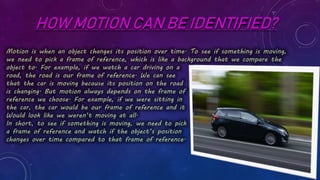
Motion is when an object changes its position over time. To see if something is moving,
we need to pick a frame of reference, which is like a background that we compare the
object to. For example, if we watch a car driving on a
road, the road is our frame of reference. We can see
that the car is moving because its position on the road
is changing. But motion always depends on the frame of
reference we choose. For example, if we were sitting in
the car, the car would be our frame of reference and it
Would look like we weren’t moving at all.
In short, to see if something is moving, we need to pick
a frame of reference and watch if the object’s position
changes over time compared to that frame of reference.
MOTION ALONG A STRAIGHT LINE
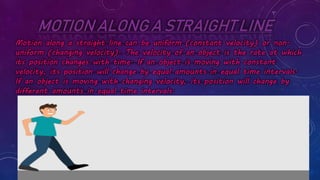
Motion along a straight line can be uniform (constant velocity) or non-
uniform (changing velocity). The velocity of an object is the rate at which
its position changes with time. If an object is moving with constant
velocity, its position will change by equal amounts in equal time intervals.
If an object is moving with changing velocity, its position will change by
different amounts in equal time intervals.
DISTANCE AND DISPLACEMENT
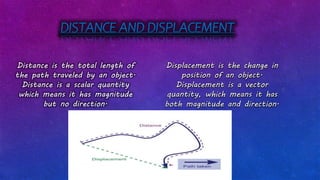
Distance is the total length of
the path traveled by an object.
Distance is a scalar quantity
which means it has magnitude
but no direction.
Displacement is the change in
position of an object.
Displacement is a vector
quantity, which means it has
both magnitude and direction.
GRAPHS:-
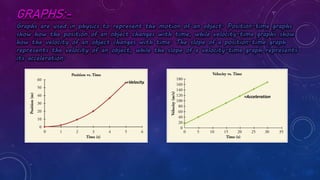
Graphs are used in physics to represent the motion of an object. Position-time graphs
show how the position of an object changes with time, while velocity-time graphs show
how the velocity of an object changes with time. The slope of a position-time graph
represents the velocity of an object, while the slope of a velocity-time graph represents
its acceleration.
=Velocity
=Acceleration
AVERAGE VELOCITY AND AVERAGE SPEED
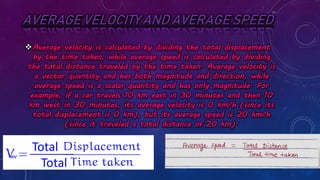
Average velocity is calculated by dividing the total displacement
by the time taken, while average speed is calculated by dividing
the total distance traveled by the time taken. Average velocity is
a vector quantity and has both magnitude and direction, while
average speed is a scalar quantity and has only magnitude. For
example, if a car travels 10 km east in 30 minutes and then 10
km west in 30 minutes, its average velocity is 0 km/h (since its
total displacement is 0 km), but its average speed is 20 km/h
(since it traveled a total distance of 20 km).
Total
Total
___________
av
INSTANTANEOUS VELOCITY
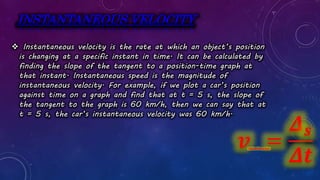
 Instantaneous velocity is the rate at which an object’s position
is changing at a specific instant in time. It can be calculated by
finding the slope of the tangent to a position-time graph at
that instant. Instantaneous speed is the magnitude of
instantaneous velocity. For example, if we plot a car’s position
against time on a graph and find that at t = 5 s, the slope of
the tangent to the graph is 60 km/h, then we can say that at
t = 5 s, the car’s instantaneous velocity was 60 km/h.
𝒗 =
𝜟𝒔
𝜟𝒕
instantaneous
ACCELERATION
Acceleration is defined as the rate at which an object’s
velocity changes with time. It can be calculated by dividing
the change in velocity by the time taken for that change to
occur. Acceleration is a vector quantity and has both
magnitude and direction. If an object’s velocity is increasing
over time (e.g., if it’s speeding up), then its acceleration will
be positive. If its velocity is decreasing over time (e.g., if it’s
slowing down), then its acceleration will be negative.
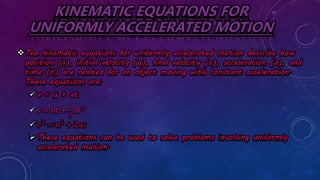
KINEMATIC EQUATIONS FOR
UNIFORMLY ACCELERATED MOTION
The kinematic equations for uniformly accelerated motion describe how
position (s), initial velocity (u), final velocity (v), acceleration (a), and
time (t) are related for an object moving with constant acceleration.
These equations are:
 v = u + at
 𝑠 = 𝑢𝑡 +
1
2
𝑎𝑡2
 𝑣2
= 𝑢2
+ 2𝑎𝑠
These equations can be used to solve problems involving uniformly
accelerated motion.
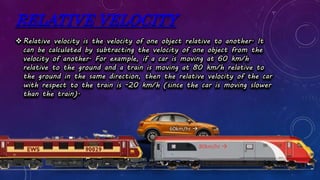
RELATIVE VELOCITY
Relative velocity is the velocity of one object relative to another. It
can be calculated by subtracting the velocity of one object from the
velocity of another. For example, if a car is moving at 60 km/h
relative to the ground and a train is moving at 80 km/h relative to
the ground in the same direction, then the relative velocity of the car
with respect to the train is -20 km/h (since the car is moving slower
than the train).
80km/hr 
60km/hr 
Motion in a straight line.pptx

Motion in a straight line.pptx

  • 1.
    MOTION IN ASTRAIGHT LINE UNIVERSAL PUBLIC SCHOOL CLASS-11TH NAME- TANMAY RAJPAL
  • 2.
    OBJECTIVES:- The objectives ofthis presentation are to: Introduce the concept of motion in a straight line Explain the different types of motion along a straight line Cover important concepts such as distance, displacement, velocity, acceleration, and more Provide examples and illustrations to help understand these concepts
  • 3.
    MOTION Motion is thechange in the position of an object with time. In the universe, motion is common to all objects. Even while we are asleep, air moves in and out of our body and blood flow in our veins and arteries. In this presentation, we will explore the concept of motion in a straight line and cover important concepts such as distance, displacement, velocity, acceleration, and more. There are different types of motion, such as rectilinear motion (motion along a straight line), circular motion (motion along a circular path), and more. In this presentation, we will focus on rectilinear motion, or motion along a straight line.
  • 4.
    HOW MOTION CANBE IDENTIFIED? Motion is when an object changes its position over time. To see if something is moving, we need to pick a frame of reference, which is like a background that we compare the object to. For example, if we watch a car driving on a road, the road is our frame of reference. We can see that the car is moving because its position on the road is changing. But motion always depends on the frame of reference we choose. For example, if we were sitting in the car, the car would be our frame of reference and it Would look like we weren’t moving at all. In short, to see if something is moving, we need to pick a frame of reference and watch if the object’s position changes over time compared to that frame of reference.
  • 5.
    MOTION ALONG ASTRAIGHT LINE Motion along a straight line can be uniform (constant velocity) or non- uniform (changing velocity). The velocity of an object is the rate at which its position changes with time. If an object is moving with constant velocity, its position will change by equal amounts in equal time intervals. If an object is moving with changing velocity, its position will change by different amounts in equal time intervals.
  • 6.
    DISTANCE AND DISPLACEMENT Distanceis the total length of the path traveled by an object. Distance is a scalar quantity which means it has magnitude but no direction. Displacement is the change in position of an object. Displacement is a vector quantity, which means it has both magnitude and direction.
  • 7.
    GRAPHS:- Graphs are usedin physics to represent the motion of an object. Position-time graphs show how the position of an object changes with time, while velocity-time graphs show how the velocity of an object changes with time. The slope of a position-time graph represents the velocity of an object, while the slope of a velocity-time graph represents its acceleration. =Velocity =Acceleration
  • 8.
    AVERAGE VELOCITY ANDAVERAGE SPEED Average velocity is calculated by dividing the total displacement by the time taken, while average speed is calculated by dividing the total distance traveled by the time taken. Average velocity is a vector quantity and has both magnitude and direction, while average speed is a scalar quantity and has only magnitude. For example, if a car travels 10 km east in 30 minutes and then 10 km west in 30 minutes, its average velocity is 0 km/h (since its total displacement is 0 km), but its average speed is 20 km/h (since it traveled a total distance of 20 km). Total Total ___________ av
  • 9.
    INSTANTANEOUS VELOCITY  Instantaneousvelocity is the rate at which an object’s position is changing at a specific instant in time. It can be calculated by finding the slope of the tangent to a position-time graph at that instant. Instantaneous speed is the magnitude of instantaneous velocity. For example, if we plot a car’s position against time on a graph and find that at t = 5 s, the slope of the tangent to the graph is 60 km/h, then we can say that at t = 5 s, the car’s instantaneous velocity was 60 km/h. 𝒗 = 𝜟𝒔 𝜟𝒕 instantaneous
  • 10.
    ACCELERATION Acceleration is definedas the rate at which an object’s velocity changes with time. It can be calculated by dividing the change in velocity by the time taken for that change to occur. Acceleration is a vector quantity and has both magnitude and direction. If an object’s velocity is increasing over time (e.g., if it’s speeding up), then its acceleration will be positive. If its velocity is decreasing over time (e.g., if it’s slowing down), then its acceleration will be negative.
  • 11.
    KINEMATIC EQUATIONS FOR UNIFORMLYACCELERATED MOTION The kinematic equations for uniformly accelerated motion describe how position (s), initial velocity (u), final velocity (v), acceleration (a), and time (t) are related for an object moving with constant acceleration. These equations are:  v = u + at  𝑠 = 𝑢𝑡 + 1 2 𝑎𝑡2  𝑣2 = 𝑢2 + 2𝑎𝑠 These equations can be used to solve problems involving uniformly accelerated motion.
  • 12.
    RELATIVE VELOCITY Relative velocityis the velocity of one object relative to another. It can be calculated by subtracting the velocity of one object from the velocity of another. For example, if a car is moving at 60 km/h relative to the ground and a train is moving at 80 km/h relative to the ground in the same direction, then the relative velocity of the car with respect to the train is -20 km/h (since the car is moving slower than the train). 80km/hr  60km/hr 