MICROTEACHING
ON
OBSTJECTIVE STRUCTURED CLINICAL
EXAMINATION
 PRESENTED BY,
 BHAGWTA K RAUT
 F.Y.MSC NURSING
 I.N.E, J.J.Hospital, Mumbai
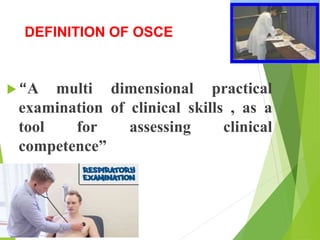
DEFINITION OF OSCE
“A multi dimensional practical
examination of clinical skills , as a
tool for assessing clinical
competence”
PURPOSES OF OSCE
1.Use in both formative and summative assessment in
health profession education
2.Identify objective performance criteria for the skill being
examined
3.structured the performance criteria in checklist to
facilitate the identification of desired clinical skill
4.A requirement for accreditation in many health
professional programs
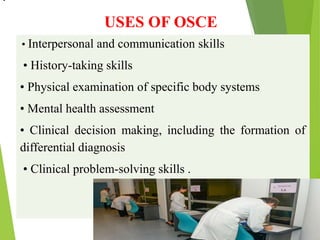
USES OF OSCE
• Interpersonal and communication skills
• History-taking skills
• Physical examination of specific body systems
• Mental health assessment
• Clinical decision making, including the formation of
differential diagnosis
• Clinical problem-solving skills .
•
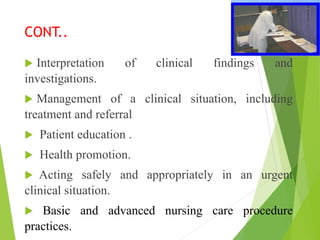
CONT..
 Interpretation of clinical findings and
investigations.
 Management of a clinical situation, including
treatment and referral
 Patient education .
 Health promotion.
 Acting safely and appropriately in an urgent
clinical situation.
 Basic and advanced nursing care procedure
practices.
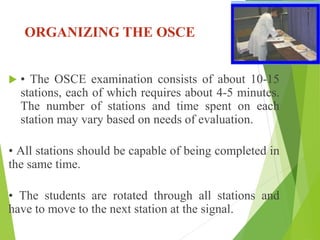
ORGANIZING THE OSCE
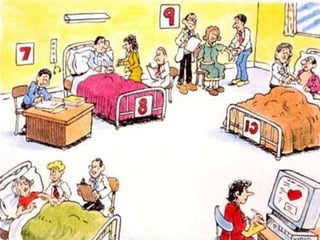
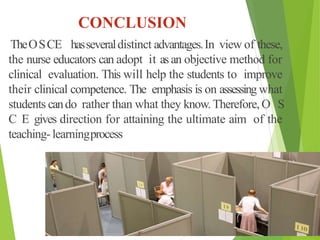
 • The OSCE examination consists of about 10-15
stations, each of which requires about 4-5 minutes.
The number of stations and time spent on each
station may vary based on needs of evaluation.
• All stations should be capable of being completed in
the same time.
• The students are rotated through all stations and
have to move to the next station at the signal.
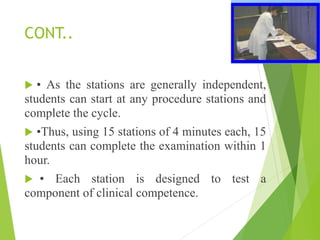
CONT..
 • As the stations are generally independent,
students can start at any procedure stations and
complete the cycle.
 •Thus, using 15 stations of 4 minutes each, 15
students can complete the examination within 1
hour.
 • Each station is designed to test a
component of clinical competence.
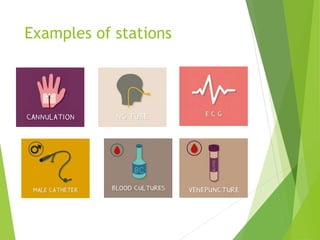
Examples of stations
Problems of using OSCE in the
Indian scenario
• Lack of feasibility due to time constrains.
• Shortage of training for use of OSCE.
• Shortage of observers/examiners.
• Lack of interest in examiners.
• Lack of enforced guidelines for practical
examination by universities number of students
examined and format of evaluation used
Advantages of OSCE
1.More valid than the traditional approach to
clinical examinations.
2.Examiners can decide in advance what is to he
tested and can then design the examination to test
these competencies.
3.Examiners can have better control on the
content and complexities.
4. Emphasis can be moved away from testing
factual knowledge to testing a wide range of skills
including advanced clinical skills.
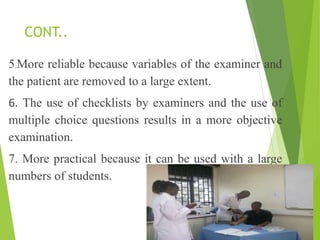
CONT..
5.More reliable because variables of the examiner and
the patient are removed to a large extent.
6. The use of checklists by examiners and the use of
multiple choice questions results in a more objective
examination.
7. More practical because it can be used with a large
numbers of students.
DISADVANTAGES OF OSCE
• Demanding for both examiners and patients.
• Examiners are required to pay close attention to
students repeating the same task on a number of
occasions.
• The time involved in setting up the examination is
greater than for the traditional examination.
CONCLUSION
TheOSCE hasseveraldistinct advantages.In view of these,
the nurse educators can adopt it asan objective method for
clinical evaluation. This will help the students to improve
their clinical competence. The emphasis is on assessing what
students cando rather than what they know.Therefore, O S
C E gives direction for attaining the ultimate aim of the
teaching- learningprocess
BIBLIOGRAPHY
 1.Jaspreet K S, Comprehensive Textbook of Nursing
Education,First edition 2017, Jaypee Publication, Page No.219-222
 2.Suresh K S, Communication And Education Technology In
Nursing, second Edition 2015,Elsevier publication,Page No.397-403
 3.R Sudha,Nursing education principles and concepts,Frist Edition
2013, Jaypee Publication, Page No.187-188
 4.http://www.oscehome.com/What_is_Objective-Structured-
Clinical-Examination_OSCE.html
 5 http://www.oscepass.com/
RESEARCH ARTICLE
 Objective Structured Clinical Examination: The Assessment of Choice
 Marliyya Zayyan*
 Abstract
 The Objective Structured Clinical Examination is a versatile multipurpose
evaluative tool that can be utilized to assess health care professionals in
a clinical setting. It assesses competency, based on objective testing
through direct observation. It is precise, objective, and reproducible
allowing uniform testing of students for a wide range of clinical skills.
Unlike the traditional clinical exam, the OSCE could evaluate areas most
critical to performance of health care professionals such as
communication skills and ability to handle unpredictable patient
behavior.
objective structured clinical examination

objective structured clinical examination

  • 2.
    MICROTEACHING ON OBSTJECTIVE STRUCTURED CLINICAL EXAMINATION PRESENTED BY,  BHAGWTA K RAUT  F.Y.MSC NURSING  I.N.E, J.J.Hospital, Mumbai
  • 3.
    DEFINITION OF OSCE “Amulti dimensional practical examination of clinical skills , as a tool for assessing clinical competence”
  • 4.
    PURPOSES OF OSCE 1.Usein both formative and summative assessment in health profession education 2.Identify objective performance criteria for the skill being examined 3.structured the performance criteria in checklist to facilitate the identification of desired clinical skill 4.A requirement for accreditation in many health professional programs
  • 5.
    USES OF OSCE •Interpersonal and communication skills • History-taking skills • Physical examination of specific body systems • Mental health assessment • Clinical decision making, including the formation of differential diagnosis • Clinical problem-solving skills . •
  • 6.
    CONT..  Interpretation ofclinical findings and investigations.  Management of a clinical situation, including treatment and referral  Patient education .  Health promotion.  Acting safely and appropriately in an urgent clinical situation.  Basic and advanced nursing care procedure practices.
  • 7.
    ORGANIZING THE OSCE • The OSCE examination consists of about 10-15 stations, each of which requires about 4-5 minutes. The number of stations and time spent on each station may vary based on needs of evaluation. • All stations should be capable of being completed in the same time. • The students are rotated through all stations and have to move to the next station at the signal.
  • 8.
    CONT..  • Asthe stations are generally independent, students can start at any procedure stations and complete the cycle.  •Thus, using 15 stations of 4 minutes each, 15 students can complete the examination within 1 hour.  • Each station is designed to test a component of clinical competence.
  • 9.
  • 10.
    Problems of usingOSCE in the Indian scenario • Lack of feasibility due to time constrains. • Shortage of training for use of OSCE. • Shortage of observers/examiners. • Lack of interest in examiners. • Lack of enforced guidelines for practical examination by universities number of students examined and format of evaluation used
  • 11.
    Advantages of OSCE 1.Morevalid than the traditional approach to clinical examinations. 2.Examiners can decide in advance what is to he tested and can then design the examination to test these competencies. 3.Examiners can have better control on the content and complexities. 4. Emphasis can be moved away from testing factual knowledge to testing a wide range of skills including advanced clinical skills.
  • 12.
    CONT.. 5.More reliable becausevariables of the examiner and the patient are removed to a large extent. 6. The use of checklists by examiners and the use of multiple choice questions results in a more objective examination. 7. More practical because it can be used with a large numbers of students.
  • 13.
    DISADVANTAGES OF OSCE •Demanding for both examiners and patients. • Examiners are required to pay close attention to students repeating the same task on a number of occasions. • The time involved in setting up the examination is greater than for the traditional examination.
  • 14.
    CONCLUSION TheOSCE hasseveraldistinct advantages.Inview of these, the nurse educators can adopt it asan objective method for clinical evaluation. This will help the students to improve their clinical competence. The emphasis is on assessing what students cando rather than what they know.Therefore, O S C E gives direction for attaining the ultimate aim of the teaching- learningprocess
  • 15.
    BIBLIOGRAPHY  1.Jaspreet KS, Comprehensive Textbook of Nursing Education,First edition 2017, Jaypee Publication, Page No.219-222  2.Suresh K S, Communication And Education Technology In Nursing, second Edition 2015,Elsevier publication,Page No.397-403  3.R Sudha,Nursing education principles and concepts,Frist Edition 2013, Jaypee Publication, Page No.187-188  4.http://www.oscehome.com/What_is_Objective-Structured- Clinical-Examination_OSCE.html  5 http://www.oscepass.com/
  • 16.
    RESEARCH ARTICLE  ObjectiveStructured Clinical Examination: The Assessment of Choice  Marliyya Zayyan*  Abstract  The Objective Structured Clinical Examination is a versatile multipurpose evaluative tool that can be utilized to assess health care professionals in a clinical setting. It assesses competency, based on objective testing through direct observation. It is precise, objective, and reproducible allowing uniform testing of students for a wide range of clinical skills. Unlike the traditional clinical exam, the OSCE could evaluate areas most critical to performance of health care professionals such as communication skills and ability to handle unpredictable patient behavior.