Education and educational
technology
DEBR
UNIT I: Introduction and Theoretical Foundations
• Education and educational technology
 Definition, aims
 Approaches and scope of educational technology
 Latest approaches to education:
o Transformational education
o Relationship based education
o Competency based education
Education
• DEFINITION
“Education is the all-round drawing out of the best in child and
man- body, mind and spirit”. - Mahatma Gandhi.
Education is the natural, harmonious and progressive development
of man’s innate powers”. - Pestaloz
Education is the development of all those capacities in the
individual which will enable him to control his environment and
fulfill his responsibilities”
- John Dewey.
Meaning
•The word education is derived from Latin root
‘educare’ means “bringing up” or “bring out”
•Education is the process of facilitating learning or
acquisition of knowledge, skill values and habits.
Aims of education
• The main aim of education was interpreted to be the preservation of
knowledge.
• Utilitarian aim: Utilitarian aim is concerned with providing knowledge and
skill required by the child for leading his day today life. Fulfillment of this
aim will enable him to make use of the knowledge and skill in a fruitful
manner. This aim makes the educative process a purposeful one and depicts
the relationship between education and life.
• Vocational aim: Education should prepare the child to earn his livelihood so
that he can lead to productive life in the society. Dignity of labour and
respect to the labour have to be developed or inculcated by means of
education.
• Social aim: Every individual is considered as a productive
member of the society. Keeping this aim in mind, educationists
have to help learners to develop a healthy, purposeful, productive,
exploratory and controlling adjustment with the environment.
• Intellectual aim: Education provides enough opportunities to
develop the innate intelligence through education will enable the
child to lead an independent life with confidence.
• Citizenship: Education enable the children to grow as productive
citizens by following the social and moral standards set by the
society.
• Physical health and well-being: Education prepare the child to
lead a healthy life through providing the knowledge required for
a healthy living and helping him to positive attitudes towards
health.
• Character development: According to Mahatma Gandhi,” the end
of all knowledge must be the building up of character”.
• Moral development: Moral values like honesty, truthfulness,
justice, goodness, purity, courage, reverence, dutifulness,
punctuality, self confidence, discrimination between good and bad,
observation of rules, belief in systematic organization, etc are
inculcated through education
• Cultural development: By undergoing education child becomes
cultured and civilized.
• Education for leisure: Leisure time should be utilized in such a
way that the individual as well as the society should benefit
from it. Education prepare the child to use his leisure time for
doing something useful.
• Self-realization: Self-realization also helps the child to realize his
strengths, weakness, opportunities and threats so that he can exert
a good control over his life by strengthening the weakness.
• Mental and Emotional development: In this fast changing world,
good mental health is a must to cope with the changing
lifestyles and societal needs. Education should train the child by
giving adequate opportunities for mental and emotional
development.
• Self education aim: As education is considered as a lifelong
process, it should prepare the child to adopt a proactive role
towards the learning process. This aim is gaining importance in
the era of knowledge explosion where students are expected to
take a leading role in the teaching-learning process than the
teacher. Teachers should make sure that students are learning as
a result of the internal motivation rather than a reaction to the
compulsion exerted by others.
• International understanding: Education is a universal process and
it helps in creating universal understanding. The progress we
achieved in the field of education is the result of the combined
efforts of the people from different countries, the scholars of all
periods, the followers of all religion and members of all the races.
• Harmonious development: Ultimately the overall aim of education
is to ensure harmonious development through the achievement of
the above mentioned aims. Harmonious development will enable
the child to deal effectively with the problems and uncertainties of
life.
Types of Education
• Education encompasses formal and informal learning experiences,
each contributing to an individual’s growth and development.
1 Formal Education:
• Formal education stands as the bedrock of societal progress,
offering structured and systematic learning experiences that shape
the minds of individuals and contribute to the overall development
of communities.
• In classrooms and lecture halls, within the walls of schools and
universities, formal education unfolds as a dynamic process that
equips learners with knowledge, skills, and qualifications. Here are
key aspects of formal education:
•Structured Curriculum: One of the defining
features of formal education is its reliance on a
structured curriculum. A carefully designed
syllabus outlines the subjects, topics, and
learning objectives, providing a roadmap for
students to navigate various fields of
knowledge.
•Certification and Degrees: Formal education
culminates in attaining certifications,
diplomas, or degrees, serving as tangible
proof of an individual’s educational
accomplishments. These credentials carry
significant weight in the professional realm,
influencing career opportunities and acting as
a gateway to specialized fields.
• Educational Institutions: Formal education predominantly
occurs within educational institutions, from primary schools
to universities. These institutions serve as organized hubs of
learning, equipped with dedicated spaces for classrooms,
laboratories, libraries, and extracurricular activities.
• Trained Educators: Central to formal education is
the role of trained educators. Teachers, professors,
and instructors bring expertise and pedagogical
skills to learning. Their guidance, mentorship, and
facilitation of classroom discussions play a pivotal
role in shaping the educational experience and
inspiring students to delve deeper into their studies.
• Standardized Assessments: Assessment is an
integral component of formal education,
systematically gauging students’ understanding of
the material. Standardized assessments and
examinations serve as benchmarks for academic
performance, enabling educators to evaluate
progress and identify areas for improvement.
• Academic Progression and Specialization: Formal
education is organized into grade levels, each
representing a stage of academic progression.
Advancement through these levels is based on
completing coursework and examinations.
•Government Regulations and
Standards: Formal education is subject to
government regulations and standards that
ensure the quality and consistency of
educational programs.
•Socialization and Peer
Interaction: Educational institutions provide a
structured socialization and peer interaction
setting. Beyond academic learning, students
develop essential social skills, teamwork, and a
sense of community.
• Preparation for Future Careers: One of the primary
objectives of formal education is to prepare individuals
for future careers. It equips students with the
knowledge, skills, and competencies needed in the
workforce.
• Global Standards and Mobility: Formal education
adheres to global standards, facilitating educational
mobility and the recognition of qualifications
internationally. This interconnectedness is fundamental
as individuals pursue educational opportunities or
careers in different countries, contributing to a global
pool of knowledge and talent.
• Formal education is a cornerstone of personal and societal
development, providing a structured framework for
intellectual growth, skill development, and the pursuit of
knowledge.
Informal Education
• The informal realm offers a dynamic, learner-driven
journey that extends far beyond the confines of
traditional classrooms. Informal education,
characterized by its spontaneity and diversity, is
crucial in shaping individuals, fostering personal
development, and complementing the structured
knowledge gained through formal channels. Here
are key aspects of in-formal education:
• Everyday Learning Experiences: Informal
education thrives in the fabric of everyday life. From
family interactions and community engagements to
personal experiences and encounters with the
world, informal learning is seamlessly woven into
the tapestry of our daily existence. It encompasses
the skills acquired through observation, trial and
error, and knowledge absorption from the situations
encountered in the real world.
• Hands-On Learning and Experiential Wisdom: At
the heart of informal education lies the hands-on
experience, an invaluable teacher in its own right.
Individuals glean experiential wisdom beyond
textbook knowledge, whether learning a craft,
navigating a new city, or experimenting with a
hobby.
• Self-Directed Exploration: One of the
distinguishing features of informal education is its
self-directed nature. Individuals have the autonomy
to pursue their passions, delve into topics of
personal interest, and chart their learning journeys.
• Mentorship and Role Models: Informal education
often unfolds in the shadow of mentorship and the
influence of role models. Whether it’s a family
member, a community leader, or a respected
colleague, informal learning benefits from the
guidance and insights shared by those with more
experience.
• Media and Technology: The digital age has
ushered in new dimensions of informal education
through the accessibility of online resources,
educational platforms, and interactive media.
Blogs, podcasts, video tutorials, and social media
create a vast landscape for informal learning,
allowing individuals to explore diverse topics,
connect with global communities, and engage in
self-paced learning.
•Cultural Transmission: Informal education is
a conduit for transmitting culture, traditions,
and societal norms. Through storytelling, oral
traditions, and community celebrations,
individuals absorb a deep understanding of
their cultural heritage, fostering a sense of
identity and connection to their roots.
• Problem-Solving and Critical Thinking: The
informal learning space incubates problem-solving
skills and critical thinking. Whether faced with
personal challenges or navigating professional
scenarios, individuals who engage in informal
learning tend to develop adaptive thinking and
approach problems creatively and resourceful.
• Community Learning and Collaboration: Informal
education often occurs within communities. Shared
knowledge, collaborative problem-solving, and
collective learning experiences contribute to the
social fabric of groups.
• Lifelong Learning Mindset: At its core, informal
education nurtures a lifelong learning mindset.
Learning doesn’t end with formal degrees or
certificates; it continues throughout life.
Informal education
•It is a lifelong process by which every person acquires
and accumulates knowledge, skills and attitude from
daily experiences and exposure to the environment at
home, at school, at work, at play etc. from parents,
friends, neighbours, reading news paper & books,
viewing T.V, listening to radio etc.
•It is also called incidental learning process. Generally
informal education is unorganised and often
unsystematic. Yet, it accounts for the great bulk of
information to any person’s life time. eg: Little baby,
as she grows up, learns how to recognize her parents
and how to eat.
Non-formal Education
• It is an organized and systematic educational activity carried on
outside the framework of the formal system to provide selected types
of learning to particular sub-groups in the population, including adults
and children according to their needs.
• eg: Extension Education, Adult Education, Vocational Education,
Functional Literacy, Continuing Education, etc.
Nursing education
•Nursing education refers to formal learning and
training in the science of nursing. This includes the
functions and duties in the physical care of patients,
and a combination of different disciplines that both
accelerates the patient's return to health and helps
maintain it.
Definition of Educational Technology
Educational technology is the study and ethical practice of
facilitating learning and improving performance by creating,
using and managing appropriate technological processes and
resources. --The Association For Educational
Communications And Technology (AECT) 2008
•Educational technology is a systematic, iterative
process for designing instruction or training used to
improve performance. -The Encyclopedia
of Educational Technology
Main Aims/ objective of educational
technology
• The essential objective of Educational Technology is to improve
the quality of education and enhance the learning process.
Most importantly, technology should magnify the teaching and
learning process as well as facilitate better performance of
educational systems as it emphasizes upon effectiveness and
efficiency.
Objectives of Educational Technology at the
Macro Level
• To identify the educational requirements and desires of the community.
• To understand the structure of education, board strategies, and its goals.
• To design and develop curriculums involving art, science and human values.
• To support strategies and human resources and material assets with the mission to achieve
determined goals.
• To create appropriate aids and instruments supporting educational purposes.
• To design educational technology models catering to improve the existing process of teaching and
learning.
• To identify and find remedies to tackle major environmental constraints.
• To expand and support educational opportunities for people around the world, especially the
neglected sections of the community.
• To manage the entire educational system starting from planning to execution, implementation, and
evaluation.
Objectives of Educational Technology at the
Micro Level
• To discover and analyse the characteristics and educational
requirements of every student.
• To determine and state the specific behavioural classroom objectives.
• To understand and organise the contents of instruction in a proper
sequence.
• To recognize the existing teaching-learning resources and materials.
• To identify the nature of the interaction of sub-systems like teachers,
students, the content of instruction, teaching-learning material, and
different methodologies.
Educational Technology
• 1. aims to provide the learner with the foundational knowledge of
how technology has paved the way for the facilitation of better
learning processes while the learning.
• 2. impart the understanding of integrating technology to help the
learner become an exemplary user of educational technology.
Concept of Educational Technology
• Educational Technology, also known as EduTech or EdTech, is the
concept of teaching and learning through the efficient medium of
technology. It facilitates an in-depth understanding of the
fundamentals of technology with its operations and to help the
teaching-learning process gain the best possible results in an efficient
and economical way.
• Educational technology is concerned with the following two aspects:
• Theoretical knowledge produced from various academic disciplines
such as Psychology, Education, Communication, Philosophy, Sociology,
Computer Science, Artificial Intelligence, etc.
• Experimental knowledge elicited from educational practice and
training.
Approaches and scope of educational
technology
Approaches of Eduacational Technology
Hardware
Approaches
Software
Approaches
System
Approaches
1. HARDWARE APPROACH
• The hardware approach is based on the application of engineering principles for
developing electro-mechanical equipment for instructional purposes. Motion
pictures, tape recorders, television, teaching machines, computers are called
educational hardware.
• Hardware approach mechanizes the process of teaching so that teachers would
be able to deal with more students with less expenditures in educating them.
• Human knowledge has three aspects:
1. Preservation,
2. Transmission and
3. Development.
• The history of preservation of the knowledge is believed to exist since
the printing machines started. The knowledge is preserved with these
machines in the form of books which are shelved in the libraries, tape
recorders and films.
• The second aspect of human knowledge is its transmission. A teacher
can impart knowledge himself to his pupils. Now a days, transmission of
the knowledge is supported by machine like mike, radio and television.
With these, thousands of pupils enjoy this home-delivery of such
benefits.
• The third aspect of human knowledge is its development. For this aspect,
provisions are made for research work. In the research programmes, the
main function is the collection and analysis of data. For this purpose,
presently the researcher uses the electronic machines and computers.
Hence, all the three aspects of knowledge allow the use of machines.
2. SOFTWARE APPROACH
• The software approach used the principles of psychology for building
in the learners a complex repertory of knowledge or modifying his
behaviour. It originates from behavioural sciences and their applied
aspects concerning psychology of learning. Psychology of learning
provides solid technology for bringing desirable behavioural changes
in the pupils and thus serves the cause of education of laying down
definite instructional procedure, teaching behaviour and behaviour
modification devices.
• The pioneering work in software approach was done by Skinner and
other behaviourists.
• The programmes which such a technology produces are often called
software. Software Approach is also termed as Instructional
Technology or Teaching Technology or Behavioural Technology.
• Newspapers, books, magazines, educational games, flash cards may
also form part of software. Software approach is characterized by task
analysis, writing precise objectives, selection of appropriate learning
strategies, immediate reinforcement of responses and constant
evaluation.
3. SYSTEMS APPROACH
• System approach is a systematic attempt to coordinate all aspects of a
problem towards specific objectives.
• Webster’s dictionary defines a system as “a regularly interacting or
independent group of items forming a unified whole”.
• Example – various parts of the digestive system may be called as
components of digestive system. Every component of the digestive
system contributes to as supports in functioning of the digestive
system as a whole.
Major steps in the systems approach in education are
• 1. Formulating of specific instructional objectives to be achieved and defining
instructional goals,
2. Deciding appropriate media to achieve these goals,
3. Defining learner characteristics and requirements,
4. Selecting appropriate methods suitable for effective learning to take place,
5. Selecting appropriate learning experiences from available alternatives,
6. Selecting appropriate materials and tools required,
7. Assigning appropriate personal roles for teachers, students and supporting
staff,
8. Implementing the programme,
9. Evaluating the outcome in terms of original objectives measured
in student performance and
10. Revising to improve efficiency of the system to improve
students’ learning.
Latest approaches to education
1. Transformational education
2. Relationship based education
3. Competency based education
Transformational education
• Transformative education is a pedagogical approach that goes beyond
basic knowledge transfer, aiming to deeply alter a learner's
understanding of the world and their place in it.
• It focuses on empowering individuals to take informed action at
personal, community, and global levels by fostering critical reflection,
empathy, and a sense of responsibility towards building inclusive and
sustainable societies.
Key Principles
• Deep Learning:
• Critical Reflection:
• Learners are encouraged to critically examine their existing beliefs, assumptions, and
perspectives, leading to a more nuanced and informed understanding of the world.
• Empathy and Diversity:
• The approach emphasizes the importance of understanding and appreciating diverse
perspectives and experiences, fostering a sense of shared humanity.
• Action-Oriented Learning:
• Transformative education aims to equip learners with the skills and knowledge to actively
participate in creating positive change in their communities and the world.
• Holistic Development:
• It recognizes the interconnectedness of intellectual, emotional, social, and spiritual growth,
aiming to develop well-rounded individuals.
Examples of Transformative Education:
• Community-Based Learning:
• Students engage in projects that address real-world issues in their local
communities, such as environmental sustainability or social justice.
• Global Citizenship Education:
• Learners explore diverse cultures, global challenges, and the interconnectedness
of global issues, fostering a sense of responsibility towards building a more just
and sustainable world.
• Adult Education Programs:
• Programs that challenge adults to critically reflect on their beliefs and values in
relation to their lived experiences, leading to personal and social transformation.
Transformative Learning and the Role of
Educators
• Facilitators of Reflection:
• Educators act as facilitators of critical reflection, creating spaces for learners to explore
their own perspectives and engage in meaningful dialogue.
• Promoters of Agency:
• They empower learners to take ownership of their learning and actively participate in
shaping their own educational experiences.
• Models of Lifelong Learning:
• Educators demonstrate a commitment to lifelong learning and continuous growth,
inspiring learners to embrace the transformative potential of education.
• In summary, transformative education is a powerful approach to learning that moves
beyond traditional methods to empower individuals to become active and responsible
participants in building a more just, equitable, and sustainable future.
Relationship-based education
• Relationship-based education emphasizes the importance of
positive relationships between educators, learners, and their families
in fostering learning and development.
• It recognizes that strong, supportive relationships can significantly
impact a learner's ability to engage, learn, and thrive, particularly for
those with social, emotional, and mental health needs.
Key Principles:
1. Focus on relationships:
2. Understanding individual needs:
• Recognizing that learners, including families, have unique needs and perspectives.
3. Collaboration and communication:
• Encouraging open communication and collaboration between educators, learners, and
families.
4. Supporting learner agency:
• Empowering learners to take ownership of their learning and well-being.
5. Creating a safe and supportive learning environment:
• Fostering an environment where learners feel valued, respected, and comfortable
taking risks.
Benefits of Relationship-Based Education
• Improved learning outcomes:
• Strong relationships can enhance engagement, motivation, and overall academic
achievement.
• Enhanced social-emotional development:
• Relationship-based approaches can help learners develop social skills, emotional regulation,
and a sense of belonging.
• Increased school attendance and engagement:
• Positive relationships can reduce absenteeism and dropout rates.
• Strengthened family-school partnerships:
• Collaborative efforts can lead to better support for learners and their families.
• Improved mental health and well-being:
• Supportive relationships can promote positive mental health and resilience.
Examples of Relationship-Based Practices:
1. Regular communication and feedback: Keeping families informed
about their child's progress and well-being.
2. Creating opportunities for family involvement: Engaging parents in
school activities and decision-making.
3. Using a strengths-based approach: Focusing on the positive aspects
of learners and their families.
4. Providing individualized support: Tailoring instruction and
interventions to meet the specific needs of each learner.
5. Modeling positive relationships: Educators demonstrating healthy
communication and interactions with learners.
Competency-based education (CBE)
• Competency-based education (CBE) is an approach that focuses on
what students learn (competencies) rather than how much time they
spend in class.
• It emphasizes mastery of specific skills and knowledge through
demonstrated proficiency, rather than solely on grades or time spent
in the classroom.
• Students progress based on their ability to demonstrate mastery, and
the curriculum is often personalized to meet individual learning
needs.
Educational philosophy
• The word philosophy is derived from two Greek words- 'Philos' and 'Sophia'.
'Philos' mean love and 'Sophia' means wisdom. Thus, philosophy means
love of wisdom.
• According to Karl Marks
• - "Philosophy is the interpretation of the world in order to change it".
• According to Plato -
• "Philosophy is the acquisition of knowledge."
• According to Dr.Radhakrishnan
• - "Philosophy is a view of life. It gives a direction to life; it offers a design for
living."
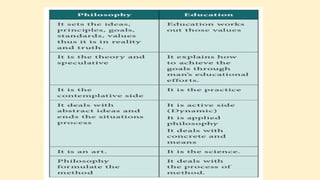
Education and Philosophy
• Education is a growing science and philosophy is the cornerstone of the
foundation of education.
• While the goal of philosophy is to explain the mysteries of universe.
• The chief means of philosophy is education which has been correctly
described as the dynamic side of philosophy.
• Education is a practical activity of philosophical thought.
• Every educational practice is illumined with the backdrop of philosophy.
• “the art of education will never attain complete clearness without
philosophy”. - Fichte,
Interdependence between Philosophy and
Education
• Philosophy and education are closely inter-related.
• Education is the application of philosophy or philosophy of education
is applied philosophy. It is the application of philosophy to the study
of the problems of education that is known as philosophy of
education.
• In fact, philosophy is the groundwork or foundation out of which
comes the objectives of education.
• Philosophy and education walk hand in hand.
• In this relationship, philosophy and education are reconstructive; they
give to and take from each other in ebb and flow of thought and
action; they are means to one another, and ends; they are process
and product.
• According to Ross, “philosophy and education are like the sides of a
coin, presenting different views of the same thing, and that one is
implied by the other”.
• In the words of sir john Adams, “education is the dynamic side of
philosophy”.
• Philosophy prescribes the goals and essentials of good life and
education is the best means to achieve those goals.
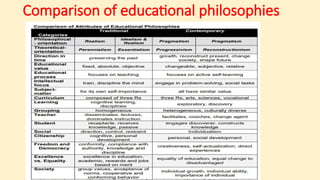
Educational philosophies
• Educational philosophies are sets of beliefs about education,
influencing how educators view teaching and learning. They guide
decisions about curriculum, methods, and the overall goals of
education.
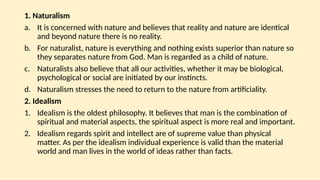
1. Naturalism
a. It is concerned with nature and believes that reality and nature are identical
and beyond nature there is no reality.
b. For naturalist, nature is everything and nothing exists superior than nature so
they separates nature from God. Man is regarded as a child of nature.
c. Naturalists also believe that all our activities, whether it may be biological,
psychological or social are initiated by our instincts.
d. Naturalism stresses the need to return to the nature from artificiality.
2. Idealism
1. Idealism is the oldest philosophy. It believes that man is the combination of
spiritual and material aspects, the spiritual aspect is more real and important.
2. Idealism regards spirit and intellect are of supreme value than physical
matter. As per the idealism individual experience is valid than the material
world and man lives in the world of ideas rather than facts.
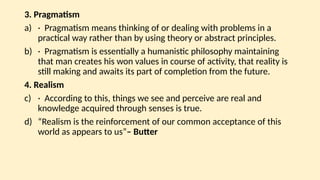
3. Pragmatism
a) · Pragmatism means thinking of or dealing with problems in a
practical way rather than by using theory or abstract principles.
b) · Pragmatism is essentially a humanistic philosophy maintaining
that man creates his won values in course of activity, that reality is
still making and awaits its part of completion from the future.
4. Realism
c) · According to this, things we see and perceive are real and
knowledge acquired through senses is true.
d) “Realism is the reinforcement of our common acceptance of this
world as appears to us”– Butter
Some key philosophies:
• Essentialism:
• Focuses on a core curriculum of basic skills and knowledge, often advocating a "back to basics" approach.
• Progressivism:
• Emphasizes experiential learning and problem-solving, aligning education with real-world challenges and
student interests.
• Perennialism:
• Believes in developing rational thinking through studying great books and ideas, aiming to instill enduring
knowledge.
• Existentialism:
• Supports self-directed learning, encouraging students to explore their own meaning and understanding of
the world.
• Constructivism:
• Highlights the active role of learners in constructing their own knowledge through experience and
interaction.
Comparison of educational philosophies
Nursing Philosophy
• The philosophy of nursing education guides the values, beliefs, and principles that shape nursing
education, aiming to prepare graduates for effective and compassionate care.
• It encompasses how nursing is viewed, including its role in society, its relationship with other
fields, and the ethical considerations involved in practice.
• Nursing philosophy emphasizes the importance of both theory and practice, as well as the
development of critical thinking and problem-solving skills.
Key Aspects of Nursing Philosophy:
• Focus on the Person:
• A core belief in nursing philosophy is the importance of treating each individual with respect,
dignity, and compassion, recognizing their unique needs and experiences.
• Holistic Care:
• Nursing philosophy emphasizes a holistic approach to care, considering the physical, emotional,
social, and spiritual aspects of health.
• Service to Humanity:
• Nursing is often viewed as a service to humanity, with a commitment to improving the
health and well-being of individuals, families, and communities.
• Scientific Basis:
• Nursing philosophy acknowledges that nursing practice is grounded in scientific knowledge,
evidence-based practices, and the application of research findings.
• Ethical Practice:
• Ethical considerations are central to nursing philosophy, emphasizing the importance of
integrity, honesty, and responsible behavior in all aspects of practice.
• Lifelong Learning:
• Nursing philosophy promotes a culture of lifelong learning, encouraging nurses to
continuously update their knowledge and skills to provide the best possible care.
Teaching learning process
The teaching-learning process, or the education
process, has been defined as a systematic,
sequential, planned course of action on the part
of both the teacher and learner to achieve the
outcomes of teaching and learning.
• Teaching and learning process can be defined as a
transformation process of knowledge from teachers to
students.
• It is referred as the combination of various elements within
the process where an educator identifies and establishes the
learning objectives and develop teaching resources and
implement the teaching and learning strategy.
• On the other hand, learning is a cardinal factor that a teacher
must consider while teaching students
•Teaching-learning process is the heart of
education. On it depends the fulfillment of the
aims and objectives of education. It is the most
powerful instrument of education to bring about
desired changes in the students.
Teaching-Learning Strategies
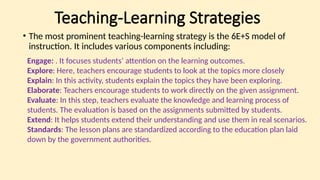
• The most prominent teaching-learning strategy is the 6E+S model of
instruction. It includes various components including:
Engage: . It focuses students’ attention on the learning outcomes.
Explore: Here, teachers encourage students to look at the topics more closely
Explain: In this activity, students explain the topics they have been exploring.
Elaborate: Teachers encourage students to work directly on the given assignment.
Evaluate: In this step, teachers evaluate the knowledge and learning process of
students. The evaluation is based on the assignments submitted by students.
Extend: It helps students extend their understanding and use them in real scenarios.
Standards: The lesson plans are standardized according to the education plan laid
down by the government authorities.
Important aspects of teaching-learning
process
Diana Laurillard argues that there are four aspects of the
teaching-learning process:-
a. Discussion:- between the teacher and learners.
b. Interaction:- between the learner and some aspect of the
world defined by the teacher.
c. Adaptation:- of the world by the teacher and action by
the learner.
d. Reflection:- on the learner’s performance by both
teachers and learners.
Teaching definition
• (1) H C Morrison:- Teaching is an intimate contact between the more
mature personality and a less mature one.
• (2) Jackson:- Teaching is a face to face encounters between two or
more persons, one of whom ( teacher) intends to effect certain
changes in the other participants ( students).
• (3) J B Hough and James K Duncan:- Teaching is an activity with four
phases, a curriculum planning phase, an instructing phase, and an
evaluating phase.
Learning
• Bastable (2014) defines learning as a “…change in behavior as a result
of a lifelong, dynamic process by which individuals acquire new
knowledge skills, and/or attitudes that can be measured and can
occur at any time or in any place due to exposure to environmental
stimuli”.
• WordNet defines learning as a "cognitive process of acquiring skill or
knowledge".
•
characteristics of good teaching are
• The Seven Principles for Good Teaching
• Encourage contact between students and faculty.
• Develop reciprocity and cooperation among students.
• Encourage active learning.
• Give prompt feedback.
• Emphasize time on task.
• Communicate high expectations.
• Respect diverse talents and ways of learning.
• (Based on Chickering and Gamson, 1987)
Nature of Teaching Learning Process
The nature of teaching learning process is as follows:
• Professional Activity
• The teaching learning process is a professional activity where the student or learner
receives guidance from a trained teacher.
• Communication
• The teaching and learning process involves a lot of communication and therefore, it is
only successful when there is proper interaction between the learner and the teacher.
• Interactive Process
• The teacher gives information to the students and the learners acquire the
information. The teaching process involves active interaction between the learner and
the teacher.
• Organized System
• The teaching learning process takes place in an organized manner in a
professional location.
• Overall Development
• The teaching learning process helps in the overall development of a
learner.
• Continuous Process
• The teaching learning process is never ending and it takes place from
birth to death. Hence, it is a continuous process.
Nature of teaching:-
• (1). Teaching is an inter-process:- It is conducted between the
teacher and the students for a specific purpose
• (2). Teaching is both an art and a science:- The nature of teaching is
both artistic and scientific. Teaching planning and evaluation activities
are more scientific in nature whereas the process aspect of teaching is
artistic in which the teacher uses his skills.
• (3). Teaching is a developmental process:- Through the process of
teaching, children are developed and the desired changes in behavior
are brought from them. Cognitive, emotional and functional aspects
are developed.
• (4). Teaching is a continuous process:- Teaching is a continuous
process which continues till the achievement of teaching-learning
objectives. It has three aspects – action, learning and evaluation.
• (5) Teaching is a process of guidance:– In teaching, efforts are made
to develop the students according to their abilities. Thus the goal is of
direction.
• (6). Teaching is a three-way process:- Most of the educationists have
called teaching as a tripartite process. According to Bloom, there are
three aspects of teaching– (i) learning objectives, (ii) learning
experiences and (iii) behavior change.
• (7). Teaching is a purposeful process:- The activities of teaching are
done to achieve some specific objectives. For them, similarly adopts
the nature of the planned process.
• (8). Teaching is a social and professional process:– The process of
teaching is carried out in the group of teaching and students. It is
absolutely necessary to have at least one teacher and one student.
Teaching is a professional activity which individuals make their means
of earning their livelihood, who are called teachers.
• (9). Teaching is measured:- Teaching is measured in the form of
teacher's behavior. Measurement of teacher behavior and analysis of
behavior pattern are also done by observation methods.
• (10). Teaching is a science:- The skill side of presentation of teaching
is an art, but their actions can also be logically monitored and
evaluated. This gives it a scientific basis.
• (11). Teaching is a formal and informal process:- The education
process is carried out in the school according to the fixed program
and is also conducted outside the school.
Characteristic of teaching:-
(1) Teaching is a complete social process
Teaching is undertaken for the society and by the society. With ever-changing social ideas,
it is not possible to describe exact and permanent nature of teaching.
(2) Teaching is giving information
Teaching tells students about the things they have to know and students cannot find out
themselves. Communication of knowledge is an essential part of teaching.
(3) teaching is an interactive process
Teaching is an interactive process between the student and the teaching sources, which is
essential for the guidance, progress, and development of students.
(4) Teaching is a process of development and learning.
(5) Teaching causes a change in behavior.
(6) Teaching is art as well as science.
(7) Teaching is face to face encounter.
(8) Teaching is observable, measurable and modifiable.
(9) Teaching is skilled occupation:- Every successful teacher
is expected to know the general methods of teaching-
learning situations.
(10) Teaching facilitates learning
(11) Teaching is both conscious and an unconscious process.
(12) Teaching is from memory level to reflective level.
(13) Teaching is a continuum of training, conditioning,
instruction, and indoctrination.
Basic Principles of Teaching
• 1. Good Teaching is Good Communication
• 2. Good Teaching is an Art
• 3. Good teaching demands the teacher to know nature of child
• 4. Good teaching is kindly and sympathetic
• 5. Good teaching develops emotional stability.
• 6. Good Teaching is Democratic
• 7. Good teaching involves skill in guiding learning
• 8. Good teaching is cooperative
• 9. Good teaching is well-planned
• 10. Good teaching is remedial
• 11. Good teaching is progressive
Maxims of Teaching
• Maxims of Teaching refers to the Techniques in Teaching that a
teacher adopts for effective teaching learning. They accelerate
momentum of teaching learning process and help in achieving
success in classroom.
• Maxims of teaching are the basic rules of teaching which when
implemented motivate learners, promote their attention on what is
being taught, encourage their active involvement and thus result in
effective learning. The teacher needs to know them and practice.
• Maxims of teaching motivate the learners and also make teaching
learning process effective, fruitful, Inspirational and meaningful.
• Without using the proper of maxim a teacher cannot teach effectively.
KNOWN TO UNKNOWN
•This maxim suggests starting with concepts students
are already familiar with and then gradually
introducing new, unfamiliar concepts. For instance,
when teaching photosynthesis, a teacher could start
by discussing how people cook food and relate it to
the process by which plants make their own food.
SIMPLE TO COMPLEX
• In this process of teaching-learning, the teacher should see those
simple things are presented first to the students. That way they will
start taking an interest. Once they become interested, thou gradually
complex type of things can also be learnt by them. By learning simple
things, they feel encouraged and they also gain confidence. On this
basis, they become further receptive to the complex matter.
PARTICULAR TO GENERAL
While teaching, the teacher should, first of all, take particular
statements and then on the basis of those particular cases,
generalization should be made. General facts, principles and
ideas are difficult to understand and hence the teacher
should always first present particular things and then lead to
general things.
CONCRETE TO ABSTRACT
• Concrete things are solid things and they can be touched with five
senses. But abstract things can only be imagined. So it is rather
difficult to teach children about abstract things.
• The students are likely to forget them soon. On the other hand, if we
teach the students with the help of concrete objects, they will never
forget the subject matter.
ANALYSIS TO SYNTHESIS
• When we divide a thing into easy parts or separate elements in order
to understand it easily is called analysis. It is the process which helps
in understanding the hidden elements of a thing or the cause of some
incident or behavior.
• Synthesis is just opposite of analysis. All parts are shown as a whole.
The process of analysis is easier than synthesis for understanding a
thing. This process develops the analytical power of the students. It is
the best method of starting the teaching process
EMPERICAL TO RATIONAL SCIENCE
• Empirical knowledge is that which is based on observation and first
and experience about which no reasoning is needed at all. It is
concrete, particular and simple. We can feel and experience it.
• On the other hand rational knowledge is based upon arguments and
explanations.
• For example suppose the students are to be taught that water boils
on heating. They should first be made to heat the water and see it
boiling. Then the teacher should explain that when water is heated,
the molecules gain kinetic energy and there is thermal agitation of the
molecules which make the water boil.
Psychological to logical
• Modern education gives more emphases on psychology of the child. A
teacher while teaching should follow this maxim viz from
psychological to logical. Psychological approach takes into
consideration the pupil his interests, abilities, aptitudes, development
level, needs and reactions.
• The teacher should keep in mind the psychological selection of the
subject matter to be presented before the pupils. Logical approach
considers the arrangement of the chosen content into logical order
and steps.
NEAR TO FAR
• Every child is able to learn well in the surroundings to which he
belongs. So the child should be acquainted fully with his immediate
environment. Gradually he may be taught about those things which
are far from his immediate environment.
• This principle, if kept in view, will smoothen the leaching-learning
process considerably. Thus the child should be taught the home,
followed by the street, the bazaar, the school and then the distant
environment of the city to which he belongs. In the same way,
acquaintance with the city should lead to acquaintance with the Tehsil,
the District, the Division, the Stale and then the Country as a whole.
• The textbook writer who writes books for the small children should
also place the different chapters in his bookkeeping in view this
principle. Then only his book will stand better chances of approval by
all concerned
Induction to Deduction
• Induction means drawing a conclusion from a set of examples
whereas deduction is its opposite. The teacher should proceed from
induction to deduction.
• For example, in English, while teaching the conversion of active voice
into passive voice, the teacher should first convert a few sentences of
active into the passive voice and on the basis of those conclude the
general rule for a conversation of active voice in to passive voice
Psychological to Logical
• While teaching, the teacher should first keep in mind the interest,
aptitudes, capacities, development level etc. of the children during
the selection of subject matter and then on to its logical arrangement.
• In teaching English, the structures are selected as per the needs and
requirements of the students and then arranged in a logical way. The
psychological appeal of the thing is more important at the early
stages. Then the’ logic behind it should be seen.
Actual to Representative
• For teaching excellently, actual objects should be, shown to the children as
far as possible. It gives them concrete learning which is more desirable.
The learners are able to retain it in their minds for quite a long time.
• Especially in the lower classes, first-hand information to the students
impresses them a good deal. Representative things in the form of pictures,
models; etc. should be used for the grown-ups or the seniors who are
already familiar with the actual objects.
• For example, the teacher should show the elephant, the camel, the horse,
the railway station, the post office etc. and thereby he should make them
understand about these things. The representative of these things in the
form of pictures or models may be used at later stages
Definite to Indefinite
In teaching, definite things should be taught first because the learner
can easily have faith in them. Then afterwards he should give the
knowledge of indefinite things.
Definite things, definite rules of grammar help the learner to have good
knowledge. Gradually he can be taught about indefinite things
Barriers to teaching and learning
• Barriers to teaching and learning can be broadly categorized
as internal (student-related) and external (environment or
teacher-related) obstacles that hinder effective instruction
and student engagement.
• These barriers can stem from various factors, including
cognitive difficulties, emotional challenges, social and
environmental influences, and lack of resources.
Internal Barriers:
• Cognitive:
• Learning disabilities like dyslexia, dyscalculia, and ADHD can significantly impact a student's
ability to learn and process information.
• Emotional:
• Anxiety, fear of failure, lack of motivation, and self-doubt can hinder a student's willingness to
engage in learning.
• Motivational:
• Lack of interest in the subject matter, absence of a clear purpose for learning, and feeling
disengaged can also act as barriers.
• Social:
• Peer pressure, bullying, and a lack of a supportive classroom environment can negatively
impact learning and well-being.
• Previous Knowledge:
• Insufficient or inaccurate prior knowledge can make it difficult to grasp new concepts and can
be a significant obstacle to learning.
External Barriers:
• Teacher-Related:
• Poor teaching quality, lack of teacher support, and unrealistic
expectations can affect student learning.
• Environment:
• Unsafe learning environments, overcrowded classrooms, lack of access
to resources, and disruptive classroom environments can all hinder
learning.
• Curriculum:
• Unclear curriculum goals, inappropriate teaching methods, and a lack of
relevance to students' lives can disengage students.
Overcoming Barriers:
Addressing these barriers requires a multifaceted approach:
• Support for Students:
• Individualized instruction, accommodations for students with
disabilities, and mental health support services can help students
overcome internal barriers.
• Teacher Training and Support:
• Professional development on differentiated instruction, inclusive
pedagogy, and classroom management can equip teachers with the
tools to address diverse learning needs.
• Creating Inclusive Learning Environments:
• Fostering a safe and supportive classroom environment, promoting
positive relationships, and ensuring equitable access to resources can
create a more conducive learning environment for all students.
• Collaboration:
• Collaboration between teachers, administrators, parents, and
community partners can create a more supportive system for
students.
• School-Related:
• Organizational and structural factors within the school can
also act as barriers, such as lack of resources, inadequate
support for teachers, and lack of collaboration.
• Socioeconomic:
• Poverty, lack of access to resources at home, and family
instability can create challenges for students' learning and
development.
Learning theories
•Learning theories in education explain how
individuals acquire, process, and retain
knowledge. Key theories include behaviorism,
cognitivism, constructivism, humanism, and
connectivism.
1. Behaviorism: This theory focuses on observable
behaviors and how they are shaped by environmental
stimuli and consequences, such as rewards and
punishments. Key figures include John B. Watson, Ivan
Pavlov, and B.F. Skinner.
•Classical Conditioning & Operant Conditioning
2. Cognitivism: This theory emphasizes internal mental
processes, like memory, attention, and problem-
solving, in the learning process. It explores how
individuals encode, store, and retrieve information.
3. Constructivism: This theory posits that
learners actively construct their own
understanding through experiences, rather than
passively receiving information. It highlights the
importance of hands-on activities and social
interaction in learning.
4. Humanism: This theory focuses on the
individual's unique needs, values, and
motivations, promoting self-directed learning
and personal growth.
5. Connectivism: This theory emphasizes the
importance of connections, both online and
offline, in the learning process, highlighting the
role of technology and networks in knowledge
acquisition.
Latest approaches to learning
oExperiential learning
oReflective learning
oScenario based learning
oSimulation based learning
oBlended learning
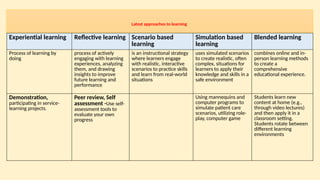
Latest approaches to learning
Experiential learning Reflective learning Scenario based
learning
Simulation based
learning
Blended learning
Process of learning by
doing
process of actively
engaging with learning
experiences, analyzing
them, and drawing
insights to improve
future learning and
performance
is an instructional strategy
where learners engage
with realistic, interactive
scenarios to practice skills
and learn from real-world
situations
uses simulated scenarios
to create realistic, often
complex, situations for
learners to apply their
knowledge and skills in a
safe environment
combines online and in-
person learning methods
to create a
comprehensive
educational experience.
Demonstration,
participating in service-
learning projects.
Peer review, Self
assessment -Use self-
assessment tools to
evaluate your own
progress
Using mannequins and
computer programs to
simulate patient care
scenarios, utilizing role-
play, computer game
Students learn new
content at home (e.g.,
through video lectures)
and then apply it in a
classroom setting.
Students rotate between
different learning
environments
Benefits of Experiential Learning
• Deepened Understanding:
• Learning by doing and reflecting leads to a more profound understanding of concepts.
• Development of Skills:
• Hands-on experiences help develop both hard and soft skills valuable in both academic and
professional settings.
• Increased Motivation:
• Experiential learning can be more engaging and motivating than traditional classroom learning,
fostering a love for learning.
• Enhanced Critical Thinking:
• The process of reflecting on experiences encourages critical thinking and problem-solving skills.
• Better Retention:
• By actively applying knowledge in real-world situations, learners are more likely to retain
information.
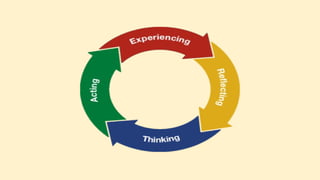
THE EXPERIENTIAL LEARNINGCYCLE
• This cycle is natural and organic way that people engage in life
situations, often without being aware that they are learning. Because
the cycle is composed of two pairs of opposite ways of grasping
information (Experiencing and Thinking) and transforming it into
knowledge (Reflecting and Acting), most people have preferences for
the way they use this learning cycle, focusing on some modes more
than others.
Benefits of Reflective Learning
• Improved Critical Thinking:
• By analyzing experiences and identifying patterns, learners develop stronger critical thinking skills.
• Enhanced Learning:
• Reflecting on past experiences can lead to deeper understanding and more effective learning.
• Increased Self-Awareness:
• Reflective learning fosters self-awareness and helps individuals understand their own learning styles
and preferences.
• Better Performance:
• By identifying areas for improvement and adjusting learning strategies, reflective learning can lead to
improved performance in various contexts.
• Greater Ownership of Learning:
• Reflective learners take more ownership of their learning journey and are more engaged in the
process.
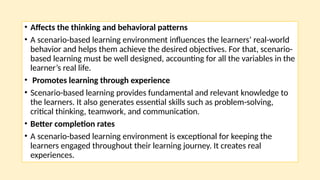
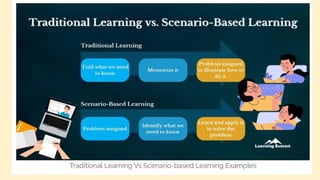
Scenario based learning
• Benefits of scenario-based learning
• Scenario-based learning incorporates storytelling in the eLearning content. It makes
the eLearning content which is full of data and information, more engaging and
impactful to its learners. It enhances the process of solving problems.
• Motivates the learners
• A well-customized scenario stimulates the learner’s curiosity. Curiosity helps them to
want to know more about what happens next. Therefore, naturally, this type of
learning helps to generate a sense of motivation in the learners.
• Prepares the learners for real-world situations
• Compared to traditional learning experiences, scenario-based learning is more likely
to produce effective outcomes. Learners develop more extraordinary cognitive
abilities than conventional learners. The learners exhibit better problem-solving skills,
memory, higher retention power, and excellent attention control.
• Affects the thinking and behavioral patterns
• A scenario-based learning environment influences the learners’ real-world
behavior and helps them achieve the desired objectives. For that, scenario-
based learning must be well designed, accounting for all the variables in the
learner’s real life.
• Promotes learning through experience
• Scenario-based learning provides fundamental and relevant knowledge to
the learners. It also generates essential skills such as problem-solving,
critical thinking, teamwork, and communication.
• Better completion rates
• A scenario-based learning environment is exceptional for keeping the
learners engaged throughout their learning journey. It creates real
experiences.
Benefits of Simulation-Based Learning
• Enhanced Skill Development:
• Provides a platform for learners to practice and refine their skills in a safe and controlled environment.
• Increased Knowledge Retention:
• Experiential learning through simulations can lead to deeper understanding and better retention of
knowledge.
• Improved Problem-Solving Skills:
• Simulations can help learners develop their ability to analyze situations, make decisions, and solve
complex problems.
• Risk-Free Learning:
• Learners can make mistakes and learn from them without jeopardizing real-world situations.
• Increased Confidence:
• By practicing skills in a simulated environment, learners can build confidence in their ability to apply
their knowledge in the real world.
Benefits of Blended Learning
1. Enhanced Learning Outcomes:
• By combining different learning styles, blended learning can lead to increased engagement and
improved learning outcomes.
2. Greater Flexibility and Control:
• Students can learn at their own pace and access resources whenever needed, promoting self-
regulated learning.
3. Cost-Effective and Scalable:
• Blended learning can be a cost-effective way to deliver education to a large number of students,
and it can be scaled to meet various learning needs.
4. Improved Student Engagement:
• The combination of online and in-person learning can create a more engaging and interactive
learning environment.
5. Data-Driven Insights:
• Blended learning platforms often provide data on student progress, allowing teachers to identify
areas for improvement and personalize instruction
Education and educational technology- B.Sc Nursing

Education and educational technology- B.Sc Nursing

  • 1.
  • 2.
    UNIT I: Introductionand Theoretical Foundations • Education and educational technology  Definition, aims  Approaches and scope of educational technology  Latest approaches to education: o Transformational education o Relationship based education o Competency based education
  • 3.
    Education • DEFINITION “Education isthe all-round drawing out of the best in child and man- body, mind and spirit”. - Mahatma Gandhi. Education is the natural, harmonious and progressive development of man’s innate powers”. - Pestaloz Education is the development of all those capacities in the individual which will enable him to control his environment and fulfill his responsibilities” - John Dewey.
  • 4.
    Meaning •The word educationis derived from Latin root ‘educare’ means “bringing up” or “bring out” •Education is the process of facilitating learning or acquisition of knowledge, skill values and habits.
  • 5.
    Aims of education •The main aim of education was interpreted to be the preservation of knowledge. • Utilitarian aim: Utilitarian aim is concerned with providing knowledge and skill required by the child for leading his day today life. Fulfillment of this aim will enable him to make use of the knowledge and skill in a fruitful manner. This aim makes the educative process a purposeful one and depicts the relationship between education and life. • Vocational aim: Education should prepare the child to earn his livelihood so that he can lead to productive life in the society. Dignity of labour and respect to the labour have to be developed or inculcated by means of education.
  • 6.
    • Social aim:Every individual is considered as a productive member of the society. Keeping this aim in mind, educationists have to help learners to develop a healthy, purposeful, productive, exploratory and controlling adjustment with the environment. • Intellectual aim: Education provides enough opportunities to develop the innate intelligence through education will enable the child to lead an independent life with confidence.
  • 7.
    • Citizenship: Educationenable the children to grow as productive citizens by following the social and moral standards set by the society. • Physical health and well-being: Education prepare the child to lead a healthy life through providing the knowledge required for a healthy living and helping him to positive attitudes towards health.
  • 8.
    • Character development:According to Mahatma Gandhi,” the end of all knowledge must be the building up of character”. • Moral development: Moral values like honesty, truthfulness, justice, goodness, purity, courage, reverence, dutifulness, punctuality, self confidence, discrimination between good and bad, observation of rules, belief in systematic organization, etc are inculcated through education
  • 9.
    • Cultural development:By undergoing education child becomes cultured and civilized. • Education for leisure: Leisure time should be utilized in such a way that the individual as well as the society should benefit from it. Education prepare the child to use his leisure time for doing something useful. • Self-realization: Self-realization also helps the child to realize his strengths, weakness, opportunities and threats so that he can exert a good control over his life by strengthening the weakness.
  • 10.
    • Mental andEmotional development: In this fast changing world, good mental health is a must to cope with the changing lifestyles and societal needs. Education should train the child by giving adequate opportunities for mental and emotional development. • Self education aim: As education is considered as a lifelong process, it should prepare the child to adopt a proactive role towards the learning process. This aim is gaining importance in the era of knowledge explosion where students are expected to take a leading role in the teaching-learning process than the teacher. Teachers should make sure that students are learning as a result of the internal motivation rather than a reaction to the compulsion exerted by others.
  • 11.
    • International understanding:Education is a universal process and it helps in creating universal understanding. The progress we achieved in the field of education is the result of the combined efforts of the people from different countries, the scholars of all periods, the followers of all religion and members of all the races. • Harmonious development: Ultimately the overall aim of education is to ensure harmonious development through the achievement of the above mentioned aims. Harmonious development will enable the child to deal effectively with the problems and uncertainties of life.
  • 12.
    Types of Education •Education encompasses formal and informal learning experiences, each contributing to an individual’s growth and development. 1 Formal Education: • Formal education stands as the bedrock of societal progress, offering structured and systematic learning experiences that shape the minds of individuals and contribute to the overall development of communities. • In classrooms and lecture halls, within the walls of schools and universities, formal education unfolds as a dynamic process that equips learners with knowledge, skills, and qualifications. Here are key aspects of formal education:
  • 13.
    •Structured Curriculum: Oneof the defining features of formal education is its reliance on a structured curriculum. A carefully designed syllabus outlines the subjects, topics, and learning objectives, providing a roadmap for students to navigate various fields of knowledge.
  • 14.
    •Certification and Degrees:Formal education culminates in attaining certifications, diplomas, or degrees, serving as tangible proof of an individual’s educational accomplishments. These credentials carry significant weight in the professional realm, influencing career opportunities and acting as a gateway to specialized fields.
  • 15.
    • Educational Institutions:Formal education predominantly occurs within educational institutions, from primary schools to universities. These institutions serve as organized hubs of learning, equipped with dedicated spaces for classrooms, laboratories, libraries, and extracurricular activities.
  • 16.
    • Trained Educators:Central to formal education is the role of trained educators. Teachers, professors, and instructors bring expertise and pedagogical skills to learning. Their guidance, mentorship, and facilitation of classroom discussions play a pivotal role in shaping the educational experience and inspiring students to delve deeper into their studies.
  • 17.
    • Standardized Assessments:Assessment is an integral component of formal education, systematically gauging students’ understanding of the material. Standardized assessments and examinations serve as benchmarks for academic performance, enabling educators to evaluate progress and identify areas for improvement.
  • 18.
    • Academic Progressionand Specialization: Formal education is organized into grade levels, each representing a stage of academic progression. Advancement through these levels is based on completing coursework and examinations.
  • 19.
    •Government Regulations and Standards:Formal education is subject to government regulations and standards that ensure the quality and consistency of educational programs. •Socialization and Peer Interaction: Educational institutions provide a structured socialization and peer interaction setting. Beyond academic learning, students develop essential social skills, teamwork, and a sense of community.
  • 20.
    • Preparation forFuture Careers: One of the primary objectives of formal education is to prepare individuals for future careers. It equips students with the knowledge, skills, and competencies needed in the workforce. • Global Standards and Mobility: Formal education adheres to global standards, facilitating educational mobility and the recognition of qualifications internationally. This interconnectedness is fundamental as individuals pursue educational opportunities or careers in different countries, contributing to a global pool of knowledge and talent.
  • 21.
    • Formal educationis a cornerstone of personal and societal development, providing a structured framework for intellectual growth, skill development, and the pursuit of knowledge.
  • 22.
    Informal Education • Theinformal realm offers a dynamic, learner-driven journey that extends far beyond the confines of traditional classrooms. Informal education, characterized by its spontaneity and diversity, is crucial in shaping individuals, fostering personal development, and complementing the structured knowledge gained through formal channels. Here are key aspects of in-formal education:
  • 23.
    • Everyday LearningExperiences: Informal education thrives in the fabric of everyday life. From family interactions and community engagements to personal experiences and encounters with the world, informal learning is seamlessly woven into the tapestry of our daily existence. It encompasses the skills acquired through observation, trial and error, and knowledge absorption from the situations encountered in the real world.
  • 24.
    • Hands-On Learningand Experiential Wisdom: At the heart of informal education lies the hands-on experience, an invaluable teacher in its own right. Individuals glean experiential wisdom beyond textbook knowledge, whether learning a craft, navigating a new city, or experimenting with a hobby.
  • 25.
    • Self-Directed Exploration:One of the distinguishing features of informal education is its self-directed nature. Individuals have the autonomy to pursue their passions, delve into topics of personal interest, and chart their learning journeys.
  • 26.
    • Mentorship andRole Models: Informal education often unfolds in the shadow of mentorship and the influence of role models. Whether it’s a family member, a community leader, or a respected colleague, informal learning benefits from the guidance and insights shared by those with more experience.
  • 27.
    • Media andTechnology: The digital age has ushered in new dimensions of informal education through the accessibility of online resources, educational platforms, and interactive media. Blogs, podcasts, video tutorials, and social media create a vast landscape for informal learning, allowing individuals to explore diverse topics, connect with global communities, and engage in self-paced learning.
  • 28.
    •Cultural Transmission: Informaleducation is a conduit for transmitting culture, traditions, and societal norms. Through storytelling, oral traditions, and community celebrations, individuals absorb a deep understanding of their cultural heritage, fostering a sense of identity and connection to their roots.
  • 29.
    • Problem-Solving andCritical Thinking: The informal learning space incubates problem-solving skills and critical thinking. Whether faced with personal challenges or navigating professional scenarios, individuals who engage in informal learning tend to develop adaptive thinking and approach problems creatively and resourceful.
  • 30.
    • Community Learningand Collaboration: Informal education often occurs within communities. Shared knowledge, collaborative problem-solving, and collective learning experiences contribute to the social fabric of groups.
  • 31.
    • Lifelong LearningMindset: At its core, informal education nurtures a lifelong learning mindset. Learning doesn’t end with formal degrees or certificates; it continues throughout life.
  • 32.
    Informal education •It isa lifelong process by which every person acquires and accumulates knowledge, skills and attitude from daily experiences and exposure to the environment at home, at school, at work, at play etc. from parents, friends, neighbours, reading news paper & books, viewing T.V, listening to radio etc.
  • 33.
    •It is alsocalled incidental learning process. Generally informal education is unorganised and often unsystematic. Yet, it accounts for the great bulk of information to any person’s life time. eg: Little baby, as she grows up, learns how to recognize her parents and how to eat.
  • 34.
    Non-formal Education • Itis an organized and systematic educational activity carried on outside the framework of the formal system to provide selected types of learning to particular sub-groups in the population, including adults and children according to their needs. • eg: Extension Education, Adult Education, Vocational Education, Functional Literacy, Continuing Education, etc.
  • 35.
    Nursing education •Nursing educationrefers to formal learning and training in the science of nursing. This includes the functions and duties in the physical care of patients, and a combination of different disciplines that both accelerates the patient's return to health and helps maintain it.
  • 36.
    Definition of EducationalTechnology Educational technology is the study and ethical practice of facilitating learning and improving performance by creating, using and managing appropriate technological processes and resources. --The Association For Educational Communications And Technology (AECT) 2008
  • 37.
    •Educational technology isa systematic, iterative process for designing instruction or training used to improve performance. -The Encyclopedia of Educational Technology
  • 38.
    Main Aims/ objectiveof educational technology • The essential objective of Educational Technology is to improve the quality of education and enhance the learning process. Most importantly, technology should magnify the teaching and learning process as well as facilitate better performance of educational systems as it emphasizes upon effectiveness and efficiency.
  • 39.
    Objectives of EducationalTechnology at the Macro Level • To identify the educational requirements and desires of the community. • To understand the structure of education, board strategies, and its goals. • To design and develop curriculums involving art, science and human values. • To support strategies and human resources and material assets with the mission to achieve determined goals. • To create appropriate aids and instruments supporting educational purposes. • To design educational technology models catering to improve the existing process of teaching and learning. • To identify and find remedies to tackle major environmental constraints. • To expand and support educational opportunities for people around the world, especially the neglected sections of the community. • To manage the entire educational system starting from planning to execution, implementation, and evaluation.
  • 40.
    Objectives of EducationalTechnology at the Micro Level • To discover and analyse the characteristics and educational requirements of every student. • To determine and state the specific behavioural classroom objectives. • To understand and organise the contents of instruction in a proper sequence. • To recognize the existing teaching-learning resources and materials. • To identify the nature of the interaction of sub-systems like teachers, students, the content of instruction, teaching-learning material, and different methodologies.
  • 41.
    Educational Technology • 1.aims to provide the learner with the foundational knowledge of how technology has paved the way for the facilitation of better learning processes while the learning. • 2. impart the understanding of integrating technology to help the learner become an exemplary user of educational technology.
  • 42.
    Concept of EducationalTechnology • Educational Technology, also known as EduTech or EdTech, is the concept of teaching and learning through the efficient medium of technology. It facilitates an in-depth understanding of the fundamentals of technology with its operations and to help the teaching-learning process gain the best possible results in an efficient and economical way.
  • 43.
    • Educational technologyis concerned with the following two aspects: • Theoretical knowledge produced from various academic disciplines such as Psychology, Education, Communication, Philosophy, Sociology, Computer Science, Artificial Intelligence, etc. • Experimental knowledge elicited from educational practice and training.
  • 44.
    Approaches and scopeof educational technology Approaches of Eduacational Technology Hardware Approaches Software Approaches System Approaches
  • 45.
    1. HARDWARE APPROACH •The hardware approach is based on the application of engineering principles for developing electro-mechanical equipment for instructional purposes. Motion pictures, tape recorders, television, teaching machines, computers are called educational hardware. • Hardware approach mechanizes the process of teaching so that teachers would be able to deal with more students with less expenditures in educating them. • Human knowledge has three aspects: 1. Preservation, 2. Transmission and 3. Development.
  • 46.
    • The historyof preservation of the knowledge is believed to exist since the printing machines started. The knowledge is preserved with these machines in the form of books which are shelved in the libraries, tape recorders and films. • The second aspect of human knowledge is its transmission. A teacher can impart knowledge himself to his pupils. Now a days, transmission of the knowledge is supported by machine like mike, radio and television. With these, thousands of pupils enjoy this home-delivery of such benefits. • The third aspect of human knowledge is its development. For this aspect, provisions are made for research work. In the research programmes, the main function is the collection and analysis of data. For this purpose, presently the researcher uses the electronic machines and computers. Hence, all the three aspects of knowledge allow the use of machines.
  • 47.
    2. SOFTWARE APPROACH •The software approach used the principles of psychology for building in the learners a complex repertory of knowledge or modifying his behaviour. It originates from behavioural sciences and their applied aspects concerning psychology of learning. Psychology of learning provides solid technology for bringing desirable behavioural changes in the pupils and thus serves the cause of education of laying down definite instructional procedure, teaching behaviour and behaviour modification devices. • The pioneering work in software approach was done by Skinner and other behaviourists.
  • 48.
    • The programmeswhich such a technology produces are often called software. Software Approach is also termed as Instructional Technology or Teaching Technology or Behavioural Technology. • Newspapers, books, magazines, educational games, flash cards may also form part of software. Software approach is characterized by task analysis, writing precise objectives, selection of appropriate learning strategies, immediate reinforcement of responses and constant evaluation.
  • 49.
    3. SYSTEMS APPROACH •System approach is a systematic attempt to coordinate all aspects of a problem towards specific objectives. • Webster’s dictionary defines a system as “a regularly interacting or independent group of items forming a unified whole”. • Example – various parts of the digestive system may be called as components of digestive system. Every component of the digestive system contributes to as supports in functioning of the digestive system as a whole.
  • 50.
    Major steps inthe systems approach in education are • 1. Formulating of specific instructional objectives to be achieved and defining instructional goals, 2. Deciding appropriate media to achieve these goals, 3. Defining learner characteristics and requirements, 4. Selecting appropriate methods suitable for effective learning to take place, 5. Selecting appropriate learning experiences from available alternatives, 6. Selecting appropriate materials and tools required, 7. Assigning appropriate personal roles for teachers, students and supporting staff, 8. Implementing the programme, 9. Evaluating the outcome in terms of original objectives measured in student performance and 10. Revising to improve efficiency of the system to improve students’ learning.
  • 51.
    Latest approaches toeducation 1. Transformational education 2. Relationship based education 3. Competency based education
  • 52.
    Transformational education • Transformativeeducation is a pedagogical approach that goes beyond basic knowledge transfer, aiming to deeply alter a learner's understanding of the world and their place in it. • It focuses on empowering individuals to take informed action at personal, community, and global levels by fostering critical reflection, empathy, and a sense of responsibility towards building inclusive and sustainable societies.
  • 53.
    Key Principles • DeepLearning: • Critical Reflection: • Learners are encouraged to critically examine their existing beliefs, assumptions, and perspectives, leading to a more nuanced and informed understanding of the world. • Empathy and Diversity: • The approach emphasizes the importance of understanding and appreciating diverse perspectives and experiences, fostering a sense of shared humanity. • Action-Oriented Learning: • Transformative education aims to equip learners with the skills and knowledge to actively participate in creating positive change in their communities and the world. • Holistic Development: • It recognizes the interconnectedness of intellectual, emotional, social, and spiritual growth, aiming to develop well-rounded individuals.
  • 54.
    Examples of TransformativeEducation: • Community-Based Learning: • Students engage in projects that address real-world issues in their local communities, such as environmental sustainability or social justice. • Global Citizenship Education: • Learners explore diverse cultures, global challenges, and the interconnectedness of global issues, fostering a sense of responsibility towards building a more just and sustainable world. • Adult Education Programs: • Programs that challenge adults to critically reflect on their beliefs and values in relation to their lived experiences, leading to personal and social transformation.
  • 55.
    Transformative Learning andthe Role of Educators • Facilitators of Reflection: • Educators act as facilitators of critical reflection, creating spaces for learners to explore their own perspectives and engage in meaningful dialogue. • Promoters of Agency: • They empower learners to take ownership of their learning and actively participate in shaping their own educational experiences. • Models of Lifelong Learning: • Educators demonstrate a commitment to lifelong learning and continuous growth, inspiring learners to embrace the transformative potential of education. • In summary, transformative education is a powerful approach to learning that moves beyond traditional methods to empower individuals to become active and responsible participants in building a more just, equitable, and sustainable future.
  • 56.
    Relationship-based education • Relationship-basededucation emphasizes the importance of positive relationships between educators, learners, and their families in fostering learning and development. • It recognizes that strong, supportive relationships can significantly impact a learner's ability to engage, learn, and thrive, particularly for those with social, emotional, and mental health needs.
  • 57.
    Key Principles: 1. Focuson relationships: 2. Understanding individual needs: • Recognizing that learners, including families, have unique needs and perspectives. 3. Collaboration and communication: • Encouraging open communication and collaboration between educators, learners, and families. 4. Supporting learner agency: • Empowering learners to take ownership of their learning and well-being. 5. Creating a safe and supportive learning environment: • Fostering an environment where learners feel valued, respected, and comfortable taking risks.
  • 58.
    Benefits of Relationship-BasedEducation • Improved learning outcomes: • Strong relationships can enhance engagement, motivation, and overall academic achievement. • Enhanced social-emotional development: • Relationship-based approaches can help learners develop social skills, emotional regulation, and a sense of belonging. • Increased school attendance and engagement: • Positive relationships can reduce absenteeism and dropout rates. • Strengthened family-school partnerships: • Collaborative efforts can lead to better support for learners and their families. • Improved mental health and well-being: • Supportive relationships can promote positive mental health and resilience.
  • 59.
    Examples of Relationship-BasedPractices: 1. Regular communication and feedback: Keeping families informed about their child's progress and well-being. 2. Creating opportunities for family involvement: Engaging parents in school activities and decision-making. 3. Using a strengths-based approach: Focusing on the positive aspects of learners and their families. 4. Providing individualized support: Tailoring instruction and interventions to meet the specific needs of each learner. 5. Modeling positive relationships: Educators demonstrating healthy communication and interactions with learners.
  • 60.
    Competency-based education (CBE) •Competency-based education (CBE) is an approach that focuses on what students learn (competencies) rather than how much time they spend in class. • It emphasizes mastery of specific skills and knowledge through demonstrated proficiency, rather than solely on grades or time spent in the classroom. • Students progress based on their ability to demonstrate mastery, and the curriculum is often personalized to meet individual learning needs.
  • 61.
    Educational philosophy • Theword philosophy is derived from two Greek words- 'Philos' and 'Sophia'. 'Philos' mean love and 'Sophia' means wisdom. Thus, philosophy means love of wisdom. • According to Karl Marks • - "Philosophy is the interpretation of the world in order to change it". • According to Plato - • "Philosophy is the acquisition of knowledge." • According to Dr.Radhakrishnan • - "Philosophy is a view of life. It gives a direction to life; it offers a design for living."
  • 62.
    Education and Philosophy •Education is a growing science and philosophy is the cornerstone of the foundation of education. • While the goal of philosophy is to explain the mysteries of universe. • The chief means of philosophy is education which has been correctly described as the dynamic side of philosophy. • Education is a practical activity of philosophical thought. • Every educational practice is illumined with the backdrop of philosophy. • “the art of education will never attain complete clearness without philosophy”. - Fichte,
  • 63.
    Interdependence between Philosophyand Education • Philosophy and education are closely inter-related. • Education is the application of philosophy or philosophy of education is applied philosophy. It is the application of philosophy to the study of the problems of education that is known as philosophy of education. • In fact, philosophy is the groundwork or foundation out of which comes the objectives of education. • Philosophy and education walk hand in hand.
  • 64.
    • In thisrelationship, philosophy and education are reconstructive; they give to and take from each other in ebb and flow of thought and action; they are means to one another, and ends; they are process and product. • According to Ross, “philosophy and education are like the sides of a coin, presenting different views of the same thing, and that one is implied by the other”. • In the words of sir john Adams, “education is the dynamic side of philosophy”. • Philosophy prescribes the goals and essentials of good life and education is the best means to achieve those goals.
  • 66.
    Educational philosophies • Educationalphilosophies are sets of beliefs about education, influencing how educators view teaching and learning. They guide decisions about curriculum, methods, and the overall goals of education.
  • 68.
    1. Naturalism a. Itis concerned with nature and believes that reality and nature are identical and beyond nature there is no reality. b. For naturalist, nature is everything and nothing exists superior than nature so they separates nature from God. Man is regarded as a child of nature. c. Naturalists also believe that all our activities, whether it may be biological, psychological or social are initiated by our instincts. d. Naturalism stresses the need to return to the nature from artificiality. 2. Idealism 1. Idealism is the oldest philosophy. It believes that man is the combination of spiritual and material aspects, the spiritual aspect is more real and important. 2. Idealism regards spirit and intellect are of supreme value than physical matter. As per the idealism individual experience is valid than the material world and man lives in the world of ideas rather than facts.
  • 69.
    3. Pragmatism a) ·Pragmatism means thinking of or dealing with problems in a practical way rather than by using theory or abstract principles. b) · Pragmatism is essentially a humanistic philosophy maintaining that man creates his won values in course of activity, that reality is still making and awaits its part of completion from the future. 4. Realism c) · According to this, things we see and perceive are real and knowledge acquired through senses is true. d) “Realism is the reinforcement of our common acceptance of this world as appears to us”– Butter
  • 70.
    Some key philosophies: •Essentialism: • Focuses on a core curriculum of basic skills and knowledge, often advocating a "back to basics" approach. • Progressivism: • Emphasizes experiential learning and problem-solving, aligning education with real-world challenges and student interests. • Perennialism: • Believes in developing rational thinking through studying great books and ideas, aiming to instill enduring knowledge. • Existentialism: • Supports self-directed learning, encouraging students to explore their own meaning and understanding of the world. • Constructivism: • Highlights the active role of learners in constructing their own knowledge through experience and interaction.
  • 71.
  • 72.
    Nursing Philosophy • Thephilosophy of nursing education guides the values, beliefs, and principles that shape nursing education, aiming to prepare graduates for effective and compassionate care. • It encompasses how nursing is viewed, including its role in society, its relationship with other fields, and the ethical considerations involved in practice. • Nursing philosophy emphasizes the importance of both theory and practice, as well as the development of critical thinking and problem-solving skills. Key Aspects of Nursing Philosophy: • Focus on the Person: • A core belief in nursing philosophy is the importance of treating each individual with respect, dignity, and compassion, recognizing their unique needs and experiences. • Holistic Care: • Nursing philosophy emphasizes a holistic approach to care, considering the physical, emotional, social, and spiritual aspects of health.
  • 73.
    • Service toHumanity: • Nursing is often viewed as a service to humanity, with a commitment to improving the health and well-being of individuals, families, and communities. • Scientific Basis: • Nursing philosophy acknowledges that nursing practice is grounded in scientific knowledge, evidence-based practices, and the application of research findings. • Ethical Practice: • Ethical considerations are central to nursing philosophy, emphasizing the importance of integrity, honesty, and responsible behavior in all aspects of practice. • Lifelong Learning: • Nursing philosophy promotes a culture of lifelong learning, encouraging nurses to continuously update their knowledge and skills to provide the best possible care.
  • 74.
    Teaching learning process Theteaching-learning process, or the education process, has been defined as a systematic, sequential, planned course of action on the part of both the teacher and learner to achieve the outcomes of teaching and learning.
  • 75.
    • Teaching andlearning process can be defined as a transformation process of knowledge from teachers to students. • It is referred as the combination of various elements within the process where an educator identifies and establishes the learning objectives and develop teaching resources and implement the teaching and learning strategy. • On the other hand, learning is a cardinal factor that a teacher must consider while teaching students
  • 76.
    •Teaching-learning process isthe heart of education. On it depends the fulfillment of the aims and objectives of education. It is the most powerful instrument of education to bring about desired changes in the students.
  • 77.
    Teaching-Learning Strategies • Themost prominent teaching-learning strategy is the 6E+S model of instruction. It includes various components including: Engage: . It focuses students’ attention on the learning outcomes. Explore: Here, teachers encourage students to look at the topics more closely Explain: In this activity, students explain the topics they have been exploring. Elaborate: Teachers encourage students to work directly on the given assignment. Evaluate: In this step, teachers evaluate the knowledge and learning process of students. The evaluation is based on the assignments submitted by students. Extend: It helps students extend their understanding and use them in real scenarios. Standards: The lesson plans are standardized according to the education plan laid down by the government authorities.
  • 78.
    Important aspects ofteaching-learning process Diana Laurillard argues that there are four aspects of the teaching-learning process:- a. Discussion:- between the teacher and learners. b. Interaction:- between the learner and some aspect of the world defined by the teacher. c. Adaptation:- of the world by the teacher and action by the learner. d. Reflection:- on the learner’s performance by both teachers and learners.
  • 79.
    Teaching definition • (1)H C Morrison:- Teaching is an intimate contact between the more mature personality and a less mature one. • (2) Jackson:- Teaching is a face to face encounters between two or more persons, one of whom ( teacher) intends to effect certain changes in the other participants ( students). • (3) J B Hough and James K Duncan:- Teaching is an activity with four phases, a curriculum planning phase, an instructing phase, and an evaluating phase.
  • 80.
    Learning • Bastable (2014)defines learning as a “…change in behavior as a result of a lifelong, dynamic process by which individuals acquire new knowledge skills, and/or attitudes that can be measured and can occur at any time or in any place due to exposure to environmental stimuli”. • WordNet defines learning as a "cognitive process of acquiring skill or knowledge". •
  • 81.
    characteristics of goodteaching are • The Seven Principles for Good Teaching • Encourage contact between students and faculty. • Develop reciprocity and cooperation among students. • Encourage active learning. • Give prompt feedback. • Emphasize time on task. • Communicate high expectations. • Respect diverse talents and ways of learning. • (Based on Chickering and Gamson, 1987)
  • 82.
    Nature of TeachingLearning Process The nature of teaching learning process is as follows: • Professional Activity • The teaching learning process is a professional activity where the student or learner receives guidance from a trained teacher. • Communication • The teaching and learning process involves a lot of communication and therefore, it is only successful when there is proper interaction between the learner and the teacher. • Interactive Process • The teacher gives information to the students and the learners acquire the information. The teaching process involves active interaction between the learner and the teacher.
  • 83.
    • Organized System •The teaching learning process takes place in an organized manner in a professional location. • Overall Development • The teaching learning process helps in the overall development of a learner. • Continuous Process • The teaching learning process is never ending and it takes place from birth to death. Hence, it is a continuous process.
  • 84.
    Nature of teaching:- •(1). Teaching is an inter-process:- It is conducted between the teacher and the students for a specific purpose • (2). Teaching is both an art and a science:- The nature of teaching is both artistic and scientific. Teaching planning and evaluation activities are more scientific in nature whereas the process aspect of teaching is artistic in which the teacher uses his skills. • (3). Teaching is a developmental process:- Through the process of teaching, children are developed and the desired changes in behavior are brought from them. Cognitive, emotional and functional aspects are developed.
  • 85.
    • (4). Teachingis a continuous process:- Teaching is a continuous process which continues till the achievement of teaching-learning objectives. It has three aspects – action, learning and evaluation. • (5) Teaching is a process of guidance:– In teaching, efforts are made to develop the students according to their abilities. Thus the goal is of direction. • (6). Teaching is a three-way process:- Most of the educationists have called teaching as a tripartite process. According to Bloom, there are three aspects of teaching– (i) learning objectives, (ii) learning experiences and (iii) behavior change. • (7). Teaching is a purposeful process:- The activities of teaching are done to achieve some specific objectives. For them, similarly adopts the nature of the planned process.
  • 86.
    • (8). Teachingis a social and professional process:– The process of teaching is carried out in the group of teaching and students. It is absolutely necessary to have at least one teacher and one student. Teaching is a professional activity which individuals make their means of earning their livelihood, who are called teachers. • (9). Teaching is measured:- Teaching is measured in the form of teacher's behavior. Measurement of teacher behavior and analysis of behavior pattern are also done by observation methods. • (10). Teaching is a science:- The skill side of presentation of teaching is an art, but their actions can also be logically monitored and evaluated. This gives it a scientific basis. • (11). Teaching is a formal and informal process:- The education process is carried out in the school according to the fixed program and is also conducted outside the school.
  • 87.
    Characteristic of teaching:- (1)Teaching is a complete social process Teaching is undertaken for the society and by the society. With ever-changing social ideas, it is not possible to describe exact and permanent nature of teaching. (2) Teaching is giving information Teaching tells students about the things they have to know and students cannot find out themselves. Communication of knowledge is an essential part of teaching. (3) teaching is an interactive process Teaching is an interactive process between the student and the teaching sources, which is essential for the guidance, progress, and development of students. (4) Teaching is a process of development and learning. (5) Teaching causes a change in behavior.
  • 88.
    (6) Teaching isart as well as science. (7) Teaching is face to face encounter. (8) Teaching is observable, measurable and modifiable. (9) Teaching is skilled occupation:- Every successful teacher is expected to know the general methods of teaching- learning situations. (10) Teaching facilitates learning (11) Teaching is both conscious and an unconscious process. (12) Teaching is from memory level to reflective level. (13) Teaching is a continuum of training, conditioning, instruction, and indoctrination.
  • 89.
    Basic Principles ofTeaching • 1. Good Teaching is Good Communication • 2. Good Teaching is an Art • 3. Good teaching demands the teacher to know nature of child • 4. Good teaching is kindly and sympathetic • 5. Good teaching develops emotional stability. • 6. Good Teaching is Democratic • 7. Good teaching involves skill in guiding learning • 8. Good teaching is cooperative • 9. Good teaching is well-planned • 10. Good teaching is remedial • 11. Good teaching is progressive
  • 90.
    Maxims of Teaching •Maxims of Teaching refers to the Techniques in Teaching that a teacher adopts for effective teaching learning. They accelerate momentum of teaching learning process and help in achieving success in classroom. • Maxims of teaching are the basic rules of teaching which when implemented motivate learners, promote their attention on what is being taught, encourage their active involvement and thus result in effective learning. The teacher needs to know them and practice.
  • 91.
    • Maxims ofteaching motivate the learners and also make teaching learning process effective, fruitful, Inspirational and meaningful. • Without using the proper of maxim a teacher cannot teach effectively.
  • 92.
    KNOWN TO UNKNOWN •Thismaxim suggests starting with concepts students are already familiar with and then gradually introducing new, unfamiliar concepts. For instance, when teaching photosynthesis, a teacher could start by discussing how people cook food and relate it to the process by which plants make their own food.
  • 93.
    SIMPLE TO COMPLEX •In this process of teaching-learning, the teacher should see those simple things are presented first to the students. That way they will start taking an interest. Once they become interested, thou gradually complex type of things can also be learnt by them. By learning simple things, they feel encouraged and they also gain confidence. On this basis, they become further receptive to the complex matter.
  • 94.
    PARTICULAR TO GENERAL Whileteaching, the teacher should, first of all, take particular statements and then on the basis of those particular cases, generalization should be made. General facts, principles and ideas are difficult to understand and hence the teacher should always first present particular things and then lead to general things.
  • 95.
    CONCRETE TO ABSTRACT •Concrete things are solid things and they can be touched with five senses. But abstract things can only be imagined. So it is rather difficult to teach children about abstract things. • The students are likely to forget them soon. On the other hand, if we teach the students with the help of concrete objects, they will never forget the subject matter.
  • 96.
    ANALYSIS TO SYNTHESIS •When we divide a thing into easy parts or separate elements in order to understand it easily is called analysis. It is the process which helps in understanding the hidden elements of a thing or the cause of some incident or behavior. • Synthesis is just opposite of analysis. All parts are shown as a whole. The process of analysis is easier than synthesis for understanding a thing. This process develops the analytical power of the students. It is the best method of starting the teaching process
  • 97.
    EMPERICAL TO RATIONALSCIENCE • Empirical knowledge is that which is based on observation and first and experience about which no reasoning is needed at all. It is concrete, particular and simple. We can feel and experience it. • On the other hand rational knowledge is based upon arguments and explanations. • For example suppose the students are to be taught that water boils on heating. They should first be made to heat the water and see it boiling. Then the teacher should explain that when water is heated, the molecules gain kinetic energy and there is thermal agitation of the molecules which make the water boil.
  • 98.
    Psychological to logical •Modern education gives more emphases on psychology of the child. A teacher while teaching should follow this maxim viz from psychological to logical. Psychological approach takes into consideration the pupil his interests, abilities, aptitudes, development level, needs and reactions. • The teacher should keep in mind the psychological selection of the subject matter to be presented before the pupils. Logical approach considers the arrangement of the chosen content into logical order and steps.
  • 99.
    NEAR TO FAR •Every child is able to learn well in the surroundings to which he belongs. So the child should be acquainted fully with his immediate environment. Gradually he may be taught about those things which are far from his immediate environment. • This principle, if kept in view, will smoothen the leaching-learning process considerably. Thus the child should be taught the home, followed by the street, the bazaar, the school and then the distant environment of the city to which he belongs. In the same way, acquaintance with the city should lead to acquaintance with the Tehsil, the District, the Division, the Stale and then the Country as a whole.
  • 100.
    • The textbookwriter who writes books for the small children should also place the different chapters in his bookkeeping in view this principle. Then only his book will stand better chances of approval by all concerned
  • 101.
    Induction to Deduction •Induction means drawing a conclusion from a set of examples whereas deduction is its opposite. The teacher should proceed from induction to deduction. • For example, in English, while teaching the conversion of active voice into passive voice, the teacher should first convert a few sentences of active into the passive voice and on the basis of those conclude the general rule for a conversation of active voice in to passive voice
  • 102.
    Psychological to Logical •While teaching, the teacher should first keep in mind the interest, aptitudes, capacities, development level etc. of the children during the selection of subject matter and then on to its logical arrangement. • In teaching English, the structures are selected as per the needs and requirements of the students and then arranged in a logical way. The psychological appeal of the thing is more important at the early stages. Then the’ logic behind it should be seen.
  • 103.
    Actual to Representative •For teaching excellently, actual objects should be, shown to the children as far as possible. It gives them concrete learning which is more desirable. The learners are able to retain it in their minds for quite a long time. • Especially in the lower classes, first-hand information to the students impresses them a good deal. Representative things in the form of pictures, models; etc. should be used for the grown-ups or the seniors who are already familiar with the actual objects. • For example, the teacher should show the elephant, the camel, the horse, the railway station, the post office etc. and thereby he should make them understand about these things. The representative of these things in the form of pictures or models may be used at later stages
  • 104.
    Definite to Indefinite Inteaching, definite things should be taught first because the learner can easily have faith in them. Then afterwards he should give the knowledge of indefinite things. Definite things, definite rules of grammar help the learner to have good knowledge. Gradually he can be taught about indefinite things
  • 105.
    Barriers to teachingand learning • Barriers to teaching and learning can be broadly categorized as internal (student-related) and external (environment or teacher-related) obstacles that hinder effective instruction and student engagement. • These barriers can stem from various factors, including cognitive difficulties, emotional challenges, social and environmental influences, and lack of resources.
  • 106.
    Internal Barriers: • Cognitive: •Learning disabilities like dyslexia, dyscalculia, and ADHD can significantly impact a student's ability to learn and process information. • Emotional: • Anxiety, fear of failure, lack of motivation, and self-doubt can hinder a student's willingness to engage in learning. • Motivational: • Lack of interest in the subject matter, absence of a clear purpose for learning, and feeling disengaged can also act as barriers. • Social: • Peer pressure, bullying, and a lack of a supportive classroom environment can negatively impact learning and well-being. • Previous Knowledge: • Insufficient or inaccurate prior knowledge can make it difficult to grasp new concepts and can be a significant obstacle to learning.
  • 107.
    External Barriers: • Teacher-Related: •Poor teaching quality, lack of teacher support, and unrealistic expectations can affect student learning. • Environment: • Unsafe learning environments, overcrowded classrooms, lack of access to resources, and disruptive classroom environments can all hinder learning. • Curriculum: • Unclear curriculum goals, inappropriate teaching methods, and a lack of relevance to students' lives can disengage students.
  • 108.
    Overcoming Barriers: Addressing thesebarriers requires a multifaceted approach: • Support for Students: • Individualized instruction, accommodations for students with disabilities, and mental health support services can help students overcome internal barriers. • Teacher Training and Support: • Professional development on differentiated instruction, inclusive pedagogy, and classroom management can equip teachers with the tools to address diverse learning needs.
  • 109.
    • Creating InclusiveLearning Environments: • Fostering a safe and supportive classroom environment, promoting positive relationships, and ensuring equitable access to resources can create a more conducive learning environment for all students. • Collaboration: • Collaboration between teachers, administrators, parents, and community partners can create a more supportive system for students.
  • 110.
    • School-Related: • Organizationaland structural factors within the school can also act as barriers, such as lack of resources, inadequate support for teachers, and lack of collaboration. • Socioeconomic: • Poverty, lack of access to resources at home, and family instability can create challenges for students' learning and development.
  • 111.
    Learning theories •Learning theoriesin education explain how individuals acquire, process, and retain knowledge. Key theories include behaviorism, cognitivism, constructivism, humanism, and connectivism.
  • 112.
    1. Behaviorism: Thistheory focuses on observable behaviors and how they are shaped by environmental stimuli and consequences, such as rewards and punishments. Key figures include John B. Watson, Ivan Pavlov, and B.F. Skinner. •Classical Conditioning & Operant Conditioning
  • 113.
    2. Cognitivism: Thistheory emphasizes internal mental processes, like memory, attention, and problem- solving, in the learning process. It explores how individuals encode, store, and retrieve information.
  • 115.
    3. Constructivism: Thistheory posits that learners actively construct their own understanding through experiences, rather than passively receiving information. It highlights the importance of hands-on activities and social interaction in learning.
  • 116.
    4. Humanism: Thistheory focuses on the individual's unique needs, values, and motivations, promoting self-directed learning and personal growth.
  • 117.
    5. Connectivism: Thistheory emphasizes the importance of connections, both online and offline, in the learning process, highlighting the role of technology and networks in knowledge acquisition.
  • 118.
    Latest approaches tolearning oExperiential learning oReflective learning oScenario based learning oSimulation based learning oBlended learning
  • 119.
    Latest approaches tolearning Experiential learning Reflective learning Scenario based learning Simulation based learning Blended learning Process of learning by doing process of actively engaging with learning experiences, analyzing them, and drawing insights to improve future learning and performance is an instructional strategy where learners engage with realistic, interactive scenarios to practice skills and learn from real-world situations uses simulated scenarios to create realistic, often complex, situations for learners to apply their knowledge and skills in a safe environment combines online and in- person learning methods to create a comprehensive educational experience. Demonstration, participating in service- learning projects. Peer review, Self assessment -Use self- assessment tools to evaluate your own progress Using mannequins and computer programs to simulate patient care scenarios, utilizing role- play, computer game Students learn new content at home (e.g., through video lectures) and then apply it in a classroom setting. Students rotate between different learning environments
  • 120.
    Benefits of ExperientialLearning • Deepened Understanding: • Learning by doing and reflecting leads to a more profound understanding of concepts. • Development of Skills: • Hands-on experiences help develop both hard and soft skills valuable in both academic and professional settings. • Increased Motivation: • Experiential learning can be more engaging and motivating than traditional classroom learning, fostering a love for learning. • Enhanced Critical Thinking: • The process of reflecting on experiences encourages critical thinking and problem-solving skills. • Better Retention: • By actively applying knowledge in real-world situations, learners are more likely to retain information.
  • 121.
    THE EXPERIENTIAL LEARNINGCYCLE •This cycle is natural and organic way that people engage in life situations, often without being aware that they are learning. Because the cycle is composed of two pairs of opposite ways of grasping information (Experiencing and Thinking) and transforming it into knowledge (Reflecting and Acting), most people have preferences for the way they use this learning cycle, focusing on some modes more than others.
  • 123.
    Benefits of ReflectiveLearning • Improved Critical Thinking: • By analyzing experiences and identifying patterns, learners develop stronger critical thinking skills. • Enhanced Learning: • Reflecting on past experiences can lead to deeper understanding and more effective learning. • Increased Self-Awareness: • Reflective learning fosters self-awareness and helps individuals understand their own learning styles and preferences. • Better Performance: • By identifying areas for improvement and adjusting learning strategies, reflective learning can lead to improved performance in various contexts. • Greater Ownership of Learning: • Reflective learners take more ownership of their learning journey and are more engaged in the process.
  • 125.
    Scenario based learning •Benefits of scenario-based learning • Scenario-based learning incorporates storytelling in the eLearning content. It makes the eLearning content which is full of data and information, more engaging and impactful to its learners. It enhances the process of solving problems. • Motivates the learners • A well-customized scenario stimulates the learner’s curiosity. Curiosity helps them to want to know more about what happens next. Therefore, naturally, this type of learning helps to generate a sense of motivation in the learners. • Prepares the learners for real-world situations • Compared to traditional learning experiences, scenario-based learning is more likely to produce effective outcomes. Learners develop more extraordinary cognitive abilities than conventional learners. The learners exhibit better problem-solving skills, memory, higher retention power, and excellent attention control.
  • 126.
    • Affects thethinking and behavioral patterns • A scenario-based learning environment influences the learners’ real-world behavior and helps them achieve the desired objectives. For that, scenario- based learning must be well designed, accounting for all the variables in the learner’s real life. • Promotes learning through experience • Scenario-based learning provides fundamental and relevant knowledge to the learners. It also generates essential skills such as problem-solving, critical thinking, teamwork, and communication. • Better completion rates • A scenario-based learning environment is exceptional for keeping the learners engaged throughout their learning journey. It creates real experiences.
  • 128.
    Benefits of Simulation-BasedLearning • Enhanced Skill Development: • Provides a platform for learners to practice and refine their skills in a safe and controlled environment. • Increased Knowledge Retention: • Experiential learning through simulations can lead to deeper understanding and better retention of knowledge. • Improved Problem-Solving Skills: • Simulations can help learners develop their ability to analyze situations, make decisions, and solve complex problems. • Risk-Free Learning: • Learners can make mistakes and learn from them without jeopardizing real-world situations. • Increased Confidence: • By practicing skills in a simulated environment, learners can build confidence in their ability to apply their knowledge in the real world.
  • 131.
    Benefits of BlendedLearning 1. Enhanced Learning Outcomes: • By combining different learning styles, blended learning can lead to increased engagement and improved learning outcomes. 2. Greater Flexibility and Control: • Students can learn at their own pace and access resources whenever needed, promoting self- regulated learning. 3. Cost-Effective and Scalable: • Blended learning can be a cost-effective way to deliver education to a large number of students, and it can be scaled to meet various learning needs. 4. Improved Student Engagement: • The combination of online and in-person learning can create a more engaging and interactive learning environment. 5. Data-Driven Insights: • Blended learning platforms often provide data on student progress, allowing teachers to identify areas for improvement and personalize instruction