BLOOMS TAXONOMY
• Bloom's taxonomy is a set of three hierarchical
models used to classify educational learning objectives
into levels of complexity and specificity.
• The three lists cover the learning objectives in
cognitive, affective and sensory domains.
THE THREE DOMAINS OF LEARNING
• The committee identified three domains of
educational activities or learning (Bloom, et al.
1956):
• Cognitive: mental skills (knowledge)
• Affective: growth in feelings or emotional areas
(attitude or self)
• Psychomotor: manual or physical skills (skills)
COGNITIVE
DOMAIN
Keep calm at
all sporting events
In the original version of the taxonomy1956, the cognitive
domain is broken into the following six levels of objectives.
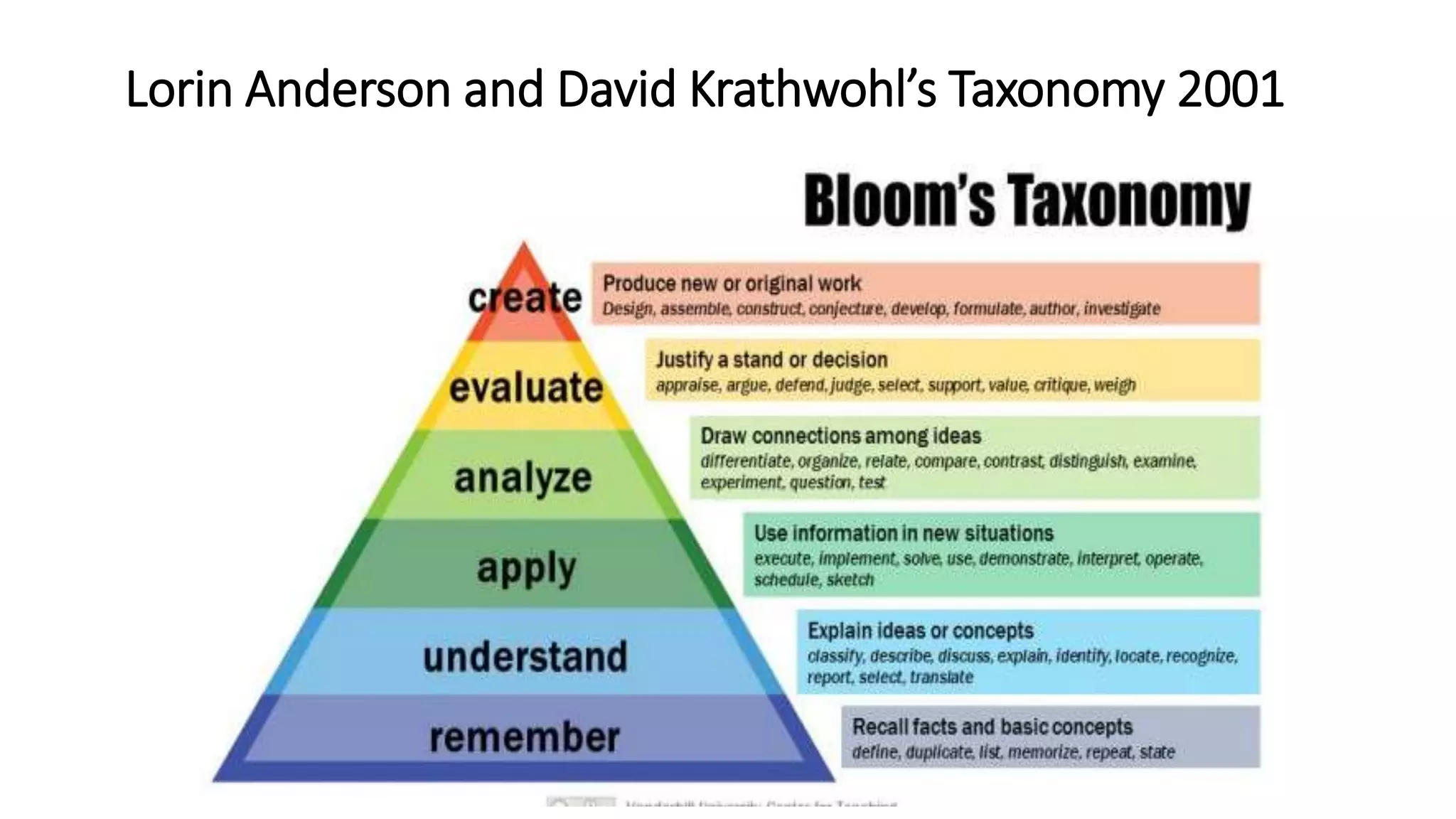
Lorin Anderson and David Krathwohl’s Taxonomy
2001
Lorin Anderson and David Krathwohl’s Taxonomy 2001
• 1. Remembering: Recognizing or recalling knowled ge from memory.
Remembering is when memory is used to produce or retrieve
definitions, facts, or lists, or to recite previously learned information
Understanding:
• Constructing meaning from different types of functions be they
written or graphic messages or activities like interpreting,
exemplifying, classifying, summarizing, inferring, comparing, or
explaining.
• . Applying: Carrying out or using a procedure through executing, or
implementing. Applying relates to or refers to situations where
learned material is used through products like models, presentations,
interviews or simulations.
Analyzing
• : Breaking materials or concepts into
parts, determining how the parts
relate to one another or how they
interrelate, or how the parts relate to
an overall structure or purpose.
• Mental actions included in this
function are differentiating,
organizing, and attributing, as well as
being able to distinguish between
the components or parts. When one
is analyzing, he/she can illustrate this
mental function by creating
spreadsheets, surveys, charts, or
diagrams, or graphic representations.
6. Creating:
• Putting elements together to form a coherent or functional whole;
reorganizing elements into a new pattern or structure through
generating, planning, or producing. Creating requires users to put
parts together in a new way, or synthesize parts into something new
and different creating a new form or product. This process is the most
difficult mental function in the new taxonomy.
Evaluating:
• Making judgments based on criteria and standards through checking
and critiquing. Critiques, recommendations, and reports are some of
the products that can be created to demonstrate the processes of
evaluation. In the newer taxonomy, evaluating comes before creating
as it is often a necessary part of the precursory behavior before one
creates something.
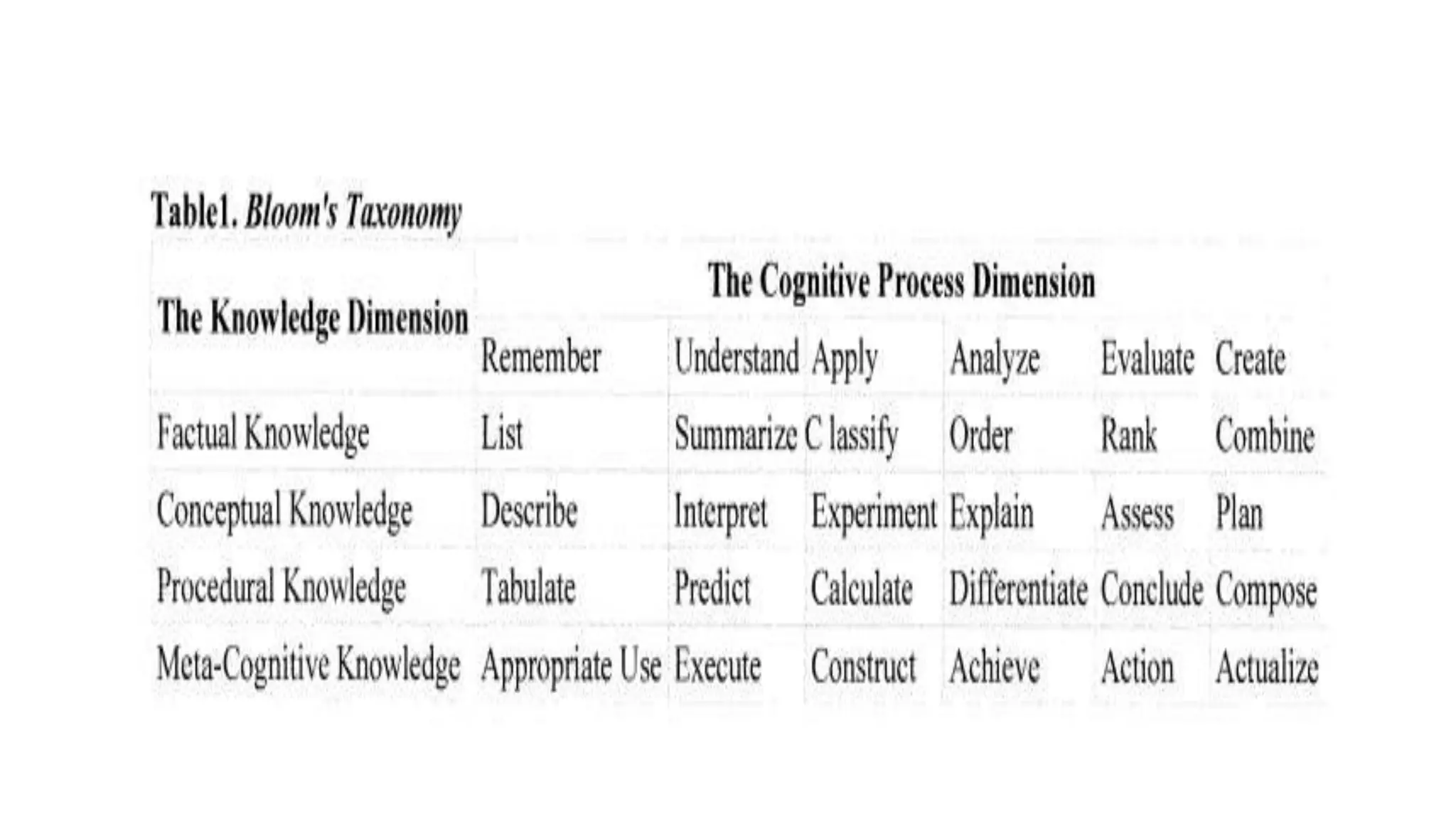
– Bloom vs. Anderson/Krathwohl
Levels of Knowledge
• The first three of these levels were identified in the original work, but
rarely discussed or introduced when initially discussing uses for the
taxonomy. Metacognition was added in the revised version.
• Factual Knowledge – The basic elements students must know to be
acquainted with a discipline or solve problems.
• Conceptual Knowledge – The interrelationships among the basic elements
within a larger structure that enable them to function together.
• Procedural Knowledge – How to do something, methods of inquiry, and
criteria for using skills, algorithms, techniques, and methods.
• Metacognitive Knowledge – Knowledge of cognition in general, as well as
awareness and knowledge of one’s own cognition. It is strategic or reflective
knowledge about how to go about solving problems, cognitive tasks, to
include contextual and conditional knowledge and knowledge of self.
METACOGNITION
awareness and understanding of one's
own thought processes.
Metacognition is, put simply,
thinking about one's thinking.
it refers to the processes used to plan, monitor,
and assess one's understanding and
performance.
Metacognition includes a critical awareness of a) one's
thinking and learning and b) oneself as a thinker and
learner
Metacognition is "cognition about cognition",
"thinking about thinking", "knowing about knowing",
becoming "aware of one's awareness" .
Bloom's Taxonomy
Bloom's Taxonomy

Bloom's Taxonomy

  • 1.
  • 2.
    • Bloom's taxonomyis a set of three hierarchical models used to classify educational learning objectives into levels of complexity and specificity. • The three lists cover the learning objectives in cognitive, affective and sensory domains.
  • 3.
    THE THREE DOMAINSOF LEARNING • The committee identified three domains of educational activities or learning (Bloom, et al. 1956): • Cognitive: mental skills (knowledge) • Affective: growth in feelings or emotional areas (attitude or self) • Psychomotor: manual or physical skills (skills)
  • 5.
  • 6.
    Keep calm at allsporting events
  • 7.
    In the originalversion of the taxonomy1956, the cognitive domain is broken into the following six levels of objectives.
  • 8.
    Lorin Anderson andDavid Krathwohl’s Taxonomy 2001
  • 10.
    Lorin Anderson andDavid Krathwohl’s Taxonomy 2001
  • 11.
    • 1. Remembering:Recognizing or recalling knowled ge from memory. Remembering is when memory is used to produce or retrieve definitions, facts, or lists, or to recite previously learned information
  • 12.
    Understanding: • Constructing meaningfrom different types of functions be they written or graphic messages or activities like interpreting, exemplifying, classifying, summarizing, inferring, comparing, or explaining.
  • 13.
    • . Applying:Carrying out or using a procedure through executing, or implementing. Applying relates to or refers to situations where learned material is used through products like models, presentations, interviews or simulations.
  • 14.
    Analyzing • : Breakingmaterials or concepts into parts, determining how the parts relate to one another or how they interrelate, or how the parts relate to an overall structure or purpose. • Mental actions included in this function are differentiating, organizing, and attributing, as well as being able to distinguish between the components or parts. When one is analyzing, he/she can illustrate this mental function by creating spreadsheets, surveys, charts, or diagrams, or graphic representations.
  • 15.
    6. Creating: • Puttingelements together to form a coherent or functional whole; reorganizing elements into a new pattern or structure through generating, planning, or producing. Creating requires users to put parts together in a new way, or synthesize parts into something new and different creating a new form or product. This process is the most difficult mental function in the new taxonomy.
  • 16.
    Evaluating: • Making judgmentsbased on criteria and standards through checking and critiquing. Critiques, recommendations, and reports are some of the products that can be created to demonstrate the processes of evaluation. In the newer taxonomy, evaluating comes before creating as it is often a necessary part of the precursory behavior before one creates something.
  • 17.
    – Bloom vs.Anderson/Krathwohl
  • 21.
    Levels of Knowledge •The first three of these levels were identified in the original work, but rarely discussed or introduced when initially discussing uses for the taxonomy. Metacognition was added in the revised version. • Factual Knowledge – The basic elements students must know to be acquainted with a discipline or solve problems. • Conceptual Knowledge – The interrelationships among the basic elements within a larger structure that enable them to function together. • Procedural Knowledge – How to do something, methods of inquiry, and criteria for using skills, algorithms, techniques, and methods. • Metacognitive Knowledge – Knowledge of cognition in general, as well as awareness and knowledge of one’s own cognition. It is strategic or reflective knowledge about how to go about solving problems, cognitive tasks, to include contextual and conditional knowledge and knowledge of self.
  • 22.
    METACOGNITION awareness and understandingof one's own thought processes. Metacognition is, put simply, thinking about one's thinking. it refers to the processes used to plan, monitor, and assess one's understanding and performance. Metacognition includes a critical awareness of a) one's thinking and learning and b) oneself as a thinker and learner Metacognition is "cognition about cognition", "thinking about thinking", "knowing about knowing", becoming "aware of one's awareness" .