Classroom management
    Is define as the administration or
direction of activities with special
reference to such problem as discipline,
democratic techniques, use and cares of
supplies, and references materials,
physical features of the classroom,
general house keeping, and the social
relationships of the pupils.
Approaches to classroom management
          1. Assertive approach
     2. Business academic approach
    3. Behavior modification approach
       4. Group managerial approach
        5. Group guidance approach
           6. Acceptance approach
             7. Success approach
ASSERTIVE APPROACH
-- Teacher specify rules   Suggest that teacher:
                           1. Clearly identified expectations
of behavior and            2. Take positions “I like that ” ”I hate that”
                           3. Use firm voice
consequences for           4. Used eye contact, gestures and touch
disobeying them and            supplement verbal messages.
                           5. Say no without guilt feeling
to communicate these       6. Give and receive complements
                           7. Place demand on student and enforced
rules and                      them.
                           8. Indicate consequences of behavior and
consequences clearly.          why specific action is necessary.
                           9. Set limits on student
                           10. Be calm and consistent
                           11. Follow regularly
                           12. Don’t give up on rules enforced
                           13. Gain confidence and skills in work in
                               chronic behavior.
BUSINESS ACADEMIC APPROACH
Emphasizes the organization and management of
students as they engage in academic work.

Three major categories
     a. Establishment and communication of
     work assignment
     b. Standards and procedures, monitoring of
     student work
     c. Feedback of students
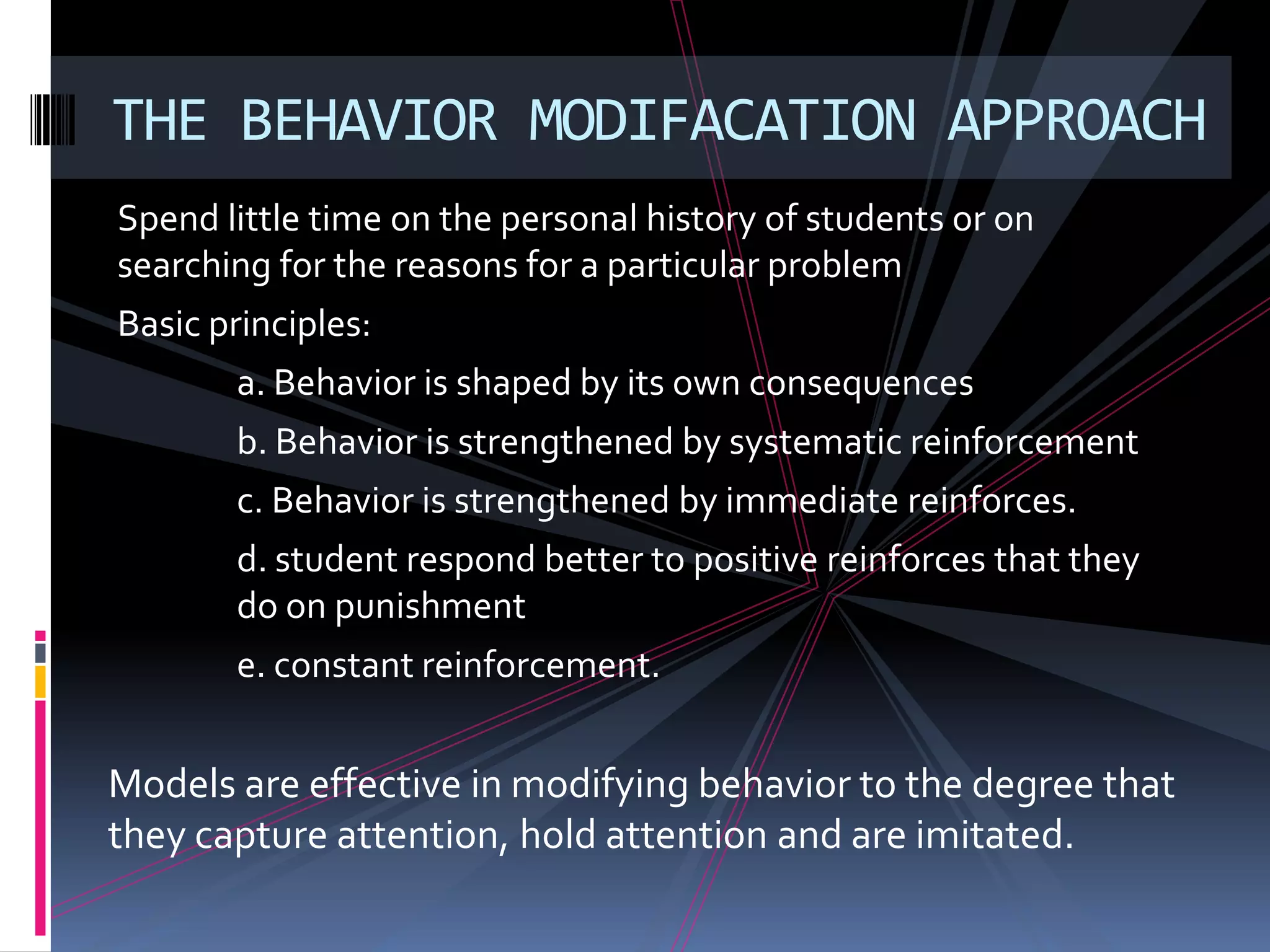
THE BEHAVIOR MODIFACATION APPROACH
Spend little time on the personal history of students or on
searching for the reasons for a particular problem
Basic principles:
       a. Behavior is shaped by its own consequences
       b. Behavior is strengthened by systematic reinforcement
       c. Behavior is strengthened by immediate reinforces.
       d. student respond better to positive reinforces that they
       do on punishment
       e. constant reinforcement.


Models are effective in modifying behavior to the degree that
they capture attention, hold attention and are imitated.
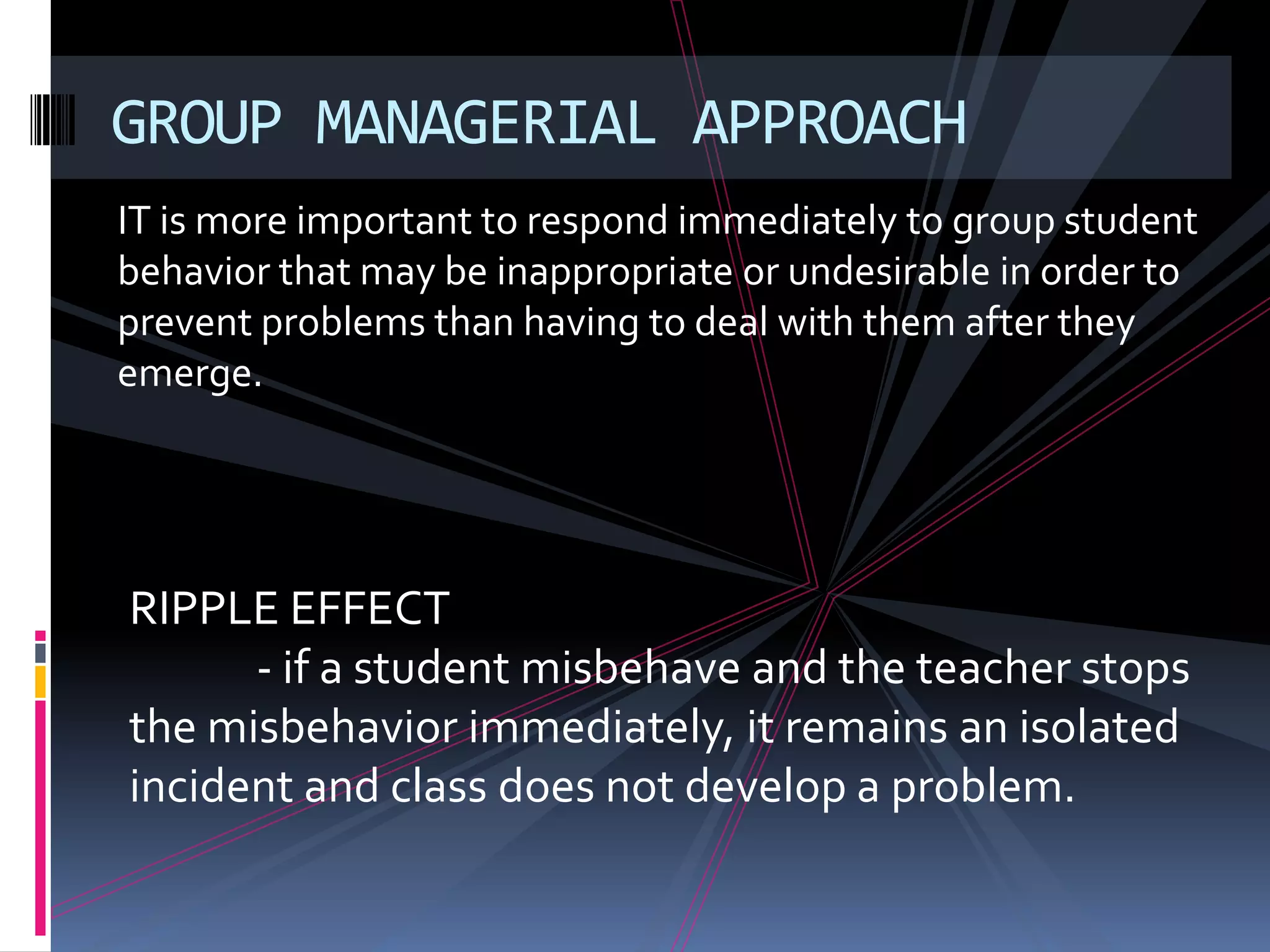
GROUP MANAGERIAL APPROACH
IT is more important to respond immediately to group student
behavior that may be inappropriate or undesirable in order to
prevent problems than having to deal with them after they
emerge.


RIPPLE EFFECT
      - if a student misbehave and the teacher stops
the misbehavior immediately, it remains an isolated
incident and class does not develop a problem.
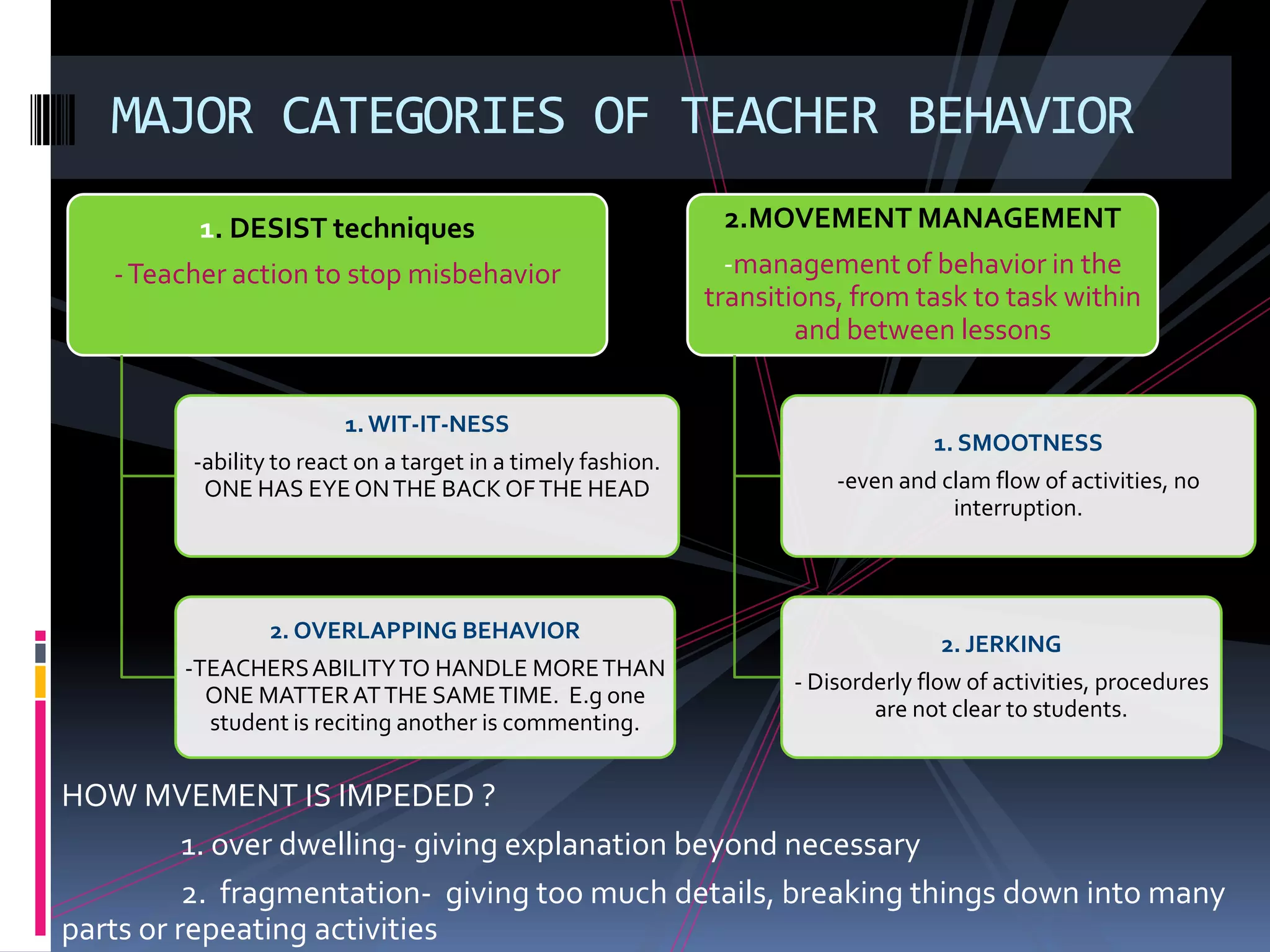
MAJOR CATEGORIES OF TEACHER BEHAVIOR
         1. DESIST techniques                                  2.MOVEMENT MANAGEMENT
   - Teacher action to stop misbehavior                         -management of behavior in the
                                                              transitions, from task to task within
                                                                      and between lessons


                         1. WIT-IT-NESS
                                                                                   1. SMOOTNESS
         -ability to react on a target in a timely fashion.
          ONE HAS EYE ON THE BACK OF THE HEAD                            -even and clam flow of activities, no
                                                                                    interruption.


                 2. OVERLAPPING BEHAVIOR
                                                                                    2. JERKING
        -TEACHERS ABILITY TO HANDLE MORE THAN
                                                                     - Disorderly flow of activities, procedures
          ONE MATTER AT THE SAME TIME. E.g one
                                                                             are not clear to students.
          student is reciting another is commenting.


HOW MVEMENT IS IMPEDED ?
          1. over dwelling- giving explanation beyond necessary
          2. fragmentation- giving too much details, breaking things down into many
parts or repeating activities
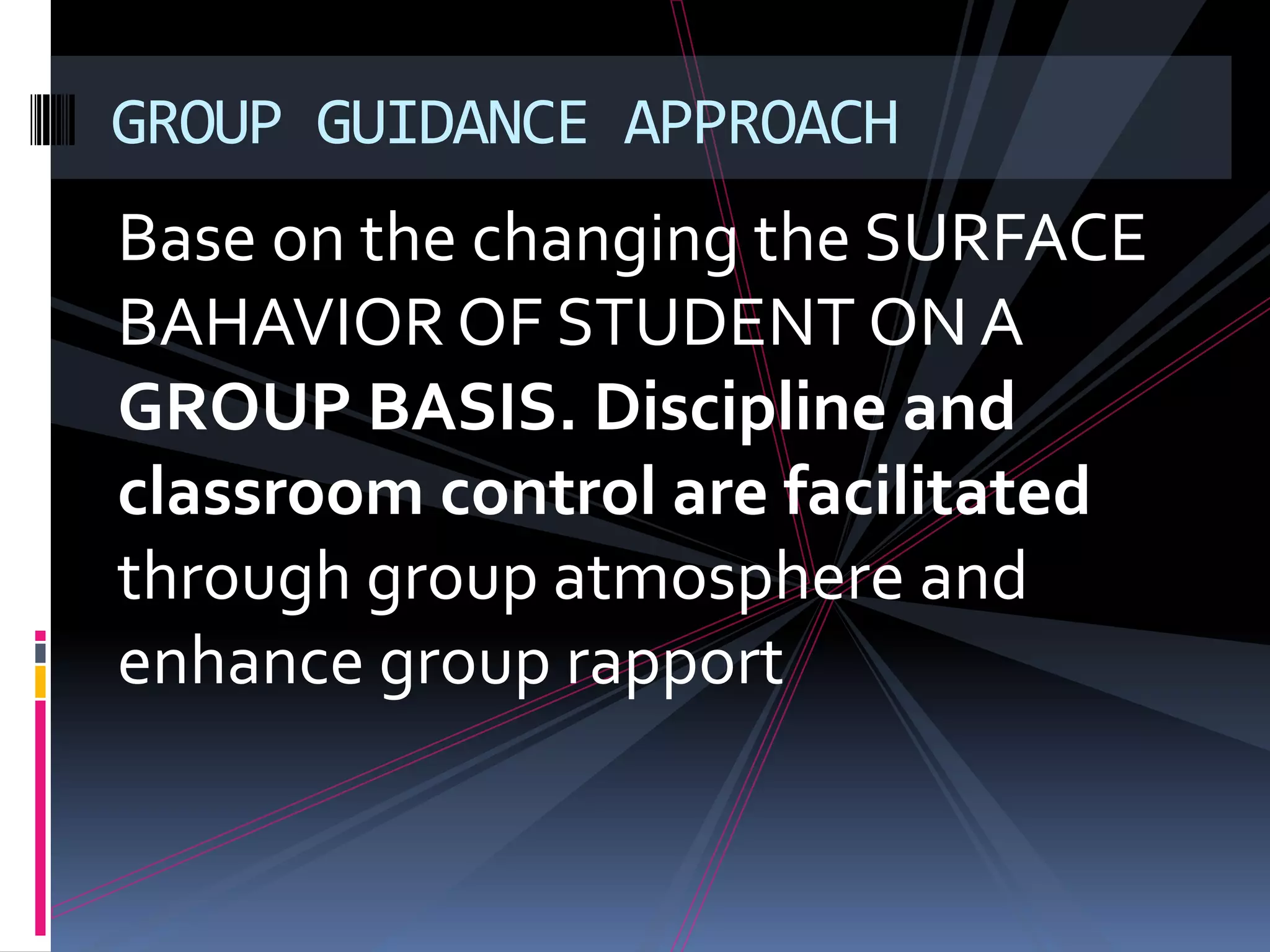
GROUP GUIDANCE APPROACH
Base on the changing the SURFACE
BAHAVIOR OF STUDENT ON A
GROUP BASIS. Discipline and
classroom control are facilitated
through group atmosphere and
enhance group rapport
ACCEPTANCE APPROACH
Maintains that every individual
needs to feel acceptance and
belongingness. Student will strive
to behave appropriately because
they want to be accepted and to
belong to the group
SUCCESS APPROACH
DEALS with general psychological and
social conditions instead of dealing with
appropriate behavior and the consequences
of such behavior. Teacher’s job is to help
students make good choices.

 Teachers need to change whatever negative
 behavior exist and improve conditions so they
 lead to student success.
 This implies that teacher must show care and are
 positive and persistent .
Student problem types-teacher describes

1.   Failure Syndrome– usually says, I can’t do it.
2.   Perfectionist– anxious of making mistakes
3.   Under Achiever– student do minimum to get by.
4.   Low Achiever– student have difficulty even they willing to work,
     problem is low potential.
5.   Hostile Aggressive– they are not easily control, they damage
     property
6.   Passive Aggressive– express opposition to teachers but indirectly.
7.   Defiant– student resist authority and carry on a power struggle with
     teacher.
8.   Hyperactive – show excessive and constant movement even when
     sitting.
PREVENTIVE MEASURES
A.   Planned ignoring                    Moderate preventive measures
B.   Signal interference-use signal to   a.   Establishing classroom activities
     disapprove                          b.   Rules and procedures
C.   Proximity control-                  c.   Academic work and activities
D. Interest boosting-show you are        d.   Routines
     interesting to him                  e.   Enacting processes
E.   Humor- humor defuse tense           f.   Hidden curriculum
F.   Hurdle lessons- those who           g.   Monitoring
     misunderstand lesson, try to
     provide academic assistance         h.   Maintaining group lessons
G. Restructuring the program- class      i.   Seat works
     rescheduled                         j.   Transitions engage time
H. Routine – lack of self control        k.   cueing
     need routine.

Classroom management

  • 1.
    Classroom management  Is define as the administration or direction of activities with special reference to such problem as discipline, democratic techniques, use and cares of supplies, and references materials, physical features of the classroom, general house keeping, and the social relationships of the pupils.
  • 2.
    Approaches to classroommanagement 1. Assertive approach 2. Business academic approach 3. Behavior modification approach 4. Group managerial approach 5. Group guidance approach 6. Acceptance approach 7. Success approach
  • 3.
    ASSERTIVE APPROACH -- Teacherspecify rules Suggest that teacher: 1. Clearly identified expectations of behavior and 2. Take positions “I like that ” ”I hate that” 3. Use firm voice consequences for 4. Used eye contact, gestures and touch disobeying them and supplement verbal messages. 5. Say no without guilt feeling to communicate these 6. Give and receive complements 7. Place demand on student and enforced rules and them. 8. Indicate consequences of behavior and consequences clearly. why specific action is necessary. 9. Set limits on student 10. Be calm and consistent 11. Follow regularly 12. Don’t give up on rules enforced 13. Gain confidence and skills in work in chronic behavior.
  • 4.
    BUSINESS ACADEMIC APPROACH Emphasizesthe organization and management of students as they engage in academic work. Three major categories a. Establishment and communication of work assignment b. Standards and procedures, monitoring of student work c. Feedback of students
  • 5.
    THE BEHAVIOR MODIFACATIONAPPROACH Spend little time on the personal history of students or on searching for the reasons for a particular problem Basic principles: a. Behavior is shaped by its own consequences b. Behavior is strengthened by systematic reinforcement c. Behavior is strengthened by immediate reinforces. d. student respond better to positive reinforces that they do on punishment e. constant reinforcement. Models are effective in modifying behavior to the degree that they capture attention, hold attention and are imitated.
  • 6.
    GROUP MANAGERIAL APPROACH ITis more important to respond immediately to group student behavior that may be inappropriate or undesirable in order to prevent problems than having to deal with them after they emerge. RIPPLE EFFECT - if a student misbehave and the teacher stops the misbehavior immediately, it remains an isolated incident and class does not develop a problem.
  • 7.
    MAJOR CATEGORIES OFTEACHER BEHAVIOR 1. DESIST techniques 2.MOVEMENT MANAGEMENT - Teacher action to stop misbehavior -management of behavior in the transitions, from task to task within and between lessons 1. WIT-IT-NESS 1. SMOOTNESS -ability to react on a target in a timely fashion. ONE HAS EYE ON THE BACK OF THE HEAD -even and clam flow of activities, no interruption. 2. OVERLAPPING BEHAVIOR 2. JERKING -TEACHERS ABILITY TO HANDLE MORE THAN - Disorderly flow of activities, procedures ONE MATTER AT THE SAME TIME. E.g one are not clear to students. student is reciting another is commenting. HOW MVEMENT IS IMPEDED ? 1. over dwelling- giving explanation beyond necessary 2. fragmentation- giving too much details, breaking things down into many parts or repeating activities
  • 8.
    GROUP GUIDANCE APPROACH Baseon the changing the SURFACE BAHAVIOR OF STUDENT ON A GROUP BASIS. Discipline and classroom control are facilitated through group atmosphere and enhance group rapport
  • 9.
    ACCEPTANCE APPROACH Maintains thatevery individual needs to feel acceptance and belongingness. Student will strive to behave appropriately because they want to be accepted and to belong to the group
  • 10.
    SUCCESS APPROACH DEALS withgeneral psychological and social conditions instead of dealing with appropriate behavior and the consequences of such behavior. Teacher’s job is to help students make good choices. Teachers need to change whatever negative behavior exist and improve conditions so they lead to student success. This implies that teacher must show care and are positive and persistent .
  • 11.
    Student problem types-teacherdescribes 1. Failure Syndrome– usually says, I can’t do it. 2. Perfectionist– anxious of making mistakes 3. Under Achiever– student do minimum to get by. 4. Low Achiever– student have difficulty even they willing to work, problem is low potential. 5. Hostile Aggressive– they are not easily control, they damage property 6. Passive Aggressive– express opposition to teachers but indirectly. 7. Defiant– student resist authority and carry on a power struggle with teacher. 8. Hyperactive – show excessive and constant movement even when sitting.
  • 12.
    PREVENTIVE MEASURES A. Planned ignoring Moderate preventive measures B. Signal interference-use signal to a. Establishing classroom activities disapprove b. Rules and procedures C. Proximity control- c. Academic work and activities D. Interest boosting-show you are d. Routines interesting to him e. Enacting processes E. Humor- humor defuse tense f. Hidden curriculum F. Hurdle lessons- those who g. Monitoring misunderstand lesson, try to provide academic assistance h. Maintaining group lessons G. Restructuring the program- class i. Seat works rescheduled j. Transitions engage time H. Routine – lack of self control k. cueing need routine.