Multi-level classes


                      Multi-level classes
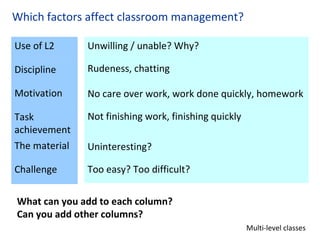
Which factors affect classroom management?

Students not   Why?
  using L2
  Discipline   What?

Motivation     What?

    Task     What?
achievement
The material What?

 Challenge     What?


                                             Multi-level classes
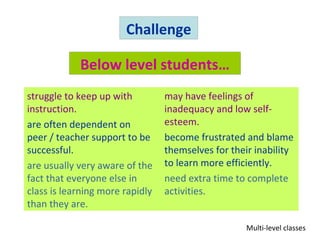
Which factors affect classroom management?

Use of L2      Unwilling / unable? Why?

Discipline     Rudeness, chatting

Motivation     No care over work, work done quickly, homework

Task           Not finishing work, finishing quickly
achievement
The material   Uninteresting?

Challenge      Too easy? Too difficult?


What can you add to each column?
Can you add other columns?
                                                       Multi-level classes
Challenge

            Below level students…
struggle to keep up with         may have feelings of
instruction.                     inadequacy and low self-
are often dependent on           esteem.
peer / teacher support to be     become frustrated and blame
successful.                      themselves for their inability
are usually very aware of the    to learn more efficiently.
fact that everyone else in       need extra time to complete
class is learning more rapidly   activities.
than they are.

                                                    Multi-level classes
Challenge

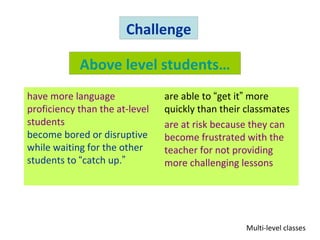
            Above level students…
have more language              are able to “get it” more
proficiency than the at-level   quickly than their classmates
students                        are at risk because they can
become bored or disruptive      become frustrated with the
while waiting for the other     teacher for not providing
students to “catch up.”         more challenging lessons


                                                  Multi-level classes
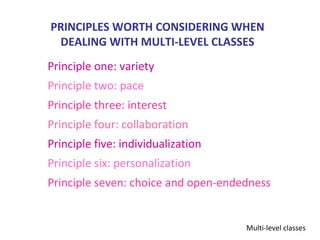
PRINCIPLES WORTH CONSIDERING WHEN
 DEALING WITH MULTI-LEVEL CLASSES
Principle one: variety
Principle two: pace
Principle three: interest
Principle four: collaboration
Principle five: individualization
Principle six: personalization
Principle seven: choice and open-endedness


                                     Multi-level classes
personalization


individualization
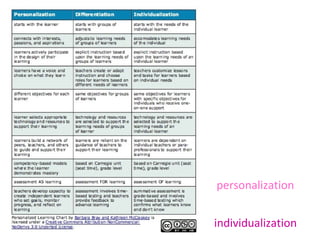
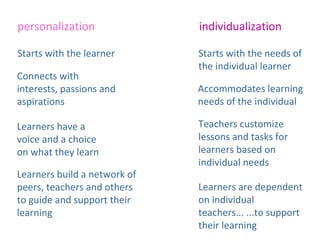
personalization               individualization

Starts with the learner       Starts with the needs of
                              the individual learner
Connects with
interests, passions and       Accommodates learning
aspirations                   needs of the individual

Learners have a               Teachers customize
voice and a choice            lessons and tasks for
on what they learn            learners based on
                              individual needs
Learners build a network of
peers, teachers and others    Learners are dependent
to guide and support their    on individual
learning                      teachers... ...to support
                              their learning
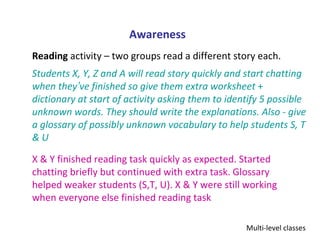
Awareness
Reading activity – two groups read a different story each.
Students X, Y, Z and A will read story quickly and start chatting
when they’ve finished so give them extra worksheet +
dictionary at start of activity asking them to identify 5 possible
unknown words. They should write the explanations. Also - give
a glossary of possibly unknown vocabulary to help students S, T
&U

X & Y finished reading task quickly as expected. Started
chatting briefly but continued with extra task. Glossary
helped weaker students (S,T, U). X & Y were still working
when everyone else finished reading task

                                                   Multi-level classes
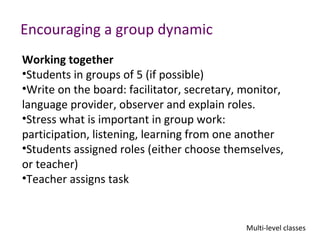
Encouraging a group dynamic
Working together
•Students in groups of 5 (if possible)
•Write on the board: facilitator, secretary, monitor,
language provider, observer and explain roles.
•Stress what is important in group work:
participation, listening, learning from one another
•Students assigned roles (either choose themselves,
or teacher)
•Teacher assigns task


                                             Multi-level classes
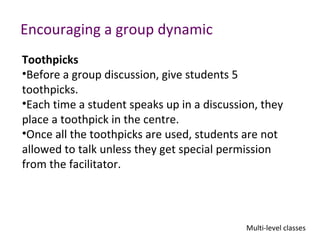
Encouraging a group dynamic
Toothpicks
•Before a group discussion, give students 5
toothpicks.
•Each time a student speaks up in a discussion, they
place a toothpick in the centre.
•Once all the toothpicks are used, students are not
allowed to talk unless they get special permission
from the facilitator.


                                            Multi-level classes
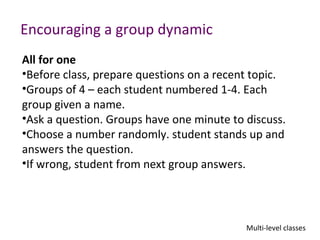
Encouraging a group dynamic
All for one
•Before class, prepare questions on a recent topic.
•Groups of 4 – each student numbered 1-4. Each
group given a name.
•Ask a question. Groups have one minute to discuss.
•Choose a number randomly. student stands up and
answers the question.
•If wrong, student from next group answers.


                                           Multi-level classes
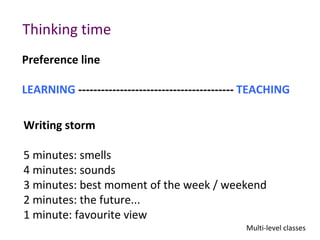
Thinking time
Preference line

LEARNING ----------------------------------------- TEACHING

Writing storm

5 minutes: smells
4 minutes: sounds
3 minutes: best moment of the week / weekend
2 minutes: the future...
1 minute: favourite view
                                                 Multi-level classes
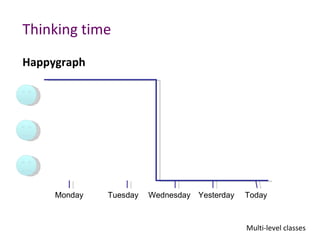
Thinking time
Happygraph


     Monday   Tuesday   Wednesday Yesterday   Today


                                              Multi-level classes
Simple dialogue activities
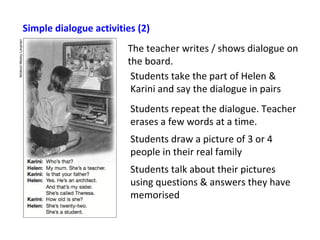
Simple dialogue activities (2)
                        The teacher writes / shows dialogue on
                        the board.
                         Students take the part of Helen &
                         Karini and say the dialogue in pairs
                         Students repeat the dialogue. Teacher
                         erases a few words at a time.
                         Students draw a picture of 3 or 4
                         people in their real family
                         Students talk about their pictures
                         using questions & answers they have
                         memorised
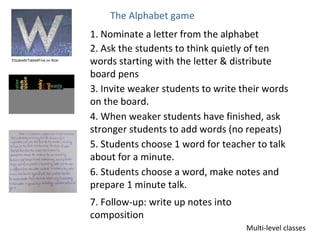
The Alphabet game
                                 1. Nominate a letter from the alphabet
                                 2. Ask the students to think quietly of ten
Elizabeth/Table4Five on flickr
                                 words starting with the letter & distribute
                                 board pens
                                 3. Invite weaker students to write their words
                                 on the board.
                                 4. When weaker students have finished, ask
                                 stronger students to add words (no repeats)
                                 5. Students choose 1 word for teacher to talk
                                 about for a minute.
                                 6. Students choose a word, make notes and
                                 prepare 1 minute talk.
                                 7. Follow-up: write up notes into
                                 composition
                                                                     Multi-level classes
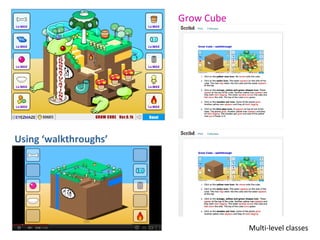
Grow Cube


Using ‘walkthroughs’


                                   Multi-level classes
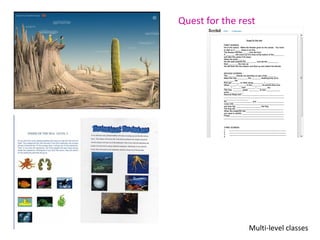
Quest for the rest


                Multi-level classes
Using YouTube with multi-level classes


The Artistifier (http://theartistifier.com)
                                              Multi-level classes
PRINCIPLES WORTH CONSIDERING WHEN
 DEALING WITH MULTI-LEVEL CLASSES
Principle one: variety
Principle two: pace
Principle three: interest
Principle four: collaboration
Principle five: individualization
Principle six: personalization
Principle seven: choice and open-endedness


                                     Multi-level classes
Links

 The Alphabet game
http://cerij.wordpress.com/2011/02/26/w-is-for-words/

Grow cube / Best of the rest:
http://kylemawer.wikispaces.com/Grow+cube+walkthrough
http://kylemawer.wikispaces.com/Quest+For+The+Rest

Simple dialogues:
http://www.teachingenglish.org.uk/sites/teacheng/files/mixedability.pdf

The Artistifier
http://quickshout.blogspot.com/2012/03/create-and-exploit-silent-movies-for.html


                                                               Multi-level classes

Multilevelclasses fri am_bilbao

  • 1.
    Multi-level classes Multi-level classes
  • 2.
    Which factors affectclassroom management? Students not Why? using L2 Discipline What? Motivation What? Task What? achievement The material What? Challenge What? Multi-level classes
  • 3.
    Which factors affectclassroom management? Use of L2 Unwilling / unable? Why? Discipline Rudeness, chatting Motivation No care over work, work done quickly, homework Task Not finishing work, finishing quickly achievement The material Uninteresting? Challenge Too easy? Too difficult? What can you add to each column? Can you add other columns? Multi-level classes
  • 4.
    Challenge Below level students… struggle to keep up with may have feelings of instruction. inadequacy and low self- are often dependent on esteem. peer / teacher support to be become frustrated and blame successful. themselves for their inability are usually very aware of the to learn more efficiently. fact that everyone else in need extra time to complete class is learning more rapidly activities. than they are. Multi-level classes
  • 5.
    Challenge Above level students… have more language are able to “get it” more proficiency than the at-level quickly than their classmates students are at risk because they can become bored or disruptive become frustrated with the while waiting for the other teacher for not providing students to “catch up.” more challenging lessons Multi-level classes
  • 6.
    PRINCIPLES WORTH CONSIDERINGWHEN DEALING WITH MULTI-LEVEL CLASSES Principle one: variety Principle two: pace Principle three: interest Principle four: collaboration Principle five: individualization Principle six: personalization Principle seven: choice and open-endedness Multi-level classes
  • 7.
  • 8.
    personalization individualization Starts with the learner Starts with the needs of the individual learner Connects with interests, passions and Accommodates learning aspirations needs of the individual Learners have a Teachers customize voice and a choice lessons and tasks for on what they learn learners based on individual needs Learners build a network of peers, teachers and others Learners are dependent to guide and support their on individual learning teachers... ...to support their learning
  • 9.
    Awareness Reading activity –two groups read a different story each. Students X, Y, Z and A will read story quickly and start chatting when they’ve finished so give them extra worksheet + dictionary at start of activity asking them to identify 5 possible unknown words. They should write the explanations. Also - give a glossary of possibly unknown vocabulary to help students S, T &U X & Y finished reading task quickly as expected. Started chatting briefly but continued with extra task. Glossary helped weaker students (S,T, U). X & Y were still working when everyone else finished reading task Multi-level classes
  • 10.
    Encouraging a groupdynamic Working together •Students in groups of 5 (if possible) •Write on the board: facilitator, secretary, monitor, language provider, observer and explain roles. •Stress what is important in group work: participation, listening, learning from one another •Students assigned roles (either choose themselves, or teacher) •Teacher assigns task Multi-level classes
  • 11.
    Encouraging a groupdynamic Toothpicks •Before a group discussion, give students 5 toothpicks. •Each time a student speaks up in a discussion, they place a toothpick in the centre. •Once all the toothpicks are used, students are not allowed to talk unless they get special permission from the facilitator. Multi-level classes
  • 12.
    Encouraging a groupdynamic All for one •Before class, prepare questions on a recent topic. •Groups of 4 – each student numbered 1-4. Each group given a name. •Ask a question. Groups have one minute to discuss. •Choose a number randomly. student stands up and answers the question. •If wrong, student from next group answers. Multi-level classes
  • 13.
    Thinking time Preference line LEARNING----------------------------------------- TEACHING Writing storm 5 minutes: smells 4 minutes: sounds 3 minutes: best moment of the week / weekend 2 minutes: the future... 1 minute: favourite view Multi-level classes
  • 14.
    Thinking time Happygraph Monday Tuesday Wednesday Yesterday Today Multi-level classes
  • 15.
  • 16.
    Simple dialogue activities(2) The teacher writes / shows dialogue on the board. Students take the part of Helen & Karini and say the dialogue in pairs Students repeat the dialogue. Teacher erases a few words at a time. Students draw a picture of 3 or 4 people in their real family Students talk about their pictures using questions & answers they have memorised
  • 17.
    The Alphabet game 1. Nominate a letter from the alphabet 2. Ask the students to think quietly of ten Elizabeth/Table4Five on flickr words starting with the letter & distribute board pens 3. Invite weaker students to write their words on the board. 4. When weaker students have finished, ask stronger students to add words (no repeats) 5. Students choose 1 word for teacher to talk about for a minute. 6. Students choose a word, make notes and prepare 1 minute talk. 7. Follow-up: write up notes into composition Multi-level classes
  • 18.
  • 19.
    Quest for therest Multi-level classes
  • 20.
    Using YouTube withmulti-level classes The Artistifier (http://theartistifier.com) Multi-level classes
  • 21.
    PRINCIPLES WORTH CONSIDERINGWHEN DEALING WITH MULTI-LEVEL CLASSES Principle one: variety Principle two: pace Principle three: interest Principle four: collaboration Principle five: individualization Principle six: personalization Principle seven: choice and open-endedness Multi-level classes
  • 24.
    Links The Alphabetgame http://cerij.wordpress.com/2011/02/26/w-is-for-words/ Grow cube / Best of the rest: http://kylemawer.wikispaces.com/Grow+cube+walkthrough http://kylemawer.wikispaces.com/Quest+For+The+Rest Simple dialogues: http://www.teachingenglish.org.uk/sites/teacheng/files/mixedability.pdf The Artistifier http://quickshout.blogspot.com/2012/03/create-and-exploit-silent-movies-for.html Multi-level classes