FAST 
LEARNERS 
Maribel Fernandez 
BSED-MAPEH 3 
Humprey Ian O. Sagabaen 
BSED-RVED 3 
EDST 105
FAST LEARNERS 
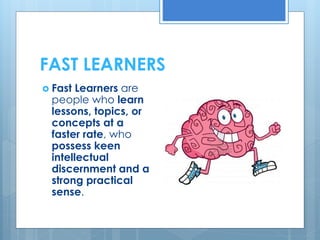
 Fast Learners are 
people who learn 
lessons, topics, or 
concepts at a 
faster rate, who 
possess keen 
intellectual 
discernment and a 
strong practical 
sense.
FAST LEARNERS 
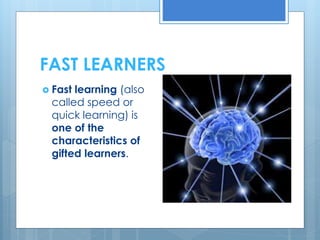
 Fast learning (also 
called speed or 
quick learning) is 
one of the 
characteristics of 
gifted learners.
CAUSES 
Pre-natal – Hereditary 
Post-natal – Environmental 
Factors
Learning and Behavioral 
CHARACTERISTICS 
of Fast Learners
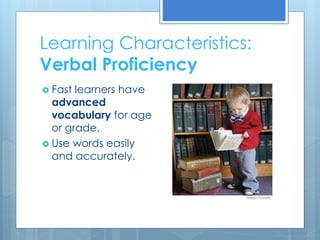
Learning Characteristics: 
Verbal Proficiency 
 Fast learners have 
advanced 
vocabulary for age 
or grade. 
 Use words easily 
and accurately.
Verbal Proficiency 
 Speak fluently and 
elaborately. 
 Read 
independently a 
great deal. 
 Enjoy difficult 
reading materials.
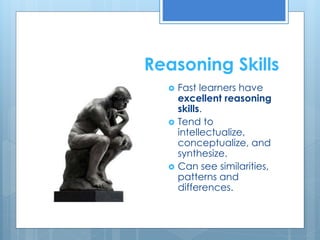
Reasoning Skills 
 Fast learners have 
excellent reasoning 
skills. 
 Tend to 
intellectualize, 
conceptualize, and 
synthesize. 
 Can see similarities, 
patterns and 
differences.
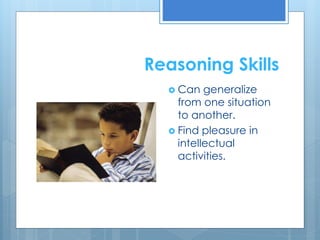
Reasoning Skills 
 Can generalize 
from one situation 
to another. 
 Find pleasure in 
intellectual 
activities.
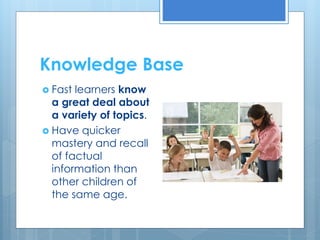
Knowledge Base 
 Fast learners know 
a great deal about 
a variety of topics. 
 Have quicker 
mastery and recall 
of factual 
information than 
other children of 
the same age.
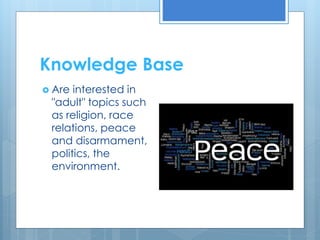
Knowledge Base 
 Are interested in 
"adult" topics such 
as religion, race 
relations, peace 
and disarmament, 
politics, the 
environment.
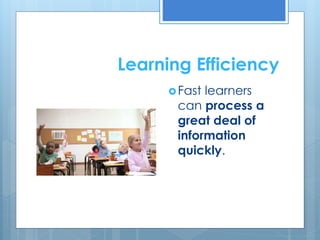
Learning Efficiency 
Fast learners 
can process a 
great deal of 
information 
quickly.
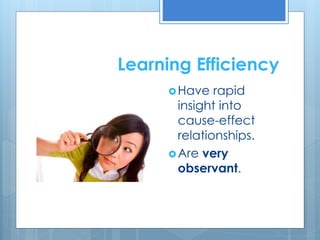
Learning Efficiency 
Have rapid 
insight into 
cause-effect 
relationships. 
Are very 
observant.
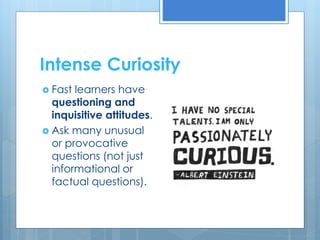
Intense Curiosity 
 Fast learners have 
questioning and 
inquisitive attitudes. 
 Ask many unusual 
or provocative 
questions (not just 
informational or 
factual questions).
Intense Curiosity 
 Are interested in the 
"why" and "how" of 
things. 
 Are concerned with 
what makes things 
right or wrong. 
 Have areas of 
"passionate" interest 
inside or outside of 
school.
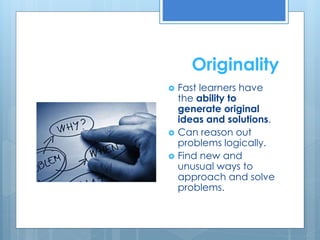
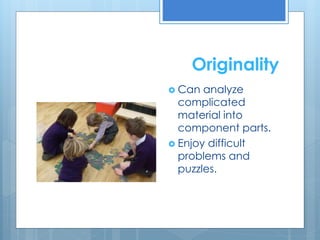
Originality 
 Fast learners have 
the ability to 
generate original 
ideas and solutions. 
 Can reason out 
problems logically. 
 Find new and 
unusual ways to 
approach and solve 
problems.
Originality 
 Can analyze 
complicated 
material into 
component parts. 
 Enjoy difficult 
problems and 
puzzles.
Power of Concentration 
 Fast learners are 
goal-oriented 
people. 
 Persist in achieving 
self-determined 
goals. 
 Have long 
attention span.
Power of Concentration 
 Work on tasks until 
completion especially 
when motivated or 
inspired. 
 Need little 
encouragement from 
others when working 
on areas of interest 
(intrinsically motivated 
or inner directed.) 
 Set high personal 
standards.
Behavioral Characteristics: 
Fast learners… 
 Can become perfectionists 
 Are success-oriented; tend to avoid something 
where failure is a possibility 
 Have a keen sense of humor; love absurdities, 
jokes, pranks 
 Can have poor social acceptance by age peers 
 Listen to only part of the explanation; appear to 
have low concentration 
 Show dislike and boredom for repetition
Behavioral Characteristics: 
Fast learners… 
 Often prefer company of older students and adults 
 Become focused or absorbed when interested 
 Become impatient with interferences and 
distractions 
 Can be stubborn in their own beliefs 
 Empathize with others; understanding and 
sympathetic 
 Show impatience with waiting for other students 
 Are perceived as too serious
TEACHING 
STRATEGIES
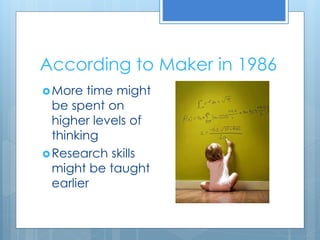
According to Maker in 1986 
More time might 
be spent on 
higher levels of 
thinking 
Research skills 
might be taught 
earlier
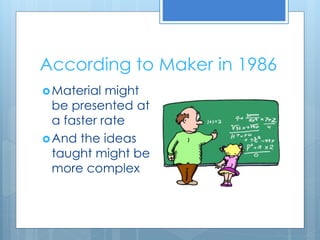
According to Maker in 1986 
Material might 
be presented at 
a faster rate 
And the ideas 
taught might be 
more complex
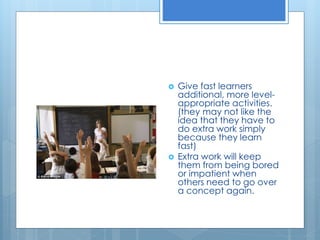
 Give fast learners 
additional, more level-appropriate 
activities. 
(they may not like the 
idea that they have to 
do extra work simply 
because they learn 
fast) 
 Extra work will keep 
them from being bored 
or impatient when 
others need to go over 
a concept again.
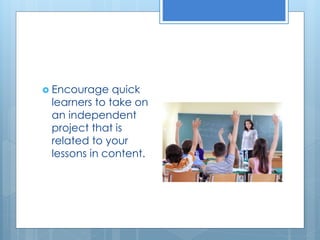
 Encourage quick 
learners to take on 
an independent 
project that is 
related to your 
lessons in content.
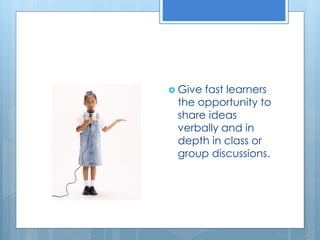
 Give fast learners 
the opportunity to 
share ideas 
verbally and in 
depth in class or 
group discussions.
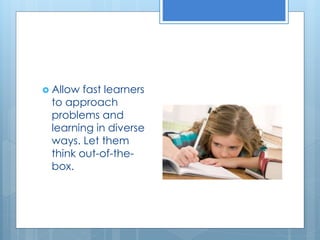
 Allow fast learners 
to approach 
problems and 
learning in diverse 
ways. Let them 
think out-of-the-box.
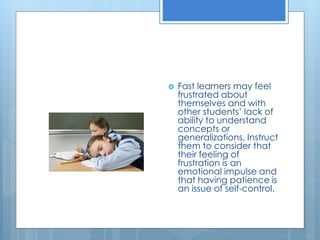
 Fast learners may feel 
frustrated about 
themselves and with 
other students’ lack of 
ability to understand 
concepts or 
generalizations. Instruct 
them to consider that 
their feeling of 
frustration is an 
emotional impulse and 
that having patience is 
an issue of self-control.
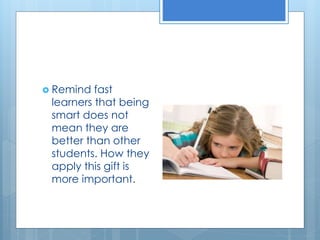
 Remind fast 
learners that being 
smart does not 
mean they are 
better than other 
students. How they 
apply this gift is 
more important.
References: 
 Yewchuk, C (1998). Learning Characteristics of Gifted Students: 
Implications for Instruction and Guidance. Retrieved January 10, 
2014, from http://www.giftedchildren.org.nz/apex/v12art06.php 
 Norman, L. (n.d.). How to Help Quick Learners with Patience. 
Retrieved December 03, 2013, from 
http://www.ehow.com/how_8483577_quick-learners-patience.html 
 Characteristics of the Gifted Learner Parent Survey [PDF file]. (n.d.). 
Retrieved from 
iu19giftednetwork.wikispaces.com/file/view/Parent%20survey.pdf 
 Teaching Strategies for Students with Diverse Learning Needs [PDF 
file]. (1996). Available from 
www.nebraskasocialstudies.org/pdf/tsfswdln.pdf
Thank you very 
much! ^_^

Fast learners

  • 1.
    FAST LEARNERS MaribelFernandez BSED-MAPEH 3 Humprey Ian O. Sagabaen BSED-RVED 3 EDST 105
  • 2.
    FAST LEARNERS Fast Learners are people who learn lessons, topics, or concepts at a faster rate, who possess keen intellectual discernment and a strong practical sense.
  • 3.
    FAST LEARNERS Fast learning (also called speed or quick learning) is one of the characteristics of gifted learners.
  • 4.
    CAUSES Pre-natal –Hereditary Post-natal – Environmental Factors
  • 5.
    Learning and Behavioral CHARACTERISTICS of Fast Learners
  • 6.
    Learning Characteristics: VerbalProficiency  Fast learners have advanced vocabulary for age or grade.  Use words easily and accurately.
  • 7.
    Verbal Proficiency Speak fluently and elaborately.  Read independently a great deal.  Enjoy difficult reading materials.
  • 8.
    Reasoning Skills Fast learners have excellent reasoning skills.  Tend to intellectualize, conceptualize, and synthesize.  Can see similarities, patterns and differences.
  • 9.
    Reasoning Skills Can generalize from one situation to another.  Find pleasure in intellectual activities.
  • 10.
    Knowledge Base Fast learners know a great deal about a variety of topics.  Have quicker mastery and recall of factual information than other children of the same age.
  • 11.
    Knowledge Base Are interested in "adult" topics such as religion, race relations, peace and disarmament, politics, the environment.
  • 12.
    Learning Efficiency Fastlearners can process a great deal of information quickly.
  • 13.
    Learning Efficiency Haverapid insight into cause-effect relationships. Are very observant.
  • 14.
    Intense Curiosity Fast learners have questioning and inquisitive attitudes.  Ask many unusual or provocative questions (not just informational or factual questions).
  • 15.
    Intense Curiosity Are interested in the "why" and "how" of things.  Are concerned with what makes things right or wrong.  Have areas of "passionate" interest inside or outside of school.
  • 16.
    Originality  Fastlearners have the ability to generate original ideas and solutions.  Can reason out problems logically.  Find new and unusual ways to approach and solve problems.
  • 17.
    Originality  Cananalyze complicated material into component parts.  Enjoy difficult problems and puzzles.
  • 18.
    Power of Concentration  Fast learners are goal-oriented people.  Persist in achieving self-determined goals.  Have long attention span.
  • 19.
    Power of Concentration  Work on tasks until completion especially when motivated or inspired.  Need little encouragement from others when working on areas of interest (intrinsically motivated or inner directed.)  Set high personal standards.
  • 20.
    Behavioral Characteristics: Fastlearners…  Can become perfectionists  Are success-oriented; tend to avoid something where failure is a possibility  Have a keen sense of humor; love absurdities, jokes, pranks  Can have poor social acceptance by age peers  Listen to only part of the explanation; appear to have low concentration  Show dislike and boredom for repetition
  • 21.
    Behavioral Characteristics: Fastlearners…  Often prefer company of older students and adults  Become focused or absorbed when interested  Become impatient with interferences and distractions  Can be stubborn in their own beliefs  Empathize with others; understanding and sympathetic  Show impatience with waiting for other students  Are perceived as too serious
  • 22.
  • 23.
    According to Makerin 1986 More time might be spent on higher levels of thinking Research skills might be taught earlier
  • 24.
    According to Makerin 1986 Material might be presented at a faster rate And the ideas taught might be more complex
  • 25.
     Give fastlearners additional, more level-appropriate activities. (they may not like the idea that they have to do extra work simply because they learn fast)  Extra work will keep them from being bored or impatient when others need to go over a concept again.
  • 26.
     Encourage quick learners to take on an independent project that is related to your lessons in content.
  • 27.
     Give fastlearners the opportunity to share ideas verbally and in depth in class or group discussions.
  • 28.
     Allow fastlearners to approach problems and learning in diverse ways. Let them think out-of-the-box.
  • 29.
     Fast learnersmay feel frustrated about themselves and with other students’ lack of ability to understand concepts or generalizations. Instruct them to consider that their feeling of frustration is an emotional impulse and that having patience is an issue of self-control.
  • 30.
     Remind fast learners that being smart does not mean they are better than other students. How they apply this gift is more important.
  • 31.
    References:  Yewchuk,C (1998). Learning Characteristics of Gifted Students: Implications for Instruction and Guidance. Retrieved January 10, 2014, from http://www.giftedchildren.org.nz/apex/v12art06.php  Norman, L. (n.d.). How to Help Quick Learners with Patience. Retrieved December 03, 2013, from http://www.ehow.com/how_8483577_quick-learners-patience.html  Characteristics of the Gifted Learner Parent Survey [PDF file]. (n.d.). Retrieved from iu19giftednetwork.wikispaces.com/file/view/Parent%20survey.pdf  Teaching Strategies for Students with Diverse Learning Needs [PDF file]. (1996). Available from www.nebraskasocialstudies.org/pdf/tsfswdln.pdf
  • 32.
    Thank you very much! ^_^