Teacher as Curricularist
Cris Capilayan MA Ed
Bilbao, et.al
(2014)
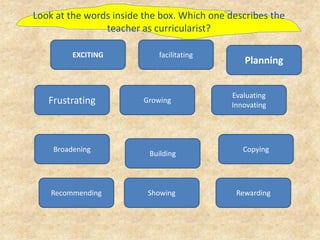
EXCITING
Frustrating
facilitating
Planning
Growing
Evaluating
Innovating
Broadening
Building
Copying
Recommending Showing Rewarding
Look at the words inside the box. Which one describes the
teacher as curricularist?
Are you aware that the teacher’s role
is very complex?
• Teachers do a series of interrelated actions
about curriculum, instruction, assessment,
evaluation, teaching and learning.
• A teacher is involved with curriculum
continuously all day.
• But very seldom has a teacher been described
as curriculum continuously all day.
Curricularists in the past
• Those who developed curriculum theories.
• The most influential curricularists (Hayes, 1991)
• John Dewey
• Hilda Taba
• Franklin Bobbit
• Ralph Tyler
Curricularist
• A professional who is curriculum specialist
• A person who is involved in curriculum
knowing, writing, planning, implementing,
evaluating, innovating, and initiating
• A teacher’s role is broader and inclusive of
other functions and so teacher is a curricularist.
What does a teacher do to deserve the
label as curricularist?
• The classroom is the first place of curricular
engagement. The first school experience sets
the tone to understand the meaning of
schooling through the interactions of learners
and teachers that will lead to learning. Hence,
curriculum is the heart of schooling
Describing teacher as curricularist
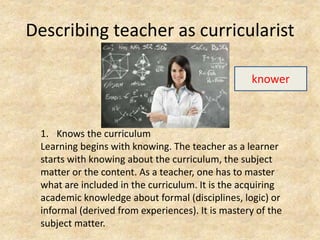
1. Knows the curriculum
Learning begins with knowing. The teacher as a learner
starts with knowing about the curriculum, the subject
matter or the content. As a teacher, one has to master
what are included in the curriculum. It is the acquiring
academic knowledge about formal (disciplines, logic) or
informal (derived from experiences). It is mastery of the
subject matter.
knower
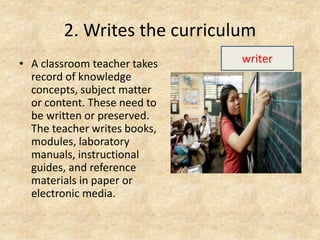
2. Writes the curriculum
• A classroom teacher takes
record of knowledge
concepts, subject matter
or content. These need to
be written or preserved.
The teacher writes books,
modules, laboratory
manuals, instructional
guides, and reference
materials in paper or
electronic media.
writer
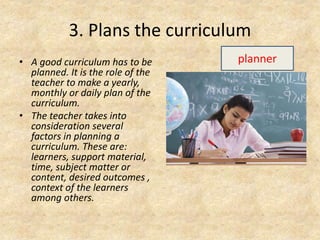
3. Plans the curriculum
• A good curriculum has to be
planned. It is the role of the
teacher to make a yearly,
monthly or daily plan of the
curriculum.
• The teacher takes into
consideration several
factors in planning a
curriculum. These are:
learners, support material,
time, subject matter or
content, desired outcomes ,
context of the learners
among others.
planner
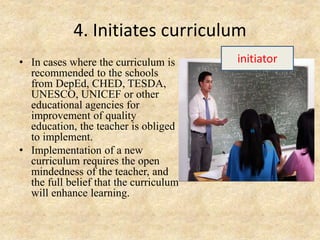
4. Initiates curriculum
• In cases where the curriculum is
recommended to the schools
from DepEd, CHED, TESDA,
UNESCO, UNICEF or other
educational agencies for
improvement of quality
education, the teacher is obliged
to implement.
• Implementation of a new
curriculum requires the open
mindedness of the teacher, and
the full belief that the curriculum
will enhance learning.
initiator
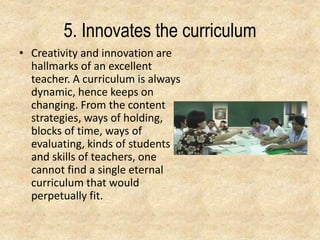
5. Innovates the curriculum
• Creativity and innovation are
hallmarks of an excellent
teacher. A curriculum is always
dynamic, hence keeps on
changing. From the content
strategies, ways of holding,
blocks of time, ways of
evaluating, kinds of students
and skills of teachers, one
cannot find a single eternal
curriculum that would
perpetually fit.
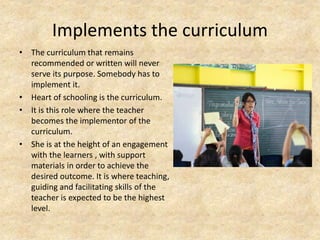
Implements the curriculum
• The curriculum that remains
recommended or written will never
serve its purpose. Somebody has to
implement it.
• Heart of schooling is the curriculum.
• It is this role where the teacher
becomes the implementor of the
curriculum.
• She is at the height of an engagement
with the learners , with support
materials in order to achieve the
desired outcome. It is where teaching,
guiding and facilitating skills of the
teacher is expected to be the highest
level.
7. Evaluates the curriculum
• How can one determine if the desired learning
outcomes have been achieved?
• Is the curriculum working?

Teacher as curricularist

  • 1.
    Teacher as Curricularist CrisCapilayan MA Ed Bilbao, et.al (2014)
  • 2.
  • 3.
    Are you awarethat the teacher’s role is very complex? • Teachers do a series of interrelated actions about curriculum, instruction, assessment, evaluation, teaching and learning. • A teacher is involved with curriculum continuously all day. • But very seldom has a teacher been described as curriculum continuously all day.
  • 4.
    Curricularists in thepast • Those who developed curriculum theories. • The most influential curricularists (Hayes, 1991) • John Dewey • Hilda Taba • Franklin Bobbit • Ralph Tyler
  • 5.
    Curricularist • A professionalwho is curriculum specialist • A person who is involved in curriculum knowing, writing, planning, implementing, evaluating, innovating, and initiating • A teacher’s role is broader and inclusive of other functions and so teacher is a curricularist.
  • 6.
    What does ateacher do to deserve the label as curricularist? • The classroom is the first place of curricular engagement. The first school experience sets the tone to understand the meaning of schooling through the interactions of learners and teachers that will lead to learning. Hence, curriculum is the heart of schooling
  • 7.
    Describing teacher ascurricularist 1. Knows the curriculum Learning begins with knowing. The teacher as a learner starts with knowing about the curriculum, the subject matter or the content. As a teacher, one has to master what are included in the curriculum. It is the acquiring academic knowledge about formal (disciplines, logic) or informal (derived from experiences). It is mastery of the subject matter. knower
  • 8.
    2. Writes thecurriculum • A classroom teacher takes record of knowledge concepts, subject matter or content. These need to be written or preserved. The teacher writes books, modules, laboratory manuals, instructional guides, and reference materials in paper or electronic media. writer
  • 9.
    3. Plans thecurriculum • A good curriculum has to be planned. It is the role of the teacher to make a yearly, monthly or daily plan of the curriculum. • The teacher takes into consideration several factors in planning a curriculum. These are: learners, support material, time, subject matter or content, desired outcomes , context of the learners among others. planner
  • 10.
    4. Initiates curriculum •In cases where the curriculum is recommended to the schools from DepEd, CHED, TESDA, UNESCO, UNICEF or other educational agencies for improvement of quality education, the teacher is obliged to implement. • Implementation of a new curriculum requires the open mindedness of the teacher, and the full belief that the curriculum will enhance learning. initiator
  • 11.
    5. Innovates thecurriculum • Creativity and innovation are hallmarks of an excellent teacher. A curriculum is always dynamic, hence keeps on changing. From the content strategies, ways of holding, blocks of time, ways of evaluating, kinds of students and skills of teachers, one cannot find a single eternal curriculum that would perpetually fit.
  • 12.
    Implements the curriculum •The curriculum that remains recommended or written will never serve its purpose. Somebody has to implement it. • Heart of schooling is the curriculum. • It is this role where the teacher becomes the implementor of the curriculum. • She is at the height of an engagement with the learners , with support materials in order to achieve the desired outcome. It is where teaching, guiding and facilitating skills of the teacher is expected to be the highest level.
  • 13.
    7. Evaluates thecurriculum • How can one determine if the desired learning outcomes have been achieved? • Is the curriculum working?