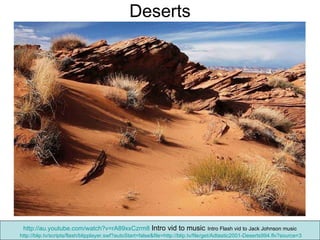
Deserts http:// au.youtube.com/watch?v =rA89xxCzrm8   Intro vid to music   Intro Flash vid to Jack Johnson music http:// blip.tv/scripts/flash/blipplayer.swf?autoStart = false&file =http://blip.tv/file/get/Adtastic2001-Deserts994.flv?source=3
Deserts occur where evaporation is greater than precipitation or where precipitation is  less than 250 millimetres a year These areas cover about  30%  of the earth’s surface. Some of the worlds deserts are  hot  and others are  cold All, however are  dry . HOT COLD
Types of Desert The world’s deserts are often classified according to the amount of precipitation they receive.  Classification Amount of Precipitation Extremely Arid No Precipitation for 12 consecutive months Arid Less than 250 millimetres of precipitation per year Semi Arid   Between 250 millimetres and 500 millimetres of precipitation per year
Hot  Deserts Hot deserts  generally lie around the tropic of cancer or the tropic of Capricorn. They have very hot summers and warm winters. Temperature extremes are common, as cloud cover is rare and  humidity  is very low. This means there is nothing to block the heat of the sun during the day or prevent its loss at night. Temperatures can range between around 45 ° and -15 ° Celcius in a 24 hour period.
Cold  Deserts Cold Deserts  lie on high ground generally north of the Tropic of Cancer and south of the tropic of Capricorn. They include the polar deserts Any precipitation falls as snow Winters are very cold and often windy; summers are dry and mild to warm.
 
 
24 Deserts Game  http://www.purposegames.com/game/111
Where are deserts located? Cold ocean currents exist off the  Western sides of continents . Winds blowing over these currents lose their moisture over the sea and are dry by the time they get to land.  In the interior of continents   Winds blowing over continents are dry by the time they get to the interior of continents.
Location of Deserts Depressions/basins in the interior of continents   The surrounding highlands around depressions/basins cause a rainshadow effect leaving the depression dry.
Location of Deserts The leeward side of tall mountains   Moisture carrying winds are blocked by the side (windward side) of tall mountains. The other side (leeward side) is consequently dry, and deserts may be formed there.
Account for the location of deserts? 1. Cold ocean currents off the west coast of continents 2. Dominance of high pressure systems 3. Lack of relief rainfall
Cold ocean currents There are cold ocean currents off the west coast of most continental landmasses. Evaporation rates from cold water are low. This limits the amount of moisture in the air and the amount of precipitation.


Dominance of high pressure systems Deserts & winds
Deserts: where & why Deserts & winds
 
Australia Apart from Antarctica, Australia is the driest continent in the world. About 35% of the continent receives so little rain, it is effectively desert. In total, 70% of the mainland receives less than 500mm of rain annually, which classes it as arid, or semi-arid.
Flash of atmospheric circ  http://www.school-portal.co.uk/GroupDownloadFile.asp?GroupId =12426&ResourceID=40425
 
 
Australia's deserts, listed below, are distributed throughout the western plateau and interior lowlands. The total desert area equates to 18% of the total mainland area of Australia.
Lack of relief rainfall Deserts & winds Middle-latitude deserts exist in rain shadows.
Orographic Rainfall The dry air mass becomes warmer, with little chance of rain. Deserts are often found on the leeward side of large mountain ranges Warm moist air approaches a mountain barrier The air mass is forced to rise as it hits the mountain and  condenses  into clouds Orographic rainfall occurs on the  windward   side of the mountains The air mass, now drier, flows down the  leeward  side of the mountains
 
Climate (Atmosphere and Hydrosphere) The desert temperature is not always hot. During the night, desert temperatures are quite cold, even below freezing point. The daytime temperatures are hot because there is very little cloud cover. This means that maximum radiation from the sun reaches the surface of the earth. In summer the temperature can reach as high as 40°C, while in winter, the temperature can reach 24°C.
Large diurnal range At night time, the lack of cloud cover allows the heat of the day to escape quickly, resulting in cold, even freezing, temperatures. The difference between the daily minimum and maximum temperatures is known as the  diurnal range .
Extremely hot days and very cold nights :   Cloudless skies   allow the sun to heat the atmosphere very quickly to very high temperatures. At night this same lack of cloud cover means that there is no insulation to hold the heat in and it escapes very quickly to the clear night sky.
So night temperatures are very cold and can even drop below freezing. Deserts have a very high DIURNAL (daily) range of temperatures, usually more than 20  C.  The annual temperature ranges are also (difference between summer and winter) are also relatively high in deserts.
 
Task : Construct a climate graph for Wadi Halfa
Desert Landforms A  plateau  is a broad, level, elevated region commonly bounded partly by cliffs. A  mesa  is smaller, flat-topped hill bounded by cliffs. They are usually wider than they are high. A  butte   is a narrow hill of resistant rock bounded by cliffs. Buttes are usually higher than they are wide. A  wadi  is steep sided, flat floored desert watercourse (river or creek) which is usually dry.
Alluvial Fans  are fan-shaped deposits of material in zone of deposition. They form where water flowing down wadis meets the desert and dumps its sediment. Playa Lakes  are ephemeral (temporary) lakes where water flows into a desert depression. Eventually the water evaporates and salt pans or clay pans are formed. Inselberg  is an isolated hill of harder rock. A  Bolson  is the flat desert basin.
A sandy desert or an  erg surface A stony desert or an  reg surface   (known as a gibber plain in Australia) A rocky desert or  hamada surface
 
 
Using pg 255 of the text draw and  Annotate and label All 4 sand dunes in figure 12.2e Use the heading Sand Dunes. Then read p254 and describe the  4 types of dunes
 
Transverse dunes
Reg or stony desert
Erg or sandy desert
Inselbergs
Barchan dune
Star dunes
Alluvial fan
Arch Animation http://www.classzone.com/books/earth_science/terc/content/visualizations/es1601/es1601page01.cfm?chapter_no=visualization
Butte
Badlands
Desert Landforms Examine the following 5 photographs What have these pictures got in common?  Divide them into two types of landscape.  Which is the odd one out?
Photo 1 – Monumental hills
Photo 2  The mountains above a stream
Photo 3 – sand and sky
Photo 4 – “Badlands landscape”
Photo 5 The archway
The photos and the questions Monumental hills The mountains above a stream Sand and sky “ Badlands” landscape The archway 1 What have they  all got in common? 2 Which is the odd one out? [and why] 3 If you had to put them into 2 groups – which ones would you put together ? Explain.
Here is what one pupil thought! They all look rather mountainous with exposed rock and very steep slopes. I put these three together – I think!
These photos seemed to form another  group They both have flat areas which are kind of bumpy – but not seriously mountainous like the others?
This was the odd one out! This was the odd one out because it had water in running  and that would have eroded the landscape in a different way to all the others! Do you agree with the pupil’s opinions?
Processes affecting landform shapes:   Erosion: Erosion is the picking up and removal of material. Erosion occurs as a result of the action of wind, water, ice, waves and gravity.
Weathering: Weathering is the breaking down of materials (rock and soil) into smaller materials through the action of weather such as temperature changes, rainfall and wind.
Deposition: Deposition is the accumulation of sediment by the action of agents such as water and wind. Water can deposit sediment to build landforms such as alluvial fans: wind can deposit sediment, such as sand, to build sand dunes.
Interactive game 2 players http://www.games4geog.com/cg/desertintro.swf
Desert Keyword Quiz 10 Questions
Name the landform 1
What type of desert is Mr Anderson in? 2
Name the landform 3
Name the landform 4
Name the landform 5
Name the landform 6
Name the landform 7
What type of desert is this? 8
Name the landform 9
Name the landform 10
Desert Keyword Quiz 10  ANSWERS
Name the landform 1 wadi
What type of desert is Mr Anderson in? 2 erg
Name the landform 3 alluvial fan
Name the landform 4 mesa
Name the landform 5 sand dune
Name the landform 6 butte
Name the landform 7 escarpment
What type of desert is this? 8 reg
Name the landform 9 oasis
Name the landform 10 playa
DESERT ANIMALS
Animal Facts- Animal Survivors Because of the lack of vegetation, there are very few food chains in deserts. Most desert animals are small, which keeps heat gain and loss to a minimum. They are also mostly nocturnal. Most avoid the heat by hiding in burrows or under rocks by day and being active during the night or early morning. Some desert animals also have adaptations for conserving water. Insects and reptiles have thick outer coverings so that they lose little water as possible through evaporation. Fat reserves stored for when food is scarce Nostrils that can be closed during sand storms Able to carry large amounts of water (equal to about 25% of its body weight in its stomach CAMEL KANGAROO RAT Collects dry seed, which it stuffs into its cheeks. It empties the seeds into its burrow, where they soak up water vapour exhaled in the rats breath. When it eats the seed it get its water back. No sweat glands, so they don’t lose water through perspiration. Small to keep heat gain and loss at a minimum
Camels The camel originally came from Asia where it was domesticated and then introduced into Africa. It has been used there by nomadic tribes such as the Tuareg in their camel caravans, carrying goods such as dates, salt and millet. Camels have a large number of adaptations allowing them to survive in the desert. Many of these adaptations can be seen in these photographs.
Camel Adaptations Wide spreading feet to prevent the camel from sinking into the sand  Tough patches of skin on their knees for kneeling  Thick fur to insulate them from the sun  The hump, used for storing fatty tissue (not water), to provide energy
Adaptations Tough lips for eating hard, thorny plants  Long eyelashes, hairy ears and nostrils that close to keep sand and dust out  Camels can also go for days without drinking water.  They can smell water, which can be quite a number of kilometres away  They can drink salty water  They can drink up to 100 litres (or 1⁄3 of their body weight) in 10 minutes and then travel for 100 kilometres on this supply.
Desert plants are called  xerophytes . They have adapted to the harsh climatic conditions of low and irregular rainfall, extreme temperatures and high evaporation by being able to store water or reduce moisture loss through  transpiration  so that they can survive.  http://www.purposegames.com/game/1669/info  Desert Animals Game
DESERT PLANTS
Plant survivors Drought resistant plants are known as   xerophytes Many of these plants are known as succulents, which means they are able to store water in their tissues. Most desert plants have small leaves that are spiky or wax coated. This reduces transpiration and deters animals. Some send their roots deep into the ground to tap into the ground water table. They spread their shallow roots to increase their personal catchment area for when it rains, and are widely spread to avoid competition for water. Many plants are  ephemerals , which means they can complete their full life cycle in just 2 – 3 weeks taking advantage of any rain that falls .
Photosynthesis takes place in the green stem (the cactus has no leaves) Thick cell walls that do not break when they dry out A thick, waxy coating keeps the water inside the cactus from evaporating.   Instead of leaves, most cacti have spines or scales (which are modified leaves). These spines and scales do not lose water through evaporation (unlike regular leaves, which lose a lot of water). The spines protect the cactus from predators (animals that would like to eat the cactus to obtain food and/or water)
 
Deserts Multiple Choice Quiz file:///G:/28%20April%202008%20Thumbstick/8%20Geography/12.Deserts/SOSE%20Alive%20Geography%201.mht  Now in keep but not use file in Intro file
Going To Extremes: Hot http://news.nationalgeographic.com/news/2004/02/0227_040227_TVhot.html  Dallol, in northern Ethiopia's Danakil Depression. http://www.smh.com.au/news/world/a-walk-through-the-desert-in-the-shoes-of-the-people/2008/05/02/1209235156062.html?page=fullpage#contentSwap2  2008 SMH article on Afar

Deserts

  • 1.
    Deserts http:// au.youtube.com/watch?v=rA89xxCzrm8 Intro vid to music Intro Flash vid to Jack Johnson music http:// blip.tv/scripts/flash/blipplayer.swf?autoStart = false&file =http://blip.tv/file/get/Adtastic2001-Deserts994.flv?source=3
  • 2.
    Deserts occur whereevaporation is greater than precipitation or where precipitation is less than 250 millimetres a year These areas cover about 30% of the earth’s surface. Some of the worlds deserts are hot and others are cold All, however are dry . HOT COLD
  • 3.
    Types of DesertThe world’s deserts are often classified according to the amount of precipitation they receive. Classification Amount of Precipitation Extremely Arid No Precipitation for 12 consecutive months Arid Less than 250 millimetres of precipitation per year Semi Arid Between 250 millimetres and 500 millimetres of precipitation per year
  • 4.
    Hot DesertsHot deserts generally lie around the tropic of cancer or the tropic of Capricorn. They have very hot summers and warm winters. Temperature extremes are common, as cloud cover is rare and humidity is very low. This means there is nothing to block the heat of the sun during the day or prevent its loss at night. Temperatures can range between around 45 ° and -15 ° Celcius in a 24 hour period.
  • 5.
    Cold DesertsCold Deserts lie on high ground generally north of the Tropic of Cancer and south of the tropic of Capricorn. They include the polar deserts Any precipitation falls as snow Winters are very cold and often windy; summers are dry and mild to warm.
  • 6.
  • 7.
  • 8.
    24 Deserts Game http://www.purposegames.com/game/111
  • 9.
    Where are desertslocated? Cold ocean currents exist off the Western sides of continents . Winds blowing over these currents lose their moisture over the sea and are dry by the time they get to land. In the interior of continents Winds blowing over continents are dry by the time they get to the interior of continents.
  • 10.
    Location of DesertsDepressions/basins in the interior of continents The surrounding highlands around depressions/basins cause a rainshadow effect leaving the depression dry.
  • 11.
    Location of DesertsThe leeward side of tall mountains Moisture carrying winds are blocked by the side (windward side) of tall mountains. The other side (leeward side) is consequently dry, and deserts may be formed there.
  • 12.
    Account for thelocation of deserts? 1. Cold ocean currents off the west coast of continents 2. Dominance of high pressure systems 3. Lack of relief rainfall
  • 13.
    Cold ocean currentsThere are cold ocean currents off the west coast of most continental landmasses. Evaporation rates from cold water are low. This limits the amount of moisture in the air and the amount of precipitation.
  • 14.
  • 15.
  • 16.
  • 17.
    Dominance of highpressure systems Deserts & winds
  • 18.
    Deserts: where &why Deserts & winds
  • 19.
    Deserts: where &why Deserts & winds
  • 20.
  • 21.
    Australia Apart fromAntarctica, Australia is the driest continent in the world. About 35% of the continent receives so little rain, it is effectively desert. In total, 70% of the mainland receives less than 500mm of rain annually, which classes it as arid, or semi-arid.
  • 22.
    Flash of atmosphericcirc http://www.school-portal.co.uk/GroupDownloadFile.asp?GroupId =12426&ResourceID=40425
  • 23.
  • 24.
  • 25.
    Australia's deserts, listedbelow, are distributed throughout the western plateau and interior lowlands. The total desert area equates to 18% of the total mainland area of Australia.
  • 26.
    Lack of reliefrainfall Deserts & winds Middle-latitude deserts exist in rain shadows.
  • 27.
    Orographic Rainfall Thedry air mass becomes warmer, with little chance of rain. Deserts are often found on the leeward side of large mountain ranges Warm moist air approaches a mountain barrier The air mass is forced to rise as it hits the mountain and condenses into clouds Orographic rainfall occurs on the windward side of the mountains The air mass, now drier, flows down the leeward side of the mountains
  • 28.
    Orographic Rainfall Thedry air mass becomes warmer, with little chance of rain. Deserts are often found on the leeward side of large mountain ranges Warm moist air approaches a mountain barrier The air mass is forced to rise as it hits the mountain and condenses into clouds Orographic rainfall occurs on the windward side of the mountains The air mass, now drier, flows down the leeward side of the mountains
  • 29.
  • 30.
    Climate (Atmosphere andHydrosphere) The desert temperature is not always hot. During the night, desert temperatures are quite cold, even below freezing point. The daytime temperatures are hot because there is very little cloud cover. This means that maximum radiation from the sun reaches the surface of the earth. In summer the temperature can reach as high as 40°C, while in winter, the temperature can reach 24°C.
  • 31.
    Large diurnal rangeAt night time, the lack of cloud cover allows the heat of the day to escape quickly, resulting in cold, even freezing, temperatures. The difference between the daily minimum and maximum temperatures is known as the diurnal range .
  • 32.
    Extremely hot daysand very cold nights : Cloudless skies allow the sun to heat the atmosphere very quickly to very high temperatures. At night this same lack of cloud cover means that there is no insulation to hold the heat in and it escapes very quickly to the clear night sky.
  • 33.
    So night temperaturesare very cold and can even drop below freezing. Deserts have a very high DIURNAL (daily) range of temperatures, usually more than 20  C. The annual temperature ranges are also (difference between summer and winter) are also relatively high in deserts.
  • 34.
  • 35.
    Task : Constructa climate graph for Wadi Halfa
  • 36.
    Desert Landforms A plateau is a broad, level, elevated region commonly bounded partly by cliffs. A mesa is smaller, flat-topped hill bounded by cliffs. They are usually wider than they are high. A butte is a narrow hill of resistant rock bounded by cliffs. Buttes are usually higher than they are wide. A wadi is steep sided, flat floored desert watercourse (river or creek) which is usually dry.
  • 37.
    Alluvial Fans are fan-shaped deposits of material in zone of deposition. They form where water flowing down wadis meets the desert and dumps its sediment. Playa Lakes are ephemeral (temporary) lakes where water flows into a desert depression. Eventually the water evaporates and salt pans or clay pans are formed. Inselberg is an isolated hill of harder rock. A Bolson is the flat desert basin.
  • 38.
    A sandy desertor an erg surface A stony desert or an reg surface (known as a gibber plain in Australia) A rocky desert or hamada surface
  • 39.
  • 40.
  • 41.
    Using pg 255of the text draw and Annotate and label All 4 sand dunes in figure 12.2e Use the heading Sand Dunes. Then read p254 and describe the 4 types of dunes
  • 42.
  • 43.
  • 44.
  • 45.
  • 46.
  • 47.
  • 48.
  • 49.
  • 50.
  • 51.
  • 52.
  • 53.
    Desert Landforms Examinethe following 5 photographs What have these pictures got in common? Divide them into two types of landscape. Which is the odd one out?
  • 54.
    Photo 1 –Monumental hills
  • 55.
    Photo 2 The mountains above a stream
  • 56.
    Photo 3 –sand and sky
  • 57.
    Photo 4 –“Badlands landscape”
  • 58.
    Photo 5 Thearchway
  • 59.
    The photos andthe questions Monumental hills The mountains above a stream Sand and sky “ Badlands” landscape The archway 1 What have they all got in common? 2 Which is the odd one out? [and why] 3 If you had to put them into 2 groups – which ones would you put together ? Explain.
  • 60.
    Here is whatone pupil thought! They all look rather mountainous with exposed rock and very steep slopes. I put these three together – I think!
  • 61.
    These photos seemedto form another group They both have flat areas which are kind of bumpy – but not seriously mountainous like the others?
  • 62.
    This was theodd one out! This was the odd one out because it had water in running and that would have eroded the landscape in a different way to all the others! Do you agree with the pupil’s opinions?
  • 63.
    Processes affecting landformshapes: Erosion: Erosion is the picking up and removal of material. Erosion occurs as a result of the action of wind, water, ice, waves and gravity.
  • 64.
    Weathering: Weathering isthe breaking down of materials (rock and soil) into smaller materials through the action of weather such as temperature changes, rainfall and wind.
  • 65.
    Deposition: Deposition isthe accumulation of sediment by the action of agents such as water and wind. Water can deposit sediment to build landforms such as alluvial fans: wind can deposit sediment, such as sand, to build sand dunes.
  • 66.
    Interactive game 2players http://www.games4geog.com/cg/desertintro.swf
  • 67.
    Desert Keyword Quiz10 Questions
  • 68.
  • 69.
    What type ofdesert is Mr Anderson in? 2
  • 70.
  • 71.
  • 72.
  • 73.
  • 74.
  • 75.
    What type ofdesert is this? 8
  • 76.
  • 77.
  • 78.
  • 79.
  • 80.
    What type ofdesert is Mr Anderson in? 2 erg
  • 81.
    Name the landform3 alluvial fan
  • 82.
  • 83.
    Name the landform5 sand dune
  • 84.
  • 85.
    Name the landform7 escarpment
  • 86.
    What type ofdesert is this? 8 reg
  • 87.
  • 88.
  • 89.
  • 90.
    Animal Facts- AnimalSurvivors Because of the lack of vegetation, there are very few food chains in deserts. Most desert animals are small, which keeps heat gain and loss to a minimum. They are also mostly nocturnal. Most avoid the heat by hiding in burrows or under rocks by day and being active during the night or early morning. Some desert animals also have adaptations for conserving water. Insects and reptiles have thick outer coverings so that they lose little water as possible through evaporation. Fat reserves stored for when food is scarce Nostrils that can be closed during sand storms Able to carry large amounts of water (equal to about 25% of its body weight in its stomach CAMEL KANGAROO RAT Collects dry seed, which it stuffs into its cheeks. It empties the seeds into its burrow, where they soak up water vapour exhaled in the rats breath. When it eats the seed it get its water back. No sweat glands, so they don’t lose water through perspiration. Small to keep heat gain and loss at a minimum
  • 91.
    Camels The cameloriginally came from Asia where it was domesticated and then introduced into Africa. It has been used there by nomadic tribes such as the Tuareg in their camel caravans, carrying goods such as dates, salt and millet. Camels have a large number of adaptations allowing them to survive in the desert. Many of these adaptations can be seen in these photographs.
  • 92.
    Camel Adaptations Widespreading feet to prevent the camel from sinking into the sand Tough patches of skin on their knees for kneeling Thick fur to insulate them from the sun The hump, used for storing fatty tissue (not water), to provide energy
  • 93.
    Adaptations Tough lipsfor eating hard, thorny plants Long eyelashes, hairy ears and nostrils that close to keep sand and dust out Camels can also go for days without drinking water. They can smell water, which can be quite a number of kilometres away They can drink salty water They can drink up to 100 litres (or 1⁄3 of their body weight) in 10 minutes and then travel for 100 kilometres on this supply.
  • 94.
    Desert plants arecalled xerophytes . They have adapted to the harsh climatic conditions of low and irregular rainfall, extreme temperatures and high evaporation by being able to store water or reduce moisture loss through transpiration so that they can survive. http://www.purposegames.com/game/1669/info Desert Animals Game
  • 95.
  • 96.
    Plant survivors Droughtresistant plants are known as xerophytes Many of these plants are known as succulents, which means they are able to store water in their tissues. Most desert plants have small leaves that are spiky or wax coated. This reduces transpiration and deters animals. Some send their roots deep into the ground to tap into the ground water table. They spread their shallow roots to increase their personal catchment area for when it rains, and are widely spread to avoid competition for water. Many plants are ephemerals , which means they can complete their full life cycle in just 2 – 3 weeks taking advantage of any rain that falls .
  • 97.
    Photosynthesis takes placein the green stem (the cactus has no leaves) Thick cell walls that do not break when they dry out A thick, waxy coating keeps the water inside the cactus from evaporating. Instead of leaves, most cacti have spines or scales (which are modified leaves). These spines and scales do not lose water through evaporation (unlike regular leaves, which lose a lot of water). The spines protect the cactus from predators (animals that would like to eat the cactus to obtain food and/or water)
  • 98.
  • 99.
    Deserts Multiple ChoiceQuiz file:///G:/28%20April%202008%20Thumbstick/8%20Geography/12.Deserts/SOSE%20Alive%20Geography%201.mht Now in keep but not use file in Intro file
  • 100.
    Going To Extremes:Hot http://news.nationalgeographic.com/news/2004/02/0227_040227_TVhot.html Dallol, in northern Ethiopia's Danakil Depression. http://www.smh.com.au/news/world/a-walk-through-the-desert-in-the-shoes-of-the-people/2008/05/02/1209235156062.html?page=fullpage#contentSwap2 2008 SMH article on Afar