1BY: RABBI C. BAIDOO. UENR-SUNYANI
OUTLINE
• Introduction to desert ecology
-Geomorphology of desert
 Soils and temperature in deserts
 Rainfall over deserts
 Wind movements in deserts
 Deserts topography
 Types of deserts
 Desert fauna and flora
 Human population in deserts
2
PRESENTATION OBJECTIVES
The objectives of this report are, to provide the details about:
1. The Geomorphology of Deserts or controlling factors forming
deserts
2. The Types of Deserts
3. Adaptation of plants and animals to dry conditions
4. Biodiversity and community composition
5. Human impact on desert ecosystems
3
INTRODUCTION
 Desert is a large part of landscape where there is almost no or little
rainfall with extreme weather condition and usually less plants.
Normally called “sand seas” or oceans of sand”
 Deserts alone covers about one fifth of the earth surface
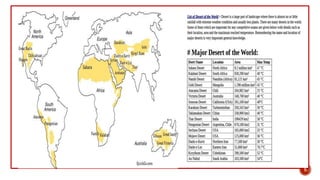
 Most of the major desert areas like the Sahara, the Arabian, the
Kalahari, and the Deserts of Australia all lie between 10 and 30
degrees north or south of the equator.
 Among all the terrestrial ecosystems, deserts are very typical landforms
due to their unique ecological conditions.
4
5
Characteristics Of Deserts
Deserts are characterized by the following ecological factors:
a. Sandy soils and a rocky substratum
b. Scanty rainfall and high evaporation
c. Hot and cold weather
d. Prevailing wind action
e. Poor soil moisture and water resources
6
Geomorphology Of Deserts
 Deserts are created by changes in climate and accumulation of sands and
other rocky wastes. A high proportion of the desert floor is an erosion
surface of a bedrock.
 Sand covers about 10 to 20 per cent of the deserts. The rest of the land
consists mostly of gravels, boulders, mountains, and various types of
soils.
 In the heart of the desert the wind has a free play. Wind erosion creates
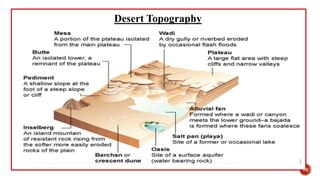
mounds of sand dunes and flat-topped hills known as mesas and buttes.
7
CONT…..
 Sand drifts, Crescentic Dunes, Loess and Longitudinal dunes and sand
sheets are the notable wind-borne geomorphic features.
 One of the most remarkable features of desert dunes is their power of
collecting all the sand from their neighborhood.
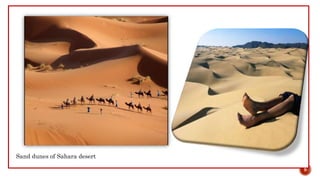
 Sand dunes: are large piles of wind-borne sands reaching a maximum
height of 250 meters above the surface.
 Dunes are characterized by two-sided slopes one along the windward
direction and the other along the leeward side.
8
Sand dunes of Sahara desert
9
Soils And Temperature In Deserts
Soils in desert regions are generally fertile but lacks soil moisture to
encourage plant growth.
Climatologically, deserts are the hottest places in the world because they
absorb more heat from the Sun than any other land in humid climates.
Deserts are mostly under arid to semi-arid climates. The temperature varies
during day and nights.
SUMMER: 38º C.(day), drop to 25º C. or more(night)
WINTER: temp. range from 10 to -21º C.
10
Rainfall Over Deserts
Rainfall is a determining factor of deserts, very scanty in all desert regions.
In spite of these, deserts are not barren wastelands.
Characteristics that are common to all deserts include;
a. irregular rainfall of less than 250 mm per year,
b. very high evaporation rates often higher than the annual precipitation, and
c. low relative humidity and cloud cover.
11
Wind Movements In Deserts
Wind movements in deserts are capable of eroding, transporting and
depositing the sand masses. The following are the processes expected:
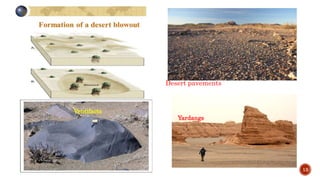
 Deflation: process by which loose sediments are removed by the wind.
Deflation creates blowouts and Desert pavements - landforms.
 Abrasion: impact of windblown particles on exposed surfaces remove
materials from that surface. Abrasion creates ventifacts and yardangs.
12
Desert pavements
Ventifacts
Yardangs
13
Water Availability In Deserts
Another controlling factor of desert is the presence of water. Due
to very scanty rainfall and sandy soil, deserts have no or very little
possibility of holding water.
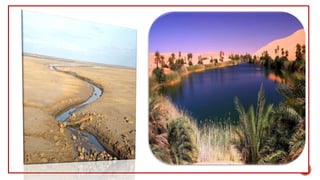
 After a rainfall, water fills the arroyos (dried streams).
 Oasis is a wet and fertile zone in a desert with vegetation.
Underground water comes nearer to the ground surface.
14
15
Desert Topography
16
Major Types Of Desert
1. Hot and Dry Desert: The seasons are generally warm all over the year
and very hot in the summer. The winters usually bring little snow or
rainfall. Temperatures show daily extremes because the atmosphere
contains little humidity to block the Sun’s rays. Plants are mainly
ground-hugging shrubs and short woody trees. These plants include:
yuccas, ocotillo, turpentine bush. The animals include small nocturnal
(active at night) carnivores.
17
18
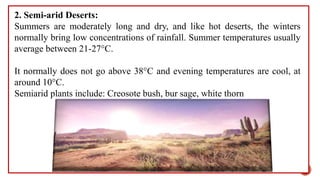
2. Semi-arid Deserts:
Summers are moderately long and dry, and like hot deserts, the winters
normally bring low concentrations of rainfall. Summer temperatures usually
average between 21-27°C.
It normally does not go above 38°C and evening temperatures are cool, at
around 10°C.
Semiarid plants include: Creosote bush, bur sage, white thorn
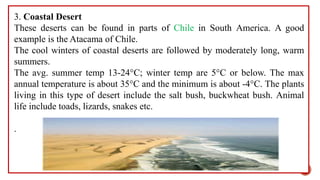
3. Coastal Desert
These deserts can be found in parts of Chile in South America. A good
example is the Atacama of Chile.
The cool winters of coastal deserts are followed by moderately long, warm
summers.
The avg. summer temp 13-24°C; winter temp are 5°C or below. The max
annual temperature is about 35°C and the minimum is about -4°C. The plants
living in this type of desert include the salt bush, buckwheat bush. Animal
life include toads, lizards, snakes etc.
.
19
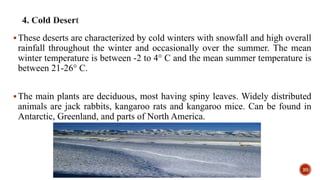
These deserts are characterized by cold winters with snowfall and high overall
rainfall throughout the winter and occasionally over the summer. The mean
winter temperature is between -2 to 4° C and the mean summer temperature is
between 21-26° C.
The main plants are deciduous, most having spiny leaves. Widely distributed
animals are jack rabbits, kangaroo rats and kangaroo mice. Can be found in
Antarctic, Greenland, and parts of North America.
20
Cont…..
The mean winter temperature is between -2 to 4° C and the mean summer
temperature is between 21-26° C.
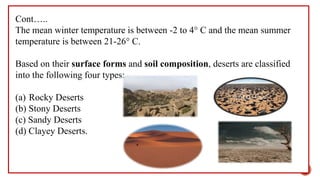
Based on their surface forms and soil composition, deserts are classified
into the following four types:
(a) Rocky Deserts
(b) Stony Deserts
(c) Sandy Deserts
(d) Clayey Deserts.
21
Flora Of Desert
 Desert plants cannot use so much water at once, and the desert soil
cannot absorb all of it. Most of the water runs off, carrying away the soil
particles.
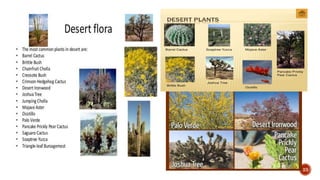
 Xerophytes. Thick waxy cuticle and succulent stem. E.g. cacti sp.
 Phreatophytes: long tap roots that penetrate the water table, anchor the
soil, and control erosion. E.g. mesquite tree
 Creosote bush: tiny leaves, extensive double root, both radial and deep.
22
23
Life forms of Plants
 The following three life forms of plants that are adapted to deserts:
a) The annuals, which avoid drought by growing only when there is
adequate moisture
b) The succulents- such as the cacti, which store water and survive
c) The desert shrubs- which have numerous branches with small but thick
leaves to store water.
 In addition to these little grass also grows on deserts but are grazed by
the animals. Mosses, algae, and lichens may be present. Blue green algae
are the nitrogen fixers in these regions also.
24
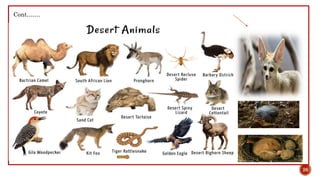
Fauna Of Deserts
 Animals of the deserts have developed special body structure and ways
of life that enable them to survive under the extreme heat.
 Centipedes, gerbils, kangaroo, rats, snakes, and scorpions spend the day
in burrows. They come out to search for food only when temperatures
drop at night.
 Many insects, lizards, and tortoises can tolerate high desert
temperatures and are active in the daytime.
 Many desert dwellers have light-colored skin, which helps them reflect
sunlight. 25
26
Cont…….
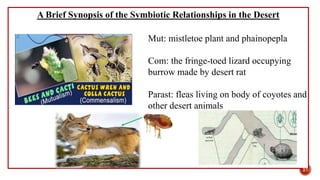
A Brief Synopsis of the Symbiotic Relationships in the Desert
Mut: mistletoe plant and phainopepla
Com: the fringe-toed lizard occupying
burrow made by desert rat
Parast: fleas living on body of coyotes and
other desert animals
27
28
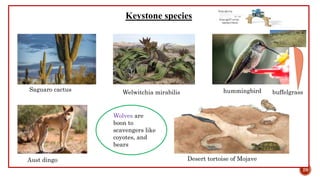
Keystone species
Saguaro cactus
Desert tortoise of Mojave
hummingbirdWelwitchia mirabilis
Aust dingo
Wolves are
boon to
scavengers like
coyotes, and
bears
buffelgrass
29
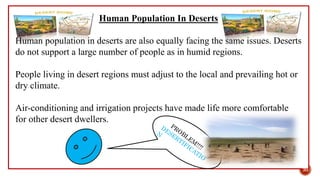
Human Population In Deserts
Human population in deserts are also equally facing the same issues. Deserts
do not support a large number of people as in humid regions.
People living in desert regions must adjust to the local and prevailing hot or
dry climate.
Air-conditioning and irrigation projects have made life more comfortable
for other desert dwellers.
30
CONCLUSION
Biomes as “the world’s major communities” are classified according to the
predominant vegetation and characterized by adaptions of organisms to
that particular environment.
The importance of biomes cannot be overestimated. Thus conservation and
preservation of biomes should be a major concern to all.
Because we share the world with many other species of plants and
animals, we must consider the consequences of our actions. It is important
to preserve all types of biomes as each houses many unique forms of life
31
REFERENCES:
1. DESERT ECOLOGY By Prof.A. Balasubramanian Centre for Advanced Studies in Earth
Science, University of Mysore, Mysore
2. Agnew, A. D. Q., Haines, R. W. 1960. Studies on the plant ecology of the Jazira of
Central Iraq. Bull. Coll. Sci. Univ. Baghdad 5:41-60
3. Alizai, H. V., Hulbert, L. C. 1969. Effects of soil texture on evaporative loss and
available water in semi-arid cli- mates. Soil Sci. 110:328-32
4. Barger, G. L., Thom, H. C. S. 1949. Evaluation of drought hazard. Agron. J. 41:519-26
5. Battan, L. J., Green, C. R. 1971. Sum- mer rainfall over the Santa Catalina Mountains.
Univ. Ariz. Inst. Atmos. Phys., Tech. Rep. 22
6. Beadle, N. C. W. 1948. The Vegetation and Pastures of New South Wales. Dept.
Conservation, NSW, Sydney: Govt. Printer. 281 pp. 32

Desert biome

  • 1.
    1BY: RABBI C.BAIDOO. UENR-SUNYANI
  • 2.
    OUTLINE • Introduction todesert ecology -Geomorphology of desert  Soils and temperature in deserts  Rainfall over deserts  Wind movements in deserts  Deserts topography  Types of deserts  Desert fauna and flora  Human population in deserts 2
  • 3.
    PRESENTATION OBJECTIVES The objectivesof this report are, to provide the details about: 1. The Geomorphology of Deserts or controlling factors forming deserts 2. The Types of Deserts 3. Adaptation of plants and animals to dry conditions 4. Biodiversity and community composition 5. Human impact on desert ecosystems 3
  • 4.
    INTRODUCTION  Desert isa large part of landscape where there is almost no or little rainfall with extreme weather condition and usually less plants. Normally called “sand seas” or oceans of sand”  Deserts alone covers about one fifth of the earth surface  Most of the major desert areas like the Sahara, the Arabian, the Kalahari, and the Deserts of Australia all lie between 10 and 30 degrees north or south of the equator.  Among all the terrestrial ecosystems, deserts are very typical landforms due to their unique ecological conditions. 4
  • 5.
  • 6.
    Characteristics Of Deserts Desertsare characterized by the following ecological factors: a. Sandy soils and a rocky substratum b. Scanty rainfall and high evaporation c. Hot and cold weather d. Prevailing wind action e. Poor soil moisture and water resources 6
  • 7.
    Geomorphology Of Deserts Deserts are created by changes in climate and accumulation of sands and other rocky wastes. A high proportion of the desert floor is an erosion surface of a bedrock.  Sand covers about 10 to 20 per cent of the deserts. The rest of the land consists mostly of gravels, boulders, mountains, and various types of soils.  In the heart of the desert the wind has a free play. Wind erosion creates mounds of sand dunes and flat-topped hills known as mesas and buttes. 7
  • 8.
    CONT…..  Sand drifts,Crescentic Dunes, Loess and Longitudinal dunes and sand sheets are the notable wind-borne geomorphic features.  One of the most remarkable features of desert dunes is their power of collecting all the sand from their neighborhood.  Sand dunes: are large piles of wind-borne sands reaching a maximum height of 250 meters above the surface.  Dunes are characterized by two-sided slopes one along the windward direction and the other along the leeward side. 8
  • 9.
    Sand dunes ofSahara desert 9
  • 10.
    Soils And TemperatureIn Deserts Soils in desert regions are generally fertile but lacks soil moisture to encourage plant growth. Climatologically, deserts are the hottest places in the world because they absorb more heat from the Sun than any other land in humid climates. Deserts are mostly under arid to semi-arid climates. The temperature varies during day and nights. SUMMER: 38º C.(day), drop to 25º C. or more(night) WINTER: temp. range from 10 to -21º C. 10
  • 11.
    Rainfall Over Deserts Rainfallis a determining factor of deserts, very scanty in all desert regions. In spite of these, deserts are not barren wastelands. Characteristics that are common to all deserts include; a. irregular rainfall of less than 250 mm per year, b. very high evaporation rates often higher than the annual precipitation, and c. low relative humidity and cloud cover. 11
  • 12.
    Wind Movements InDeserts Wind movements in deserts are capable of eroding, transporting and depositing the sand masses. The following are the processes expected:  Deflation: process by which loose sediments are removed by the wind. Deflation creates blowouts and Desert pavements - landforms.  Abrasion: impact of windblown particles on exposed surfaces remove materials from that surface. Abrasion creates ventifacts and yardangs. 12
  • 13.
  • 14.
    Water Availability InDeserts Another controlling factor of desert is the presence of water. Due to very scanty rainfall and sandy soil, deserts have no or very little possibility of holding water.  After a rainfall, water fills the arroyos (dried streams).  Oasis is a wet and fertile zone in a desert with vegetation. Underground water comes nearer to the ground surface. 14
  • 15.
  • 16.
  • 17.
    Major Types OfDesert 1. Hot and Dry Desert: The seasons are generally warm all over the year and very hot in the summer. The winters usually bring little snow or rainfall. Temperatures show daily extremes because the atmosphere contains little humidity to block the Sun’s rays. Plants are mainly ground-hugging shrubs and short woody trees. These plants include: yuccas, ocotillo, turpentine bush. The animals include small nocturnal (active at night) carnivores. 17
  • 18.
    18 2. Semi-arid Deserts: Summersare moderately long and dry, and like hot deserts, the winters normally bring low concentrations of rainfall. Summer temperatures usually average between 21-27°C. It normally does not go above 38°C and evening temperatures are cool, at around 10°C. Semiarid plants include: Creosote bush, bur sage, white thorn
  • 19.
    3. Coastal Desert Thesedeserts can be found in parts of Chile in South America. A good example is the Atacama of Chile. The cool winters of coastal deserts are followed by moderately long, warm summers. The avg. summer temp 13-24°C; winter temp are 5°C or below. The max annual temperature is about 35°C and the minimum is about -4°C. The plants living in this type of desert include the salt bush, buckwheat bush. Animal life include toads, lizards, snakes etc. . 19
  • 20.
    These deserts arecharacterized by cold winters with snowfall and high overall rainfall throughout the winter and occasionally over the summer. The mean winter temperature is between -2 to 4° C and the mean summer temperature is between 21-26° C. The main plants are deciduous, most having spiny leaves. Widely distributed animals are jack rabbits, kangaroo rats and kangaroo mice. Can be found in Antarctic, Greenland, and parts of North America. 20
  • 21.
    Cont….. The mean wintertemperature is between -2 to 4° C and the mean summer temperature is between 21-26° C. Based on their surface forms and soil composition, deserts are classified into the following four types: (a) Rocky Deserts (b) Stony Deserts (c) Sandy Deserts (d) Clayey Deserts. 21
  • 22.
    Flora Of Desert Desert plants cannot use so much water at once, and the desert soil cannot absorb all of it. Most of the water runs off, carrying away the soil particles.  Xerophytes. Thick waxy cuticle and succulent stem. E.g. cacti sp.  Phreatophytes: long tap roots that penetrate the water table, anchor the soil, and control erosion. E.g. mesquite tree  Creosote bush: tiny leaves, extensive double root, both radial and deep. 22
  • 23.
  • 24.
    Life forms ofPlants  The following three life forms of plants that are adapted to deserts: a) The annuals, which avoid drought by growing only when there is adequate moisture b) The succulents- such as the cacti, which store water and survive c) The desert shrubs- which have numerous branches with small but thick leaves to store water.  In addition to these little grass also grows on deserts but are grazed by the animals. Mosses, algae, and lichens may be present. Blue green algae are the nitrogen fixers in these regions also. 24
  • 25.
    Fauna Of Deserts Animals of the deserts have developed special body structure and ways of life that enable them to survive under the extreme heat.  Centipedes, gerbils, kangaroo, rats, snakes, and scorpions spend the day in burrows. They come out to search for food only when temperatures drop at night.  Many insects, lizards, and tortoises can tolerate high desert temperatures and are active in the daytime.  Many desert dwellers have light-colored skin, which helps them reflect sunlight. 25
  • 26.
  • 27.
    A Brief Synopsisof the Symbiotic Relationships in the Desert Mut: mistletoe plant and phainopepla Com: the fringe-toed lizard occupying burrow made by desert rat Parast: fleas living on body of coyotes and other desert animals 27
  • 28.
  • 29.
    Keystone species Saguaro cactus Deserttortoise of Mojave hummingbirdWelwitchia mirabilis Aust dingo Wolves are boon to scavengers like coyotes, and bears buffelgrass 29
  • 30.
    Human Population InDeserts Human population in deserts are also equally facing the same issues. Deserts do not support a large number of people as in humid regions. People living in desert regions must adjust to the local and prevailing hot or dry climate. Air-conditioning and irrigation projects have made life more comfortable for other desert dwellers. 30
  • 31.
    CONCLUSION Biomes as “theworld’s major communities” are classified according to the predominant vegetation and characterized by adaptions of organisms to that particular environment. The importance of biomes cannot be overestimated. Thus conservation and preservation of biomes should be a major concern to all. Because we share the world with many other species of plants and animals, we must consider the consequences of our actions. It is important to preserve all types of biomes as each houses many unique forms of life 31
  • 32.
    REFERENCES: 1. DESERT ECOLOGYBy Prof.A. Balasubramanian Centre for Advanced Studies in Earth Science, University of Mysore, Mysore 2. Agnew, A. D. Q., Haines, R. W. 1960. Studies on the plant ecology of the Jazira of Central Iraq. Bull. Coll. Sci. Univ. Baghdad 5:41-60 3. Alizai, H. V., Hulbert, L. C. 1969. Effects of soil texture on evaporative loss and available water in semi-arid cli- mates. Soil Sci. 110:328-32 4. Barger, G. L., Thom, H. C. S. 1949. Evaluation of drought hazard. Agron. J. 41:519-26 5. Battan, L. J., Green, C. R. 1971. Sum- mer rainfall over the Santa Catalina Mountains. Univ. Ariz. Inst. Atmos. Phys., Tech. Rep. 22 6. Beadle, N. C. W. 1948. The Vegetation and Pastures of New South Wales. Dept. Conservation, NSW, Sydney: Govt. Printer. 281 pp. 32