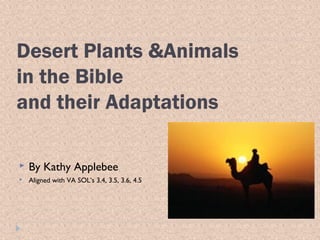
Desert Plants &Animals
in the Bible
and their Adaptations


By Kathy Applebee



Aligned with VA SOL’s 3.4, 3.5, 3.6, 4.5
Camels
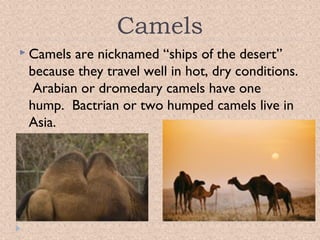
 Camels

are nicknamed “ships of the desert”
because they travel well in hot, dry conditions.
Arabian or dromedary camels have one
hump. Bactrian or two humped camels live in
Asia.
Camels
 Camels

have noses that can close to keep the
sand out. Their eyes have bushy brows and 2
sets of eyelashes to protect them.
Camels
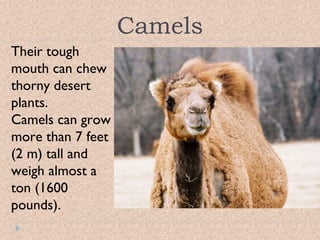
Their tough
mouth can chew
thorny desert
plants.
Camels can grow
more than 7 feet
(2 m) tall and
weigh almost a
ton (1600
pounds).
Camels
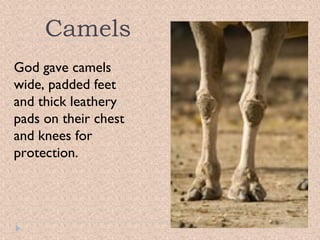
God gave camels
wide, padded feet
and thick leathery
pads on their chest
and knees for
protection.
Camels

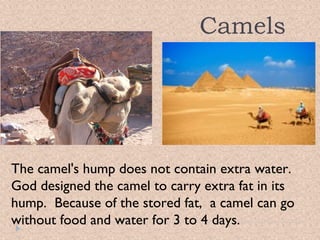
The camel's hump does not contain extra water.
God designed the camel to carry extra fat in its
hump. Because of the stored fat, a camel can go
without food and water for 3 to 4 days.
Rabbits
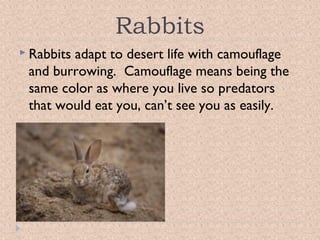
 Rabbits

adapt to desert life with camouflage
and burrowing. Camouflage means being the
same color as where you live so predators
that would eat you, can’t see you as easily.
Rabbits
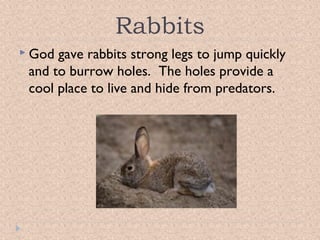
 God

gave rabbits strong legs to jump quickly
and to burrow holes. The holes provide a
cool place to live and hide from predators.
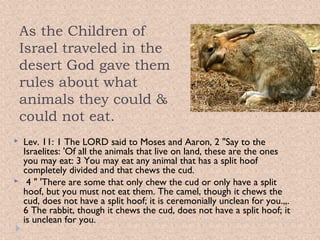
As the Children of
Israel traveled in the
desert God gave them
rules about what
animals they could &
could not eat.




Lev. 11: 1 The LORD said to Moses and Aaron, 2 "Say to the
Israelites: 'Of all the animals that live on land, these are the ones
you may eat: 3 You may eat any animal that has a split hoof
completely divided and that chews the cud.
 4 " 'There are some that only chew the cud or only have a split
hoof, but you must not eat them. The camel, though it chews the
cud, does not have a split hoof; it is ceremonially unclean for you.,,.
6 The rabbit, though it chews the cud, does not have a split hoof; it
is unclean for you.
Desert Birds
 Birds

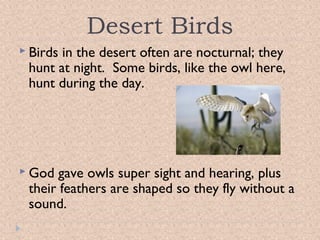
in the desert often are nocturnal; they
hunt at night. Some birds, like the owl here,
hunt during the day.

 God

gave owls super sight and hearing, plus
their feathers are shaped so they fly without a
sound.
Desert Birds
 Some

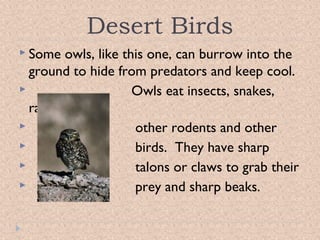
owls, like this one, can burrow into the
ground to hide from predators and keep cool.

Owls eat insects, snakes,
rats,

other rodents and other

birds. They have sharp

talons or claws to grab their

prey and sharp beaks.
Desert Birds
 Vultures

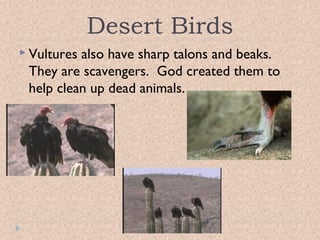
also have sharp talons and beaks.
They are scavengers. God created them to
help clean up dead animals.
Desert Birds

 Lev.

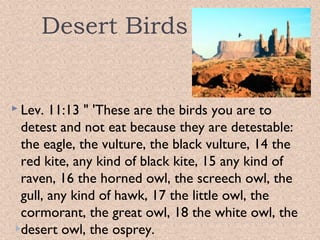
11:13 " 'These are the birds you are to
detest and not eat because they are detestable:
the eagle, the vulture, the black vulture, 14 the
red kite, any kind of black kite, 15 any kind of
raven, 16 the horned owl, the screech owl, the
gull, any kind of hawk, 17 the little owl, the
cormorant, the great owl, 18 the white owl, the
desert owl, the osprey.
Desert Reptiles
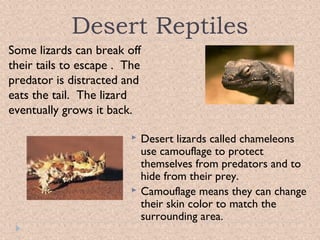
Some lizards can break off
their tails to escape . The
predator is distracted and
eats the tail. The lizard
eventually grows it back.




Desert lizards called chameleons
use camouflage to protect
themselves from predators and to
hide from their prey.
Camouflage means they can change
their skin color to match the
surrounding area.
Desert Reptiles
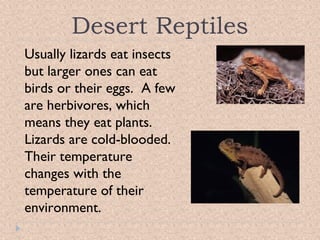
Usually lizards eat insects
but larger ones can eat
birds or their eggs. A few
are herbivores, which
means they eat plants.
Lizards are cold-blooded.
Their temperature
changes with the
temperature of their
environment.
Desert Reptiles
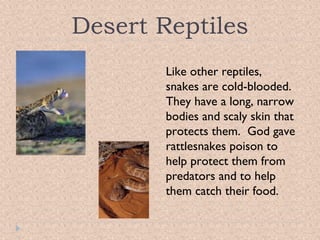
Like other reptiles,
snakes are cold-blooded.
They have a long, narrow
bodies and scaly skin that
protects them. God gave
rattlesnakes poison to
help protect them from
predators and to help
them catch their food.
Desert Reptiles
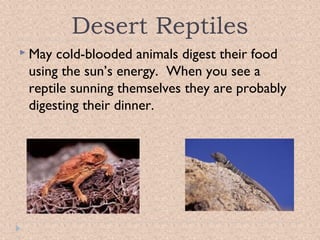
 May

cold-blooded animals digest their food
using the sun’s energy. When you see a
reptile sunning themselves they are probably
digesting their dinner.
Desert Reptiles
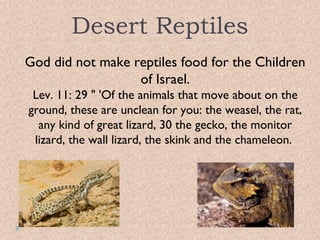
God did not make reptiles food for the Children
of Israel.
Lev. 11: 29 " 'Of the animals that move about on the
ground, these are unclean for you: the weasel, the rat,
any kind of great lizard, 30 the gecko, the monitor
lizard, the wall lizard, the skink and the chameleon.
Desert Plants
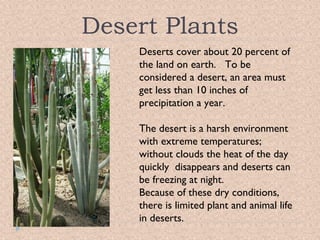
Deserts cover about 20 percent of
the land on earth. To be
considered a desert, an area must
get less than 10 inches of
precipitation a year.
The desert is a harsh environment
with extreme temperatures;
without clouds the heat of the day
quickly disappears and deserts can
be freezing at night.
Because of these dry conditions,
there is limited plant and animal life
in deserts.
Desert Plants
Cacti is the plural of cactus.
God gave the cactus special roots
to help it survive in the desert.
Prickly Pear cacti have long
roots, which absorb water from
deep down in the soil.
Some, like ball cacti, have shorter
roots that absorb dew that falls
off the cactus.
Desert Plants
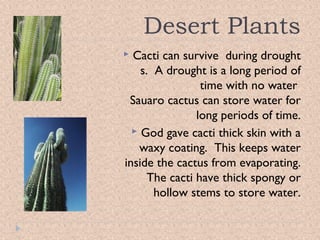
Cacti can survive during drought
s. A drought is a long period of
time with no water
Sauaro cactus can store water for
long periods of time.
 God gave cacti thick skin with a
waxy coating. This keeps water
inside the cactus from evaporating.
The cacti have thick spongy or
hollow stems to store water.


Desert Plants
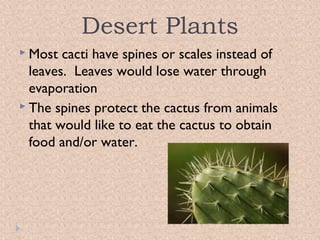
 Most

cacti have spines or scales instead of
leaves. Leaves would lose water through
evaporation
 The spines protect the cactus from animals
that would like to eat the cactus to obtain
food and/or water.
Desert Plants



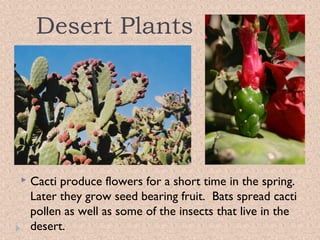
Cacti produce flowers for a short time in the spring.
Later they grow seed bearing fruit. Bats spread cacti
pollen as well as some of the insects that live in the
desert.
Desert Review


How much precipitation do deserts get each year?



How did God adapt the camel to desert life?



How did God adapt plants to live in the desert?



Think of three ways God made desert birds or reptiles
able to survive in the desert.


(Look back to check your answers)
Desert animal adaptations

Desert animal adaptations

  • 1.
    Desert Plants &Animals inthe Bible and their Adaptations  By Kathy Applebee  Aligned with VA SOL’s 3.4, 3.5, 3.6, 4.5
  • 2.
    Camels  Camels are nicknamed“ships of the desert” because they travel well in hot, dry conditions. Arabian or dromedary camels have one hump. Bactrian or two humped camels live in Asia.
  • 3.
    Camels  Camels have nosesthat can close to keep the sand out. Their eyes have bushy brows and 2 sets of eyelashes to protect them.
  • 4.
    Camels Their tough mouth canchew thorny desert plants. Camels can grow more than 7 feet (2 m) tall and weigh almost a ton (1600 pounds).
  • 5.
    Camels God gave camels wide,padded feet and thick leathery pads on their chest and knees for protection.
  • 6.
    Camels The camel's humpdoes not contain extra water. God designed the camel to carry extra fat in its hump. Because of the stored fat, a camel can go without food and water for 3 to 4 days.
  • 7.
    Rabbits  Rabbits adapt todesert life with camouflage and burrowing. Camouflage means being the same color as where you live so predators that would eat you, can’t see you as easily.
  • 8.
    Rabbits  God gave rabbitsstrong legs to jump quickly and to burrow holes. The holes provide a cool place to live and hide from predators.
  • 9.
    As the Childrenof Israel traveled in the desert God gave them rules about what animals they could & could not eat.   Lev. 11: 1 The LORD said to Moses and Aaron, 2 "Say to the Israelites: 'Of all the animals that live on land, these are the ones you may eat: 3 You may eat any animal that has a split hoof completely divided and that chews the cud.  4 " 'There are some that only chew the cud or only have a split hoof, but you must not eat them. The camel, though it chews the cud, does not have a split hoof; it is ceremonially unclean for you.,,. 6 The rabbit, though it chews the cud, does not have a split hoof; it is unclean for you.
  • 10.
    Desert Birds  Birds inthe desert often are nocturnal; they hunt at night. Some birds, like the owl here, hunt during the day.  God gave owls super sight and hearing, plus their feathers are shaped so they fly without a sound.
  • 11.
    Desert Birds  Some owls,like this one, can burrow into the ground to hide from predators and keep cool.  Owls eat insects, snakes, rats,  other rodents and other  birds. They have sharp  talons or claws to grab their  prey and sharp beaks.
  • 12.
    Desert Birds  Vultures alsohave sharp talons and beaks. They are scavengers. God created them to help clean up dead animals.
  • 13.
    Desert Birds  Lev. 11:13" 'These are the birds you are to detest and not eat because they are detestable: the eagle, the vulture, the black vulture, 14 the red kite, any kind of black kite, 15 any kind of raven, 16 the horned owl, the screech owl, the gull, any kind of hawk, 17 the little owl, the cormorant, the great owl, 18 the white owl, the desert owl, the osprey.
  • 14.
    Desert Reptiles Some lizardscan break off their tails to escape . The predator is distracted and eats the tail. The lizard eventually grows it back.   Desert lizards called chameleons use camouflage to protect themselves from predators and to hide from their prey. Camouflage means they can change their skin color to match the surrounding area.
  • 15.
    Desert Reptiles Usually lizardseat insects but larger ones can eat birds or their eggs. A few are herbivores, which means they eat plants. Lizards are cold-blooded. Their temperature changes with the temperature of their environment.
  • 16.
    Desert Reptiles Like otherreptiles, snakes are cold-blooded. They have a long, narrow bodies and scaly skin that protects them. God gave rattlesnakes poison to help protect them from predators and to help them catch their food.
  • 17.
    Desert Reptiles  May cold-bloodedanimals digest their food using the sun’s energy. When you see a reptile sunning themselves they are probably digesting their dinner.
  • 18.
    Desert Reptiles God didnot make reptiles food for the Children of Israel. Lev. 11: 29 " 'Of the animals that move about on the ground, these are unclean for you: the weasel, the rat, any kind of great lizard, 30 the gecko, the monitor lizard, the wall lizard, the skink and the chameleon.
  • 19.
    Desert Plants Deserts coverabout 20 percent of the land on earth. To be considered a desert, an area must get less than 10 inches of precipitation a year. The desert is a harsh environment with extreme temperatures; without clouds the heat of the day quickly disappears and deserts can be freezing at night. Because of these dry conditions, there is limited plant and animal life in deserts.
  • 20.
    Desert Plants Cacti isthe plural of cactus. God gave the cactus special roots to help it survive in the desert. Prickly Pear cacti have long roots, which absorb water from deep down in the soil. Some, like ball cacti, have shorter roots that absorb dew that falls off the cactus.
  • 21.
    Desert Plants Cacti cansurvive during drought s. A drought is a long period of time with no water Sauaro cactus can store water for long periods of time.  God gave cacti thick skin with a waxy coating. This keeps water inside the cactus from evaporating. The cacti have thick spongy or hollow stems to store water. 
  • 22.
    Desert Plants  Most cactihave spines or scales instead of leaves. Leaves would lose water through evaporation  The spines protect the cactus from animals that would like to eat the cactus to obtain food and/or water.
  • 23.
    Desert Plants  Cacti produceflowers for a short time in the spring. Later they grow seed bearing fruit. Bats spread cacti pollen as well as some of the insects that live in the desert.
  • 24.
    Desert Review  How muchprecipitation do deserts get each year?  How did God adapt the camel to desert life?  How did God adapt plants to live in the desert?  Think of three ways God made desert birds or reptiles able to survive in the desert.  (Look back to check your answers)